REVIEW 3 major objections 5 minor 42 references
SecureT2I: No More Unauthorized Manipulation on AI Generated Images from Prompts
T0 review · 3 major / 5 minor · reviewed 2026-08-06 · deepseek-v4-flash
Pith's one-line read Fine-tuning with blurred targets blocks unauthorized edits without sacrificing permitted ones.
desk verdict Real problem, plausible method, but the evaluation metric is circular and sign-contradictory, so the central suppression claim is not currently established. read the letter →
The pith
A machine-rendered reading of the paper's core claim, the machinery that carries it, and where it could break.
The reading
What carries the argument
The load-bearing mechanism is the vague target $x_{\mathrm{vague}}$ chosen for the forbid set together with the paired loss functions in Eq. (1), implemented in Algorithm 1 as alternating gradient steps on the forbid loss and the permit loss. The vague target is defined as a resize-based blurred image: the input is downsampled to 16×16 pixels and resized back to the original dimensions, and this same target is used as the reference for FID and CLIP calculations in the WAN* metric on the forbid set. The paper justifies the choice through Fourier analysis, arguing that a low-pass filter removes the high-frequency detail that text-driven edits rely on, and through a Lipschitz-continuity argument, arguing that the blurred target keeps gradients bounded during fine-tuning and thus reduces interference with permit-set learning.
What would settle it
Use an independent edit detector or human raters on outputs from SecureT2I's model: give a forbid-set image a clear edit prompt such as 'make the person smile' and check whether the requested attribute is still present in the output. If the generated image still exhibits the semantic change while scoring well on WAN* against the blurred target, then the paper's definition of unauthorized suppression is not measuring actual manipulation prevention.
Extended reading notes
Core claim
The central discovery claimed by the paper is that a diffusion manipulation model can be taught selective permission behavior through a dual-loss fine-tuning objective. For forbidden inputs $x_f$, the model is trained to minimize a pixel-wise $\ell^1$ distance between its output $f_\theta(x_f, p)$ and a vague target $x_{\mathrm{vague}}$, which is a resize-based blurred copy of the input obtained by downsampling to 16×16 and resizing back; for permitted inputs $x_r$, it is trained to match the pretrained model's own edit $f_{\theta_{\mathrm{pre}}}(x_r, p)$. Training with the combined objective $L_{\mathrm{total}} = \lambda_{\mathrm{forbid}} \sum_{x_f \in F} \ell^1(f_\theta(x_f,p), x_{\mathrm{vague}}) + \lambda_{\mathrm{permit}} \sum_{x_r \in P} \ell^1(f_\theta(x_r,p), x')$ produces, according to the paper, a model that keeps its editing fidelity on the permit set while its forbid-set outputs drift toward the blurred target, and this behavior transfers to held-out unseen images.
Load-bearing premise
The central premise is that producing an output close to the blurred target on the forbid set is the same as preventing unauthorized manipulation; because the evaluation scores outputs against exactly that blurred target, if closeness to the target is not what users mean by 'the edit was blocked', the quantitative evidence for suppression collapses.
Editorial extensions
If this is right
- If the claim holds, diffusion-based editors can ship with a permission layer trained into their weights, so unauthorized edits are suppressed without any external watermark detector or pre-filter.
- Permit-set quality stays close to a full retrain on the permit set in the reported metrics, so the security mechanism does not destroy ordinary editing capability.
- Unseen images from both sets are affected in the intended direction, indicating the fine-tuned behavior is not merely memorizing the small training set.
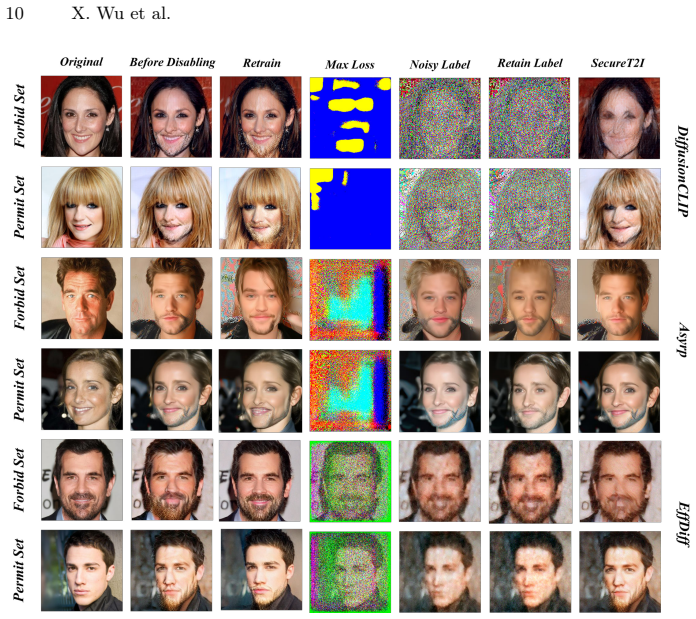
- Among vagueness strategies, the 16×16 resize gives the best measured trade-off between suppressing forbidden edits and preserving permitted edits compared with 8×8 resizing, 32×32 resizing, and Gaussian, Box, or Motion blur.
- The framework is model-agnostic in the paper's experiments: applying it to DiffusionCLIP, Asyrp, and EffDiff shows the same balancing behavior across all three backbones.
- The paper reports no defenses against adversarial perturbations and no ablation over prompt phrasing, so the claimed protection has not yet been shown to survive an attacker who tampers with inputs or rewrites prompts.
Reading between the lines
- The WAN* score on the forbid set measures distance to the same blurred target used by the forbid loss, so the reported suppression may partly re-measure training success rather than independently confirm that the requested edit is absent; an attribute-level edit detector or human study would settle this.
- A user who already possesses the original public manipulation model can bypass the protection entirely by using that unmodified model, so SecureT2I's protection is meaningful only when the model owner controls the deployed weights.
- Because the paper does not test adversarial perturbations, small input noise could plausibly restore forbidden edits, and testing SecureT2I against an attacker who adds bounded perturbations is a natural next experiment.
- The permit/forbid split must be fixed before fine-tuning, so deploying the method in the open world would require pairing it with provenance tracking or fingerprinting to assign images to the two sets at inference time.
Editorial analysis
A structured set of objections, weighed in public.
Referee Report
Summary. The paper proposes SecureT2I, a fine-tuning framework for diffusion-based text-guided image manipulation that aims to suppress edits on a predefined forbid set while preserving editing quality on a permit set. The method trains the manipulation model with two losses: a forbid loss L_forbid that drives outputs toward a blurred (vague) version of the input, and a permit loss L_permit that keeps outputs close to the original model's manipulated results. Experiments are conducted on CelebA-HQ, LSUN-Bedroom, and LSUN-Church with three manipulation models (DiffusionCLIP, Asyrp, EffDiff), comparing against retraining and three unlearning baselines. The paper also introduces composite metrics WAN and WAN* and reports results on held-out unseen images and on different vagueness strategies.
Significance. If the central claim were established, SecureT2I would be a useful contribution to the emerging area of secure/consensual image editing, with a model-agnostic fine-tuning approach and a practical threat model. The paper is the first to formulate this specific problem, and it ships code and evaluates across multiple datasets and backbones, which are genuine strengths. However, the quantitative evidence for the central claim is undermined by a circular evaluation metric and an internally inconsistent WAN* definition, so the paper's main conclusion—that SecureT2I effectively degrades manipulation on forbidden images while preserving permitted edits—is not currently supported.
major comments (3)
- [Sec. 4.2, Eq. (3)] The WAN* metric is internally inconsistent. The formula WAN* = (−FID_norm + IS_norm − CLIP_norm)/3 penalizes high CLIP similarity to the blurred reference image. If the model output exactly equaled the ideal suppression target (the blurred image), the CLIP similarity to that reference would be maximal and the −CLIP_norm term would reduce WAN*. The text states both that 'a lower CLIP similarity to the blurred target indicates that the generated image has lost more semantic information (which aligns with the suppression goal)' and that 'a higher WAN* score indicates better approximation to the vague target.' These two statements are contradictory, and the resulting WAN* values in Tables 2–6 cannot be interpreted as a measure of closeness to the vague target or as evidence of suppression.
- [Sec. 4.4 and Algorithm 1, Eq. (1)] The forbid-set evaluation is circular. In Algorithm 1 and Eq. (1), the forbid loss L_forbid trains the model to output x_vague = Trans(x_f), a blurred copy of the forbidden input. In Sec. 4.4, the paper states that 'we use the blurred images as references for FID and CLIP calculations on the forbid set' and then computes WAN* against those same blurred references. Thus the reported 'suppression' metrics re-measure the training objective rather than an independent property such as whether the requested semantic edit still appears in the output. No external edit detector, human study, or comparison against the original model's output on the forbid set is provided to validate the proxy. This circularity affects all forbid-set results in Tables 2, 3, and 4.
- [Sec. 4.5, Table 5] The generalization claim that SecureT2I 'consistently outperforms baselines' on unseen images rests on the same flawed WAN* metric, computed against the same blurred training targets for held-out samples. Since the metric is circular and sign-inconsistent, the held-out results do not provide independent evidence that unauthorized edits are suppressed; they only show that the fine-tuned model behaves consistently with its training objective on unseen inputs.
minor comments (5)
- [Sec. 3.2] The Lipschitz-condition argument for gradient stability is not substantiated: the paper does not prove that the resize-based transformation used in the experiments satisfies the stated Lipschitz bound, and the cited reference [27] concerns stochastic gradient Langevin dynamics rather than this fine-tuning setting.
- [Table 5] In the Church row under Retrain, the CLIP value for the forbid set is printed as '.00', which appears to be a typo for '1.00'.
- [Sec. 4.4 and Fig. 3] The T-SNE analysis is presented only qualitatively; the claim of a 'clear separation' in the forbid set and close clustering in the permit set would be more convincing with a quantitative separation measure or a silhouette-style score.
- [Appendix A] The experimental setup does not specify how the 100 images are split between the permit and forbid sets, nor the exact prompts used for LSUN-Bedroom and LSUN-Church; providing this information would improve reproducibility.
- [Sec. 4.2] The assertion that lower CLIP similarity to the blurred target indicates lost semantic information is presented without empirical support and conflicts with the use of FID as a closeness measure to the same reference, which should be clarified or removed.
Circularity Check
Forbid-set 'suppression' is scored by closeness to the blurred target that L_forbid is trained to reproduce, so the headline result re-measures the training objective; WAN*'s sign also penalizes the target it claims to reward.
-
fitted input called prediction
[Algorithm 1 (lines 4-5), Eq. (1) in Sec. 3.2; evaluation in Sec. 4.4]
"Obtain a vague image from F: xvague = Trans(xj) / Obtain the forbid loss: Lforbid(fθt−1s (xj, p), xvague) = ... [Algorithm 1] ... In our experiments, we use the blurred images as references for FID and CLIP calculations on the forbid set and apply the WAN∗ metric to better capture alignment with the vague target."
The forbid loss L_forbid trains the model to output x_vague = Trans(x) for forbid-set images, and the forbid-set evaluation computes FID and CLIP against exactly those same x_vague references, aggregating them into WAN*. A model that has optimized L_forbid will therefore, by construction, score well on the forbid-set WAN*; the metric does not measure whether the requested semantic edit has been suppressed, only whether the output matches the training target. The generalization experiment of Sec. 4.5 uses the same target-based metric on held-out images, so it tests generalization of the learned blurring behavior, not the claimed independent property of edit suppression.
-
other
[Sec. 4.2, Eq. (3)]
"W AN∗ = −F IDnorm + IS norm − CLIP norm / 3 . ... Since a lower CLIP similarity to the blurred target indicates that the generated image has lost more semantic information (which aligns with the suppression goal), its normalized value is negated. Therefore, a higher WAN∗ score indicates better approximation to the vague target."
Under the paper's own definition, the ideal forbid-set output equals the blurred target, so its CLIP similarity to that target is maximal. Eq. (3) subtracts CLIP_norm, which penalizes exactly the target-matching output and rewards outputs that are unlike the blur. The statement that 'a higher WAN* score indicates better approximation to the vague target' is therefore contradicted by the formula's sign by construction. Since Tables 2-5 use this sign-incoherent score as the quantitative evidence for SecureT2I's superior suppression, the reported forbid-set rankings cannot support the claimed conclusion that unauthorized edits are blocked.
full rationale
The paper's central quantitative claim that SecureT2I suppresses edits on the forbid set is supported by WAN*, computed against the same blurred images that L_forbid is trained to produce (Algorithm 1 vs. Sec. 4.4). That is a fitted-input-called-prediction pattern: the success metric re-measures the training objective. The permit-set evaluation uses standard FID/IS/CLIP metrics and retains some independent content, and there are no load-bearing self-citations or imported uniqueness theorems. However, no external edit detector, human study, or independent measure of 'edit suppressed' is provided, and the WAN* formula's negative CLIP term penalizes the very target it claims to reward. The central 'unauthorized manipulation prevention' result is therefore partially circular, with the forbid-set evidence reducing by construction to the training target. Score 7 reflects this partial but central circularity.
Assumptions & free parameters
free parameters (4)
- lambda_forbid and lambda_permit =
0.5 and 0.5 (Appendix A)
- resize target size =
16x16
- learning rate and number of iterations =
8e-6, 15 iterations (Appendix A)
- WAN/WAN* normalization reference =
unspecified
assumptions (6)
- ad hoc to paper Suppressing high-frequency image components disrupts text-guided manipulation because such edits rely on high-frequency information (Sec 3.2).
- ad hoc to paper The blur transformation T rans(x) is Lipschitz with a bounded constant, so gradients of L_forbid are bounded and smooth (Sec 3.2).
- domain assumption The attacker uses the fine-tuned model and does not use an alternative model, the original model, or adversarial perturbations (implicit threat model).
- domain assumption A static split of images into forbid and permit sets from the same dataset matches the deployment scenario (Sec 3.1).
- domain assumption FID, IS, and CLIP similarity are valid indicators of whether an unauthorized edit has been prevented (Sec 4.2).
- domain assumption The comparison baselines (Max, Noisy, Retain, retrain) are the appropriate state of the art for this task (Sec 4.3).
Cite this review
Pith. "Pith review of SecureT2I: No More Unauthorized Manipulation on AI Generated Images from Prompts." pith.science (2026). https://pith.science/paper/HL7B2UQX
@misc{pith2026250703636,
  author       = {Pith},
  title        = {Pith review of: SecureT2I: No More Unauthorized Manipulation on AI Generated Images from Prompts},
  year         = {2026},
  howpublished = {\url{https://pith.science/paper/HL7B2UQX}},
  note         = {Machine review of arXiv:2507.03636}
}
read the original abstract
Text-guided image manipulation with diffusion models enables flexible and precise editing based on prompts, but raises ethical and copyright concerns due to potential unauthorized modifications. To address this, we propose SecureT2I, a secure framework designed to prevent unauthorized editing in diffusion-based generative models. SecureT2I is compatible with both general-purpose and domain-specific models and can be integrated via lightweight fine-tuning without architectural changes. We categorize images into a permit set and a forbid set based on editing permissions. For the permit set, the model learns to perform high-quality manipulations as usual. For the forbid set, we introduce training objectives that encourage vague or semantically ambiguous outputs (e.g., blurred images), thereby suppressing meaningful edits. The core challenge is to block unauthorized editing while preserving editing quality for permitted inputs. To this end, we design separate loss functions that guide selective editing behavior. Extensive experiments across multiple datasets and models show that SecureT2I effectively degrades manipulation quality on forbidden images while maintaining performance on permitted ones. We also evaluate generalization to unseen inputs and find that SecureT2I consistently outperforms baselines. Additionally, we analyze different vagueness strategies and find that resize-based degradation offers the best trade-off for secure manipulation control.
Figures


Reference graph
Works this paper leans on
-
[1]
In: Proceedings of the IEEE/CVF conference on computer vision and pattern recognition
Avrahami, O., Lischinski, D., Fried, O.: Blended diffusion for text-driven editing of natural images. In: Proceedings of the IEEE/CVF conference on computer vision and pattern recognition. pp. 18208–18218 (2022)
2022
-
[2]
In: The Twelfth International Conference on Learning Representations (2023)
Basu, S., Zhao, N., Morariu, V.I., Feizi, S., Manjunatha, V.: Localizing and edit- ing knowledge in text-to-image generative models. In: The Twelfth International Conference on Learning Representations (2023)
work page 2023
-
[3]
In: 2021 IEEE Symposium on Security and Privacy
Bourtoule, L., Chandrasekaran, V., Choquette-Choo, C.A., Jia, H., Travers, A., Zhang, B., Lie, D., Papernot, N.: Machine unlearning. In: 2021 IEEE Symposium on Security and Privacy. pp. 141–159. IEEE (2021)
2021
-
[4]
In: Proceedings of the IEEE/CVF Conference on Computer Vision and Pattern Recognition
Brooks, T., Holynski, A., Efros, A.A.: Instructpix2pix: Learning to follow image editing instructions. In: Proceedings of the IEEE/CVF Conference on Computer Vision and Pattern Recognition. pp. 18392–18402 (2023)
2023
-
[5]
arXiv preprint arXiv:2405.07288 (2024)
Fuchi, M., Takagi, T.: Erasing concepts from text-to-image diffusion models with few-shot unlearning. arXiv preprint arXiv:2405.07288 (2024)
arXiv 2024
-
[6]
Grafakos, L., et al.: Classical fourier analysis, vol. 2. Springer (2008)
2008
-
[7]
In: Proceedings of the AAAI Conference on Artificial Intelligence
Graves, L., Nagisetty, V., Ganesh, V.: Amnesiac machine learning. In: Proceedings of the AAAI Conference on Artificial Intelligence. vol. 35, pp. 11516–11524 (2021)
2021
-
[8]
Halimi, A., Kadhe, S., Rawat, A., Baracaldo, N.: Federated unlearning: How to efficiently erase a client in fl? arXiv preprint arXiv:2207.05521 (2022)
arXiv 2022
Show all 42 references
-
[9]
Advances in Neural Information Processing Systems36 (2024)
Heng, A., Soh, H.: Selective amnesia: A continual learning approach to forgetting in deep generative models. Advances in Neural Information Processing Systems36 (2024)
2024
-
[10]
Advances in neural information processing systems30 (2017)
Heusel,M.,Ramsauer,H.,Unterthiner,T.,Nessler,B.,Hochreiter,S.:Ganstrained by a two time-scale update rule converge to a local nash equilibrium. Advances in neural information processing systems30 (2017)
2017
-
[11]
arXiv preprint arXiv:2402.17525 (2024)
Huang, Y., Huang, J., Liu, Y., Yan, M., Lv, J., Liu, J., Xiong, W., Zhang, H., Chen, S., Cao, L.: Diffusion model-based image editing: A survey. arXiv preprint arXiv:2402.17525 (2024)
2024 arXiv
-
[12]
Computers & Graphics 112, 81–91 (2023)
Khojasteh, M.H., Farid, N.M., Nickabadi, A.: Gmfim: a generative mask-guided facial image manipulation model for privacy preservation. Computers & Graphics 112, 81–91 (2023)
2023
-
[13]
In: Proceedings of the IEEE/CVF conference on computer vision and pattern recognition
Kim, G., Kwon, T., Ye, J.C.: Diffusionclip: Text-guided diffusion models for robust image manipulation. In: Proceedings of the IEEE/CVF conference on computer vision and pattern recognition. pp. 2426–2435 (2022)
2022
-
[14]
arXiv preprint arXiv:2307.05977 (2023)
Kim, S., Jung, S., Kim, B., Choi, M., Shin, J., Lee, J.: Towards safe self-distillation of internet-scale text-to-image diffusion models. arXiv preprint arXiv:2307.05977 (2023)
2023 arXiv
-
[15]
In: 2024 IEEE Conference on Secure and Trustworthy Machine Learning (SaTML)
Kong, Z., Chaudhuri, K.: Data redaction from conditional generative models. In: 2024 IEEE Conference on Secure and Trustworthy Machine Learning (SaTML). pp. 569–591. IEEE (2024)
2024
-
[16]
In: Proceedings of the IEEE/CVF International Conference on Computer Vision
Kumari, N., Zhang, B., Wang, S.Y., Shechtman, E., Zhang, R., Zhu, J.Y.: Ablat- ing concepts in text-to-image diffusion models. In: Proceedings of the IEEE/CVF International Conference on Computer Vision. pp. 22691–22702 (2023)
2023
-
[17]
arXiv preprint arXiv:2210.10960 (2022)
Kwon, M., Jeong, J., Uh, Y.: Diffusion models already have a semantic latent space. arXiv preprint arXiv:2210.10960 (2022)
2022 arXiv
-
[18]
arXiv preprint arXiv:2402.00351 (2024) 18 X
Li, G., Hsu, H., Marculescu, R., et al.: Machine unlearning for image-to-image generative models. arXiv preprint arXiv:2402.00351 (2024) 18 X. Wu et al
2024 arXiv
-
[19]
arXiv preprint arXiv:2308.09388 (2023)
Li, X., Ren, Y., Jin, X., Lan, C., Wang, X., Zeng, W., Wang, X., Chen, Z.: Diffu- sion models for image restoration and enhancement–a comprehensive survey. arXiv preprint arXiv:2308.09388 (2023)
2023
-
[20]
In: European Conference on Computer Vision
Liang, R., Gojcic, Z., Nimier-David, M., Acuna, D., Vijaykumar, N., Fidler, S., Wang, Z.: Photorealistic object insertion with diffusion-guided inverse rendering. In: European Conference on Computer Vision. pp. 446–465. Springer (2024)
2024
-
[21]
In: Proceedings of the IEEE/CVF Conference on Computer Vision and Pattern Recognition
Lu, S., Wang, Z., Li, L., Liu, Y., Kong, A.W.K.: Mace: Mass concept erasure in diffusion models. In: Proceedings of the IEEE/CVF Conference on Computer Vision and Pattern Recognition. pp. 6430–6440 (2024)
2024
-
[22]
arXiv preprint arXiv:2108.01073 (2021)
Meng, C., He, Y., Song, Y., Song, J., Wu, J., Zhu, J.Y., Ermon, S.: Sdedit: Guided image synthesis and editing with stochastic differential equations. arXiv preprint arXiv:2108.01073 (2021)
2021 arXiv
-
[23]
In: Adjunct Proceedings of the 37th Annual ACM Symposium on User Interface Software and Technology
Monteiro, K., Wu, Y., Das, S.: Manipulate to obfuscate: A privacy-focused intel- ligent image manipulation tool for end-users. In: Adjunct Proceedings of the 37th Annual ACM Symposium on User Interface Software and Technology. pp. 1–3 (2024)
2024
-
[24]
IEEE Transactions on Neural Networks and Learning Systems (2024)
Moser, B.B., Shanbhag, A.S., Raue, F., Frolov, S., Palacio, S., Dengel, A.: Diffusion models, image super-resolution, and everything: A survey. IEEE Transactions on Neural Networks and Learning Systems (2024)
2024
-
[25]
arXiv preprint arXiv:2407.21035 (2024)
Park, Y.H., Yun, S., Kim, J.H., Kim, J., Jang, G., Jeong, Y., Jo, J., Lee, G.: Direct unlearning optimization for robust and safe text-to-image models. arXiv preprint arXiv:2407.21035 (2024)
2024 arXiv
-
[26]
In: International conference on machine learning
Radford, A., Kim, J.W., Hallacy, C., Ramesh, A., Goh, G., Agarwal, S., Sastry, G., Askell, A., Mishkin, P., Clark, J., et al.: Learning transferable visual models from natural language supervision. In: International conference on machine learning. pp. 8748–8763. PmLR (2021)
2021
-
[27]
In: Conference on Learning Theory
Raginsky, M., Rakhlin, A., Telgarsky, M.: Non-convex learning via stochastic gra- dient langevin dynamics: a nonasymptotic analysis. In: Conference on Learning Theory. pp. 1674–1703. PMLR (2017)
2017
-
[28]
arXiv preprint arXiv:2302.07979 (2023)
Ravi, H., Kelkar, S., Harikumar, M., Kale, A.: Preditor: Text guided image editing with diffusion prior. arXiv preprint arXiv:2302.07979 (2023)
2023 arXiv
-
[29]
In: International Conference on Machine Learning
Sablayrolles, A., Douze, M., Schmid, C., Jégou, H.: Radioactive data: tracing through training. In: International Conference on Machine Learning. pp. 8326–
-
[30]
Advances in neural information processing systems 29 (2016)
Salimans, T., Goodfellow, I., Zaremba, W., Cheung, V., Radford, A., Chen, X.: Improved techniques for training gans. Advances in neural information processing systems 29 (2016)
2016
-
[31]
arXiv preprint arXiv:2304.04344 (2023)
Starodubcev, N., Baranchuk, D., Khrulkov, V., Babenko, A.: Towards real- time text-driven image manipulation with unconditional diffusion models. arXiv preprint arXiv:2304.04344 (2023)
2023 arXiv
-
[32]
ACM Computing Surveys57(8), 1–44 (2025)
Truong, V.T., Dang, L.B., Le, L.B.: Attacks and defenses for generative diffusion models: A comprehensive survey. ACM Computing Surveys57(8), 1–44 (2025)
2025
-
[33]
arXiv preprint arXiv:2210.09477 2(3), 5 (2022)
Valevski, D., Kalman, M., Matias, Y., Leviathan, Y.: Unitune: Text-driven image editing by fine tuning an image generation model on a single image. arXiv preprint arXiv:2210.09477 2(3), 5 (2022)
2022 arXiv
-
[34]
In: Proceedings of the IEEE/CVF International Confer- ence on Computer Vision
Wang, Z., Zhao, L., Xing, W.: Stylediffusion: Controllable disentangled style trans- fer via diffusion models. In: Proceedings of the IEEE/CVF International Confer- ence on Computer Vision. pp. 7677–7689 (2023)
2023
-
[35]
ACM Transactions on Management Information Systems (TMIS) 13(2), 1–23 (2022) SecureT2I: No More Unauthorized Manipulation 19
Werder, K., Ramesh, B., Zhang, R.: Establishing data provenance for responsi- ble artificial intelligence systems. ACM Transactions on Management Information Systems (TMIS) 13(2), 1–23 (2022) SecureT2I: No More Unauthorized Manipulation 19
2022
-
[36]
arXiv preprint arXiv:2312.03771 (2023)
Xie, S., Zhao, Y., Xiao, Z., Chan, K.C., Li, Y., Xu, Y., Zhang, K., Hou, T.: Dreaminpainter: Text-guided subject-driven image inpainting with diffusion mod- els. arXiv preprint arXiv:2312.03771 (2023)
2023 arXiv
-
[37]
ACM Computing Surveys57(2), 1–42 (2024)
Xing, Z., Feng, Q., Chen, H., Dai, Q., Hu, H., Xu, H., Wu, Z., Jiang, Y.G.: A survey on video diffusion models. ACM Computing Surveys57(2), 1–42 (2024)
2024
-
[38]
Sensors 25(12), 3769 (2025)
Xu, H., Song, Y., Xu, G., Wu, K., Wen, J.: Hetmcl: High-frequency enhancement transformer and multi-layer context learning network for remote sensing scene classification. Sensors 25(12), 3769 (2025)
2025
-
[39]
In: Proceedings of the IEEE/CVF Conference on Computer Vision and Pattern Recognition
Yang, B., Gu, S., Zhang, B., Zhang, T., Chen, X., Sun, X., Chen, D., Wen, F.: Paint by example: Exemplar-based image editing with diffusion models. In: Proceedings of the IEEE/CVF Conference on Computer Vision and Pattern Recognition. pp. 18381–18391 (2023)
2023
-
[40]
ACM Computing Surveys56(4), 1–39 (2023)
Yang,L.,Zhang,Z.,Song,Y.,Hong,S.,Xu,R.,Zhao,Y.,Zhang,W.,Cui,B.,Yang, M.H.: Diffusion models: A comprehensive survey of methods and applications. ACM Computing Surveys56(4), 1–39 (2023)
2023
-
[41]
In: Proceedings of the IEEE/CVF Conference on Computer Vision and Pattern Recognition
Zhang, S., Yang, X., Feng, Y., Qin, C., Chen, C.C., Yu, N., Chen, Z., Wang, H., Savarese, S., Ermon, S., et al.: Hive: Harnessing human feedback for instructional visual editing. In: Proceedings of the IEEE/CVF Conference on Computer Vision and Pattern Recognition. pp. 9026–90...
2024
-
[42]
Zhao, M., Zhang, L., Zheng, T., Kong, Y., Yin, B.: Separable multi-concept erasure from diffusion models. arXiv preprint arXiv:2402.05947 (2024) Appendix A Implementation Details We develop our manipulation model based on a diffusion model with non- Markovian sampling, ensurin...
2024 arXiv
Reviewed August 6, 2026 · model on record in the stance chip above.
Discussion (0). Sign in to comment.