REVIEW 3 major objections 5 minor 1 cited by
Dark bubble cosmology and the equivalence principle
T0 review · 3 major / 5 minor · reviewed 2026-08-06 · deepseek-v4-flash
Pith's one-line read Non-abelian gauge fields on the dark bubble couple to induced gravity with the wrong sign, making the proton's gravitational mass differ from its inertial mass by about 99%.
desk verdict Sharp, falsifiable claim against the dark bubble scenario, but the load-bearing sign flip for non-abelian fields is asserted, not derived, and the electroweak section has a sign inconsistency that undermines confidence. read the letter →
The pith
A machine-rendered reading of the paper's core claim, the machinery that carries it, and where it could break.
The reading
What carries the argument
The load-bearing object is the discontinuity of the bulk Kalb-Ramond field across the brane, $\Delta H_{r\mu\nu}$, which sources the 4D Einstein equations through the Israel junction conditions. In the abelian case this discontinuity is linear in the Maxwell field strength, $\Delta H \propto F$, letting bulk backreaction add twice the brane's wrong-sign stress tensor and restore the correct electromagnetic energy-momentum tensor. For a non-abelian $SU(N)$ field strength $F = F^a T^a$ with $\mathrm{Tr}\,T^a = 0$, the trace in the worldvolume action kills the linear term, leaving $\Delta H \propto \mathrm{Tr}(F^3)$ at subleading order in $\alpha'$; the brane's own negative stress tensor is then uncompensated. This is what flips the sign of the gluon energy-momentum tensor in the proton, turning the standard sum rule $A_q(0)+A_g(0)=1$ into the difference $A_q(0)-A_g(0)\approx 0.009$.
What would settle it
Compute the full non-abelian D3-brane action including all $\alpha'$ corrections; if a term linear in $F$ survives in the B-field discontinuity, the negative gluon coupling disappears. Alternatively, measure the free-fall acceleration of a proton or hydrogen atom relative to a macroscopic test mass to better than 1%: the dark bubble prediction requires $m_g/m_i \approx 0.01$, whereas ordinary gravity requires 1.
Extended reading notes
Core claim
The paper's central discovery is a sign flip with a measurable consequence. In the abelian case the D3-brane action couples the bulk Kalb-Ramond field $B$ to the worldvolume field strength linearly, giving a discontinuity $\Delta H \propto F$, and the bulk backreaction enters the induced Einstein equations with the correct sign, reproducing the Maxwell stress tensor. For non-abelian fields the linear source vanishes because $\mathrm{Tr}\,F = 0$, so the leading source is cubic, $\Delta H \propto \mathrm{Tr}(F^3)$, suppressed in $\alpha'$; the brane's own contribution to the induced energy-momentum tensor then stands uncompensated and with the wrong sign. Applying the flipped sign to the gluonic part of the proton's gravitational form factor, with $A_g(0)=0.501$ and $A_q(0)=0.510$ from lattice QCD, yields a proton gravitational mass of about $(A_q - A_g)m_p \approx 0.009\,m_p$ instead of $m_p$. The resulting fractional deviation between gravitational and inertial proton mass is roughly $0.99$, far above both the $7\times 10^{-3}$ bound obtainable from existing proton mass measurements and the $10^{-15}$ MICROSCOPE bound.
Load-bearing premise
The load-bearing premise is that non-abelian worldvolume gauge fields couple to the bulk B-field only through the subleading cubic term $\mathrm{Tr}(F^3)$, so the brane's own wrong-sign energy-momentum contribution is not cancelled; if a linear coupling exists through another bulk field, or if the brane contribution's sign is not actually negative, the predicted equivalence-principle violation disappears.
Editorial extensions
If this is right
- Electroweak physics is untouched at tree level: in the Higgs phase the negative $SU(2)$ contribution combines with the $U(1)$ and Higgs terms so that W and Z gravitational masses still coincide with their inertial masses.
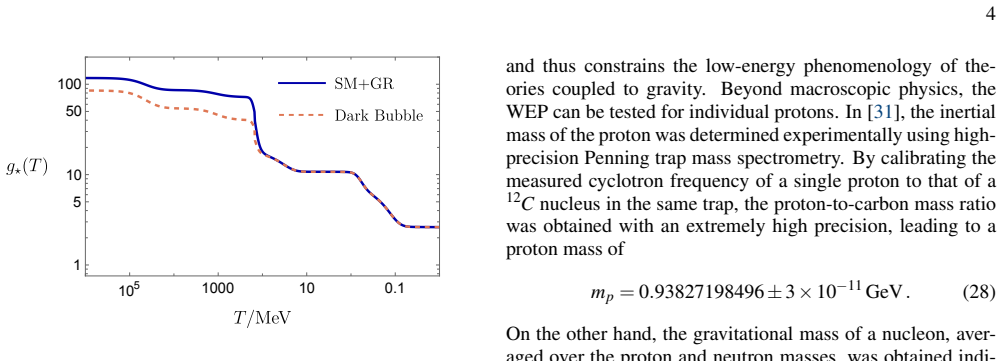
- Before the QCD crossover, gluons with the wrong-sign coupling behave like 16 negative relativistic degrees of freedom, lowering $g_*$ from 61.5 to 29.5; this alters the early thermal history, though it is hard to probe directly because it happens before Big Bang nucleosynthesis and CMB decoupling.
- The proton prediction is $(m_g^{(p)}-m_i^{(p)})/m_i^{(p)} \approx 0.99$, which exceeds the proton-mass-derived bound of $7\times 10^{-3}$ and the MICROSCOPE bound of $10^{-15}$ by roughly 13 orders of magnitude.
- The paper concludes that the current dark bubble formulation is incompatible with the Standard Model; any rescue must introduce a different mechanism, such as boundary conditions that realize the effective 4D graviton without relying on B- and C-field couplings.
Reading between the lines
- If the sign flip is generic, the same mechanism suppresses the gravitational mass of every hadron roughly in proportion to its gluon momentum fraction, making the weak-equivalence-principle violation nearly composition-independent and therefore hard to evade by choosing test materials.
- The large gap between the predicted 0.99 and the existing 0.007 bound means a dedicated measurement of the proton's gravitational-to-inertial mass ratio, rather than another UV computation, could settle the fate of the scenario.
- A complete non-abelian DBI action beyond the symmetrized-trace $F^4$ truncation might generate an effective linear coupling to the B-field; testing that requires computing the full action, not just the leading terms.
Editorial analysis
A structured set of objections, weighed in public.
Referee Report
Summary. This paper studies the coupling of non-abelian gauge fields to induced gravity in the dark bubble scenario. The authors argue that, unlike the abelian case, the bulk B-field source for non-abelian worldvolume fields starts only at cubic order in the field strength because Tr F = 0, so the uncompensated brane contribution to the Israel junction condition gives a negative-sign energy-momentum tensor in the induced Einstein equations. Applied to QCD, this flips the gluon contribution to the proton's gravitational form factor, producing a relative difference between gravitational and inertial proton mass of order 0.99, in conflict with the equivalence-principle bound of 7e-3. The electroweak sector is argued to be unaffected. The paper concludes that the dark bubble scenario, as currently formulated, is incompatible with the Standard Model.
Significance. If the sign-flip mechanism is correct, this is a sharp and falsifiable result: it converts a top-down string-construction proposal into a quantitative contradiction with existing precision measurements, using published lattice-QCD form factors and no free parameters. The paper is appropriately cautious, concluding incompatibility rather than overclaiming. However, the central prediction rests on a sign that is asserted rather than derived in this paper, on an assumption that background B-field fluxes vanish, and on an electroweak section that contains an apparent sign inconsistency. The result is therefore plausible but currently under-supported; it deserves publication only after the missing derivation is supplied.
major comments (3)
- [III (Eqs. (13)–(14))] The central sign-flip premise is asserted rather than derived. The statement that the uncompensated brane contribution to the induced Einstein equations has 'the wrong sign' is imported from the abelian analysis of Ref. [9], and the conclusion that no compensating linear coupling exists is based on Tr F = 0 plus the symmetrized-trace DBI expansion. Since Eq. (38) follows directly from this sign, I request an explicit derivation of the Israel junction condition for non-abelian worldvolume fields, including all signs in the coefficients, before the WEP prediction can be considered established.
- [III] The argument assumes that there is no background B-field on the brane. If the dark bubble vacuum has B0 ≠ 0, then expanding STr[(B0 I + τF)^4] produces terms linear in B0 and quadratic in F, so the variation with respect to B gives a discontinuity ΔH ∝ B0 Tr F², not only ΔH ∝ Tr F³. Such a source enters the induced Einstein equations at the same order as the brane energy-momentum tensor and could cancel the wrong-sign contribution. The paper neither computes B0 in the dark bubble background nor argues that it vanishes; this is a concrete loophole in the central mechanism.
- [IV (Eqs. (19)–(20))] There is an internal inconsistency in the electroweak analysis. Eq. (19) states T00 = -(v²/32)[g²(A1)² + g²(A2)² + (-gA3 + g'B)²], which is a negative definite quadratic form, while Eq. (20) uses a positive definite matrix with entries v²g²/4 and v²g'^2/4. The conclusion that the gravitational and inertial masses of W and Z coincide follows from the positive matrix, not from Eq. (19). As written, Eq. (19) would imply negative gravitational masses for the massive gauge bosons. The sign convention must be reconciled before the paper can claim that the electroweak sector is unaffected.
minor comments (5)
- [V (Eq. (38))] The word 'gravational' should be 'gravitational'.
- [Fig. 1] The axes are unlabeled; the horizontal axis appears to be temperature but the units and scale are not stated.
- [V] The text says that the extrapolated deviation violates the macroscopic MICROSCOPE bound by 13 orders of magnitude, but comparing the proton-level ratio 0.99 with 10^-15 gives roughly 15 orders of magnitude; the intended comparison should be clarified.
- [V (Eqs. (21)–(22))] The stated counting of relativistic degrees of freedom before the QCD phase transition appears to give g⋆ = 61.75 rather than 61.5; please check the counting.
- [V (Eqs. (35)–(38))] The step from Eq. (37) to Eq. (38) is numerically correct but easy to misread: the gravitational mass itself is (0.009 ± 0.037)mp, while the relative deviation is approximately -0.99. Stating mg ≈ 0.01mi explicitly would improve clarity.
Circularity Check
WEP-violation prediction rests on a load-bearing negative sign imported from the authors' prior papers, but is not a fitted or self-definitional result; external benchmarks make the central claim independently testable.
-
self citation load bearing
[Section III, after Eq. (14); applied in Section IV (Eq. (16)) and Section V (Eqs. (37)-(38))]
"The discontinuity correspond to the induced energy-momentum tensor in the 4d Einstein equations, whose brane contribution has the wrong sign. In the abelian case, the backreaction from the bulk B-field contributes the correct sign with a factor of two, resulting in the correct energy-momentum tensor 2 Tµν − Tµν = +Tµν . In the non-abelian sector, the minus sign from the brane contribution cannot be compensated by the higher-order terms, which are subleading in α′."
The central prediction is not derived from an independently established coupling; it is carried over from the abelian analysis of Refs. [9] and [12], whose authors overlap with the present paper. Section V then simply flips the gluon form-factor sign: with the lattice values Aq(0)=0.510 and Ag(0)=0.501, Eq. (37) subtracts the gluon contribution, giving (m_g−m_i)/m_i ≈ 0.99. If the imported brane-source sign were positive rather than negative, non-abelian fields would couple normally and Eq. (38) would vanish. Thus the incompatibility claim reduces to an unverified, self-cited input rather than to a calculation performed in this paper. The result is still a genuine falsifiable consequence of that input, so this is load-bearing self-citation, not a fitted parameter or a tautology.
full rationale
The paper does not fit any parameter to the data it claims to predict: the MICROSCOPE bound, the Penning-trap proton mass, and the lattice QCD form factors Aq(0), Ag(0) are all external inputs, and the proton WEP estimate follows by combining them with a sign flip. There is no self-definitional step of the kind 'X is defined to make Y true'. The only circular ingredient is the sign of the non-abelian brane coupling to induced gravity, which is asserted via the authors' earlier abelian analysis (Refs. [9,12]) rather than re-derived here. Because that sign is the load-bearing premise for the WEP violation, the central conclusion is conditional on a self-cited framework input. I therefore score this as partial circularity (4), not higher: the prediction is externally testable and would genuinely refute the dark bubble scenario if the sign input is correct. Note also a separate sign inconsistency in the electroweak section (Eq. (19) is negative while the matrix in Eq. (20) is positive, yet the masses are said to coincide); this is a correctness concern, not a circularity, and does not affect the score.
Assumptions & free parameters
assumptions (5)
- standard math Israel junction conditions and Gauss-Codazzi equations give the induced 4D Einstein equations on the brane
- domain assumption The dark bubble scenario with D3-branes and bulk 2-form fields B and C is a valid string theory construction
- ad hoc to paper Non-abelian worldvolume gauge fields couple to the bulk via the symmetrized trace DBI action, and the leading bulk source for the B-field is proportional to Tr(F^3), with no linear term because Tr F = 0
- ad hoc to paper The uncompensated brane contribution to the induced energy-momentum tensor has the wrong sign for non-abelian fields
- domain assumption Lattice QCD forward-limit gravitational form factors A_q(0)=0.510 and A_g(0)=0.501 from [35] can be applied with the gluonic operator sign flipped
Cite this review
Pith. "Pith review of Dark bubble cosmology and the equivalence principle." pith.science (2026). https://pith.science/paper/3KKNWYVN
@misc{pith2026250703748,
  author       = {Pith},
  title        = {Pith review of: Dark bubble cosmology and the equivalence principle},
  year         = {2026},
  howpublished = {\url{https://pith.science/paper/3KKNWYVN}},
  note         = {Machine review of arXiv:2507.03748}
}
read the original abstract
The main goal of string phenomenology is to find realistic models of particle physics and cosmology within string theory. Dark bubble cosmology is an alternative to string compactifications, where our universe lives on a bubble expanding in a higher-dimensional spacetime. This construction is inherently non-supersymmetric and can yield a four-dimensional realistic cosmology, where radiation behaves as expected due to its coupling to higher-dimensional fields. We study the coupling of the electroweak and strong sectors to the induced braneworld gravity via the same mechanism. While the electroweak sector is unaffected, the gravitational and inertial masses of the proton differ significantly, severely violating measurements of the equivalence principle.
Figures

Forward citations
Cited by 1 Pith paper
-
Weak gravity at micron scales from dark bubble cosmology and its cosmological consequences
Dark bubble cosmology predicts gravity weakens below L~10^-5 m, yielding V=-G4M(1/rho - 3L^2/(2rho^3)+...) and a radiation-only inflationary phase.
Reference graph
Works this paper leans on
- [9]
-
[1]
S. Banerjee, U. Danielsson, G. Dibitetto, S. Giri, and M. Schillo, Phys. Rev. Lett. 121, 261301 (2018), arXiv:1807.01570 [hep-th]
arXiv 2018
-
[2]
S. Banerjee, U. Danielsson, G. Dibitetto, S. Giri, and M. Schillo, Journal of High Energy Physics 2019 (2019), 10.1007/jhep10(2019)164
-
[3]
S. Banerjee, U. Danielsson, and S. Giri, JHEP 20, 085 (2020), arXiv:2001.07433 [hep-th]
arXiv 2020
-
[4]
S. Banerjee, U. Danielsson, and S. Giri, Int. J. Mod. Phys. D 30, 2142029 (2021), arXiv:2103.17121 [hep-th]
arXiv 2021
-
[5]
U. H. Danielsson, D. Panizo, R. Tielemans, and T. Van Riet, Phys. Rev. D 104, 086015 (2021), arXiv:2105.03253 [hep-th]
arXiv 2021
-
[6]
S. Banerjee, U. Danielsson, and S. Giri, Phys. Rev. D 108, 126009 (2023), arXiv:2212.14004 [hep-th]
arXiv 2023
-
[7]
U. Danielsson, O. Henriksson, and D. Panizo, Phys. Rev. D 107, 026020 (2023), arXiv:2211.10191 [hep-th]
arXiv 2023
Show all 44 references
-
[8]
Danielsson, D
U. Danielsson, D. Panizo, and R. Tielemans, Phys. Rev. D 106, 024002 (2022), arXiv:2202.00545 [hep-th]
2022 arXiv
-
[10]
Banerjee, U
S. Banerjee, U. Danielsson, and M. Zemsch, JHEP 02, 102 (2024), arXiv:2311.16242 [hep-th]
2024 arXiv
-
[11]
Charged nariai black holes on the dark bubble,
U. Danielsson and V . V . Hemelryck, “Charged nariai black holes on the dark bubble,” (2024), arXiv:2405.13679 [hep-th]
2024 arXiv
- [12]
-
[13]
See also [43] for a related proposal with end-of-the-world branes
-
[14]
Danielsson and D
U. Danielsson and D. Panizo, Phys. Rev. D109, 026003 (2024), arXiv:2311.14589 [hep-th]
2024 arXiv
-
[15]
Sagnotti, in Supersymmetry and unification of fundamental interactions
A. Sagnotti, in Supersymmetry and unification of fundamental interactions. Proceedings, International Workshop, SUSY 95, Palaiseau, France, May 15-19 (1995) pp. 473–484, arXiv:hep- th/9509080 [hep-th]
1995
-
[16]
Sagnotti, Theory of elementary particles
A. Sagnotti, Theory of elementary particles. Proceedings, 30th International Symposium Ahrenshoop, Buckow, Germany, Au- gust 27-31, 1996 , Nucl. Phys. Proc. Suppl. 56B, 332 (1997), arXiv:hep-th/9702093 [hep-th]
1997 arXiv
-
[17]
As such, it is expected to violate several swampland conditions [44], although the AdS bulk does not
-
[18]
Banerjee, U
S. Banerjee, U. Danielsson, G. Dibitetto, S. Giri, and M. Schillo, JHEP 10, 164 (2019), arXiv:1907.04268 [hep-th]
2019 arXiv
- [19]
-
[20]
Israel, Nuovo Cim
W. Israel, Nuovo Cim. B 44S10, 1 (1966), [Erratum: Nuovo Cim.B 48, 463 (1967)]
1966
-
[21]
J. F. Morales, C. A. Scrucca, and M. Serone, Nucl. Phys. B 552, 291 (1999), arXiv:hep-th/9812071
1999 arXiv
-
[22]
A. A. Tseytlin, Nucl. Phys. B 501, 41 (1997), arXiv:hep- th/9701125
1997
-
[23]
R. C. Myers, JHEP 12, 022 (1999), arXiv:hep-th/9910053 [hep- th]
1999 arXiv
-
[24]
Hashimoto and W
A. Hashimoto and W. Taylor, Nucl. Phys. B 503, 193 (1997), arXiv:hep-th/9703217
1997 arXiv
-
[25]
Sevrin, J
A. Sevrin, J. Troost, and W. Troost, Nucl. Phys. B 603, 389 (2001), arXiv:hep-th/0101192
2001 arXiv
-
[26]
Damour and A
T. Damour and A. M. Polyakov, Nucl. Phys. B423, 532 (1994), arXiv:hep-th/9401069
1994 arXiv
-
[27]
G. J. Olmo, Phys. Rev. Lett. 98, 061101 (2007), arXiv:gr- qc/0612002
2007
-
[28]
C. M. Will, Living Rev. Rel. 17, 4 (2014), arXiv:1403.7377 [gr- qc]
2014 arXiv
-
[29]
Touboul et al
P. Touboul et al. (MICROSCOPE), Phys. Rev. Lett. 129, 121102 (2022), arXiv:2209.15487 [gr-qc]
2022 arXiv
-
[30]
Touboul, G
P. Touboul, G. M ´etris, M. Rodrigues, Y . Andr ´e, Q. Baghi, J. Berg ´e, D. Boulanger, S. Bremer, P. Carle, R. Chhun, B. Christophe, V . Cipolla, T. Damour, P. Danto, H. Dittus, P. Fayet, B. Foulon, C. Gageant, P.-Y . Guidotti, D. Hage- dorn, E. Hardy, P.-A. Huynh, H. Inchaus...
2017
-
[31]
Heiße, F
F. Heiße, F. K ¨ohler-Langes, S. Rau, J. Hou, S. Junck, A. Kracke, A. Mooser, W. Quint, S. Ulmer, G. Werth, K. Blaum, and S. Sturm, Phys. Rev. Lett. 119, 033001 (2017)
2017
-
[32]
Andreas, Y
B. Andreas, Y . Azuma, G. Bartl, P. Becker, H. Bettin, M. Bo- rys, I. Busch, P. Fuchs, K. Fujii, H. Fujimoto, E. Kessler, M. Krumrey, U. Kuetgens, N. Kuramoto, G. Mana, E. Massa, S. Mizushima, A. Nicolaus, A. Picard, A. Pramann, O. Rienitz, D. Schiel, S. Valkiers, A. Waseda, a...
2011
-
[33]
The combined neutron-proton mass difference and binding en- ergy is negative
-
[34]
D. C. Hackett, P. R. Oare, D. A. Pefkou, and P. E. Shanahan, Phys. Rev. D 108, 114504 (2023), arXiv:2307.11707 [hep-lat]
2023 arXiv
-
[35]
D. C. Hackett, D. A. Pefkou, and P. E. Shanahan, Phys. Rev. Lett. 132, 251904 (2024), arXiv:2310.08484 [hep-lat]
2024 arXiv
-
[36]
Adhikari et al
S. Adhikari et al. (GlueX), Phys. Rev. C 108, 025201 (2023), arXiv:2304.03845 [nucl-ex]
2023 arXiv
-
[37]
K. A. Mamo and I. Zahed, Phys. Rev. D 106, 086004 (2022), arXiv:2204.08857 [hep-ph]
2022 arXiv
-
[38]
P. E. Shanahan and W. Detmold, Phys. Rev. D 99, 014511 (2019), arXiv:1810.04626 [hep-lat]
2019 arXiv
-
[39]
U. H. Danielsson, S. S. Haque, G. Shiu, and T. Van Riet, JHEP 09, 114 (2009), arXiv:0907.2041 [hep-th]
2009 arXiv
-
[40]
Obied, H
G. Obied, H. Ooguri, L. Spodyneiko, and C. Vafa, (2018), arXiv:1806.08362 [hep-th]
2018 arXiv
-
[41]
Andriot and C
D. Andriot and C. Roupec, Fortsch. Phys. 67, 1800105 (2019), arXiv:1811.08889 [hep-th]
2019 arXiv
-
[42]
Banerjee, U
S. Banerjee, U. Danielsson, and S. Giri, JHEP 21, 250 (2020), arXiv:2009.01597 [hep-th]
2020 arXiv
-
[43]
Muntz, A
B. Muntz, A. Padilla, and P. M. Saffin, JHEP 05, 006 (2025), arXiv:2411.05912 [hep-th]
2025 arXiv
-
[44]
Anastasi, R
E. Anastasi, R. Angius, J. Huertas, A. Uranga, and C. Wang, (2025), arXiv:2501.03310 [hep-th]
2025 arXiv
Reviewed August 6, 2026 · model on record in the stance chip above.
Discussion (0). Sign in to comment.