REVIEW 4 major objections 8 minor 29 references
Demystifying ChatGPT: How It Masters Genre Recognition
T0 review · 4 major / 8 minor · reviewed 2026-08-06 · deepseek-v4-flash
Pith's one-line read This paper claims that ChatGPT, without fine-tuning, outperforms other large language models at multi-label movie genre prediction from trailer subtitles, and that fine-tuning it yields the best overall performance.
desk verdict A useful applied benchmark and dataset extension, but the 'masters genre recognition' claim fails because the evaluation cannot rule out memorization of well-known movie metadata. read the letter →
The pith
A machine-rendered reading of the paper's core claim, the machinery that carries it, and where it could break.
The reading
What carries the argument
The central objects are the carefully constructed prompts: a zero-shot prompt that gives the model the closed genre set G and a trailer subtitle S; a few-shot prompt that adds two example subtitle-to-genre pairs; and a fine-tuning instruction in a conversational chat format. The VLM extension uses llava to convert a movie poster into descriptive text (title, colors, imagery, actors, taglines) that is appended to the subtitle prompt. These prompts convert genre prediction into a constrained text-generation problem, and the paper's argument rides on the model's ability to map subtitle language to genre labels without task-specific training.
What would settle it
Take a set of movies whose trailers were released after ChatGPT's training cutoff, run the same zero-shot prompts, and check whether the macro F1 stays near the reported 0.64; if it falls to chance, the reported scores largely reflect memorized genre knowledge rather than subtitle-based recognition.
Extended reading notes
Core claim
On the MovieLens-100K benchmark, a multi-label genre prediction task with 18 genres and up to several genres per movie, the paper claims that ChatGPT without any fine-tuning is the strongest zero-shot predictor among the tested LLMs, beating text-davinci-002 and text-davinci-003 on all 54 metric instances (precision, recall, F1 across 18 genres), and that fine-tuned ChatGPT performs best overall. Under few-shot prompting with two examples, fine-tuned ChatGPT again leads, and the optimal number of shots is two. The paper further claims that a VLM (llava) that reads IMDb posters and adds poster-derived text to the subtitle prompt improves recall across average metrics while reducing precision in most genres, and that all tested LLMs exceed traditional classifiers (KNN, logistic regression, SVM) trained on SBERT subtitle embeddings, even at zero training examples.
Load-bearing premise
The evaluation assumes ChatGPT's genre guesses come from the provided trailer subtitles rather than from genre information the model memorized during pretraining, and that MovieLens-100K genre labels are complete and accurate.
Editorial extensions
If this is right
- Zero-shot ChatGPT can be used as a drop-in genre tagger for movie content, with no training data, at a macro F1 around 0.64.
- Fine-tuning ChatGPT on roughly 80 percent of MovieLens-100K raises macro F1 to about 0.81, a 26.5 percent relative improvement, at six times the token training cost.
- Few-shot prompting with two examples offers only a 4.6 percent F1 gain over zero-shot while tripling input tokens, so zero-shot is cost-preferred.
- Adding VLM poster information improves recall (micro recall rises by 7 percent) but lowers precision in most genres; fine-tuning the VLM could yield more task-specific gains.
- LLMs outperform traditional classifiers trained on SBERT embeddings, maintaining decent performance even with no training examples.
Reading between the lines
- If the model has seen these well-known movies in pretraining, part of the reported accuracy may reflect memorized genre metadata rather than inference from subtitle content; a test on trailer subtitles from post-cutoff movies would separate the two.
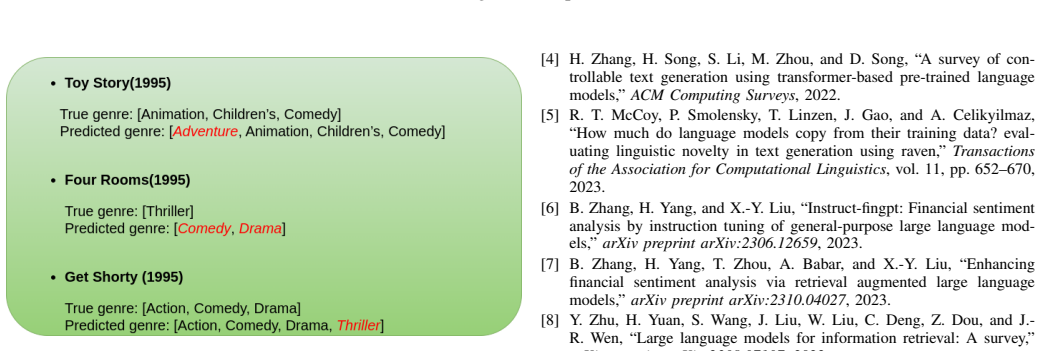
- The case study suggests MovieLens genre labels are incomplete — Toy Story's Adventure label is a false positive only because the dataset omits it — so the true precision and recall of all systems may be better than the reported numbers.
- The same prompt design could transfer to other content-classification domains (books, music, games) where transcripts or subtitles are available, with visual cues as an optional second channel.
- The pattern of recall rising while precision falls when poster text is added suggests posters flag additional plausible genres but also distract from the subtitle signal; a learned fusion weight might capture both signals.
Editorial analysis
A structured set of objections, weighed in public.
Referee Report
Summary. The paper benchmarks three LLMs (text-davinci-002, text-davinci-003, and gpt-3.5-turbo, plus a fine-tuned gpt-3.5-turbo) on multi-label movie genre prediction using the MovieLens-100K dataset. Trailer subtitles are used in zero-shot and few-shot prompts, SBERT-based classifiers are compared, a cost analysis is performed, and LLaVA-extracted poster descriptions are added to the prompts. The central claims are that ChatGPT outperforms the other LLMs, that fine-tuning improves performance, and that VLM information further enhances genre prediction.
Significance. If the results were valid, the paper would offer a useful comparison of LLMs on a practical content-understanding task, together with a rare cost-benefit analysis. The authors should be credited for extending the dataset with trailer subtitles and posters, for evaluating multiple prompting and fine-tuning settings, and for candidly acknowledging label noise in the case study. However, the evaluation lacks any control for pretraining contamination, relies on ground-truth labels that the paper itself describes as incomplete or inappropriate, and the VLM integration results are far weaker than the abstract suggests. The central capability claim is therefore not established by the current experiments.
major comments (4)
- [Section IV, Tables I-II and IV.C] The zero-shot and few-shot F1 scores cannot be interpreted as measuring genre recognition from subtitles. The 1,682 movies predate GPT-3.5's training data, and trailer subtitles often contain dialogue, character names, and other identifying content, so the model may be retrieving known movie-to-genre associations from pretraining rather than reasoning from the provided text. The paper provides no control: there are no post-cutoff movies, no entity-scrubbed or scrambled subtitles, and no analysis of which input features drove predictions. This also affects RQ2's comparison with SBERT-based classifiers, which have no such prior knowledge. A concrete fix would be to evaluate on movies released after the model's training cutoff or on subtitles with identifying named entities removed.
- [Section VI, Tables I-VI] The ground-truth labels are admitted to be 'limited or, in some instances, inappropriate,' yet these same labels are used to compute every precision, recall, and F1 score in the paper. The Toy Story example shows that a prediction can be correct in reality but counted as a false positive against MovieLens labels. This is not merely a VLM-specific issue; it undermines the absolute scores and the model rankings throughout the paper. The authors should either correct and release a revised label set or report results separately on labels verified against external sources.
- [Section V, Tables V-VI and Abstract] The claim that VLM integration 'further enhances' genre prediction is not supported by the reported numbers. Table VI shows micro, weighted, and samples F1 improvements of only 0.01-0.02, while macro F1 is unchanged at 0.64, and Table V shows precision declining on most individual genres. Section V states that 'F1-score has improved in all the average metrics,' which is contradicted by the unchanged macro average. The abstract should be revised to reflect the marginal and mixed nature of the VLM contribution.
- [Section IV.A.1] The fine-tuning split is arithmetically inconsistent with the stated dataset size. The paper says MovieLens-100K contains 1,682 movies and then reports an 80:20 split as 1,205 training and 302 test movies, but these two numbers sum to 1,507. The discrepancy of 175 movies is unexplained and matters because every subsequent result depends on which movies were used for training and testing.
minor comments (8)
- [Section III.A.2] 'few show settings' should be 'few-shot settings'.
- [Table V, Animation row] The percentage annotation '0.85⇓⇓15%)15%)' is malformed and should be fixed.
- [Section VI] 'Get Shortly' should be 'Get Shorty'.
- [Section IV.B] 'idential' should be 'identical'.
- [Section III.B] The sentence 'Detailed descriptions of these LLMs can be found here' contains no link or citation; please add a proper reference.
- [Section IV.D, Eq. (4)] The cost analysis is hard to follow because 'Cost chatgpt', 'ScalingF actor', and the scaling factor X are not clearly defined; please define X and the training-cost multiplier explicitly.
- [Entire manuscript] The paper alternates between 'MovieLens' and 'Movielens'; please standardize the spelling.
- [Entire manuscript] No code or data release is mentioned; providing the prompts, subtitle texts, and poster descriptions would substantially improve reproducibility.
Circularity Check
No internal circularity: the paper is an empirical benchmark whose conclusions do not reduce to its inputs by construction.
full rationale
The paper is an empirical evaluation of LLMs for multi-label movie genre prediction on MovieLens-100K. It contains no mathematical derivation chain in which an output quantity is defined in terms of the target quantity, and no fitted parameter is renamed as a prediction. Fine-tuning uses a standard 80/20 split (Section IV-A-1), with 1,205 movies for training and 302 held-out movies for testing, so the fine-tuned results are normal supervised evaluation rather than circular. Zero-shot and few-shot prompting are directly specified in terms of genre list G and subtitles S, and performance is measured against MovieLens labels; there is no equation through which the reported F1 scores are forced by construction. The only self-citation ([23]) is a passing remark that genre prediction is closely related to recommendation and is not load-bearing. Section VI explicitly concedes that MovieLens-100K genre labels are 'limited or, in some instances, inappropriate,' giving the example that Adventure is a valid genre for Toy Story but is counted as a false positive; this is a label-quality and construct-validity concern, not circularity. Likewise, the possibility that ChatGPT memorized movie-genre associations during pretraining is an external contamination concern about what zero-shot scores measure, not an internal circular reduction. No step meets the required standard of exhibiting a specific reduction of a claimed result to its own inputs, so the circularity score is 0.
Assumptions & free parameters
free parameters (5)
- temperature =
0.1
- top_p =
1
- max_tokens =
270
- number_of_few_shot_examples =
2
- train_test_split =
80:20
assumptions (4)
- domain assumption MovieLens-100K genre labels are accurate and complete ground truth for evaluation.
- domain assumption Trailer subtitles provide sufficient signal for genre prediction.
- domain assumption The LLM's pretraining does not include the test movies' genre information.
- domain assumption LLM outputs can be parsed into a valid genre subset.
Cite this review
Pith. "Pith review of Demystifying ChatGPT: How It Masters Genre Recognition." pith.science (2026). https://pith.science/paper/2XXP3B4X
@misc{pith2026250703875,
  author       = {Pith},
  title        = {Pith review of: Demystifying ChatGPT: How It Masters Genre Recognition},
  year         = {2026},
  howpublished = {\url{https://pith.science/paper/2XXP3B4X}},
  note         = {Machine review of arXiv:2507.03875}
}
read the original abstract
The introduction of ChatGPT has garnered significant attention within the NLP community and beyond. Previous studies have demonstrated ChatGPT's substantial advancements across various downstream NLP tasks, highlighting its adaptability and potential to revolutionize language-related applications. However, its capabilities and limitations in genre prediction remain unclear. This work analyzes three Large Language Models (LLMs) using the MovieLens-100K dataset to assess their genre prediction capabilities. Our findings show that ChatGPT, without fine-tuning, outperformed other LLMs, and fine-tuned ChatGPT performed best overall. We set up zero-shot and few-shot prompts using audio transcripts/subtitles from movie trailers in the MovieLens-100K dataset, covering 1682 movies of 18 genres, where each movie can have multiple genres. Additionally, we extended our study by extracting IMDb movie posters to utilize a Vision Language Model (VLM) with prompts for poster information. This fine-grained information was used to enhance existing LLM prompts. In conclusion, our study reveals ChatGPT's remarkable genre prediction capabilities, surpassing other language models. The integration of VLM further enhances our findings, showcasing ChatGPT's potential for content-related applications by incorporating visual information from movie posters.
Figures


Figures from the paper (5 more)


Reference graph
Works this paper leans on
-
[1]
Large language models in machine translation,
T. Brants, A. C. Popat, P. Xu, F. J. Och, and J. Dean, “Large language models in machine translation,”Computational Linguistics, 2007
work page 2007
-
[2]
Document- level machine translation with large language models,
L. Wang, C. Lyu, T. Ji, Z. Zhang, D. Yu, S. Shi, and Z. Tu, “Document- level machine translation with large language models,”arXiv preprint arXiv:2304.02210, 2023
arXiv 2023
-
[3]
Adaptive machine translation with large language models,
Y . Moslem, R. Haque, and A. Way, “Adaptive machine translation with large language models,”arXiv preprint arXiv:2301.13294, 2023. 8 (a) Heatmap for Precision of LLMs (b) Heatmap for Recall of LLMs (c) Heatmap for F1-score of LLMs Fig. 5: Performance of LLMs under zero-shot settings on Movielens-100K dataset. The Y-axis represents different genre labels, ...
arXiv 2023
-
[4]
A survey of con- trollable text generation using transformer-based pre-trained language models,
H. Zhang, H. Song, S. Li, M. Zhou, and D. Song, “A survey of con- trollable text generation using transformer-based pre-trained language models,”ACM Computing Surveys, 2022
work page 2022
-
[5]
R. T. McCoy, P. Smolensky, T. Linzen, J. Gao, and A. Celikyilmaz, “How much do language models copy from their training data? eval- uating linguistic novelty in text generation using raven,”Transactions of the Association for Computational Linguistics, vol. 11, pp. 652–670, 2023
work page 2023
-
[6]
B. Zhang, H. Yang, and X.-Y . Liu, “Instruct-fingpt: Financial sentiment analysis by instruction tuning of general-purpose large language mod- els,”arXiv preprint arXiv:2306.12659, 2023
arXiv 2023
-
[7]
Enhancing Financial Sentiment Analysis via Retrieval Augmented Large Language Models
B. Zhang, H. Yang, T. Zhou, A. Babar, and X.-Y . Liu, “Enhancing financial sentiment analysis via retrieval augmented large language models,”arXiv preprint arXiv:2310.04027, 2023
work page Pith review arXiv 2023
-
[8]
Large language models for information retrieval: A survey,
Y . Zhu, H. Yuan, S. Wang, J. Liu, W. Liu, C. Deng, Z. Dou, and J.- R. Wen, “Large language models for information retrieval: A survey,” arXiv preprint arXiv:2308.07107, 2023
arXiv 2023
Show all 29 references
-
[9]
Movie genre 10 classification with convolutional neural networks,
G. S. Simoes, J. Wehrmann, R. C. Barros, and D. D. Ruiz, “Movie genre 10 classification with convolutional neural networks,” in2016 International Joint Conference on Neural Networks (IJCNN). IEEE, 2016, pp. 259– 266
2016
-
[10]
1d cnn architectures for music genre classification,
S. Allamy and A. L. Koerich, “1d cnn architectures for music genre classification,” in2021 IEEE Symposium Series on Computational Intelligence (SSCI). IEEE, 2021, pp. 01–07
2021
-
[11]
Multimodal movie genre classification using recurrent neural network,
T. Behrouzi, R. Toosi, and M. A. Akhaee, “Multimodal movie genre classification using recurrent neural network,”Multimedia Tools and Applications, vol. 82, no. 4, pp. 5763–5784, 2023
2023
-
[12]
Long short-term memory recurrent neural network based segment features for music genre classification,
J. Dai, S. Liang, W. Xue, C. Ni, and W. Liu, “Long short-term memory recurrent neural network based segment features for music genre classification,” in2016 10th International Symposium on Chinese Spoken Language Processing (ISCSLP). IEEE, 2016, pp. 1–5
2016
-
[13]
Language representation models for music genre classification using lyrics,
H. Akalp, E. Furkan Cigdem, S. Yilmaz, N. Bolucu, and B. Can, “Language representation models for music genre classification using lyrics,” in2021 International Symposium on Electrical, Electronics and Information Engineering, 2021, pp. 408–414
2021
-
[14]
Predicting song genre with deep learning,
A. Mariji ´c and M. Bagi ´c Babac, “Predicting song genre with deep learning,”Global Knowledge, Memory and Communication, 2023
2023
-
[15]
Learning to prompt for vision- language models,
K. Zhou, J. Yang, C. C. Loy, and Z. Liu, “Learning to prompt for vision- language models,”International Journal of Computer Vision, vol. 130, no. 9, pp. 2337–2348, 2022
2022
-
[16]
Image retrieval on real-life images with pre-trained vision-and-language models,
Z. Liu, C. Rodriguez-Opazo, D. Teney, and S. Gould, “Image retrieval on real-life images with pre-trained vision-and-language models,” in Proceedings of the IEEE/CVF International Conference on Computer Vision, 2021, pp. 2125–2134
2021
-
[17]
Prompting large vision-language models for compositional reasoning,
T. Ossowski, M. Jiang, and J. Hu, “Prompting large vision-language models for compositional reasoning,”arXiv preprint arXiv:2401.11337, 2024
2024 arXiv
-
[18]
Multitask vision-language prompt tuning,
S. Shen, S. Yang, T. Zhang, B. Zhai, J. E. Gonzalez, K. Keutzer, and T. Darrell, “Multitask vision-language prompt tuning,” inProceedings of the IEEE/CVF Winter Conference on Applications of Computer Vision, 2024, pp. 5656–5667
2024
-
[19]
Predicting genre from movie posters,
G. Barney and K. Kaya, “Predicting genre from movie posters,”Stanford CS 229: Machine Learning, 2019
2019
-
[20]
Multi-label movie genre detection from a movie poster using knowledge transfer learning,
K. Kundalia, Y . Patel, and M. Shah, “Multi-label movie genre detection from a movie poster using knowledge transfer learning,”Augmented Human Research, vol. 5, pp. 1–9, 2020
2020
-
[21]
Movie genre classification based on poster images with deep neural networks,
W.-T. Chu and H.-J. Guo, “Movie genre classification based on poster images with deep neural networks,” inproceedings of the workshop on multimodal understanding of social, affective and subjective attributes, 2017, pp. 39–45
2017
-
[22]
Visual instruction tuning,
H. Liu, C. Li, Q. Wu, and Y . J. Lee, “Visual instruction tuning,” in NeurIPS, 2023
2023
-
[23]
A multi- modal multi-task based approach for movie recommendation,
S. Raj, P. Mondal, D. Chakder, S. Saha, and N. Onoe, “A multi- modal multi-task based approach for movie recommendation,” in2023 International Joint Conference on Neural Networks (IJCNN). IEEE, 2023, pp. 1–8
2023
-
[24]
A brief review of nearest neighbor algorithm for learning and classification,
K. Taunk, S. De, S. Verma, and A. Swetapadma, “A brief review of nearest neighbor algorithm for learning and classification,” in2019 international conference on intelligent computing and control systems (ICCS). IEEE, 2019, pp. 1255–1260
2019
-
[25]
Logistic regression,
R. E. Wright, “Logistic regression,” 1995, published by American Psychological Association
1995
-
[26]
What is a support vector machine?
W. S. Noble, “What is a support vector machine?”Nature biotechnology, vol. 24, no. 12, pp. 1565–1567, 2006
2006
-
[27]
Sentence-bert: Sentence embeddings using siamese bert-networks,
N. Reimers and I. Gurevych, “Sentence-bert: Sentence embeddings using siamese bert-networks,”arXiv preprint arXiv:1908.10084, 2019
1908 arXiv
-
[28]
Per- sonalized prompt for sequential recommendation,
Y . Wu, R. Xie, Y . Zhu, F. Zhuang, X. Zhang, L. Lin, and Q. He, “Per- sonalized prompt for sequential recommendation,”IEEE Transactions on Knowledge and Data Engineering, 2024
2024
-
[29]
Prompting large language models for recommender systems: A comprehensive framework and empirical analysis,
L. Xu, J. Zhang, B. Li, J. Wang, M. Cai, W. X. Zhao, and J.-R. Wen, “Prompting large language models for recommender systems: A comprehensive framework and empirical analysis,”arXiv preprint arXiv:2401.04997, 2024
2024 arXiv
Reviewed August 6, 2026 · model on record in the stance chip above.
Discussion (0). Sign in to comment.