REVIEW 3 major objections 4 minor 1 cited by
Spherical photon orbits around the Kerr-like black hole in Einstein-Bumblebee gravity
T0 review · 3 major / 4 minor · reviewed 2026-08-06 · deepseek-v4-flash
Pith's one-line read In Einstein-Bumblebee gravity, all spherical photon orbits around the Kerr-like black hole are governed by one sextic polynomial; increasing the Lorentz-violation parameter lowers the critical impact parameter, so the predicted photon…
desk verdict A Kerr-style photon-orbit analysis for the Bumblebee black hole that is internally inconsistent as written because the stated Δ contradicts the horizon and geodesic equations; the intended metric is clear and the fix is a typo, so it deserves a conditional referee rather than a desk rejection. read the letter →
The pith
A machine-rendered reading of the paper's core claim, the machinery that carries it, and where it could break.
The reading
What carries the argument
The sextic polynomial (12), built from the separated Hamilton-Jacobi radial equation with a Carter constant and the effective inclination angle $v=\sin^2 i$, is the central object. Its roots are the radii of spherical photon orbits, and the argument proceeds by locating these roots in polar, equatorial, and inclined planes, then factorizing the polynomial at the critical inclination and at extremality.
What would settle it
Substitute $x_h = 1+\sqrt{1-(1+\ell)u}$ into $\Delta = x^2 - \frac{2x}{1+\ell} + u$ for, say, $\ell=0.4$ and $u=0.1$; a nonzero value means the claimed horizon is not a horizon and the orbit counts that depend on its position would have to be redone.
Extended reading notes
Core claim
The paper's central claim is that photon motion in the Kerr-like Einstein-Bumblebee black hole separates in the Hamilton-Jacobi sense, and that the spherical photon orbits are exactly the positive roots of the sextic $f(x) = (1+\ell)^2 u^2 v + 2(1+\ell)^2 u^2 v x + (1+\ell)u[(1+\ell)u-6]v x^2 - 4(1+\ell)u x^3 + [9+2(1+\ell)uv]x^4 - 6x^5 + x^6$ (Eq. 12), with $x=r/M$, $u=a^2/M^2$, and $v=\sin^2 i$. In the polar plane ($v=1$) this reduces to a cubic with one orbit outside the horizon and one inside; in the equatorial plane ($v=0$) it gives the retrograde, prograde, and inner orbits; in the general case the same polynomial yields the critical inclination $v_{\rm cr}$ at which the sextic factorizes into a quartic and a squared linear factor. The paper reports that all outer photon orbits are radially unstable, and that the critical impact parameter $\beta$ decreases as $\ell$ increases, which it reads as a brightness enhancement of the photon ring relative to Kerr.
Load-bearing premise
Everything with $\ell\neq 0$ assumes the horizon radius quoted in the paper is the actual zero of the metric's radial function $\Delta$; putting that radius into $\Delta$ gives a nonzero answer for $\ell\neq 0$, so the orbit placements inherit that assumption.
Editorial extensions
If this is right
- Roots of Eq. (12) give the complete spherical photon orbit structure for any inclination, so the same sextic is the starting point for shadow and lensing calculations in this spacetime.
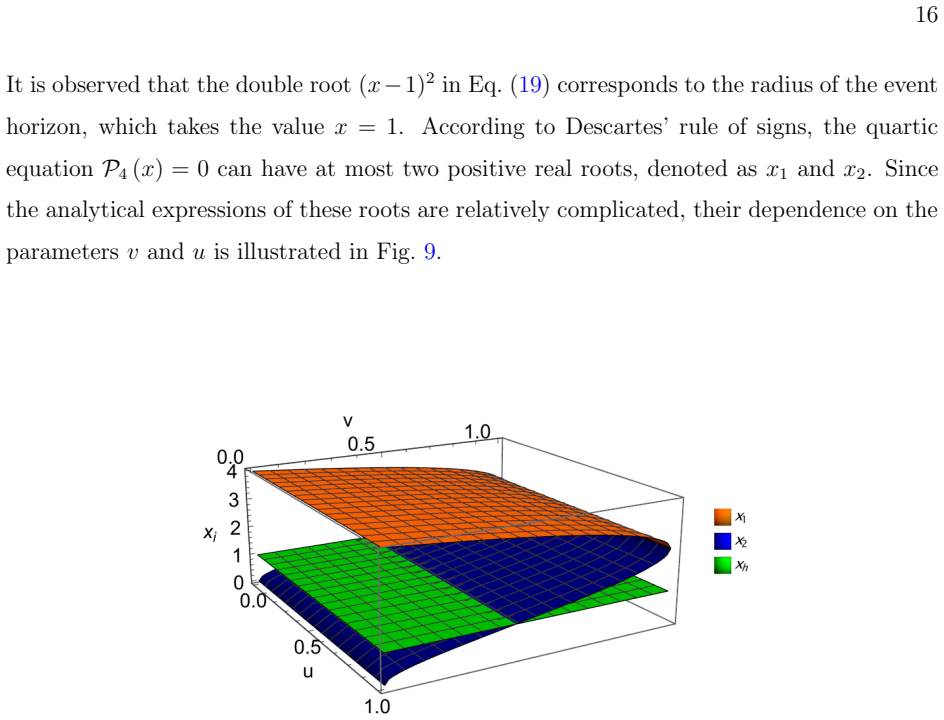
- In the extremal limit $u=1/(1+\ell)$, the sextic develops a double root at $x=1$ (the event horizon), leaving the quartic $P_4(x)=(x-4)x^3+v(2x^2+4x+1)$ to determine the outer orbits.
- There is a critical inclination $v_{\rm cr}$ (with $v>3/7$ in the extremal case) above which two photon orbits lie outside the horizon and below which only one does; the number of observable rings therefore depends on viewing angle.
- All photon orbits outside the horizon are radially unstable ($d^2R/dx^2>0$), and the inner orbit is a saddle point, so no stable photon sphere forms.
- Because the critical impact parameter $\beta$ decreases as $\ell$ grows, the photon ring is predicted to be brighter for larger Lorentz violation, giving a potential observational discriminator from general relativity.
Reading between the lines
- A natural next step is to turn Eq. (12) into full shadow images and brightness profiles; the paper stops at the critical impact parameter, so the mapping from $\beta$ to image intensity is not yet made.
- The same factorization strategy should transfer to any axisymmetric spacetime with a separable Hamilton-Jacobi equation and a Carter constant, not just Bumblebee gravity.
- The paper's parameter bounds imply that for $\ell>0$ the spin parameter is capped at $1/(1+\ell)$; a measured black hole spin near that cap would constrain $\ell$, an observational route the paper does not pursue.
- Because retrograde and prograde impact parameters respond differently to $\ell$, the left-right brightness asymmetry of a shadow could be a more sensitive Lorentz-violation probe than the overall ring brightness.
Editorial analysis
A structured set of objections, weighed in public.
Referee Report
Summary. The paper studies spherical photon orbits around a Kerr-like black hole in Einstein-Bumblebee gravity with Lorentz-violation parameter ℓ. Using the Hamilton-Jacobi formalism, it derives a sixth-order polynomial (Eq. 12) for the photon orbit radii, then analyzes polar, equatorial, and general inclined orbits, their radial stability, and the critical impact parameter β. The central physical claims are that increasing ℓ lowers β and that photon rings become brighter than in Kerr, with a critical inclination angle controlling the number of orbits in the non-extremal case.
Significance. If correct, the paper would extend the analytical classification of spherical photon orbits from Kerr to a Lorentz-violating gravity model, providing a concrete, falsifiable prediction (decreasing impact parameter and enhanced photon-ring brightness with ℓ) that is testable with current and future very-long-baseline observations. The manuscript is mostly analytical, uses a standard Hamilton-Jacobi separation, and the ℓ→0 limit correctly recovers the Kerr polynomial. However, the significance is currently compromised by an internal inconsistency between the stated metric and the derived equations, so the results as written do not yet apply to the spacetime the authors intend to study.
major comments (3)
- [Section II, Eq. (14) vs. Eq. (3b)] The event horizon in Eq. (14), x_h = 1 + sqrt(1 - (1+ℓ)u), does not solve Δ = 0 for the metric (2) with Δ given by Eq. (3b), r^2 - 2Mr/(1+ℓ) + a^2. Substituting (14) into (3b) gives a nonzero value for ℓ ≠ 0. The correct outer horizon of (3b) is x_h = [1 + sqrt(1 - (1+ℓ)^2 u)]/(1+ℓ), and the degenerate/extremal limit of this Δ occurs at u = 1/(1+ℓ)^2, not at u = 1/(1+ℓ) as used throughout the paper. Consequently, all statements about extremality, the allowed u-range for ℓ>0, and the merging of photon orbits with the horizon (e.g., Figs. 2, 6, 10) are not consequences of the stated spacetime.
- [Section II, Eq. (7a)] The radial geodesic equation (7a) is not the null geodesic equation of the metric (2)-(3). For a=0, the metric is static with g_tt = -(1-2M/r) and g_rr = (1 - 2M/[(1+ℓ)r])^{-1}; the exact null circular orbit condition gives r = 3M, whereas Eq. (7a) with Δ from (3b) yields r = 3M/(1+ℓ). This proves that the critical constants (8a,b) and the sextic (12) are not derived from the metric as written. Rather, Eq. (12) corresponds to the Kerr polynomial with a^2 replaced by (1+ℓ)a^2, i.e., to a spacetime with Δ = r^2 - 2Mr + (1+ℓ)a^2 (and correspondingly rescaled spin in A and g_tφ), which is not stated anywhere in the manuscript. The authors must either correct the metric (3b) (and any related inconsistency) or re-derive (7a)-(12) from the metric they actually use.
- [Sections III and IV (all ℓ-dependent results)] Because the radial equation (7a) underlying the stability analysis (Eq. 15), the critical impact parameter (Eq. 17), the factorization at extremality (Eq. 19), and the critical inclination angle (Eqs. 21-22) all descend from the inconsistent equations of motion, the paper's central conclusions for ℓ ≠ 0 — that β decreases with ℓ and that photon rings become brighter than in Kerr — are unsupported for the spacetime (2)-(3). The claims may be valid for the intended (corrected) metric, but as written the analysis applies to an unidentified spacetime. This issue must be resolved before the results can be evaluated.
minor comments (4)
- [Section IV, paragraph after Eq. (22)] The text says 'the rotation parameter ℓ must satisfy the bound ℓ > -1'; ℓ is the Lorentz-violation parameter, not the rotation parameter (which is u).
- [Section V, first paragraph of Conclusion] There is a typo: 'nstein-Bumblebee gravity' should be 'Einstein-Bumblebee gravity'.
- [Section III.A, after Eq. (15)] The phrase 'By substituting the roots of Eq. (9) into Eq. (15)' is incorrect; the roots are of Eq. (13) (polar) or Eq. (18) (equatorial), not Eq. (9).
- [Section III.A, last paragraph and Section V] The claim that a decreasing β 'implies that photons with smaller angular momentum are more easily captured' is opposite to the standard interpretation; a smaller critical impact parameter means fewer photons are captured. The earlier statement in Sec. III.A that the black hole's capture ability is weakened is the correct one, and the conclusion should be reworded.
Circularity Check
No circular reduction found: the predicted orbit radii, critical angles, and impact parameters are explicit algebraic consequences of the stated equations, not fits re-labeled as predictions.
full rationale
The derivation chain runs from the Hamilton-Jacobi equations (4)-(7), through the critical conserved parameters (8), to the sextic (12), and then to the root, stability, and impact-parameter results (13)-(25). At no point is a parameter fitted to the quantity that is later 'predicted': the photon-orbit radii, the critical inclination angle, and the critical impact parameter are all explicit algebraic functions of u, ell, and v, so the conclusions are consequences of the stated equations rather than re-statements of input data. The external references [10, 15, 21, 43, 54] are standard Kerr and geodesic results, not prior papers by the present authors, so no load-bearing self-citation chain carries the argument. A serious internal inconsistency does exist: the horizon expression (14) does not solve Delta = 0 for the Delta defined in Eq. (3b) when ell is nonzero, which would make the ell-dependent orbit analysis unsupported for the metric as written. That is a correctness and consistency defect, not a circularity: the predicted ell-dependence does not reduce to an input fit, and the formulas would remain non-circular even if re-derived from a corrected metric.
Assumptions & free parameters
assumptions (4)
- domain assumption The metric (2) with Δ from (3b) is the correct Kerr-like Bumblebee black hole solution
- domain assumption Hamilton-Jacobi equations separate with a Carter constant K in this spacetime
- domain assumption Critical conserved parameters ξ and η from Eq. (8) are correct
- standard math The critical inclination angle formula (22) and factorization (24) from Ref. [10] apply
Cite this review
Pith. "Pith review of Spherical photon orbits around the Kerr-like black hole in Einstein-Bumblebee gravity." pith.science (2026). https://pith.science/paper/T4AZP6DO
@misc{pith2026250703981,
  author       = {Pith},
  title        = {Pith review of: Spherical photon orbits around the Kerr-like black hole in Einstein-Bumblebee gravity},
  year         = {2026},
  howpublished = {\url{https://pith.science/paper/T4AZP6DO}},
  note         = {Machine review of arXiv:2507.03981}
}
abstract
In this paper, we investigate the photon orbits around a Kerr-like black hole in Einstein-Bumblebee gravity, where Lorentz symmetry is spontaneously broken. By solving the Hamilton-Jacobi equation, we derive a sixth-order polynomial that governs the photon motion, explicitly dependent on the rotation parameter $u$, the Lorentz violation parameter $\ell$, and the effective inclination angle $v$. We analyze photon orbit configurations in polar, equatorial, and general inclined planes, identifying significant deviations from the Kerr solution. In the polar and equatorial planes, we identify distinct photon orbit configurations and analyze their dependence on model parameters. For general inclined orbits, we find a critical inclination angle $v$ that determines the number and location of photon orbits in both extremal and non-extremal cases. All photon orbits are radially unstable, and the critical impact parameter decreases with increasing Lorentz violation, potentially providing observable signatures to differentiate Einstein-Bumblebee gravity from general relativity.
Figures


Figures from the paper (11 more)




Forward citations
Cited by 1 Pith paper
-
Probing Lorentz-violating effects via precession and accretion disk images of a rotating bumblebee black hole
Lorentz violation in a rotating bumblebee black hole suppresses Lense-Thirring precession, increases periastron precession, shrinks the inner shadow, and enhances the lensed ring while leaving the critical curve nearl...
Reference graph
Works this paper leans on
-
[1]
School of Physics and Astronomy, China West Normal University, Nanchong 637009, China In this paper, we investigate the photon orbits around a Kerr-like black hole in Einstein-Bumblebee gravity, where Lorentz symmetry is spontaneously broken. By solving the Hamilton-Jacobi equation, we derive a sixth-order polynomial that governs the photon motion, explic...
work page Pith review arXiv 2025
-
[2]
First, we examine the extreme case, where u = 1/(1 + ℓ) with 0 < u <1
around the Kerr-like black hole in Einstein-Bumblebee gravity. First, we examine the extreme case, where u = 1/(1 + ℓ) with 0 < u <1. Substituting ℓ in Eq. (12) with u, one obtains (x − 1)2P4 (x) = 0, (19) where P4 (x) = (x − 4) x3 + v 2x2 + 4x + 1 . (20) 16 It is observed that the double root (x − 1)2 in Eq. (19) corresponds to the radius of the event ho...
-
[3]
K. Akiyama et al. (Event Horizon Telescope), Astrophys. J. Lett. 930, L12 (2022), arXiv:2311.08680
arXiv 2022
-
[4]
K. Akiyama et al. (Event Horizon Telescope), Astrophys. J. Lett. 875, L5 (2019), arXiv:1906.11242
arXiv 2019
-
[5]
K. Akiyama et al. (Event Horizon Telescope), Astrophys. J. Lett. 875, L6 (2019), arXiv:1906.11243
arXiv 2019
-
[6]
B. P. Abbott et al. (LIGO Scientific, Virgo), Phys. Rev. Lett. 116, 061102 (2016), arXiv:1602.03837
arXiv 2016
-
[7]
J. M. Bardeen and W. H. Press, J. Math. Phys. 14, 7 (1973). 24
work page 1973
-
[8]
S. Chandrasekhar and K. S. Thorne, The Mathematical Theory of Black Holes(1985) pp. 1013–1015
work page 1985
Show all 56 references
-
[9]
J. M. Bardeen, W. H. Press, and S. A. Teukolsky, Astrophys. J. 178, 347 (1972)
1972
-
[10]
J. M. Bardeen and J. A. Petterson, Astrophys. J. Lett. 195, L65 (1975)
1975
- [11]
- [12]
-
[13]
Chatterjee, Z
K. Chatterjee, Z. Younsi, M. Liska, A. Tchekhovskoy, S. B. Markoff, D. Yoon, D. van Eijnatten, C. Hesp, A. Ingram, and M. van der Klis, Mon. Not. Roy. Astron. Soc. 499, 362 (2020), arXiv:2002.08386
2020 arXiv
-
[14]
H. Yang, D. A. Nichols, F. Zhang, A. Zimmerman, Z. Zhang, and Y. Chen, Phys. Rev. D 86, 104006 (2012), arXiv:1207.4253
2012 arXiv
-
[15]
Lu et al., Nature 616, 686 (2023), arXiv:2304.13252
R.-S. Lu et al., Nature 616, 686 (2023), arXiv:2304.13252
2023 arXiv
-
[16]
Cui et al., Nature 621, 711 (2023), arXiv:2310.09015
Y. Cui et al., Nature 621, 711 (2023), arXiv:2310.09015
2023 arXiv
-
[17]
Carter, Phys
B. Carter, Phys. Rev. 174, 1559 (1968)
1968
-
[18]
Grenzebach, V
A. Grenzebach, V. Perlick, and C. L¨ ammerzahl, Phys. Rev. D 89, 124004 (2014), arXiv:1403.5234
2014 arXiv
- [19]
-
[20]
W. Liu, D. Wu, X. Fang, J. Jing, and J. Wang, JCAP 08, 035 (2024), arXiv:2406.00579
2024 arXiv
-
[21]
W. Liu, D. Wu, and J. Wang, JCAP 05, 017 (2025), arXiv:2407.07416
2025 arXiv
-
[22]
Zheng, M.-Q
H.-B. Zheng, M.-Q. Wu, G.-P. Li, and Q.-Q. Jiang, Eur. Phys. J. C 85, 46 (2025), arXiv:2411.10315
2025 arXiv
-
[23]
Tavlayan and B
A. Tavlayan and B. Tekin, Phys. Rev. D 102, 104036 (2020), arXiv:2009.07012
2020 arXiv
-
[24]
Chen, J.-H
Y.-X. Chen, J.-H. Huang, and H. Jiang, Phys. Rev. D 107, 044066 (2023), arXiv:2210.08509
2023 arXiv
-
[25]
A. S. Alam, L. C. Andaru, B. N. Jayawiguna, and H. S. Ramadhan, Gen. Rel. Grav. 56, 79 (2024), arXiv:2404.17277
2024 arXiv
-
[26]
Tavlayan and B
A. Tavlayan and B. Tekin, Phys. Rev. D 107, 024016 (2023), arXiv:2209.14873
2023 arXiv
-
[27]
Mattingly, Living Reviews in Relativity 8 (2005), 10.12942/lrr-2005-5
D. Mattingly, Living Reviews in Relativity 8 (2005), 10.12942/lrr-2005-5
2005 doi
-
[28]
Amelino-Camelia, Living Rev
G. Amelino-Camelia, Living Rev. Rel. 16, 5 (2013), arXiv:0806.0339
2013 arXiv
-
[29]
W. Dai, Z. Guo, R. Cai, and Y. Zhang, European Physical Journal C 77, 386 (2017)
2017
-
[30]
Colladay and V
D. Colladay and V. A. Kostelecky, Phys. Rev. D 55, 6760 (1997), arXiv:hep-ph/9703464
1997 arXiv
-
[31]
Colladay and V
D. Colladay and V. A. Kostelecky, Phys. Rev. D 58, 116002 (1998), arXiv:hep-ph/9809521. 25
1998 arXiv
-
[32]
V. A. Kostelecky, Phys. Rev. D 69, 105009 (2004), arXiv:hep-th/0312310
2004 arXiv
-
[33]
S. R. Coleman and S. L. Glashow, Phys. Lett. B 405, 249 (1997), arXiv:hep-ph/9703240
1997 arXiv
-
[34]
S. R. Coleman and S. L. Glashow, Phys. Rev. D 59, 116008 (1999), arXiv:hep-ph/9812418
1999 arXiv
-
[35]
R. C. Myers and M. Pospelov, Phys. Rev. Lett. 90, 211601 (2003), arXiv:hep-ph/0301124
2003 arXiv
-
[36]
V. A. Kostelecky and S. Samuel, Phys. Rev. D 39, 683 (1989)
1989
-
[37]
V. A. Kosteleck´ y and S. Samuel, Phys. Rev. Lett. 63, 224 (1989)
1989
-
[38]
Ovgun, K
A. Ovgun, K. Jusufi, and I. Sakalli, Phys. Rev. D 99, 024042 (2019)
2019
-
[39]
Casana, A
R. Casana, A. Cavalcante, F. P. Poulis, and E. B. Santos, Phys. Rev. D 97, 104001 (2018)
2018
-
[40]
Capelo and J
D. Capelo and J. P´ aramos, Phys. Rev. D 91, 104007 (2015)
2015
-
[41]
W. D. R. Jesus and A. F. Santos, Mod. Phys. Lett. A 34, 1950171 (2019)
2019
-
[42]
A. F. Santos, A. Y. Petrov, W. D. R. Jesus, and J. R. Nascimento, Mod. Phys. Lett. A 30, 1550011 (2015)
2015
-
[43]
C. A. Hernaski, Phys. Rev. D 90, 124036 (2014)
2014
-
[44]
R. V. Maluf, J. E. G. Silva, and C. A. S. Almeida, Phys. Lett. B 749, 304 (2015)
2015
-
[45]
C. Ding, C. Liu, R. Casana, and A. Cavalcante, Eur. Phys. J. C 80, 178 (2020), arXiv:1910.02674
2020 arXiv
-
[46]
Ovg¨ un, K
A. Ovg¨ un, K. Jusufi, and I. Sakalli, Annals Phys. 399, 193 (2018), arXiv:1805.09431
2018 arXiv
-
[47]
Oliveira, D
R. Oliveira, D. M. Dantas, and C. A. S. Almeida, EPL 135, 10003 (2021), arXiv:2105.07956
2021 arXiv
- [48]
-
[49]
G¨ ull¨ u and A.¨Ovg¨ un, Annals Phys.436, 168721 (2022), arXiv:2012.02611
I. G¨ ull¨ u and A.¨Ovg¨ un, Annals Phys.436, 168721 (2022), arXiv:2012.02611
2022 arXiv
-
[50]
R. V. Maluf and J. C. S. Neves, Phys. Rev. D 103, 044002 (2021), arXiv:2011.12841
2021 arXiv
-
[51]
C. Ding, X. Chen, and X. Fu, Nucl. Phys. B 975, 115688 (2022), arXiv:2102.13335
2022 arXiv
- [52]
-
[53]
C. Liu, C. Ding, and J. Jing, (2019), arXiv:1910.13259
2019 arXiv
-
[54]
Wang and S.-W
H.-M. Wang and S.-W. Wei, Eur. Phys. J. Plus 137, 571 (2022), arXiv:2106.14602
2022 arXiv
-
[55]
Bluhm and V
R. Bluhm and V. A. Kosteleck´ y, Phys. Rev. D 71, 065008 (2005), arXiv:hep-th/0412320
2005 arXiv
-
[56]
P. V. P. Cunha, C. A. R. Herdeiro, and E. Radu, Phys. Rev. D 96, 024039 (2017), arXiv:1705.05461
2017 arXiv
Reviewed August 6, 2026 · model on record in the stance chip above.
Discussion (0). Sign in to comment.