REVIEW 4 major objections 6 minor 30 references
Relational inductive biases on attention mechanisms
T0 review · 4 major / 6 minor · reviewed 2026-08-06 · deepseek-v4-flash
Pith's one-line read Attention layers are characterized by the graph they assume on data, not by their learned weights.
desk verdict A clean, useful taxonomy of attention masks as graph structure, but the proofs are mostly definitional and the translation-equivariance theorems are wrong as stated for finite sequences. read the letter →
The pith
A machine-rendered reading of the paper's core claim, the machinery that carries it, and where it could break.
The reading
What carries the argument
The attention matrix $\alpha$, read as a stochastic adjacency matrix, carries the whole argument. The paper defines an attention layer as a graph layer whose hidden representation is the expected value of projected neighbor messages, and Lemma 1 states that every bias appears as a masking process on the product matrix $K$ before softmax, setting entries to $-\infty$ to produce zeros in $\alpha$. The mask's binary support is the relational graph, and the resulting graph class defines the bias; the equivariance theorems then derive the symmetry group from that graph.
What would settle it
Train two attention models with identical binary mask support on the same sequential data, one with a near-zero softmax temperature that forces attention onto very few allowed pairs and one with uniform attention over the same allowed pairs, and check whether their outputs permute or translate the same way under input reorderings; if the symmetry behavior differs, the binary mask support does not fully determine the relational inductive bias.
Extended reading notes
Core claim
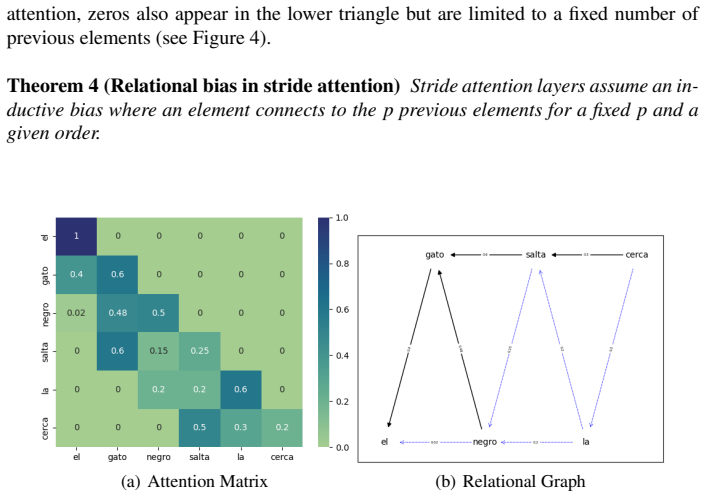
The central claim is that the relational inductive bias of an attention mechanism is fully determined by which pairs of entities are allowed to interact, not by the learned weight values. The paper states this as four theorems: self-attention corresponds to a fully connected graph (Theorem 1), encoder-decoder attention to a bipartite graph (Theorem 2), masked attention to a total order on previous elements (Theorem 3), and strided attention to a DAG in which each element connects to the p previous elements (Theorem 4). Equivariance follows from the same graph structure: self-attention is permutation equivariant, masked and strided attention are translation equivariant, and encoder-decoder attention is block permutation equivariant. The paper concludes with a hierarchy of common attention mechanisms and a table classifying them by assumed relations, symmetry group, and suited data type.
Load-bearing premise
The classification treats the relational inductive bias as the binary support of the attention matrix (which pairs may interact) and ignores the continuous learned attention weights, temperature, and positional encodings; if those carry relational information, the hierarchy is incomplete.
Editorial extensions
If this is right
- If the classification holds, any attention layer is equivalent to a choice of mask, so implementing graph structure by masking is a complete implementation of its relational bias.
- A model builder can choose an attention layer by matching its implied graph to the known relational structure of the task: complete graphs for bidirectional text, total orders for autoregressive generation, bipartite graphs for encoder-decoder tasks, and bounded windows for fixed-range dependencies.
- Because graph attention subsumes the others when the adjacency matrix is supplied per instance, it is the most general attention layer in the hierarchy.
- The equivariance results give a formal way to predict how an attention layer will respond to reordering or shifting of inputs without running it.
- Masking thus becomes a design tool for injecting relational priors into transformers, potentially reducing the data needed when the imposed graph matches the data structure.
Reading between the lines
- If the binary support fully determines the bias, then attention weights learned inside the mask are free parameters that can encode task-specific preferences on top of the graph bias; one testable extension is whether restricting the support but leaving weights learned produces the same generalization behavior as a hard zero-mask on a softmax with the same support.
- The kernel view mentioned in the paper suggests non-binary relational biases are possible; extending the classification to weighted graphs or continuous masks could capture temperature and positional encodings as relational information.
- The paper's future-work remark on higher-order interactions implies a fuller characterization would need hypergraph or tensor attention where triples, not just pairs, are the relational units; one could test whether transformer heads behave as if they implement such higher-order relations.
- Because graph attention is the most general layer, the hierarchy suggests that specialized architectures such as vision transformers could be viewed as graph attention over specially structured adjacency matrices, which may clarify how spatial priors enter those models.
Editorial analysis
A structured set of objections, weighed in public.
Referee Report
Summary. The paper proposes a geometric-deep-learning framework for characterizing the relational inductive biases of attention mechanisms. It defines an attention layer as a graph layer, argues via Lemma 1 that masking implements graph connectivity, and then proves graph-type labels for common mechanisms: self-attention (complete graph), encoder-decoder attention (bipartite graph), masked attention (total order on previous elements), strided attention (p previous elements), and graph attention (data-dependent neighborhoods). It also proves or sketches equivariance properties (permutation equivariance for self-attention, translation equivariance for masked and strided attention, block-permutation equivariance for encoder-decoder attention) and organizes the mechanisms into a hierarchy with a table of associated architectures.
Significance. If taken as a statement about the binary support of the attention matrix, Theorems 1-4 give a defensible and clearly presented taxonomy that connects attention mechanisms to message-passing graph networks. The paper usefully collects definitions, proofs, code, and architectural examples in one place, and it correctly identifies that masking is the mechanism by which graph structure is imposed on attention. However, the stronger claim that attention layers are 'characterized by' these graph structures is not established: the paper itself defers non-binary relational biases and higher-order interactions to future work, and the equivariance theorems for masked and strided attention are not rigorously grounded because the group action on finite sequences is unspecified. The contribution is thus a useful synthesis rather than a complete formal characterization.
major comments (4)
- [Section 2.4, Lemma 1, and Abstract] The central claim that attention layers are 'characterized by' the underlying relationships is stronger than what Lemma 1 proves. Lemma 1 shows that masking expresses graph connectivity, but it does not show that continuous attention weights, temperature, positional encodings, or kernel choices carry no relational bias. The manuscript itself states in Section 2.4 that 'this perspective opens the possibility for relational biases that are not necessarily binary. This is a direction we leave for future work,' and the conclusions say that higher-order relationships are needed 'to achieve a complete characterization.' Please weaken the wording to 'characterized at the level of the binary mask support' throughout, or provide a completeness proof ruling out non-binary relational information.
- [Theorems 6 and 7, Section 3.1] The translation equivariance results are not well-defined on finite sequences. The input set is {x1,...,xn}, and the proof defines a translation as sigma(i)=i+m; this map is not a bijection on {1,...,n}, so it does not define a group action of Z on the finite index set. Boundary effects change the set of attended positions: for instance, with n=3 and m=1, the causal mask at position 1 has only {1} as allowed context, while at position 2 after translating the first position one would need {1,2}; the proof shows only that j<=i implies sigma(j)<=sigma(i), which is insufficient. Please specify the index set (e.g., Z with a suitable convention for sequences of finite support) or supply a boundary convention and prove equivariance under that convention.
- [Theorem 7 and Corollary 1] The proof of Theorem 7 is internally confusing. It first says that the order in stride attention 'does not define a total order,' then claims that a DAG's unique topological order 'making it a total order' allows the masked-attention argument to apply. A topological order is just a linear extension of a partial order; it does not imply that the stride adjacency is preserved under translation. The equivariance of the layer with respect to translation needs a direct argument about the mask entries. Also, Corollary 1 states that stride attention generalizes masked attention by choosing 't = max{n : n = |x|},' which is not a well-formed expression; if the intended meaning is to take the stride parameter at least the sequence length, that should be stated clearly and proven.
- [Theorem 3, proof] The proof of Theorem 3 defines O(x) = {(xi,xi+1) : i=1,...,n-1}, which contains only adjacent pairs, but the masking rule allows connections for all j<=i. The subsequent verification of reflexivity, antisymmetry, and transitivity is about the usual <= relation on indices, not about the relation generated by O(x). Please define the order relation explicitly as the reflexive and transitive closure of O(x), or directly as the relation {(xi,xj) : j<=i}, and then prove that this relation is total.
minor comments (6)
- [Theorem 2, proof] There is an index swap: after defining the mask, the text says 'alpha(i,j)>0 if and only if xi in X and yj in Y'; the correct condition is yi in Y and xj in X.
- [Definition 8 and Theorem 4] The stride constant is called k in Definition 8 but p in Theorem 4 and Corollary 1. Please use consistent notation.
- [Table 1] The row for Sparse Attention lists 'Relations: Arbitrary' and 'Symmetry: Arbitrary,' which conflicts with Theorem 4's characterization of strided attention as 'p previous elements' with translation equivariance. Clarify whether 'sparse attention' in Table 1 denotes the general class or only the strided variant.
- [Theorem 8] The statement calls a block permutation an 'epimorphism sigma: X -> X,' but a permutation should be a bijection; also, the proof only shows that the partition is preserved, not that the encoder-decoder layer's output transforms equivariantly. Please state the group of block permutations precisely and verify the equivariance condition.
- [Appendix B.4] In SparseAttention.masking, the loop variable j is used both for the stride index and for the column index in a confusing way; also the term 'stride attention' typically refers to the sparse-attention pattern of Child et al., which is defined by a stride parameter in the original paper. Consider renaming the class and the parameter to avoid ambiguity.
- [General] There are several typographical issues: 'Rsearch in Computing Science' in the footnote, inconsistent use of 'stride attention' vs 'strided attention,' and Equation (7) still using k while the theorem uses p.
Circularity Check
The relational-bias classification in Theorems 1–4 reduces by construction to the masking constraints already present in Definitions 5–9; the binary-support premise is assumed rather than derived.
-
self definitional
[Theorem 3 (Relational bias in masked attention), Section 3]
"Let x = {x1,x2,...,xn} be the set of input entities, and define an order O(x) = {(xi,xi+1) : i = 1,...,n−1} over the entities. Considering the product matrix K in the attention mechanism, masking is determined by: Ki,j = k(xi,xj) if j ≤ i; −∞ if j > i. Thus, αi,j != 0 if and only if xj precedes xi in O(x)."
Definition 7 already defines masked attention by the summation bound j≤i: h_i = Σ_{j≤i} α(x_i,x_j)ψ_v(x_j). The theorem's proof imports the same inequality j≤i as the mask and then declares this a total order. No property of learned attention weights beyond the defining support is used; the graph label is read off from the same constraint used to define the mechanism. The claimed characterization is the definition restated in graph language.
-
self definitional
[Theorem 4 (Relational bias in stride attention), Section 3]
"Stride attention is similar to masked attention and also requires an order O(x) over the entities. Under this order, we define the entries of K as: Ki,j = k(xi,xj) if t ≤ j ≤ i; −∞ if t > j > i. Here, t = max{0,i−p} for some p ≥ 0. Relationships among entities occur only with the p previous elements, defining a directed acyclic graph (DAG)."
Definition 8 fixes the attention window by t=max{0,i−k} and sums over t≤j≤i. Theorem 4 repeats this same interval as the support of K and concludes entities connect only to the p previous elements. The inductive-bias conclusion is the defining interval of the mechanism, so the theorem is the definition in graph vocabulary rather than a derivation from independently characterized relational structure.
1 more flagged steps
-
self definitional
[Section 3, paragraph preceding Lemma 1; Definition 10]
"In the following, we rely on this definition to demonstrate the relational inductive biases reflected in each type of attention mechanism. In particular, we focus on how these relationships are expressed in the attention matrix, since, as noted, this matrix determines the relationships among entities."
Definition 10 makes the adjacency (mask) matrix part of the definition of an attention layer, and Lemma 1 equates masks with disconnections in the relational graph. This builds the conclusion that relational inductive bias equals binary mask support into the framework. The paper itself states in Section 2.4 that non-binary relational biases are left to future work, so the completeness of the binary-support identification is assumed rather than proven; the subsequent theorems then recover graph types already encoded in the mask support.
full rationale
The paper's own caveats undercut the strong claim that attention layers are characterized by the graph labels in Theorems 1-4. Section 2.4 notes that the kernel perspective 'opens the possibility for relational biases that are not necessarily binary. This is a direction we leave for future work,' and the Conclusions name higher-order interactions as an open challenge for 'a complete characterization.' The classification is nonetheless internally consistent: each theorem reads the graph type off the same mask inequality used in the corresponding Definition (e.g., 'if j ≤ i' in Definition 7 and Theorem 3; 't ≤ j ≤ i' in Definition 8 and Theorem 4). This is circular in the definitional sense, not a fitted-parameter or empirical circularity. There are no load-bearing self-citations: the framework cites Bronstein et al. and other external works, and the paper's own code is illustrative. The equivariance results (Theorems 6-7) rely on a translation σ(i)=i+m that is not a bijection on finite sequences without a boundary convention, so the stated translation equivariance is questionable as a correctness matter, but that is a technical flaw rather than circularity. Overall score 6: the central relational-bias classification reduces by construction to the masking definitions, though the paper does add an equivariance analysis that goes beyond the mask labels.
Assumptions & free parameters
assumptions (4)
- domain assumption Attention weights form a stochastic matrix, alpha_{i,j} = p(x_j | x_i), given by softmax over a generalized kernel (Equation 9).
- domain assumption Masking an entry of K with -inf before softmax exactly implements a disconnection in the underlying graph (Lemma 1).
- standard math Every group is isomorphic to a permutation subgroup (Cayley's theorem), so equivariance analysis can restrict to permutation subgroups.
- domain assumption Attention can be viewed as a generalized (non-symmetric) kernel following Tsai et al. [28].
Cite this review
Pith. "Pith review of Relational inductive biases on attention mechanisms." pith.science (2026). https://pith.science/paper/YVY4YUN7
@misc{pith2026250704117,
  author       = {Pith},
  title        = {Pith review of: Relational inductive biases on attention mechanisms},
  year         = {2026},
  howpublished = {\url{https://pith.science/paper/YVY4YUN7}},
  note         = {Machine review of arXiv:2507.04117}
}
read the original abstract
Inductive learning aims to construct general models from specific examples, guided by biases that influence hypothesis selection and determine generalization capacity. In this work, we focus on characterizing the relational inductive biases present in attention mechanisms, understood as assumptions about the underlying relationships between data elements. From the perspective of geometric deep learning, we analyze the most common attention mechanisms in terms of their equivariance properties with respect to permutation subgroups, which allows us to propose a classification based on their relational biases. Under this perspective, we show that different attention layers are characterized by the underlying relationships they assume on the input data.
Figures


Figures from the paper (2 more)

Reference graph
Works this paper leans on
-
[1]
arXiv preprint arXiv:1603.04467 (2016)
Abadi, M., Agarwal, A., Barham, P., Brevdo, E., Chen, Z., Citro, C., Corrado, G.S., Davis, A., Dean, J., Devin, M., et al.: Tensorflow: Large-scale machine learning on heterogeneous distributed systems. arXiv preprint arXiv:1603.04467 (2016)
arXiv 2016
-
[2]
arXiv preprint arXiv:1409.0473 (2014)
Bahdanau, D.: Neural machine translation by jointly learning to align and translate. arXiv preprint arXiv:1409.0473 (2014)
arXiv 2014
-
[3]
arXiv preprint arXiv:1806.01261 (2018)
Battaglia, P.W., Hamrick, J.B., Bapst, V ., Sanchez-Gonzalez, A., Zambaldi, V ., Malinowski, M., Tacchetti, A., Raposo, D., Santoro, A., Faulkner, R., et al.: Relational inductive biases, deep learning, and graph networks. arXiv preprint arXiv:1806.01261 (2018)
arXiv 2018
-
[4]
Bertsch, A., Alon, U., Neubig, G., Gormley, M.R.: Unlimiformer: Long-range transformers with unlimited length input (2023), https://arxiv.org/abs/2305.01625
arXiv 2023
-
[5]
Bradbury, J., Frostig, R., Hawkins, P., Johnson, M.J., Leary, C., Maclaurin, D., Necula, G., Paszke, A., VanderPlas, J., Wanderman-Milne, S., et al.: Jax: composable transformations of python+ numpy programs (2018)
work page 2018
-
[6]
arXiv preprint arXiv:2104.13478 (2021)
Bronstein, M.M., Bruna, J., Cohen, T., Veli ˇckovi´c, P.: Geometric deep learning: Grids, groups, graphs, geodesics, and gauges. arXiv preprint arXiv:2104.13478 (2021)
arXiv 2021
-
[7]
IEEE Signal Processing Magazine 34(4), 18–42 (2017)
Bronstein, M.M., Bruna, J., LeCun, Y ., Szlam, A., Vandergheynst, P.: Geometric deep learning: going beyond euclidean data. IEEE Signal Processing Magazine 34(4), 18–42 (2017)
work page 2017
-
[8]
The London, Edinburgh, and Dublin Philosophical Magazine and Journal of Science7(42), 40–47 (1854)
Cayley, A.: On the theory of groups, as depending on the symbolic equation θn= 1. The London, Edinburgh, and Dublin Philosophical Magazine and Journal of Science7(42), 40–47 (1854)
Show all 30 references
-
[9]
arXiv preprint arXiv:1904.10509 (2019)
Child, R., Gray, S., Radford, A., Sutskever, I.: Generating long sequences with sparse transformers. arXiv preprint arXiv:1904.10509 (2019)
2019 arXiv
-
[10]
In: Linzen, T., Chrupała, G., Belinkov, Y ., Hupkes, D
Clark, K., Khandelwal, U., Levy, O., Manning, C.D.: What does BERT look at? an analysis of BERT‘s attention. In: Linzen, T., Chrupała, G., Belinkov, Y ., Hupkes, D. (eds.) Proceedings of the 2019 ACL Workshop BlackboxNLP: Analyzing and Interpreting Neural Networks for NLP. pp....
2019 doi
-
[11]
In: Korhonen, A., Traum, D., M`arquez, L
Dai, Z., Yang, Z., Yang, Y ., Carbonell, J., Le, Q., Salakhutdinov, R.: Transformer-XL: Atten- tive language models beyond a fixed-length context. In: Korhonen, A., Traum, D., M`arquez, L. (eds.) Proceedings of the 57th Annual Meeting of the Association for Computational Lingu...
2019
-
[12]
In: Proceedings of the 2019 conference of the North American chapter of the association for computational linguistics: human language technologies, volume 1 (long and short papers)
Devlin, J., Chang, M.W., Lee, K., Toutanova, K.: Bert: Pre-training of deep bidirectional transformers for language understanding. In: Proceedings of the 2019 conference of the North American chapter of the association for computational linguistics: human language technologies...
2019
-
[13]
Dosovitskiy, A., Beyer, L., Kolesnikov, A., Weissenborn, D., Zhai, X., Unterthiner, T., Dehghani, M., Minderer, M., Heigold, G., Gelly, S., Uszkoreit, J., Houlsby, N.: An image is worth 16x16 words: Transformers for image recognition at scale (2021), https://arxiv.org/abs/2010.11929
2021 arXiv
-
[14]
Gavranovi ´c, B., Lessard, P., Dudzik, A., von Glehn, T., Ara ´ujo, J.G.M., Veli ˇckovi´c, P.: Position: Categorical deep learning is an algebraic theory of all architectures (2024), https://arxiv.org/abs/2402.15332
2024 arXiv
-
[15]
Gu, A., Goel, K., R ´e, C.: Efficiently modeling long sequences with structured state spaces (2022), https://arxiv.org/abs/2111.00396
2022 arXiv
-
[16]
In: The Thirty-Fifth AAAI Conference on Artificial Intelligence
Hao, Y ., Dong, L., Wei, F., Xu, K.: Self-attention attribution: Interpreting information inter- actions inside transformer. In: The Thirty-Fifth AAAI Conference on Artificial Intelligence. AAAI Press (2021)
2021
-
[17]
Advances in applied analysis pp
Kisil, V .V .: Erlangen program at large: an overview. Advances in applied analysis pp. 1–94 (2012)
2012
-
[18]
IEEE Transactions on Visualization and Computer Graphics 29(6), 2888–2900 (2023)
Li, Y ., Wang, J., Dai, X., Wang, L., Yeh, C.C.M., Zheng, Y ., Zhang, W., Ma, K.L.: How does attention work in vision transformers? a visual analytics attempt. IEEE Transactions on Visualization and Computer Graphics 29(6), 2888–2900 (2023)
2023
-
[19]
IEEE Transactions on Neural Networks and Learning Systems (2023)
Liu, Y ., Zhang, Y ., Wang, Y ., Hou, F., Yuan, J., Tian, J., Zhang, Y ., Shi, Z., Fan, J., He, Z.: A survey of visual transformers. IEEE Transactions on Neural Networks and Learning Systems (2023)
2023
-
[20]
arXiv preprint arXiv:2205.07417 (2022)
Lu, D., Xie, Q., Wei, M., Gao, K., Xu, L., Li, J.: Transformers in 3d point clouds: A survey. arXiv preprint arXiv:2205.07417 (2022)
2022 arXiv
-
[21]
Readings in Machine Learning (1980)
Mitchell, T.M.: The need for biases in learning generalizations. Readings in Machine Learning (1980)
1980
-
[22]
Mitchell, T.M., Mitchell, T.M.: Machine learning, vol. 1. McGraw-hill New York (1997)
1997
-
[23]
arXiv preprint arXiv:2304.10031 (2023)
Papillon, M., Sanborn, S., Hajij, M., Miolane, N.: Architectures of topological deep learning: A survey of message-passing topological neural networks. arXiv preprint arXiv:2304.10031 (2023)
2023 arXiv
-
[24]
Advances in neural information processing systems 32 (2019)
Paszke, A., Gross, S., Massa, F., Lerer, A., Bradbury, J., Chanan, G., Killeen, T., Lin, Z., Gimelshein, N., Antiga, L., et al.: Pytorch: An imperative style, high-performance deep learning library. Advances in neural information processing systems 32 (2019)
2019
-
[25]
Radford, A., Narasimhan, K.: Improving language understanding by generative pre-training (2018), https://api.semanticscholar.org/CorpusID:49313245
2018
-
[26]
Journal of machine learning research 21(140), 1–67 (2020)
Raffel, C., Shazeer, N., Roberts, A., Lee, K., Narang, S., Matena, M., Zhou, Y ., Li, W., Liu, P.J.: Exploring the limits of transfer learning with a unified text-to-text transformer. Journal of machine learning research 21(140), 1–67 (2020)
2020
-
[27]
In: Proceedings of the 36th International Conference on Neural Information Processing Systems
Rao, Y ., Zhao, W., Tang, Y ., Zhou, J., Lim, S.N., Lu, J.: Hornet: efficient high-order spatial interactions with recursive gated convolutions. In: Proceedings of the 36th International Conference on Neural Information Processing Systems. NIPS ’22, Curran Associates Inc. (2022)
2022
-
[28]
In: Proceedings of the 2019 Conference on Empirical Methods in Natural Language Processing and the 9th International Joint Conference on Natural Language Processing (EMNLP-IJCNLP)
Tsai, Y .H.H., Bai, S., Yamada, M., Morency, L.P., Salakhutdinov, R.: Transformer dissection: An unified understanding for transformer‘s attention via the lens of kernel. In: Proceedings of the 2019 Conference on Empirical Methods in Natural Language Processing and the 9th Int...
2019 doi
-
[29]
arXiv preprint arXiv:1706.03762 (2017)
Vaswani, A.: Attention is all you need. arXiv preprint arXiv:1706.03762 (2017)
2017 arXiv
-
[30]
The goal of this model was to create word embeddings that could be applied to general tasks
Veli ˇckovi´c, P., Cucurull, G., Casanova, A., Romero, A., Li`o, P., Bengio, Y .: Graph attention networks (2018), https://arxiv.org/abs/1710.10903 A Attention-Based Architectures A.1 BERT and Self-Attention The BERT model [12] was one of the first language models to leverage ...
2018 arXiv
Reviewed August 6, 2026 · model on record in the stance chip above.
Discussion (0). Sign in to comment.