REVIEW 5 major objections 4 minor 2 cited by
Zero-Shot Cyclic Peptide Design via Composable Geometric Constraints
T0 review · 5 major / 4 minor · reviewed 2026-08-06 · deepseek-v4-flash
Pith's one-line read CP-Composer claims that a diffusion model trained only on linear peptides can design cyclic peptide binders zero-shot by decomposing cyclization into unit type and distance constraints, hitting 38–84% success on four cyclization strategies.
desk verdict The zero-shot trick is real and worth a look, but the headline success rates are leniently measured and the binding claim outruns the evidence. read the letter →
The pith
A machine-rendered reading of the paper's core claim, the machinery that carries it, and where it could break.
The reading
What carries the argument
The load-bearing machinery is the decomposition of cyclization into unit geometric constraints plus the geometric conditioning that lets the denoiser consume them, driven at sampling time by a modified classifier-free guidance score (steering sampling by the difference between conditional and unconditional denoiser outputs). A type constraint $C_T = \{(i, l_i)\}$ forces node $i$ to be amino acid type $l_i$; a distance constraint $C_D = \{(i, j, d_{ij})\}$ forces nodes $i$ and $j$ to be $d_{ij}$ apart, measured on $\mathrm{C}\alpha$ coordinates. Type constraints enter as one-hot node features; distance constraints enter as radial-basis-function (RBF) edge features processed by an extra equivariant message-passing layer; both encodings are E(3)-invariant (unchanged by rotations, translations, and reflections) and injective (Theorem 3.3), so the conditional score preserves equivariance and distinct constraints remain distinguishable. Training draws unit constraints from linear peptides with at most four pinned nodes and distance pairs at graph distances 3, 4, or 6 with at most six edges — a design space whose Cartesian product covers the cyclization constraint space. At inference the guided score is $\tilde{\epsilon}(G^{(t)}_z, C^*_T, C^*_D, t) = (w{+}1)\epsilon_\theta(G^{(t)}_z, C^*_T, C^*_D, t) - w\epsilon_\theta(G^{(t)}_z, t)$, where the guidance weight $w$ trades constraint satisfaction against distributional fidelity.
What would settle it
Recompute the constraint satisfaction check for all four cyclization strategies on the same generated candidates using a fixed, stated distance tolerance — for example, $\mathrm{C}\alpha$-pair distance within $\pm 0.5$ Å of the target bond length (disulfur $d_S$, lysine–aspartate $d_{KD}$, lysine–glutamate $d_{KE}$, amide $d_P$, bicycle $d_T$) — and count per-candidate rather than per-target pass rates, since if the per-candidate rate at any physically sensible tolerance falls far below the reported 38–84%, the zero-shot success claim is weaker than stated.
Extended reading notes
Core claim
CP-Composer's central discovery is that cyclic peptide design can be posed as a constraint-satisfaction problem whose constraints decompose into two unit geometric constraints — type constraints $C_T$, which pin residues to specific amino acids, and distance constraints $C_D$, which pin residue pairs to specific distances (measured as $\mathrm{C}\alpha$ distances) — and that a denoiser trained on these units over linear peptides can satisfy their novel combinations at inference. Each cyclization strategy is a specific pair $(C_T, C_D)$: stapled peptides pin a lysine to an aspartate at $i{+}3$ or a glutamate at $i{+}4$ at a covalent-linkage distance; head-to-tail peptides pin residues $0$ and $N{-}1$ to the amide-bond distance; disulfide peptides pin two cysteines to the disulfur-bond distance $d_S$; bicycle peptides pin three cysteines to the three equal sides of a triangle ($d_T$). The units enter the denoiser as geometric conditioning — one-hot type vectors on nodes and radial-basis-function distance vectors on edges — both E(3)-invariant (unchanged by rotations, translations, reflections), so the conditional score stays equivariant, and both injective, so distinct constraints yield distinct control signals. Training samples unit constraints from linear peptides (up to four pinned types; distance pairs at graph distances 3, 4, or 6, up to six edges), and inference imposes the four cyclization-specific combinations, amplified by a reweighted classifier-free guidance score. At $w = 5$ the success rates reach 38.57% (stapled), 74.42% (head-to-tail), 82.50% (disulfide), and 84.62% (bicycle), where success means at least one of five candidate peptides passes the constraint check, and the generated samples keep amino-acid and dihedral divergences low relative to reference peptide distributions.
Load-bearing premise
The load-bearing premise is that the reported success rates measure genuine constraint satisfaction: Section 4.1 counts a target as solved when at least one of five generated peptides passes the geometric constraint check, the paper gives no distance tolerance for that check, and per-candidate pass rates are not reported, so if the tolerance is generous or most candidates fail, the headline 38–84% overstates what a user gets from a single generated peptide.
Editorial extensions
If this is right
- A model trained only on linear peptides can satisfy cyclization geometries it never saw in training, implying that basic cyclic peptide design no longer requires a dedicated cyclic dataset.
- Higher-order cyclizations compose as well: stacking unit constraints yields success on two stapled pairs, one disulfide plus head-to-tail, and two or three disulfide bonds in a single peptide, with the two- and three-disulfide cases reaching 62.0% and 65.5% at $w = 3.0$.
- The guidance weight $w$ is a practical dial: success rises with $w$ up to the reported optimum at $w = 5$ and then falls, while divergence from the reference amino-acid and dihedral distributions grows monotonically, so a user can trade hit rate against naturalness.
- The geometric-conditioning scheme is not tied to its particular diffusion backbone; the paper states it adapts to other diffusion-based generative frameworks.
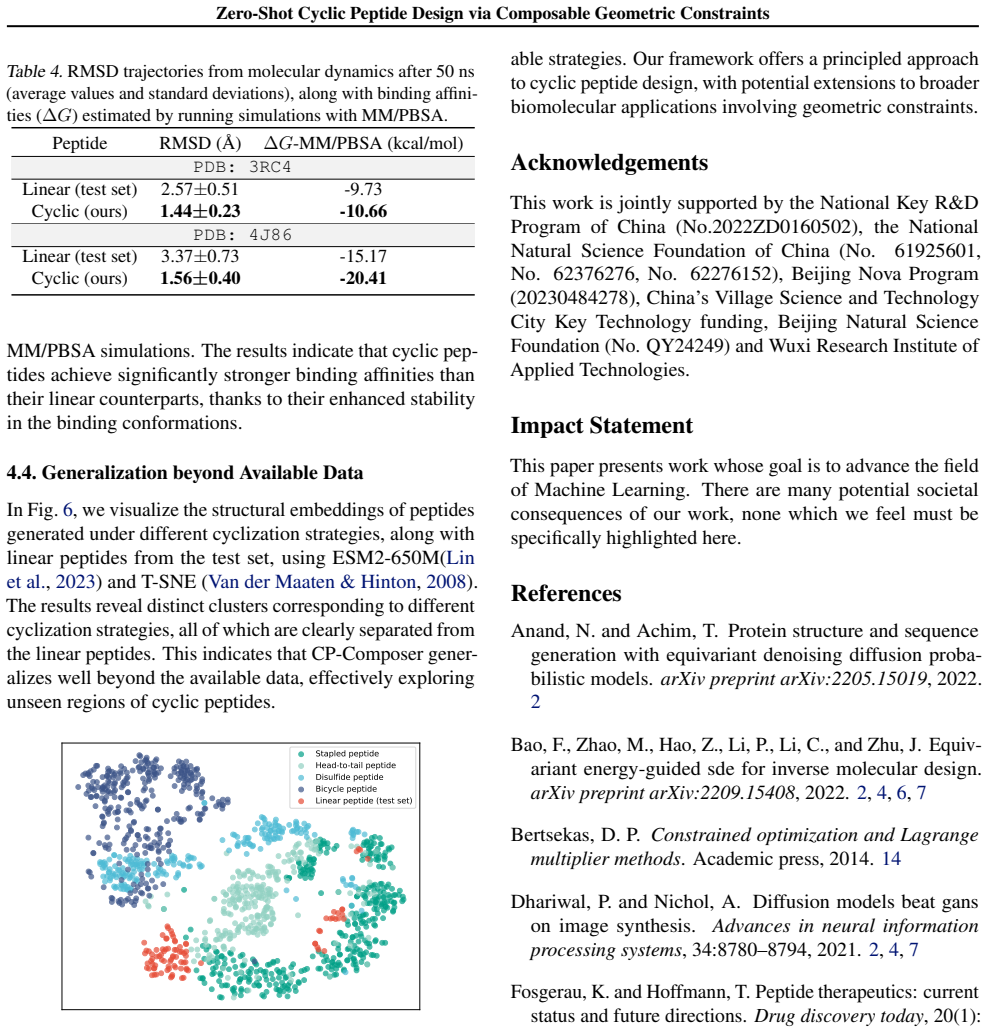
- In two molecular-dynamics comparisons, the generated cyclic peptides show lower binding-conformation RMSD (root-mean-square deviation of atomic positions: 1.44 vs 2.57 Å; 1.56 vs 3.37 Å) and stronger predicted binding affinity ($\Delta G = -10.66$ vs $-9.73$; $-20.41$ vs $-15.17$ kcal/mol) than the native linear binders.
Reading between the lines
- General recipe: any biomolecular constraint family that factors into type-plus-distance units — macrocycle stapling, metal-coordination sites, designed crosslinks — is a candidate for the same zero-shot treatment, since the paper's mechanism is agnostic to which chemistry the units encode.
- Compositionality boundary: the training design space pins at most four residues and uses graph distances 3, 4, or 6 with up to six edges, so a direct probe of where the zero-shot claim breaks would be to test unseen combinations outside this box — five pinned residues, or a distance-5 pair — and check whether success degrades gracefully or collapses.
- Yield accounting: the reported rates are per target (at least one of five candidates passes), so the per-candidate pass rate and its sensitivity to the distance tolerance — quantities the paper does not report — should be measured before using the method in a lab; the authors can supply them from their existing pipeline.
- The molecular-dynamics evidence covers two targets with one generated cyclic peptide each; replicating the stability-and-affinity comparison across more targets and all four strategies would test whether the lower-RMSD, stronger-binding trend is a general effect of cyclization or specific to the two chosen complexes.
Editorial analysis
A structured set of objections, weighed in public.
Referee Report
Summary. The paper proposes CP-Composer, a latent geometric diffusion model for target-specific cyclic peptide design. Cyclization patterns are decomposed into node-level type constraints and edge-level distance constraints, which are encoded as invariant conditioning signals in the PepGLAD denoising network. The model is trained on linear peptides with randomly sampled unit constraints and their combinations, and at inference is guided by classifier-free guidance toward novel constraint combinations corresponding to stapled, head-to-tail, disulfide, bicycle, and high-order multi-cyclization patterns. Experiments report success rates of 38% to 84% across cyclization strategies, comparisons against unguided and energy-guided baselines and DiffPepBuilder, and molecular dynamics simulations on two target proteins. The central claim is that compositional geometric constraints learned from linear peptides transfer zero-shot to cyclic peptide design.
Significance. If the reported success rates are reproducible, the work is significant: it would demonstrate zero-shot transfer of compositional geometric constraints from linear peptides to cyclic designs, a practically useful capability given the scarcity of cyclic peptide data. The method is clearly described, the decomposition of cyclization patterns into unit constraints is chemically motivated, and the exploration of high-order combinations is a valuable extension. The inclusion of a code link and the joint consideration of type and distance constraints are strengths. However, the current evaluation does not fully support the quantitative claims because the central success metric is under-specified and because some fidelity metrics are computed after excluding constrained residues; the qualitative conclusions should be accepted only after the evaluation is tightened.
major comments (5)
- [§4.1, Eq. (1), Appendix B] The Success Rate metric in Sec. 4.1 counts a target as successful if at least one of five generated peptides satisfies the geometric constraints of the cyclization strategy, but the distance tolerance used to declare satisfaction is never stated and per-candidate success rates are not reported. Because Eq. (1) and Appendix B express all cyclization strategies as Cα-distance constraints, a passing sample may only place two Cα atoms within an unspecified tolerance of a target distance, which does not verify that the actual covalent linkage (e.g., a disulfide-bonded cysteine pair or a head-to-tail amide bond) can form with correct side-chain geometry. This definition is inherited by Tables 1, 2, and 3 and by the MD analysis, so the headline 38% to 84% success rates are not reproducible as stated. Please report the tolerance, per-candidate success rates, and a chemical validity check on the predicted geometry.
- [§4.1, AA-KL definition] The AA-KL metric excludes amino acid types that are constrained at specific positions before computing the divergence, with the explanation that successful designs inherently deviate from the reference composition. This post hoc exclusion makes the claim of "maintaining fidelity to reference distributions" difficult to evaluate, and it can inflate apparent fidelity precisely in the high-guidance regime where type constraints dominate, as seen in the w=5 and w=10 rows of Table 1. Please report AA-KL without exclusions, or justify the exclusion with a sensitivity analysis.
- [§4.1, Table 1] The reported success rates use different guidance weights for different cyclization strategies (e.g., head-to-tail 74.42% at w=5 versus 65.11% at w=2; disulfide 82.50% at w=5 versus 62.50% at w=10), and the paper does not state how the operating point was selected. If w was chosen per strategy on the test set, the comparison to baselines is optimistic. Please state a fixed-w selection rule or a validation-based selection procedure, and report performance at that rule for all strategies.
- [§4.3, Table 4] The MD evaluation is based on only two target proteins with one generated cyclic peptide each, so the claim that cyclic peptides "achieve significantly stronger binding affinities" rests on n=1 per target. Please provide multiple independent generations and seeds per target, and ideally more targets, or explicitly present the MD results as illustrative case studies rather than as general evidence.
- [Appendix B] The decomposition in Appendix B defines target distances dKD, dKE, dP, dS, and dT but does not report their numerical values or how they were obtained. Since these values are the conditioning targets for the diffusion model and the basis for the success evaluation, omitting them prevents reproduction of the experiments. Please include the numerical values used.
minor comments (4)
- [Appendix A.1 and Appendix C.4] The proof of Theorem 3.3 asserts injectivity of the RBF feature map, but the implementation truncates the map to 32 channels; the theorem should be qualified to the truncated map or accompanied by a statement that injectivity holds only in the infinite-dimensional limit.
- [Throughout] There are several typos that should be corrected in a revision, including "overal" (Section 3), "animo acids" (Section 3.1), "incorperate" (Section 4.1), and "cycplic" (Table 3 caption).
- [§4.4, Figure 6] The T-SNE visualization is qualitative; if the claim is that the model generalizes beyond available data, consider adding a quantitative distributional-distance measure (e.g., MMD or FID-like score) in addition to the visualization.
- [References] Two references for DiffPepBuilder (Wang et al., 2024a and 2024b) appear to describe the same work; please consolidate them or explicitly distinguish the arXiv and journal versions.
Circularity Check
No significant circularity: CP-Composer's zero-shot transfer is an empirical generalization result, not a definitional fit or self-citation chain.
full rationale
The paper's derivation chain is not circular. The central claim is that constraints learned from linear peptides generalize zero-shot to cyclic peptide cyclization patterns. This claim is supported by empirical success rates on test targets, not by a fitted parameter or a theorem imported from the authors' prior work. The reliance on PepGLAD (Kong et al., 2024) for the latent diffusion backbone, dyMEAN (Kong et al., 2023) for equivariant layers, and PepBench/ProtFrag/LNR for data is disclosed and concerns architecture and datasets, not an unverified uniqueness theorem or an ansatz that forbids alternatives. The decomposition of cyclization strategies into type and distance constraints is explicit in Appendix B with formulas for stapled, head-to-tail, disulfide, and bicycle peptides, so it does not reduce to a self-citation. The success-rate metric in Section 4.1 checks whether generated peptides satisfy the geometric constraints of the chosen cyclization strategy; because the same constraints are used as conditioning inputs, this is an adherence-to-condition evaluation standard for controlled generation, not a case where the prediction is equivalent to its input by construction. The zero-shot aspect is meaningful because the cyclic constraint combinations are not seen during training; the model is trained only on unit constraints and random combinations from linear peptides. No fitted parameter is renamed as a prediction, and no result is justified solely by citing the authors' own prior work. The main legitimate concerns are evaluation reproducibility, such as the unspecified distance tolerance in the success-rate definition and the use of C-alpha distances as a proxy for covalent linkage geometry; these are correctness and reporting issues, not circularity. Overall, the paper's derivation and evaluation are self-contained enough that the circularity score is low.
Assumptions & free parameters
free parameters (3)
- Guidance weight w =
5 for headline rates; swept 0-10
- Constraint satisfaction tolerance =
Unspecified
- AA-KL constrained-residue exclusion =
Constrained amino acids excluded
assumptions (4)
- domain assumption The four cyclization strategies (stapled, head-to-tail, disulfide, bicycle) can be fully decomposed into type and distance constraints.
- domain assumption C-alpha distance is a sufficient geometric descriptor for cyclization feasibility.
- domain assumption Linear peptide datasets contain enough unit constraints and random combinations to cover the cyclic constraint space.
- standard math The relation between guided score and conditional distribution (Eq. 4) holds for the composed geometric constraints.
Cite this review
Pith. "Pith review of Zero-Shot Cyclic Peptide Design via Composable Geometric Constraints." pith.science (2026). https://pith.science/paper/DHZANBOH
@misc{pith2026250704225,
  author       = {Pith},
  title        = {Pith review of: Zero-Shot Cyclic Peptide Design via Composable Geometric Constraints},
  year         = {2026},
  howpublished = {\url{https://pith.science/paper/DHZANBOH}},
  note         = {Machine review of arXiv:2507.04225}
}
read the original abstract
Cyclic peptides, characterized by geometric constraints absent in linear peptides, offer enhanced biochemical properties, presenting new opportunities to address unmet medical needs. However, designing target-specific cyclic peptides remains underexplored due to limited training data. To bridge the gap, we propose CP-Composer, a novel generative framework that enables zero-shot cyclic peptide generation via composable geometric constraints. Our approach decomposes complex cyclization patterns into unit constraints, which are incorporated into a diffusion model through geometric conditioning on nodes and edges. During training, the model learns from unit constraints and their random combinations in linear peptides, while at inference, novel constraint combinations required for cyclization are imposed as input. Experiments show that our model, despite trained with linear peptides, is capable of generating diverse target-binding cyclic peptides, reaching success rates from 38% to 84% on different cyclization strategies.
Figures


Figures from the paper (4 more)



Forward citations
Cited by 2 Pith papers
-
GeoCycler: Reward-Aligned 3D Diffusion for Constraint-Conditioned Cyclic Peptide Design
GeoCycler aligns latent diffusion models via reward-weighted training with a type-gated stair reward to raise cyclic peptide closure rates across multiple topologies on the LNR benchmark.
-
MuCO: Generative Peptide Cyclization Empowered by Multi-stage Conformation Optimization
A multi-stage generative pipeline—backbone flow matching, side-chain flow matching, and force-field minimization—produces cyclic peptide conformations with lower predicted energy and higher sampled diversity than AF2-...
Reference graph
Works this paper leans on
-
[1]
write newline
" write newline "" before.all 'output.state := FUNCTION n.dashify 't := "" t empty not t #1 #1 substring "-" = t #1 #2 substring "--" = not "--" * t #2 global.max substring 't := t #1 #1 substring "-" = "-" * t #2 global.max substring 't := while if t #1 #1 substring * t #2 global.max substring 't := if while FUNCTION format.date year duplicate empty "emp...
-
[2]
Anand, N. and Achim, T. Protein structure and sequence generation with equivariant denoising diffusion probabilistic models. arXiv preprint arXiv:2205.15019, 2022
arXiv 2022
-
[3]
Equivariant energy-guided sde for inverse molecular design
Bao, F., Zhao, M., Hao, Z., Li, P., Li, C., and Zhu, J. Equivariant energy-guided sde for inverse molecular design. arXiv preprint arXiv:2209.15408, 2022
arXiv 2022
-
[4]
Bertsekas, D. P. Constrained optimization and Lagrange multiplier methods. Academic press, 2014
work page 2014
-
[5]
and Nichol, A
Dhariwal, P. and Nichol, A. Diffusion models beat gans on image synthesis. Advances in neural information processing systems, 34: 0 8780--8794, 2021
2021
-
[6]
Fosgerau, K. and Hoffmann, T. Peptide therapeutics: current status and future directions. Drug discovery today, 20 0 (1): 0 122--128, 2015
work page 2015
-
[7]
Genheden, S. and Ryde, U. The mm/pbsa and mm/gbsa methods to estimate ligand-binding affinities. Expert opinion on drug discovery, 10 0 (5): 0 449--461, 2015
work page 2015
-
[8]
Efficient simulation of inextensible cloth
Goldenthal, R., Harmon, D., Fattal, R., Bercovier, M., and Grinspun, E. Efficient simulation of inextensible cloth. In ACM SIGGRAPH 2007 papers, pp.\ 49--es. 2007
work page 2007
Show all 56 references
-
[9]
A survey of geometric graph neural networks: Data structures, models and applications
Han, J., Cen, J., Wu, L., Li, Z., Kong, X., Jiao, R., Yu, Z., Xu, T., Wu, F., Wang, Z., et al. A survey of geometric graph neural networks: Data structures, models and applications. arXiv preprint arXiv:2403.00485, 2024 a
2024 arXiv
-
[10]
Geometric trajectory diffusion models
Han, J., Xu, M., Lou, A., Ye, H., and Ermon, S. Geometric trajectory diffusion models. In The Thirty-eighth Annual Conference on Neural Information Processing Systems, 2024 b . URL https://openreview.net/forum?id=OYmms5Mv9H
2024
-
[11]
and Salimans, T
Ho, J. and Salimans, T. Classifier-free diffusion guidance. arXiv preprint arXiv:2207.12598, 2022
2022 arXiv
-
[12]
Denoising diffusion probabilistic models
Ho, J., Jain, A., and Abbeel, P. Denoising diffusion probabilistic models. Advances in neural information processing systems, 33: 0 6840--6851, 2020
2020
-
[13]
Ho, J., Salimans, T., Gritsenko, A., Chan, W., Norouzi, M., and Fleet, D. J. Video diffusion models. Advances in Neural Information Processing Systems, 35: 0 8633--8646, 2022
2022
-
[14]
R., Craven, T
Hosseinzadeh, P., Watson, P. R., Craven, T. W., Li, X., Rettie, S., Pardo-Avila, F., Bera, A. K., Mulligan, V. K., Lu, P., Ford, A. S., et al. Anchor extension: a structure-guided approach to design cyclic peptides targeting enzyme active sites. Nature Communications, 12 0 (1)...
2021
-
[15]
Composer: Creative and controllable image synthesis with composable conditions
Huang, L., Chen, D., Liu, Y., Shen, Y., Zhao, D., and Zhou, J. Composer: Creative and controllable image synthesis with composable conditions. arXiv preprint arXiv:2302.09778, 2023
2023 arXiv
-
[16]
L., and Heinis, C
Ji, X., Nielsen, A. L., and Heinis, C. Cyclic peptides for drug development. Angewandte Chemie International Edition, 63 0 (3): 0 e202308251, 2024
2024
-
[17]
Ode-dps: Ode-based diffusion posterior sampling for inverse problems in partial differential equation
Jiang, E., Peng, J., Ma, Z., and Yan, X.-B. Ode-dps: Ode-based diffusion posterior sampling for inverse problems in partial differential equation. arXiv preprint arXiv:2404.13496, 2024
2024 arXiv
-
[18]
L., Chandrasekhar, J., Madura, J
Jorgensen, W. L., Chandrasekhar, J., Madura, J. D., Impey, R. W., and Klein, M. L. Comparison of simple potential functions for simulating liquid water. The Journal of chemical physics, 79 0 (2): 0 926--935, 1983
1983
-
[19]
Denoising diffusion restoration models
Kawar, B., Elad, M., Ermon, S., and Song, J. Denoising diffusion restoration models. Advances in Neural Information Processing Systems, 35: 0 23593--23606, 2022
2022
-
[20]
End-to-end full-atom antibody design
Kong, X., Huang, W., and Liu, Y. End-to-end full-atom antibody design. arXiv preprint arXiv:2302.00203, 2023
2023 arXiv
-
[21]
Full-atom peptide design with geometric latent diffusion, 2024
Kong, X., Jia, Y., Huang, W., and Liu, Y. Full-atom peptide design with geometric latent diffusion, 2024. URL https://arxiv.org/abs/2402.13555
2024 arXiv
-
[22]
C.-L., Harris, J
Lee, A. C.-L., Harris, J. L., Khanna, K. K., and Hong, J.-H. A comprehensive review on current advances in peptide drug development and design. International journal of molecular sciences, 20 0 (10): 0 2383, 2019
2019
-
[23]
Hotspot-driven peptide design via multi-fragment autoregressive extension
Li, J., Chen, T., Luo, S., Cheng, C., Guan, J., Guo, R., Wang, S., Liu, G., Peng, J., and Ma, J. Hotspot-driven peptide design via multi-fragment autoregressive extension. arXiv preprint arXiv:2411.18463, 2024 a
2024 arXiv
-
[24]
Full-atom peptide design based on multi-modal flow matching
Li, J., Cheng, C., Wu, Z., Guo, R., Luo, S., Ren, Z., Peng, J., and Ma, J. Full-atom peptide design based on multi-modal flow matching. In Forty-first International Conference on Machine Learning, 2024 b
2024
-
[25]
Delineating the stepwise millisecond allosteric activation mechanism of the class c gpcr dimer mglu5
Li, M., Lan, X., Shi, X., Zhu, C., Lu, X., Pu, J., Lu, S., and Zhang, J. Delineating the stepwise millisecond allosteric activation mechanism of the class c gpcr dimer mglu5. Nature Communications, 15 0 (1): 0 7519, 2024 c
2024
-
[26]
Lin, H., Zhang, O., Zhao, H., Jiang, D., Wu, L., Liu, Z., Huang, Y., and Li, S. Z. Ppflow: Target-aware peptide design with torsional flow matching. In Forty-first International Conference on Machine Learning, 2024
2024
-
[27]
Evolutionary-scale prediction of atomic-level protein structure with a language model
Lin, Z., Akin, H., Rao, R., Hie, B., Zhu, Z., Lu, W., Smetanin, N., Verkuil, R., Kabeli, O., Shmueli, Y., et al. Evolutionary-scale prediction of atomic-level protein structure with a language model. Science, 379 0 (6637): 0 1123--1130, 2023
2023
-
[28]
Liu, N., Li, S., Du, Y., Torralba, A., and Tenenbaum, J. B. Compositional visual generation with composable diffusion models. In European Conference on Computer Vision, pp.\ 423--439. Springer, 2022
2022
-
[29]
Antigen-specific antibody design and optimization with diffusion-based generative models for protein structures
Luo, S., Su, Y., Peng, X., Wang, S., Peng, J., and Ma, J. Antigen-specific antibody design and optimization with diffusion-based generative models for protein structures. In Oh, A. H., Agarwal, A., Belgrave, D., and Cho, K. (eds.), Advances in Neural Information Processing Sys...
2022
-
[30]
A., Martinez, C., Kasavajhala, K., Wickstrom, L., Hauser, K
Maier, J. A., Martinez, C., Kasavajhala, K., Wickstrom, L., Hauser, K. E., and Simmerling, C. ff14sb: improving the accuracy of protein side chain and backbone parameters from ff99sb. Journal of chemical theory and computation, 11 0 (8): 0 3696--3713, 2015
2015
-
[31]
and Shen, Y
Park, J. and Shen, Y. Equivariant blurring diffusion for hierarchical molecular conformer generation. arXiv preprint arXiv:2410.20255, 2024
2024 arXiv
-
[32]
F., Zhao, Q., Leveille, A., Liu, A., Bera, A., Wilms, J., \"U ffing, A., et al
Rettie, S., Juergens, D., Adebomi, V., Bueso, Y. F., Zhao, Q., Leveille, A., Liu, A., Bera, A., Wilms, J., \"U ffing, A., et al. Accurate de novo design of high-affinity protein binding macrocycles using deep learning. bioRxiv, pp.\ 2024--11, 2024
2024
-
[33]
High-resolution image synthesis with latent diffusion models
Rombach, R., Blattmann, A., Lorenz, D., Esser, P., and Ommer, B. High-resolution image synthesis with latent diffusion models. 2022 ieee. In CVF Conference on Computer Vision and Pattern Recognition (CVPR), volume 1, 2021
2022
-
[34]
Ryckaert, J.-P., Ciccotti, G., and Berendsen, H. J. Numerical integration of the cartesian equations of motion of a system with constraints: molecular dynamics of n-alkanes. Journal of computational physics, 23 0 (3): 0 327--341, 1977
1977
-
[35]
Sadat, S., Buhmann, J., Bradley, D., Hilliges, O., and Weber, R. M. Cads: Unleashing the diversity of diffusion models through condition-annealed sampling, 2024. URL https://arxiv.org/abs/2310.17347
2024 arXiv
-
[36]
W., Poole, D., Le Grand, S., and Walker, R
Salomon-Ferrer, R., Gotz, A. W., Poole, D., Le Grand, S., and Walker, R. C. Routine microsecond molecular dynamics simulations with amber on gpus. 2. explicit solvent particle mesh ewald. Journal of chemical theory and computation, 9 0 (9): 0 3878--3888, 2013
2013
-
[37]
G., Hoogeboom, E., and Welling, M
Satorras, V. G., Hoogeboom, E., and Welling, M. E (n) equivariant graph neural networks. In International conference on machine learning, pp.\ 9323--9332. PMLR, 2021
2021
-
[38]
u tt, K. T., Sauceda, H. E., Kindermans, P.-J., Tkatchenko, A., and M \
Sch \"u tt, K. T., Sauceda, H. E., Kindermans, P.-J., Tkatchenko, A., and M \"u ller, K.-R. Schnet--a deep learning architecture for molecules and materials. The Journal of Chemical Physics, 148 0 (24), 2018
2018
-
[39]
M., Zhang, Z., Hu, X., Qu, Q., and Shen, L
Song, B., Kwon, S. M., Zhang, Z., Hu, X., Qu, Q., and Shen, L. Solving inverse problems with latent diffusion models via hard data consistency. In The Twelfth International Conference on Learning Representations, 2024. URL https://openreview.net/forum?id=j8hdRqOUhN
2024
-
[40]
Denoising diffusion implicit models
Song, J., Meng, C., and Ermon, S. Denoising diffusion implicit models. In International Conference on Learning Representations, 2021 a . URL https://openreview.net/forum?id=St1giarCHLP
2021
-
[41]
Loss-guided diffusion models for plug-and-play controllable generation
Song, J., Zhang, Q., Yin, H., Mardani, M., Liu, M.-Y., Kautz, J., Chen, Y., and Vahdat, A. Loss-guided diffusion models for plug-and-play controllable generation. In International Conference on Machine Learning, pp.\ 32483--32498. PMLR, 2023
2023
-
[42]
P., Kumar, A., Ermon, S., and Poole, B
Song, Y., Sohl-Dickstein, J., Kingma, D. P., Kumar, A., Ermon, S., and Poole, B. Score-based generative modeling through stochastic differential equations. arXiv preprint arXiv:2011.13456, 2020
2011 arXiv
-
[43]
Solving inverse problems in medical imaging with score-based generative models
Song, Y., Shen, L., Xing, L., and Ermon, S. Solving inverse problems in medical imaging with score-based generative models. arXiv preprint arXiv:2111.08005, 2021 b
2021 arXiv
-
[44]
Swanson, S., Sivaraman, V., Grigoryan, G., and Keating, A. E. Tertiary motifs as building blocks for the design of protein-binding peptides. Protein Science, 31 0 (6): 0 e4322, 2022
2022
-
[45]
K., Avraham, O., Ben-Aharon, Z., Khramushin, A., and Schueler-Furman, O
Tsaban, T., Varga, J. K., Avraham, O., Ben-Aharon, Z., Khramushin, A., and Schueler-Furman, O. Harnessing protein folding neural networks for peptide--protein docking. Nature communications, 13 0 (1): 0 176, 2022
2022
-
[46]
and Hinton, G
Van der Maaten, L. and Hinton, G. Visualizing data using t-sne. Journal of machine learning research, 9 0 (11), 2008
2008
-
[47]
Target-specific de novo peptide binder design with diffpepbuilder, 2024 a
Wang, F., Wang, Y., Feng, L., Zhang, C., and Lai, L. Target-specific de novo peptide binder design with diffpepbuilder, 2024 a . URL https://arxiv.org/abs/2405.00128
2024 arXiv
-
[48]
Target-specific de novo peptide binder design with diffpepbuilder
Wang, F., Wang, Y., Feng, L., Zhang, C., and Lai, L. Target-specific de novo peptide binder design with diffpepbuilder. Journal of Chemical Information and Modeling, 2024 b
2024
-
[49]
L., Juergens, D., Bennett, N
Watson, J. L., Juergens, D., Bennett, N. R., Trippe, B. L., Yim, J., Eisenach, H. E., Ahern, W., Borst, A. J., Ragotte, R. J., Milles, L. F., et al. De novo design of protein structure and function with rfdiffusion. Nature, 620 0 (7976): 0 1089--1100, 2023
2023
-
[50]
Geodiff: A geometric diffusion model for molecular conformation generation
Xu, M., Yu, L., Song, Y., Shi, C., Ermon, S., and Tang, J. Geodiff: A geometric diffusion model for molecular conformation generation. In International Conference on Learning Representations, 2022. URL https://openreview.net/forum?id=PzcvxEMzvQC
2022
-
[51]
Geometric latent diffusion models for 3d molecule generation
Xu, M., Powers, A., Dror, R., Ermon, S., and Leskovec, J. Geometric latent diffusion models for 3d molecule generation. In International Conference on Machine Learning. PMLR, 2023
2023
-
[52]
Learning physical constraints with neural projections
Yang, S., He, X., and Zhu, B. Learning physical constraints with neural projections. Advances in Neural Information Processing Systems, 33: 0 5178--5189, 2020
2020
-
[53]
TFG : Unified training-free guidance for diffusion models
Ye, H., Lin, H., Han, J., Xu, M., Liu, S., Liang, Y., Ma, J., Zou, J., and Ermon, S. TFG : Unified training-free guidance for diffusion models. In The Thirty-eighth Annual Conference on Neural Information Processing Systems, 2024. URL https://openreview.net/forum?id=N8YbGX98vc
2024
-
[54]
L., De Bortoli, V., Mathieu, E., Doucet, A., Barzilay, R., and Jaakkola, T
Yim, J., Trippe, B. L., De Bortoli, V., Mathieu, E., Doucet, A., Barzilay, R., and Jaakkola, T. Se (3) diffusion model with application to protein backbone generation. arXiv preprint arXiv:2302.02277, 2023
2023 arXiv
-
[55]
and Chen, S
Zhang, H. and Chen, S. Cyclic peptide drugs approved in the last two decades (2001--2021). RSC Chemical Biology, 3 0 (1): 0 18--31, 2022
2001
-
[56]
Cyclic peptide therapeutics: past, present and future
Zorzi, A., Deyle, K., and Heinis, C. Cyclic peptide therapeutics: past, present and future. Current opinion in chemical biology, 38: 0 24--29, 2017
2017
Reviewed August 6, 2026 · model on record in the stance chip above.
Discussion (0). Sign in to comment.