REVIEW 3 major objections 5 minor 3 cited by
Observation of Electride-like $s$ States Coexisting with Correlated $d$ Electrons in NdNiO$_2$
T0 review · 3 major / 5 minor · reviewed 2026-08-06 · deepseek-v4-flash
Pith's one-line read The paper claims to resolve the orbital character of the electron pocket in NdNiO2: polarization- and resonance-dependent ARPES show it arises from interstitial s states, not rare-earth 5d or 4f orbitals, establishing electride-like…
desk verdict First ARPES identification of interstitial s pocket in NdNiO2; the s assignment is solid, but 'negligible Nd' is softer than the abstract claims. read the letter →
The pith
A machine-rendered reading of the paper's core claim, the machinery that carries it, and where it could break.
The reading
What carries the argument
The load-bearing object is the interstitial $s$ state (sometimes called a 'zeronium' state), an electron whose wavefunction occupies the void between Ni sites along the $c$ axis created by the absence of apical oxygen, rather than an atomic orbital on Nd or Ni. Because this state is isotropic and has out-of-plane character, it produces the observed polarization dependence of the β pocket—strong intensity under horizontal linear polarization in both measurement geometries—and it is not expected to resonate at Nd absorption edges. The analysis is carried by the contrast between atomic-orbital photoemission selection rules (for $d_{xy}$, $d_{x^2-y^2}$, $d_{xz}$, $d_{yz}$) and the measured intensity pattern, together with resonant photoemission that tracks the fate of Nd 4f states.
What would settle it
A momentum-resolved ARPES measurement that sweeps the photon energy across the Nd M$_5$ or N$_4$ edge and resolves the β band would falsify the claim if the β-pocket spectral weight resonantly enhances at the Nd edge, since the paper argues Nd 4f states show no enhancement within 1 eV of E_F. Alternatively, detecting a Γ-point electron pocket under cleaner surface preparation or with higher sensitivity would falsify the absence claim.
Extended reading notes
Core claim
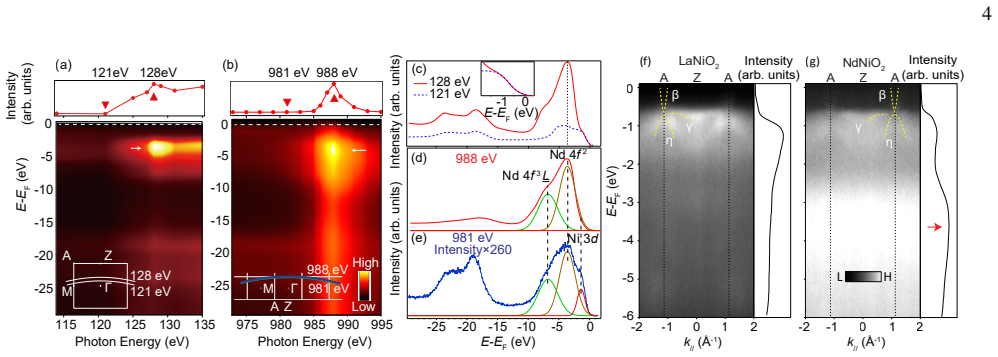
The paper claims that the β electron pocket near the A point in NdNiO$_2$ is predominantly built from interstitial $s$ states delocalized in the lattice voids left by the missing apical oxygen, coexisting with strongly correlated Ni $3d_{x^2-y^2}$ electrons. This is argued from polarization-dependent ARPES: the α band follows the expected $d_{x^2-y^2}$ selection rules, whereas the β band stays strong under horizontal linear polarization regardless of in-plane sample orientation, matching an isotropic, out-of-plane interstitial $s$ orbital and excluding $d_{xy}$ and $d_{xz}/d_{yz}$ contributions. Resonant photoemission across the Nd $N_4$ and $M_5$ edges shows resonant enhancement only at deep valence states (about 3.4 and 8 eV below $E_F$), not within 1 eV of the Fermi level, so Nd 4f and 5d states are localized and do not participate in the Fermi surface. The authors further observe quantum-well states whose number scales with film thickness, indicating the interstitial electrons are uniformly distributed through the film. Comparing NdNiO$_2$ with LaNiO$_2$, they attribute small band shifts and a more rounded α pocket to chemical pressure rather than to direct rare-earth orbital involvement.
Load-bearing premise
The paper's central assignment rests on the assumption that the atomic-orbital photoemission matrix-element simulations used to judge polarization dependence correctly describe the interstitial s state, and that the absence of resonant enhancement in momentum-integrated Nd-edge spectra reliably excludes Nd 5d and 4f contributions at every point on the Fermi surface.
Editorial extensions
If this is right
- The rare-earth 5d and 4f orbitals do not sit at the Fermi level, so theories that build superconductivity on Kondo-type hybridization or rare-earth d electrons need to be revised.
- The small size of the β pocket gives it a low density of states, making it an unlikely source of a dominant BCS-type mechanism proposed from GW calculations.
- Interstitial s electrons are spatially delocalized carriers that coexist with correlated Ni d electrons; their hybridizations with Ni 3d$_{3z^2-r^2}$ and $d_{x^2-y^2}$ become part of the minimal model for nickelate superconductivity.
- Rare-earth substitution tunes the electronic structure mainly by chemical pressure, shifting the Ni 3d$_{3z^2-r^2}$ band and changing hopping integrals, which may explain the systematic increase of $T_c$ with heavier rare earths.
- No Γ-point electron pocket is observed, disfavoring predictions of a pocket formed by hybridized Nd 5d$_{3z^2-r^2}$ and Ni 3d$_{3z^2-r^2}$ orbitals.
Reading between the lines
- If the β pocket is truly interstitial, the self-doping of the NiO$_2$ planes should be re-evaluated: electron transfer may come from the lattice voids rather than from rare-earth 5d states, changing how carrier densities are assigned in transport and spectroscopy.
- The electride-like interstitial states may generalize to other reduced oxides and infinite-layer compounds without apical oxygen; a sharp prediction is that the β-band dispersion and pocket size should respond strongly to c-axis compression, a testable pressure experiment.
- The quantum-well states reported here imply that the interstitial electrons are coherent across the film thickness; one could exploit this by measuring their effective mass and mobility via magnetotransport in ultra-thin films, which would connect the band character to transport properties.
Editorial analysis
A structured set of objections, weighed in public.
Referee Report
Summary. The manuscript reports polarization-dependent and resonant ARPES measurements on uncapped, fully reduced NdNiO2/SrTiO3 films. The authors identify the large α Fermi pocket as Ni 3d_{x^2-y^2} and the small β pocket as an interstitial s-like state, based on polarization selection rules that exclude dxy and dxz/dyz contributions. Resonant photoemission across the Nd N4 and M5 edges shows no enhancement within 1 eV of EF, which they interpret as negligible Nd 4f and 5d contributions. Additional observations include quantum well states in the β subbands and differences between NdNiO2 and LaNiO2 that are attributed to chemical pressure. The central claim is that the β pocket is electride-like interstitial s character coexisting with correlated Ni 3d electrons.
Significance. If the central claim holds, the paper would resolve a long-standing debate about the orbital origin of the electron pockets in infinite-layer nickelates and would extend the concept of electride-like interstitial states into a correlated oxide. The experimental strengths are substantial: the films are carefully characterized by REXS to rule out residual-oxygen reconstruction, the polarization-dependent measurements are performed in well-defined geometries with in-plane rotation controls, the exclusion logic for dxy and dxz/dyz is clearly presented, and the observation of multiple well-resolved quantum well states is an independent indication of homogeneous, extended states throughout the film. The comparison between NdNiO2 and LaNiO2 is also valuable. However, the strongest claim, that rare-earth 5d and 4f contributions are negligible near EF, rests on a momentum-integrated null result whose sensitivity is not quantified, and the resonant edges used primarily probe 4f final states rather than 5d states. The conclusion is therefore plausible but currently overreaches the evidence.
major comments (3)
- [Results, Fig. 3] The resonant photoemission across the Nd N4 (4d→4f) and M5 (3d→4f) edges enhances 4f-derived final states and is not a direct probe of Nd 5d spectral weight. The statement in the text that 'Nd states, especially the Nd 4f states, are undetectably weak' therefore cannot support the abstract's claim of 'negligible contributions from rare-earth 5d and 4f orbitals near the Fermi level.' The absence of a 4f resonance excludes only 4f weight; Nd 5d contributions could in principle be present without producing a Fano enhancement at these edges. The authors should either provide a 5d-sensitive measurement, an explicit model for why the 4f resonance would also reveal hybridized 5d weight, or soften the claim to exclude only 4f and state that 5d exclusion rests on the polarization data alone.
- [Results, Fig. 3(c-d) and inset] The absence of resonant enhancement within 1 eV of EF is a momentum-integrated null result with no quantified detection limit. The β pocket is a small, k-localized feature near the A point, so a modest Nd 5d or even 4f admixture (say 10–20%) in that pocket could be diluted below the noise floor after integration over the full Brillouin zone. To make the claim load-bearing, the authors should report the noise level of the integrated spectra, estimate the fractional spectral weight in the β band that would have produced a detectable enhancement, or present angle-resolved resonant spectra along A-Z-A at the resonance energies. Without such a sensitivity estimate, 'negligible contributions' is not established.
- [Results, Fig. 2(h-l)] The assignment of the β pocket to interstitial s states is made by exclusion, and the exclusion list is incomplete. The polarization analysis explicitly considers dxy, dx2-y2, dxz, dyz, and an isotropic interstitial s state, but theoretical proposals also include Nd 5d orbitals with other symmetries, such as 5d_{3z^2-r^2} components that could contribute near the A point. The text mentions 'Nd 5dxy' but does not systematically rule out all Nd 5d orbital characters. In addition, the simulated photoemission intensities in Fig. 2(h-l) are only described as 'adapted from ref. 43'; no details are given for the calculation (final state, polarization geometry, parameters), which makes it difficult to assess whether the predicted contrast for an interstitial s state is reliable. Please provide the simulation method and complete the symmetry analysis over all candidate orbitals.
minor comments (5)
- [Introduction] There is a typographical error: 'distinct form the single-band cuprates' should read 'distinct from the single-band cuprates.'
- [Introduction and Discussion] Several typographical errors appear: 'nicklates' in the Introduction, 'o ffer' in the Discussion, 'insu fficient' in the Discussion, and 'itinerate interstitial s orbitals' in the Results section should be corrected.
- [Figure 3 caption] The caption for panels (d-e) says '988 eV (on-resonance) and 981 eV (on-resonance)'; the 981 eV spectrum is presumably off-resonance and should be labeled accordingly.
- [Results, Fig. 3(c) inset] The inset of Fig. 3(c) is referenced to show the absence of enhancement near EF, but in the provided figure the inset is difficult to discern; enlarging it or adding a separate panel would improve clarity.
- [Results, Fig. 2] The statement that an isotropic interstitial s state nevertheless 'has out-of-plane character that enhances the overall intensity under LH polarization' is not self-evident; a one-sentence explanation in terms of the final-state wave function or the simulation would help the reader.
Circularity Check
No significant circularity: the orbital-character conclusions are drawn from independent polarization-dependent and resonant ARPES measurements, not from fitting or from a self-citation chain.
full rationale
The paper's central claim is that the β pocket in NdNiO2 arises predominantly from interstitial s states with negligible rare-earth 5d and 4f contributions. This is supported by two independent experimental pillars: polarization-dependent ARPES, which excludes dxy, dxz/dyz, and by symmetry other Ni orbitals based on measured LH/LV intensity changes; and resonant photoemission across the Nd N4 and M5 edges, where no resonant enhancement is observed within 1 eV of EF. Neither step fits a parameter to the data and then re-predicts the same quantity; there is no equation or model whose input is defined in terms of the target conclusion. The atomic-orbital photoemission simulations are cited from ref. 43, a review that includes one coauthor, but they are used as supporting standard matrix-element/selection-rule calculations, not as a source that already asserts the interstitial-s assignment. The comparison with LaNiO2 from ref. 2, also from the same group, is used for the chemical-pressure discussion and not for the β-pocket orbital assignment; the NdNiO2 data independently establish the polarization and resonance behavior. The absence of a quantified detection limit for the resonant null result is a legitimate scientific robustness concern, but it is a matter of inferential strength, not circularity: the conclusion is not forced by construction or by a self-citation chain. Therefore no circular steps are identified.
Assumptions & free parameters
free parameters (1)
- Inner potential V0 =
17 eV
assumptions (3)
- domain assumption Photoemission matrix element selection rules for the candidate orbitals are correctly described by the atomic-orbital simulations in Fig. 2(h-l).
- domain assumption Absence of 3a0 superlattice reflections in REXS confirms complete reduction and absence of residual apical oxygen in the uncapped NdNiO2 films.
- domain assumption Momentum-integrated resonant photoemission at the Nd N4 and M5 edges is sensitive enough to detect Nd 4f/5d contributions near EF if they exist.
Cite this review
Pith. "Pith review of Observation of Electride-like $s$ States Coexisting with Correlated $d$ Electrons in NdNiO$_2$." pith.science (2026). https://pith.science/paper/AIIBRE6Y
@misc{pith2026250704378,
  author       = {Pith},
  title        = {Pith review of: Observation of Electride-like $s$ States Coexisting with Correlated $d$ Electrons in NdNiO$_2$},
  year         = {2026},
  howpublished = {\url{https://pith.science/paper/AIIBRE6Y}},
  note         = {Machine review of arXiv:2507.04378}
}
abstract
Despite exhibiting a similar $d_{x^2-y^2}$ band character to cuprates, infinite-layer nickelates host additional electron pockets that distinguish them from single-band cuprates. The elusive orbital origin of these electron pockets has led to competing theoretical scenarios. Here, using polarization-dependent and resonant angle-resolved photoemission spectroscopy (ARPES), we determine the orbital character of the Fermi surfaces in NdNiO$_2$. Our data reveal that the electron-like pocket arises predominantly from interstitial $s$ states, with negligible contributions from rare-earth 5$d$ and 4$f$ orbitals near the Fermi level. The observation of well-defined quantum well states indicates a uniform distribution of these interstitial electrons throughout the film thickness. By comparing with electronic structure of LaNiO$_2$, we find that the rare-earth element modulates the Ni-derived bands and hopping integrals through a chemical pressure effect. These findings clarify the role of rare-earth elements in shaping the low-energy electronic structure and establish the presence of electride-like interstitial $s$ states in a correlated oxide system, where electrons occupy lattice voids rather than atomic orbitals. The electride-like character offer new insight into the self-doping and superconductivity in infinite-layer nickelates.
Figures


Figures from the paper (1 more)

Forward citations
Cited by 3 Pith papers
-
Quantum critical origin of strange-metals at the end of a pseudogap phase in infinite-layer nickelates
In superconducting infinite-layer nickelates, S/T diverges logarithmically at the strange-metal onset doping, identifying a quantum critical point and a cuprate-like collapse of the Ni-d band carrier density.
-
Persistent paramagnons in high-temperature infinite-layer nickelate superconductors
In samarium-based infinite-layer nickelates, the measured exchange coupling is about 20% smaller than in praseodymium-based nickelates despite a nearly two-fold higher Tc, opposite to the trend in cuprates.
-
Hole distribution and self-doping enhanced electronic correlation in hole-doped infinite-layer nickelates
In hole-doped infinite-layer nickelates, DFT+DMFT calculations show doped holes split almost equally between Ni-3d_x2-y2 and interstitial-s orbitals, and the interstitial-s orbital acts as a self-doping charge donor t...
Reference graph
Works this paper leans on
-
[1]
V . Anisimov, D. Bukhvalov, and T. Rice, Electronic structure of possible nickelate analogs to the cuprates, Physical Review B 59, 7901 (1999)
work page 1999
-
[2]
X. Ding, Y . Fan, X. Wang, C. Li, Z. An, J. Ye, S. Tang, M. Lei, X. Sun, N. Guo, et al. , Cuprate-like electronic structures in infinite-layer nickelates with substantial hole dopings, National Science Review , nwae194 (2024)
work page 2024
-
[3]
W. Sun, Z. Jiang, C. Xia, B. Hao, S. Yan, M. Wang, Y . Li, H. Liu, J. Ding, J. Liu, et al., Electronic structure of supercon- ducting infinite-layer lanthanum nickelates, Science Advances 11, eadr5116 (2025)
work page 2025
-
[4]
L. Si, E. Jacob, W. Wu, A. Hausoel, J. Krsnik, P. Worm, S. Di Cataldo, O. Janson, and K. Held, Closing in on possi- ble scenarios for infinite-layer nickelates: Comparison of dy- namical mean-field theory with angular-resolved photoemis- sion spectroscopy, Phys. Rev. Res.6, 043104 (2024)
work page 2024
-
[5]
H. LaBollita, A. Hampel, J. Karp, A. S. Botana, and A. J. Millis, Conductivity of infinite-layer NdNiO 2 as a probe of spectator bands, Physical Review B 107, 205155 (2023)
work page 2023
-
[6]
F. Lechermann, Multiorbital processes rule the Nd 1−xSrxNiO2 normal state, Physical Review X 10, 041002 (2020)
work page 2020
-
[7]
J. Karp, A. Hampel, M. Zingl, A. S. Botana, H. Park, M. R. Norman, and A. J. Millis, Comparative many-body study of Pr4Ni3O8 and NdNiO2, Physical Review B102, 245130 (2020)
work page 2020
-
[8]
G.-M. Zhang, Y .-f. Yang, and F.-C. Zhang, Self-doped mott insulator for parent compounds of nickelate superconductors, Physical Review B 101, 020501 (2020)
work page 2020
Show all 62 references
-
[9]
Lee and W
K.-W. Lee and W. Pickett, Infinite-layer LaNiO 2: Ni 1 + is not Cu 2 +, Physical Review B—Condensed Matter and Materials Physics 70, 165109 (2004)
2004
-
[10]
Foyevtsova, I
K. Foyevtsova, I. Elfimov, and G. A. Sawatzky, Distinct elec- tridelike nature of infinite-layer nickelates and the resulting the- oretical challenges to calculate their electronic structure, Phys- ical Review B 108, 205124 (2023)
2023
-
[11]
Y . Gu, S. Zhu, X. Wang, J. Hu, and H. Chen, A substantial hy- bridization between correlated Ni- d orbital and itinerant elec- trons in infinite-layer nickelates, Communications Physics3, 84 (2020)
2020
-
[12]
Nomura, M
Y . Nomura, M. Hirayama, T. Tadano, Y . Yoshimoto, K. Naka- mura, and R. Arita, Formation of a two-dimensional single- component correlated electron system and band engineering in the nickelate superconductor NdNiO 2, Physical review B 100, 205138 (2019)
2019
-
[13]
X. Wu, D. Di Sante, T. Schwemmer, W. Hanke, H. Y . Hwang, S. Raghu, and R. Thomale, Robustdx2−y2-wave superconductiv- ity of infinite-layer nickelates, Physical Review B 101, 060504 (2020)
2020
-
[14]
Adhikary, S
P. Adhikary, S. Bandyopadhyay, T. Das, I. Dasgupta, and T. Saha-Dasgupta, Orbital-selective superconductivity in a two- band model of infinite-layer nickelates, Physical Review B102, 100501 (2020)
2020
-
[15]
P. Worm, Q. Wang, M. Kitatani, I. Biało, Q. Gao, X. Ren, J. Choi, D. Csontosov ´a, K.-J. Zhou, X. Zhou, et al., Spin fluc- tuations sufficient to mediate superconductivity in nickelates, Physical Review B 109, 235126 (2024)
2024
-
[16]
Li and S
Z. Li and S. G. Louie, Two-gap superconductivity and the de- 6 cisive role of rare-earth d electrons in infinite-layer nickelates, Phys. Rev. Lett. 133, 126401 (2024)
2024
-
[17]
Zhang, C
R. Zhang, C. Lane, B. Singh, J. Nokelainen, B. Barbiellini, R. S. Markiewicz, A. Bansil, and J. Sun, Magnetic and f-electron effects in LaNiO 2 and NdNiO 2 nickelates with cuprate-like 3dx2−y2 band, Communications Physics 4, 118 (2021)
2021
-
[18]
Jiang, L
P. Jiang, L. Si, Z. Liao, and Z. Zhong, Electronic structure of rare-earth infinite-layer RNiO 2 (R= La, Nd), Physical Review B 100, 201106 (2019)
2019
-
[19]
Choi, K.-W
M.-Y . Choi, K.-W. Lee, and W. E. Pickett, Role of 4f states in infinite-layer NdNiO2, Physical Review B 101, 020503 (2020)
2020
-
[20]
Bandyopadhyay, P
S. Bandyopadhyay, P. Adhikary, T. Das, I. Dasgupta, and T. Saha-Dasgupta, Superconductivity in infinite-layer nicke- lates: Role of f orbitals, Physical Review B 102, 220502 (2020)
2020
-
[21]
Kamihara, T
Y . Kamihara, T. Watanabe, M. Hirano, and H. Hosono, Iron- based layered superconductor La[O 1−xFx]FeAs (x =0.05-0.12) with Tc= 26 K, Journal of the American Chemical Society 130, 3296 (2008)
2008
-
[22]
Stewart, Superconductivity in iron compounds, Reviews of Modern Physics 83, 1589 (2011)
G. Stewart, Superconductivity in iron compounds, Reviews of Modern Physics 83, 1589 (2011)
2011
-
[23]
Matsuishi, Y
S. Matsuishi, Y . Toda, M. Miyakawa, K. Hayashi, T. Kamiya, M. Hirano, I. Tanaka, and H. Hosono, High-density electron an- ions in a nanoporous single crystal:[Ca 24Al28O64]4+(4e−), Sci- ence 301, 626 (2003)
2003
-
[24]
K. Lee, S. W. Kim, Y . Toda, S. Matsuishi, and H. Hosono, Di- calcium nitride as a two-dimensional electride with an anionic electron layer, Nature 494, 336 (2013)
2013
-
[25]
Hirayama, S
M. Hirayama, S. Matsuishi, H. Hosono, and S. Murakami, Elec- trides as a new platform of topological materials, Physical Re- view X 8, 031067 (2018)
2018
-
[26]
Osada, B
M. Osada, B. Y . Wang, B. H. Goodge, S. P. Harvey, K. Lee, D. Li, L. F. Kourkoutis, and H. Y . Hwang, Nickelate supercon- ductivity without rare-earth magnetism:(La,Sr)NiO2, Advanced Materials 33, 2104083 (2021)
2021
-
[27]
S. Zeng, C. Li, L. E. Chow, Y . Cao, Z. Zhang, C. S. Tang, X. Yin, Z. S. Lim, J. Hu, P. Yang, et al. , Superconductivity in infinite-layer nickelate La1−xCaxNiO2 thin films, Science ad- vances 8, eabl9927 (2022)
2022
-
[28]
Osada, B
M. Osada, B. Y . Wang, K. Lee, D. Li, and H. Y . Hwang, Phase diagram of infinite layer praseodymium nickelate Pr1−xSrxNiO2 thin films, Physical Review Materials 4, 121801 (2020)
2020
-
[29]
D. Li, K. Lee, B. Y . Wang, M. Osada, S. Crossley, H. R. Lee, Y . Cui, Y . Hikita, and H. Y . Hwang, Superconductivity in an infinite-layer nickelate, Nature 572, 624 (2019)
2019
-
[30]
K. Lee, B. Y . Wang, M. Osada, B. H. Goodge, T. C. Wang, Y . Lee, S. Harvey, W. J. Kim, Y . Yu, C. Murthy, et al. , Linear-in-temperature resistivity for optimally superconducting (Nd,Sr)NiO2, Nature 619, 288 (2023)
2023
-
[31]
W. Wei, D. Vu, Z. Zhang, F. J. Walker, and C. H. Ahn, Su- perconducting Nd1−xEuxNiO2 thin films using in situ synthesis, Science Advances 9, eadh3327 (2023)
2023
-
[32]
Y . Lee, X. Wei, Y . Yu, L. Bhatt, K. Lee, B. H. Goodge, S. P. Harvey, B. Y . Wang, D. A. Muller, L. F. Kourkoutis, et al. , Millimeter-scale freestanding superconducting infinite- layer nickelate membranes, arXiv preprint arXiv:2402.05104 (2024)
2024 arXiv
-
[33]
S. Chow, Z. Luo, and A. Ariando, Bulk superconductivity near 40 K in hole-doped SmNiO 2 at ambient pressure, Nature , 1 (2025)
2025
-
[34]
M. Yang, H. Wang, J. Tang, J. Luo, X. Wu, R. Mao, W. Xu, G. Zhou, Z. Dong, B. Feng, et al., Enhanced superconductivity in co-doped infinite-layer samarium nickelate thin films, arXiv preprint arXiv:2503.18346 (2025)
2025 arXiv
-
[35]
C. T. Parzyck, N. K. Gupta, Y . Wu, V . Anil, L. Bhatt, M. Bou- liane, R. Gong, B. Gregory, A. Luo, R. Sutarto, et al., Absence of 3a0 charge density wave order in the infinite-layer nickelate NdNiO2, Nature materials 23, 486 (2024)
2024
-
[36]
C. T. Parzyck, V . Anil, Y . Wu, B. H. Goodge, M. Roddy, L. F. Kourkoutis, D. G. Schlom, and K. M. Shen, Synthesis of thin film infinite-layer nickelates by atomic hydrogen reduc- tion: clarifying the role of the capping layer, APL Materials 12 (2024)
2024
-
[37]
Parzyck, Y
C. Parzyck, Y . Wu, L. Bhatt, M. Kang, Z. Arthur, T. Pedersen, R. Sutarto, S. Fan, J. Pelliciari, V . Bisogni, et al. , Supercon- ductivity in the parent infinite-layer nickelate NdNiO 2, arXiv preprint arXiv:2410.02007 (2024)
2024 arXiv
-
[38]
X. Ren, R. Sutarto, Q. Gao, Q. Wang, J. Li, Y . Wang, T. Xiang, J. Hu, J. Chang, R. Comin, X. J. Zhou, and Z. Zhu, Two dis- tinct charge orders in infinite-layer PrNiO 2+δ revealed by res- onant X-ray di ffraction, CHINESE PHYSICS LETTERS 41, 10.1088/0256-307X/41/11/117404 (2024)
2024 doi
-
[39]
A. Raji, G. Krieger, N. Viart, D. Preziosi, J.-P. Rue ff, and A. Gloter, Charge distribution across capped and un- capped infinite-layer neodymium nickelate thin films, Small19, 2304872 (2023)
2023
-
[40]
C. C. Tam, J. Choi, X. Ding, S. Agrestini, A. Nag, M. Wu, B. Huang, H. Luo, P. Gao, M. Garc´ıa-Fern´andez, et al., Charge density waves in infinite-layer NdNiO 2 nickelates, Nature Ma- terials 21, 1116 (2022)
2022
-
[41]
Krieger, L
G. Krieger, L. Martinelli, S. Zeng, L. Chow, K. Kummer, R. Arpaia, M. Moretti Sala, N. B. Brookes, A. Ariando, N. Viart, et al. , Charge and spin order dichotomy in NdNiO 2 driven by the capping layer, Physical Review Letters 129, 027002 (2022)
2022
-
[42]
Rossi, H
M. Rossi, H. Lu, K. Lee, B. Goodge, J. Choi, M. Osada, Y . Lee, D. Li, B. Wang, D. Jost, et al., Universal orbital and magnetic structures in infinite-layer nickelates, Physical Review B 109, 024512 (2024)
2024
-
[43]
Z.-R. Ye, Y . Zhang, B.-P. Xie, and D.-L. Feng, Angle-resolved photoemission spectroscopy study on iron-based superconduc- tors, Chinese Physics B 22, 087407 (2013)
2013
-
[44]
Gauthier, J
N. Gauthier, J. A. Sobota, M. Hashimoto, H. Pfau, D.-H. Lu, E. D. Bauer, F. Ronning, P. S. Kirchmann, and Z.-X. Shen, Quantum-well states in fractured crystals of the heavy-fermion material CeCoIn5, Physical Review B 102, 125111 (2020)
2020
-
[45]
Kobayashi, K
M. Kobayashi, K. Yoshimatsu, E. Sakai, M. Kitamura, K. Horiba, A. Fujimori, and H. Kumigashira, Origin of the anomalous mass renormalization in metallic quantum well states of strongly correlated oxide SrVO3, Physical Review Let- ters 115, 076801 (2015)
2015
-
[46]
J. K. Kawasaki, C. H. Kim, J. N. Nelson, S. Crisp, C. J. Zollner, E. Biegenwald, J. T. Heron, C. J. Fennie, D. G. Schlom, and K. M. Shen, Engineering carrier e ffective masses in ultrathin quantum wells of IrO 2, Physical Review Letters 121, 176802 (2018)
2018
-
[47]
Kawakami, E
R. Kawakami, E. Rotenberg, H. J. Choi, E. J. Escorcia- Aparicio, M. Bowen, J. Wolfe, E. Arenholz, Z. Zhang, N. Smith, and Z. Qiu, Quantum-well states in copper thin films, Nature 398, 132 (1999)
1999
-
[48]
Jiang, Z.-J
R. Jiang, Z.-J. Lang, T. Berlijn, and W. Ku, Variation of carrier density in semimetals via short-range correlation: A case study with nickelate NdNiO2, Physical Review B108, 155126 (2023)
2023
-
[49]
Damascelli, Z
A. Damascelli, Z. Hussain, and Z.-X. Shen, Angle-resolved photoemission studies of the cuprate superconductors, Reviews of modern physics 75, 473 (2003)
2003
-
[50]
Namatame, A
H. Namatame, A. Fujimori, Y . Tokura, M. Nakamura, K. Yam- aguchi, A. Misu, H. Matsubara, S. Suga, H. Eisaki, T. Ito,et al., 7 Resonant-photoemission study of Nd2−xCexCuO4, Physical Re- view B 41, 7205 (1990)
1990
-
[51]
Fujimori, T
A. Fujimori, T. Miyahara, T. Koide, T. Shidara, H. Kato, H. Fukutani, and S. Sato, 4 f -derived photoemission and 4 f - ligand hybridization in light rare-earth halides, Physical Review B 38, 7789 (1988)
1988
-
[52]
B. Y . Wang, T. C. Wang, Y .-T. Hsu, M. Osada, K. Lee, C. Jia, C. Duffy, D. Li, J. Fowlie, M. R. Beasley,et al., Effects of rare- earth magnetism on the superconducting upper critical field in infinite-layer nickelates, Science advances 9, eadf6655 (2023)
2023
-
[53]
F. B. Kugler, C.-J. Kang, and G. Kotliar, Low-energy perspec- tive on two-orbital hund metals and the case of LaNiO2, Physi- cal Review B 110, 155101 (2024)
2024
-
[54]
Hepting, D
M. Hepting, D. Li, C. Jia, H. Lu, E. Paris, Y . Tseng, X. Feng, M. Osada, E. Been, Y . Hikita,et al., Electronic structure of the parent compound of superconducting infinite-layer nickelates, Nature materials 19, 381 (2020)
2020
-
[55]
H. Lu, M. Rossi, A. Nag, M. Osada, D. Li, K. Lee, B. Wang, M. Garcia-Fernandez, S. Agrestini, Z. Shen, et al. , Magnetic excitations in infinite-layer nickelates, Science373, 213 (2021)
2021
-
[56]
Sharma, M.-C
S. Sharma, M.-C. Jung, H. LaBollita, and A. S. Botana, Pres- sure e ffects on the electronic structure and magnetic proper- ties of infinite-layer nickelates, Physical Review B110, 155156 (2024)
2024
-
[57]
Bernardini, A
F. Bernardini, A. Bosin, and A. Cano, Geometric e ffects in the infinite-layer nickelates, Physical Review Materials 6, 044807 (2022)
2022
-
[58]
T. A. Maier, S. Karakuzu, and D. J. Scalapino, Overdoped end of the cuprate phase diagram, Physical Review Research 2, 033132 (2020)
2020
-
[59]
W. Wu, M. S. Scheurer, S. Chatterjee, S. Sachdev, A. Georges, and M. Ferrero, Pseudogap and fermi-surface topology in the two-dimensional hubbard model, Physical Review X8, 021048 (2018)
2018
-
[60]
Honerkamp and M
C. Honerkamp and M. Salmhofer, Magnetic and superconduct- ing instabilities of the hubbard model at the van hove filling, Physical Review Letters 87, 187004 (2001)
2001
-
[61]
N. Wang, M. Yang, Z. Yang, K. Chen, H. Zhang, Q. Zhang, Z. Zhu, Y . Uwatoko, L. Gu, X. Dong, et al., Pressure-induced monotonic enhancement of Tc to over 30 K in superconducting Pr0.82Sr0.18NiO2 thin films, Nature communications 13, 4367 (2022)
2022
-
[62]
Di Cataldo, P
S. Di Cataldo, P. Worm, J. M. Tomczak, L. Si, and K. Held, Un- conventional superconductivity without doping in infinite-layer nickelates under pressure, Nature Communications 15, 3952 (2024)
2024
Reviewed August 6, 2026 · model on record in the stance chip above.
Discussion (0). Sign in to comment.