REVIEW 4 major objections 5 minor 17 references
SpiritRAG: A Q&A System for Religion and Spirituality in the United Nations Archive
T0 review · 4 major / 5 minor · reviewed 2026-08-06 · deepseek-v4-flash
Pith's one-line read A chat-based Q&A system retrieves and cites religion- and spirituality-related content from 7,500 UN resolutions on health and education, with expert ratings on 100 questions indicating practical usefulness.
desk verdict A genuinely useful new corpus for a niche domain, wrapped around a standard RAG pipeline whose evaluation, as reported, does not yet establish the paper's central claim of practical value. read the letter →
The pith
A machine-rendered reading of the paper's core claim, the machinery that carries it, and where it could break.
The reading
What carries the argument
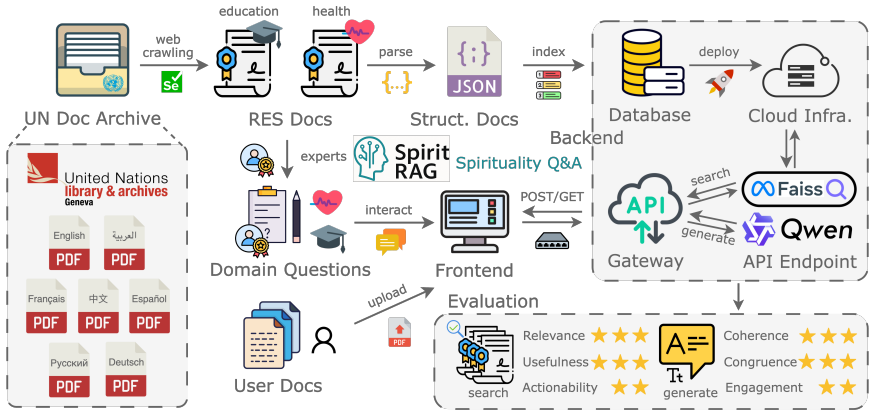
The load-bearing mechanism is retrieval-augmented generation (RAG): retrieve relevant documents from a corpus first, then condition the language model's answer on those documents. The retriever maps the query and each document to embeddings with the same text encoder, pre-fetches the top-$n$ resolutions by cosine similarity, then re-ranks them by a weighted combination of maximum and average Euclidean distance between the query embedding and the sentence embeddings within each document, with the maximum weighted at $\alpha = 0.7$. The top-$k$ documents, together with an optional user-uploaded parsed PDF, are passed through a fixed prompt template to an instruction-tuned Qwen3 model, which produces a Markdown answer pointing back to cited resolution documents. The corpus side uses keyword-based crawling of the UN Official Document System, Docling-based paragraph parsing, Faiss indexing, and vLLM-accelerated generation.
What would settle it
Run the 100 published test questions through a standard keyword or phrase search over the same UN corpus and have independent evaluators fact-check every SpiritRAG answer against its cited resolutions; if the keyword baseline matches or beats SpiritRAG on relevance and accuracy, or if a substantial share of generated claims cannot be found in the cited documents, the system's claimed practical advantage would be undercut.
Extended reading notes
Core claim
On the paper's own terms, the discovery is that a domain-specific retrieval-augmented generation pipeline can operationalize 'religion' and 'spirituality' in archival search. The system retrieves UN resolutions by dense embedding similarity, re-ranks them by sentence-level relevance, and conditions a Qwen3 model on the top documents to write answers that cite original resolutions. The authors claim this makes complex, context-sensitive queries, such as how religious freedom or cultural appropriateness has been framed over time, answerable through an ordinary chat interface. The pilot evaluation reports mean expert ratings of 4.26 for retrieval relevance and 4.18 for answer relevance in the health plus R/S domain, and 3.51 and 3.98 respectively in education, with the larger retriever and generator consistently outperforming the smaller ones. The paper frames SpiritRAG as a proof-of-concept for LLM-augmented work in public policy, historical scholarship, and digital humanities, and as a complement to topic-modeling studies of these archives.
Load-bearing premise
The claim of practical value rests on two domain experts' average five-point ratings of 100 questions they wrote themselves, with no baseline system, no inter-rater agreement statistic, and no independent check that the generated answers' factual claims are supported by the cited resolutions.
Editorial extensions
If this is right
- A researcher can ask multi-part, diachronic questions such as how UN language on religious freedom or cultural appropriateness changed over time and receive an answer with links to the underlying resolutions.
- A policymaker without archival training can trace what UN resolutions say about faith-based organizations, religious discrimination, or health equity, because the chat interface handles contextual sensitivity that keyword search misses.
- The same modular pipeline can be extended to other UN bodies or non-UN document collections, since the system already accepts user-uploaded PDFs and the architecture is designed for other domain-specific sources.
- The 100-question expert test set gives later systems a reusable benchmark for R/S-related retrieval and generation in UN archives.
- The paper reports that the best system configuration answers in about seven seconds, suggesting the approach is light enough for real-time use in research and policy settings.
Reading between the lines
- Not in the paper: a direct comparison of SpiritRAG with the UN's existing keyword search over the same corpus; running the 100 published questions through both interfaces would quantify how much of the reported usefulness comes from the RAG pipeline rather than from the underlying archive.
- Not in the paper: inter-rater reliability or independent fact-checking, so the stability of the mean ratings is unknown; a second set of raters scoring the same 100 answers would test whether the usefulness scores reproduce.
- A testable consequence the authors leave implicit: because replacing the retriever produced the largest rating gains, fine-tuning or scaling the retriever may add more practical value than scaling the generator.
- The high temporality ratings suggest an undeveloped feature the authors do not spell out: letting users constrain retrieval to explicit time windows would make diachronic questions such as 'since 1946' answerable with greater precision.
Editorial analysis
A structured set of objections, weighed in public.
Referee Report
Summary. SpiritRAG is a retrieval-augmented generation (RAG) system for question answering over approximately 7,500 United Nations resolution documents related to religion and spirituality (R/S) in the health and education domains. The system combines a sentence-embedding retriever with a reranking step and a Qwen3-based answer generator, packaged as a chat-based web interface. The paper contributes the system architecture, a multilingual corpus of UN resolutions, and an expert-authored test set of 100 questions. The central claim is that the system enables complex, context-sensitive searches of a large archive and that a pilot evaluation with two domain experts demonstrates its practical value and usefulness.
Significance. If the system performs as claimed, it would be a useful proof-of-concept for domain-specific RAG in archival research and policy analysis, offering a low-barrier interface to a large, noisy document collection. The open release of the corpus and code is a concrete strength, as is the modular architecture that eases extension to other domains. The paper also provides a curated 100-question test set, which could support future benchmarking. However, the paper's central claim of practical value rests on a pilot evaluation that does not measure factual correctness, lacks a baseline, and reports only mean Likert scores from two raters who authored the questions. These are significant gaps that must be addressed before the claim can be considered supported.
major comments (4)
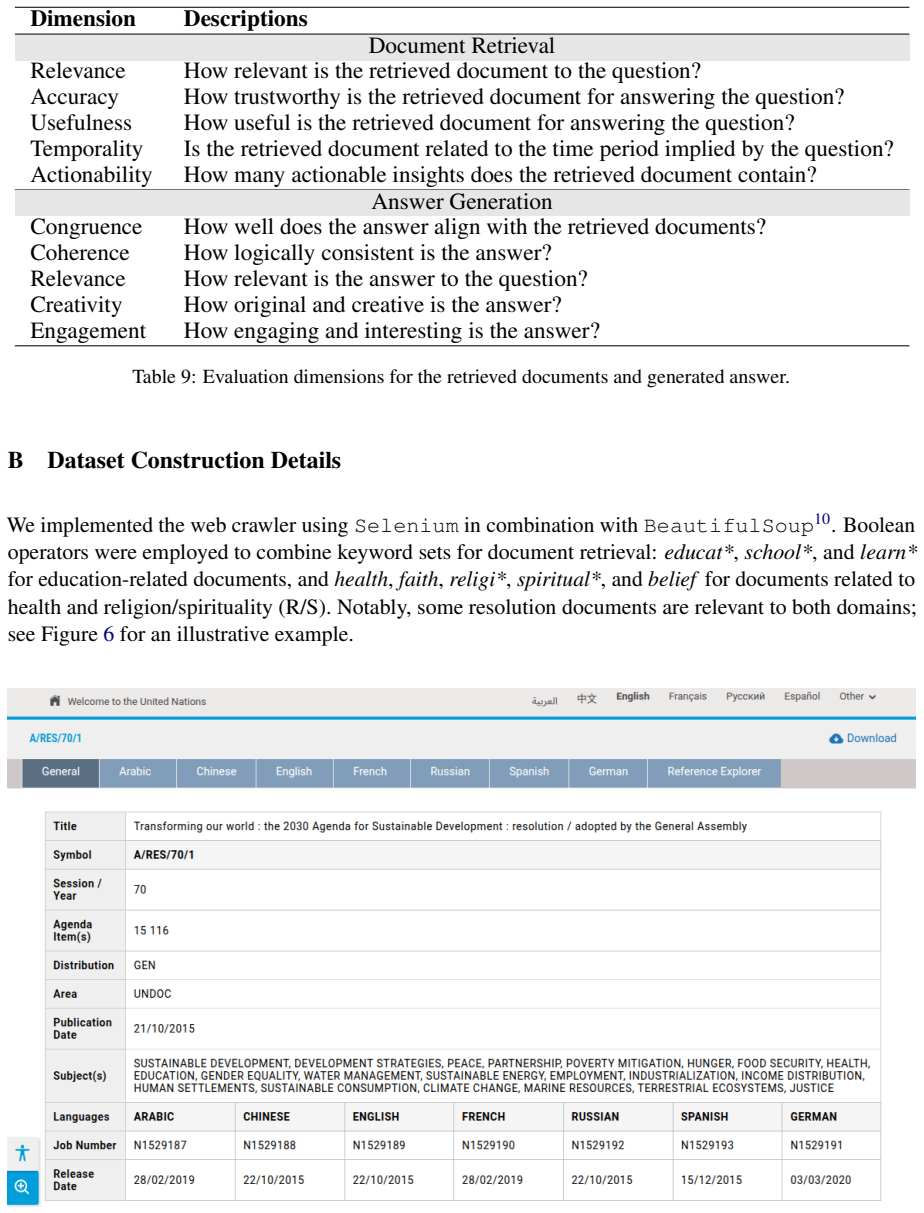
- [Section 4, Tables 2 and 3] The evaluation does not verify the factual correctness of generated answers, yet the abstract's claim of 'practical value and usefulness' for a Q&A system depends on answer accuracy. The five answer-generation dimensions (Congruence, Coherence, Relevance, Creativity, Engagement) in Table 9 omit any accuracy or faithfulness metric. The document-retrieval dimension 'Accuracy' asks whether a retrieved document is trustworthy, not whether the generated answer's claims, resolution numbers, dates, or quotations are correct. Consequently, the reported scores would be unchanged even if the system systematically hallucinated citations or misattributed content. The paper itself acknowledges the absence of ground-truth answers in Section 6 (Limitations), confirming that no objective correctness check was performed. I recommend adding an explicit factual-verification component, such as independent expert fact-checking of a sample of answers or an automatic faithfulness metric, and reporting the corresponding error rates.
- [Section 4] The central claim that SpiritRAG improves on existing archival search is not supported by any baseline comparison. The paper states that current UN search interfaces are poorly designed and that general-purpose LLMs lack contextual sensitivity, but the pilot evaluation compares only internal configurations of SpiritRAG (different retrievers and generators). Without a comparison to the existing UN document system, a general-purpose search engine, or a non-RAG LLM baseline, the reported ratings cannot substantiate the claim that SpiritRAG makes large, noisy datasets more accessible. Please include a baseline condition in the evaluation.
- [Section 4 and Appendix A] The evaluation relies on mean Likert ratings from two domain experts who also authored the 100 test questions, and no inter-rater reliability is reported. With only two raters and self-authored questions, the scores are susceptible to leniency and representativeness bias, and mean ratings alone do not indicate agreement or consistency. Report per-rater scores and a chance-corrected agreement measure (e.g., weighted Cohen's kappa) for each dimension. Ideally, have additional independent experts write or evaluate a subset of questions, or at minimum discuss how the potential bias was mitigated.
- [Section 6, Limitations] The limitation statement 'in the absence of ground-truth answers and relevant documents, we did not fine-tune the document retriever for optimal performance' also confirms that no ground-truth-based evaluation was performed. This is not merely a limitation for fine-tuning; it directly undermines the abstract's claim that the pilot 'demonstrates the practical value and usefulness of SpiritRAG.' A Q&A system's practical value is inseparable from whether its answers are correct. The paper should either temper the central claim to reflect that only perceived quality was measured, or supply a ground-truth-based evaluation.
minor comments (5)
- [Section 4] The sentence 'Evaluators noted the considerable improvement in performance between Sentence-BERT and Qwen3-Embedding as document retriever, and particularly a significant and consistent improvement in answer length and detail of Qwen3-0.6B in comparison with Qwen3-1.7B as answer generator' appears to have the model names reversed; Table 2 shows Qwen3-1.7B outperforming Qwen3-0.6B on all reported dimensions.
- [Figure 1 caption] The caption states 'Human evaluation results of SpiritRAG on 50 health + R/S test questions,' but the paper reports results for 100 questions (Tables 2 and 3). Clarify whether Figure 1 covers only the health subset or the full set.
- [Table 1] The corpus size is described as 'nearly 7,500 documents' and 'approx. 7,500,' but Table 1 lists per-language document counts that are much higher when summed (overlapping translations). Clarify that the 7,500 figure refers to unique multilingual documents, and state how overlap is handled.
- [Section 2.2, Equation (3)] The relevance score r(Di; q) uses L2 (Euclidean) distance while the initial retrieval ranking uses cosine similarity. Clarify whether a lower L2 distance indicates higher relevance and how the two measures are aligned in the ranking.
- [Appendix C] The example answer in Table 10 is useful, but the paper would benefit from additional examples that illustrate failure cases, particularly with respect to factual grounding, so readers can gauge typical error modes.
Circularity Check
No significant circularity: the system's value claim rests on external expert ratings, not on a fitted parameter or self-citation chain; minor self-citations are non-load-bearing.
full rationale
SpiritRAG is an empirical systems paper: it constructs a corpus, builds a retrieval-augmented Q&A system, and evaluates it with human ratings. There is no derivation chain in which an output is equivalent to an input by construction. The retrieval weighting alpha=0.7 is an empirically chosen constant, not a parameter fitted to the evaluation results, and no predicted quantity is defined in terms of the evaluation scores. The central evidence consists of mean Likert ratings from two domain experts over 100 manually composed questions; this is external human judgment about retrieved documents and generated answers, not a quantity computed from the system's own inputs. The most relevant self-citations are Gao et al. (2024) for the modular design principle and Winiger et al. (2025) for the observation that R/S definitions vary; neither is load-bearing for the paper's claim of practical value, and neither is used to forbid alternative designs. The paper explicitly notes the absence of ground-truth answers as a limitation, which weakens the validity of the evaluation but is not circularity: no generated answer or retrieval score is made equivalent to the test questions by definition. The system is assessed against a purpose-built test set rather than external benchmarks, but that is an evaluation-design choice, not a circular reduction.
Assumptions & free parameters
free parameters (2)
- alpha (reranking balance) =
0.7
- top-n pre-fetch and top-k final retrieval counts =
not reported
assumptions (3)
- domain assumption The keyword-based crawl (educat*, school*, learn*; health, faith, religi*, spiritual*, belief) yields a representative corpus of R/S-related UN resolutions.
- domain assumption Two domain experts' Likert ratings are a valid measure of practical value and usefulness.
- domain assumption Pretrained embedding and generation models (Sentence-BERT, Qwen3) transfer to this domain without fine-tuning.
Cite this review
Pith. "Pith review of SpiritRAG: A Q&A System for Religion and Spirituality in the United Nations Archive." pith.science (2026). https://pith.science/paper/TTUBEU6I
@misc{pith2026250704395,
  author       = {Pith},
  title        = {Pith review of: SpiritRAG: A Q&A System for Religion and Spirituality in the United Nations Archive},
  year         = {2026},
  howpublished = {\url{https://pith.science/paper/TTUBEU6I}},
  note         = {Machine review of arXiv:2507.04395}
}
read the original abstract
Religion and spirituality (R/S) are complex and highly domain-dependent concepts which have long confounded researchers and policymakers. Due to their context-specificity, R/S are difficult to operationalize in conventional archival search strategies, particularly when datasets are very large, poorly accessible, and marked by information noise. As a result, considerable time investments and specialist knowledge is often needed to extract actionable insights related to R/S from general archival sources, increasing reliance on published literature and manual desk reviews. To address this challenge, we present SpiritRAG, an interactive Question Answering (Q&A) system based on Retrieval-Augmented Generation (RAG). Built using 7,500 United Nations (UN) resolution documents related to R/S in the domains of health and education, SpiritRAG allows researchers and policymakers to conduct complex, context-sensitive database searches of very large datasets using an easily accessible, chat-based web interface. SpiritRAG is lightweight to deploy and leverages both UN documents and user provided documents as source material. A pilot test and evaluation with domain experts on 100 manually composed questions demonstrates the practical value and usefulness of SpiritRAG.
Figures


Figures from the paper (6 more)




Reference graph
Works this paper leans on
-
[1]
Promotion of Interreligious and Intercultural Dialogue Resolution 75/26(adopted on 2 December 2020) emphasizes the importance of interreligious and intercultural dialogue for peace, mutual understanding, and social stability. It underscores the need to create an environment conducive to peace and mutual respect at both global and local levels. This resolu...
work page 2020
-
[2]
Eminently Social Spirituality . Oxford Uni- versity Press New York. Sherrie M. Steiner and James T. Christie, editors. 2021. Religious Soft Diplomacy and the United Nations: Religious Engagement as Loyal Opposition. Lexing- ton Books, Lanham. 7 Anne Stensvold. 2017. Religion, State and the United Nations: Value Politics. Routledge Studies in Reli- gion an...
work page Pith review arXiv 2021
-
[3]
Declaration on the Elimination of All Forms of Intolerance and Discrimination Based on Religion or Belief Resolution 36/55(adopted on 25 November 1981) proclaims theDeclaration on the Elimination of All Forms of Intolerance and Discrimination Based on Religion or Belief, which includes provisions for gender equality. The declaration emphasizes the importa...
work page 1981
-
[4]
International Day of Living Together in Peace Resolution 72/130(adopted on 8 December 2017) designates 28 December as the International Day of Living Together in Peace. While not explicitly mentioning gender equality, this resolution underscores the importance of mutual respect and understanding, which are critical for gender equality in religious and spi...
work page 2017
-
[5]
United Nations Alliance of Civilizations Resolution 69/312(adopted on 6 July 2015) reaffirms theUnited Nations Alliance of Civilizations, which promotes dialogue among civilizations, cultures, religions, and beliefs. This initiative aligns with the goal of fostering gender equality by encouraging respectful interactions between diverse groups, including r...
work page 2015
-
[6]
Human Rights and Religious Minorities Resolution 74/306(adopted on 11 September 2020) recognizes the need to counter discrimination, hate speech, and xenophobia related to the COVID-19 pandemic. It reaffirms the primary responsi- bility of states to protect human rights, including the rights of religious minorities. This resolution explicitly links gender...
work page 2020
-
[7]
Combating Violent Extremism and Hate Speech Resolution 73/285(adopted on 2 April 2019) calls for the elimination of violence based on religion or belief and emphasizes the role of interreligious and intercultural dialogue in countering hate speech. This resolution supports gender equality by addressing systemic issues that contribute to discrimination and...
work page 2019
-
[8]
International Day of Commemoration of the Victims of Acts of Violence Based on Religion or Belief Resolution 73/296 (adopted on 28 May 2019) designates 22 August as the International Day of Commemoration of the Victims of Acts of Violence Based on Religion or Belief. This day highlights the need to address violence rooted in religious or spiritual discrim...
work page 2019
Show all 17 references
-
[9]
Global Migration and Cultural Diversity Resolution 74/23 (adopted on 12 December 2019) acknowledges the growing importance of interreligious and intercultural dialogue in the context of migration. This resolution reinforces the idea that cultural diversity and the pursuit of c...
2019
-
[10]
These initiatives indirectly support gender equality by ensuring that religious and spiritual practices are respected and accessible to all, including women and girls
Strategic Initiatives and Campaigns UNESCO’s Unite for Heritage Campaign(launched in 2015) and thePlan of Action to Safeguard Religious Sites(prepared by the United Nations Alliance of Civilizations) highlight the importance of pre- serving cultural heritage and promoting tole...
2015
-
[14]
Role of Freedom of Expression in Combating Intolerance Resolution 73/296also reiterates the importance of theright to freedom of opinion and expressionin strengthening democracy and combating religious intolerance. This principle is central to gender equality, as it ensures th...
-
[15]
• It reaffirms its agreement from 1997/2 and recalls previous resolutions (e.g., 2011/6, 2012/24, 2013/16, etc.)
Mainstreaming a Gender Perspective Resolution adopted by the Economic and Social Council on 7 June 2023(Agenda item 12). • It reaffirms its agreement from 1997/2 and recalls previous resolutions (e.g., 2011/6, 2012/24, 2013/16, etc.). • It emphasizes the importance of mainstre...
2023
-
[16]
• The outcomes of the twenty-third special session and the implementation of the Programme of Action of the International Conference on Population and Development are highlighted
Gender Equality and the Beijing Declaration and Platform for Action • The UN has reiterated that gender mainstreaming is a critical strategy for achieving gender equality and empowering women and girls. • The outcomes of the twenty-third special session and the implementation ...
-
[17]
These references collectively emphasize the role of gender equality and the integration of religious/spiritual aspects into UN policies and initiatives
Global Commitments • The UN recognizes the importance of gender equality and empowerment through various summits and conferences, including the 2005 World Summit, 2011 World Summit, and the 2015 development agenda. These references collectively emphasize the role of gender equ...
2005
-
[127]
Shoko Yamada
Oxford University Press. Shoko Yamada. 2024. The Synchronic and Diachronic Evolution of Key Themes around SDG 4 before and after 2015: From a Quantitative Analysis of Web- downloaded Texts. International Review of Educa- tion, 70(4):651–671. An Yang, Anfeng Li, Baosong Yang, B...
2024
-
[2022]
Spiritual Dimension
The Spirit of Global Health: The World Health Organization and the “Spiritual Dimension” of Health, 1946-2021. Oxford University Press, Ox- ford, New York. Flor Plaza-del Arco, Amanda Curry, Susanna Paoli, Alba Cercas Curry, and Dirk Hovy. 2024. Divine LLaMAs: Bias, Stereotype...
1946
-
[2025]
culturally appropriate
Qwen3 Technical Report. arXiv preprint arXiv:2505.09388. Yanzhao Zhang, Mingxin Li, Dingkun Long, Xin Zhang, Huan Lin, Baosong Yang, Pengjun Xie, An Yang, Dayiheng Liu, Junyang Lin, and 1 others. 2025. Qwen3 Embedding: Advancing Text Embedding and Reranking Through Foundation ...
2025 arXiv
Reviewed August 6, 2026 · model on record in the stance chip above.
Discussion (0). Sign in to comment.