REVIEW 4 major objections 5 minor 36 references
MVL-Loc: Leveraging Vision-Language Model for Generalizable Multi-Scene Camera Relocalization
T0 review · 4 major / 5 minor · reviewed 2026-08-06 · deepseek-v4-flash
Pith's one-line read The paper claims MVL-Loc, a vision-language fusion framework, achieves state-of-the-art multi-scene 6-DoF camera relocalization, with 0.16 m / 6.98° on 7Scenes and 0.93 m / 2.90° on Cambridge Landmarks.
desk verdict Plausible and useful VLM-guided relocalization with consistent gains, but the fusion step is underspecified as written; deserves review with major revision. read the letter →
The pith
A machine-rendered reading of the paper's core claim, the machinery that carries it, and where it could break.
The reading
What carries the argument
The core mechanism is a cross-modal fusion encoder that computes the dot product of a visual feature map with the transpose of a language embedding, then passes the fused tensor through four standard transformer decoder layers with self-attention and multi-head attention. The language branch is meant to reshape text embeddings into a spatial $C \times H \times W$ tensor so they can be multiplied with image features; the resulting fused features are fed to a scene-specific MLP pose regressor chosen by a softmax classifier. This fusion is what is claimed to direct attention onto stable objects and spatial relationships.
What would settle it
A controlled experiment that replaces the language descriptions with fixed random per-scene vectors, or with no language at all, and measures pose error on 7Scenes and Cambridge Landmarks: if accuracy does not drop, the language guidance claim is not supported. A simpler check is to inspect whether the text encoder output is a single vector and whether any projection to $C \times H \times W$ is specified in the code or text; if no such projection exists, the fusion operation cannot be implemented as written.
Extended reading notes
Core claim
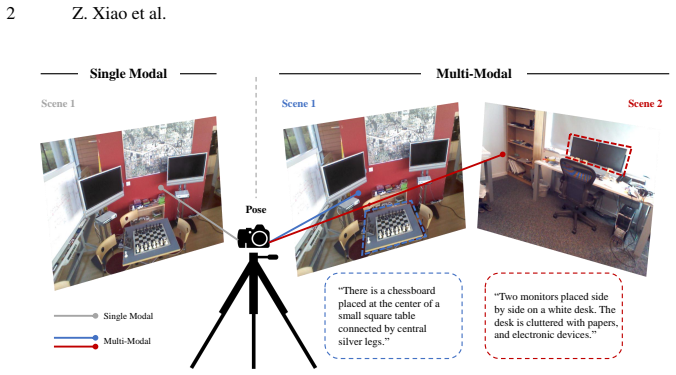
The central discovery is that adding open-set natural language scene descriptions to a CLIP-based visual encoder improves multi-scene 6-DoF camera relocalization beyond prior multi-scene baselines. The framework indexes each scene with a detailed, non-template language prompt, fuses the text embedding with visual features through a dot-product cross-modal encoder, and selects the correct pose regressor via a softmax scene classifier. The paper reports consistent gains over MSPN and C2f-MS-Transformer across indoor and outdoor scenes, with ablations showing that each component—pretrained world knowledge, language descriptions, and multi-scene training—contributes to the final accuracy.
Load-bearing premise
The method assumes that a text embedding from CLIP, which is a single vector, can be projected into the same spatial feature-map shape as the image features so that the dot-product fusion in Equation (6) is well defined and preserves enough metric information for pose regression.
Editorial extensions
If this is right
- A single model can replace separate per-scene pose regressors, with language prompts providing both scene identity and a semantic anchor for the regressor selection.
- Language descriptions can shift attention away from dynamic objects such as pedestrians and cars toward stable structures, which is why outdoor results improve on Cambridge Landmarks.
- The 23.8% position-error reduction on 7Scenes indicates that language guidance is especially helpful in cluttered indoor scenes where visual appearance alone is ambiguous.
- Prompt quality directly controls accuracy: the paper's own attention maps show that detailed descriptions produce sharper focus than broad ones, so writing better prompts is a direct path to better poses.
Reading between the lines
- The paper leaves the text-to-spatial projection unspecified; if that projection is filled in, the same cross-modal fusion idea could be extended to other dense regression tasks such as depth estimation or semantic mapping, though this goes beyond what the paper tests.
- Because the method requires one language prompt per scene, an obvious next step is to let a large language model generate the prompts automatically, which would remove the manual annotation bottleneck; this is our inference, not the paper's claim.
- The consistent rotation gains (19.2% on 7Scenes and 7.3% on Cambridge) hint that language helps most with orientation, possibly because language encodes object layout; this could be tested by ablating the orientation loss components separately.
- A head-to-head comparison with CLIP-Loc on the same scenes would show whether end-to-end learned fusion is a more robust alternative to landmark-association methods, since the paper does not run that direct comparison.
Editorial analysis
A structured set of objections, weighed in public.
Referee Report
Summary. The manuscript proposes MVL-Loc, an end-to-end multi-scene 6-DoF camera relocalization framework that fuses CLIP visual features with per-scene natural-language descriptions through transformer decoder layers, then regresses pose via a classification-weighted MLP. Experiments on 7Scenes and four selected Cambridge Landmarks scenes report state-of-the-art median errors (0.16 m / 6.98 degrees on 7Scenes and 0.93 m / 2.90 degrees on Cambridge Landmarks) and ablation studies attribute the gains to CLIP pretraining, language descriptions, and multi-scene training.
Significance. If the architecture is made fully precise, the paper would make a useful empirical contribution: it demonstrates cross-scene pose regression gains from language guidance, provides ablations isolating the source of gains, and evaluates against several modern baselines. The paper ships no code or full prompt list, and gives no error bars, but the central empirical claim is not circular; it is a held-out benchmark comparison. The main risks are not circularity but under-specification of the fusion mechanism and a selective evaluation protocol, both of which are addressable in revision.
major comments (4)
- [Eqs. (2) and (6)] Eq. (2) asserts that the language feature L-tilde lies in R^{C x H x W}, but the CLIP text encoder used in the paper outputs a single pooled embedding (or a token sequence), not a spatial feature map, and no projection ftoken is defined. Eq. (6) then defines fusion as V-tilde dot L-tilde^T with both tensors in R^{C x H x W}, which is not a well-defined matrix product and cannot produce (V,L) in R^{C x H x W} as required by Eqs. (3)-(5). Because the reported gains are attributed to language guidance, this is load-bearing; please specify the exact projection, tensor shapes, and fusion operation, and make Eqs. (3)-(5) dimensionally consistent.
- [Section 4.3] The Cambridge Landmarks evaluation is run on four of the six scenes, excluding Great Court and Street, with the stated reason that IRPNet, LSTM-PoseNet, and MS-Trans failed to converge on those scenes. Since the claimed 6% and 7.3% improvements over c2f-MsTrans in Table 1 are based on this reduced average, the protocol needs justification: either report all six scenes with per-scene results for every method, or cite an established four-scene protocol; otherwise the headline comparison is not interpretable.
- [Tables 1 and 2] All results are reported as single runs without repeated seeds, confidence intervals, or significance tests. The closest Cambridge comparison is 0.99 m versus 0.93 m average position error, a 6% difference that could easily arise from training noise; please report mean and standard deviation over at least three seeds, or otherwise quantify variability.
- [Sections 3.2 and 3.3] The central novelty is language guidance, but the full set of per-scene prompts is not provided; only illustrative examples appear in Figures 1-2 and the text. Moreover, Section 3.2 calls the descriptions 'dynamic, learnable language descriptions' while Section 3.3 treats them as fixed indexed inputs. Please provide the exact prompt list and clarify whether the prompts are learnable parameters or fixed strings; otherwise the method cannot be reproduced or compared fairly.
minor comments (5)
- [Eq. (7)] Equation (7) uses exp(k_i) in the Softmax, but the text defines z = [z1, z2, ..., zk] as the classification logits; please align the notation.
- [Eqs. (10) and (11)] Equation (10) writes the loss as |p - p-hat|1e^{-alpha} + alpha, which is ambiguous; it should be e^{-alpha} ||p - p-hat||_1 + alpha (and similarly for rotation). Equation (11) also appears dimensionally inconsistent: with q = (eta, zeta) where eta is a scalar and zeta is a vector, the expression eta/||eta|| cos^{-1}(zeta) is not the standard quaternion logarithm; please correct the formula.
- [Section 3.1 and Table 5] The text says the model failed to converge when N = 2 and that N = 8 and 16 are prohibitively expensive, but Table 5 reports results for N = 2 and N = 8; please reconcile these statements.
- [Section 3.3 citation] The text says 'Our work builds upon the VidLoc [21] pose estimation method,' but reference [21] is MapNet; VidLoc is reference [7]. Please correct the citation.
- [Section 4.1] The statement that CLIP was pretrained on 'MS-COCO, Visual Genome, and others' is inaccurate; the original CLIP model was trained on WebImageText. Please correct this description.
Circularity Check
No circularity found: MVL-Loc's claims are empirical benchmark results, and its only self-citation (EffLoc) is a background reference, not a load-bearing premise.
full rationale
I find no circular derivation step. MVL-Loc is an empirical relocalization system whose reported accuracy is obtained by training on benchmark train splits and measuring median pose errors on held-out test images; predictions are not derived from fitted constants or from the paper's own assumptions. The language descriptions and CLIP embeddings are auxiliary inputs, and the pose regressor is trained with the multi-scene loss in Eq. (10) against ground-truth poses, so the benchmark numbers are genuine out-of-sample measurements. The self-citation of EffLoc (ref. [9]) appears only in related work as a factual description of a prior method and is not used to justify the framework or the results. The shape inconsistency between Eq. (2)'s C x H x W language feature and CLIP's pooled text embedding, and the underspecified dot-product in Eq. (6), are reproducibility and correctness concerns rather than circularity: an undefined operation is not a self-referential definition. The ablation studies test components empirically rather than assert them by construction. No equation reduces to another by construction, and no fitted parameter is renamed as a prediction.
Assumptions & free parameters
free parameters (3)
- Loss scale parameters alpha and beta =
alpha=-4.0, beta=-2.0 (initial values; final values not reported)
- Number of transformer decoder layers N =
4
- Positional embedding scale gamma =
negative square root of width W
assumptions (6)
- domain assumption Pretrained CLIP visual and text features retain enough metric spatial information for 6-DoF pose regression after fusion.
- ad hoc to paper Text embeddings can be represented as spatial C by H by W feature maps compatible with image features.
- domain assumption Each test image belongs to exactly one of the K training scenes, and the softmax classifier selects the correct per-scene pose head.
- ad hoc to paper The four selected Cambridge Landmarks scenes are a representative test of multi-scene outdoor relocalization.
- ad hoc to paper Handcrafted per-scene language descriptions are available and valid for all test images.
- domain assumption Ground-truth poses from KinectFusion and SfM used in the benchmark splits are accurate enough for median error comparisons.
Cite this review
Pith. "Pith review of MVL-Loc: Leveraging Vision-Language Model for Generalizable Multi-Scene Camera Relocalization." pith.science (2026). https://pith.science/paper/SJTZKCZ3
@misc{pith2026250704509,
  author       = {Pith},
  title        = {Pith review of: MVL-Loc: Leveraging Vision-Language Model for Generalizable Multi-Scene Camera Relocalization},
  year         = {2026},
  howpublished = {\url{https://pith.science/paper/SJTZKCZ3}},
  note         = {Machine review of arXiv:2507.04509}
}
read the original abstract
Camera relocalization, a cornerstone capability of modern computer vision, accurately determines a camera's position and orientation (6-DoF) from images and is essential for applications in augmented reality (AR), mixed reality (MR), autonomous driving, delivery drones, and robotic navigation. Unlike traditional deep learning-based methods that regress camera pose from images in a single scene, which often lack generalization and robustness in diverse environments, we propose MVL-Loc, a novel end-to-end multi-scene 6-DoF camera relocalization framework. MVL-Loc leverages pretrained world knowledge from vision-language models (VLMs) and incorporates multimodal data to generalize across both indoor and outdoor settings. Furthermore, natural language is employed as a directive tool to guide the multi-scene learning process, facilitating semantic understanding of complex scenes and capturing spatial relationships among objects. Extensive experiments on the 7Scenes and Cambridge Landmarks datasets demonstrate MVL-Loc's robustness and state-of-the-art performance in real-world multi-scene camera relocalization, with improved accuracy in both positional and orientational estimates.
Figures


Figures from the paper (2 more)


Reference graph
Works this paper leans on
-
[1]
M. A. Fischler and R. C. Bolles, “Random sample consensus: A paradigm for model fitting with applications to image analysis and automated cartography,” Commun. ACM, vol. 24, no. 6, p. 381–395, Jun. 1981
work page 1981
-
[2]
Posenet: A convolutional network for real-time 6-dof camera relocalization,
A. Kendall, M. Grimes, and R. Cipolla, “Posenet: A convolutional network for real-time 6-dof camera relocalization,” in CVPR, 2015
work page 2015
-
[3]
Image-based localization using lstms for structured feature correlation,
F. Walch, C. Hazirbas, L. Leal-Taixe, T. Sattler, S. Hilsenbeck, and D. Cremers, “Image-based localization using lstms for structured feature correlation,” in CVPR, 2017
work page 2017
-
[4]
Image-based localization using hourglass networks,
I. Melekhov, J. Ylioinas, J. Kannala, and E. Rahtu, “Image-based localization using hourglass networks,” in ICCV, 2017
work page 2017
-
[5]
Modelling uncertainty in deep learning for camera relocalization,
A. Kendall and R. Cipolla, “Modelling uncertainty in deep learning for camera relocalization,” in ICRA, 2016
work page 2016
-
[6]
Geometric loss functions for camera pose regression with deep learning,
——, “Geometric loss functions for camera pose regression with deep learning,” inCVPR, 2017
work page 2017
-
[7]
Vidloc: A deep spatio-temporal model for 6-dof video-clip relocalization,
R. Clark, S. Wang, A. Markham, N. Trigoni, and H. Wen, “Vidloc: A deep spatio-temporal model for 6-dof video-clip relocalization,” in CVPR, 2017
work page 2017
-
[8]
Atloc: Attention guided camera localization,
B. Wang, C. Chen, C. X. Lu, P. Zhao, N. Trigoni, and A. Markham, “Atloc: Attention guided camera localization,” inProceedings of the AAAI Conference on Artificial Intelligence, vol. 34, no. 06, 2020, pp. 10 393–10 401
work page 2020
Show all 36 references
-
[9]
Effloc: Lightweight vision transformer for effi- cient 6-dof camera relocalization,
Z. Xiao, C. Chen, S. Yang, and W. Wei, “Effloc: Lightweight vision transformer for effi- cient 6-dof camera relocalization,” in 2024 IEEE International Conference on Robotics and Automation (ICRA), 2024, pp. 8529–8536
2024
-
[10]
Navgpt: Explicit reasoning in vision-and-language navigation with large language models,
G. Zhou, Y . Hong, and Q. Wu, “Navgpt: Explicit reasoning in vision-and-language navigation with large language models,” arXiv preprint arXiv:2305.16986, 2023
2023 arXiv
-
[11]
Rt-2: Vision-language-action models transfer web knowledge to robotic control,
A. Brohan, N. Brown, J. Carbajal, Y . Chebotar, and X. Chen, “Rt-2: Vision-language-action models transfer web knowledge to robotic control,” inarXiv preprint arXiv:2307.15818, 2023
2023 arXiv
-
[12]
Extending absolute pose regression to multiple scenes,
H. Blanton, C. Greenwell, S. Workman, and N. Jacobs, “Extending absolute pose regression to multiple scenes,” in Proceedings of the IEEE/CVF Conference on Computer Vision and Pattern Recognition Workshops, 2020, pp. 38–39
2020
-
[13]
Coarse-to-fine multi-scene pose regression with trans- formers,
Y . Shavit, R. Ferens, and Y . Keller, “Coarse-to-fine multi-scene pose regression with trans- formers,” IEEE transactions on pattern analysis and machine intelligence, vol. PP, 08 2023. Title Suppressed Due to Excessive Length 13
2023
-
[14]
City-scale landmark identification on mobile devices,
D. M. Chen, G. Baatz, K. K ¨oser, S. S. Tsai, R. Vedantham, T. Pylv ¨an¨ainen, K. Roimela, X. Chen, J. Bach, M. Pollefeys et al., “City-scale landmark identification on mobile devices,” in CVPR, 2011
2011
-
[15]
Imagdressing-v1: Cus- tomizable virtual dressing,
F. Shen, X. Jiang, X. He, H. Ye, C. Wang, X. Du, Z. Li, and J. Tang, “Imagdressing-v1: Cus- tomizable virtual dressing,” in Proceedings of the AAAI Conference on Artificial Intelligence, vol. 39, no. 7, 2025, pp. 6795–6804
2025
-
[16]
Imagpose: A unified conditional framework for pose-guided person generation,
F. Shen and J. Tang, “Imagpose: A unified conditional framework for pose-guided person generation,” Advances in neural information processing systems , vol. 37, pp. 6246–6266, 2024
2024
-
[17]
Dsac-differentiable ransac for camera localization,
E. Brachmann, A. Krull, S. Nowozin, J. Shotton, F. Michel, S. Gumhold, and C. Rother, “Dsac-differentiable ransac for camera localization,” in CVPR, 2017
2017
-
[18]
Hybrid scene compression for visual localization,
F. Camposeco, A. Cohen, M. Pollefeys, and T. Sattler, “Hybrid scene compression for visual localization,” in CVPR, 2019
2019
-
[19]
Map-free visual relocalization: Metric pose relative to a single image,
E. Arnold, J. Wynn, S. Vicente, G. Garcia-Hernando, ´A. Monszpart, V . A. Prisacariu, D. Tur- mukhambetov, and E. Brachmann, “Map-free visual relocalization: Metric pose relative to a single image,” in ECCV, 2022
2022
-
[20]
Learning multi-scene absolute pose regression with transformers,
Y . Shavit, R. Ferens, and Y . Keller, “Learning multi-scene absolute pose regression with transformers,” in 2021 IEEE/CVF International Conference on Computer Vision (ICCV) , 2021, pp. 2713–2722
2021
-
[21]
Geometry-aware learning of maps for camera localization,
S. Brahmbhatt, J. Gu, K. Kim, J. Hays, and J. Kautz, “Geometry-aware learning of maps for camera localization,” in CVPR, 2018
2018
-
[22]
Fusionloc: Camera-2d lidar fusion using multi-head self-attention for end-to-end serving robot relocalization,
J. Lee, H. Lee, and J. Oh, “Fusionloc: Camera-2d lidar fusion using multi-head self-attention for end-to-end serving robot relocalization,” IEEE Access, vol. 11, pp. 75 121–75 133, 2023
2023
-
[23]
Learning transferable visual models from natural language supervision,
A. Radford, J. W. Kim, C. Hallacy, A. Ramesh, G. Goh, S. Agarwal, G. Sastry, A. Askell, P. Mishkin, J. Clark et al. , “Learning transferable visual models from natural language supervision,” in International conference on machine learning. PMLR, 2021, pp. 8748– 8763
2021
-
[24]
Clip-adapter: Better vision-language models with feature adapters,
P. Gao, S. Geng, R. Zhang, T. Ma, R. Fang, Y . Zhang, H. Li, and Y . Qiao, “Clip-adapter: Better vision-language models with feature adapters,” arXiv preprint arXiv:2110.04544, 2021
2021 arXiv
-
[25]
Envedit: Environment editing for vision-and-language naviga- tion,
J. Li, H. Tan, and M. Bansal, “Envedit: Environment editing for vision-and-language naviga- tion,” in 2022 IEEE/CVF Conference on Computer Vision and Pattern Recognition (CVPR), 2022, pp. 15 386–15 396
2022
-
[26]
Learning to generate scene graph from natural language supervision,
Y . Zhong, J. Shi, J. Yang, C. Xu, and Y . Li, “Learning to generate scene graph from natural language supervision,” in ICCV, 2021
2021
-
[27]
Denseclip: Language-guided dense prediction with context-aware prompting,
Y . Rao, W. Zhao, G. Chen, Y . Tang, Z. Zhu, G. Huang, J. Zhou, and J. Lu, “Denseclip: Language-guided dense prediction with context-aware prompting,” in Proceedings of the IEEE Conference on Computer Vision and Pattern Recognition (CVPR), 2022
2022
-
[28]
Fm-loc: Using foundation models for improved vision-based localization,
R. Mirjalili, M. Krawez, and W. Burgard, “Fm-loc: Using foundation models for improved vision-based localization,” in 2023 IEEE/RSJ International Conference on Intelligent Robots and Systems (IROS), 2023, pp. 1381–1387
2023
-
[29]
Clip-loc: Multi-modal landmark association for global localization in object-based maps,
S. Matsuzaki, T. Sugino, K. Tanaka, Z. Sha, S. Nakaoka, S. Yoshizawa, and K. Shintani, “Clip-loc: Multi-modal landmark association for global localization in object-based maps,” 2024 IEEE International Conference on Robotics and Automation (ICRA), pp. 13 673–13 679, 2024
2024
-
[30]
Geollm: Extracting geospatial knowledge from large language models,
R. Manvi, S. Khanna, G. Mai, M. Burke, D. B. Lobell, and S. Ermon, “Geollm: Extracting geospatial knowledge from large language models,” in The Twelfth International Conference on Learning Representations, 2024
2024
-
[31]
Georeasoner: Geo-localization with reasoning in street views using a large vision-language model,
L. Li, Y . Ye, B. Jiang, and W. Zeng, “Georeasoner: Geo-localization with reasoning in street views using a large vision-language model,” inInternational Conference on Machine Learning (ICML), 2024. 14 Z. Xiao et al
2024
-
[32]
Advancing pose-guided image synthesis with progressive conditional diffusion models,
F. Shen, H. Ye, J. Zhang, C. Wang, X. Han, and W. Yang, “Advancing pose-guided image synthesis with progressive conditional diffusion models,”arXiv preprint arXiv:2310.06313, 2023
2023 arXiv
-
[33]
Boosting consistency in story visualization with rich-contextual conditional diffusion models,
F. Shen, H. Ye, S. Liu, J. Zhang, C. Wang, X. Han, and Y . Wei, “Boosting consistency in story visualization with rich-contextual conditional diffusion models,” in Proceedings of the AAAI Conference on Artificial Intelligence, vol. 39, no. 7, 2025, pp. 6785–6794
2025
-
[34]
7-scenes dataset,
A. Criminisi, J. Shotton, B. Glocker, S. Izadi, and A. Fitzgibbon, “7-scenes dataset,” 2013
2013
-
[35]
Do we really need scene-specific pose encoders?
Y . Shavit and R. Ferens, “Do we really need scene-specific pose encoders?” IEEE, 2021, pp. 3186–3192
2021
-
[36]
Image-based localization using hourglass networks,
I. Melekhov, J. Ylioinas, J. Kannala, and E. Rahtu, “Image-based localization using hourglass networks,” in 2017 IEEE International Conference on Computer Vision Workshops (ICCVW), 2017, pp. 870–877
2017
Reviewed August 6, 2026 · model on record in the stance chip above.
Discussion (0). Sign in to comment.