REVIEW 5 major objections 7 minor 53 references
any4: Learned 4-bit Numeric Representation for LLMs
T0 review · 5 major / 7 minor · reviewed 2026-08-06 · deepseek-v4-flash
Pith's one-line read any4 learns a per-row 16-entry codebook for each weight matrix and claims it outperforms fixed 4-bit formats without preprocessing.
desk verdict A credible 4-bit LUT quantization recipe with an overstated headline claim and a derivation that needs fixing; worth refereeing. read the letter →
The pith
A machine-rendered reading of the paper's core claim, the machinery that carries it, and where it could break.
The reading
What carries the argument
The mechanism that carries the argument is the per-row, 16-entry lookup table (LUT) produced by the any4 algorithm. After group-wise scaling of weights, an alternating Lloyd iteration assigns each scaled weight to its nearest centroid (the E-step) and then updates each centroid by Eq. 23, so that cluster centroids are weighted by $\alpha_{i,j}\mathbb{E}|x_j|$; this is a weighted k-means whose objective is output-activation error rather than weight reconstruction error. The calibration activation statistic $\mathbb{E}|x_j|$ is estimated from a single 88-word prompt, k-means++ seeds the centroids, and each row is processed independently in parallel, quantizing Llama3 8B in about 10 minutes. The same LUT mechanism is then realized in the tinygemm CUDA kernels with a one-register warp-shuffle lookup, which is why any4 avoids the latency penalty usually associated with per-row codebooks.
What would settle it
Quantize Llama3 8B with any4 using ten different 88-word prompts that cover the same five topics but use different sentences, and measure the spread of WikiText-2 perplexity; if the spread is larger than the roughly 0.1-point margin by which any4 beats nf4 on the published prompt, the single-prompt calibration premise fails to support the headline comparison.
Extended reading notes
Core claim
On the paper's own terms, the central discovery is that a 4-bit weight representation should be a per-row codebook of 16 arbitrary bfloat16 values rather than a fixed integer, floating-point, or normal-float grid. The authors derive, from minimizing the expected absolute activation error $\mathbb{E}|\hat{y}_i-y_i|$, that the optimal centroid for each k-means cluster of scaled weights is the weighted average $$$w^{{Q_q}}$_i = \frac{\sum_{q \in Q_i^q} \alpha_{i,j} w^S_{i,j} \mathbb{E}|x_j|}{\sum_{q \in Q_i^q} \alpha_{i,j} \mathbb{E}|x_j|},$$ where $\alpha_{i,j}$ is the group scale and $\mathbb{E}|x_j|$ is the mean absolute activation of the input channel. They show that this learned representation beats int4, fp4, and nf4 on perplexity for Llama 2, Llama 3, Mistral, and Mixtral at 4 bits, is competitive with AWQ, GPTQ, and QuIP that use preprocessing, and extends usefully to 3 bits and partly to 2 bits, where QuIP remains strongest.
Load-bearing premise
The whole accuracy comparison rests on the assumption that one hand-written 88-word prompt, run through the model, gives a reliable estimate of the mean absolute activation per channel for every row and every task, even though no seed or prompt variability analysis is reported.
Editorial extensions
If this is right
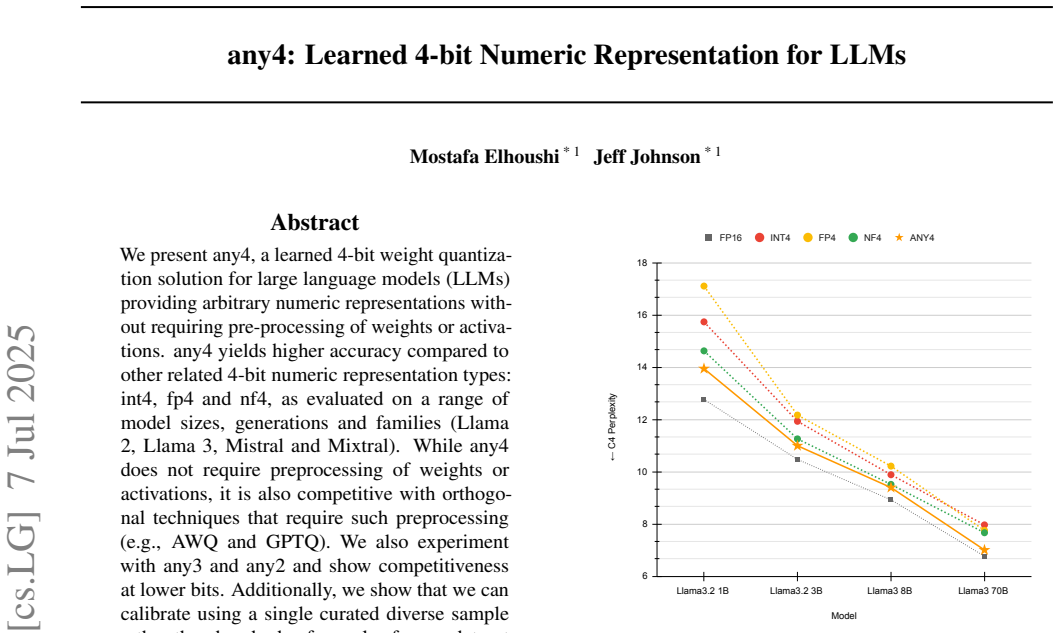
- At 4 bits, any4 consistently gives lower perplexity than int4, fp4, and nf4 across Llama 2, Llama 3, Mistral, and Mixtral, including 70B models.
- Without preprocessing weights or activations, any4 matches or beats AWQ, GPTQ, and QuIP with int4 on Llama3 8B and 70B WikiText-2 perplexity.
- The calibration corpus can be a single 88-word prompt covering fiction, news, code, math, and facts rather than hundreds of dataset samples.
- tinygemm makes any4 run at almost the same speed as nf4 on A100 for small-batch matrix-vector multiplication, so the accuracy gain is available without a latency penalty.
- Any3 is competitive with 3-bit preprocessing methods, while any2 beats AWQ and roughly matches GPTQ at 2-bit; QuIP remains best at 2-bit.
Reading between the lines
- Beyond the paper, if single-prompt calibration really transfers across tokenizers and tasks, PTQ pipelines could drop dataset calibration entirely, but prompt and seed sensitivity need a dedicated study.
- Because any4 is orthogonal to preprocessing, replacing int4 with any4 inside AWQ, GPTQ, or rotation-based pipelines is a direct next test that the paper leaves open.
- The group-size ablation hints that learned codebooks absorb scale variation that breaks fp4 and nf4 at large groups, which could make any4 the safer choice for coarse-grain quantization; this deserves a stress test at group sizes beyond 1024.
- The 2-bit results indicate learned representations do not remove the need for preprocessing at very low bits, since QuIP still leads; a hybrid of any4 with incoherence processing is the natural experiment.
Editorial analysis
A structured set of objections, weighed in public.
Referee Report
Summary. The paper proposes any4, a weight-only 4-bit post-training quantization method that learns a per-row 16-entry lookup table via k-means clustering, with centroid updates weighted by group scale and mean absolute calibration activations. It also introduces tinygemm, a CUDA GEMM library implementing LUT-based dequantization for small-batch LLM inference. Experiments compare any4 against int4, fp4, and nf4 on perplexity and downstream tasks across Llama 2, Llama 3, Mistral, and Mixtral, and include 3-bit and 2-bit variants, a calibration ablation using a single hand-written 88-word prompt, and group-size ablations.
Significance. If the headline claim is supported, any4 would be a useful contribution: it adds only 0.0625 bits per entry over grouped int4, ships open-source code and a latency-optimized tinygemm library, and achieves nf4-comparable speed. The strengths are the broad model coverage, the open-source implementation, the calibration ablations, and the group-size study. However, the margins over nf4 are often only 0.02-0.12 perplexity points, downstream-task results are mixed, and the theoretical derivation in Section 4.1 contains internal inconsistencies. The significance of the work is therefore conditional on a corrected derivation and on additional robustness evidence.
major comments (5)
- [Section 4.1, Eqs. (11)-(23)] The stated objective and the M-step are inconsistent. Eq. (11) minimizes expected absolute output error, but Eq. (23) is a weighted mean, which is the minimizer of a weighted squared-error objective, not an absolute-error objective. Moreover, the step from Eq. (20) to Eq. (21) replaces the expectation of an absolute value of a sum with a sum of expectations of absolute values; this is not valid for signed error terms without a strong distributional assumption. Since Eq. (23) defines the centroid update, this needs to be repaired, either by deriving the update from a squared-error objective with a valid expectation expansion or by justifying the L1-to-L2 substitution explicitly.
- [Algorithm 1, Section 4.1] Algorithm 1 sets sample_weight = alphai * abs(xi.mean()), which is not the per-element weight alpha_i,j * E|x_j| in Eq. (23): it is the absolute value of a mean (possibly a single scalar for a row) rather than the mean of absolute activations per channel. These quantities differ when activations have both signs. The paper must state which weighting was actually used in the reported experiments and reconcile the algorithm with the derivation, rerunning the main comparisons if the implementation differs from Eq. (23).
- [Abstract, Section 5, Tables 1, A1, A2] The abstract's unqualified 'higher accuracy' claim is not supported by the paper's own downstream results. any4 is worse than nf4 on HumanEval for Llama3.2 1B (11.0 vs 13.4), Llama3 8B (21.3 vs 23.2), Llama3 70B (17.1 vs 18.9), and Llama2 70B (26.8 vs 29.9), and worse on MBPP for Llama2 7B and Llama2 70B. Perplexity gaps are often 0.02-0.12, and no repeated runs, seeds, or variance estimates are reported. The authors should either restrict the headline claim to perplexity, or add error bars, multiple seeds, and aggregate win rates that support a broader accuracy claim.
- [Table 3, Section 5.1] The single-prompt calibration ablation is run on one model only (Llama3.2 1B), and the differences between the handwritten prompt and dataset-based calibrations (0.01-0.1 perplexity) are comparable to or smaller than the any4-vs-nf4 margins in Tables 1, A1, and A2. The claim that a single curated prompt is sufficient needs evidence of stability across models, tokenizers, and prompt variants, including variance over calibration runs, before it can be treated as a robust finding.
- [Section 5, Table 2] The claim that any2 is 'competitive with GPTQ' is contradicted by the reported numbers. For Llama3 8B, any2 perplexity is 1.0E3 versus GPTQ 2.1E2; for Llama3 70B, any2 is 253.8 versus GPTQ 11.9. The lower-bit claims in the abstract and Section 5 should be revised or supported by additional experiments that show actual competitiveness.
minor comments (7)
- [Eq. (17)] The squared-error expansion should read (alpha_i,j x_j)^2 (wS_i,j - wQ_i,j)^2, not alpha_i,j x_j (wS_i,j - wQ_i,j)^2; as written the square on the scale-activation product is missing.
- [Eqs. (10)-(11)] Eq. (10) writes the objective as E ||y_hat - y|| without specifying the norm, and Eq. (11) switches to E |y_hat_i - y_i|; please clarify which objective is being minimized.
- [Table A3 / Section C.1] The caption of Table A3 says 'Llama3 8B' but the surrounding text in Section C.1 refers to Llama3.2 1B; the model name should be made consistent.
- [Section 2.5.1] The groupwise index range is written as 'kg <= j < k(g+1)'; the intended range is presumably k*g <= j < (k+1)*g, since the current expression has interval length k rather than g.
- [Table A4] The caption contains a typo: 'initialzied' should be 'initialized'.
- [Figure 3] The speed benchmark would benefit from stating the batch/sequence dimension M used for the matrix multiplications and clarifying whether the weight matrices are square K x K across all sizes.
- [Listing 1] The '88 words' description is a word count, not a token count, and the number of tokens depends on the tokenizer; the text should state this explicitly to avoid confusion.
Circularity Check
No significant circularity: any4 codebooks are fit on calibration text and evaluated on held-out perplexity, with no reported fitted parameter that targets the evaluation metric.
full rationale
The central derivation in Section 4.1 minimizes an output-activation error objective and yields the weighted k-means centroid update in Eq. 23. This is a fitting procedure, not a prediction procedure: the LUT centroids are computed from calibration activations and then evaluated on held-out corpora (WikiText-2, C4, PTB, CodeParrot). No reported parameter is fitted to the final perplexity or downstream accuracy numbers, and the calibration sample in Listing 1 is not reported as selected by searching evaluation perplexity. The calibration ablation in Table 3 shows that different calibration data change results by small amounts, but this is an empirical sensitivity result rather than a circular argument. The paper's comparisons to GPTQ, AWQ, and QuIP rely on external published numbers (Huang et al., 2024), and there is no load-bearing self-citation; the only project-related mention is that an early tinygemm version shipped in PyTorch, which is not used to justify any4's accuracy claim. Some mathematical steps (e.g., replacing signed activation values by E|x_j| in Eq. 21) are questionable as a derivation, but that is a correctness/robustness concern, not circularity. Overall, the accuracy claim is supported by an independent fit-then-evaluate protocol, so the circularity score is 0.
Assumptions & free parameters
free parameters (4)
- quantization group size g =
128 (default; ablated 64, 256, 512, 1024)
- symmetric vs asymmetric scaling per model =
symmetric for Llama3 70B, asymmetric otherwise
- hand-curated calibration prompt =
88-word prompt covering fiction, news, code, math, facts (Listing 1)
- k-means hyperparameters (n_init, tol, max_iter) =
scikit-learn defaults
assumptions (4)
- standard math k-means alternating optimization converges to a useful local optimum for the per-row codebook problem
- domain assumption The mean absolute activation E|x_j|, estimated from a single calibration sample, is representative of activation statistics during evaluation
- ad hoc to paper Minimizing a weighted squared-error surrogate (weighted k-means) is an effective proxy for the stated objective of minimizing expected absolute output error
- domain assumption Rows of a weight matrix can be quantized independently without co-optimization
Cite this review
Pith. "Pith review of any4: Learned 4-bit Numeric Representation for LLMs." pith.science (2026). https://pith.science/paper/K4XBOTYQ
@misc{pith2026250704610,
  author       = {Pith},
  title        = {Pith review of: any4: Learned 4-bit Numeric Representation for LLMs},
  year         = {2026},
  howpublished = {\url{https://pith.science/paper/K4XBOTYQ}},
  note         = {Machine review of arXiv:2507.04610}
}
read the original abstract
We present any4, a learned 4-bit weight quantization solution for large language models (LLMs) providing arbitrary numeric representations without requiring pre-processing of weights or activations. any4 yields higher accuracy compared to other related 4-bit numeric representation types: int4, fp4 and nf4, as evaluated on a range of model sizes, generations and families (Llama 2, Llama 3, Mistral and Mixtral). While any4 does not require preprocessing of weights or activations, it is also competitive with orthogonal techniques that require such preprocessing (e.g., AWQ and GPTQ). We also experiment with any3 and any2 and show competitiveness at lower bits. Additionally, we show that we can calibrate using a single curated diverse sample rather than hundreds of samples from a dataset as done in most quantization approaches. We also open source tinygemm, a latency optimized GPU matrix multiplication library for LLMs, that implements any4 using a GPU-efficient lookup table strategy along with other common quantization methods. We open source our code at https://github.com/facebookresearch/any4 .
Figures


Reference graph
Works this paper leans on
-
[1]
write newline
" write newline "" before.all 'output.state := FUNCTION n.dashify 't := "" t empty not t #1 #1 substring "-" = t #1 #2 substring "--" = not "--" * t #2 global.max substring 't := t #1 #1 substring "-" = "-" * t #2 global.max substring 't := while if t #1 #1 substring * t #2 global.max substring 't := if while FUNCTION format.date year duplicate empty "emp...
-
[2]
Arthur, D. and Vassilvitskii, S. k-means++: the advantages of careful seeding. In Proceedings of the Eighteenth Annual ACM-SIAM Symposium on Discrete Algorithms, SODA '07, pp.\ 1027–1035, USA, 2007. Society for Industrial and Applied Mathematics. ISBN 9780898716245
work page 2007
-
[3]
L., Li, B., Cameron, P., Jaggi, M., Alistarh, D., Hoefler, T., and Hensman, J
Ashkboos, S., Mohtashami, A., Croci, M. L., Li, B., Cameron, P., Jaggi, M., Alistarh, D., Hoefler, T., and Hensman, J. Quarot: Outlier-free 4-bit inference in rotated LLM s. In The Thirty-eighth Annual Conference on Neural Information Processing Systems, 2024 a . URL https://openreview.net/forum?id=dfqsW38v1X
work page 2024
-
[4]
L., Li, B., Cameron, P., Jaggi, M., Alistarh, D., Hoefler, T., and Hensman, J
Ashkboos, S., Mohtashami, A., Croci, M. L., Li, B., Cameron, P., Jaggi, M., Alistarh, D., Hoefler, T., and Hensman, J. Quarot: Outlier-free 4-bit inference in rotated llms, 2024 b . URL https://arxiv.org/abs/2404.00456
arXiv 2024
-
[5]
A framework for the evaluation of code generation models
Ben Allal, L., Muennighoff, N., Kumar Umapathi, L., Lipkin, B., and von Werra, L. A framework for the evaluation of code generation models. https://github.com/bigcode-project/bigcode-evaluation-harness, 2022
work page 2022
-
[6]
Chee, J., Cai, Y., Kuleshov, V., and Sa, C. D. Qu IP : 2-bit quantization of large language models with guarantees. In Thirty-seventh Conference on Neural Information Processing Systems, 2023. URL https://openreview.net/forum?id=xrk9g5vcXR
work page 2023
-
[7]
CodeParrot. Codeparrot/codeparrot-clean. URL https://huggingface.co/datasets/codeparrot/codeparrot-clean
-
[8]
Vs-quant: Per-vector scaled quantization for accurate low-precision neural network inference
Dai, S., Venkatesan, R., Ren, M., Zimmer, B., Dally, W., and Khailany, B. Vs-quant: Per-vector scaled quantization for accurate low-precision neural network inference. In Smola, A., Dimakis, A., and Stoica, I. (eds.), Proceedings of Machine Learning and Systems, volume 3, pp.\ 873--884, 2021. URL https://proceedings.mlsys.org/paper_files/paper/2021/file/4...
work page 2021
Show all 53 references
-
[9]
Pushing the limits of narrow precision inferencing at cloud scale with microsoft floating point
Darvish Rouhani, B., Lo, D., Zhao, R., Liu, M., Fowers, J., Ovtcharov, K., Vinogradsky, A., Massengill, S., Yang, L., Bittner, R., Forin, A., Zhu, H., Na, T., Patel, P., Che, S., Chand Koppaka, L., SONG, X., Som, S., Das, K., T, S., Reinhardt, S., Lanka, S., Chung, E., and Bur...
2020
-
[10]
Gpt3.int8(): 8-bit matrix multiplication for transformers at scale
Dettmers, T., Lewis, M., Belkada, Y., and Zettlemoyer, L. Gpt3.int8(): 8-bit matrix multiplication for transformers at scale. In Koyejo, S., Mohamed, S., Agarwal, A., Belgrave, D., Cho, K., and Oh, A. (eds.), Advances in Neural Information Processing Systems, volume 35, pp.\ 3...
2022
-
[11]
8-bit optimizers via block-wise quantization
Dettmers, T., Lewis, M., Shleifer, S., and Zettlemoyer, L. 8-bit optimizers via block-wise quantization. In International Conference on Learning Representations, 2022 b . URL https://openreview.net/forum?id=shpkpVXzo3h
2022
-
[12]
Qlora: Efficient finetuning of quantized llms
Dettmers, T., Pagnoni, A., Holtzman, A., and Zettlemoyer, L. Qlora: Efficient finetuning of quantized llms. In Oh, A., Naumann, T., Globerson, A., Saenko, K., Hardt, M., and Levine, S. (eds.), Advances in Neural Information Processing Systems, volume 36, pp.\ 10088--10115. Cur...
2023
-
[13]
Extreme compression of large language models via additive quantization
Egiazarian, V., Panferov, A., Kuznedelev, D., Frantar, E., Babenko, A., and Alistarh, D. Extreme compression of large language models via additive quantization. In Forty-first International Conference on Machine Learning, 2024. URL https://openreview.net/forum?id=5mCaITRTmO
2024
-
[14]
OPTQ : Accurate quantization for generative pre-trained transformers
Frantar, E., Ashkboos, S., Hoefler, T., and Alistarh, D. OPTQ : Accurate quantization for generative pre-trained transformers. In The Eleventh International Conference on Learning Representations, 2023. URL https://openreview.net/forum?id=tcbBPnfwxS
2023
-
[15]
Don’t waste your bits! S queeze activations and gradients for deep neural networks via T iny S cript
Fu, F., Hu, Y., He, Y., Jiang, J., Shao, Y., Zhang, C., and Cui, B. Don’t waste your bits! S queeze activations and gradients for deep neural networks via T iny S cript. In III, H. D. and Singh, A. (eds.), Proceedings of the 37th International Conference on Machine Learning, v...
2020
-
[16]
A framework for few-shot language model evaluation, 07 2024
Gao, L., Tow, J., Abbasi, B., Biderman, S., Black, S., DiPofi, A., Foster, C., Golding, L., Hsu, J., Le Noac'h, A., Li, H., McDonell, K., Muennighoff, N., Ociepa, C., Phang, J., Reynolds, L., Schoelkopf, H., Skowron, A., Sutawika, L., Tang, E., Thite, A., Wang, B., Wang, K., a...
2024
-
[17]
Low-precision floating-point for efficient on-board deep neural network processing, 2023
Gernigon, C., Filip, S.-I., Sentieys, O., Coggiola, C., and Bruno, M. Low-precision floating-point for efficient on-board deep neural network processing, 2023. URL https://arxiv.org/abs/2311.11172
2023 arXiv
-
[18]
Deep Learning
Goodfellow, I., Bengio, Y., and Courville, A. Deep Learning. MIT Press, 2016. URL http://www.deeplearningbook.org. Book in preparation for MIT Press
2016
-
[19]
Grattafiori, A., Dubey, A., Jauhri, A., Pandey, A., Kadian, A., Al-Dahle, A., Letman, A., Mathur, A., Schelten, A., Vaughan, A., Yang, A., Fan, A., Goyal, A., Hartshorn, A., Yang, A., Mitra, A., Sravankumar, A., Korenev, A., Hinsvark, A., Rao, A., Zhang, A., Rodriguez, A., Gre...
2024 arXiv
-
[20]
Han, S., Mao, H., and Dally, W. J. Deep compression: Compressing deep neural networks with pruning, trained quantization and huffman coding. International Conference on Learning Representations (ICLR), 2016
2016
-
[21]
Hooper, C. R. C., Kim, S., Mohammadzadeh, H., Mahoney, M. W., Shao, S., Keutzer, K., and Gholami, A. KVQ uant: Towards 10 million context length LLM inference with KV cache quantization. In The Thirty-eighth Annual Conference on Neural Information Processing Systems, 2024. URL...
2024
-
[22]
An empirical study of llama3 quantization: From llms to mllms, 2024
Huang, W., Zheng, X., Ma, X., Qin, H., Lv, C., Chen, H., Luo, J., Qi, X., Liu, X., and Magno, M. An empirical study of llama3 quantization: From llms to mllms, 2024. URL https://arxiv.org/abs/2404.14047
2024 arXiv
-
[23]
Quantization and training of neural networks for efficient integer-arithmetic-only inference
Jacob, B., Kligys, S., Chen, B., Zhu, M., Tang, M., Howard, A., Adam, H., and Kalenichenko, D. Quantization and training of neural networks for efficient integer-arithmetic-only inference. In Proceedings of the IEEE Conference on Computer Vision and Pattern Recognition (CVPR),...
2018
-
[24]
Q., Sablayrolles, A., Mensch, A., Bamford, C., Chaplot, D
Jiang, A. Q., Sablayrolles, A., Mensch, A., Bamford, C., Chaplot, D. S., de las Casas, D., Bressand, F., Lengyel, G., Lample, G., Saulnier, L., Lavaud, L. R., Lachaux, M.-A., Stock, P., Scao, T. L., Lavril, T., Wang, T., Lacroix, T., and Sayed, W. E. Mistral 7b, 2023. URL http...
2023 arXiv
-
[25]
Squeezellm: Dense-and-sparse quantization
Kim, S., Hooper, C., Gholami, A., Dong, Z., Li, X., Shen, S., Mahoney, M., and Keutzer, K. Squeezellm: Dense-and-sparse quantization. arXiv, 2023
2023
-
[26]
Awq: Activation-aware weight quantization for llm compression and acceleration
Lin, J., Tang, J., Tang, H., Yang, S., Chen, W.-M., Wang, W.-C., Xiao, G., Dang, X., Gan, C., and Han, S. Awq: Activation-aware weight quantization for llm compression and acceleration. In MLSys, 2024
2024
-
[27]
Spinquant: Llm quantization with learned rotations, 2024
Liu, Z., Zhao, C., Fedorov, I., Soran, B., Choudhary, D., Krishnamoorthi, R., Chandra, V., Tian, Y., and Blankevoort, T. Spinquant: Llm quantization with learned rotations, 2024. URL https://arxiv.org/abs/2405.16406
2024 arXiv
-
[28]
Least squares quantization in pcm
Lloyd, S. Least squares quantization in pcm. IEEE Transactions on Information Theory, 28 0 (2): 0 129--137, 1982 a . doi:10.1109/TIT.1982.1056489
1982
-
[29]
Least squares quantization in pcm
Lloyd, S. Least squares quantization in pcm. IEEE transactions on information theory, 28 0 (2): 0 129--137, 1982 b
1982
-
[30]
MacQueen, J. et al. Some methods for classification and analysis of multivariate observations. In Proceedings of the fifth Berkeley symposium on mathematical statistics and probability, volume 1, pp.\ 281--297. Oakland, CA, USA, 1967
1967
-
[31]
P., Marcinkiewicz, M
Marcus, M. P., Marcinkiewicz, M. A., and Santorini, B. Building a large annotated corpus of english: the penn treebank. Comput. Linguist., 19 0 (2): 0 313–330, June 1993. ISSN 0891-2017
1993
-
[32]
Quantizing for minimum distortion
Max, J. Quantizing for minimum distortion. IRE Transactions on Information Theory, 6 0 (1): 0 7--12, 1960. doi:10.1109/TIT.1960.1057548
1960
-
[33]
Pointer sentinel mixture models
Merity, S., Xiong, C., Bradbury, J., and Socher, R. Pointer sentinel mixture models. In International Conference on Learning Representations, 2017. URL https://openreview.net/forum?id=Byj72udxe
2017
-
[34]
A., Van Baalen, M., Louizos, C., and Blankevoort, T
Nagel, M., Amjad, R. A., Van Baalen, M., Louizos, C., and Blankevoort, T. Up or down? adaptive rounding for post-training quantization. In Proceedings of the 37th International Conference on Machine Learning, ICML'20. JMLR.org, 2020
2020
-
[35]
Scikit-learn: Machine learning in P ython
Pedregosa, F., Varoquaux, G., Gramfort, A., Michel, V., Thirion, B., Grisel, O., Blondel, M., Prettenhofer, P., Weiss, R., Dubourg, V., Vanderplas, J., Passos, A., Cournapeau, D., Brucher, M., Perrot, M., and Duchesnay, E. Scikit-learn: Machine learning in P ython. Journal of ...
2011
-
[36]
Fp8-lm: Training fp8 large language models, 2023
Peng, H., Wu, K., Wei, Y., Zhao, G., Yang, Y., Liu, Z., Xiong, Y., Yang, Z., Ni, B., Hu, J., Li, R., Zhang, M., Li, C., Ning, J., Wang, R., Zhang, Z., Liu, S., Chau, J., Hu, H., and Cheng, P. Fp8-lm: Training fp8 large language models, 2023
2023
-
[37]
gpt-fast, 2023
PyTorch. gpt-fast, 2023. URL https://github.com/pytorch-labs/gpt-fast
2023
-
[38]
torchao, 2024
PyTorch. torchao, 2024. URL https://github.com/pytorch/ao
2024
-
[39]
Raffel, C., Shazeer, N., Roberts, A., Lee, K., Narang, S., Matena, M., Zhou, Y., Li, W., and Liu, P. J. Exploring the limits of transfer learning with a unified text-to-text transformer. arXiv e-prints, 2019
2019
-
[40]
With shared microexponents, a little shifting goes a long way, 2023
Rouhani, B., Zhao, R., Elango, V., Shafipour, R., Hall, M., Mesmakhosroshahi, M., More, A., Melnick, L., Golub, M., Varatkar, G., Shao, L., Kolhe, G., Melts, D., Klar, J., L'Heureux, R., Perry, M., Burger, D., Chung, E., Deng, Z., Naghshineh, S., Park, J., and Naumov, M. With ...
2023 arXiv
-
[41]
And the bit goes down: Revisiting the quantization of neural networks
Stock, P., Joulin, A., Gribonval, R., Graham, B., and Jégou, H. And the bit goes down: Revisiting the quantization of neural networks. In International Conference on Learning Representations, 2020. URL https://openreview.net/forum?id=rJehVyrKwH
2020
-
[42]
V., and Gopalakrishnan, K
Sun, X., Wang, N., Chen, C.-Y., Ni, J., Agrawal, A., Cui, X., Venkataramani, S., El Maghraoui, K., Srinivasan, V. V., and Gopalakrishnan, K. Ultra-low precision 4-bit training of deep neural networks. In Larochelle, H., Ranzato, M., Hadsell, R., Balcan, M., and Lin, H. (eds.),...
2020
-
[43]
Llama: Open and efficient foundation language models, 2023 a
Touvron, H., Lavril, T., Izacard, G., Martinet, X., Lachaux, M.-A., Lacroix, T., Rozière, B., Goyal, N., Hambro, E., Azhar, F., Rodriguez, A., Joulin, A., Grave, E., and Lample, G. Llama: Open and efficient foundation language models, 2023 a . URL https://arxiv.org/abs/2302.13971
2023 arXiv
-
[44]
Touvron, H., Martin, L., Stone, K., Albert, P., Almahairi, A., Babaei, Y., Bashlykov, N., Batra, S., Bhargava, P., Bhosale, S., Bikel, D., Blecher, L., Ferrer, C. C., Chen, M., Cucurull, G., Esiobu, D., Fernandes, J., Fu, J., Fu, W., Fuller, B., Gao, C., Goswami, V., Goyal, N....
2023 arXiv
-
[45]
Tseng, A., Sun, Q., Hou, D., and Sa, C. D. QTIP : Quantization with trellises and incoherence processing. In The Thirty-eighth Annual Conference on Neural Information Processing Systems, 2024. URL https://openreview.net/forum?id=7sdkLVuYCU
2024
-
[46]
Training deep neural networks with 8-bit floating point numbers
Wang, N., Choi, J., Brand, D., Chen, C.-Y., and Gopalakrishnan, K. Training deep neural networks with 8-bit floating point numbers. In Bengio, S., Wallach, H., Larochelle, H., Grauman, K., Cesa-Bianchi, N., and Garnett, R. (eds.), Advances in Neural Information Processing Syst...
2018
-
[47]
I., Gu, A., Madaan, L., Hupkes, D., Liu, J., Wei, Y., Jain, N., Lai, Y., Sootla, S., Press, O., Rozière, B., and Synnaeve, G
Wang, S. I., Gu, A., Madaan, L., Hupkes, D., Liu, J., Wei, Y., Jain, N., Lai, Y., Sootla, S., Press, O., Rozière, B., and Synnaeve, G. E val- A rena: noise and errors on llm evaluations. https://github.com/crux-eval/eval-arena, 2024
2024
-
[48]
L., Gugger, S., Drame, M., Lhoest, Q., and Rush, A
Wolf, T., Debut, L., Sanh, V., Chaumond, J., Delangue, C., Moi, A., Cistac, P., Rault, T., Louf, R., Funtowicz, M., Davison, J., Shleifer, S., von Platen, P., Ma, C., Jernite, Y., Plu, J., Xu, C., Scao, T. L., Gugger, S., Drame, M., Lhoest, Q., and Rush, A. M. Transformers: St...
2020
-
[49]
A simple and efficient stochastic rounding method for training neural networks in low precision, 2021
Xia, L., Anthonissen, M., Hochstenbach, M., and Koren, B. A simple and efficient stochastic rounding method for training neural networks in low precision, 2021. URL https://arxiv.org/abs/2103.13445
2021 arXiv
-
[50]
S mooth Q uant: Accurate and efficient post-training quantization for large language models
Xiao, G., Lin, J., Seznec, M., Wu, H., Demouth, J., and Han, S. S mooth Q uant: Accurate and efficient post-training quantization for large language models. In Proceedings of the 40th International Conference on Machine Learning, 2023
2023
-
[51]
and Jabri, M
Xie, Y. and Jabri, M. Analysis of the effects of quantization in multilayer neural networks using a statistical model. IEEE Transactions on Neural Networks, 3 0 (2): 0 334--338, 1992. doi:10.1109/72.125876
1992 doi
-
[52]
Nf4 isn't information theoretically optimal (and that's good), 2023
Yoshida, D. Nf4 isn't information theoretically optimal (and that's good), 2023. URL https://arxiv.org/abs/2306.06965
2023 arXiv
-
[53]
H., Edo, I., Awad, O
Zadeh, A. H., Edo, I., Awad, O. M., and Moshovos, A. GOBO: Quantizing Attention-Based NLP Models for Low Latency and Energy Efficient Inference . In 2020 53rd Annual IEEE/ACM International Symposium on Microarchitecture (MICRO), pp.\ 811--824, Los Alamitos, CA, USA, October 20...
2020
Reviewed August 6, 2026 · model on record in the stance chip above.
Discussion (0). Sign in to comment.