REVIEW 3 major objections 5 minor 51 references
Tuning electronic correlations in the Kagome metals $RT_3$B$_2$
T0 review · 3 major / 5 minor · reviewed 2026-08-06 · deepseek-v4-flash
Pith's one-line read The kagome metal LuOs3B2 is a bulk type-II superconductor at $T_c = 4.75$ K with enhanced correlations and imaginary phonon modes, while YCo3B2 is its correlated but non-superconducting counterpart.
desk verdict Credible characterization of two kagome metals, but the coexistence claim is undermined by an unexplained electron-phonon coupling discrepancy and phonon calculations that omit spin-orbit coupling in a 5d compound. read the letter →
The pith
A machine-rendered reading of the paper's core claim, the machinery that carries it, and where it could break.
The reading
What carries the argument
The central object is the perfect kagome lattice of Os (or Co) atoms in the RT3B2 structure, which supplies the quasi-flat bands, Dirac cones, and van Hove singularities near the Fermi level. The argument is carried by three tools: the Wilson ratio and Kadowaki-Woods ratio, which convert measured susceptibility, specific heat, and resistivity into correlation-strength indicators; density functional theory plus density functional perturbation theory, which produce the band structures, Fermi surfaces, and phonon dispersions; and the McMillan formula, which translates the calculated electron-phonon coupling into a predicted superconducting $T_c$. The imaginary phonon modes at high-symmetry points, especially L, are the load-bearing signal connecting correlations to a possible charge-order or structural transition.
What would settle it
A single-crystal or phase-pure sample of LuOs3B2 measured for susceptibility, resistivity, and heat capacity would settle the central claim: if $T_c = 4.75$ K, Wilson ratio ≈ 3, Kadowaki-Woods ratio ≈ 48, and the heat-capacity jump survive in the clean sample, the correlations are intrinsic; if the ratios shrink or the transition weakens, the reported impurity phases were carrying part of the signal.
Extended reading notes
Core claim
On the paper's own terms: LuOs3B2 superconducts in bulk at $T_c = 4.75$ K, with magnetization, resistivity, and heat capacity all showing the transition, and the normalized heat-capacity jump is smaller than the single-gap BCS expectation, hinting at multigap behavior. First-principles calculations give an electron-phonon coupling λ ≈ 1.96 and a predicted $T_c ≈ 6$ K, in fair agreement with experiment, and the measured Wilson and Kadowaki-Woods ratios (≈3 and ≈48) indicate non-negligible correlations. Its calculated phonon spectrum has imaginary modes, notably at the L point, which the authors interpret as susceptibility to a structural distortion or charge-density-wave-like order. YCo3B2, by contrast, shows kagome flat bands, Dirac cones, and van Hove singularities, a Kadowaki-Woods ratio ≈13, no superconductivity above 1.8 K, and no imaginary phonon modes. The pair is offered as evidence that in this family the strength of electronic correlations and the tendency toward lattice instability can be tuned by switching the transition-metal site while preserving the kagome geometry.
Load-bearing premise
The paper's key assumption is that the measured superconductivity and correlation ratios come from LuOs3B2 itself, even though the sample contains about 5% of a different compound (LuOs2) and 4% osmium metal, and these impurities prevented a full structural refinement; if those phases contribute to the susceptibility, resistivity, or heat capacity, the correlation numbers and the bulk nature of the superconducting transition could be misattributed.
Editorial extensions
If this is right
- LuOs3B2 becomes a concrete candidate for pressure or doping experiments aimed at driving the L-point phonon instability into a charge-density-wave or structural transition.
- The smaller-than-BCS heat-capacity jump and the unusual quasi-linear upper-critical-field curve point to multigap or strong-coupling superconductivity, which spectroscopic gap measurements could test directly.
- In YCo3B2, doping that moves the Fermi level down into the large density of states just below it could activate superconductivity or other correlation effects.
- The contrast with LaRh3B2 (no strong correlations, no imaginary modes) and LuOs3B2 (both present) tightens the proposed link between electronic correlations and phonon anomalies in the RT3B2 family.
Reading between the lines
- An implication the authors leave implicit is that single-crystal or phase-pure samples of LuOs3B2 are needed to confirm the correlation estimates, because the ~5% LuOs2 and ~4% Os impurities could contribute to susceptibility, resistivity, or heat capacity.
- A concrete extension would be hydrostatic pressure: if the L-point imaginary mode controls a real instability, pressure should drive LuOs3B2 toward a structural or charge-density-wave transition.
- The quasi-linear $H_{c2}(T)$ behavior suggests the single-band WHH picture may be incomplete, so a two-band or strong-coupling analysis is a direct next test of the superconducting state.
Editorial analysis
A structured set of objections, weighed in public.
Referee Report
Summary. The paper reports an experimental and first-principles study of two kagome metals, LuOs3B2 and YCo3B2. The experiments show that LuOs3B2 is a bulk type-II superconductor with Tc ≈ 4.75 K, evidenced by resistivity, magnetization, and heat capacity, and that YCo3B2 does not superconduct above 1.8 K. From the measured susceptibility, resistivity, and heat capacity, the authors derive Wilson and Kadowaki-Woods ratios and conclude that both compounds are electronically correlated. The DFT calculations describe the band structure, Fermi surface, and phonon spectra. The phonon calculations for LuOs3B2 produce imaginary modes at Γ, A, and L, which the authors interpret as a lattice instability and use as a basis for proposing pressure or doping studies toward charge order.
Significance. If the central claims are established, the paper identifies a kagome metal in which strong electronic correlations and a phonon instability coexist, which would be an interesting target for future pressure and doping studies. The experimental measurements are standard and appear to support bulk superconductivity in LuOs3B2. The paper also makes falsifiable predictions, such as the lattice-instability tendency, and its description of the kagome-derived electronic structure is a useful contribution. However, the theoretical pillar currently has an unresolved internal inconsistency and a missing spin-orbit-coupling check, so the significance is conditional: the coexistence claim is not yet firmly supported by the evidence as presented.
major comments (3)
- [Methods; Phonon Calculations] The imaginary modes at Γ, A, and L are computed with density-functional perturbation theory using scalar-relativistic norm-conserving pseudopotentials without spin-orbit coupling, although the paper itself emphasizes that SOC has the most significant effect on the band structure of LuOs3B2. Since the L-point mode is the sole basis for the structural-instability and charge-order-candidacy claim, an SOC-inclusive phonon calculation or an explicit relaxation of the distorted structure with SOC is needed to show that the mode survives. As it stands, the calculation does not exclude the possibility that the L-point instability is an artifact of the scalar-relativistic approximation.
- [Physical Properties (McMillan inversion); Phonon Calculations] There is an unresolved quantitative inconsistency in the electron-phonon coupling. From the measured Tc the authors obtain λep = 0.54 for μ* = 0.10 and 0.64 for μ* = 0.15, while the DFPT result is λe−ph = 1.96 for LuOs3B2. The text states that the first-principles estimates are consistent with the observed Tc and that Tc ≈ 6 K is obtained in fair agreement, but with λ = 1.96 and the stated μ* range the McMillan formula would predict a substantially higher Tc for any reasonable ωlog; reproducing 6 K would require an unusually small ωlog, which is not reported. The paper should present the Eliashberg function, the value of ωlog, and the μ* used for the 6 K estimate, and should reconcile the DFPT λ value with the McMillan-inverted value.
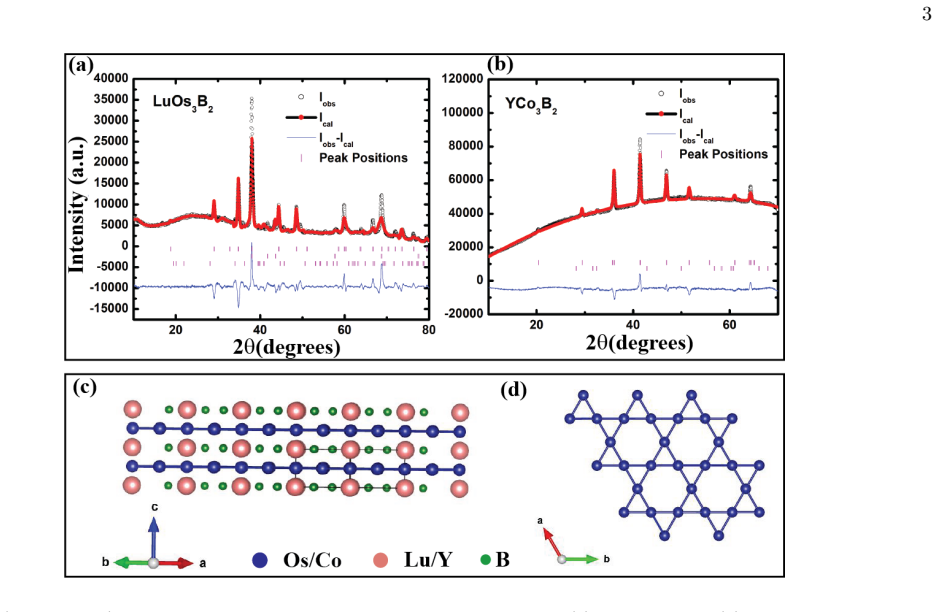
- [Structure] The LuOs3B2 sample contains approximately 5% LuOs2 and 4% Os impurity phases, and the authors state that these impurities prevented a good Rietveld refinement. The measured susceptibility, resistivity, and heat capacity are then used without impurity subtraction to infer χP, γ, A, and hence the Wilson ratio ≈ 3 and Kadowaki-Woods ratio ≈ 48. These ratios are central to the claimed electronic correlations, so the authors should quantify possible impurity contributions or compare with the single-phase samples reported in ref. [51] to demonstrate that the derived correlation parameters are intrinsic to LuOs3B2.
minor comments (5)
- [Abstract; Results] The abstract and summary mention Fermi surface calculations revealing quasi-one-dimensional behavior along the c-axis in YCo3B2, but no Fermi surface results are presented in the Results section. Either add the corresponding figure and discussion or remove this claim.
- [Phonon Calculations] The text says intermediate-frequency modes are due to Co or Rh atoms, but the compounds studied contain Co and Os, not Rh. This appears to be a typographical error.
- [Fig. 5(b)] The suggestion of multi-gap superconductivity is based only on a reduced normalized heat-capacity jump. A reduced jump can arise from strong coupling, anisotropy, or other effects, so the wording should be more cautious unless a two-gap analysis is provided.
- [Fig. 1 caption; Structure] The Fig. 1 caption refers to 'results of refinement' while the main text says a good Rietveld refinement was not possible and no refinement parameters are used. The caption and text should be made consistent.
- [Text] There are several typographical errors, including 'seperated', 'feild', and 'super-cell'; these should be corrected in a revision.
Circularity Check
No significant circularity: the paper's claims rest on direct measurements and independent first-principles calculations, with self-citations used only as qualitative comparison.
full rationale
This is an experimental characterization study combined with independent DFT calculations. The superconducting Tc, Wilson ratio, Kadowaki-Woods ratio, and Debye temperature are direct measured quantities or standard combinations of measured quantities; the DFT electron-phonon coupling λe-ph ≈ 1.96 is obtained from first-principles DFPT and used in the McMillan formula to predict Tc ≈ 6 K, which is not fitted to the observed 4.75 K. The McMillan-inverted λep ≈ 0.54 is separately labeled as an estimate from Tc and is not presented as the ab initio prediction. The phonon imaginary modes are an ab initio result, independent of the measured data. Self-citations to the authors' earlier LaRh3B2 paper [29] are used only for qualitative comparison of kagome band features and correlation signatures, not as a load-bearing argument that forces the main conclusions. The Note Added citing independent work [51] in qualitative agreement provides external support. The internal discrepancy between λe-ph ≈ 1.96 (DFPT) and λep ≈ 0.54 (McMillan inversion) is a correctness or consistency concern, but it is not circularity: neither quantity is defined in terms of the other, and the predictive chain does not reduce to its own inputs.
Assumptions & free parameters
free parameters (10)
- χ0 (temperature-independent Pauli susceptibility for LuOs3B2) =
13.4(1) × 10^-5 cm3/mol
- TE (susceptibility model temperature scale) =
884(7) K
- C (Curie constant from impurities) =
0.00138(1) cm3 K/mol
- θ (Weiss temperature) =
-6.1(1) K
- a (T^2 resistivity coefficient, LuOs3B2) =
9.7 × 10^-3 μΩ cm K^-2
- A (T^2 resistivity coefficient, YCo3B2) =
2.2(6) × 10^-3 μΩ cm K^-2
- γ (Sommerfeld coefficient, LuOs3B2) =
14.28(9) mJ/mol K^2
- γ (Sommerfeld coefficient, YCo3B2) =
12.83(4) mJ/mol K^2
- μ* (Coulomb pseudopotential) =
0.10-0.15 (assumed)
- β (T^3 heat capacity coefficient, LuOs3B2) =
0.261(6) mJ/mol K^4
assumptions (6)
- domain assumption GGA-PBE DFT accurately describes the electronic and phonon structure of these 4d/5d transition-metal borides.
- standard math The McMillan and Allen-Dynes formulas provide reliable estimates of Tc from λ and ωlog.
- domain assumption Atomic diamagnetic susceptibility values from the literature can be summed to estimate the core diamagnetism of LuOs3B2.
- domain assumption The Van Vleck paramagnetic orbital contribution is negligible for LuOs3B2.
- domain assumption The impurity phases (LuOs2, Os) do not materially affect the measured heat capacity, susceptibility, and resistivity used for correlation estimates.
- domain assumption The imaginary phonon mode at the L point is a physical instability and not a numerical artifact.
Cite this review
Pith. "Pith review of Tuning electronic correlations in the Kagome metals $RT_3$B$_2$." pith.science (2026). https://pith.science/paper/OHIYHNSG
@misc{pith2026250704693,
  author       = {Pith},
  title        = {Pith review of: Tuning electronic correlations in the Kagome metals $RT_3$B$_2$},
  year         = {2026},
  howpublished = {\url{https://pith.science/paper/OHIYHNSG}},
  note         = {Machine review of arXiv:2507.04693}
}
abstract
The $RT_3$B$_2$ ($R=$Y, Lu, $T=$ Co, Os) family hosts a perfect kagome lattice of $T$ atoms, offering an interesting platform to investigate the interplay of electronic structure, superconductivity, and lattice dynamics. Here, we compare two members of this family, LuOs$_3$B$_2$ and YCo$_3$B$_2$, with similar crystallography but differing chemical composition, leading to distinct electronic correlation strengths and spin-orbit coupling effects. We confirm superconductivity in LuOs$_3$B$_2$ with $T_c = 4.75$K, while YCo$_3$B$_2$ remains non-superconducting above 1.8K. First-principles estimates of the electron-phonon coupling for LuOs$_3$B$_2$ are consistent with its observed $T_c$ and suggest a moderate coupling strength. Both materials exhibit kagome-derived electronic features, including quasi-flat bands, Dirac cones, and van Hove singularities. Fermi surface calculations reveal quasi-one-dimensional behavior along the $c$-axis in YCo$_3$B$_2$, in contrast to the more three-dimensional Fermiology of LuOs$_3$B$_2$. Phonon calculations for LuOs$_3$B$_2$ show imaginary modes, indicating potential lattice instabilities. Experimental estimates of the Wilson and Kadowaki-Woods ratios point to non-negligible electronic correlations in both compounds.
Figures


Figures from the paper (6 more)


Reference graph
Works this paper leans on
-
[51]
Y. Xiao, Q. Duan, T. jia, Y. Cui, S. Liu, Z. Wen, L. Ji, R. Zhong, Y. Chen, and Y. Zhao, Superconductivity and electron correlations in the kagome metal luos3b2, Phys. Rev. B 111, 195132 (2025)
work page 2025
-
[1]
Balents, Spin liquids in frustrated magnets, Nature 464, 199 (2010)
L. Balents, Spin liquids in frustrated magnets, Nature 464, 199 (2010)
2010
-
[2]
Savary and L
L. Savary and L. Balents, Quantum spin liquids: a re- view, Reports on Progress in Physics80, 016502 (2016)
2016
-
[3]
Broholm, R
C. Broholm, R. J. Cava, S. A. Kivelson, D. G. Nocera, M. R. Norman, and T. Senthil, Quantum spin liquids, Science 367, eaay0668 (2020)
2020
-
[4]
J. Knolle and R. Moessner, A Field Guide to Spin Liq- uids, Ann. Rev. Condensed Matter Phys.10, 451 (2019), arXiv:1804.02037 [cond-mat.str-el]
work page Pith review arXiv 2019
-
[5]
M. Fu, T. Imai, T.-H. Han, and Y. S. Lee, Evidence for a gapped spin-liquid ground state in a kagome heisenberg antiferromagnet, Science 350, 655 (2015), https://www.science.org/doi/pdf/10.1126/science.aab2120
-
[6]
T.-H. Han, J. S. Helton, S. Chu, D. G. Nocera, J. A. Rodriguez-Rivera, C. Broholm, and Y. S. Lee, Fraction- alized excitations in the spin-liquid state of a kagome- lattice antiferromagnet, Nature492, 406 (2012)
2012
-
[7]
C. Balz, B. Lake, J. Reuther, H. Luetkens, R. Schöne- mann, T. Herrmannsdörfer, Y. Singh, A. T. M. Naz- mulIslam, E.M.Wheeler, J.Rodriguez-Rivera, T.Guidi, G. Simeoni, C. Baines, and H. Ryll, Physical realization of a quantum spin liquid based on a complex frustration mechanism, Nature Physics12, 942 (2016)
work page 2016
Show all 51 references
-
[8]
Okamoto, M
Y. Okamoto, M. Nohara, H. Aruga-Katori, and H. Tak- agi, Spin-liquid state in thes = 1/2 hyperkagome antifer- romagnet na4ir3o8, Phys. Rev. Lett.99, 137207 (2007)
2007
-
[9]
Singh, Y
Y. Singh, Y. Tokiwa, J. Dong, and P. Gegenwart, Spin liquid close to a quantum critical point in na4ir3o8, Phys. Rev. B 88, 220413 (2013)
2013
-
[10]
Mazin, H
I. Mazin, H. Jeschke, F. Lechermann, H. Lee, M. Fink, R. Thomale, and R. Valentí, Theoretical prediction of a strongly correlated dirac metal, Nature communica- tions 5, 10.1038/ncomms5261 (2014), funding Informa- tion: We acknowledge useful discussions with C. Krell- ner, C. ...
2014 doi
-
[11]
M. Kang, L. Ye, S. Fang, J. You, A. Levitan, M. Han, J. Facio, C. Jozwiak, A. Bostwick, E. Rotenberg, M. Chan, R. McDonald, D. Graf, K. Kaznatcheev, E. Vescovo, D. Bell, E. Kaxiras, J. van den Brink, M. Richter, M. Prasad Ghimire, J. Checkelsky, and R. Comin, Dirac fermions an...
2020
-
[12]
M. Kang, S. Fang, L. Ye, H. Po, J. Denlinger, C. Jozwiak, A. Bostwick, E. Rotenberg, E. Kaxiras, J. Checkel- sky, and R. Comin, Topological flat bands in frus- trated kagome lattice cosn, Nature Communications11, 10.1038/s41467-020-17465-1 (2020), publisher Copyright: © 2020, ...
2020 doi
-
[13]
M. Li, Q. Wang, G. Wang, Z. Yuan, W. Song, R. Lou, Z. Liu, Y. Huang, Z. Liu, H. Lei, Z. Yin, and S. Wang, Dirac cone, flat band and saddle point in kagome magnet ymn6sn6, Nature Communications12, 3129 (2021)
2021
-
[14]
B. R. Ortiz, L. C. Gomes, J. R. Morey, M. Winiarski, M. Bordelon, J. S. Mangum, I. W. H. Oswald, J. A. Rodriguez-Rivera, J. R. Neilson, S. D. Wil- son, E. Ertekin, T. M. McQueen, and E. S. To- berer, New kagome prototype materials: discovery of kv3sb5, rbv3sb5, and csv3sb5, Ph...
2019
-
[15]
B. R. Ortiz, S. M. L. Teicher, Y. Hu, J. L. Zuo, P. M. Sarte, E. C. Schueller, A. M. M. Abeykoon, M. J. Krogstad, S. Rosenkranz, R. Osborn, R. Seshadri, L. Ba- lents, J. He, and S. D. Wilson,Csv3sb5: A 𭟋2 topologi- cal kagome metal with a superconducting ground state, Phys. Re...
2020
-
[16]
B. R. Ortiz, P. M. Sarte, E. M. Kenney, M. J. Graf, S. M. L. Teicher, R. Seshadri, and S. D. Wilson, Super- conductivity in the𭟋2 kagome metalkv3sb5, Phys. Rev. Mater. 5, 034801 (2021)
2021
-
[17]
S.-Y. Yang, Y. Wang, B. R. Ortiz, D. Liu, J. Gayles, E. Derunova, R. Gonzalez-Hernandez, L. Šmejkal, Y. Chen, S. S. P. Parkin, S. D. Wilson, E. S. To- berer, T.McQueen, andM. N.Ali,Giant, unconventional anomalous hall effect in the metallic frustrated magnet candidate, kv<sub>...
2020
-
[18]
H. Ku, G. Meisner, F. Acker, and D. Johnston, Supercon- ducting and magnetic properties of new ternary borides with the ceco3b2-type structure, Solid State Communi- cations 35, 91 (1980)
1980
-
[19]
Barz, New ternary superconductors with silicon, Ma- terials Research Bulletin15, 1489 (1980)
H. Barz, New ternary superconductors with silicon, Ma- terials Research Bulletin15, 1489 (1980)
1980
-
[20]
Vandenberg and H
J. Vandenberg and H. Barz, The crystal structure of a new ternary silicide in the system rare-earth-ruthenium- silicon, Materials Research Bulletin15, 1493 (1980)
1980
-
[21]
S. K. Malik, A. M. Umarji, G. K. Shenoy, A. T. Aldred, and D. G. Niarchos, Magnetism and superconductivity in the systemce1−xlaxrh3b2, Phys. Rev. B32, 4742 (1985)
1985
-
[22]
Athreya, L
K. Athreya, L. Hausermann-Berg, R. Shelton, S. Ma- lik, A. Umarji, and G. Shenoy, Superconductivity in the ternary borides ceos3b2 and ceru3b2: Magnetic suscep- tibility and specific heat measurements, Physics Letters A 113, 330 (1985)
1985
-
[23]
Rauchschwalbe, W
U. Rauchschwalbe, W. Lieke, F. Steglich, C. Godart, L. C. Gupta, and R. D. Parks, Superconductivity in a mixed-valent system: ceru3si2, Phys. Rev. B 30, 444 (1984)
1984
-
[24]
S. Li, B. Zeng, X. Wan, J. Tao, F. Han, H. Yang, Z. Wang, and H.-H. Wen, Anomalous properties in the normal and superconducting states of laru 3si2, Phys. Rev. B 84, 214527 (2011)
2011
-
[25]
S. Li, J. Tao, X. Wan, X. Ding, H. Yang, and H.-H. Wen, Distinct behaviors of suppression to superconductivity in laru3si2 induced by fe and co dopants, Phys. Rev. B86, 024513 (2012)
2012
-
[26]
B. Li, S. Li, and H.-H. Wen, Chemical doping effect in the laru3si2 superconductor with a kagome lattice, Phys. Rev. B 94, 094523 (2016)
2016
-
[27]
Mielke, Y
C. Mielke, Y. Qin, J.-X. Yin, H. Nakamura, D. Das, K. Guo, R. Khasanov, J. Chang, Z. Q. Wang, S. Jia, S. Nakatsuji, A. Amato, H. Luetkens, G. Xu, M. Z. Hasan, and Z. Guguchia, Nodeless kagome superconduc- tivity in laru3si2, Phys. Rev. Mater.5, 034803 (2021)
2021
-
[28]
Y. Liu, J. Li, W.-Z. Yang, J.-Y. Lu, B.-Y. Cao, H.-X. Li, W.-L. Chai, S.-Q. Wu, B.-Z. Li, Y.-L. Sun, W.-H. Jiao, C. Wang, X.-F. Xu, Z. Ren, and G.-H. Cao, Supercon- ductivity in kagome metal thru3si2, Chinese Physics B 33, 057401 (2024)
2024
-
[29]
Chaudhary, Shama, J
S. Chaudhary, Shama, J. Singh, A. Consiglio, D. Di Sante, R. Thomale, and Y. Singh, Role of elec- tronic correlations in the kagome-lattice superconductor larh3b2, Phys. Rev. B107, 085103 (2023)
2023
-
[30]
Kresse and J
G. Kresse and J. Hafner, Ab initio molecular dynamics for liquid metals, Phys. Rev. B47, 558 (1993)
1993
-
[31]
Kresse and J
G. Kresse and J. Hafner, Ab initio molecular-dynamics simulation of the liquid-metal–amorphous-semiconductor transition in germanium, Phys. Rev. B49, 14251 (1994)
1994
-
[32]
Kresse and J
G. Kresse and J. Furthmüller, Efficient iterative schemes for ab initio total-energy calculations using a plane-wave basis set, Phys. Rev. B54, 11169 (1996)
1996
-
[33]
Kresse and J
G. Kresse and J. Furthmüller, Efficiency of ab-initio total energy calculations for metals and semiconductors using a plane-wave basis set, Computational Materials Science 6, 15 (1996)
1996
-
[34]
Kresse and D
G. Kresse and D. Joubert, From ultrasoft pseudopoten- tials to the projector augmented-wave method, Phys. Rev. B 59, 1758 (1999)
1999
-
[35]
J. P. Perdew, K. Burke, and M. Ernzerhof, Generalized gradient approximation made simple, Phys. Rev. Lett. 77, 3865 (1996)
1996
-
[36]
Giannozzi, O
P. Giannozzi, O. Baseggio, P. Bonfà, D. Brunato, R. Car, I. Carnimeo, C. Cavazzoni, S. de Gironcoli, P. Delugas, F. Ferrari Ruffino, A. Ferretti, N. Marzari, I. Timrov, A. Urru, and S. Baroni, Quantum espresso toward the exascale, The Journal of Chemical Physics 152, 154105 (2...
2020 doi
-
[37]
Giannozzi, S
P. Giannozzi, S. Baroni, N. Bonini, M. Calandra, R. Car, C. Cavazzoni, D. Ceresoli, G. L. Chiarotti, M. Cococ- cioni, I. Dabo, A. Dal Corso, S. de Gironcoli, S. Fabris, G. Fratesi, R. Gebauer, U. Gerstmann, C. Gougoussis, A. Kokalj, M. Lazzeri, L. Martin-Samos, N. Marzari, F. ...
2009
-
[38]
Giannozzi, O
P. Giannozzi, O. Andreussi, T. Brumme, O. Bunau, M. Buongiorno Nardelli, M. Calandra, R. Car, C. Cavaz- zoni, D. Ceresoli, M. Cococcioni, N. Colonna, I. Carn- imeo, A. Dal Corso, S. de Gironcoli, P. Delugas, R. A. DiStasio, A. Ferretti, A. Floris, G. Fratesi, G. Fugallo, R. Ge...
2017
-
[39]
D. R. Hamann, Optimized norm-conserving vanderbilt pseudopotentials, Phys. Rev. B88, 085117 (2013)
2013
-
[40]
Wierzbowska, S
M. Wierzbowska, S. de Gironcoli, and P. Giannozzi, Ori- gins of low- and high-pressure discontinuities oftc in nio- bium (2006), arXiv:cond-mat/0504077 [cond-mat.supr- con]
2006 arXiv
-
[41]
Chacon and O
C. Chacon and O. Isnard, The structural and magnetic properties of yn+1co3n+5b2n compounds investigated by neutron diffraction, Journal of Physics: Condensed Matter 13, 5841 (2001)
2001
-
[42]
L. B. Mendelsohn, F. Biggs, and J. B. Mann, Hartree- fock diamagnetic susceptibilities, Phys. Rev. A2, 1130 (1970)
1970
-
[43]
Singh, A
Y. Singh, A. Niazi, M. D. Vannette, R. Prozorov, and D. C. Johnston, Superconducting and normal-state prop- ertiesofthelayeredboride Osb2,Phys.Rev.B 76,214510 (2007)
2007
-
[44]
K. G. Wilson, The renormalization group: Critical phe- nomena and the kondo problem, Rev. Mod. Phys. 47, 773 (1975)
1975
-
[45]
C. Gong, S. Tian, Z. Tu, Q. Yin, Y. Fu, R. Luo, and H. Lei, Superconductivity in kagome metal yru3si2 with strong electron correlations, Chinese Physics Letters39, 087401 (2022)
2022
-
[46]
M.J.Rice,Electron-electronscatteringintransitionmet- als, Phys. Rev. Lett.20, 1439 (1968)
1968
-
[47]
Kadowaki and S
K. Kadowaki and S. Woods, Universal relationship of the resistivity and specific heat in heavy-fermion compounds, Solid State Communications58, 507 (1986)
1986
-
[48]
Singh, C
Y. Singh, C. Martin, S. L. Bud’ko, A. Ellern, R. Pro- zorov, and D. C. Johnston, Multigap superconductivity and shubnikov–de haas oscillations in single crystals of the layered boride osb2, Phys. Rev. B82, 144532 (2010)
2010
-
[49]
W. L. McMillan, Transition temperature of strong- coupled superconductors, Phys. Rev.167, 331 (1968)
1968
-
[50]
J. P. Carbotte, Properties of boson-exchange supercon- ductors, Rev. Mod. Phys.62, 1027 (1990)
1990
Reviewed August 6, 2026 · model on record in the stance chip above.
Discussion (0). Continue with ORCID to comment.