Multidimensional Nebular-Phase Calculations of Dynamically-Driven Double-Degenerate Double-Detonation Models for Type Ia Supernovae
Pith reviewed 2026-05-19 06:15 UTC · model grok-4.3
The pith
Nebular-phase spectra from 3D double-detonation models tentatively favor detonation of only the primary white dwarf.
A machine-rendered reading of the paper's core claim, the machinery that carries it, and where it could break.
Core claim
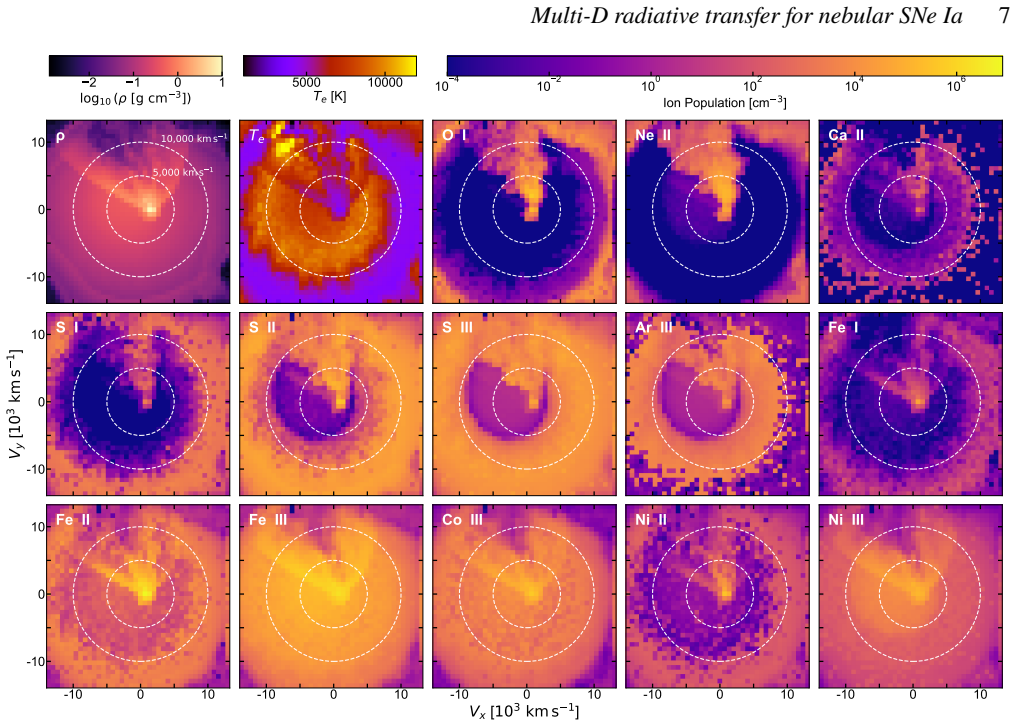
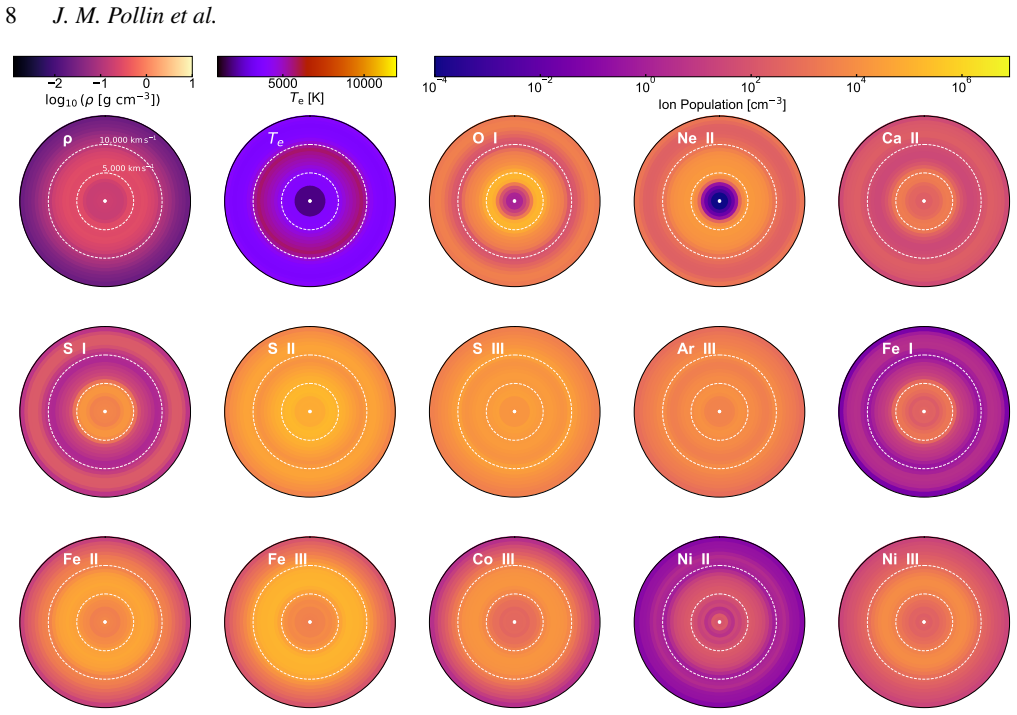
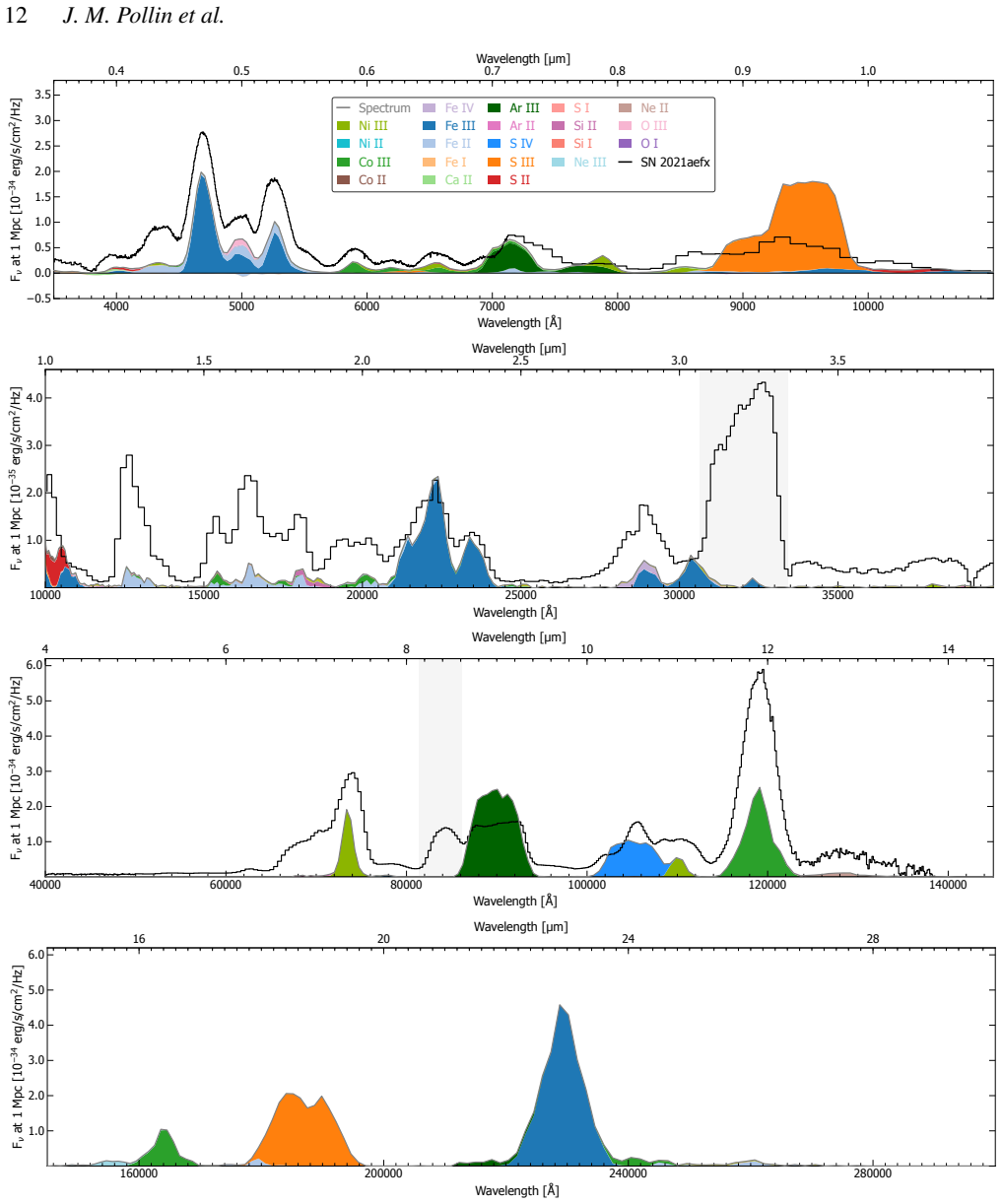
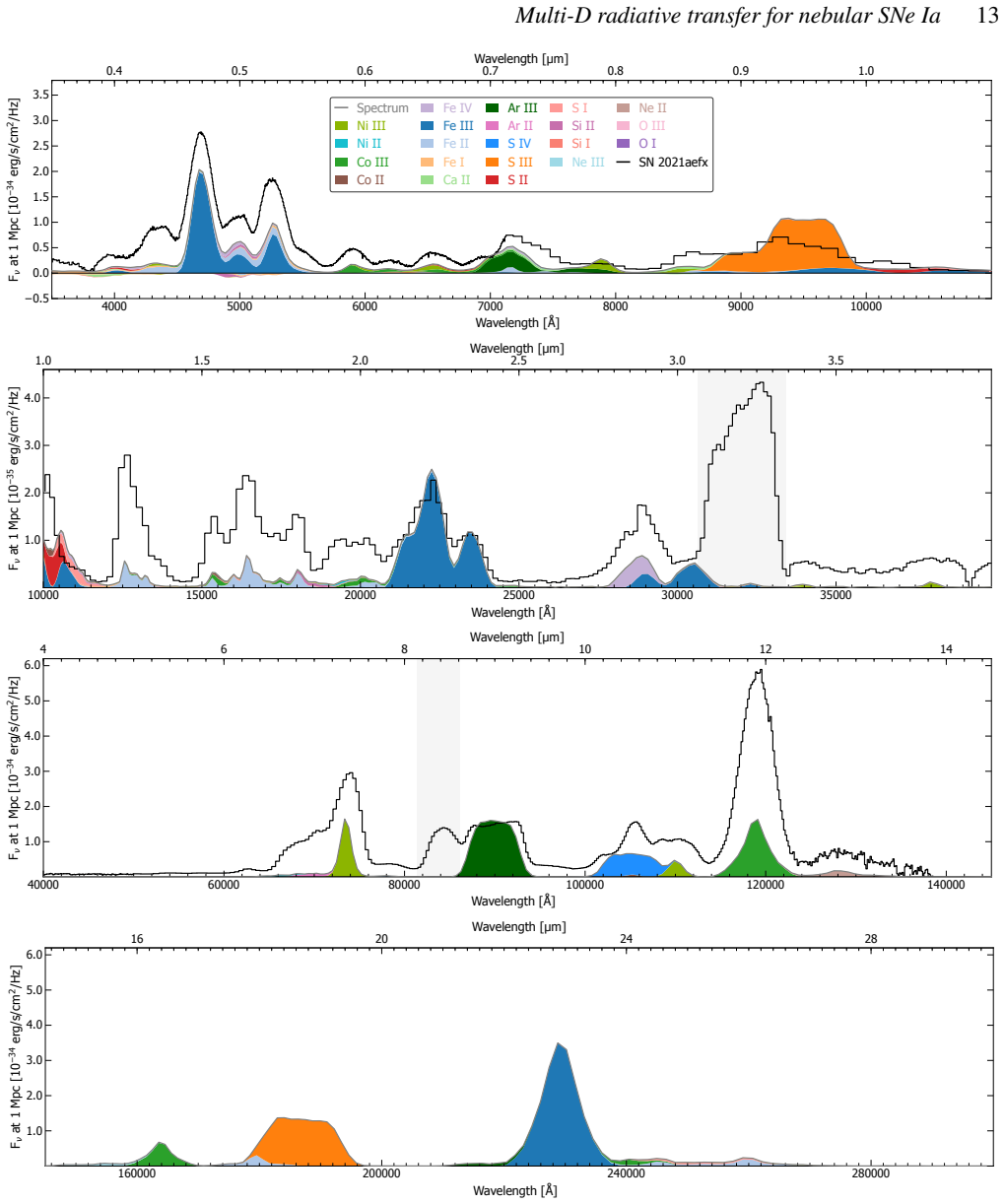
In the dynamically-driven double-degenerate double-detonation scenario, full non-local thermodynamic equilibrium nebular-phase spectra computed in one and three dimensions show that multidimensional ejecta structures alter the overall ionisation balance, feature widths, and velocities, especially when the secondary white dwarf also detonates. Some element distributions then produce line profiles that appear centrally peaked from certain viewing angles and flat-topped from others. Both single- and double-detonation realisations reproduce most observed features from optical to mid-infrared wavelengths, yet the models yield inconsistent line shapes and relative strengths, including overly-promi
What carries the argument
Full non-local thermodynamic equilibrium nebular-phase spectrum calculations performed in one and three dimensions that track how innermost ejecta asymmetries affect ionisation and line formation.
If this is right
- When the secondary white dwarf detonates, three-dimensional effects improve average agreement with observations compared to one-dimensional runs.
- Line profiles can appear centrally peaked from some viewing angles and flat-topped from others when both white dwarfs detonate.
- Both scenarios produce most observed spectral features from optical to mid-infrared, but neither consistently matches all line shapes and relative strengths.
- Prominent optical Ar III emission appears in the models but conflicts with existing observational data.
- More model realisations and additional mid-infrared observations are needed to test the viability of each scenario.
Where Pith is reading between the lines
- High-resolution mid-infrared spectra could distinguish the two scenarios by exposing differences in element distributions not visible at shorter wavelengths.
- Asymmetric ejecta may help explain some of the diversity seen among Type Ia supernovae in large samples.
- Varying the initial masses and separations of the white dwarf pairs in future simulations could reduce remaining mismatches with observations.
Load-bearing premise
The mismatches with observations, such as overly strong optical Ar III emission, are not mainly the result of limitations in the current model realisations or unaccounted physics.
What would settle it
A measurement of the strength of optical Ar III emission lines in nebular spectra of normal Type Ia supernovae; strong emission as predicted by the models but absent in data would support preferring the primary-only detonation scenario.
Figures








read the original abstract
The dynamically-driven double-degenerate double-detonation model has emerged as a promising progenitor candidate for Type Ia supernovae. In this scenario, the primary white dwarf ignites due to dynamical interaction with a companion white dwarf, which may also undergo a detonation. Consequently, two scenarios exist: one in which the secondary survives and another in which both white dwarfs detonate. In either case, substantial departures from spherical symmetry are imprinted on the ejecta. Here, we compute full non-local thermodynamic equilibrium nebular-phase spectra in 1D and 3D to probe the innermost asymmetries. Our simulations reveal that the multidimensional structures significantly alter the overall ionisation balance, width and velocity of features, especially when the secondary detonates. In this scenario, some element distributions may produce orientation-dependent line profiles that can be centrally peaked from some viewing-angles and somewhat flat-topped from others. Comparison to observations reveals that both scenarios produce most observed features from the optical to mid-infrared. However, the current model realisations do not consistently reproduce all line shapes or relative strengths, and yield prominent optical Ar III emission which is inconsistent with the data. When the secondary detonates, including 3D effects improves the average agreement with observations, however when compared to observations, particularly weak optical Co III emission and the presence of optical O I and near-infrared S I challenge its viability for normal Type Ia supernovae. Thus, overall, our comparisons with normal Type Ia's tentatively favour detonation of only the primary white dwarf, but we stress that more model realisations and mid-infrared observations are needed.
Editorial analysis
A structured set of objections, weighed in public.
Referee Report
Summary. The manuscript presents 1D and 3D non-LTE nebular-phase spectral calculations for dynamically-driven double-degenerate double-detonation Type Ia supernova models. It contrasts the case of primary-only detonation against the case in which both white dwarfs detonate, showing that multidimensional ejecta structures alter ionization balance, line widths, and velocity profiles (especially in the secondary-detonation scenario). Direct comparison with optical-to-mid-IR observations of normal SNe Ia indicates that both scenarios reproduce many observed features, yet prominent optical Ar III, weak Co III, and the presence of O I and S I features lead the authors to conclude that the data tentatively favor primary-only detonation, while stressing the need for additional model realizations and mid-IR data.
Significance. If the central claim holds, the work supplies useful constraints on SN Ia progenitors by demonstrating that multidimensional nebular modeling can distinguish detonation scenarios through orientation-dependent line profiles and ionization changes. The explicit inclusion of 3D effects and the reproducible comparison to external observational datasets constitute clear strengths; the authors' own caveat that more realizations are required is appropriately cautious and enhances the paper's credibility.
major comments (2)
- [Abstract] Abstract: The tentative conclusion that observations favor primary-only detonation is load-bearing for the paper's main claim, yet it rests on the premise that the reported mismatches (prominent Ar III, weak Co III, O I, S I) are intrinsic rather than artifacts of the limited set of realizations explored. The abstract itself notes that 3D structures improve average agreement when the secondary detonates; without a quantitative assessment of how line strengths and ionization balance respond to variations in WD masses, ignition geometry, or non-LTE treatment, it remains possible that the current discrepancies could be mitigated by broader sampling of parameter space.
- [§4 or §5 (results/comparisons)] The manuscript does not appear to include a systematic exploration or table quantifying the sensitivity of the discrepant lines (Ar III, Co III, O I, S I) to changes in the underlying model parameters. If such an analysis exists in §4 or §5, it should be highlighted; otherwise the central claim that the mismatches challenge the secondary-detonation scenario requires additional support to be considered robust.
minor comments (2)
- Figure captions and axis labels should explicitly state the viewing angles used for the 3D orientation-dependent profiles to allow readers to assess the claimed central-peaked versus flat-topped behavior.
- A short table summarizing the key line-strength ratios or equivalent widths for the discrepant features (Ar III, Co III, etc.) across the 1D and 3D models would improve clarity of the observational comparisons.
Simulated Author's Rebuttal
We thank the referee for their constructive and detailed comments on our manuscript. We address each major comment below, providing clarifications and indicating where revisions will be made to strengthen the presentation of our results and caveats.
read point-by-point responses
-
Referee: [Abstract] Abstract: The tentative conclusion that observations favor primary-only detonation is load-bearing for the paper's main claim, yet it rests on the premise that the reported mismatches (prominent Ar III, weak Co III, O I, S I) are intrinsic rather than artifacts of the limited set of realizations explored. The abstract itself notes that 3D structures improve average agreement when the secondary detonates; without a quantitative assessment of how line strengths and ionization balance respond to variations in WD masses, ignition geometry, or non-LTE treatment, it remains possible that the current discrepancies could be mitigated by broader sampling of parameter space.
Authors: We agree that the conclusion is tentative and depends on the specific realizations explored, as we already emphasize in the abstract and throughout the text. The mismatches, particularly the prominent optical Ar III emission, appear consistently in the secondary-detonation models we computed, while the primary-only case aligns better with the absence of this feature in observations. Although a broader parameter study could refine line strengths, the current discrepancies provide initial support for favoring primary-only detonation. We will revise the abstract to more explicitly frame the conclusion as dependent on the available models and to underscore the call for additional realizations. revision: partial
-
Referee: [§4 or §5 (results/comparisons)] The manuscript does not appear to include a systematic exploration or table quantifying the sensitivity of the discrepant lines (Ar III, Co III, O I, S I) to changes in the underlying model parameters. If such an analysis exists in §4 or §5, it should be highlighted; otherwise the central claim that the mismatches challenge the secondary-detonation scenario requires additional support to be considered robust.
Authors: The manuscript does not contain a systematic sensitivity analysis or dedicated table for these lines, as the focus was on comparing the primary-only and double-detonation scenarios using the computed 1D and 3D models. We acknowledge that quantifying responses to variations in WD masses, ignition geometry, and non-LTE treatment would enhance robustness. Within the present work, the noted discrepancies are discussed in the context of the models at hand. In revision, we will expand the discussion in the results/comparisons section to explicitly address this limitation and to highlight the need for future parameter explorations. revision: yes
Circularity Check
No significant circularity: comparisons rely on external simulations and independent observations
full rationale
The paper computes 1D and 3D non-LTE nebular spectra from pre-existing hydrodynamic double-detonation models and directly compares the resulting line profiles, ionization states, and feature strengths to published observational spectra of normal Type Ia supernovae. No parameters are fitted to the target data, no predictions are redefined in terms of the same fitted quantities, and no load-bearing step reduces to a self-citation or self-defined ansatz. The central claim (tentative preference for primary-only detonation) is an interpretive inference from mismatches with external data rather than a mathematical identity or fitted output. The derivation chain therefore remains independent of its inputs.
Axiom & Free-Parameter Ledger
Lean theorems connected to this paper
-
IndisputableMonolith/Foundation/AlexanderDuality.leanalexander_duality_circle_linking unclear?
unclearRelation between the paper passage and the cited Recognition theorem.
We perform our radiative transfer calculations using the 3D Monte Carlo radiative transfer code artis … transport is performed on a 3D Cartesian grid that co-expands with the ejecta.
-
IndisputableMonolith/Cost/FunctionalEquation.leanwashburn_uniqueness_aczel unclear?
unclearRelation between the paper passage and the cited Recognition theorem.
Our simulations reveal that the multidimensional structures significantly alter the overall ionisation balance, width and velocity of features
What do these tags mean?
- matches
- The paper's claim is directly supported by a theorem in the formal canon.
- supports
- The theorem supports part of the paper's argument, but the paper may add assumptions or extra steps.
- extends
- The paper goes beyond the formal theorem; the theorem is a base layer rather than the whole result.
- uses
- The paper appears to rely on the theorem as machinery.
- contradicts
- The paper's claim conflicts with a theorem or certificate in the canon.
- unclear
- Pith found a possible connection, but the passage is too broad, indirect, or ambiguous to say the theorem truly supports the claim.
Reference graph
Works this paper leans on
-
[1]
ARTIS Collaboration et al., 2024b, artis, @doi 10.5281/zenodo.11230916 , https://doi.org/10.5281/zenodo.11230916
-
[2]
ARTIS Collaboration Shingles L. J., Collins C. E., Holas A., Callan F., Sim S., 2024a, artistools, @doi 10.5281/zenodo.14337284 , https://doi.org/10.5281/zenodo.14337284
-
[3]
S., 1989, @doi [ ] 10.1086/167317 , https://ui.adsabs.harvard.edu/abs/1989ApJ...339..558A 339, 558
Anderson L. S., 1989, @doi [ ] 10.1086/167317 , https://ui.adsabs.harvard.edu/abs/1989ApJ...339..558A 339, 558
-
[4]
Ashall C., et al., 2024, @doi [ ] 10.3847/1538-4357/ad6608 , https://ui.adsabs.harvard.edu/abs/2024ApJ...975..203A 975, 203
-
[5]
S., 1980, PhD thesis, University of California, Santa Cruz
Axelrod T. S., 1980, PhD thesis, University of California, Santa Cruz
work page 1980
-
[6]
Bildsten L., Shen K. J., Weinberg N. N., Nelemans G., 2007, @doi [ ] 10.1086/519489 , https://ui.adsabs.harvard.edu/abs/2007ApJ...662L..95B 662, L95
-
[7]
Black C. S., Fesen R. A., Parrent J. T., 2016, @doi [ ] 10.1093/mnras/stw1680 , https://ui.adsabs.harvard.edu/abs/2016MNRAS.462..649B 462, 649
-
[8]
Blondin S., Dessart L., Hillier D. J., Khokhlov A. M., 2017, @doi [ ] 10.1093/mnras/stw2492 , https://ui.adsabs.harvard.edu/abs/2017MNRAS.470..157B 470, 157
-
[9]
Blondin S., Dessart L., Hillier D. J., Ramsbottom C. A., Storey P. J., 2023, @doi [ ] 10.1051/0004-6361/202347147 , https://ui.adsabs.harvard.edu/abs/2023A&A...678A.170B 678, A170
-
[10]
Boos S. J., Townsley D. M., Shen K. J., Caldwell S., Miles B. J., 2021, @doi [ ] 10.3847/1538-4357/ac07a2 , https://ui.adsabs.harvard.edu/abs/2021ApJ...919..126B 919, 126
-
[11]
Boos S. J., Townsley D. M., Shen K. J., 2024, @doi [arXiv e-prints] 10.48550/arXiv.2401.08011 , https://ui.adsabs.harvard.edu/abs/2024arXiv240108011B p. arXiv:2401.08011
-
[12]
Boty \'a nszki J., Kasen D., 2017, @doi [ ] 10.3847/1538-4357/aa81d8 , https://ui.adsabs.harvard.edu/abs/2017ApJ...845..176B 845, 176
-
[13]
Bulla M., Sim S. A., Kromer M., 2015, @doi [ ] 10.1093/mnras/stv657 , https://ui.adsabs.harvard.edu/abs/2015MNRAS.450..967B 450, 967
-
[14]
Childress M. J., et al., 2015, @doi [ ] 10.1093/mnras/stv2173 , https://ui.adsabs.harvard.edu/abs/2015MNRAS.454.3816C 454, 3816
-
[15]
Collins C. E., Gronow S., Sim S. A., R \"o pke F. K., 2022, @doi [ ] 10.1093/mnras/stac2665 , https://ui.adsabs.harvard.edu/abs/2022MNRAS.517.5289C 517, 5289
-
[16]
Collins C. E., et al., 2025, @doi [ ] 10.1093/mnras/staf261 , https://ui.adsabs.harvard.edu/abs/2025MNRAS.538.1289C 538, 1289
-
[17]
Das P., et al., 2025, @doi [Nature Astronomy] 10.1038/s41550-025-02589-5
-
[18]
De K., et al., 2019, @doi [ ] 10.3847/2041-8213/ab0aec , https://ui.adsabs.harvard.edu/abs/2019ApJ...873L..18D 873, L18
-
[19]
Diamond T. R., Hoeflich P., Gerardy C. L., 2015, @doi [ ] 10.1088/0004-637X/806/1/107 , https://ui.adsabs.harvard.edu/abs/2015ApJ...806..107D 806, 107
-
[20]
El-Badry K., et al., 2023, @doi [The Open Journal of Astrophysics] 10.21105/astro.2306.03914 , https://ui.adsabs.harvard.edu/abs/2023OJAp....6E..28E 6, 28
-
[21]
K., Hillebrandt W., Seitenzahl I
Fink M., R \"o pke F. K., Hillebrandt W., Seitenzahl I. R., Sim S. A., Kromer M., 2010, @doi [ ] 10.1051/0004-6361/200913892 , https://ui.adsabs.harvard.edu/abs/2010A&A...514A..53F 514, A53
-
[22]
Fl \"o rs A., et al., 2020, @doi [ ] 10.1093/mnras/stz3013 , https://ui.adsabs.harvard.edu/abs/2020MNRAS.491.2902F 491, 2902
-
[23]
Fransson C., Jerkstrand A., 2015, @doi [ ] 10.1088/2041-8205/814/1/L2 , https://ui.adsabs.harvard.edu/abs/2015ApJ...814L...2F 814, L2
-
[24]
Gerardy C. L., et al., 2007, @doi [ ] 10.1086/516728 , https://ui.adsabs.harvard.edu/abs/2007ApJ...661..995G 661, 995
-
[25]
T., Pakmor R., Kromer M., Seitenzahl I
Gronow S., Collins C., Ohlmann S. T., Pakmor R., Kromer M., Seitenzahl I. R., Sim S. A., R \"o pke F. K., 2020, @doi [ ] 10.1051/0004-6361/201936494 , https://ui.adsabs.harvard.edu/abs/2020A&A...635A.169G 635, A169
-
[26]
Gronow S., Collins C. E., Sim S. A., R \"o pke F. K., 2021, @doi [ ] 10.1051/0004-6361/202039954 , https://ui.adsabs.harvard.edu/abs/2021A&A...649A.155G 649, A155
-
[27]
Guillochon J., Dan M., Ramirez-Ruiz E., Rosswog S., 2010, @doi [ ] 10.1088/2041-8205/709/1/L64 , https://ui.adsabs.harvard.edu/abs/2010ApJ...709L..64G 709, L64
-
[28]
Harris C. R., et al., 2020, @doi [Nature] 10.1038/s41586-020-2649-2 , 585, 357
-
[29]
J., 1990, , https://ui.adsabs.harvard.edu/abs/1990A&A...231..116H 231, 116
Hillier D. J., 1990, , https://ui.adsabs.harvard.edu/abs/1990A&A...231..116H 231, 116
work page 1990
-
[30]
Hillier D. J., Miller D. L., 1998, @doi [ ] 10.1086/305350 , https://ui.adsabs.harvard.edu/abs/1998ApJ...496..407H 496, 407
-
[31]
Hoeflich P., Khokhlov A., 1996, @doi [ ] 10.1086/176748 , https://ui.adsabs.harvard.edu/abs/1996ApJ...457..500H 457, 500
-
[32]
L., Nomoto K., Motohara K., Fesen R
H \"o flich P., Gerardy C. L., Nomoto K., Motohara K., Fesen R. A., Maeda K., Ohkubo T., Tominaga N., 2004, @doi [ ] 10.1086/425571 , https://ui.adsabs.harvard.edu/abs/2004ApJ...617.1258H 617, 1258
-
[33]
Holas A., et al., 2025,
work page 2025
-
[34]
Hollands M. A., Shen K. J., Raddi R., Gaensicke B. T., Bauer E. B., Rebassa-Mansergas A., 2025, arXiv e-prints, https://ui.adsabs.harvard.edu/abs/2025arXiv250608081H p. arXiv:2506.08081
-
[35]
Hosseinzadeh G., et al., 2022, @doi [ ] 10.3847/2041-8213/ac7cef , https://ui.adsabs.harvard.edu/abs/2022ApJ...933L..45H 933, L45
-
[36]
A., 1960, @doi [ ] 10.1086/146963 , https://ui.adsabs.harvard.edu/abs/1960ApJ...132..565H 132, 565
Hoyle F., Fowler W. A., 1960, @doi [ ] 10.1086/146963 , https://ui.adsabs.harvard.edu/abs/1960ApJ...132..565H 132, 565
-
[37]
Iben I. J., Tutukov A. V., 1984, @doi [ ] 10.1086/190932 , https://ui.adsabs.harvard.edu/abs/1984ApJS...54..335I 54, 335
-
[38]
JUWELS 2021, @doi [Journal of large-scale research facilities] 10.17815/jlsrf-7-183 , 7
-
[39]
Jerkstrand A., 2017, Spectra of Supernovae in the Nebular Phase. Springer International Publishing, Cham, pp 795--842, @doi 10.1007/978-3-319-21846-5_29 , https://doi.org/10.1007/978-3-319-21846-5_29
-
[40]
Jerkstrand A., Fransson C., Maguire K., Smartt S., Ergon M., Spyromilio J., 2012, @doi [ ] 10.1051/0004-6361/201219528 , https://ui.adsabs.harvard.edu/abs/2012A&A...546A..28J 546, A28
-
[41]
Jiang J.-A., et al., 2017, @doi [ ] 10.1038/nature23908 , https://ui.adsabs.harvard.edu/abs/2017Natur.550...80J 550, 80
-
[42]
Kashyap R., Fisher R., Garc \' a-Berro E., Aznar-Sigu \'a n G., Ji S., Lor \'e n-Aguilar P., 2015, @doi [ ] 10.1088/2041-8205/800/1/L7 , https://ui.adsabs.harvard.edu/abs/2015ApJ...800L...7K 800, L7
-
[43]
Kozma C., Fransson C., 1992, @doi [ ] 10.1086/171311 , https://ui.adsabs.harvard.edu/abs/1992ApJ...390..602K 390, 602
-
[44]
Kozma C., Fransson C., Hillebrandt W., Travaglio C., Sollerman J., Reinecke M., R \"o pke F. K., Spyromilio J., 2005, @doi [ ] 10.1051/0004-6361:20053044 , https://ui.adsabs.harvard.edu/abs/2005A&A...437..983K 437, 983
-
[45]
Kromer M., Sim S. A., 2009, @doi [ ] 10.1111/j.1365-2966.2009.15256.x , https://ui.adsabs.harvard.edu/abs/2009MNRAS.398.1809K 398, 1809
-
[46]
Kromer M., Sim S. A., Fink M., R \"o pke F. K., Seitenzahl I. R., Hillebrandt W., 2010, @doi [ ] 10.1088/0004-637X/719/2/1067 , https://ui.adsabs.harvard.edu/abs/2010ApJ...719.1067K 719, 1067
-
[47]
Kwok L. A., et al., 2023, @doi [ ] 10.3847/2041-8213/acb4ec , https://ui.adsabs.harvard.edu/abs/2023ApJ...944L...3K 944, L3
-
[48]
Kwok L. A., et al., 2024, @doi [ ] 10.3847/1538-4357/ad2c0d , https://ui.adsabs.harvard.edu/abs/2024ApJ...966..135K 966, 135
-
[49]
C., 2007, @doi [ ] 10.1086/522367 , https://ui.adsabs.harvard.edu/abs/2007ApJ...670.1275L 670, 1275
Leonard D. C., 2007, @doi [ ] 10.1086/522367 , https://ui.adsabs.harvard.edu/abs/2007ApJ...670.1275L 670, 1275
-
[50]
Li C., Hillier D. J., Dessart L., 2012, @doi [ ] 10.1111/j.1365-2966.2012.21198.x , https://ui.adsabs.harvard.edu/abs/2012MNRAS.426.1671L 426, 1671
-
[51]
Liu W., Jeffery D. J., Schultz D. R., 1997, @doi [ ] 10.1086/310752 , https://ui.adsabs.harvard.edu/abs/1997ApJ...483L.107L 483, L107
-
[52]
Liu Z.-W., R \"o pke F. K., Han Z., 2023, @doi [Research in Astronomy and Astrophysics] 10.1088/1674-4527/acd89e , https://ui.adsabs.harvard.edu/abs/2023RAA....23h2001L 23, 082001
-
[53]
Livne E., 1990, @doi [ ] 10.1086/185721 , https://ui.adsabs.harvard.edu/abs/1990ApJ...354L..53L 354, L53
-
[54]
Livne E., Arnett D., 1995, @doi [ ] 10.1086/176279 , https://ui.adsabs.harvard.edu/abs/1995ApJ...452...62L 452, 62
-
[55]
S., 1990, @doi [ ] 10.1086/169189 , https://ui.adsabs.harvard.edu/abs/1990ApJ...361..244L 361, 244
Livne E., Glasner A. S., 1990, @doi [ ] 10.1086/169189 , https://ui.adsabs.harvard.edu/abs/1990ApJ...361..244L 361, 244
-
[56]
Lucy L. B., 2002, @doi [ ] 10.1051/0004-6361:20011756 , https://ui.adsabs.harvard.edu/abs/2002A&A...384..725L 384, 725
-
[57]
Lucy L. B., 2003, @doi [ ] 10.1051/0004-6361:20030357 , https://ui.adsabs.harvard.edu/abs/2003A&A...403..261L 403, 261
-
[58]
Lucy L. B., 2005, @doi [ ] 10.1051/0004-6361:20041656 , https://ui.adsabs.harvard.edu/abs/2005A&A...429...19L 429, 19
-
[59]
Maeda K., Taubenberger S., Sollerman J., Mazzali P. A., Leloudas G., Nomoto K., Motohara K., 2010, @doi [ ] 10.1088/0004-637X/708/2/1703 , https://ui.adsabs.harvard.edu/abs/2010ApJ...708.1703M 708, 1703
-
[60]
Maguire K., Taubenberger S., Sullivan M., Mazzali P. A., 2016, @doi [ ] 10.1093/mnras/stv2991 , https://ui.adsabs.harvard.edu/abs/2016MNRAS.457.3254M 457, 3254
-
[61]
Maguire K., et al., 2018, @doi [ ] 10.1093/mnras/sty820 , https://ui.adsabs.harvard.edu/abs/2018MNRAS.477.3567M 477, 3567
-
[62]
Maoz D., Mannucci F., Brandt T. D., 2012, @doi [ ] 10.1111/j.1365-2966.2012.21871.x , https://ui.adsabs.harvard.edu/abs/2012MNRAS.426.3282M 426, 3282
-
[63]
Maurer I., Jerkstrand A., Mazzali P. A., Taubenberger S., Hachinger S., Kromer M., Sim S., Hillebrandt W., 2011, @doi [ ] 10.1111/j.1365-2966.2011.19376.x , https://ui.adsabs.harvard.edu/abs/2011MNRAS.418.1517M 418, 1517
-
[64]
Mazzali P. A., Nomoto K., Patat F., Maeda K., 2001, @doi [ ] 10.1086/322420 , https://ui.adsabs.harvard.edu/abs/2001ApJ...559.1047M 559, 1047
-
[65]
Mazzali P. A., et al., 2015, @doi [ ] 10.1093/mnras/stv761 , https://ui.adsabs.harvard.edu/abs/2015MNRAS.450.2631M 450, 2631
-
[66]
A., Ashall C., Pian E., Stritzinger M
Mazzali P. A., Ashall C., Pian E., Stritzinger M. D., Gall C., Phillips M. M., H \"o flich P., Hsiao E., 2018, @doi [ ] 10.1093/mnras/sty434 , https://ui.adsabs.harvard.edu/abs/2018MNRAS.476.2905M 476, 2905
-
[67]
Mazzali P. A., et al., 2020, @doi [ ] 10.1093/mnras/staa839 , https://ui.adsabs.harvard.edu/abs/2020MNRAS.494.2809M 494, 2809
-
[68]
Mor \'a n-Fraile J., Holas A., R \"o pke F. K., Pakmor R., Schneider F. R. N., 2024, @doi [ ] 10.1051/0004-6361/202347769 , https://ui.adsabs.harvard.edu/abs/2024A&A...683A..44M 683, A44
-
[69]
Motohara K., et al., 2006, @doi [ ] 10.1086/509919 , https://ui.adsabs.harvard.edu/abs/2006ApJ...652L.101M 652, L101
-
[70]
Noebauer U. M., Kromer M., Taubenberger S., Baklanov P., Blinnikov S., Sorokina E., Hillebrandt W., 2017, @doi [ ] 10.1093/mnras/stx2093 , https://ui.adsabs.harvard.edu/abs/2017MNRAS.472.2787N 472, 2787
-
[71]
Nomoto K., 1980, @doi [ ] 10.1007/BF00168350 , https://ui.adsabs.harvard.edu/abs/1980SSRv...27..563N 27, 563
-
[72]
H., 1997, @doi [ ] 10.1086/304459 , https://ui.adsabs.harvard.edu/abs/1997ApJ...485..812N 485, 812
Nugent P., Baron E., Branch D., Fisher A., Hauschildt P. H., 1997, @doi [ ] 10.1086/304459 , https://ui.adsabs.harvard.edu/abs/1997ApJ...485..812N 485, 812
-
[73]
Pakmor R., Kromer M., Taubenberger S., Sim S. A., R \"o pke F. K., Hillebrandt W., 2012, @doi [ ] 10.1088/2041-8205/747/1/L10 , https://ui.adsabs.harvard.edu/abs/2012ApJ...747L..10P 747, L10
-
[74]
Pakmor R., Kromer M., Taubenberger S., Springel V., 2013, @doi [ ] 10.1088/2041-8205/770/1/L8 , https://ui.adsabs.harvard.edu/abs/2013ApJ...770L...8P 770, L8
-
[75]
Pakmor R., et al., 2022, @doi [ ] 10.1093/mnras/stac3107 , https://ui.adsabs.harvard.edu/abs/2022MNRAS.517.5260P 517, 5260
-
[76]
Pakmor R., Seitenzahl I. R., Ruiter A. J., Sim S. A., R \"o pke F. K., Taubenberger S., Bieri R., Blondin S., 2024, @doi [ ] 10.1051/0004-6361/202449637 , https://ui.adsabs.harvard.edu/abs/2024A&A...686A.227P 686, A227
-
[77]
M., 1993, @doi [ ] 10.1086/186970 , https://ui.adsabs.harvard.edu/abs/1993ApJ...413L.105P 413, L105
Phillips M. M., 1993, @doi [ ] 10.1086/186970 , https://ui.adsabs.harvard.edu/abs/1993ApJ...413L.105P 413, L105
-
[78]
Polin A., Nugent P., Kasen D., 2019, @doi [ ] 10.3847/1538-4357/aafb6a , https://ui.adsabs.harvard.edu/abs/2019ApJ...873...84P 873, 84
-
[79]
Polin A., Nugent P., Kasen D., 2021, @doi [ ] 10.3847/1538-4357/abcccc , https://ui.adsabs.harvard.edu/abs/2021ApJ...906...65P 906, 65
-
[80]
Pollin J. M., Sim S. A., Pakmor R., Callan F. P., Collins C. E., Shingles L. J., Röpke F. K., Srivastav S., 2024, @doi [Monthly Notices of the Royal Astronomical Society] 10.1093/mnras/stae1909 , 533, 3036
discussion (0)
Sign in with ORCID, Apple, or X to comment. Anyone can read and Pith papers without signing in.