REVIEW 3 major objections 5 minor 20 references
Logit Reweighting for Topic-Focused Summarization
T0 review · 3 major / 5 minor · reviewed 2026-08-06 · deepseek-v4-flash
Pith's one-line read Logit reweighting at inference time can steer an instruction-tuned language model toward a target topic in abstractive summarization, and the Threshold Selection variant does so without degrading summary quality.
desk verdict A cheap decoding trick with a real but partly circular evaluation; the threshold variant is worth a serious referee. read the letter →
The pith
A machine-rendered reading of the paper's core claim, the machinery that carries it, and where it could break.
The reading
What carries the argument
The mechanism is a custom logits processor that runs inside the standard transformer decoding loop and alters only the logits of tokens deemed topic-relevant. Topic relevance is defined by the top 25 words of the target LDA topic, expanded with lemmatized, stemmed, capitalized, and spaced variants so that each word maps to several token ids. Constant Shift adds a constant $c$ to those logits; Factor Scaling multiplies them by $\alpha$; Threshold Selection sets any topic token already above probability $\theta$ to $\max(\text{scores})+\beta$. The threshold rule is the load-bearing innovation: it acts selectively on tokens the model already considers plausible, which is why it can pull text toward a topic without distorting quality.
What would settle it
Run a human reading study or score summaries with a topic model whose vocabulary was not used for the intervention; if Threshold Selection does not show improved topical relevance (or does so at a visible cost in fluency, coherence, or factuality), the 'without compromising quality' claim is falsified.
Extended reading notes
Core claim
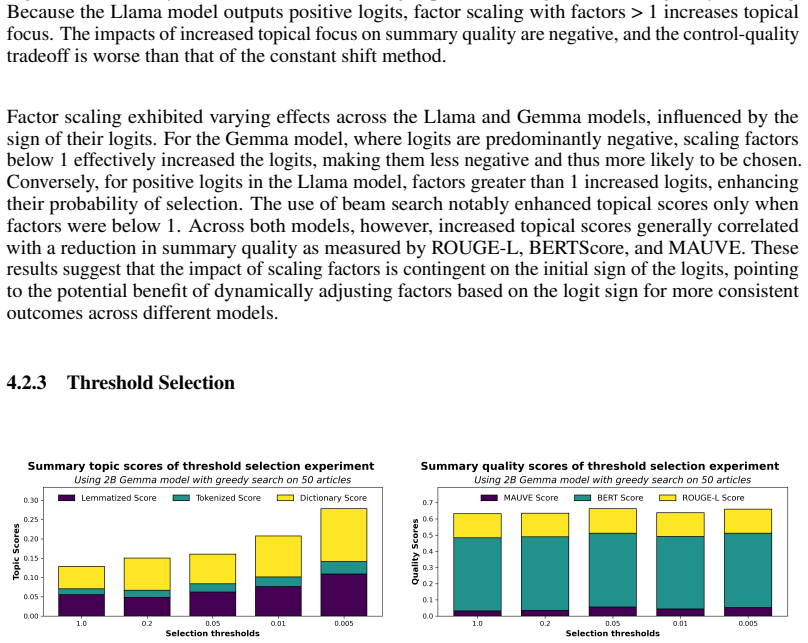
The central claim is that topical focus can be controlled at inference time by modifying the next-token distribution, with no weight updates. In Threshold Selection, the logit of a topic-relevant token $i$ is replaced by $\max(\text{scores}) + \beta$ whenever its softmax probability satisfies $\mathrm{softmax}[i] \ge \theta$; otherwise it is left unchanged. Across Gemma-2B and Llama-3-8B, with greedy decoding and beam search, lowering $\theta$ monotonically increased all three topicality measures while summary-quality metrics stayed essentially flat. The paper argues this makes Threshold Selection the most practical and model-independent of the three interventions, and positions logit reweighting as a viable alternative to fine-tuning for topical control.
Load-bearing premise
The results rest on the assumption that topical focus is adequately captured by lexical overlap with the LDA top-25 topic words and that summary quality is adequately captured by ROUGE-L, BERTScore, and MAUVE, since no human evaluation was run.
Editorial extensions
If this is right
- Users can steer a small instruction-tuned model toward a target topic by setting one probability threshold, with no training run and no prompt redesign.
- Because Threshold Selection acts only on tokens already likely under the model, it can be combined with beam search to further concentrate topic vocabulary while keeping quality metrics stable.
- The threshold parameter transfers across models more easily than shift constants or scaling factors, since it is defined on probabilities rather than raw logit magnitudes.
- The method provides a cheap upper-bound test for whether a topic is steerable before investing in fine-tuning.
- Larger models show higher absolute topicality and quality, so the technique remains useful as model scale grows.
Reading between the lines
- The topic-score gains are likely partly mechanical, because the same LDA vocabulary is used both to boost tokens and to score topical focus; an external topic evaluator would test how much real topical control remains.
- The same logit-reweighting recipe should transfer to other controlled-generation goals, such as sentiment, formality, or domain style, whenever the target outcome can be expressed as a list of tokens.
- A dynamic schedule that applies stronger boosts only before content words, rather than uniformly at every step, could improve the control-quality trade-off further.
Editorial analysis
A structured set of objections, weighed in public.
Referee Report
Summary. The paper proposes three inference-time logit-reweighting methods—Constant Shift, Factor Scaling, and Threshold Selection—to steer abstractive summaries toward a specified topic, evaluated on the NEWTS dataset with Gemma-2B and Llama-3-8B. The authors report that these methods increase the use of topic-relevant vocabulary, and claim that Threshold Selection improves topical focus without degrading summary quality, offering a lightweight alternative to fine-tuning. Quality is measured with ROUGE-L, BERTScore, and MAUVE; topical focus is measured with three metrics that match or weight words from the same LDA top-25 topic-word list used to construct the intervention's token set.
Significance. If the central claim were established, the paper would describe a simple, practical, and resource-efficient way to control topic adherence in small instruction-tuned language models, which is a useful contribution. The manuscript has strengths: the method is clearly specified, the code is released, the comparison spans two models and two decoding strategies, and the limitations section is candid about the absence of human evaluation. However, the main empirical support is weakened by a circularity problem: the intervention promotes tokens from the LDA topic-word list, and the topical-focus metrics count exactly those same words. In addition, the experiments report no error bars or significance tests, and the claim that quality is not compromised rests solely on automatic metrics. The contribution is therefore not yet supported to the standard required for publication.
major comments (3)
- [Sec. 2.3.2, Sec. 2.2, Sec. 4.1.3] The primary topical-focus outcome is partly circular with the intervention. The Lemmatization-Based, Tokenizing-Based, and Dictionary-Based evaluations in Sec. 2.3.2 all measure overlap or prevalence of the LDA top-25 topic words (or their lemmas/tokens), while the reweighting methods in Sec. 2.2 and Sec. 4.1.3 promote exactly those words' tokens. Consequently, increasing the probability of these tokens mechanically increases the reported topic scores, and the claimed 'improves topical focus' (Abstract; Sec. 4.2.3) is not established independently of the manipulation. The paper should validate the topic-focus claim with an external measure, such as human topic judgments or a topic classifier trained without the promoted vocabulary, or at least demonstrate that the effect persists for held-out topic words not in the promoted list.
- [Sec. 2.2, Sec. 4.2] The experimental results are reported as single point estimates in figures, with no error bars, confidence intervals, or significance tests. The number of articles per condition varies between 25 and 50 depending on the model and decoding strategy, so the observed differences across methods and settings could reflect sampling noise rather than genuine effects. The paper should provide repeated sampling or bootstrap confidence intervals, or a statistical comparison across conditions, to support claims such as 'topic scores increase reliably' in Sec. 4.2.3.
- [Sec. 4.2.3, Sec. 5.2] The claim that Threshold Selection 'successfully improves topical focus without compromising summary quality' is not backed by human evaluation. The paper concedes in Sec. 5.2 that 'all quality judgments rely on automatic metrics, and no human evaluation was conducted,' yet the conclusion treats ROUGE-L, BERTScore, and MAUVE as sufficient evidence that quality is preserved. These overlap- and distribution-based metrics can be insensitive to degraded fluency or coherence caused by repeated insertion of topic words. A human evaluation of summary quality (e.g., fluency, coherence, and overall readability), or at least an automated fluency metric such as perplexity or grammaticality, is needed to support the 'without compromising quality' claim.
minor comments (5)
- [Sec. 3.2] The sentence 'When expecting the generated summaries, this was likely caused due to the model reiterating the instructions...' appears to contain a typo; it should likely read 'When inspecting the generated summaries...'.
- [Sec. 2.3.1] The reference to the 'rouge_scorer .RougeScorer' class has stray spacing and should be formatted as code; also, the text says 'ROUGE-L ... introduces by Lin [2004]', which should be 'introduced by'.
- [Sec. 4.2] The results are presented only through figures with no corresponding numerical tables, and the text often reports qualitative trends (e.g., 'roughly twofold', 'scores increased') without exact values. Adding a table of mean scores and standard deviations for each condition would improve reproducibility and interpretability.
- [Sec. 4.1.3] The threshold values and the encouragement factor β are not systematically reported; the text only mentions an example threshold of 0.005. The paper should state the full range of θ and β values tested.
- [Sec. 2.2] The phrase 'the number of articles varied between 25 or 50' should be 'between 25 and 50', and the reason for choosing either 25 or 50 per condition should be stated explicitly rather than left as a computational constraint.
Circularity Check
Topical-focus metrics are built from the same LDA top-25 word list that the logit intervention boosts, so the reported focus gains are partly mechanical; the independent quality metrics keep the result from being fully circular.
-
self definitional
[Sec. 2.2, Sec. 2.3.2, Sec. 4.1.3]
"From the LDA model, we consistently used the top 25 words associated with the topic to represent it. To translate from words to tokens, we generated multiple variations of each word, including the lemmatized and stemmed versions, as well as variations in capitalization and spacing. ... In this approach, text is tokenized using a model-specific tokenizer, and tokens are matched against those generated from topic-specific words identified by the LDA model. ... The LDA model then provides a distribution over topics for these words."
The intervention in Sec. 4.1.3 (and Secs. 4.1.1-4.1.2) rewrites the logits of 'topic-relevant tokens,' which by Sec. 2.2 are the token variants of the LDA top-25 words. All three topical-focus metrics in Sec. 2.3.2 count or weight exactly those same LDA-derived lemmas/tokens, or use the same LDA topic distribution. Therefore raising the probability of those tokens makes the summary contain more of exactly the items the topic metrics measure; the reported increase in topical focus is entailed by the shared construction of the intervention and the metric rather than established against an independent topic-relevance signal. The abstract's phrase 'effectively increase the use of topic-relevant vocabulary' is close to a restatement of the intervention itself.
full rationale
Most of the paper is a controlled empirical comparison, not a mathematical derivation. The quality metrics (ROUGE-L, BERTScore, MAUVE) are reference-based and do not share construction with the topic-token intervention, so the 'without compromising summary quality' part of the claim is genuinely informative and not circular. However, the central topical-focus claim is partially circular by construction: the topic-relevant token set (Sec. 2.2) and the three topic-focus metrics (Sec. 2.3.2) are both derived from the same LDA top-25 words. Threshold Selection, Constant Shift, and Factor Scaling all increase the sampling probability of those exact tokens, and the metrics then count exactly those tokens. Thus the observed rise in topic scores is partly a direct consequence of how both the method and the metric are defined. The paper's Limitations (Sec. 5.2) concede that 'all quality judgments rely on automatic metrics, and no human evaluation was conducted,' which further highlights that the claim of improved topical focus has not been validated against an external semantic or human-judged topic signal. This is not full circularity: the experiments do demonstrate a real shift in token distributions, and the quality metrics are independent evidence that the intervention does not trivially destroy fluency. Score 6 reflects a partial, construction-based circularity in the main topical-focus claim rather than a completely empty derivation.
Assumptions & free parameters
free parameters (6)
- shift constant c =
not numerically listed in text; varied in plots
- scaling factor alpha =
varied in plots
- threshold theta and encouragement beta =
theta varied in plots; beta value not stated
- number of topic words and token variants =
top 25 LDA words plus inflection variants
- evaluation subset size =
25 or 50 articles depending on model and decoding
- generation settings =
80-90 token length, top-p 0.95, top-k 50, 4 beams in beam experiments
assumptions (4)
- standard math Softmax maps logits to probabilities, and modifying selected logits changes the sampling distribution as specified.
- domain assumption The LDA model's top 25 words are a faithful representation of a topic for the purpose of topical focus.
- domain assumption ROUGE-L, BERTScore, and MAUVE against NEWTS reference summaries adequately measure summary quality.
- domain assumption Instruction-tuned Gemma-2B and Llama-3-8B summarize NEWTS articles without additional fine-tuning and follow the topic prompt as intended.
Cite this review
Pith. "Pith review of Logit Reweighting for Topic-Focused Summarization." pith.science (2026). https://pith.science/paper/D5KUBXTR
@misc{pith2026250705235,
  author       = {Pith},
  title        = {Pith review of: Logit Reweighting for Topic-Focused Summarization},
  year         = {2026},
  howpublished = {\url{https://pith.science/paper/D5KUBXTR}},
  note         = {Machine review of arXiv:2507.05235}
}
read the original abstract
Generating abstractive summaries that adhere to a specific topic remains a significant challenge for language models. While standard approaches, such as fine-tuning, are resource-intensive, simpler methods like prompt engineering often struggle to maintain topical focus, particularly with smaller models. To address this, we propose a lightweight method that enhances topical relevance by directly reweighting the logits of topic-relevant tokens during generation. We evaluate three such reweighting techniques: Constant Shift, which adds a constant value to logits; Factor Scaling, which multiplies them by a factor; and Threshold Selection, which selectively boosts logits that exceed a probability threshold. Experiments on the NEWTS topical summarization dataset, using both Gemma-2B and Llama-3-8B models, show that these techniques effectively increase the use of topic-relevant vocabulary. Notably, the Threshold Selection method successfully improves topical focus without compromising summary quality-a trade-off often seen in other approaches. Our findings demonstrate that directly reweighting logits is a practical and resource-efficient alternative to fine-tuning, offering a promising pathway for precisely controlling the thematic content of generated text.
Figures


Figures from the paper (10 more)




Reference graph
Works this paper leans on
-
[1]
Cats: Customizable abstractive topic-based summarization
Seyed Ali Bahrainian, George Zerveas, Fabio Crestani, and Carsten Eickhoff. Cats: Customizable abstractive topic-based summarization. ACM Trans. Inf. Syst., 40 0 (1), oct 2021. ISSN 1046-8188. doi:10.1145/3464299. URL https://doi.org/10.1145/3464299
-
[2]
Controllable Topic-Focused Abstractive Summarization
Seyed Ali Bahrainian, Martin Jaggi, and Carsten Eickhoff. Controllable topic-focused abstractive summarization. CoRR, abs/2311.06724, 2023. URL https://doi.org/10.48550/arXiv.2311.06724
work page Pith review arXiv doi:10.48550/arxiv.2311.06724 2023
-
[3]
A survey on in-context learning, 2023
Qingxiu Dong, Lei Li, Damai Dai, Ce Zheng, Zhiyong Wu, Baobao Chang, Xu Sun, Jingjing Xu, Lei Li, and Zhifang Sui. A survey on in-context learning, 2023
work page 2023
-
[4]
Direct preference optimization: Your language model is secretly a reward model
Rafael Rafailov, Archit Sharma, Eric Mitchell, Christopher D Manning, Stefano Ermon, and Chelsea Finn. Direct preference optimization: Your language model is secretly a reward model. In Thirty-seventh Conference on Neural Information Processing Systems, 2023. URL https://openreview.net/forum?id=HPuSIXJaa9
2023
-
[5]
Training language models to follow instructions with human feedback
Long Ouyang, Jeffrey Wu, Xu Jiang, Diogo Almeida, Carroll Wainwright, Pamela Mishkin, Chong Zhang, Sandhini Agarwal, Katarina Slama, Alex Gray, John Schulman, Jacob Hilton, Fraser Kelton, Luke Miller, Maddie Simens, Amanda Askell, Peter Welinder, Paul Christiano, Jan Leike, and Ryan Lowe. Training language models to follow instructions with human feedback...
2022
-
[6]
NEWTS : A corpus for news topic-focused summarization
Seyed Ali Bahrainian, Sheridan Feucht, and Carsten Eickhoff. NEWTS : A corpus for news topic-focused summarization. In Findings of the Association for Computational Linguistics: ACL 2022, pages 493--503, Dublin, Ireland, May 2022. Association for Computational Linguistics. doi:10.18653/v1/2022.findings-acl.42. URL https://aclanthology.org/2022.findings-acl.42
-
[7]
Abstractive text summarization using sequence-to-sequence RNN s and beyond
Ramesh Nallapati, Bowen Zhou, Cicero dos Santos, C a g lar Gul c ehre, and Bing Xiang. Abstractive text summarization using sequence-to-sequence RNN s and beyond. In Stefan Riezler and Yoav Goldberg, editors, Proceedings of the 20th SIGNLL Conference on Computational Natural Language Learning , pages 280--290, Berlin, Germany, August 2016. Association for...
-
[8]
Gemma: Open models based on gemini research and technology, 2024
GemmaTeam. Gemma: Open models based on gemini research and technology, 2024
work page 2024
Show all 20 references
-
[9]
Introducing meta llama 3: The most capable openly available llm to date
Llama3Team . Introducing meta llama 3: The most capable openly available llm to date. https://ai.meta.com/blog/meta-llama-3/, April 2024. Accessed: 2024-04-22
2024
-
[10]
ROUGE : A Package for Automatic Evaluation of Summaries
Chin-Yew Lin. ROUGE : A Package for Automatic Evaluation of Summaries . In Text Summarization Branches Out , pages 74--81, Barcelona, Spain, July 2004. Association for Computational Linguistics. URL https://aclanthology.org/W04-1013
2004
-
[11]
MAUVE : Measuring the gap between neural text and human text using divergence frontiers
Krishna Pillutla, Swabha Swayamdipta, Rowan Zellers, John Thickstun, Sean Welleck, Yejin Choi, and Zaid Harchaoui. MAUVE : Measuring the gap between neural text and human text using divergence frontiers. In A. Beygelzimer, Y. Dauphin, P. Liang, and J. Wortman Vaughan, editors,...
2021
-
[12]
Weinberger, and Yoav Artzi
Tianyi Zhang*, Varsha Kishore*, Felix Wu*, Kilian Q. Weinberger, and Yoav Artzi. Bertscore: Evaluating text generation with bert. In International Conference on Learning Representations, 2020. URL https://openreview.net/forum?id=SkeHuCVFDr
2020
-
[13]
BERT : Pre-training of deep bidirectional transformers for language understanding
Jacob Devlin, Ming-Wei Chang, Kenton Lee, and Kristina Toutanova. BERT : Pre-training of deep bidirectional transformers for language understanding. In Proceedings of the 2019 Conference of the North A merican Chapter of the Association for Computational Linguistics: Human Lan...
2019 doi
-
[14]
Deberta: Decoding-enhanced bert with disentangled attention
Pengcheng He, Xiaodong Liu, Jianfeng Gao, and Weizhu Chen. Deberta: Decoding-enhanced bert with disentangled attention. In International Conference on Learning Representations, 2021. URL https://openreview.net/forum?id=XPZIaotutsD
2021
-
[15]
Steering llama 2 via contrastive activation addition
Nina Panickssery, Nick Gabrieli, Julian Schulz, Meg Tong, Evan Hubinger, and Alexander Turner. Steering llama 2 via contrastive activation addition. In Proceedings of the 62nd Annual Meeting of the Association for Computational Linguistics (Volume 1: Long Papers). Association ...
2024
-
[16]
Self-refine: Iterative refinement with self-feedback
Aman Madaan, Niket Tandon, Prakhar Gupta, Skyler Hallinan, Luyu Gao, Sarah Wiegreffe, Uri Alon, Nouha Dziri, Shrimai Prabhumoye, Yiming Yang, Shashank Gupta, Bodhisattwa Prasad Majumder, Katherine Hermann, Sean Welleck, Amir Yazdanbakhsh, and Peter Clark. Self-refine: Iterativ...
2023
-
[17]
A language model's guide through latent space
Dimitri von R\" u tte, Sotiris Anagnostidis, Gregor Bachmann, and Thomas Hofmann. A language model's guide through latent space. In Proceedings of the 41st International Conference on Machine Learning, ICML'24. JMLR.org, 2024
2024
-
[18]
Analysing the generalisation and reliability of steering vectors
Daniel Chee Hian Tan, David Chanin, Aengus Lynch, Brooks Paige, Dimitrios Kanoulas, Adri \`a Garriga-Alonso, and Robert Kirk. Analysing the generalisation and reliability of steering vectors. In The Thirty-eighth Annual Conference on Neural Information Processing Systems, 2024...
2024
-
[19]
A sober look at steering vectors for llms
Joschka Braun, Dmitrii Krasheninnikov, Usman Anwar, Robert Kirk, Daniel Tan, and David Scott Krueger. A sober look at steering vectors for llms. In AI Alignment Forum, November 2024b. URL https://www. alignmentforum. org/posts/QQP4nq7TXg89CJGBh/a-sober-look-at-steering-vectors...
2024
-
[20]
Understanding (un)reliability of steering vectors in language models
Joschka Braun, Carsten Eickhoff, David Krueger, Seyed Ali Bahrainian, and Dmitrii Krasheninnikov. Understanding (un)reliability of steering vectors in language models. In ICLR 2025 Workshop on Foundation Models in the Wild, 2025. URL https://openreview.net/forum?id=qGCp2AYosf
2025
Reviewed August 6, 2026 · model on record in the stance chip above.
Discussion (0). Sign in to comment.