REVIEW 3 major objections 8 minor 35 references
Self-Attention Based Multi-Scale Graph Auto-Encoder Network of 3D Meshes
T0 review · 3 major / 8 minor · reviewed 2026-08-06 · deepseek-v4-flash
Pith's one-line read A graph-convolution autoencoder with attention-based per-vertex fusion of global and local decoders reaches 0.171 mm mean reconstruction error on COMA faces, beating all compared methods except LSA-Conv.
desk verdict A clean internal ablation on an incremental attention-fusion autoencoder, but the Table I comparison against external baselines is not controlled and the significance claim is unsupported. read the letter →
The pith
A machine-rendered reading of the paper's core claim, the machinery that carries it, and where it could break.
The reading
What carries the argument
The load-bearing mechanism is the attention-based adaptive fusion $D(z) = \mathrm{diag}(w_G)D_G(z_G) + \mathrm{diag}(w_L)D_L(z_L)$, where the per-vertex weights are output by a two-layer network with ReLU and softmax on the concatenated decoded features. Around this core sit FeaStConv (Feature-Steered Graph Convolution), a spatial graph convolution with learned dynamic edge weights, which forms every GC layer; a hierarchy of quadric-edge-collapse down/up-sampling; residual skip connections inside the local path; and the mean principal curvature $H(v)=\frac12(k_1(v)+k_2(v))$ as a fourth input feature. The argument depends on these pieces in sequence: curvature disambiguates surface bending, the dual paths separate global structure from local detail, and the attention weights learn the locally optimal blend rather than assuming a fixed ratio.
What would settle it
Re-run all twelve methods from Table I under a single common COMA 9:1 split, with the same vertex normalization and evaluation code, and compare mean errors; if any method other than LSA-Conv matches or beats 0.171 mm, or if LSA-Conv's margin disappears, the paper's central claim is falsified. Alternatively, replace the FeaStConv layers with LSA-Conv inside 3DGeoMeshNet and check whether the error falls below 0.153 mm as the authors predict.
Extended reading notes
Core claim
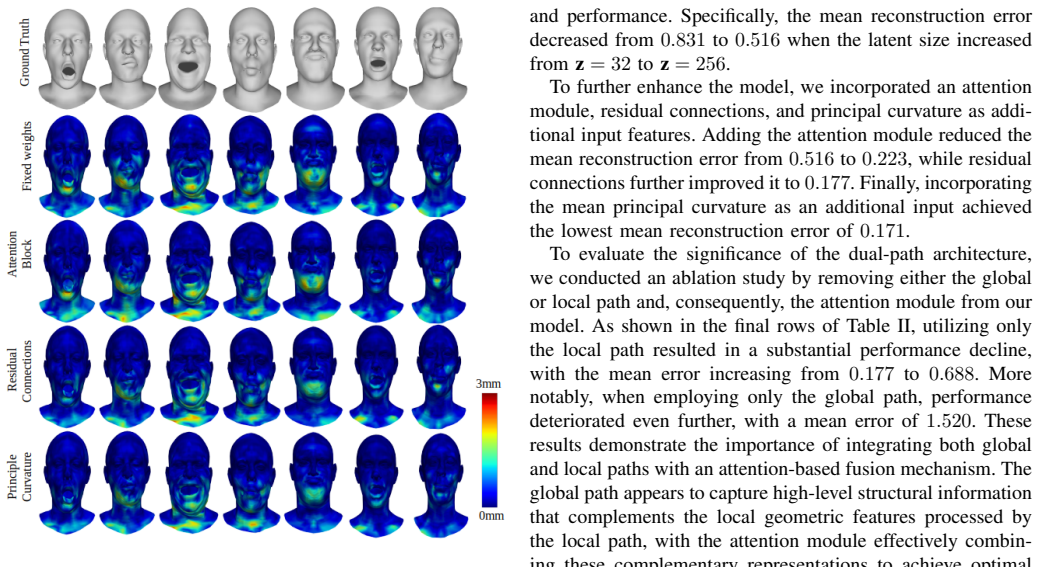
The paper's central claim is that the bottleneck in graph-autoencoder mesh reconstruction is not the convolution operator alone but how coarse and fine features are combined. 3DGeoMeshNet therefore merges the global and local decoder outputs with vertex-dependent weights generated by an attention head, $[w_G, w_L] = \mathrm{Att}(X_G, X_L)$, instead of the fixed scalar weights used in FaceCom. Combined with residual connections in the local path and mean principal curvature as an extra per-vertex input channel, this yields a mean error of 0.171 mm with latent size $z=256$, and the ablations attribute each modification a concrete gain: attention lowers the error from 0.516 to 0.223, residuals to 0.177, and curvature to 0.171. The authors claim this is lower than every method they compare against except LSA-Conv.
Load-bearing premise
The claim of superiority rests on treating the published error numbers for the competing methods as comparable to the authors' own runs; if the baselines used different splits, preprocessing, or error code, the ordering in Table I need not hold.
Editorial extensions
If this is right
- On the paper's own numbers, the reported 0.171 mm mean error at $z=256$ puts 3DGeoMeshNet ahead of spectral and spiral baselines such as COMA (0.845) and SpiralNet++ (0.54), suggesting learned multi-scale fusion plus curvature is a competitive recipe for fixed-topology mesh autoencoders.
- Each architectural addition gives a measurable gain in the ablations, so the paper's recipe can be transferred in parts: attention alone more than halves the error of the FaceCom-style base, and residual and curvature refinements compound that gain.
- Because both path-only variants fail (local-only 0.688, global-only 1.520), any successful variant of this architecture must keep both scales and their learned fusion.
- The spherical regularizer $(\|z\|_2 - 1)^2$ on the latent code gives a smooth latent space, which the paper exploits for linear interpolation and extrapolation of expressions and for denoising meshes without training on noise.
Reading between the lines
- The paper reports a 0.171 mm mean error against LSA-Conv's 0.153 mm with standard deviations of 0.187 and 0.217; the two distributions overlap substantially, so a head-to-head rerun on identical infrastructure could plausibly reorder them. This is an inference about the comparison, not a claim the paper makes.
- The attention weights $w_L, w_G$ are per-vertex, so they could be visualized as maps showing where local detail versus global shape dominates; the paper does not analyze these maps, and such a saliency analysis would be a direct test of the fusion mechanism.
- The same template-registered, fixed-topology recipe should transfer to other deformable mesh domains such as hands or bodies, where COMA-style registration exists; the paper only demonstrates faces, so this transfer is untested.
- If the spherical latent regularizer works as described, the latent space should support arithmetic expression-transfer operations; the interpolation and extrapolation plots hint at this, but no quantitative identity-versus-expression disentanglement metric is reported.
Editorial analysis
A structured set of objections, weighed in public.
Referee Report
Summary. The paper proposes 3DGeoMeshNet, a graph autoencoder for 3D mesh reconstruction that combines a global encoder-decoder path and a local encoder-decoder path built from FeaStConv layers, with per-vertex attention-based fusion, residual connections, mean curvature input features, and a spherical regularization on the latent code. On the COMA dataset, the method is reported to achieve a mean reconstruction error of 0.171 mm, which Table I places below most published baselines but above LSA-Conv (0.153 mm). The paper also reports an ablation study attributing gains to the attention module, residual connections, and curvature input, and it demonstrates interpolation, extrapolation, and mesh denoising applications.
Significance. If the reported comparison is valid, the contribution is of practical interest: the architecture is simple, the attention-based fusion is a sensible alternative to fixed weights in FaceCom, and the ablation study is systematic, with large error reductions from each added component. The paper's strengths include explicit reporting of mean and median errors and a clear ablation design. However, the central comparative claim currently rests on numbers gathered from heterogeneous prior papers without verification of a common protocol, and the word 'statistically significant' is unsupported by any test. These issues must be resolved before the ranking claim can be accepted.
major comments (3)
- [V.B, Table I] The central claim that 3DGeoMeshNet achieves the second-best COMA reconstruction error rests entirely on Table I, yet all entries except the authors' modified FaceCom baseline are transcribed from prior publications with no verification that they were produced under the same train/test split, mesh preprocessing, evaluation set, and per-vertex error metric. The table mixes methods with very different latent dimensions (z = 8, 32, 128, 256) and methods that are not mesh autoencoders in the same sense (PCA, FLAME, point-cloud-based Gu et al.), and FaceCom is originally an inpainting method whose 'modified' reconstruction baseline is not described in detail. The authors should either re-run all baselines under a common protocol or carefully justify protocol equivalence; without this, the stated rank ordering is not established.
- [VI; also V.B] The conclusion states that the approach yields 'statistically significant improvements over SOTA methods,' but no significance tests, confidence intervals, or repeated-seed results are reported anywhere in the paper. Moreover, the statement is internally contradicted by Table I, where LSA-Conv achieves a lower mean error (0.153 mm vs 0.171 mm). The wording should be replaced by a precise claim limited to the reported means under the authors' protocol, and, if significance is intended, a proper statistical comparison over repeated runs or test subjects should be provided.
- [III.c-III.e, Eqs. (2)-(4)] The architecture is not fully specified because of inconsistent notation. In Section III.c the global encoder is called 'DG' and the local encoder 'DL' even though they were introduced as EG and EL; Section III.d defines the decoder output as diag(wG)DG(zG)+diag(wL)DL(zL), while Eq. (4) writes [wG,wL] = Att(XG, XL), where XG and XL are only defined later as the decoded vertex features. The dimensions of wG and wL, the exact input to the attention block, and the dependence of DG and DL on zG and zL need to be stated precisely. Since no code is released, these inconsistencies make the model difficult to reimplement and therefore compromise the reproducibility of the central contribution.
minor comments (8)
- [V.B] The sentence '3DGeoMeshNet achieves the lowest reconstruction error, outperforming all the competing methods by a significant margin except LSA-Conv' is self-contradictory; if LSA-Conv is excluded, the method is not the lowest. It should read 'second-lowest among the compared methods' or similar.
- [III.a] Equation (1) defines the mean curvature H(v), but the text refers to 'mean principal curvatures'; the terminology should be made consistent.
- [IV] The spherical regularization loss is justified by 'preventing vanishing KL-divergence,' but no KL divergence term appears in the loss function; unless the model is formulated as a variational autoencoder, this motivation is confusing and should be clarified or removed.
- [Table I] The table header spells 'FLAM' while the text and references use 'FLAME'; the abbreviation should be made consistent.
- [References] References [6] and [8] are duplicates of the same Neural3DMM paper, and [18] duplicates [12]; these should be consolidated to keep the bibliography clean.
- [Title and III.e] The title uses 'Self-Attention,' but the attention block described in Section III.e is a small MLP applied to concatenated decoded features, not self-attention over a set of tokens; this naming should be reconsidered or clarified.
- [Table II] The 'L2' column is reported without a definition; the paper should state the exact formula for this error metric.
- [V.A] The text says the learning rate is 'halved every 50 epoch'; the grammatical issue is minor, but the schedule should be stated completely, including the initial value and whether the halving is applied after each epoch or each optimizer step.
Circularity Check
No circularity identified: the reconstruction errors are empirical measurements against ground-truth meshes, and the reported gains are not derived by construction from the model's inputs or from a self-citation chain.
full rationale
The paper makes no first-principles derivation that is claimed to predict an experimental outcome. 3DGeoMeshNet is trained with an MSE reconstruction loss and its reported 0.171 mm mean error is measured on held-out COMA test meshes; the attention weights w_G and w_L in Eq. (4) are learned from data rather than set to force the reported error. No equation in Sections III-IV defines the target metric in terms of the model output, and no fitted parameter is renamed as a prediction. The comparison in Table I mixes locally run results with numbers taken from prior publications, which is a legitimate protocol-comparability and reproducibility concern for the claimed 'second-best' ranking, but it is not circularity because the external numbers are not derived from this paper's own outputs. There is no load-bearing self-citation chain: the only similarly named citation, 'Olivier et al. [29]', is not authored by the present authors, and the other key references (FaceCom [36], Attention U-Net [38], FeaStNet [27], curvature-based methods [33-35]) are standard external work. Tuning hyperparameters such as lambda_reg and latent size on the same dataset is a common experimental practice and does not reduce the central reconstruction claim to its input by construction. Accordingly, no circular step can be exhibited with the required quote-and-reduction evidence.
Assumptions & free parameters
free parameters (1)
- lambda_reg =
0.0001
assumptions (3)
- domain assumption COMA meshes are registered to a common template with 5023 vertices and identical topology.
- domain assumption FeaStConv is a suitable anisotropic convolution operator for mesh reconstruction.
- ad hoc to paper Spherical regularization loss improves optimization and reconstruction stability.
Cite this review
Pith. "Pith review of Self-Attention Based Multi-Scale Graph Auto-Encoder Network of 3D Meshes." pith.science (2026). https://pith.science/paper/7S4QBPSM
@misc{pith2026250705304,
  author       = {Pith},
  title        = {Pith review of: Self-Attention Based Multi-Scale Graph Auto-Encoder Network of 3D Meshes},
  year         = {2026},
  howpublished = {\url{https://pith.science/paper/7S4QBPSM}},
  note         = {Machine review of arXiv:2507.05304}
}
read the original abstract
3D meshes are fundamental data representations for capturing complex geometric shapes in computer vision and graphics applications. While Convolutional Neural Networks (CNNs) have excelled in structured data like images, extending them to irregular 3D meshes is challenging due to the non-Euclidean nature of the data. Graph Convolutional Networks (GCNs) offer a solution by applying convolutions to graph-structured data, but many existing methods rely on isotropic filters or spectral decomposition, limiting their ability to capture both local and global mesh features. In this paper, we introduce 3D Geometric Mesh Network (3DGeoMeshNet), a novel GCN-based framework that uses anisotropic convolution layers to effectively learn both global and local features directly in the spatial domain. Unlike previous approaches that convert meshes into intermediate representations like voxel grids or point clouds, our method preserves the original polygonal mesh format throughout the reconstruction process, enabling more accurate shape reconstruction. Our architecture features a multi-scale encoder-decoder structure, where separate global and local pathways capture both large-scale geometric structures and fine-grained local details. Extensive experiments on the COMA dataset containing human faces demonstrate the efficiency of 3DGeoMeshNet in terms of reconstruction accuracy.
Figures


Figures from the paper (3 more)


Reference graph
Works this paper leans on
-
[1]
A Review of Deep Learning-Powered Mesh Reconstruction Methods
Z. Chen, “A review of deep learning-powered mesh reconstruction methods,” arXiv preprint arXiv:2303.02879 , 2023
work page Pith review arXiv 2023
-
[2]
Geoudf: Surface reconstruction from 3d point clouds via geometry-guided distance rep- resentation,
S. Ren, J. Hou, X. Chen, Y . He, and W. Wang, “Geoudf: Surface reconstruction from 3d point clouds via geometry-guided distance rep- resentation,” in Proceedings of the IEEE/CVF International Conference on Computer Vision , 2023, pp. 14 214–14 224
work page 2023
-
[3]
A survey on deep learning advances on different 3d data representations,
E. Ahmed, A. Saint, A. E. R. Shabayek, K. Cherenkova, R. Das, G. Gu- sev, D. Aouada, and B. Ottersten, “A survey on deep learning advances on different 3d data representations,” arXiv preprint arXiv:1808.01462 , 2018
arXiv 2018
-
[4]
Convolutional neural networks on graphs with fast localized spectral filtering,
M. Defferrard, X. Bresson, and P. Vandergheynst, “Convolutional neural networks on graphs with fast localized spectral filtering,” Advances in neural information processing systems , vol. 29, 2016
2016
-
[5]
Generating 3d faces using convolutional mesh autoencoders,
A. Ranjan, T. Bolkart, S. Sanyal, and M. J. Black, “Generating 3d faces using convolutional mesh autoencoders,” inProceedings of the European conference on computer vision (ECCV) , 2018, pp. 704–720
work page 2018
-
[7]
Surface simplification using quadric er- ror metrics,
M. Garland and P. S. Heckbert, “Surface simplification using quadric er- ror metrics,” in Proceedings of the 24th annual conference on Computer graphics and interactive techniques , 1997, pp. 209–216
work page 1997
-
[8]
G. Bouritsas, S. Bokhnyak, S. Ploumpis, M. Bronstein, and S. Zafeiriou, “Neural 3d morphable models: Spiral convolutional networks for 3d shape representation learning and generation,” in Proceedings of the IEEE/CVF international conference on computer vision , 2019, pp. 7213– 7222
work page 2019
-
[10]
A morphable model for the synthesis of 3d faces,
V . Blanz and T. Vetter, “A morphable model for the synthesis of 3d faces,” in Seminal Graphics Papers: Pushing the Boundaries, V olume 2 , 2023, pp. 157–164
work page 2023
Show all 35 references
-
[11]
A 3d face model for pose and illumination invariant face recognition,
P. Paysan, R. Knothe, B. Amberg, S. Romdhani, and T. Vetter, “A 3d face model for pose and illumination invariant face recognition,” in 2009 sixth IEEE international conference on advanced video and signal based surveillance. Ieee, 2009, pp. 296–301
2009
-
[13]
High-fidelity pose and expression normalization for face recognition in the wild,
X. Zhu, Z. Lei, J. Yan, D. Yi, and S. Z. Li, “High-fidelity pose and expression normalization for face recognition in the wild,” in Proceedings of the IEEE conference on computer vision and pattern recognition, 2015, pp. 787–796
2015
-
[14]
Facewarehouse: A 3d facial expression database for visual computing,
C. Cao, Y . Weng, S. Zhou, Y . Tong, and K. Zhou, “Facewarehouse: A 3d facial expression database for visual computing,” IEEE Transactions on Visualization and Computer Graphics , vol. 20, no. 3, pp. 413–425, 2013
2013
-
[15]
Smpl: A skinned multi-person linear model,
M. Loper, N. Mahmood, J. Romero, G. Pons-Moll, and M. J. Black, “Smpl: A skinned multi-person linear model,” in Seminal Graphics Papers: Pushing the Boundaries, V olume 2 , 2023, pp. 851–866
2023
-
[16]
Embodied hands: Modeling and capturing hands and bodies together** supplementary material,
J. Romero, D. Tzionas, and M. J. Black, “Embodied hands: Modeling and capturing hands and bodies together** supplementary material,” 2017
2017
-
[17]
Large scale 3d morphable models,
J. Booth, A. Roussos, A. Ponniah, D. Dunaway, and S. Zafeiriou, “Large scale 3d morphable models,” International Journal of Computer Vision , vol. 126, no. 2, pp. 233–254, 2018
2018
-
[18]
Learning a model of facial shape and expression from 4d scans
T. Li, T. Bolkart, M. J. Black, H. Li, and J. Romero, “Learning a model of facial shape and expression from 4d scans.” ACM Trans. Graph. , vol. 36, no. 6, pp. 194–1, 2017
2017
-
[19]
Spectral representations for con- volutional neural networks,
O. Rippel, J. Snoek, and R. P. Adams, “Spectral representations for con- volutional neural networks,” Advances in neural information processing systems, vol. 28, 2015
2015
-
[20]
Semi-supervised classification with graph convolutional networks,
T. N. Kipf and M. Welling, “Semi-supervised classification with graph convolutional networks,” arXiv preprint arXiv:1609.02907 , 2016
2016 arXiv
-
[21]
3d face reprentation and reconstruction with multi-scale graph convolutional autoencoders,
C. Yuan, K. Li, Y .-K. Lai, Y . Liu, and J. Yang, “3d face reprentation and reconstruction with multi-scale graph convolutional autoencoders,” in 2019 IEEE International Conference on Multimedia and Expo (ICME) . IEEE, 2019, pp. 1558–1563
2019
-
[22]
Disentangled representation learning for 3d face shape,
Z.-H. Jiang, Q. Wu, K. Chen, and J. Zhang, “Disentangled representation learning for 3d face shape,” in Proceedings of the IEEE/CVF Conference on Computer Vision and Pattern Recognition , 2019, pp. 11 957–11 966
2019
-
[23]
Learning distribution independent latent representation for 3d face disentanglement,
Z. Zhang, C. Yu, H. Li, J. Sun, and F. Liu, “Learning distribution independent latent representation for 3d face disentanglement,” in 2020 International Conference on 3D Vision (3DV) . IEEE, 2020, pp. 848– 857
2020
-
[24]
Inductive representation learning on large graphs,
W. Hamilton, Z. Ying, and J. Leskovec, “Inductive representation learning on large graphs,” Advances in neural information processing systems, vol. 30, 2017
2017
-
[25]
Graph attention networks,
P. Veli ˇckovi´c, G. Cucurull, A. Casanova, A. Romero, P. Lio, and Y . Ben- gio, “Graph attention networks,” arXiv preprint arXiv:1710.10903, 2017
2017 arXiv
-
[26]
Monet: Debiasing graph embeddings via the metadata-orthogonal training unit,
J. Palowitch and B. Perozzi, “Monet: Debiasing graph embeddings via the metadata-orthogonal training unit,” arXiv preprint arXiv:1909.11793, 2019
1909 arXiv
-
[27]
Feastnet: Feature-steered graph convolutions for 3d shape analysis,
N. Verma, E. Boyer, and J. Verbeek, “Feastnet: Feature-steered graph convolutions for 3d shape analysis,” in Proceedings of the IEEE confer- ence on computer vision and pattern recognition , 2018, pp. 2598–2606
2018
-
[28]
Spiralnet++: A fast and highly efficient mesh convolution operator,
S. Gong, L. Chen, M. Bronstein, and S. Zafeiriou, “Spiralnet++: A fast and highly efficient mesh convolution operator,” in Proceedings of the IEEE/CVF international conference on computer vision workshops , 2019, pp. 0–0
2019
-
[29]
Facetunegan: Face autoencoder for convolutional expression transfer using neural generative adversarial networks,
N. Olivier, K. Baert, F. Danieau, F. Multon, and Q. Avril, “Facetunegan: Face autoencoder for convolutional expression transfer using neural generative adversarial networks,” Computers & Graphics , vol. 110, pp. 69–85, 2023
2023
-
[30]
Information bottlenecked variational au- toencoder for disentangled 3d facial expression modelling,
H. Sun, N. Pears, and Y . Gu, “Information bottlenecked variational au- toencoder for disentangled 3d facial expression modelling,” in Proceed- ings of the IEEE/CVF Winter Conference on Applications of Computer Vision, 2022, pp. 157–166
2022
-
[31]
Robust mesh representation learning via efficient local structure-aware anisotropic convolution,
Z. Gao, J. Yan, G. Zhai, J. Zhang, and X. Yang, “Robust mesh representation learning via efficient local structure-aware anisotropic convolution,” IEEE Transactions on Neural Networks and Learning Systems, vol. 34, no. 11, pp. 8566–8578, 2022
2022
-
[32]
Adversarial 3d face disentanglement of identity and expression,
Y . Gu, N. Pears, and H. Sun, “Adversarial 3d face disentanglement of identity and expression,” in 2023 IEEE 17th International Conference on Automatic Face and Gesture Recognition (FG) . IEEE, 2023, pp. 1–7
2023
-
[33]
Deep learning of curvature features for shape completion,
M. Hern ´andez-Bautista and F. J. Melero, “Deep learning of curvature features for shape completion,” Computers & Graphics , vol. 115, pp. 204–215, 2023
2023
-
[34]
Discrete differential-geometry operators for triangulated 2-manifolds,
M. Meyer, M. Desbrun, P. Schr ¨oder, and A. H. Barr, “Discrete differential-geometry operators for triangulated 2-manifolds,” in Visu- alization and mathematics III . Springer, 2003, pp. 35–57
2003
-
[35]
Rimeshgnn: A rotation- invariant graph neural network for mesh classification,
B. Shakibajahromi, E. Kim, and D. E. Breen, “Rimeshgnn: A rotation- invariant graph neural network for mesh classification,” in Proceedings of the IEEE/CVF Winter Conference on Applications of Computer Vision, 2024, pp. 3150–3160
2024
-
[36]
Face- com: Towards high-fidelity 3d facial shape completion via optimization and inpainting guidance,
Y . Li, H. Wu, X. Wang, Q. Qin, Y . Zhao, Y . Wang, and A. Hao, “Face- com: Towards high-fidelity 3d facial shape completion via optimization and inpainting guidance,” in Proceedings of the IEEE/CVF Conference on Computer Vision and Pattern Recognition , 2024, pp. 2177–2186
2024
-
[37]
Fast graph representation learning with pytorch geometric,
M. Fey and J. E. Lenssen, “Fast graph representation learning with pytorch geometric,” arXiv preprint arXiv:1903.02428 , 2019
1903 arXiv
-
[38]
Attention u-net: Learning where to look for the pancreas,
O. Oktay, J. Schlemper, L. L. Folgoc, M. Lee, M. Heinrich, K. Misawa, K. Mori, S. McDonagh, N. Y . Hammerla, B. Kainz, B. Glocker, and D. Rueckert, “Attention u-net: Learning where to look for the pancreas,” 2018. [Online]. Available: https://arxiv.org/abs/1804.03999
2018 arXiv
Reviewed August 6, 2026 · model on record in the stance chip above.
Discussion (0). Sign in to comment.