REVIEW 3 major objections 5 minor 57 references
Predicting mutational effects on protein binding from folding energy
T0 review · 3 major / 5 minor · reviewed 2026-08-06 · deepseek-v4-flash
Pith's one-line read This paper claims that a predictor called STAB-DDG, built by subtracting the folding-energy estimates of two binding partners from those of their complex, is the first deep learning model to match FoldX's accuracy on mutation-induced…
desk verdict Careful benchmark, useful predictor, but the 'first to match FoldX' claim needs the omitted same-form baseline and a clearer story on folding fine-tuning. read the letter →
The pith
A machine-rendered reading of the paper's core claim, the machinery that carries it, and where it could break.
The reading
What carries the argument
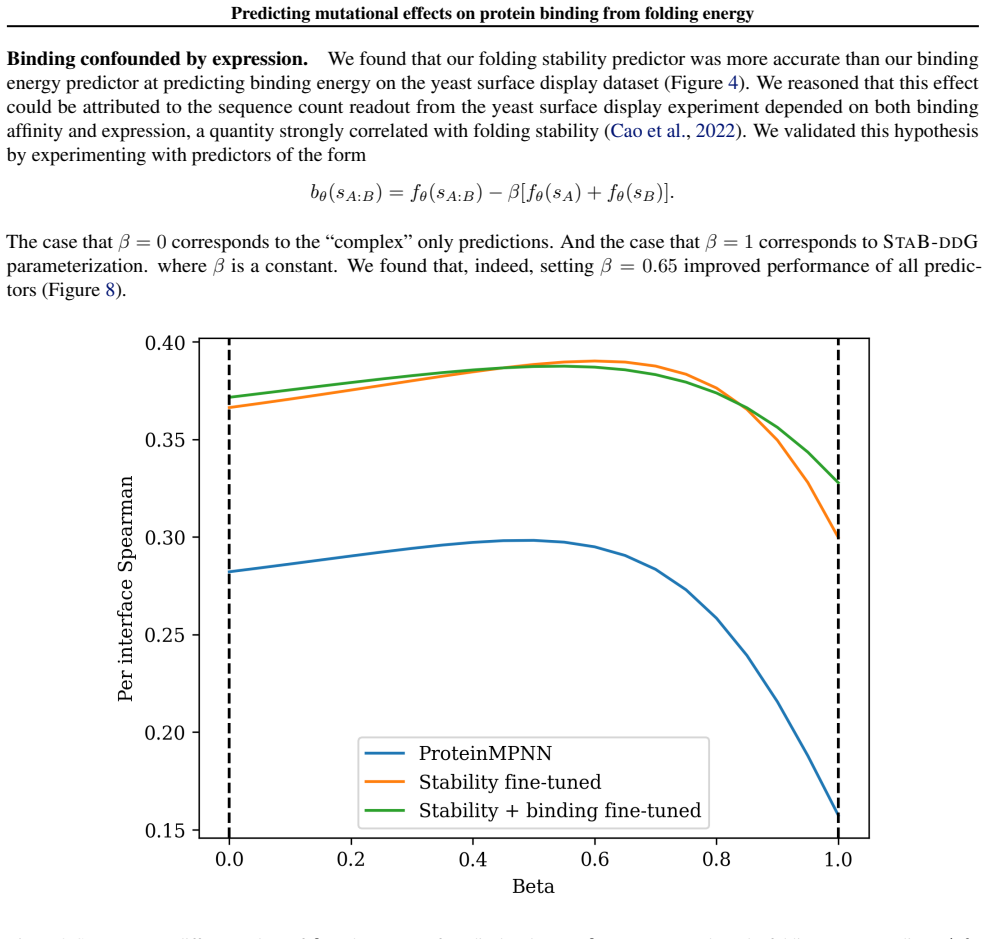
The StaB (stability-to-binding) parameterization defines a binding predictor $b_\theta(s_{A:B}) = f_\theta(s_{A:B}) - f_\theta(s_A) - f_\theta(s_B)$ with $f_\theta(s) = \log p_\theta(s)$ from a structure-conditioned inverse-folding model (ProteinMPNN). Plugging this into $\Delta b_\theta(s,s') = b_\theta(s') - b_\theta(s)$ yields a delta-delta-G predictor that is antisymmetric and path-independent by construction, and the same bound-complex backbone is used for the complex and both partners so that all six evaluations share one input structure. Two variance-reduction devices, using the same decoding order and backbone noise for wild-type and mutant and averaging over Monte Carlo samples, are treated as part of the mechanism because they materially improve accuracy.
What would settle it
Compare STAB-DDG and FoldX on a prospective, homology-clustered set with at least as many interface clusters as SKEMPIv2's full set; if STAB-DDG's per-interface Spearman correlation falls more than a standard error below FoldX's on that larger set, the claim of matched accuracy fails.
Extended reading notes
Core claim
The central claim is that mutation-induced binding-energy changes reduce to folding-energy changes through the identity $\Delta G_{\mathrm{bind}}(A:B) = \Delta G_{\mathrm{fold}}(A:B) - \Delta G_{\mathrm{fold}}(A) - \Delta G_{\mathrm{fold}}(B)$, so a predictor trained on abundant folding-stability data can be transferred to binding. On a homology-clustered split of SKEMPIv2.0, STAB-DDG reaches a per-interface Spearman correlation of 0.45 versus 0.48 for FoldX, a difference the paper reports as not statistically significant, while running in about 0.2 seconds per mutation on a GPU versus roughly 210 seconds for FoldX. The same parameterization, without any binding training, also beats previously published deep-learning baselines on this benchmark.
Load-bearing premise
The whole argument rests on the premise that an inverse-folding model's log-likelihood is a faithful, roughly linear proxy for folding free energy, evaluated on both the complex and its partners using just the bound-complex backbone.
Editorial extensions
If this is right
- If STAB-DDG's accuracy holds outside the benchmark, protein engineers can screen entire mutational libraries in silico in minutes, since the model evaluates a mutation in about 0.2 seconds on a GPU.
- Because the parameterization separates binding into folding terms, future improvements in inverse-folding or folding-stability models should transfer directly to binding prediction without new binding data.
- The fact that the zero-shot form already beats supervised deep-learning baselines implies that the thermodynamic parameterization itself, not the binding training set, is what closes the gap to force fields.
- Averaging STAB-DDG with FoldX reaches a per-interface Spearman correlation of 0.53, indicating that the learned and force-field predictors encode partly independent information about mutations.
- Sequential fine-tuning on folding measurements followed by binding data improves training-split accuracy but not test-split accuracy, so the folding-to-binding transfer is currently strongest on interfaces similar to the training clusters.
Reading between the lines
- Editorial inference: the same decomposition could be applied to any bimolecular interaction that a structure-conditioned sequence model can score, such as protein-DNA, protein-RNA, or peptide-MHC complexes, provided folding-energy data exist for the partners.
- Editorial inference: because STAB-DDG is fast enough for full saturation mutagenesis, an obvious next test is to run it on every single-residue substitution across a large panel of interfaces and compare with experimentally measured enrichment data, which would settle whether the FoldX-matching accuracy survives at scale.
- Editorial inference: the reported test-split inversion (folding fine-tuning helps on training but not on test) suggests that sequential fine-tuning is a fragile way to combine the two data sources; a joint or meta-learned weighting of folding and binding losses might transfer better across interface clusters.
- Editorial inference: if the log-likelihood proxy is the ceiling, replacing ProteinMPNN with a structure-conditioned model whose likelihood is trained directly on measured folding energies, rather than on PDB sequences, should push per-interface correlation above FoldX.
Editorial analysis
A structured set of objections, weighed in public.
Referee Report
Summary. The paper proposes STAB-DDG, a deep-learning predictor of binding free-energy changes upon mutation (ΔΔG_bind). The method parameterizes binding energy as the difference between the folding energy of the complex and the sum of folding energies of the partners, using ProteinMPNN log-likelihoods as a proxy for folding energy. The model is initialized from pre-trained ProteinMPNN weights, optionally fine-tuned on a large folding-stability dataset (Tsuboyama et al., 2023), and then fine-tuned on binding data from SKEMPIv2.0. On a homology-split benchmark, the authors report per-interface Spearman correlations of 0.45 for STAB-DDG and 0.48 for FoldX, with the difference not statistically significant, and a roughly 1000x speedup. The paper also presents ablation studies, two case-study datasets (yeast surface display and TCR mimics), and a theoretical analysis of thermodynamic properties of the predictor family.
Significance. If the central claim holds, STAB-DDG provides a practical fast alternative to FoldX for large-scale variant screening, and the transfer-learning recipe from abundant stability data to scarce binding data is a useful methodological contribution. The benchmark construction is careful: structural-homology-based clustering, explicit filtering of SKEMPIv2.0, standard errors, and paired t-tests for significance. The code and train/test splits are released, which is a substantial strength for reproducibility. The zero-shot variant, which uses no binding or stability labels beyond the pre-trained ProteinMPNN weights, already approaches FoldX accuracy, indicating the StaB parameterization and variance-reduction techniques are effective. However, the claim of being the 'first deep learning predictor to match FoldX' is a comparative historical assertion that is not adequately supported, as the closest prior method with the same parametric form is explicitly excluded from the benchmark.
major comments (3)
- [Abstract; Section 5.2, Table 7] The abstract's claim that STAB-DDG is 'the first deep learning predictor to match the accuracy of FoldX' is not supported because Boltzmann Alignment (Jiao et al., 2024), a learned calibration of the same ProteinMPNN inverse-folding likelihood on binding data, is excluded from the comparison. The stated reason—'the parametric form of the predictor is similar to STAB-DDG zero-shot'—is precisely why this comparator is needed: the paper's own zero-shot variant already achieves per-interface Spearman 0.43, statistically indistinguishable from FoldX's 0.48 (Table 7, Section 5.2). If Boltzmann Alignment also reaches comparable accuracy, the novelty claim fails. The authors should either include this baseline (even with a note on any required adaptations) or temper the historical claim to describe STAB-DDG as a fast predictor that matches FoldX on the evaluated benchmark.
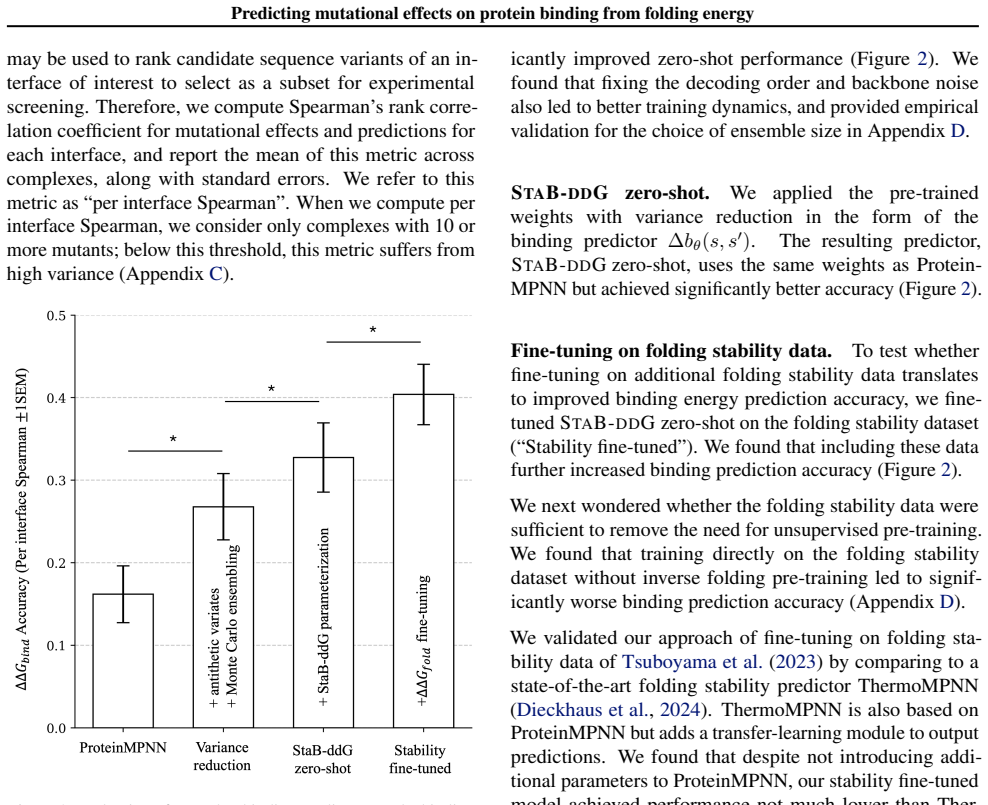
- [Section 5.1, Figure 2; Section 5.2, Figure 3 and Table 7] The paper claims that fine-tuning on folding-stability data improves binding prediction (Section 5.1, Figure 2), but this result is shown only on the training split. On the held-out test split, the stability fine-tuned model achieves lower per-interface Spearman (0.40) than the zero-shot model (0.43) and identical per-interface Pearson (0.45) (Table 7). The attribution of this inversion to 'the small number of clusters in the test split' is not accompanied by any quantitative support, such as cluster-bootstrap confidence intervals or a paired test on the difference. Since the transfer-learning mechanism is a central contribution, the paper should either provide evidence that the inversion is consistent with noise or qualify the claim that folding fine-tuning improves binding prediction on held-out interfaces.
- [Section 3.1, Eqs. (3)-(4); Appendix D.2, Table 6] The predictor relies on the assumption that a single bound-complex backbone can be used to compute fθ for the complex and both partners for both wild-type and mutant sequences. The authors test an alternative using AlphaFold3-predicted apo structures (Appendix D.2) and report no significant change in per-interface Spearman, which is some support. However, the test-split inversion noted above suggests that the proxy's validity may be context-dependent. The paper would be strengthened by a direct analysis of how the log-likelihood difference in Eq. (6) tracks measured folding ΔΔG on the complexes used for binding evaluation, or by a discussion of when the single-backbone assumption is likely to fail (e.g., flexible interfaces, as hinted by the stratification in Table 3). This is not a fatal flaw, but it is load-bearing for the transfer-learning interpretation.
minor comments (5)
- [Section 3.2, Eq. (8)] Equation (8) is labeled Lfold but is applied to binding data Dbind; this appears to be a typo and should read Lbind.
- [Throughout] The method name is inconsistently capitalized: 'STAB-DDG' and 'StaB-ddG' are used interchangeably (e.g., Abstract vs. Section 3.1). Please standardize.
- [Figures 2 and 3] Figure 2 reports one-sided paired t-tests while Figure 3 reports two-sided paired t-tests; the choice of one-sided vs. two-sided testing should be justified and applied consistently, especially where the direction of the effect is not hypothesized a priori.
- [Section 5.2, running time] The speedup comparison uses 'a single device' for FoldX (CPU) and an NVIDIA-5090 GPU for STAB-DDG. It would be helpful to state whether the reported 1000x speedup accounts for hardware differences or is a raw wall-clock comparison; if the latter, the claim should be qualified.
- [Appendix D.5, Table 6] The entry 'No folding' shows per-interface metrics that are not statistically different from STAB-DDG, yet the text in Section 5.1 implies a clear benefit from folding fine-tuning. The distinction between statistical significance and practical improvement should be stated more carefully.
Circularity Check
No significant circularity; the binding predictor is a thermodynamic identity applied to an external inverse-folding likelihood, with independent fine-tuning data and a held-out test split.
full rationale
The derivation chain is self-contained. Equation (1) is the standard thermodynamic identity expressing binding free energy as a difference of folding free energies, and Equations (3)-(5) instantiate it using the log-likelihood of a pre-trained ProteinMPNN as a folding-energy proxy. No fitted parameter is relabeled as a prediction: zero-shot STAB-DDG uses fixed pre-trained weights with no binding labels, and fine-tuned models are trained on the external Megascale stability dataset and the SKEMPIv2 training split, with the test split held out from fitting. The folding-to-binding transfer is an empirical assumption supported by prior external correlations (Lapedes et al., Notin et al.), not by a result of the present authors. Self-citations such as Householder et al. (2024) are motivational and not load-bearing for the central claim. The exclusion of Boltzmann Alignment from the benchmark is a completeness concern about the historical 'first' claim, not a circularity in the derivation, since the paper explicitly acknowledges the parametric similarity rather than deriving its contribution from that prior work.
Assumptions & free parameters
free parameters (5)
- Per-interface Spearman mutant threshold =
10 mutants
- SKEMPIv2.0 filtering criteria =
remove <3 mutants, >40% identical ΔΔG, unresolved residues, non-interface mutations
- FoldX repair steps =
5
- Flex ddG backrub steps and model count =
35,000 steps, 10 models
- Monte Carlo ensemble size =
20
assumptions (5)
- standard math Free energy is a state function, so ΔGbind = ΔGfold(complex) - ΔGfold(A) - ΔGfold(B)
- domain assumption log pθ(s) from an inverse-folding model is an approximately linear proxy for folding free energy
- domain assumption A single bound-complex backbone can represent the structures of the complex and both monomers for all six terms
- domain assumption ProteinMPNN can approximate arbitrary simplex-valued functions (expressivity)
- domain assumption Megascale (Tsuboyama et al. 2023) and SKEMPIv2.0 provide reliable labeled energies
Cite this review
Pith. "Pith review of Predicting mutational effects on protein binding from folding energy." pith.science (2026). https://pith.science/paper/EZU3YS6J
@misc{pith2026250705502,
  author       = {Pith},
  title        = {Pith review of: Predicting mutational effects on protein binding from folding energy},
  year         = {2026},
  howpublished = {\url{https://pith.science/paper/EZU3YS6J}},
  note         = {Machine review of arXiv:2507.05502}
}
read the original abstract
Accurate estimation of mutational effects on protein-protein binding energies is an open problem with applications in structural biology and therapeutic design. Several deep learning predictors for this task have been proposed, but, presumably due to the scarcity of binding data, these methods underperform computationally expensive estimates based on empirical force fields. In response, we propose a transfer-learning approach that leverages advances in protein sequence modeling and folding stability prediction for this task. The key idea is to parameterize the binding energy as the difference between the folding energy of the protein complex and the sum of the folding energies of its binding partners. We show that using a pre-trained inverse-folding model as a proxy for folding energy provides strong zero-shot performance, and can be fine-tuned with (1) copious folding energy measurements and (2) more limited binding energy measurements. The resulting predictor, StaB-ddG, is the first deep learning predictor to match the accuracy of the state-of-the-art empirical force-field method FoldX, while offering an over 1,000x speed-up.
Figures


Figures from the paper (5 more)


Reference graph
Works this paper leans on
-
[1]
Abramson, J., Adler, J., Dunger, J., Evans, R., Green, T., Pritzel, A., Ronneberger, O., Willmore, L., Ballard, A. J., Bambrick, J., et al. Accurate structure prediction of biomolecular interactions with A lpha F old 3. Nature, 2024
work page 2024
-
[2]
F., Leaver-Fay, A., Jeliazkov, J
Alford, R. F., Leaver-Fay, A., Jeliazkov, J. R., O’Meara, M. J., DiMaio, F. P., Park, H., Shapovalov, M. V., Renfrew, P. D., Mulligan, V. K., Kappel, K., Labonte, J. W., Pacella, M. S., Bonneau, R., Bradley, P., Dunbrack, R. L., Das, R., Baker, D., Kuhlman, B., Kortemme, T., and Gray, J. J. The R osetta all-atom energy function for macromolecular modeling...
work page 2017
-
[3]
A., O Conchuir, S., Thompson, S., Suresh, P., Lucas, J
Barlow, K. A., O Conchuir, S., Thompson, S., Suresh, P., Lucas, J. E., Heinonen, M., and Kortemme, T. Flex dd G : Rosetta ensemble-based estimation of changes in protein--protein binding affinity upon mutation. The Journal of Physical Chemistry B, 2018
work page 2018
-
[4]
R., Coventry, B., Goreshnik, I., Huang, B., Allen, A., Vafeados, D., Peng, Y
Bennett, N. R., Coventry, B., Goreshnik, I., Huang, B., Allen, A., Vafeados, D., Peng, Y. P., Dauparas, J., Baek, M., Stewart, L., et al. Improving de novo protein binder design with deep learning. Nature Communications, 2023
work page 2023
-
[5]
Birnbaum, M. E., Mendoza, J. L., Sethi, D. K., Dong, S., Glanville, J., Dobbins, J., \"O zkan, E., Davis, M. M., Wucherpfennig, K. W., and Garcia, K. C. Deconstructing the peptide- MHC specificity of T cell recognition. Cell, 2014
work page 2014
-
[6]
Learning to design protein-protein interactions with enhanced generalization
Bushuiev, A., Bushuiev, R., Kouba, P., Filkin, A., Gabrielova, M., Gabriel, M., Sedlar, J., Pluskal, T., Damborsky, J., Mazurenko, S., and Sivic, J. Learning to design protein-protein interactions with enhanced generalization. In International Conference on Learning Representations, 2024
work page 2024
-
[7]
Cameron, A. C. and Miller, D. L. A practitioner’s guide to cluster-robust inference. Journal of human resources, 2015
work page 2015
-
[8]
Cao, L., Coventry, B., Goreshnik, I., Huang, B., Sheffler, W., Park, J. S., Jude, K. M., Markovi \'c , I., Kadam, R. U., Verschueren, K. H., et al. Design of protein-binding proteins from the target structure alone. Nature, 2022
work page 2022
Show all 57 references
-
[9]
J., Milles, L
Dauparas, J., Anishchenko, I., Bennett, N., Bai, H., Ragotte, R. J., Milles, L. F., Wicky, B. I., Courbet, A., de Haas, R. J., Bethel, N., et al. Robust deep learning--based protein sequence design using P rotein MPNN . Science, 2022
2022
-
[10]
J., Gong, C., Ouyang-Zhang, J., Loy, J
Diaz, D. J., Gong, C., Ouyang-Zhang, J., Loy, J. M., Wells, J., Yang, D., Ellington, A. D., Dimakis, A. G., and Klivans, A. R. Stability O racle: a structure-based graph-transformer framework for identifying stabilizing mutations. Nature Communications, 2024
2024
-
[11]
Z., and Kuhlman, B
Dieckhaus, H., Brocidiacono, M., Randolph, N. Z., and Kuhlman, B. Transfer learning to leverage larger datasets for improved prediction of protein stability changes. Proceedings of the National Academy of Sciences, 2024
2024
-
[12]
Dourado, D. F. and Flores, S. C. A multiscale approach to predicting affinity changes in protein--protein interfaces. Proteins: Structure, Function, and Bioinformatics, 2014
2014
-
[13]
Binding oracle: Fine-tuning from stability to binding free energy
Gong, C., Klivans, A., Wells, J., Loy, J., Dimakis, A., Diaz, D., et al. Binding oracle: Fine-tuning from stability to binding free energy. In NeurIPS 2023 Generative AI and Biology (GenBio) Workshop, 2023
2023
-
[14]
and Pierce, B
Gowthaman, R. and Pierce, B. G. TCR 3d: The T cell receptor structural repertoire database. Bioinformatics, 2019
2019
-
[15]
E., and Serrano, L
Guerois, R., Nielsen, J. E., and Serrano, L. Predicting changes in the stability of proteins and protein complexes: a study of more than 1000 mutations. Journal of molecular biology, 2002
2002
-
[16]
Hammersley, J. M. and Morton, K. W. A new M onte C arlo technique: antithetic variates. In Mathematical proceedings of the Cambridge philosophical society. Cambridge University Press, 1956
1956
-
[17]
and Tibshirani, R
Hastie, T. and Tibshirani, R. Generalized additive models. Statistical science, 1986
1986
-
[18]
Hastie, T., Tibshirani, R., and Friedman, J. H. The elements of statistical learning: data mining, inference, and prediction, 2009
2009
-
[19]
J., Crean, R
Holland, C. J., Crean, R. M., Pentier, J. M., de Wet, B., Lloyd, A., Srikannathasan, V., Lissin, N., Lloyd, K. A., Blicher, T. H., Conroy, P. J., et al. Specificity of bispecific T cell receptors and antibodies targeting peptide- HLA . The Journal of clinical investigation, 2020
2020
-
[20]
A., Ingraham, J
Hopf, T. A., Ingraham, J. B., Poelwijk, F. J., Sch \"a rfe, C. P., Springer, M., Sander, C., and Marks, D. S. Mutation effects predicted from sequence co-variation. Nature biotechnology, 2017
2017
-
[21]
D., Xiang, X., Jude, K
Householder, K. D., Xiang, X., Jude, K. M., Deng, A., Obenaus, M., Wilson, S. C., Chen, X., Wang, N., and Garcia, K. C. De novo design and structure of a peptide-centric TCR mimic binding module. bioRxiv, 2024
2024
-
[22]
H.-C., Wright, K
Hsiue, E. H.-C., Wright, K. M., Douglass, J., Hwang, M. S., Mog, B. J., Pearlman, A. H., Paul, S., DiNapoli, S. R., Konig, M. F., Wang, Q., et al. Targeting a neoantigen derived from a common TP 53 mutation. Science, 2021
2021
-
[23]
Learning protein fitness models from evolutionary and assay-labeled data
Hsu, C., Nisonoff, H., Fannjiang, C., and Listgarten, J. Learning protein fitness models from evolutionary and assay-labeled data. Nature biotechnology, 2022 a
2022
-
[24]
Learning inverse folding from millions of predicted structures
Hsu, C., Verkuil, R., Liu, J., Lin, Z., Hie, B., Sercu, T., Lerer, A., and Rives, A. Learning inverse folding from millions of predicted structures. In International Conference on Machine Learning, 2022 b
2022
-
[25]
S., Miller, M
Hwang, M. S., Miller, M. S., Thirawatananond, P., Douglass, J., Wright, K. M., Hsiue, E. H.-C., Mog, B. J., Aytenfisu, T. Y., Murphy, M. B., Aitana Azurmendi, P., et al. Structural engineering of chimeric antigen receptors targeting HLA -restricted neoantigens. Nature communic...
2021
-
[26]
Jankauskait \.e , J., Jim \'e nez-Garc \' a, B., Dapk \=u nas, J., Fern \'a ndez-Recio, J., and Moal, I. H. SKEMPI 2.0: an updated benchmark of changes in protein--protein binding energy, kinetics and thermodynamics upon mutation. Bioinformatics, 2019
2019
-
[27]
Boltzmann- A ligned inverse folding model as a predictor of mutational effects on protein-protein interactions
Jiao, X., Mao, W., Jin, W., Yang, P., Chen, H., and Shen, C. Boltzmann- A ligned inverse folding model as a predictor of mutational effects on protein-protein interactions. arXiv preprint arXiv:2410.09543, 2024
2024 arXiv
-
[28]
DSMBind : Tutorial notebook
Jin, W. DSMBind : Tutorial notebook. https://github.com/wengong-jin/DSMBind/blob/master/tutorial.ipynb, 2025. Jupyter notebook; results referenced are in Cell 22. Accessed: 2025-06-27
2025
-
[29]
SE(3) denoising score matching for unsupervised binding energy prediction and nanobody design
Jin, W., Sarzikova, S., Chen, X., Uhler, C., and Hacohen, N. SE(3) denoising score matching for unsupervised binding energy prediction and nanobody design. In NeurIPS 2023 Generative AI and Biology (GenBio) Workshop, 2023
2023
-
[30]
H., Wolff, D., Scapolo, B., Fernandez-Quintero, M
Johansen, K. H., Wolff, D., Scapolo, B., Fernandez-Quintero, M. L., Christensen, C. R., Loeffler, J. R., Rivera-de Torre, E., Overath, M. D., Munk, K. K., Morell, O., et al. De novo designed p MHC binders facilitate T cell induced killing of cancer cells. bioRxiv, 2024
2024
-
[31]
Kastritis, P. L. and Bonvin, A. M. On the binding affinity of macromolecular interactions: daring to ask why proteins interact. Journal of The Royal Society Interface, 2013
2013
-
[32]
A., Chandran, S
Klebanoff, C. A., Chandran, S. S., Baker, B. M., Quezada, S. A., and Ribas, A. T cell receptor therapeutics: immunological targeting of the intracellular cancer proteome. Nature Reviews Drug Discovery, 2023
2023
-
[33]
Fine-tuning can distort pretrained features and underperform out-of-distribution
Kumar, A., Raghunathan, A., Jones, R., Ma, T., and Liang, P. Fine-tuning can distort pretrained features and underperform out-of-distribution. arXiv preprint arXiv:2202.10054, 2022
2022 arXiv
-
[34]
Using sequence alignments to predict protein structure and stability with high accuracy
Lapedes, A., Giraud, B., and Jarzynski, C. Using sequence alignments to predict protein structure and stability with high accuracy. arXiv preprint arXiv:1207.2484, 2012
2012 arXiv
-
[35]
C., Swanson, O., Harlos, K., Rozbesky, D., Cain, D
Li, D., Brackenridge, S., Walters, L. C., Swanson, O., Harlos, K., Rozbesky, D., Cain, D. W., Wiehe, K., Scearce, R. M., Barr, M., et al. Mouse and human antibodies bind HLA - E -leader peptide complexes and enhance NK cell cytotoxicity. Communications Biology, 2022
2022
-
[36]
P., Stadtmauer, E
Linette, G. P., Stadtmauer, E. A., Maus, M. V., Rapoport, A. P., Levine, B. L., Emery, L., Litzky, L., Bagg, A., Carreno, B. M., Cimino, P. J., et al. Cardiovascular toxicity and titin cross-reactivity of affinity-enhanced T cells in myeloma and melanoma. Blood, The Journal of...
2013
-
[37]
F., Bonzanini, J
Liu, B., Greenwood, N. F., Bonzanini, J. E., Motmaen, A., Sharp, J., Wang, C., Visani, G. M., Vafeados, D. K., Roullier, N., Nourmohammad, A., et al. Design of high specificity binders for peptide- MHC - I complexes. bioRxiv, 2024 a
2024
-
[38]
Predicting mutational effects on protein-protein binding via a side-chain diffusion probabilistic model
Liu, S., Zhu, T., Ren, M., Yu, C., Bu, D., and Zhang, H. Predicting mutational effects on protein-protein binding via a side-chain diffusion probabilistic model. Advances in Neural Information Processing Systems, 2024 b
2024
-
[39]
Rotamer density estimator is an unsupervised learner of the effect of mutations on protein-protein interaction
Luo, S., Su, Y., Wu, Z., Su, C., Peng, J., and Ma, J. Rotamer density estimator is an unsupervised learner of the effect of mutations on protein-protein interaction. In International Conference on Learning Representations, 2023
2023
-
[40]
Multi-level interaction modeling for protein mutational effect prediction
Mo, Y., Hong, X., Gao, B., Jia, Y., and Lan, Y. Multi-level interaction modeling for protein mutational effect prediction. arXiv preprint arXiv:2405.17802, 2024
2024 arXiv
-
[41]
Proteingym: Large-scale benchmarks for protein fitness prediction and design
Notin, P., Kollasch, A., Ritter, D., Van Niekerk, L., Paul, S., Spinner, H., Rollins, N., Shaw, A., Orenbuch, R., Weitzman, R., Frazer, J., Dias, M., Franceschi, D., Gal, Y., and Marks, D. Proteingym: Large-scale benchmarks for protein fitness prediction and design. Advances i...
2023
-
[42]
K., Kim, D
Park, H., Bradley, P., Greisen Jr, P., Liu, Y., Mulligan, V. K., Kim, D. E., Baker, D., and DiMaio, F. Simultaneous optimization of biomolecular energy functions on features from small molecules and macromolecules. Journal of chemical theory and computation, 2016
2016
-
[43]
J., Ingraham, J
Riesselman, A. J., Ingraham, J. B., and Marks, D. S. Deep generative models of genetic variation capture the effects of mutations. Nature methods, 2018
2018
-
[44]
L., Ma, J., et al
Rives, A., Meier, J., Sercu, T., Goyal, S., Lin, Z., Liu, J., Guo, D., Ott, M., Zitnick, C. L., Ma, J., et al. Biological structure and function emerge from scaling unsupervised learning to 250 million protein sequences. Proceedings of the National Academy of Sciences, 2021
2021
-
[45]
J., Turner, S
Rossjohn, J., Gras, S., Miles, J. J., Turner, S. J., Godfrey, D. I., and McCluskey, J. T cell antigen receptor recognition of antigen-presenting molecules. Annual review of immunology, 2015
2015
-
[46]
M., Cannon, D
Sampson, J. M., Cannon, D. A., Duan, J., Epstein, J. C., Sergeeva, A. P., Katsamba, P. S., Mannepalli, S. M., Bahna, F. A., Adihou, H., Gu \'e ret, S. M., et al. Robust prediction of relative binding energies for protein-protein complex mutations using free energy perturbation...
2024
-
[47]
P., Katsamba, P
Sergeeva, A. P., Katsamba, P. S., Cosmanescu, F., Brewer, J. J., Ahlsen, G., Mannepalli, S., Shapiro, L., and Honig, B. DIP/Dpr interactions and the evolutionary design of specificity in protein families. Nature communications, 2020
2020
-
[48]
P., Katsamba, P
Sergeeva, A. P., Katsamba, P. S., Liao, J., Sampson, J. M., Bahna, F., Mannepalli, S., Morano, N. C., Shapiro, L., Friesner, R. A., and Honig, B. Free energy perturbation calculations of mutation effects on SARS-CoV-2 RBD:: ACE2 binding affinity . Journal of Molecular Biology, 2023
2023
-
[49]
Rational development of high-affinity T -cell receptor-like antibodies
Stewart-Jones, G., Wadle, A., Hombach, A., Shenderov, E., Held, G., Fischer, E., Kleber, S., Nuber, N., Stenner-Liewen, F., Bauer, S., et al. Rational development of high-affinity T -cell receptor-like antibodies. Proceedings of the National Academy of Sciences of the United S...
2009
-
[50]
J., Gupta, S., Young, M
Sun, Y., Florio, T. J., Gupta, S., Young, M. C., Marshall, Q. F., Garfinkle, S. E., Papadaki, G. F., Truong, H. V., Mycek, E., Li, P., et al. Structural principles of peptide-centric chimeric antigen receptor recognition guide therapeutic expansion. Science immunology, 2023
2023
-
[51]
J., Mangan, N
Tsuboyama, K., Dauparas, J., Chen, J., Laine, E., Mohseni Behbahani, Y., Weinstein, J. J., Mangan, N. M., Ovchinnikov, S., and Rocklin, G. J. Mega-scale experimental analysis of protein folding stability in biology and design. Nature, 2023
2023
-
[52]
M., DiNapoli, S
Wright, K. M., DiNapoli, S. R., Miller, M. S., Aitana Azurmendi, P., Zhao, X., Yu, Z., Chakrabarti, M., Shi, W., Douglass, J., Hwang, M. S., et al. Hydrophobic interactions dominate the recognition of a KRAS G 12 V neoantigen. Nature communications, 2023
2023
-
[53]
and Li, S
Wu, F. and Li, S. Z. Surface-vqmae: Vector-quantized masked auto-encoders on molecular surfaces. In International Conference on Machine Learning, 2024
2024
-
[54]
V., and Li, S
Wu, L., Tian, Y., Lin, H., Huang, Y., Li, S., Chawla, N. V., and Li, S. Z. Learning to predict mutation effects of protein-protein interactions by microenvironment-aware hierarchical prompt learning. arXiv preprint arXiv:2405.10348, 2024
2024 arXiv
-
[55]
M., Borowska, M., Savvides, C
Yang, X., Nishimiya, D., L \"o chte, S., Jude, K. M., Borowska, M., Savvides, C. S., Dougan, M., Su, L., Zhao, X., Piehler, J., et al. Facile repurposing of peptide-- MHC -restricted antibodies for cancer immunotherapy. Nature Biotechnology, 2023
2023
-
[56]
Zwanzig, R. W. High-temperature equation of state by a perturbation method. I. Nonpolar gases . The Journal of Chemical Physics, 1954
1954
-
[57]
write newline
" write newline "" before.all 'output.state := FUNCTION n.dashify 't := "" t empty not t #1 #1 substring "-" = t #1 #2 substring "--" = not "--" * t #2 global.max substring 't := t #1 #1 substring "-" = "-" * t #2 global.max substring 't := while if t #1 #1 substring * t #2 gl...
Reviewed August 6, 2026 · model on record in the stance chip above.
Discussion (0). Sign in to comment.