REVIEW 3 major objections 4 minor 54 references
Special-Unitary Parameterization for Trainable Variational Quantum Circuits
T0 review · 3 major / 4 minor · reviewed 2026-08-06 · deepseek-v4-flash
Pith's one-line read Restricting variational circuit layers to SU(2^k) blocks keeps gradient variance polynomial, making trainable variational circuits without barren plateaus.
desk verdict The paper's central claim that overlapping brick-wall SU(4) blocks yield a direct-sum DLA is false, so the barren-plateau argument collapses and the small numerical results don't rescue it. read the letter →
The pith
A machine-rendered reading of the paper's core claim, the machinery that carries it, and where it could break.
The reading
What carries the argument
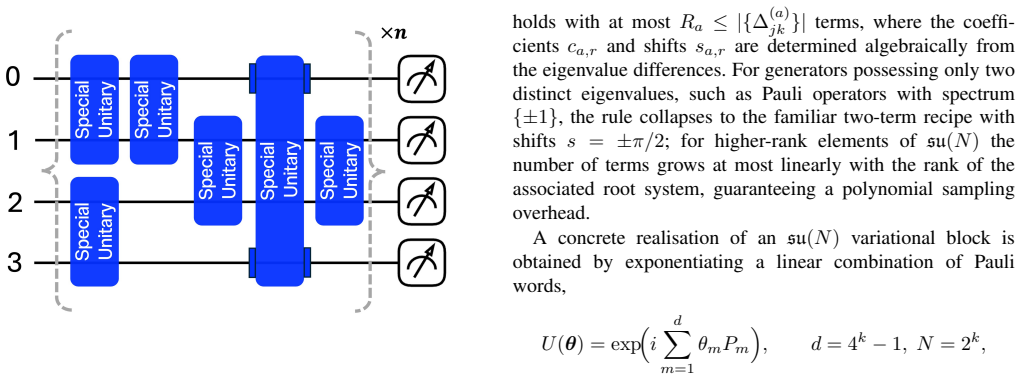
The load-bearing object is the SUN-VQC block: a single exponential U(θ) = exp(i Σ_a θ_a Λ_a), where the Λ_a form a basis of su(2^k) acting on a k-qubit block, with k=2 in all benchmarks, giving su(4), the 15-dimensional Lie algebra of two-qubit unitaries. The exponential map is surjective onto SU(4), so each block can realize any two-qubit gate in one geodesic step. The argument then leans on the claimed direct-sum structure of the global dynamical Lie algebra over the blocks, g = ⊕_blocks su(2^k), whose dimension grows only linearly in the number of blocks, plus the variance bound Var = O(dim $g^{{-1}}$). The generalized parameter-shift rule supplies exact, hardware-compatible derivatives by writing each partial derivative as a finite combination of shifted circuit evaluations.
What would settle it
Run the iterative Lie closure of the 15 generators of each SU(4) block in the six-qubit depth-two brick-wall circuit by repeated commutators, and compare the resulting dimension with 12 * 15 = 180. If the closure spans operators on three or more qubits and closes to a space larger than the direct sum, the central claim fails at the benchmark itself; the paper does not report the computed DLA dimension from its numerical experiment.
Extended reading notes
Core claim
The central discovery, on the paper's own terms, is that the exponential map of a compact Lie subalgebra su(2^k) gives a variational layer whose reachable manifold is both broad and low-dimensional. For k=2, each block W(ϑ) = exp(i Σ_{a=1}^{15} ϑ_a Λ_a) is a single geodesic step over all of SU(4). The paper claims that a depth-two brick-wall of such blocks on six qubits has dynamical Lie algebra g(12) = ⊕_{j=1}^{12} su(4) with dimension 180, and more generally that k-qubit block layers give dim g = O(n). Combining this with the bound Var(∂_θ C) = O(dim $g^{{-1}}$) yields only polynomial suppression of gradient variance, which the paper identifies as circumventing barren plateaus. Exact gradients are then obtained from the generalized parameter-shift rule, which expresses each derivative as a finite linear combination of shifted expectation values with coefficients derived from the generator spectrum.
Load-bearing premise
The load-bearing premise is that a brick-wall stack of k-qubit block exponentials generates a dynamical Lie algebra that stays a direct sum of independent su(2^k) factors; if adjacent blocks share qubits, their nested commutators can generate operators on larger supports and the algebra can grow toward su(2^n), which would erase the polynomial-gradient guarantee.
Editorial extensions
If this is right
- A k-qubit block circuit has dynamical Lie algebra dimension O(n), so gradient variance decays as O(1/n) and optimization signal survives as the qubit count grows.
- Exact gradients are available from a fixed parameter-shift stencil, so no ancillary qubits or finite-difference bias are needed.
- On the six-qubit auto-encoding task, the SUN-VQC approach reaches the 10^-2 infidelity threshold within O(10^3) iterations and approaches the Schmidt-decomposition bound, whereas the hardware-efficient baseline stagnates roughly two orders of magnitude higher.
- On the two-moons classification task, the SUN-VQC reaches about 98% accuracy and crosses 95% within roughly 50 epochs, outperforming the depth-matched hardware-efficient circuit by about 3 percentage points.
- Since the reachable manifold has polynomial volume, classical optimizers search a dramatically smaller parameter space at fixed depth.
Reading between the lines
- The paper leaves implicit that if the direct-sum DLA claim is verified for larger brick-wall layouts, the polynomial gradient scaling should extend beyond the six-qubit benchmark, making a 50+ qubit simulation of gradient variance versus depth a natural next test.
- A single-exponential SU(4) block could be implemented as one calibrated two-qubit pulse on tunable-coupler or cross-resonance hardware, and the paper's own caveat about compilation overhead makes this a concrete hardware experiment.
- The same Lie-subalgebra restriction generalizes to non-compact or projective symmetry groups such as Sp(2N) for fermionic parity, which would carry the barren-plateau argument into quantum chemistry and lattice-gauge ansätze.
- The parameter-shift machinery is not tied to Pauli generators, so it applies to any structured circuit whose generators have discrete spectra, not only to the SUN-VQC construction.
Editorial analysis
A structured set of objections, weighed in public.
Referee Report
Summary. The paper proposes SUN-VQC, a variational quantum circuit architecture in which each elementary layer is a single exponential of an embedded su(2^k) subalgebra, with the intention of keeping the dynamical Lie algebra (DLA) small and thereby avoiding barren plateaus. The theoretical argument is that, for a circuit composed of two-qubit SU(4) blocks in a brick-wall layout, the DLA is a direct sum of local su(4) algebras, so dim g = O(n) and gradient variance is only polynomially suppressed. The authors derive a generalized parameter-shift rule, and support the proposal with numerical experiments on a six-qubit quantum autoencoding task and a four-qubit classification task, comparing SUN-VQC against Cartan-decomposition, Pauli-rotation, and hardware-efficient ansatze.
Significance. If the DLA claim were correct, the paper would offer a principled and practically relevant route to barren-plateau-resilient variational circuits. The paper does present a clear statement of the generalized parameter-shift framework and a useful finite-size comparison of several SU(4) parameterizations, which are strengths. However, the central theoretical premise is false for the implemented brick-wall layout: overlapping two-qubit blocks generate nested commutators that close to the full su(2^n), not to a direct sum of su(4) algebras. Since every scaling claim in the abstract and Section III depends on this premise, the main contribution does not stand as written.
major comments (3)
- [III.B, after Eq. (5)] The central claim g(12) = ⊕_{j=1}^{12} su(4) is not correct for the implemented circuit. A depth-two brick-wall layout on six qubits applies SU(4) blocks on overlapping nearest-neighbour pairs: for example, layer one contains pair (1,2) and layer two contains pair (2,3). The generators of the su(4) algebra on (1,2) and those on (2,3) do not mutually commute; nested commutators produce operators supported on three qubits, and repeated commutation along the connected brick-wall graph generates the full su(64), of dimension 4^6 - 1 = 4095, not 180. The sentence 'Because the block acts on disjoint qubit pairs' is inconsistent with the brick-wall geometry, and the paper's own Sec. II.A warns that when the control set is not a basis of a single embedded su(2^k), the DLA can grow up to the full su(2^n). Since the gradient-variance bound in Sec. II.A is Var = O(1/dim g), the claimed polynomial suppression and barren-plateau circumvention rest entirely on this false premise.
- [III.B, '12 blocks' paragraph] The circuit description is internally inconsistent: a depth-two brick-wall on six qubits contains five nearest-neighbour blocks in total (three in the first layer and two in the second), so it cannot yield 12 two-qubit blocks. If the authors instead intend multiple repetitions or a different arrangement, this must be specified, because the DLA calculation depends on the exact set of pairs and their overlaps. As written, the dimension count 180 = 12 × 15 does not match the stated depth-two brick-wall layout.
- [III.D and IV] The numerical evidence does not test the scaling claim. The benchmarks are performed at n = 6 (autoencoding) and n = 4 (classification), and no gradient-variance statistics are reported at any system size. The convergence curves in Figs. 2 and 3 could be explained by the larger per-block expressiveness or by small-system finite-size effects; they do not verify the predicted O(n^{-1}) gradient-variance scaling. To support the abstract's scalability claim, the paper would need to measure Var(∂_θ C) as a function of n over a meaningful range and compare it with dim g.
minor comments (4)
- [II.C] The generalized parameter-shift formula contains an unexplained weight matrix ω_ℓm; please define it explicitly and state the conditions under which the formula holds, since the reference to Wierichs et al. does not by itself justify the displayed expression.
- [Abstract and II.A] The statement 'SU(2^k) ⊂ SU(2^n) with k ≪ n' is imprecise: the embedding is a diagonal block embedding (Eq. 2), and the dimension reduction is O(4^k) per block only when the blocks are mutually non-overlapping; the text should say this explicitly to avoid confusion.
- [References] Reference [37] duplicates reference [10]; please remove the duplicate and renumber.
- [Figures] In Fig. 2, the vertical axis label is not visible in the text; please ensure all axis labels and legends are legible in the final version.
Circularity Check
No significant circularity: the barren-plateau argument rests on an external variance bound and an (unproven, likely incorrect) DLA assumption, not on fitted data or self-citation.
full rationale
The paper's load-bearing chain is: (i) gradient variance scales as O(1/dim g), cited to external prior work; (ii) local SU(4) blocks are asserted to give dim g = O(n); (iii) hence polynomial gradient suppression. No step reuses the paper's numerical results as input: the benchmarks report fidelity and accuracy curves, not gradient variances, and no parameter is fitted to training data and then called a prediction. The DLA claim in Sec. III.B ('Because the block acts on disjoint qubit pairs... the direct sum g(12) = ⊕_{j=1}^{12} su(4)') is asserted rather than derived; for the described depth-two brick-wall layout with overlapping nearest-neighbour pairs the claim appears mathematically incorrect, and if false the barren-plateau conclusion collapses. That is a correctness/mathematical-error concern, not circularity: the conclusion is not equivalent to the premise by definition, and the premise is not justified by a self-citation. The parameter-shift rule is cited to Wierichs et al. as independent external work, and the many self-citations in the introduction are background references rather than load-bearing premises. No circularity score above 0 is warranted.
Assumptions & free parameters
free parameters (2)
- learning rate eta =
2e-2
- number of gradient iterations T =
30000
assumptions (5)
- domain assumption Var[∂_θ C] = O(dim g^{-1}) is a universal bound.
- ad hoc to paper The depth-two brick-wall circuit on six qubits has DLA g(12) = ⊕_{j=1}^{12} su(4).
- standard math The exponential map is surjective for SU(4), so every two-qubit unitary is reachable in a single step.
- standard math The generalized parameter-shift rule of Wierichs et al. is valid for SU(N) generators.
- domain assumption The fidelity F = ⟨000|ρ_trash|000⟩ is an appropriate cost function for auto-encoding.
Cite this review
Pith. "Pith review of Special-Unitary Parameterization for Trainable Variational Quantum Circuits." pith.science (2026). https://pith.science/paper/IFYPWVVB
@misc{pith2026250705535,
  author       = {Pith},
  title        = {Pith review of: Special-Unitary Parameterization for Trainable Variational Quantum Circuits},
  year         = {2026},
  howpublished = {\url{https://pith.science/paper/IFYPWVVB}},
  note         = {Machine review of arXiv:2507.05535}
}
abstract
We propose SUN-VQC, a variational-circuit architecture whose elementary layers are single exponentials of a symmetry-restricted Lie subgroup, $\mathrm{SU}(2^{k}) \subset \mathrm{SU}(2^{n})$ with $k \ll n$. Confining the evolution to this compact subspace reduces the dynamical Lie-algebra dimension from $\mathcal{O}(4^{n})$ to $\mathcal{O}(4^{k})$, ensuring only polynomial suppression of gradient variance and circumventing barren plateaus that plague hardware-efficient ans\"atze. Exact, hardware-compatible gradients are obtained using a generalized parameter-shift rule, avoiding ancillary qubits and finite-difference bias. Numerical experiments on quantum auto-encoding and classification show that SUN-VQCs sustain order-of-magnitude larger gradient signals, converge 2--3$\times$ faster, and reach higher final fidelities than depth-matched Pauli-rotation or hardware-efficient circuits. These results demonstrate that Lie-subalgebra engineering provides a principled, scalable route to barren-plateau-resilient VQAs compatible with near-term quantum processors.
Figures


Reference graph
Works this paper leans on
-
[1]
Quantum computing in the nisq era and beyond,
J. Preskill, “Quantum computing in the nisq era and beyond,” Quantum, vol. 2, p. 79, 2018
2018
-
[2]
Noisy intermediate-scale quantum algorithms,
K. Bharti, A. Cervera-Lierta, T. H. Kyaw, T. Haug, S. Alperin-Lea, A. Anand, M. Degroote, H. Heimonen, J. S. Kottmann, T. Menke, et al., “Noisy intermediate-scale quantum algorithms,” Reviews of Modern Physics, vol. 94, no. 1, p. 015004, 2022
work page 2022
-
[3]
Variational quantum algorithms,
M. Cerezo, A. Arrasmith, R. Babbush, S. C. Benjamin, S. Endo, K. Fujii, J. R. McClean, K. Mitarai, X. Yuan, L. Cincio, et al. , “Variational quantum algorithms,” Nature Reviews Physics , vol. 3, no. 9, pp. 625– 644, 2021
2021
-
[4]
Training variational quantum algorithms is np-hard,
L. Bittel and M. Kliesch, “Training variational quantum algorithms is np-hard,” Physical review letters, vol. 127, no. 12, p. 120502, 2021
work page 2021
-
[5]
Varia- tional quantum algorithms for nonlinear problems,
M. Lubasch, J. Joo, P. Moinier, M. Kiffner, and D. Jaksch, “Varia- tional quantum algorithms for nonlinear problems,” Physical Review A , vol. 101, no. 1, p. 010301, 2020
work page 2020
-
[6]
Performance comparison of optimization methods on variational quantum algorithms,
X. Bonet-Monroig, H. Wang, D. Vermetten, B. Senjean, C. Moussa, T. B ¨ack, V . Dunjko, and T. E. O’Brien, “Performance comparison of optimization methods on variational quantum algorithms,” Physical Review A, vol. 107, no. 3, p. 032407, 2023
work page 2023
-
[7]
Schr¨odinger-heisenberg variational quantum algorithms,
Z.-X. Shang, M.-C. Chen, X. Yuan, C.-Y . Lu, and J.-W. Pan, “Schr¨odinger-heisenberg variational quantum algorithms,” Physical Re- view Letters, vol. 131, no. 6, p. 060406, 2023
work page 2023
-
[8]
Exploiting symmetry in variational quantum machine learning,
J. J. Meyer, M. Mularski, E. Gil-Fuster, A. A. Mele, F. Arzani, A. Wilms, and J. Eisert, “Exploiting symmetry in variational quantum machine learning,” PRX quantum, vol. 4, no. 1, p. 010328, 2023
work page 2023
Show all 54 references
-
[9]
Variational quantum circuits for deep reinforcement learning,
S. Y .-C. Chen, C.-H. H. Yang, J. Qi, P.-Y . Chen, X. Ma, and H.-S. Goan, “Variational quantum circuits for deep reinforcement learning,” IEEE access, vol. 8, pp. 141007–141024, 2020
2020
-
[11]
Quantum agents in the gym: a variational quantum algorithm for deep q-learning,
A. Skolik, S. Jerbi, and V . Dunjko, “Quantum agents in the gym: a variational quantum algorithm for deep q-learning,” Quantum, vol. 6, p. 720, 2022
2022
-
[12]
A distributed learning scheme for variational quantum algorithms,
Y . Du, Y . Qian, X. Wu, and D. Tao, “A distributed learning scheme for variational quantum algorithms,” IEEE Transactions on Quantum Engineering, vol. 3, pp. 1–16, 2022
2022
-
[13]
Learning quantum phase estimation by variational quantum circuits,
C.-Y . Liu, K.-C. Chen, and C.-H. A. Lin, “Learning quantum phase estimation by variational quantum circuits,” in 2024 International Joint Conference on Neural Networks (IJCNN) , pp. 1–6, IEEE, 2024
2024
-
[14]
Compressedmediq: Hybrid quantum machine learning pipeline for high-dimentional neu- roimaging data,
K.-C. Chen, Y .-T. Li, T.-Y . Li, and C.-Y . Liu, “Compressedmediq: Hybrid quantum machine learning pipeline for high-dimentional neu- roimaging data,” arXiv preprint arXiv:2409.08584 , 2024
2024 arXiv
-
[15]
Quantum op- timization using variational algorithms on near-term quantum devices,
N. Moll, P. Barkoutsos, L. S. Bishop, J. M. Chow, A. Cross, D. J. Egger, S. Filipp, A. Fuhrer, J. M. Gambetta, M. Ganzhorn, et al., “Quantum op- timization using variational algorithms on near-term quantum devices,” Quantum Science and Technology , vol. 3, no. 3, p. 030503, 2018
2018
-
[16]
Improving variational quantum optimization using cvar,
P. K. Barkoutsos, G. Nannicini, A. Robert, I. Tavernelli, and S. Woerner, “Improving variational quantum optimization using cvar,” Quantum, vol. 4, p. 256, 2020
2020
-
[17]
Noise- aware distributed quantum approximate optimization algorithm on near- term quantum hardware,
K.-C. Chen, X. Xu, F. Burt, C.-Y . Liu, S. Yu, and K. K. Leung, “Noise- aware distributed quantum approximate optimization algorithm on near- term quantum hardware,” in 2024 IEEE International Conference on Quantum Computing and Engineering (QCE) , vol. 2, pp. 144–149, IEEE, 2024
2024
-
[18]
Learning to learn with quantum optimization via quantum neural networks,
K.-C. Chen, H. Matsuyama, and W.-H. Huang, “Learning to learn with quantum optimization via quantum neural networks,” arXiv preprint arXiv:2505.00561, 2025
2025 arXiv
-
[19]
Quantum variational autoencoder,
A. Khoshaman, W. Vinci, B. Denis, E. Andriyash, H. Sadeghi, and M. H. Amin, “Quantum variational autoencoder,” Quantum Science and Technology, vol. 4, no. 1, p. 014001, 2018
2018
-
[20]
Effect of data encoding on the expressive power of variational quantum-machine-learning models,
M. Schuld, R. Sweke, and J. J. Meyer, “Effect of data encoding on the expressive power of variational quantum-machine-learning models,” Physical Review A , vol. 103, no. 3, p. 032430, 2021
2021
-
[21]
Shedding light on the future: Exploring quantum neural networks through optics,
S. Yu, Z. Jia, A. Zhang, E. Mer, Z. Li, V . Crescimanna, K.-C. Chen, R. B. Patel, I. A. Walmsley, and D. Kaszlikowski, “Shedding light on the future: Exploring quantum neural networks through optics,” Advanced Quantum Technologies, p. 2400074, 2024
2024
-
[22]
Quantum machine learning for particle physics using a variational quantum classifier,
A. Blance and M. Spannowsky, “Quantum machine learning for particle physics using a variational quantum classifier,” Journal of High Energy Physics, vol. 2021, no. 2, pp. 1–20, 2021
2021
-
[23]
Quantum-enhanced support vector machine for large-scale multi-class stellar classification,
K.-C. Chen, X. Xu, H. Makhanov, H.-H. Chung, and C.-Y . Liu, “Quantum-enhanced support vector machine for large-scale multi-class stellar classification,” in International Conference on Intelligent Com- puting, pp. 155–168, Springer, 2024
2024
-
[24]
Quantum- classical-quantum workflow in quantum-hpc middleware with gpu ac- celeration,
K.-C. Chen, X. Li, X. Xu, Y .-Y . Wang, and C.-Y . Liu, “Quantum- classical-quantum workflow in quantum-hpc middleware with gpu ac- celeration,” in 2024 International Conference on Quantum Communica- tions, Networking, and Computing (QCNC) , pp. 304–311, IEEE, 2024
2024
-
[25]
Consensus-based distributed quantum kernel learning for speech recognition,
K.-C. Chen, W. Ma, and X. Xu, “Consensus-based distributed quantum kernel learning for speech recognition,” arXiv preprint arXiv:2409.05770, 2024
2024 arXiv
-
[26]
Robust decentralized quantum kernel learning for noisy and adversarial environment,
W. Ma, K.-C. Chen, S. Yu, M. Liu, and R. Deng, “Robust decentralized quantum kernel learning for noisy and adversarial environment,” arXiv preprint arXiv:2504.13782, 2025
2025 arXiv
-
[27]
Quantum-train long short- term memory: Application on flood prediction problem,
C.-H. A. Lin, C.-Y . Liu, and K.-C. Chen, “Quantum-train long short- term memory: Application on flood prediction problem,” in 2024 IEEE International Conference on Quantum Computing and Engineering (QCE), vol. 2, pp. 268–273, IEEE, 2024
2024
-
[28]
Quantum kernel-based long short-term memory for climate time-series forecasting,
Y .-C. Hsu, N.-Y . Chen, T.-Y . Li, P.-H. H. Lee, and K.-C. Chen, “Quantum kernel-based long short-term memory for climate time-series forecasting,” in 2025 International Conference on Quantum Commu- nications, Networking, and Computing (QCNC) , pp. 421–426, IEEE, 2025
2025
-
[29]
Programming variational quantum circuits with quantum-train agent,
C.-Y . Liu, S. Y .-C. Chen, K.-C. Chen, W.-J. Huang, and Y .-J. Chang, “Programming variational quantum circuits with quantum-train agent,” in 2025 International Conference on Quantum Communications, Net- working, and Computing (QCNC) , pp. 544–548, IEEE, 2025
2025
-
[30]
Toward large-scale distributed quantum long short-term memory with modular quantum computers,
K.-C. Chen, S. Y .-C. Chen, C.-Y . Liu, and K. K. Leung, “Toward large-scale distributed quantum long short-term memory with modular quantum computers,” arXiv preprint arXiv:2503.14088 , 2025
2025 arXiv
-
[31]
Differentiable quantum architecture search in quantum-enhanced neural network parameter generation,
S. Y .-C. Chen, C.-Y . Liu, K.-C. Chen, W.-J. Huang, Y .-J. Chang, and W.-H. Huang, “Differentiable quantum architecture search in quantum-enhanced neural network parameter generation,” arXiv preprint arXiv:2505.09653, 2025
2025 arXiv
-
[32]
Quantum-enhanced parameter- efficient learning for typhoon trajectory forecasting,
C.-Y . Liu, K.-C. Chen, Y .-C. Chen, S. Y .-C. Chen, W.-H. Huang, W.-J. Huang, and Y .-J. Chang, “Quantum-enhanced parameter- efficient learning for typhoon trajectory forecasting,” arXiv preprint arXiv:2505.09395, 2025
2025 arXiv
-
[33]
Distributed quantum neural networks on distributed photonic quantum computing,
K.-C. Chen, C.-Y . Liu, Y . Shang, F. Burt, and K. K. Leung, “Distributed quantum neural networks on distributed photonic quantum computing,” arXiv preprint arXiv:2505.08474 , 2025
2025 arXiv
-
[34]
Federated quantum-train with batched parameter generation,
C.-Y . Liu and S. Y .-C. Chen, “Federated quantum-train with batched parameter generation,” arXiv preprint arXiv:2409.02763 , 2024
2024 arXiv
-
[35]
Qtrl: Toward practical quantum reinforcement learning via quantum- train,
C.-Y . Liu, C.-H. A. Lin, C.-H. H. Yang, K.-C. Chen, and M.-H. Hsieh, “Qtrl: Toward practical quantum reinforcement learning via quantum- train,” arXiv preprint arXiv:2407.06103 , 2024
2024 arXiv
-
[36]
Differentiable quantum architecture search in asynchronous quantum reinforcement learning,
S. Y .-C. Chen, “Differentiable quantum architecture search in asynchronous quantum reinforcement learning,” arXiv preprint arXiv:2407.18202, 2024
2024 arXiv
-
[37]
Variational quantum reinforcement learning via evolutionary optimization,
S. Y .-C. Chen, C.-M. Huang, C.-W. Hsing, H.-S. Goan, and Y .- J. Kao, “Variational quantum reinforcement learning via evolutionary optimization,” Machine Learning: Science and Technology, vol. 3, no. 1, p. 015025, 2022
2022
-
[38]
Quantum-train- based distributed multi-agent reinforcement learning,
K.-C. Chen, S. Y .-C. Chen, C.-Y . Liu, and K. K. Leung, “Quantum-train- based distributed multi-agent reinforcement learning,” in 2025 IEEE Symposium for Multidisciplinary Computational Intelligence Incubators (MCII Companion), pp. 1–5, IEEE, 2025
2025
-
[39]
Parameterized quantum circuits as machine learning models,
M. Benedetti, E. Lloyd, S. Sack, and M. Fiorentini, “Parameterized quantum circuits as machine learning models,” Quantum science and technology, vol. 4, no. 4, p. 043001, 2019
2019
-
[40]
Barren plateaus in variational quantum computing,
M. Larocca, S. Thanasilp, S. Wang, K. Sharma, J. Biamonte, P. J. Coles, L. Cincio, J. R. McClean, Z. Holmes, and M. Cerezo, “Barren plateaus in variational quantum computing,” Nature Reviews Physics , pp. 1–16, 2025
2025
-
[41]
Cost function dependent barren plateaus in shallow parametrized quantum circuits,
M. Cerezo, A. Sone, T. V olkoff, L. Cincio, and P. J. Coles, “Cost function dependent barren plateaus in shallow parametrized quantum circuits,” Nature communications, vol. 12, no. 1, p. 1791, 2021
2021
-
[42]
General parameter- shift rules for quantum gradients,
D. Wierichs, J. Izaac, C. Wang, and C. Y .-Y . Lin, “General parameter- shift rules for quantum gradients,” Quantum, vol. 6, p. 677, 2022
2022
-
[43]
Classifica- tion of dynamical lie algebras of 2-local spin systems on linear, circular and fully connected topologies,
R. Wiersema, E. K ¨okc¨u, A. F. Kemper, and B. N. Bakalov, “Classifica- tion of dynamical lie algebras of 2-local spin systems on linear, circular and fully connected topologies,” npj Quantum Information , vol. 10, no. 1, p. 110, 2024
2024
-
[44]
Lie algebraic analysis and control of quantum dy- namics,
D. D’Alessandro, “Lie algebraic analysis and control of quantum dy- namics,” arXiv preprint arXiv:0803.1193 , 2008
2008 arXiv
-
[45]
Barren plateaus in quantum neural network training landscapes,
J. R. McClean, S. Boixo, V . N. Smelyanskiy, R. Babbush, and H. Neven, “Barren plateaus in quantum neural network training landscapes,”Nature communications, vol. 9, no. 1, p. 4812, 2018
2018
-
[46]
Monotone metrics on matrix spaces,
D. Petz, “Monotone metrics on matrix spaces,” Linear algebra and its applications, vol. 244, pp. 81–96, 1996
1996
-
[47]
Geometric theory of nonlocal two-qubit operations,
J. Zhang, J. Vala, S. Sastry, and K. B. Whaley, “Geometric theory of nonlocal two-qubit operations,” Physical Review A , vol. 67, no. 4, p. 042313, 2003
2003
-
[48]
Constructive control of quantum systems using factorization of unitary operators,
S. G. Schirmer, A. D. Greentree, V . Ramakrishna, and H. Rabitz, “Constructive control of quantum systems using factorization of unitary operators,” Journal of Physics A: Mathematical and General , vol. 35, no. 39, p. 8315, 2002
2002
-
[49]
Eval- uating analytic gradients on quantum hardware,
M. Schuld, V . Bergholm, C. Gogolin, J. Izaac, and N. Killoran, “Eval- uating analytic gradients on quantum hardware,” Physical Review A , vol. 99, no. 3, p. 032331, 2019
2019
-
[50]
Here comes the su (n): multivariate quantum gates and gradients,
R. Wiersema, D. Lewis, D. Wierichs, J. Carrasquilla, and N. Killoran, “Here comes the su (n): multivariate quantum gates and gradients,” Quantum, vol. 8, p. 1275, 2024
2024
-
[51]
A lie algebraic theory of barren plateaus for deep parameterized quantum circuits,
M. Ragone, B. N. Bakalov, F. Sauvage, A. F. Kemper, C. Ortiz Marrero, M. Larocca, and M. Cerezo, “A lie algebraic theory of barren plateaus for deep parameterized quantum circuits,” Nature Communications, vol. 15, no. 1, p. 7172, 2024
2024
-
[52]
Cartan subalgebra approach to efficient measurements of quantum observables,
T.-C. Yen and A. F. Izmaylov, “Cartan subalgebra approach to efficient measurements of quantum observables,” PRX quantum , vol. 2, no. 4, p. 040320, 2021
2021
-
[53]
Time optimal control in spin systems,
N. Khaneja, R. Brockett, and S. J. Glaser, “Time optimal control in spin systems,” Physical Review A , vol. 63, no. 3, p. 032308, 2001
2001
-
[54]
Elementary gates for quantum computation,
A. Barenco, C. H. Bennett, R. Cleve, D. P. DiVincenzo, N. Margolus, P. Shor, T. Sleator, J. A. Smolin, and H. Weinfurter, “Elementary gates for quantum computation,” Physical review A , vol. 52, no. 5, p. 3457, 1995
1995
-
[55]
Efficient discrete feature encoding for variational quantum classifier,
H. Yano, Y . Suzuki, K. M. Itoh, R. Raymond, and N. Yamamoto, “Efficient discrete feature encoding for variational quantum classifier,” IEEE Transactions on Quantum Engineering , vol. 2, pp. 1–14, 2021
2021
Reviewed August 6, 2026 · model on record in the stance chip above.
Discussion (0). Sign in to comment.