REVIEW 2 major objections 5 minor 44 references
Gait-Based Hand Load Estimation via Deep Latent Variable Models with Auxiliary Information
T0 review · 2 major / 5 minor · reviewed 2026-08-06 · deepseek-v4-flash
Pith's one-line read AuxVAE estimates carried box weight from gait sensors with 5.670 lb mean absolute error by fusing each worker's unloaded walking baseline and marginalizing over carrying style.
desk verdict Useful modeling contribution with a clean marginalization trick, but the headline accuracy claim lacks participant-level statistics and is currently overstated. read the letter →
The pith
A machine-rendered reading of the paper's core claim, the machinery that carries it, and where it could break.
The reading
What carries the argument
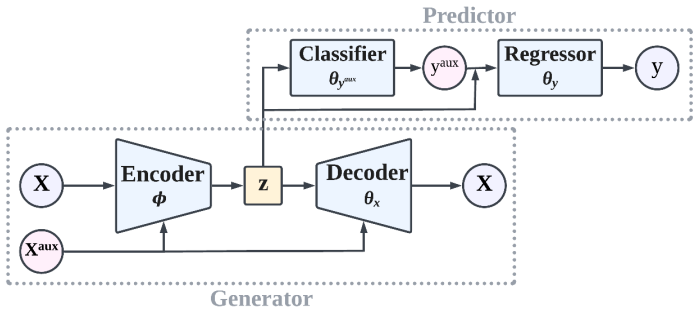
The load-bearing object is AuxVAE, a conditional variational autoencoder whose latent variable $z$ is inferred from both the loaded gait sequence $X$ and the unloaded baseline $X_{aux}$, and whose ELBO objective contains three likelihood terms: reconstruction of $X$, classification of carrying style $y_{aux}$, and regression of load magnitude $y$ conditioned on $y_{aux}$. The mechanism that carries the argument is bidirectional multi-head cross-attention between the two sensor streams after dilated temporal convolutional encoding: each temporal position in the loaded sequence attends to the most informative positions in the unloaded sequence and vice versa, so the model can highlight gait phases where carrying a load deviates from the worker's personal baseline. A scaled KL term with annealing stabilizes training, and the final prediction marginalizes over the $L$ carrying styles so the auxiliary label is used during training but not needed at deployment.
What would settle it
Record each participant's unloaded walk again on a separate day or after reattaching the sensors, rerun the leave-one-participant-out evaluation, and compare the mean absolute error; if it rises toward the no-baseline ablation level of 8.036 lb, the cross-attention personalization is not what is producing the reported gain.
Extended reading notes
Core claim
The paper's central claim is that a conditional deep latent variable model can turn two underused cues into a large accuracy gain for gait-based hand load estimation. The model formalizes the joint distribution $p_\theta(X, y, y_{aux}, z \mid X_{aux}) = p(z)\,p_{\theta_X}(X \mid X_{aux}, z)\,p_{\theta_{y_{aux}}}(y_{aux} \mid z)\,p_{\theta_y}(y \mid y_{aux}, z)$, so the latent variable $z$ is shaped by both the loaded gait $X$ and the unloaded baseline $X_{aux}$, while the load $y$ is predicted conditionally on the inferred carrying style. A variational encoder $q_\phi(z \mid X, X_{aux})$ built from dilated temporal convolutions and bidirectional cross-attention selects which temporal segments of the two signals inform each other, and training maximizes an ELBO whose supervised terms jointly classify style and regress load. At inference, the model averages the load prediction over all $L$ carrying styles weighted by their predicted probabilities, so no manual style label is required. The experiments show the full model reaches a mean absolute error of 5.670 lb on held-out participants, that removing cross-attention or joint style modeling degrades performance, and that simply concatenating baseline gait into standard sequence models can even hurt.
Load-bearing premise
The reported gains rest on the premise that a new worker's unloaded-walking baseline is available when the model is used and still matches the training conditions: same session, same corridor, same footwear, and same sensor placement.
Editorial extensions
If this is right
- A new worker only needs a short unloaded-walking recording before deployment, and the model can then use that baseline to personalize load estimates without any manual carrying-style labels.
- Body-worn IMU data alone can drive continuous ergonomic monitoring, because the system outputs a load estimate at roughly 5.7 lb mean absolute error across the 10–50 lb box range rather than a coarse weight class.
- Naive concatenation of auxiliary and primary sensor streams is not a reliable way to add information; explicit fusion is what allows standard sequence models to benefit.
- The near-linear arrangement of load magnitudes in the learned latent space gives the model a representation that supports interpolation between the four trained box weights.
- Modeling a label that is missing at test time, here carrying style, can improve the main regression target even though that label is never observed during deployment.
Reading between the lines
- The paper does not test whether the baseline remains informative across days, footwear changes, or sensor reattachment; a field study that records the unloaded walk under deployment conditions would show whether the 5.7 lb error survives realistic use.
- The paired-baseline idea may transfer to other ergonomic exposures with an easy reference condition, such as tool use, backpack load, or fatigue during a shift, if a similar unloaded reference signal can be captured.
- Performance on an unseen carrying style is untested; because inference marginalizes over the four trained styles, a novel style would force probability mass onto known classes and could degrade load accuracy.
- The monotonic latent axis by load suggests a direct test of extrapolation: train on 10, 20, and 30 lb boxes, then check whether the model estimates 50 lb boxes with the same error as the current setup.
Editorial analysis
A structured set of objections, weighed in public.
Referee Report
Summary. The paper proposes AuxVAE, a deep latent variable model for estimating hand load from IMU gait recordings. The model uses a VAE-style encoder-decoder with TCNs and bidirectional cross-attention to fuse the loaded gait X with an unloaded baseline gait Xaux; a classifier head predicts carrying style from the latent code, and a regressor predicts load magnitude conditioned on the inferred style. At inference, the model marginalizes over carrying style, so style labels are needed only for training. Experiments use a 22-participant IMU dataset with leave-one-participant-out cross-validation and compare against LSTM, TCN, Transformer, Informer, and TimesNet, plus ablations. The paper reports AuxVAE MAE 5.670 lb versus the best baseline 7.434 lb and argues that explicit fusion and joint modeling are necessary.
Significance. The contribution is potentially valuable: explicit use of a personalized unloaded gait baseline and a training-only style variable is a sensible design, and the evaluation protocol (leave-one-participant-out with held-out participants) is appropriate for the deployment claim. The ELBO derivation is standard and correct, and the inference-time marginalization in Eq. (15) is a clean way to avoid requiring style labels at test time. The ablation study (Table 2) provides useful evidence that cross-attention fusion and joint modeling each contribute. The main weakness is that the headline comparison lacks participant-level statistical analysis, so the strength of the central claim is currently not quantified.
major comments (2)
- [Section 4.2.1, Table 1] The claim that AuxVAE "consistently outperforms all benchmark models" is not supported by the reported statistics. The ± values are standard deviations across 10 random-seed repetitions, not across the 22 leave-one-participant-out folds. Since each participant contributes 16 correlated trials, the effective independent sample for comparing generalization to new workers is 22 participants. Please report per-participant MAE for each model, the per-participant paired difference (AuxVAE minus baseline), a paired test (e.g., Wilcoxon signed-rank over the 22 folds), a confidence interval for the mean or median difference, and an effect size. Without such analysis, the 1.76 lb gap (5.670 vs 7.434) may not be distinguished from participant-level noise. The same issue applies to the ablation comparisons in Table 2, where seed-level standard deviations overlap between settings (e.g., Setting 4 at 6.746 ± 0.446 versus AuxVAE at 5.670 ± 0.185).
- [Section 4.3.3, Tables 1 and 3] The comparison that supposedly shows naive fusion can hurt is under-specified. Both tables appear to describe baselines that concatenate Xaux with X and jointly predict yaux and y; the only clear difference in the text is that Table 1 models are "adapted for hand load estimation conditioned on carrying styles" while Table 3 uses "separate output layers appended to the final shared layers." Please state exactly what differs between the two setups (e.g., whether yaux is provided as an input at training, whether a separate classification head is used, or how the output heads share layers). As written, the direction of the TCN result (6.613 in Table 3 vs 7.593 in Table 1) is confusing and makes the "naive fusion hurts" interpretation hard to verify.
minor comments (5)
- [Section 3.4] The exact KL annealing schedule (starting epoch, ending epoch, functional form) is not specified; please provide these details for reproducibility.
- [Section 3.3.1] In the dilated convolution equation, the summation bound S(u) appears to index output channels; it should instead be the number of input channels to layer u, presumably S(u-1).
- [Section 3.2.2 and 3.4] The implemented regression loss for y is stated as MAE, which is not the negative log-likelihood of the Gaussian distribution in Eq. (5). Please clarify whether Eq. (14) is the actual training objective with log pθy replaced by a MAE surrogate, or whether the Gaussian likelihood is used and MAE is only a monitoring metric.
- [Section 4.1.1 and 4.2.1] The deployment assumption that unloaded baseline gait Xaux_i' is available in the same session and with the same sensor placement as in training is not tested; please discuss how different-day baselines, fatigue, or sensor reattachment might affect the personalization benefit.
- [General] The paper does not include a data or code availability statement. Providing the code or a detailed implementation release would substantially improve reproducibility.
Circularity Check
No significant circularity: the AuxVAE predictions are genuine holdout estimates, and the only self-citations are non-load-bearing.
full rationale
The paper's central empirical claim is that AuxVAE achieves lower MAE than benchmarks on held-out participants. The prediction in Eq. (15) marginalizes over the inferred carrying-style distribution without using the ground-truth style at test time, and the evaluation uses leave-one-participant-out cross-validation with separate training and test subjects. No fitted parameter is reused to construct the target result, and no equation reduces to its own input by construction. The model's use of auxiliary baseline gait X_aux is an additional input, not a renamed version of the output y. The only self-citations are [25], [26], and [43]; [25] is the external dataset source, [26] is a related-work mention of fairness in hand-load estimation that does not support the accuracy claim, and [43] is a future-work pointer. None of these is load-bearing for the main result. The concern about seed-level versus participant-level variability in Table 1 is a statistical-evidence weakness, not a circularity, because the reported errors come from genuine holdout predictions rather than from training-fit quantities.
Assumptions & free parameters
free parameters (5)
- latent dimension k =
128
- TCN hidden units per layer =
{256, 128, 64}
- number of attention heads =
4
- KL annealing schedule =
beta increases from 0 to 1 over training
- Monte Carlo sample count S for inference =
not specified
assumptions (5)
- domain assumption Factorized joint distribution p_theta(X, y, y_aux, z | X_aux) = p(z) p_thetaX(X | X_aux, z) p_thetay(y | y_aux, z) p_thetay_aux(y_aux | z)
- domain assumption Variational posterior q_phi(z | X, X_aux) is Gaussian with diagonal covariance
- domain assumption Gaussian and categorical likelihoods for X, y, and y_aux
- domain assumption Baseline unloaded gait X_aux is available for any new worker at inference
- domain assumption The 22-participant IMU dataset is representative of target worker populations
Cite this review
Pith. "Pith review of Gait-Based Hand Load Estimation via Deep Latent Variable Models with Auxiliary Information." pith.science (2026). https://pith.science/paper/ULOK45AC
@misc{pith2026250705544,
  author       = {Pith},
  title        = {Pith review of: Gait-Based Hand Load Estimation via Deep Latent Variable Models with Auxiliary Information},
  year         = {2026},
  howpublished = {\url{https://pith.science/paper/ULOK45AC}},
  note         = {Machine review of arXiv:2507.05544}
}
read the original abstract
Machine learning methods are increasingly applied to ergonomic risk assessment in manual material handling, particularly for estimating carried load from gait motion data collected from wearable sensors. However, existing approaches often rely on direct mappings from loaded gait to hand load, limiting generalization and predictive accuracy. In this study, we propose an enhanced load estimation framework that incorporates auxiliary information, including baseline gait patterns during unloaded walking and carrying style. While baseline gait can be automatically captured by wearable sensors and is thus readily available at inference time, carrying style typically requires manual labeling and is often unavailable during deployment. Our model integrates deep latent variable modeling with temporal convolutional networks and bi-directional cross-attention to capture gait dynamics and fuse loaded and unloaded gait patterns. Guided by domain knowledge, the model is designed to estimate load magnitude conditioned on carrying style, while eliminating the need for carrying style labels at inference time. Experiments using real-world data collected from inertial measurement units attached to participants demonstrate substantial accuracy gains from incorporating auxiliary information and highlight the importance of explicit fusion mechanisms over naive feature concatenation.
Figures


Figures from the paper (3 more)


Reference graph
Works this paper leans on
-
[1]
M. Spallek, W. Kuhn, S. Uibel, A. van Mark, and D. Quarcoo, “Work-related muscu- loskeletal disorders in the automotive industry due to repetitive work-implications for rehabilitation,” Journal of Occupational Medicine and Toxicology, vol. 5, pp. 1–6, 2010
work page 2010
-
[2]
Y.-C. Lee, X. Hong, and S. S. Man, “Prevalence and associated factors of work-related musculoskeletal disorders symptoms among construction workers: a cross-sectional study in south china,” International Journal of Environmental Research and Public Health, vol. 20, no. 5, p. 4653, 2023
work page 2023
-
[3]
Work-related musculoskeletal disorders: the epidemi- ologic evidence and the debate,
L. Punnett and D. H. Wegman, “Work-related musculoskeletal disorders: the epidemi- ologic evidence and the debate,” Journal of electromyography and kinesiology , vol. 14, no. 1, pp. 13–23, 2004
work page 2004
-
[5]
A. Ranavolo, F. Draicchio, T. Varrecchia, A. Silvetti, and S. Iavicoli, “Wearable mon- itoring devices for biomechanical risk assessment at work: Current status and future challenges—a systematic review,” International journal of environmental research and public health, vol. 15, no. 9, p. 2001, 2018
work page 2001
-
[6]
Effect of load carriage lifestyle on kinematics and kinetics of gait,
H.-H. Wang, W.-C. Tsai, C.-Y. Chang, M.-H. Hung, J.-H. Tu, T. Wu, and C.-H. Chen, “Effect of load carriage lifestyle on kinematics and kinetics of gait,” Applied bionics and biomechanics, vol. 2023, no. 1, p. 8022635, 2023
work page 2023
-
[7]
Advances in biomechanics-based motion analysis,
C. Z.-H. Ma, Z. Li, and C. He, “Advances in biomechanics-based motion analysis,” 2023
work page 2023
-
[8]
S. Anwer, H. Li, M. F. Antwi-Afari, W. Umer, I. Mehmood, and A. Y. L. Wong, “Effects of load carrying techniques on gait parameters, dynamic balance, and physiological parameters during a manual material handling task,” Engineering, Construction and Architectural Management, vol. 29, no. 9, pp. 3415–3438, 2022
work page 2022
-
[9]
J. Yoon, B. Lee, J. Chun, B. Son, and H. Kim, “Investigation of the relationship between ironworker’s gait stability and different types of load carrying using wearable sensors,” Advanced Engineering Informatics, vol. 51, p. 101521, 2022
work page 2022
Show all 44 references
-
[10]
Measuring effects of two-handed side and anterior load carriage on thoracic-pelvic coordination using wearable gyroscopes,
S. Lim and C. D’Souza, “Measuring effects of two-handed side and anterior load carriage on thoracic-pelvic coordination using wearable gyroscopes,” Sensors, vol. 20, no. 18, p. 5206, 2020
2020
-
[11]
Rula: a survey method for the investigation of work-related upper limb disorders,
L. McAtamney and E. N. Corlett, “Rula: a survey method for the investigation of work-related upper limb disorders,” Applied ergonomics, vol. 24, no. 2, pp. 91–99, 1993
1993
-
[12]
Rapid entire body assessment (reba),
S. Hignett and L. McAtamney, “Rapid entire body assessment (reba),” Applied er- gonomics, vol. 31, no. 2, pp. 201–205, 2000. 21
2000
-
[13]
Improved reba: deep learn- ing based rapid entire body risk assessment for prevention of musculoskeletal disorders,
Z. Jiao, K. Huang, Q. Wang, G. Jia, Z. Zhong, and Y. Cai, “Improved reba: deep learn- ing based rapid entire body risk assessment for prevention of musculoskeletal disorders,” Ergonomics, vol. 67, no. 10, pp. 1356–1370, 2024
2024
-
[14]
Ergonomic risk assessment based on computer vision and machine learning,
M. MassirisFern´ andez, J.´A. Fern´ andez, J. M. Bajo, and C. A. Delrieux, “Ergonomic risk assessment based on computer vision and machine learning,” Computers & Industrial Engineering, vol. 149, p. 106816, 2020
2020
-
[15]
Wearables for monitoring and postural feedback in the work context: a scoping review,
V. Figueira, S. Silva, I. Costa, B. Campos, J. Salgado, L. Pinho, M. Freitas, P. Carvalho, J. Marques, and F. Pinho, “Wearables for monitoring and postural feedback in the work context: a scoping review,” Sensors, vol. 24, no. 4, p. 1341, 2024
2024
-
[16]
Posture risk assessment in an automotive assembly line using inertial sensors,
M. L. Nunes, D. Folgado, C. Fuj˜ ao, L. Silva, J. Rodrigues, P. Matias, M. Barandas, A. V. Carreiro, S. Madeira, and H. Gamboa, “Posture risk assessment in an automotive assembly line using inertial sensors,” IEEE Access, vol. 10, pp. 83221–83235, 2022
2022
-
[17]
Wearable sensor network for biomechanical overload assessment in manual material handling,
P. Giannini, G. Bassani, C. A. Avizzano, and A. Filippeschi, “Wearable sensor network for biomechanical overload assessment in manual material handling,” Sensors, vol. 20, no. 14, p. 3877, 2020
2020
-
[18]
Automatic ergonomic risk assess- ment using a variational deep network architecture,
T. Chatzis, D. Konstantinidis, and K. Dimitropoulos, “Automatic ergonomic risk assess- ment using a variational deep network architecture,” Sensors, vol. 22, no. 16, p. 6051, 2022
2022
-
[19]
An attention-based adap- tive spatial–temporal graph convolutional network for long-video ergonomic risk assess- ment,
C. Zhou, J. Zeng, L. Qiu, S. Wang, P. Liu, and J. Pan, “An attention-based adap- tive spatial–temporal graph convolutional network for long-video ergonomic risk assess- ment,” Engineering Applications of Artificial Intelligence , vol. 131, p. 107780, 2024
2024
-
[20]
Deep learning-based networks for automated recognition and classification of awkward working postures in construction using wearable insole sensor data,
M. F. Antwi-Afari, Y. Qarout, R. Herzallah, S. Anwer, W. Umer, Y. Zhang, and P. Manu, “Deep learning-based networks for automated recognition and classification of awkward working postures in construction using wearable insole sensor data,” Au- tomation in construction , vol. ...
2022
-
[21]
Classifying hazardous movements and loads during manual materials handling using accelerometers and instrumented insoles,
M. Trkov, D. T. Stevenson, and A. S. Merryweather, “Classifying hazardous movements and loads during manual materials handling using accelerometers and instrumented insoles,” Applied ergonomics, vol. 101, p. 103693, 2022
2022
-
[22]
Lifting posture prediction with generative models for improving occupational safety,
L. Li, S. Prabhu, Z. Xie, H. Wang, L. Lu, and X. Xu, “Lifting posture prediction with generative models for improving occupational safety,” IEEE Transactions on Human- Machine Systems , vol. 51, no. 5, pp. 494–503, 2021
2021
-
[23]
Measuring biomechanical risk in lifting load tasks through wearable system and machine-learning approach,
I. Conforti, I. Mileti, Z. Del Prete, and E. Palermo, “Measuring biomechanical risk in lifting load tasks through wearable system and machine-learning approach,” Sensors, vol. 20, no. 6, p. 1557, 2020
2020
-
[24]
A promising wearable solution for the practical and accurate monitoring of low back loading in manual material handling,
E. S. Matijevich, P. Volgyesi, and K. E. Zelik, “A promising wearable solution for the practical and accurate monitoring of low back loading in manual material handling,” Sensors, vol. 21, no. 2, p. 340, 2021. 22
2021
-
[25]
Statistical prediction of load carriage mode and magnitude from inertial sensor derived gait kinematics,
S. Lim and C. D’Souza, “Statistical prediction of load carriage mode and magnitude from inertial sensor derived gait kinematics,” Applied ergonomics, vol. 76, pp. 1–11, 2019
2019
-
[26]
Fairness in machine learning-based hand load estimation: A case study on load carriage tasks,
A. Rahman, S. Lim, and S. Chung, “Fairness in machine learning-based hand load estimation: A case study on load carriage tasks,” arXiv preprint arXiv:2504.05610 , 2025
2025 arXiv
-
[27]
Multi-modal gait recognition via effective spatial-temporal feature fusion,
Y. Cui and Y. Kang, “Multi-modal gait recognition via effective spatial-temporal feature fusion,” in Proceedings of the IEEE/CVF Conference on Computer Vision and Pattern Recognition, pp. 17949–17957, 2023
2023
-
[28]
A multi-stage adaptive feature fusion neural network for multimodal gait recognition,
S. Zou, J. Xiong, C. Fan, C. Shen, S. Yu, and J. Tang, “A multi-stage adaptive feature fusion neural network for multimodal gait recognition,” IEEE Transactions on Biomet- rics, Behavior, and Identity Science , 2024
2024
-
[29]
A comprehensive review of gait analysis using deep learning approaches in criminal investigation,
S. T. Y. Aung and W. Kusakunniran, “A comprehensive review of gait analysis using deep learning approaches in criminal investigation,” PeerJ Computer Science , vol. 10, p. e2456, 2024
2024
-
[30]
Auto-encoding variational bayes,
D. P. Kingma, M. Welling, et al. , “Auto-encoding variational bayes,” 2013
2013
-
[31]
Learning structured output representation using deep conditional generative models,
K. Sohn, H. Lee, and X. Yan, “Learning structured output representation using deep conditional generative models,” Advances in neural information processing systems , vol. 28, 2015
2015
-
[32]
An empirical evaluation of generic convolutional and recurrent networks for sequence modeling,
S. Bai, J. Z. Kolter, and V. Koltun, “An empirical evaluation of generic convolutional and recurrent networks for sequence modeling,” arXiv preprint arXiv:1803.01271, 2018
2018 arXiv
-
[33]
Lxmert: Learning cross-modality encoder representations from transformers,
H. Tan and M. Bansal, “Lxmert: Learning cross-modality encoder representations from transformers,” arXiv preprint arXiv:1908.07490 , 2019
1908 arXiv
-
[34]
Gaussian error linear units (gelus),
D. Hendrycks and K. Gimpel, “Gaussian error linear units (gelus),” arXiv preprint arXiv:1606.08415, 2016
2016 arXiv
-
[35]
Attention is all you need,
A. Vaswani, N. Shazeer, N. Parmar, J. Uszkoreit, L. Jones, A. N. Gomez, L. Kaiser, and I. Polosukhin, “Attention is all you need,” Advances in neural information processing systems, vol. 30, 2017
2017
-
[36]
Ladder varia- tional autoencoders,
C. K. Sønderby, T. Raiko, L. Maaløe, S. K. Sønderby, and O. Winther, “Ladder varia- tional autoencoders,” Advances in neural information processing systems, vol. 29, 2016
2016
-
[37]
Gener- ating sentences from a continuous space,
S. R. Bowman, L. Vilnis, O. Vinyals, A. M. Dai, R. Jozefowicz, and S. Bengio, “Gener- ating sentences from a continuous space,” arXiv preprint arXiv:1511.06349 , 2015
2015 arXiv
-
[38]
Long short-term memory,
A. Graves and A. Graves, “Long short-term memory,” Supervised sequence labelling with recurrent neural networks, pp. 37–45, 2012. 23
2012
-
[39]
Informer: Beyond efficient transformer for long sequence time-series forecasting,
H. Zhou, S. Zhang, J. Peng, S. Zhang, J. Li, H. Xiong, and W. Zhang, “Informer: Beyond efficient transformer for long sequence time-series forecasting,” in Proceedings of the AAAI conference on artificial intelligence , vol. 35, pp. 11106–11115, 2021
2021
-
[40]
Timesnet: Temporal 2d- variation modeling for general time series analysis,
H. Wu, T. Hu, Y. Liu, H. Zhou, J. Wang, and M. Long, “Timesnet: Temporal 2d- variation modeling for general time series analysis,” arXiv preprint arXiv:2210.02186 , 2022
2022 arXiv
-
[41]
Deep time series models: A comprehensive survey and benchmark,
Y. Wang, H. Wu, J. Dong, Y. Liu, M. Long, and J. Wang, “Deep time series models: A comprehensive survey and benchmark,” 2024
2024
-
[42]
Deep learning with differential privacy,
M. Abadi, A. Chu, I. Goodfellow, H. B. McMahan, I. Mironov, K. Talwar, and L. Zhang, “Deep learning with differential privacy,” in Proceedings of the 2016 ACM SIGSAC conference on computer and communications security , pp. 308–318, 2016
2016
-
[43]
Federated automatic latent variable selection in multi-output gaussian processes,
J. Gao and S. Chung, “Federated automatic latent variable selection in multi-output gaussian processes,” arXiv preprint arXiv:2407.16935 , 2024
2024 arXiv
-
[44]
Model-agnostic meta-learning for fast adaptation of deep networks,
C. Finn, P. Abbeel, and S. Levine, “Model-agnostic meta-learning for fast adaptation of deep networks,” in International conference on machine learning , pp. 1126–1135, PMLR, 2017
2017
-
[45]
Real-time adaptation for time-series signal prediction using label-aware neural processes,
S. Chung and R. Al Kontar, “Real-time adaptation for time-series signal prediction using label-aware neural processes,” Reliability Engineering & System Safety, p. 110833, 2025. 24
2025
Reviewed August 6, 2026 · model on record in the stance chip above.
Discussion (0). Continue with ORCID to comment.