REVIEW 3 major objections 4 minor 122 references
How Easy Is It to Learn Motion Models from Widefield Fluorescence Single Particle Tracks?
T0 review · 3 major / 4 minor · reviewed 2026-08-06 · deepseek-v4-flash
Pith's one-line read The paper argues that in typical widefield fluorescence single-particle tracking, the emission model contributes about 99% of the log-likelihood, so post-processed trajectories carry little information about the particle's motion model
desk verdict The 99/1 emission/motion split is a magnitude comparison, not an information measure; the paper's strongest claim fails, but the tracking demo and likelihood decomposition are worth a careful look. read the letter →
The pith
A machine-rendered reading of the paper's core claim, the machinery that carries it, and where it could break.
The reading
What carries the argument
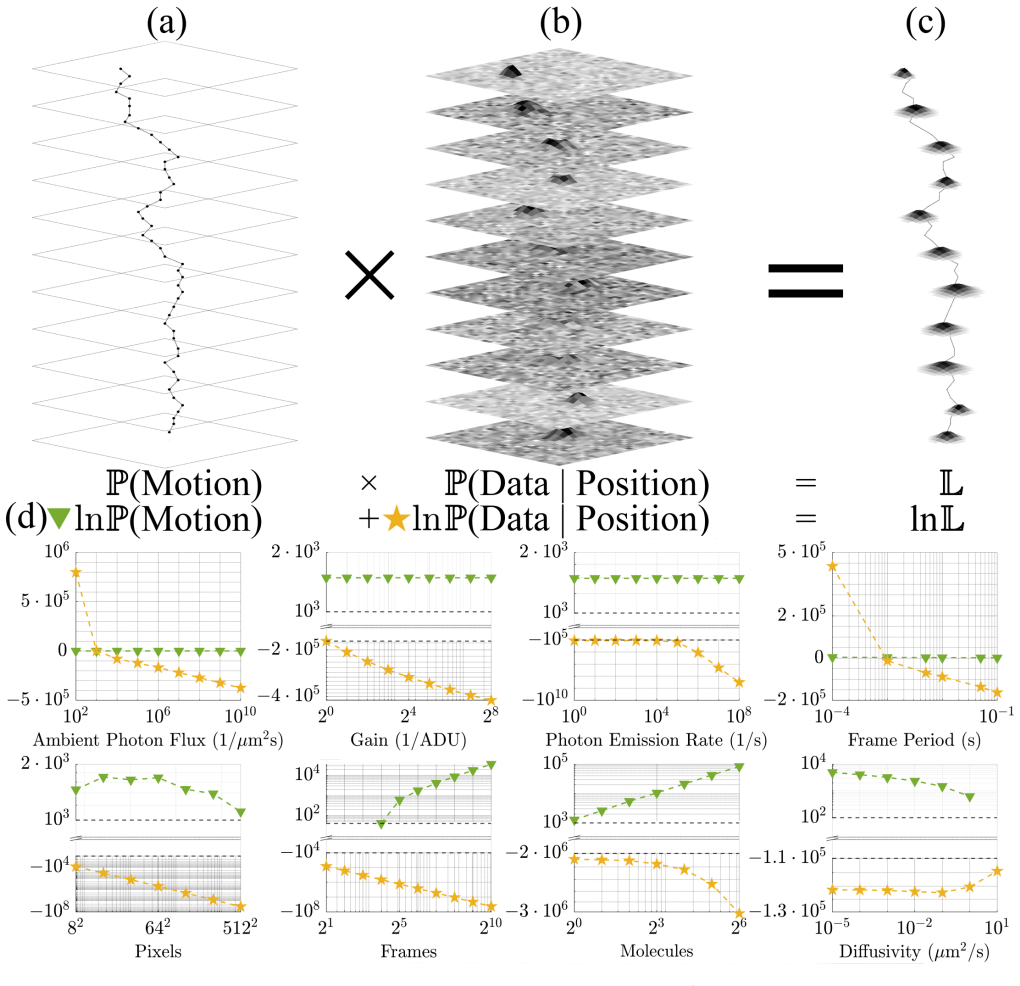
The load-bearing object is the factorized tracking likelihood $\mathbb{L} = \mathbb{P}(\mathrm{Data}\mid\mathrm{Position}) \times \mathbb{P}(\mathrm{Position}\mid\mathrm{Motion})$, which separates the emission model—a Gaussian point-spread function integrated over pixels, compounded over frames and pixels with a Gamma-distributed EMCCD readout—from the motion model, a Gaussian transition density with diffusivity $D$ and a tunable number $K$ of intraframe interpolations. The argument is carried by comparing the logarithms of the two factors: the emission term accumulates over the number of pixels and frames, giving it an enormous magnitude, while the motion term depends on displacement statistics and is comparatively small. The comparison is performed under Markov chain Monte Carlo sampling with a Brownian-motion prior.
What would settle it
Run a controlled simulation with known ground-truth Brownian and anomalous trajectories, compute the Bayes factor between Brownian motion and each anomalous model from the raw image-stack likelihood and from the post-processed trajectory likelihood, and check whether the image-stack comparison is substantially more decisive; if it is not, the claim that post-processing discards most motion information would be refuted.
Extended reading notes
Core claim
The central claim is that in widefield fluorescence single-particle tracking, the likelihood factorizes cleanly into an emission part and a motion part, and the emission part dominates. For a particle diffusing in three dimensions imaged on an EMCCD with a Gaussian point spread function, the emission log-likelihood—arising from pixel integration, photon shot noise, and detector gain—is typically about two orders of magnitude larger than the motion log-likelihood, with the motion share never exceeding 10% and often falling near 0.1%. The authors verify this by synthesizing image stacks from several motion models, tracking them with a Brownian-motion likelihood, and measuring the numerical contribution of each term. They find that a Brownian assumption recovers 99.9% of true positions even for anomalous motion models, confirming that tracking is robust to the assumed dynamics, yet two benchmark classifiers misclassify pure Brownian trajectories as anomalous in most trials. The authors conclude that post-processed trajectories are primarily informed by the emission model and that motion models should be learned from raw image stacks.
Load-bearing premise
The load-bearing premise is that the relative numerical sizes of the emission and motion terms in the log-likelihood measure how much information each contributes to learning the motion model, with the split also depending on the chosen number of intraframe interpolations $K$.
Editorial extensions
If this is right
- Most anomalous-diffusion classifications obtained from post-processed widefield fluorescence trajectories may be artifacts of static and dynamic localization errors rather than genuine motion.
- Learning motion models from raw image stacks is necessary, because post-processed trajectories discard most of the information the data contain about position and therefore about motion.
- A Brownian-motion assumption in the tracking step is not the main source of bias: particle positions are recovered with 99.9% accuracy even when particles move anomalously.
- Existing classifiers that do not include Brownian motion as a candidate model will systematically over-report anomalous diffusion, and the paper documents that 12 of 15 benchmark tools never test for Brownian motion.
- The framework offers a quantitative diagnostic: before reporting a motion model, researchers can compute the emission share of the likelihood on simulated data and report it alongside the inferred model.
Reading between the lines
- A complementary sensitivity analysis—computing the Fisher information of $D$ and the anomalous exponent rather than comparing log-likelihood magnitudes—would test whether the motion term's small numerical share also means low identifiability, since the emission term does not itself contain $D$.
- The factorized likelihood suggests a practical diagnostic: before reporting a motion model from any widefield single-particle-tracking dataset, researchers could simulate under the fitted camera model and report the emission share of the log-likelihood.
- The same emission/motion split could be applied to other detector architectures such as sCMOS, confocal, or MINFLUX to identify acquisition regimes where motion information survives post-processing.
- Because the motion term grows with the number of intraframe interpolations $K$, the framework implies that adding unobserved interpolated positions does not recover lost motion information in practice, since interpolated positions are highly uncertain and inflate the motion term artificially.
Editorial analysis
A structured set of objections, weighed in public.
Referee Report
Summary. The paper derives a likelihood for widefield fluorescence single-particle tracking that explicitly separates an emission model (pixel intensities, PSF, camera noise) from a motion model (transition probabilities). It then compares the numerical magnitudes of the two contributions to the log-likelihood, reports that the emission term contributes roughly 99% and the motion term about 1%, and concludes that post-processed trajectories carry almost no information about the particle's motion model, thereby casting doubt on the widespread practice of learning motion models from trajectories. The paper also demonstrates that a Brownian-motion likelihood can track particles generated from several anomalous diffusion models with high coverage, and it shows that two existing classification tools (CONDOR and AnomDiffDB) frequently misclassify Brownian trajectories after trajectory extraction.
Significance. If the central claim were valid, it would have broad implications for the single-particle-tracking literature on anomalous diffusion. The paper is also commendable for shipping code and data, for formulating a reasonably explicit likelihood, and for providing a concrete, potentially reproducible comparison of trajectory-extraction methods and classifiers. However, the headline claim is not supported by the paper's own equations: the emission term is independent of the motion-model parameters, so its large numerical magnitude cannot measure how much information the data carry about motion. The tracking-invariance result and the classifier-bias observations are of some independent interest, but the paper's principal conclusion—that motion models explain only about 1% of the data—is an artifact of comparing likelihood magnitudes rather than an information-theoretic statement.
major comments (3)
- [Eqs. (3), (6), (7), and (8); Introduction, 'Logic dictates'] The central inference conflates the magnitude of a log-likelihood term with its information content. In Eq. (6), the emission term depends on the observed pixel counts, the PSF, the photon rate, the background, and the particle positions, but not on the diffusivity D or on any parameter of the motion model. The motion term in Eq. (3) is the only place where D enters. Consequently, every likelihood ratio between different values of D—equivalently, every posterior comparison or model-selection quantity involving motion parameters—has the emission term cancel exactly. The large numerical size of the emission contribution in Eq. (8b) comes from summing over P×N pixels and from the camera noise model; a large additive constant in log-likelihood carries no information about D. The sentence in the Introduction beginning 'Logic dictates' is therefore not a logical consequence of the likelihood decomposition, and the abstract's claim that the emission model 'contributes approximately 99% to the likelihood, leaving motion models to explain a meager 1% of the data' is not a valid basis for the conclusion that little motion-model information permeates into post-processed trajectories.
- [Results, 'Likelihood Contributors' (paragraph beginning 'In principle, there exists a single exception')] The 99/1 split is not a robust experimental finding because it depends on tunable modeling choices. The authors themselves concede that an arbitrarily large number K of intraframe interpolations would reverse the split, since this shrinks the lag time Δt and inflates the motion term in Eq. (8c). The choice of ROI size (32×32 pixels, Table 2) and the pixel count P also directly scale the emission term in Eq. (8b), so the reported 'approximately 99%' is a consequence of the authors' parameter choices rather than a property of widefield fluorescence experiments in general. The manuscript should at minimum quantify the sensitivity of the 99/1 ratio to K, ROI size, and P; without such an analysis the headline statistic is not a defensible summary of 'typical' experiments.
- [Results, 'Motion Model Classification'; Table 1] The classification results in Table 1 are presented as evidence for the 99/1 claim, but they support only a weaker and different statement. The observation that CONDOR and AnomDiffDB classify inferred trajectories differently from ground-truth trajectories shows that trajectory extraction can bias downstream classification; it does not quantify how much information about the motion model is present in the post-processed trajectory. The small sample (six trials for each tool in Table 1) and the already-known sensitivity of feature-based classifiers to localization error make these results suggestive but not load-bearing for the paper's central conclusion. The claim in the Discussion that the findings 'confirm that motion model classifications are biased by trajectory inference' is fine, but it should not be equated with the claim that the emission term explains 99% of the data or that motion models are 'a meager 1%' of the likelihood.
minor comments (4)
- [Introduction, paragraph 3] The phrase 'the motion-induced variance introduced when measuring its average position over a single, may generate' appears to be missing the word 'frame' after 'single'.
- [Table 2 caption] The caption reads 'despite it's peak QE'; this should be 'its peak QE'.
- [Supplementary Information, Part IV] The text refers to 'Table 3in the main text' where the main text numbering gives Table 2 for the reference parameters; please correct the cross-reference.
- [General notation] The notation 'w1:P N' and 'R1:K 2:N' is used without an explicit definition of the indexing convention in the main text; a short notation table or explicit sentence would improve readability.
Circularity Check
The headline 99/1 'emission vs motion' result is self-definitional: the paper defines information as the relative magnitude of the two likelihood terms, so the conclusion restates the computed split rather than measuring learnability; the tracking and classification experiments are independent and not circular.
-
self definitional
[Introduction, paragraph 3; Methods, Eqs. (1), (6), (8a-8c); Results, 'Likelihood Contributors']
"Logic dictates that if the likelihood is primarily informed by the motion model, it should be straightforward to learn the motion model from the post-processed trajectory. Contrarily, if the majority of the likelihood is dominated by the emission model, the post-processed trajectory inferred from data is primarily informed by the emission model, and very little information on the motion model permeates into the post-processed trajectories analyzed downstream to learn motion models."
This passage operationalizes 'information on the motion model' as the relative magnitude of the two log-likelihood factors in Eq. (1). Because ln L is defined as ln P(Data|Position) + ln P(Position|Motion) (Eq. 8), the reported 'approximately 99% / 1%' split is literally the ratio of those two defined terms. The emission term (Eq. 8b) contains no dependence on the diffusivity D or on any transition-density parameter, so it cancels in likelihood ratios between motion models; a large constant in log-likelihood carries no information about D. Thus the conclusion that motion models explain 'a meager 1%' is the same magnitude comparison that was set up as the definition of information, rather than a consequence derived from it.
full rationale
The tracking demonstration (Figure 2, 99.9% recovery against simulated ground truth) and the classification benchmarks (Table 1 using AnomDiffDB and CONDOR) are self-contained, externally generated evaluations and do not reduce to the paper's own definitions. No load-bearing argument rests on a self-citation: BNP-Track is the authors' own tool, but its accuracy is checked against independent simulations from the AnDi repository, so this is not circular. The circularity is concentrated in the central quantitative claim of the abstract and Discussion: 'the emission model often robustly contributes approximately 99% to the likelihood, leaving motion models to explain a meager 1%.' The paper defines 'information' as the relative magnitude of the emission and motion terms in its own likelihood, then reports that ratio as if it measured how much motion-model information reaches post-processed trajectories. Since the emission term is independent of D and motion-model parameters, its large numerical magnitude cannot discriminate among motion models; the only term that does is the motion term. The 99/1 figure therefore reduces, by construction, to the chosen decomposition and the chosen interpolation count K, not to an independent information-theoretic or statistical result. Because the tracking and classification results are genuine and independent, the paper is only partially circular, warranting a score of 6 rather than a higher score.
Assumptions & free parameters
free parameters (3)
- Diffusivity D =
0.05 µm^2/s (reference; varied in Figure 3c)
- Intra-frame interpolation count K =
not stated in main text
- ROI size and pixel count =
32x32 pixels
assumptions (4)
- standard math The likelihood factorizes as P(Data|Position) × P(Position|Motion), Eq. (1).
- ad hoc to paper The relative magnitude of the log-likelihood terms measures how much information each model contributes to inference.
- domain assumption The PSF is Gaussian and the EMCCD readout is Gamma-distributed at high gain, Eqs. (2) and (5).
- domain assumption Initial particle position is Gaussian around the optical axis, Eq. (2).
Cite this review
Pith. "Pith review of How Easy Is It to Learn Motion Models from Widefield Fluorescence Single Particle Tracks?." pith.science (2026). https://pith.science/paper/FHBV34KB
@misc{pith2026250705599,
  author       = {Pith},
  title        = {Pith review of: How Easy Is It to Learn Motion Models from Widefield Fluorescence Single Particle Tracks?},
  year         = {2026},
  howpublished = {\url{https://pith.science/paper/FHBV34KB}},
  note         = {Machine review of arXiv:2507.05599}
}
read the original abstract
Motion models (i.e., transition probability densities) are often deduced from fluorescence widefield tracking experiments by analyzing single-particle trajectories post-processed from data. This analysis immediately raises the question: To what degree is our ability to learn motion models impacted by analyzing post-processed trajectories versus raw measurements? To answer this question, we mathematically formulate a data likelihood for diffraction-limited fluorescence widefield tracking experiments. In particular, we make the likelihood's dependence on the motion model versus the emission (or measurement) model explicit. The emission model describes how photons emitted by biomolecules are distributed in space according to the optical point spread function, with intensities subsequently integrated over a pixel, and convoluted with camera noise. Logic dictates that if the likelihood is primarily informed by the motion model, it should be straightforward to learn the motion model from the post-processed trajectory. Contrarily, if the majority of the likelihood is dominated by the emission model, the post-processed trajectory inferred from data is primarily informed by the emission model, and very little information on the motion model permeates into the post-processed trajectories analyzed downstream to learn motion models. Indeed, we find that for typical diffraction-limited fluorescence experiments, the emission model often robustly contributes approximately 99% to the likelihood, leaving motion models to explain a meager 1% of the data. This result immediately casts doubt on our ability to reliably learn motion models from post-processed data, raising further questions on the significance of motion models learned thus far from post-processed single-particle trajectories from single-molecule widefield fluorescence tracking experiments.
Figures


Reference graph
Works this paper leans on
-
[1]
Brown, R. XXVII. A Brief Account of Microscopical Observations Made in the Months of June, July and August 1827, on the Particles Contained in the Pollen of Plants; and on the General Existence of Active Molecules in Organic and Inorganic Bodies. The Philosophical Magazine 4, 161. https://doi.org/10.1080/ 14786442808674769 (1828)
-
[2]
Stokes, G. G. On the Effect of the Internal Friction of Fluids on the Motion of Pendulums. Transactions of the Cambridge Philosophical Society 9, 8. https://archive.org/details/b22464074 (1851)
-
[3]
Ueber Diffusion
Fick, A. Ueber Diffusion. Annalen der Physik 170. https://onlinelibrary.wiley.com/doi/abs/10.1002/ andp.18551700105 (1855)
-
[4]
Einstein, A. ¨Uber die von der Molekularkinetischen Theorie der W¨ arme Geforderte Bewegung von in Ruhenden Fl¨ ussigkeiten Suspendierten Teilchen.Annalen der Physik 322. https://onlinelibrary.wiley.com/doi/ abs/10.1002/andp.19053220806 (1905)
-
[6]
Kolmogorov, A. N. Wienersche Spiralen und Einige Andere Interessante Kurven in Hilbertscen Raum. Proceedings (Doklady) of the USSR Academy of Sciences 26. https://api.semanticscholar.org/CorpusID:202489454 (1940)
1940
-
[9]
Richardson, L. F. & Walker, G. T. Atmospheric Diffusion Shown on a Distance-Neighbour Graph. Proceedings of the Royal Society of London. Series A, Containing Papers of a Mathematical and Physical Character 110,
-
[11]
Chen, P. et al. Fluorescence Lifetime Tracking and Imaging of Single Moving Particles Assisted by a Low-Photon-Count Analysis Algorithm. Biomedical Optics Express 14, 1718. https://opg.optica.org/boe/abstract.cfm? URI=boe-14-4-1718 (2023)
2023
-
[12]
Manley, S. et al. High-Density Mapping of Single-Molecule Trajectories with Photoactivated Localization Microscopy. Nature Methods 5, 155. https://doi.org/10.1038/nmeth.1176 (2008)
Show all 122 references
-
[13]
Balzarotti, F. et al. Nanometer Resolution Imaging and Tracking of Fluorescent Molecules with Minimal Photon Fluxes. Science 355, 606 (2017)
2017
-
[14]
Cole, F. et al. Super-Resolved FRET and Co-Tracking in pMINFLUX. Nature Photonics 18, 478 (2024). 15
2024
-
[15]
& Pang, D.-W
Liu, H.-Y., Wang, Z.-G., Liu, S.-L. & Pang, D.-W. Single-Virus Tracking with Quantum Dots in Live Cells. Nature Protocols 18, 458. https://doi.org/10.1038/s41596-022-00775-7 (2023)
2023 doi
-
[16]
Saxton, M. J. & Jacobson, K. Single-Particle Tracking: Applications to Membrane Dynamics. Annual Review of Biophysics 26, 373. https://www.annualreviews.org/content/journals/10.1146/annurev.biophys. 26.1.373 (1997)
1997 doi
-
[17]
Metzler, R. et al. Analysis of Single Particle Trajectories: From Normal to Anomalous Diffusion. Acta Physica Polonica B 40, 1315. https : / / cris . biu . ac . il / en / publications / analysis - of - single - particle - trajectories-from-normal-to-anomalous (2009)
2009
-
[18]
& Gratton, E
Levi, V. & Gratton, E. in Single Particle Tracking and Single Molecule Energy Transfer 1 (John Wiley & Sons, Ltd, 2009)
2009
-
[19]
& Schmidt, T
Holtzer, L. & Schmidt, T. in Single Particle Tracking and Single Molecule Energy Transfer 25 (John Wiley & Sons, Ltd, 2009)
2009
-
[21]
Wolpert, D. H. Stacked Generalization. Neural Networks 5, 241. https://www.sciencedirect.com/science/ article/pii/S0893608005800231 (1992)
1992
-
[24]
Park, S., Thapa, S., Kim, Y., Lomholt, M. A. & Jeon, J.-H. Bayesian Inference of L´ evy Walks via Hidden Markov Models. Journal of Physics A: Mathematical and Theoretical 54, 484001. https://dx.doi.org/10. 1088/1751-8121/ac31a1 (2021)
2021
-
[35]
Donahue, J. et al. Long-Term Recurrent Convolutional Networks for Visual Recognition and Description.IEEE Transactions on Pattern Analysis and Machine Intelligence 39, 677 (2017)
2017
-
[37]
& Volpe, G
Gentili, A. & Volpe, G. Characterization of Anomalous Diffusion Classical Statistics Powered by Deep Learning (CONDOR). Journal of Physics A: Mathematical and Theoretical 54, 314003. https://dx.doi.org/10. 1088/1751-8121/ac0c5d (2021)
2021
-
[41]
Garibo i Orts, `O., Garcia-March, M. A. & Conejero, J. A. Efficient Recurrent Neural Network Methods for Anomalously Diffusing Single Particle Short and Noisy Trajectories. Journal of Physics A: Mathematical and Theoretical 54, 1. https://doi.org/10.1088/1751-8121/ac3707 (2021)
2021 doi
-
[42]
Feng, X. et al. Reliable Deep Learning in Anomalous Diffusion Against Out-of-Distribution Dynamics. Nature Computational Science 4, 761. https://doi.org/10.1038/s43588-024-00703-7 (2024)
2024 doi
-
[43]
Zhang, Y., Zhu, J., Xie, H. & He, Y. Physics-Informed Deep Learning for Stochastic Particle Dynamics Estimation. Proceedings of the National Academy of Sciences 122, e2418643122. https://www.pnas.org/ doi/abs/10.1073/pnas.2418643122 (2025)
2025 doi
-
[46]
Neural Network-Based Anomalous Diffusion Parameter Estimation Approaches for Gaussian Processes
Szarek, D. Neural Network-Based Anomalous Diffusion Parameter Estimation Approaches for Gaussian Processes. International Journal of Advances in Engineering Sciences and Applied Mathematics 13. https://doi.org/ 10.1007/s12572-021-00298-6 (2021)
2021 doi
-
[48]
Das, R., Cairo, C. W. & Coombs, D. A Hidden Markov Model for Single Particle Tracks Quantifies Dynamic Interactions between LF A-1 and the Actin Cytoskeleton. PLOS Computational Biology 5, 1. https://doi. org/10.1371/journal.pcbi.1000556 (2009)
2009 doi
-
[50]
D., Bohr, S
Pinholt, H. D., Bohr, S. S.-R., Iversen, J. F., Boomsma, W. & Hatzakis, N. S. Single-Particle Diffusional Fingerprinting: A Machine-Learning Framework for Quantitative Analysis of Heterogeneous Diffusion.Proceedings of the National Academy of Sciences 118, e2104624118. https:/...
2021 doi
-
[51]
& Metzler, R
Seckler, H., Szwabi´ nski, J. & Metzler, R. Machine-Learning Solutions for the Analysis of Single-Particle Diffusion Trajectories. The Journal of Physical Chemistry Letters 14. doi: 10.1021/acs.jpclett.3c01351, 7910. https://doi.org/10.1021/acs.jpclett.3c01351 (7, 2023)
-
[52]
Qu, X. et al. Semantic Segmentation of Anomalous Diffusion Using Deep Convolutional Networks. Physical Review Research 6, 013054. https://link.aps.org/doi/10.1103/PhysRevResearch.6.013054 (1 2024)
2024 doi
-
[53]
Mu˜ noz-Gil, G., i Corominas, G. G. & Lewenstein, M. Unsupervised Learning of Anomalous Diffusion Data: An Anomaly Detection Approach. Journal of Physics A: Mathematical and Theoretical 54, 504001. https: //dx.doi.org/10.1088/1751-8121/ac3786 (2021)
2021 doi
-
[54]
Chui, C. K. & Chen, G. Kalman Filtering isbn: 9783319476124 (Springer International Publishing, 2017)
2017
-
[56]
Jaqaman, K. et al. Robust Single-Particle Tracking in Live-Cell Time-Lapse Sequences. Nature Methods 5. https://doi.org/10.1038/nmeth.1237 (2008)
2008 doi
-
[57]
& Alexiev, U
Wolf, A., Volz-Rakebrand, P., Balke, J. & Alexiev, U. Diffusion Analysis of NAnoscopic Ensembles: A Tracking-Free Diffusivity Analysis for NAnoscopic Ensembles in Biological Samples and Nanotechnology. Small 19. issn: 1613-6829 (2023). 17
2023
-
[58]
Martens, K. J. A., Turkowyd, B., Hohlbein, J. & Endesfelder, U. Temporal Analysis of Relative Distances (TARDIS) is a Robust, Parameter-Free Alternative to Single-Particle Tracking. Nature Methods 21, 1074. https://doi.org/10.1038/s41592-023-02149-7 (2024)
2024 doi
-
[59]
Berglund, A. J. Statistics of Camera-Based Single-Particle Tracking. Physical Review E 82. https://link. aps.org/doi/10.1103/PhysRevE.82.011917 (2010)
2010 doi
-
[60]
Kalwarczyk, T. et al. Apparent Anomalous Diffusion in the Cytoplasm of Human Cells: The Effect of Probes’ Polydispersity. The Journal of Physical Chemistry B 121, 9831. https://doi.org/10.1021/acs.jpcb. 7b07158 (2017)
2017 doi
-
[61]
Lelek, M. et al. Single-Molecule Localization Microscopy. Nature Reviews Methods Primers 1, 39 (2021)
2021
-
[62]
M., Dagdug, L
Berezhkovskii, A. M., Dagdug, L. & Bezrukov, S. M. Discriminating between Anomalous Diffusion and Transient Behavior in Microheterogeneous Environments. Biophysical Journal 106, L09. https://doi.org/ 10.1016/j.bpj.2013.12.013 (2014)
2014 doi
-
[63]
Tinevez, J.-Y. et al. TrackMate: An Open and Extensible Platform for Single-Particle Tracking. Methods 115. https://www.sciencedirect.com/science/article/pii/S1046202316303346 (2017)
2017
-
[64]
Ershov, D. et al. TrackMate 7: Integrating State-of-the-Art Segmentation Algorithms into Tracking Pipelines. Nature Methods 19. https://doi.org/10.1038/s41592-022-01507-1 (2022)
2022 doi
-
[65]
Wu, Y.-L. et al. Maximum-Likelihood Model Fitting for Quantitative Analysis of SMLM Data. 20, 139 (2022)
2022
-
[66]
& Press´ e, S
Kilic, Z., Sgouralis, I. & Press´ e, S. Generalizing HMMs to Continuous Time for Fast Kinetics: Hidden Markov Jump Processes. Biophysical Journal 120, 409. https://www.sciencedirect.com/science/article/pii/ S0006349521000060 (2021)
2021
-
[67]
Tavakoli, M. et al. Pitching Single-Focus Confocal Data Analysis One Photon at a Time with Bayesian Nonparametrics. Physical Review X 10, 011021. https://link.aps.org/doi/10.1103/PhysRevX.10.011021 (1 2020)
2020 doi
-
[68]
Sgouralis, I. et al. BNP-Track: A Framework for Superresolved Tracking. Nature Methods. https://doi.org/ 10.1038/s41592-024-02349-9 (2024)
2024 doi
-
[70]
Ryan, D. P. et al. A Gain Series Method for Accurate EMCCD Calibration. Scientific Reports 11, 18348. https://doi.org/10.1038/s41598-021-97759-6 (2021)
2021 doi
-
[71]
Fazel, M. et al. Fluorescence Microscopy: A Statistics-Optics Perspective. Reviews of Modern Physics 96, 025003 (2024)
2024
-
[73]
Liu, S. et al. sCMOS Noise-Correction Algorithm for Microscopy Images. Nature Methods 14, 760. https: //doi.org/10.1038/nmeth.4379 (2017)
2017 doi
-
[74]
Huang, Z.-L. et al. Localization-Based Super-Resolution Microscopy with an sCMOS Camera. Optics Express 19, 19156. https://opg.optica.org/oe/abstract.cfm?URI=oe-19-20-19156 (2011)
2011
-
[75]
J., Martin-Fernandez, M
Hirsch, M., Wareham, R. J., Martin-Fernandez, M. L., Hobson, M. P. & Rolfe, D. J. A Stochastic Model for Electron Multiplication Charge-Coupled Devices – From Theory to Practice. PLOS ONE 8, 1 (2013)
2013
-
[76]
& Fern´ andez, G
Mu˜ noz-Gil, G., Bachimanchi, H., Requena, B., Manzo, C. & Fern´ andez, G. AnDi Datasets 2020. https : //github.com/AnDiChallenge/andi_datasets
2020
-
[79]
Davies, R. B. & Harte, D. S. Tests for Hurst Effect. Biometrika 74, 95. https://doi.org/10.1093/biomet/ 74.1.95 (1987)
1987 doi
-
[81]
in (2006)
Asmussen, S. in (2006)
2006
-
[82]
Hence, the generative model for particle trajectories is given by P (τ ′) ∼ τ ′−(ς+1), ς ∈ (0, 2) τ ′ ℓ ∼ P (τ ′) Rℓ|Rℓ−1, τ′ ℓ ∼ Rℓ−1 ± vτ ′ ℓ. (17) For ς ∈ (0, 1), the particle undergoes ballistic diffusion because the anomalous exponent becomes α = 2; for ς ∈ (1, 2), the pa...
-
[83]
Hosking, J. R. M. Modeling Persistence in Hydrological Time Series Using Fractional Differencing. Water Resources Research20, 1898. https://agupubs.onlinelibrary.wiley.com/doi/abs/10.1029/WR020i012p01898 (1984)
1984 doi
-
[84]
Yildiz, A. et al. Myosin V Walks Hand-Over-Hand: Single Fluorophore Imaging with 1.5-nm Localization. Science 300, 2061. https://www.science.org/doi/abs/10.1126/science.1084398 (2003)
2003 doi
-
[87]
Grimm, J. B. et al. A General Method to Improve Fluorophores for Live-Cell and Single-Molecule Microscopy. Nature Methods 12, 244. https://doi.org/10.1038/nmeth.3256 (2015)
2015 doi
-
[88]
& Huang, F
Li, Y. & Huang, F. A Statistical Resolution Measure of Fluorescence Microscopy with Finite Photons. Nature Communications 15, 3760. https://doi.org/10.1038/s41467-024-48155-x (2024)
2024 doi
-
[89]
Zheng, Q. et al. Ultra-Stable Organic Fluorophores for Single-Molecule Research. Chemical Society Reviews 43, 1044. http://dx.doi.org/10.1039/C3CS60237K (4 2014)
2014 doi
-
[90]
V., Martioli, E
Bernardes, D. V., Martioli, E. & Rodrigues, C. V. Characterization of the SPARC4 CCDs. Publications of the Astronomical Society of the Pacific 130, 095002. https://dx.doi.org/10.1088/1538-3873/aacb1e (2018)
2018 doi
-
[91]
Xiang, L., Chen, K., Yan, R., Li, W. & Xu, K. Single-Molecule Displacement Mapping Unveils Nanoscale Heterogeneities in Intracellular Diffusivity. Nature Methods 17, 524. issn: 1548-7105. https://doi.org/10. 1038/s41592-020-0793-0 (2020)
2020
-
[92]
Fujiwara, M. et al. Real-Time Estimation of the Optically Detected Magnetic Resonance Shift in Diamond Quantum Thermometry Toward Biological Applications. Physical Review Research 2 (2020)
2020
-
[93]
G., Thapa, S., Wagner, C
Cherstvy, A. G., Thapa, S., Wagner, C. E. & Metzler, R. Non-Gaussian, Non-Ergodic, and Non-Fickian Diffusion of Tracers in Mucin Hydrogels. Soft Matter 54, 504001. https://dx.doi.org/10.1088/1751- 8121/ac3786 (12 2019)
2019 doi
-
[94]
Wong, I. Y. et al. Anomalous Diffusion Probes Microstructure Dynamics of Entangled F-Actin Networks. Physical Review Letters 92, 178101. https://link.aps.org/doi/10.1103/PhysRevLett.92.178101 (17 2004)
2004 doi
-
[95]
Metzler, R., Jeon, J.-H., Cherstvy, A. G. & Barkai, E. Anomalous Diffusion Models and Their Properties: Non-Stationarity, Non-Ergodicity, and Ageing at the Centenary of Single Particle Tracking.Physical Chemistry Chemical Physics 16, 24128. http://dx.doi.org/10.1039/C4CP03465A...
-
[96]
Jeon, J.-H., Leijnse, N., Oddershede, L. B. & Metzler, R. Anomalous Diffusion and Power-Law Relaxation of the Time Averaged Mean Squared Displacement in Worm-Like Micellar Solutions. New Journal of Physics 15, 045011. https://dx.doi.org/10.1088/1367-2630/15/4/045011 (2013)
2013 doi
-
[98]
Cherstvy, A. G. & Metzler, R. Anomalous Diffusion in Time-Fluctuating Non-Stationary Diffusivity Landscapes. Physical Chemistry Chemical Physics 18, 23840 (2016)
2016
-
[99]
Saurabh, A., Xu, L. W. Q. & Press´ e, S. On the Statistical Foundation of a Recent Single Molecule FRET Benchmark. Nature Communications 15, 3627. https://doi.org/10.1038/s41467-024-47733-3 (2024)
2024 doi
-
[100]
Sposini, V. et al. Towards a Robust Criterion of Anomalous Diffusion. Communications Physics 5 (2022)
2022
-
[101]
Kannan, B. et al. Electron Multiplying Charge-Coupled Device Camera Based Fluorescence Correlation Spectroscopy. Analytical Chemistry 78, 3444. https://doi.org/10.1021/ac0600959 (2006)
2006 doi
-
[102]
Abudayyeh, H. et al. Overcoming the Rate-Directionality Trade-off: A Room-Temperature Ultrabright Quantum Light Source. ACS Nano 15, 17384. https://doi.org/10.1021/acsnano.1c08591 (2021)
2021 doi
-
[103]
& Toli´ c-Nørrelykke, I
Coelho, M., Maghelli, N. & Toli´ c-Nørrelykke, I. M. Single-Molecule Imaging in vivo: The Dancing Building Blocks of the Cell. Integrative Biology 5, 748. https://doi.org/10.1039/c3ib40018b (2013)
2013 doi
-
[104]
Tamariz, S. et al. Toward Bright and Pure Single Photon Emitters at 300 K Based on GaN Quantum Dots on Silicon. ACS Photonics 7, 1515. https://doi.org/10.1021/acsphotonics.0c00310 (2020)
2020 doi
-
[105]
Hendrix, Z. H. Widefield Motion Model Data 2025. https://zenodo.org/records/15845741. 19 Supplementary Information Contents References (Main) 15 Part I: Burn In Removal 20 Part II: Alternate Motion Models for Anomalous Diffusion 21 Directed Brownian Motion . . . . . . . . . . ...
2025
-
[106]
Kim, D.-H. et al. Super-Photostable Organic Dye for Long-Term Live-Cell Single-Protein Imaging. Nature Methods 22, 550. https://doi.org/10.1038/s41592-024-02584-0 (2025)
2025 doi
-
[107]
Hendrix, Z. & Xu, L. W. Q. WideFieldMotionModels 2025. https://github.com/LabPresse/WidefieldMotionModels
2025
-
[109]
H., Lund, F
Krog, J., Jacobsen, L. H., Lund, F. W., W¨ ustner, D. & Lomholt, M. A. Bayesian Model Selection with Fractional Brownian Motion. Journal of Statistical Mechanics: Theory and Experiment 2018, 093501. https: //dx.doi.org/10.1088/1742-5468/aadb0e (2018)
2018 doi
-
[110]
Thapa, S. et al. Bayesian Inference of Scaled Versus Fractional Brownian Motion. Journal of Physics A: Mathematical and Theoretical 55, 194003. https://dx.doi.org/10.1088/1751-8121/ac60e7 (2022)
2022 doi
-
[111]
Brockwell, P. J. & Davis, R. A. Time Series: Theory and Methods (Springer New York, NY, 1991). 28
1991
-
[112]
& Sgouralis, I
Press´ e, S. & Sgouralis, I. Data Modeling for the Sciences: Applications, Basics, Computations (Cambridge University Press, 2023)
2023
-
[113]
E., Larson, D
Thompson, R. E., Larson, D. R. & Webb, W. W. Precise Nanometer Localization Analysis for Individual Fluorescent Probes. Biophysical Journal 82, 2775. https://www.sciencedirect.com/science/article/ pii/S000634950275618X (2002)
2002
-
[114]
J., Martin-Fernandez, M
Hirsch, M., Wareham, R. J., Martin-Fernandez, M. L., Hobson, M. P. & Rolfe, D. J. A Stochastic Model for Electron Multiplication Charge-Coupled Devices – From Theory to Practice. PLOS ONE 8, 1. https: //doi.org/10.1371/journal.pone.0053671 (2013)
2013 doi
-
[115]
Huang, F. et al. Video-Rate Nanoscopy Using sCMOS Camera–Specific Single-Molecule Localization Algorithms. Nature Methods 10, 653 (2013)
2013
-
[116]
Mandracchia, B. et al. Fast and Accurate sCMOS Noise Correction for Fluorescence Microscopy. Nature Communications 11, 94. https://doi.org/10.1038/s41467-019-13841-8 (2020)
2020 doi
-
[117]
Massignan, P. et al. Nonergodic Subdiffusion from Brownian Motion in an Inhomogeneous Medium. Physical Review Letters 112, 150603. https://link.aps.org/doi/10.1103/PhysRevLett.112.150603 (2014)
2014 doi
-
[118]
Jeon, J. et al. In vivo Anomalous Diffusion and Weak Ergodicity Breaking of Lipid Granules. Physical Review Letters 106, 048103. https://link.aps.org/doi/10.1103/PhysRevLett.106.048103 (2011)
2011 doi
-
[119]
Montroll, E. W. & Weiss, G. H. Random Walks on Lattices. II. Journal of Mathematical Physics 6, 167. https://aip.scitation.org/doi/10.1063/1.1704269 (1965)
1965 doi
-
[120]
& Montroll, E
Scher, H. & Montroll, E. W. Anomalous Transit-Time Dispersion in Amorphous Solids. Physical Review B 12. https://link.aps.org/doi/10.1103/PhysRevB.12.2455 (1975)
1975 doi
-
[121]
Differential-Space
Wiener, N. Differential-Space. Journal of Mathematics and Physics 2, 131. https://onlinelibrary.wiley. com/doi/abs/10.1002/sapm192321131 (1923)
1923 doi
-
[122]
Theorie de l’Addition des Variables Aleatoires (Gauthier-Villars, 1937)
Levy, P. Theorie de l’Addition des Variables Aleatoires (Gauthier-Villars, 1937)
1937
-
[123]
Mandelbrot, B. B. The Fractal Geometry of Nature (W. H. Freeman and Company, New York, 1982)
1982
-
[124]
A., Chechkin, A
Koren, T., Lomholt, M. A., Chechkin, A. V., Klafter, J. & Metzler, R. Leapover Lengths and First Passage Time Statistics for L´ evy Flights.Physical Review Letters 99, 160602. https://link.aps.org/doi/10.1103/ PhysRevLett.99.160602 (16 2007)
-
[125]
V., Chechkin, A
Palyulin, V. V., Chechkin, A. V. & Metzler, R. L´ evy Flights Do Not Always Optimize Random Blind Search for Sparse Targets. Proceedings of the National Academy of Sciences 111, 2931. https://www.pnas.org/ doi/abs/10.1073/pnas.1320424111 (2014)
2014 doi
-
[126]
F., Klafter, J
Shlesinger, M. F., Klafter, J. & Wong, Y. M. Random Walks with Infinite Spatial and Temporal Moments. Journal of Statistical Physics 27, 499. https://doi.org/10.1007/BF01011089 (1982)
1982 doi
-
[127]
Shlesinger, M. F. & Klafter, J. in On Growth and Form: Fractal and Non-Fractal Patterns in Physics (eds Stanley, H. E. & Ostrowsky, N.) 279 (Springer Netherlands, Dordrecht, 1986). https://doi.org/10.1007/ 978-94-009-5165-5_29
1986
-
[128]
& Klafter, J
Zaburdaev, V., Denisov, S. & Klafter, J. L´ evy Walks. Reviews of Modern Physics 87, 483. https://link. aps.org/doi/10.1103/RevModPhys.87.483 (2 2015)
2015 doi
-
[129]
& Wiersma, D
Barthelemy, P., Bertolotti, J. & Wiersma, D. S. A L´ evy Flight for Light. Nature 453, 495. https://doi.org/ 10.1038/nature06948 (2008)
2008 doi
-
[130]
Campeau, W., Simons, A. M. & Stevens, B. The Evolutionary Maintenance of L´ evy Flight Foraging. PLOS Computational Biology 18. https://doi.org/10.1371/Journal.pcbi.1009490 (2022)
2022 doi
-
[131]
& Yuan, J
Huo, H., He, R., Zhang, R. & Yuan, J. Swimming Escherichia coli Cells Explore the Environment by L´ evy Walk. Applied and Environmental Microbiology 87, e02429. https : / / doi . org / 10 . 1128 / AEM . 02429 - 20 (2021)
2021
-
[132]
Mu˜ noz-Gil, G. et al. Objective Comparison of Methods to Decode Anomalous Diffusion.Nature Communications
-
[133]
https://doi.org/10.1038/s41467-021-26320-w (2021)
2021 doi
-
[134]
Mandelbrot, B. B. & Van Ness, J. W. Fractional Brownian Motions, Fractional Noises and Applications. SIAM Review 10 (1968)
1968
-
[135]
Lim, S. C. & Muniandy, S. V. Self-similar Gaussian processes for modeling anomalous diffusion. Physical Review E 66, 021114. https://link.aps.org/doi/10.1103/PhysRevE.66.021114 (2 2002)
2002 doi
-
[136]
Jeon, J.-H., Chechkin, A. V. & Metzler, R. Scaled Brownian Motion: A Paradoxical Process with a Time Dependent Diffusivity for the Description of Anomalous Diffusion. Physical Chemistry Chemical Physics 16. http://dx.doi.org/10.1039/C4CP02019G (2014)
2014 doi
-
[137]
Bodrova, A. S. et al. Underdamped Scaled Brownian Motion: (Non-)Existence of the Overdamped Limit in Anomalous Diffusion. Scientific Reports 6, 30520. https://doi.org/10.1038/srep30520 (2016)
2016 doi
-
[138]
Wolpert, D. H. Stacked Generalization. Neural Networks 5, 241. https://www.sciencedirect.com/science/ article/pii/S0893608005800231 (1992). 29
1992
-
[139]
Mu˜ noz-Gil, G. et al. Phase Separation of Tunable Biomolecular Condensates Predicted by an Interacting Particle Model. bioRxiv. https://www.biorxiv.org/content/early/2022/01/25/2020.09.09.289876 (2022)
2022
-
[140]
Verdier, H. et al. Learning Physical Properties of Anomalous Random Walks Using Graph Neural Networks. Journal of Physics A: Mathematical and Theoretical 54, 234001. http : / / dx . doi . org / 10 . 1088 / 1751 - 8121/abfa45 (2021)
2021
-
[141]
& Sun, J
He, K., Zhang, X., Ren, S. & Sun, J. Deep Residual Learning for Image Recognition in 2016 IEEE Conference on Computer Vision and Pattern Recognition (CVPR) (2016), 770
2016
-
[142]
& Guestrin, C
Chen, T. & Guestrin, C. XGBoost: A Scalable Tree Boosting System in Proceedings of the 22nd ACM SIGKDD International Conference on Knowledge Discovery and Data Mining (Association for Computing Machinery, San Francisco, California, USA, 2016), 785. isbn: 9781450342322. https :...
2016
-
[143]
W., Wyman, C
Arts, M., Smal, I., Paul, M. W., Wyman, C. & Meijering, E. Particle Mobility Analysis Using Deep Learning and the Moment Scaling Spectrum. Scientific Reports 9, 17160. https://doi.org/10.1038/s41598- 019- 53663-8 (2019)
2019 doi
-
[144]
Argun, A., Volpe, G. & Bo, S. Classification, Inference and Segmentation of Anomalous Diffusion with Recurrent Neural Networks. Journal of Physics A: Mathematical and Theoretical 54, 294003. https : / / dx.doi.org/10.1088/1751-8121/ac070a (2021)
2021 doi
-
[145]
Bai, S., Kolter, J. Z. & Koltun, V. An Empirical Evaluation of Generic Convolutional and Recurrent Networks for Sequence Modeling. Computing Research Repository in ArXiv. http : / / arxiv . org / abs / 1803 . 01271 (2018)
2018
-
[146]
Granik, N. et al. Single-Particle Diffusion Characterization by Deep Learning. Biophysical Journal 117, 185. https://www.sciencedirect.com/science/article/pii/S0006349519305041 (2019)
2019
-
[147]
G., Adlakha, V., Kantz, H
Aghion, E., Meyer, P. G., Adlakha, V., Kantz, H. & Bassler, K. E. Moses, Noah and Joseph effects in L´ evy Walks. New Journal of Physics 23, 023002. https://dx.doi.org/10.1088/1367-2630/abd43c (2021)
2021 doi
-
[148]
& Bagnall, A
Lines, J., Taylor, S. & Bagnall, A. Time Series Classification with HIVE-COTE: The Hierarchical Vote Collective of Transformation-Based Ensembles. ACM Transactions on Knowledge Discovery from Data 12. https://doi.org/10.1145/3182382 (2018)
2018 doi
-
[149]
& Ifrim, G
Le Nguyen, T., Gsponer, S., Ilie, I., O’Reilly, M. & Ifrim, G. Interpretable Time Series Classification Using Linear Models and Multi-Resolution Multi-Domain Symbolic Representations. Data Mining and Knowledge Discovery 33, 1183. issn: 1573-756X. https://doi.org/10.1007/s10618...
2019 doi
-
[150]
& Szwabi ´ nski, J
Kowalek, P., Loch-Olszewska, H. & Szwabi ´ nski, J. Classification of Diffusion Modes in Single-Particle Tracking Data: Feature-Based Versus Deep-Learning Approach. Physical Review E 100, 032410. https://link.aps. org/doi/10.1103/PhysRevE.100.032410 (3 2019)
-
[151]
& Szwabi´ nski, J
Loch-Olszewska, H. & Szwabi´ nski, J. Impact of Feature Choice on Machine Learning Classification of Fractional Anomalous Diffusion. Entropy 22. https://www.mdpi.com/1099-4300/22/12/1436 (2020)
2020
-
[152]
& Weron, A
Janczura, J., Kowalek, P., Loch-Olszewska, H., Szwabi ´ nski, J. & Weron, A. Classification of Particle Trajectories in Living Cells: Machine Learning Versus Statistical Testing Hypothesis for Fractional Anomalous Diffusion. Physical Review E 102, 032402. https://link.aps.org/...
-
[153]
Extreme Learning Machine for the Characterization of Anomalous Diffusion from Single Trajectories (AnDi-ELM)
Manzo, C. Extreme Learning Machine for the Characterization of Anomalous Diffusion from Single Trajectories (AnDi-ELM). Journal of Physics A: Mathematical and Theoretical 54, 334002. https://dx.doi.org/10. 1088/1751-8121/ac13dd (2021)
2021
-
[154]
& Biteen, J
Chen, Z., Geffroy, L. & Biteen, J. S. NOBIAS: Analyzing Anomalous Diffusion in Single-Molecule Tracks With Nonparametric Bayesian Inference. Frontiers in Bioinformatics 1. https://www.frontiersin.org/ journals/bioinformatics/articles/10.3389/fbinf.2021.742073 (2021)
2021
-
[155]
& Huang, Z
Li, D., Yao, Q. & Huang, Z. WaveNet-Based Deep Neural Networks for the Characterization of Anomalous Diffusion (W ADNet).Journal of Physics A: Mathematical and Theoretical 54, 404003. https://dx.doi.org/ 10.1088/1751-8121/ac219c (2021)
2021 doi
-
[156]
Donahue, J. et al. Long-Term Recurrent Convolutional Networks for Visual Recognition and Description.IEEE Transactions on Pattern Analysis and Machine Intelligence 39, 677 (2017). 30
2017
-
[709]
https://royalsocietypublishing.org/doi/abs/10.1098/rspa.1926.0043 (1926)
1926
Reviewed August 6, 2026 · model on record in the stance chip above.
Discussion (0). Continue with ORCID to comment.