REVIEW 2 major objections 4 minor 54 references
Uncovering coupled ionic-polaronic dynamics and interfacial enhancement in Li$_x$FePO$_4$
T0 review · 2 major / 4 minor · reviewed 2026-08-06 · deepseek-v4-flash
Pith's one-line read The paper claims that in Li$_x$FePO$_4$, Fe$^{2+}$/Fe$^{3+}$ polaron flips are orders of magnitude faster than lithium hops, and that Li-rich/Li-poor phase boundaries further accelerate them, suggesting a fast interfacial electronic…
desk verdict Solid MLFF study with a plausible but under-validated central kinetic claim; the 'orders of magnitude faster' language needs a direct DFT barrier check before it is published as fact. read the letter →
The pith
A machine-rendered reading of the paper's core claim, the machinery that carries it, and where it could break.
The reading
What carries the argument
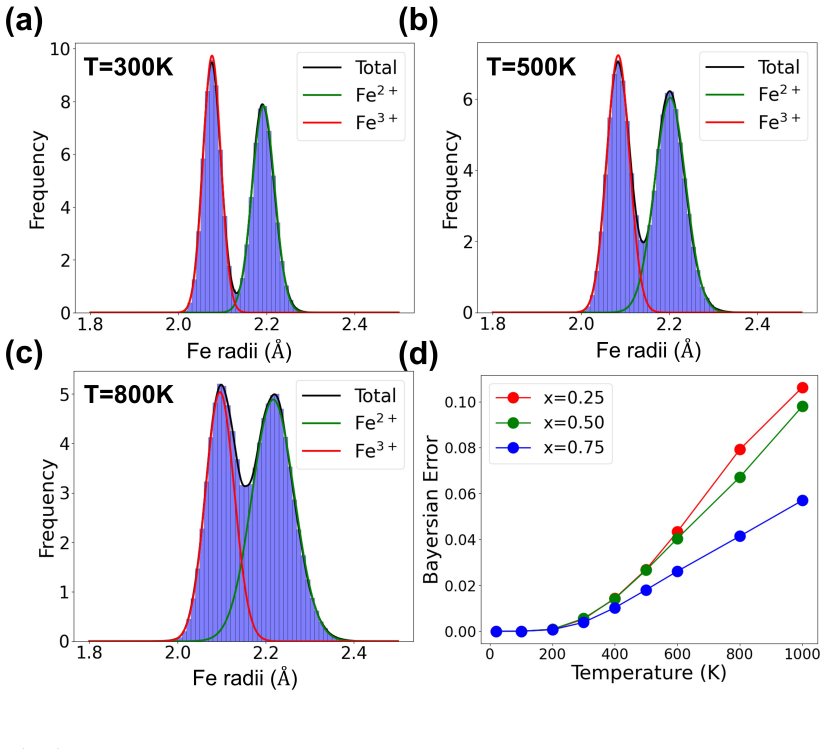
The load-bearing object is a fine-tuned machine-learned force field that infers Fe oxidation states from local geometry rather than explicit charge labels. Its key fingerprint is the Fe–O bond length: Fe$^{3+}$ centers sit near 2.08 Å and Fe$^{2+}$ near 2.16 Å, two well-separated Gaussian populations. In molecular dynamics trajectories, a Gaussian mixture classifier assigns each Fe atom a valence state from its time-averaged bond length, and a valence flip is counted when a state change survives a 0.08 ps minimum lifetime, with a temporal Gaussian filter suppressing thermal noise. This structural fingerprint carries the entire kinetic argument, because it is how polaron flips are detected and counted in a model that never sees spin or charge labels.
What would settle it
A direct nudged-elastic-band calculation of one Fe$^{2+}\to$Fe$^{3+}$ polaron hop in bulk Li$_x$FePO$_4$ at the same first-principles level, compared with the reported 0.131 eV flip barrier and 0.273 eV lithium-hop barrier, would settle whether the ordering of the rates is real; an independent single-crystal conductivity measurement across 300–1000 K at $x\approx0.5$ could test it experimentally.
Extended reading notes
Core claim
The central claim is that small polaron dynamics in Li$_x$FePO$_4$ are decoupled in rate from, yet strongly correlated with, lithium-vacancy configurations: valence flips between Fe$^{2+}$ and Fe$^{3+}$ proceed on picosecond timescales with $E_a=0.131\pm 0.002$ eV, roughly half the 0.273 eV barrier for lithium hops, so electrons are not the bottleneck in the single-crystal solid-solution regime. The flip events are short-ranged and charge-compensating: opposite-sign pairs peak within 0.05 ps and Fe–Fe distances below 4.4 Å, with a preference ratio of 3.97 versus same-sign pairs. Lithium ordering acts as a switch: an alternating Li-vacancy order along $x$ suppresses flips through a Li–Fe–Li clamp motif, while order along $y$ enhances them. At a constructed LiFePO$_4$/FePO$_4$ interface, flips concentrate in the interfacial layers and occur at higher rates than in any bulk solid-solution configuration, with $E_a=0.112\pm0.003$ eV and a larger prefactor, leading the paper to propose that phase boundaries may act as high-conductivity channels for small polaron transport.
Load-bearing premise
The kinetic conclusions rest on the assumption that the fine-tuned machine-learned force field, validated on relaxed geometries and valence recovery, also reproduces the true energy barriers for Fe$^{2+}$/Fe$^{3+}$ flips on the underlying first-principles surface.
Editorial extensions
If this is right
- If the central claim holds, lithium-ion migration, not polaron hopping, is the rate-limiting step for charge transport in the single-crystal solid-solution regime of Li$_x$FePO$_4$.
- Polaron flips occur as short-range, transient, charge-compensating pairs, so the elementary electronic event is local electron transfer between neighboring Fe sites rather than long-range band transport.
- Lithium-vacancy ordering is a control knob for electronic transport: $x$-ordered alternating layers suppress polaron flips via Li–Fe–Li clamps, while $y$-ordered layers enhance them.
- LiFePO$_4$/FePO$_4$ phase boundaries can act as fast electronic conduction channels, with interfacial flips exceeding the rate in any bulk solid-solution configuration.
- Fine-tuning a general-purpose machine-learned force field, without explicit charge labels, is sufficient to recover valence-resolved polaron dynamics in a multivalent oxide.
Reading between the lines
- Editorial extension: if phase boundaries are genuinely fast polaron channels, then in two-phase electrodes a meaningful fraction of the electronic current could flow along LiFePO$_4$/FePO$_4$ interfaces, spatially separating electron and lithium-ion pathways during cycling.
- Editorial extension: the coupling between Li-vacancy order and polaron flip rate suggests a testable engineering prediction: choosing delithiation directions or particle shapes that avoid the Li–Fe–Li clamp motif could raise electronic conductivity without changing total lithium content.
- Editorial extension: since the force field has no explicit valence labels, a natural stress test would be to freeze a Li configuration and scan Fe–O bond lengths while holding formal valences fixed, to see whether the learned valence assignment is causally tied to bond length or only statistically correlated.
Editorial analysis
A structured set of objections, weighed in public.
Referee Report
Summary. The manuscript fine-tunes the pretrained DPA-2 machine-learned force field on PBE+U DFT data for LixFePO4 without explicit charge labels, then runs molecular dynamics to study Fe2+/Fe3+ polaron dynamics. The authors report bulk polaron flip rates that are orders of magnitude faster than Li-ion hops in the solid solution (Ea = 0.131 eV with A = 13.9 ps^-1 versus Ea = 0.273 eV with A = 5.9 ps^-1), with flip events correlated to Li-vacancy ordering and a clamp motif that suppresses flipping. They further construct a LiFePO4/FePO4 interface and find enhanced polaron flip rates at the interface (Ea = 0.112 eV, A = 18.4 ps^-1), which they interpret as a possible interfacial electronic conduction channel.
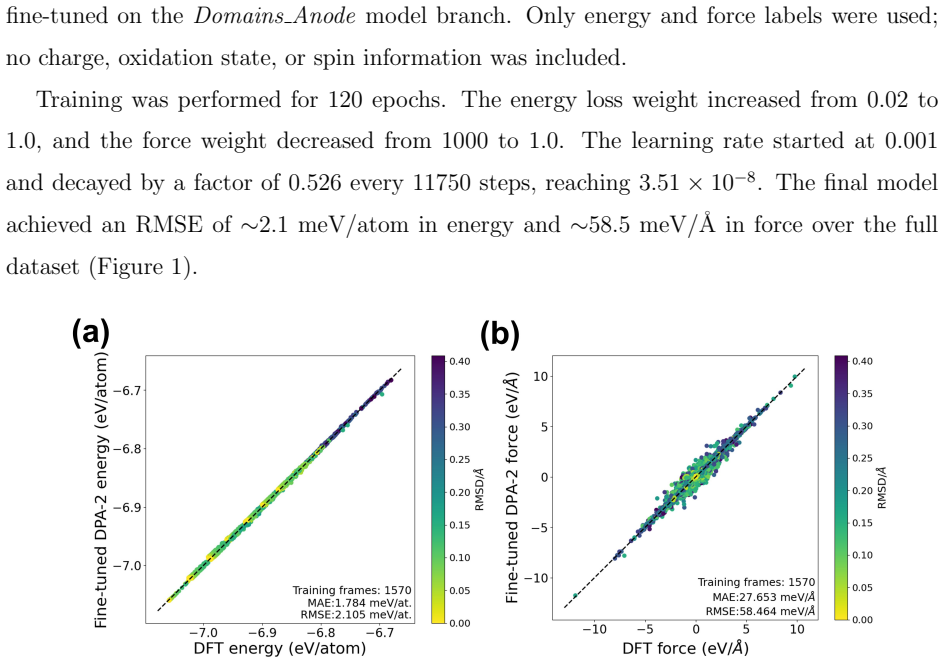
Significance. If the kinetic results are correct, the paper demonstrates a practical route to coupled ionic-polaronic MD with a fine-tuned universal MLFF, and it makes a specific, testable prediction about fast polaron dynamics at phase boundaries. Concrete strengths are the release of the DFT training set and fine-tuned model on AIS Square, the meV/atom energy accuracy, the 98.4% valence recovery, and the use of a post-processing GMM classifier that is not fitted to the target rates. The central claim, however, rests on an MLFF barrier that has not been benchmarked against direct DFT transition-state calculations; the significance is therefore conditional on closing that gap. The paper is honest about Born-Oppenheimer limitations, but this does not substitute for a PBE+U reference barrier.
major comments (2)
- [Results, Fig. 1(b), Table I; SI Sec. II A] The headline kinetic claim—polaron flips orders of magnitude faster than Li migration—is not benchmarked against a direct DFT polaron-hopping barrier. SI Sec. II A validates that the fine-tuned model reproduces relaxed Fe2+/Fe3+ geometries and valence configurations, but it does not test the model's transition-state barrier for Fe2+/Fe3+ exchange on the PBE+U surface. Since the rate ratio in Table I depends exponentially on the 0.142 eV difference between the two activation energies, an MLFF error of 0.05–0.10 eV in the polaron barrier changes the 300 K rate by factors of roughly 10–100 and could reverse the ordering. Please add PBE+U NEB (or equivalent) polaron-hop barriers for representative configurations, and compare the MLFF-predicted flip rate with the rate obtained from the DFT barrier. The Conclusions caveat that Born-Oppenheimer/DFT 'may contribute to the underestimation of polaron activation barriers' does not address this MLFF-vs-DFT validation gap.
- [SI Sec. I C; Fig. 1(b)] The statistical reliability of the low-temperature Li-hop rates is not established. The SI states that MD simulations at each temperature last 10–30 ps, while the fitted Li-hop parameters (A = 5.9 ps^-1, Ea = 0.273 eV) imply roughly 0.014 Li-hop events per ps across the entire x = 0.5 supercell (~96 Li atoms), i.e., about one event per ~70 ps of simulated time. With only 10–30 ps per temperature, the 300 K Li-hop rate is either an extrapolation from high-temperature data or based on very few events. Please report the number of Li-hop and polaron-flip events at each temperature, the total simulated time per temperature, and how zero-event temperatures were treated in the Arrhenius fit. This matters because the 'orders of magnitude faster' statement is evaluated at 300 K.
minor comments (4)
- [Abstract and Conclusion] The phrase 'orders of magnitude faster' should be qualified with the relevant temperature; from Table I, the bulk polaron-flip to Li-hop rate ratio is about 570 at 300 K but only about 13 at 1000 K, so the statement is not uniformly true across the simulated temperature range.
- [SI Sec. I C] The SI refers to 'D1, D2, D3, x and z configurations', but the main text and Figure 3 describe the second ordered configuration as the y-order; please correct the SI label to match the main text.
- [SI Sec. I A] The text states that nine AIMD trajectories of 1 ps with a 4 fs timestep yielded 1462 converged frames, but with 250 steps per trajectory the total candidate count is 2250; please clarify whether 1462 refers only to electronically converged frames and explain the difference.
- [Fig. 1(b) and Table I] The Arrhenius plot does not show error bars on the individual rate data, and the Li-hop prefactor in Table I has no uncertainty; please add these or state explicitly how the rates and uncertainties are obtained from the cooling/heating cycles.
Circularity Check
No significant circularity: kinetic and interfacial results emerge from MD on a DFT-trained MLFF; only minor non-load-bearing self-citations are present.
full rationale
The paper's derivation chain is self-contained and non-circular. The target quantities—bulk polaron flip activation energy (0.131 eV), Li hop barrier (0.273 eV), and interfacial polaron flip parameters (0.112 eV, A = 18.4 ps−1)—are not inputs to the MLFF. The MLFF was trained only on DFT total energies and forces from relaxations and short AIMD trajectories, with no charge, oxidation-state, or spin labels, and the validation in Supplementary Section II A checks structural and energetic reproduction of polaronic configurations, including 98.4% valence recovery. The polaron flip rates and Li hop rates then emerge from finite-temperature MD and are fitted afterward to an Arrhenius form; the fit is a post-processing summary of simulated frequencies, not a parameter imposed on the model. The GMM classifier used to label Fe2+/Fe3+ is also fitted per composition and temperature to the simulated Fe–O bond-length distributions and serves as a measurement tool, not as part of the physical model. The only self-citations ([20] DPA-2, [23] PFD) are methodological building blocks; the paper independently validates the fine-tuned model against DFT data, so these citations are not load-bearing for the central claim. Thus no circular step reduces the conclusions to the inputs.
Assumptions & free parameters
free parameters (2)
- GMM valence classifier parameters (per composition and temperature) =
not reported (means/variances fitted per x and T)
- Valence flip event detection thresholds =
Gaussian filter, minimum lifetime 0.08 ps
assumptions (6)
- domain assumption PBE+U (U=5.3 eV on Fe 3d) with collinear ferromagnetic order accurately describes the energetics of Fe2+/Fe3+ polarons in LiFePO4.
- domain assumption Born-Oppenheimer adiabatic approximation: valence dynamics evolve on the ground-state potential energy surface.
- domain assumption Fe-O bond length is a reliable proxy for Fe valence state.
- domain assumption The fine-tuned DPA-2 model generalizes to dynamics beyond training configurations.
- domain assumption Classical MD on the MLFF PES captures thermally activated polaron hopping rates.
- domain assumption A 2x4x6 supercell with 10-80 ps trajectories samples representative dynamics.
Cite this review
Pith. "Pith review of Uncovering coupled ionic-polaronic dynamics and interfacial enhancement in Li$_x$FePO$_4$." pith.science (2026). https://pith.science/paper/YSIFMIEB
@misc{pith2026250705626,
  author       = {Pith},
  title        = {Pith review of: Uncovering coupled ionic-polaronic dynamics and interfacial enhancement in Li$_x$FePO$_4$},
  year         = {2026},
  howpublished = {\url{https://pith.science/paper/YSIFMIEB}},
  note         = {Machine review of arXiv:2507.05626}
}
abstract
Understanding and controlling coupled ionic-polaronic dynamics is crucial for optimizing electrochemical performance in battery materials. However, studying such coupled dynamics remains challenging due to the intricate interplay between Li-ion configurations, polaron charge ordering, and lattice vibrations. Here, we develop a fine-tuned machine-learned force field (MLFF) for Li$_x$FePO$_4$ that captures coupled ion-polaron behavior. Our simulations reveal picosecond-scale polaron flips occurring orders of magnitude faster than Li-ion migration, featuring strong correlation to Li configurations. Notably, polaron charge fluctuations are further enhanced at Li-rich/Li-poor phase boundaries, suggesting a potential interfacial electronic conduction mechanism. These results demonstrate the capability of fine-tuned MLFFs to resolve complex coupled transport and provide insight into emergent ionic-polaronic dynamics in multivalent battery cathodes.
Figures


Figures from the paper (3 more)

Reference graph
Works this paper leans on
-
[1]
Fr¨ ohlich, Electrons in lattice fields, Advances in Physics 10.1080/00018735400101213 (1954)
H. Fr¨ ohlich, Electrons in lattice fields, Advances in Physics 10.1080/00018735400101213 (1954)
-
[2]
the molecular-crystal model, Annals of Physics 8, 325 (1959)
Studies of polaron motion: Part I. the molecular-crystal model, Annals of Physics 8, 325 (1959)
work page 1959
-
[3]
M. Reticcioli, U. Diebold, G. Kresse, and C. Franchini, Small polarons in transition metal oxides, in Handbook of Materials Modeling (Springer, Cham, 2020) pp. 1035– 1073
work page 2020
- [4]
- [5]
-
[6]
C. Wang and J. Hong, Ionic/electronic conducting char- acteristics of LiFePO 4 cathode materials, Electrochemi- cal and Solid-State Letters 10, A65 (2007)
work page 2007
-
[7]
R. Amin, P. Balaya, and J. Maier, Anisotropy of elec- tronic and ionic transport in LiFePO 4 single crystals, Electrochemical and Solid-State Letters 10, A13 (2007)
work page 2007
- [8]
Show all 54 references
-
[9]
Delacourt, P
C. Delacourt, P. Poizot, J.-M. Tarascon, and C. Masque- lier, The existence of a temperature-driven solid solution in Li xFePO4 for 0 < x < 1, Nature Materials 4, 254 (2005)
2005
-
[10]
Malik, F
R. Malik, F. Zhou, and G. Ceder, Kinetics of non- equilibrium lithium incorporation in LiFePO 4, Nature Materials 10, 587 (2011)
2011
-
[11]
F. Zhou, T. Maxisch, and G. Ceder, Configurational elec- tronic entropy and the phase diagram of mixed-valence oxides: The case of Li xFePO4, Physical Review Letters 97, 155704 (2006)
2006
-
[12]
Morgan, A
D. Morgan, A. Van Der Ven, and G. Ceder, Li conductiv- ity in Li xMPO4 (M = Mn, Fe, Co, Ni) olivine materials, Electrochemical and Solid-State Letters 7, A30 (2004)
2004
-
[13]
Maxisch, F
T. Maxisch, F. Zhou, and G. Ceder, Ab initio study of the migration of small polarons in olivine Li xFePO4 and their association with lithium ions and vacancies, Physi- cal Review B 73, 104301 (2006)
2006
-
[14]
S. P. Ong, V. L. Chevrier, and G. Ceder, Comparison of small polaron migration and phase separation in olivine LiMnPO4 and LiFePO 4 using hybrid density functional theory, Physical Review B 83, 075112 (2011)
2011
-
[15]
Nakayama, S
M. Nakayama, S. Yamada, R. Jalem, and T. Kasuga, Density functional studies of olivine-type LiFePO 4 and NaFePO4 as positive electrode materials for rechargeable lithium and sodium ion batteries, Solid State Ionics 286, 40 (2016)
2016
-
[16]
X. Wang, J. Huang, Y. Liu, and S. Chen, The decisive role of electrostatic interactions in transport mode and phase segregation of lithium ions in LiFePO 4, Chemical Science 14, 13042 (2023)
2023
-
[17]
Batatia, D
I. Batatia, D. P. Kovacs, G. Simm, C. Ortner, and G. Csanyi, MACE: Higher order equivariant message passing neural networks for fast and accurate force fields, in Advances in Neural Information Processing Systems , Vol. 35, edited by S. Koyejo, S. Mohamed, A. Agarwal, D. Belgra...
-
[18]
Rhodes, S
B. Rhodes, S. Vandenhaute, V. ˇSimkus, J. Gin, J. God- win, T. Duignan, and M. Neumann, Orb-v3: Atomistic simulation at scale (2025), arXiv:2504.06231 [cond-mat]
2025 arXiv
-
[19]
Chen and S
C. Chen and S. P. Ong, A universal graph deep learn- ing interatomic potential for the periodic table, Nature Computational Science 2, 718 (2022)
2022
-
[20]
Zhang, X
D. Zhang, X. Liu, X. Zhang, C. Zhang, C. Cai, H. Bi, Y. Du, X. Qin, A. Peng, J. Huang, B. Li, Y. Shan, J. Zeng, Y. Zhang, S. Liu, Y. Li, J. Chang, X. Wang, S. Zhou, J. Liu, X. Luo, Z. Wang, W. Jiang, J. Wu, Y. Yang, J. Yang, M. Yang, F.-Q. Gong, L. Zhang, M. Shi, F.-Z. Dai, D....
2024
-
[21]
B. Deng, P. Zhong, K. Jun, J. Riebesell, K. Han, C. J. Bartel, and G. Ceder, CHGNet as a pretrained universal neural network potential for charge-informed atomistic modelling, Nature Machine Intelligence 5, 1031 (2023)
2023
-
[22]
V. C. Birschitzky, L. Leoni, M. Reticcioli, and C. Fran- chini, Machine learning small polaron dynamics, Physical Review Letters 134, 216301 (2025)
2025
-
[23]
R. Wang, Y. Gao, H. Wu, and Z. Zhong, PFD: Auto- matically generating machine learning force fields from universal models (2025), arXiv:2502.20809 [cond-mat]
2025
-
[24]
Materials Data on LiFePO 4 by Materials Project , 6 Tech. Rep. mp-19017 (Lawrence Berkeley National Lab. (LBNL), Berkeley, CA (United States). LBNL Materials Project, 2020)
2020
-
[25]
Datasets/351/LixFePO4 trajectory plus aimd, https://www.aissquare.com/datasets/detail? pageType=datasets&name=LixFePO4_trajectory_ plus_aimd&id=351, accessed: 2025-07-01
2025
-
[26]
Models/350/DPA-2.3.1-LFPO-finetuned, https: //www.aissquare.com/models/detail?pageType= models&name=DPA-2.3.1-LFPO-finetuned&id=350 , accessed: 2025-07-01
2025
-
[27]
Yamada, H
A. Yamada, H. Koizumi, N. Sonoyama, and R. Kanno, Phase change in Li xFePO4, Electrochemical and Solid- State Letters 8, A409 (2005)
2005
-
[28]
J. Dodd, B. Fultz, and R. Yazami, Phase diagram of LixFePO4, ECS Meeting Abstracts MA2005-02, 132 (2006)
2006
-
[29]
H. Liu, F. C. Strobridge, O. J. Borkiewicz, K. M. Wiaderek, K. W. Chapman, P. J. Chupas, and C. P. Grey, Capturing metastable structures during high-rate cycling of LiFePO 4 nanoparticle electrodes, Science 344, 1252817 (2014)
2014
-
[30]
Orikasa, T
Y. Orikasa, T. Maeda, Y. Koyama, H. Murayama, K. Fukuda, H. Tanida, H. Arai, E. Matsubara, Y. Uchi- moto, and Z. Ogumi, Direct observation of a metastable crystal phase of Li xFePO4 under electrochemical phase transition, Journal of the American Chemical Society 135, 5497 (2013)
2013
-
[31]
Xiao and G
P. Xiao and G. Henkelman, Kinetic monte carlo study of li intercalation in LiFePO 4, ACS Nano 12, 844 (2018)
2018
-
[32]
W. Kong, J. Zhou, Y. Z. Luo, T. Yang, S. Wang, J. Chen, A. Rusydi, Y. P. Feng, and M. Yang, Forma- tion of two-dimensional small polarons at the conduct- ing LaAlO 3/SrTiO3 interface, Physical Review B 100, 085413 (2019)
2019
-
[33]
Thiel, G
S. Thiel, G. Hammerl, A. Schmehl, C. W. Schneider, and J. Mannhart, Tunable quasi-two-dimensional elec- tron gases in oxide heterostructures, Science 313, 1942 (2006)
2006
-
[34]
Mannhart and D
J. Mannhart and D. G. Schlom, Oxide interfaces—an op- portunity for electronics, Science 327, 1607 (2010)
2010
-
[35]
Ohtomo and H
A. Ohtomo and H. Y. Hwang, A high-mobility electron gas at the LaAlO 3/SrTiO3 heterointerface, Nature 427, 423 (2004)
2004
-
[36]
Delacourt, L
C. Delacourt, L. Laffont, R. Bouchet, C. Wurm, J.-B. Leriche, M. Morcrette, J.-M. Tarascon, and C. Masque- lier, Toward understanding of electrical limitations (elec- tronic, ionic) in LiMPO 4 (M=Fe, Mn) electrode materi- als, Journal of The Electrochemical Society 152, A913 (2005)
2005
-
[37]
Xu, S.-Y
Y.-N. Xu, S.-Y. Chung, J. T. Bloking, Y.-M. Chiang, and W. Y. Ching, Electronic structure and electrical conduc- tivity of undoped LiFePO 4, Electrochemical and Solid- State Letters 7, A131 (2004). APS/123-QED Supplementary Information: Uncovering coupled ionic-polaronic dynam...
2004
-
[38]
Kresse and J
G. Kresse and J. Hafner, Ab initio molecular dynamics for liquid met als, Physical Review B 47, 558 (1993)
1993
-
[39]
Kresse and J
G. Kresse and J. Furthm¨ uller, Efficiency of ab initio total energy calculations for metals and semiconductors using a plane-wave basis set, Computational Materials Science 6, 15 (1996)
1996
-
[40]
Kresse and J
G. Kresse and J. Furthm¨ uller, Efficient iterative schemes for ab initio total-energy calculations using a plane-wave basis set, Physical Review B 54, 11169 (1996)
1996
-
[41]
Kresse and D
G. Kresse and D. Joubert, From ultrasoft pseudopotentials to the pr ojector augmented-wave method, Physical Review B 59, 1758 (1999). 7
1999
-
[42]
J. P. Perdew, K. Burke, and M. Ernzerhof, Generalized gradient ap proximation made simple, Physical Review Letters 77, 3865 (1996)
1996
-
[43]
J. P. Perdew, K. Burke, and M. Ernzerhof, Generalized gradient ap proximation made simple [Phys. Rev. Lett. 77, 3865 (1996)], Physical Review Letters 78, 1396 (1997)
1996
-
[44]
S. L. Dudarev, G. A. Botton, S. Y. Savrasov, C. J. Humphreys, and A. P. Su tton, Electron- energy-loss spectra and the structural stability of nickel oxide: An LSDA+U study, Physical Review B 57, 1505 (1998)
1998
-
[45]
A. Jain, S. P. Ong, G. Hautier, W. Chen, W. D. Richards, S. Dacek, S. C holia, D. Gunter, D. Skinner, G. Ceder, and K. A. Persson, Commentary: The Materials Pr oject: A materials genome approach to accelerating materials innovation, APL Materials 1, 011002 (2013)
2013
-
[46]
Hubbard U values materials project documentation, https://docs.m aterialsproject.org/methodology/materials- methodology/calculation-details/gga+u-calculations/hubbard-u-values (2023)
2023
-
[47]
Zhang, X
D. Zhang, X. Liu, X. Zhang, C. Zhang, C. Cai, H. Bi, Y. Du, X. Qin, A. Peng, J. Huang, B. Li, Y. Shan, J. Zeng, Y. Zhang, S. Liu, Y. Li, J. Chang, X. Wang, S. Zhou, J. Liu, X. Lu o, Z. Wang, W. Jiang, J. Wu, Y. Yang, J. Yang, M. Yang, F.-Q. Gong, L. Zhang, M. Shi, F. - Z. Dai,...
2024
-
[48]
J. Zeng, D. Zhang, A. Peng, X. Zhang, S. He, Y. Wang, X. Liu, H. Bi, Y. Li, C. Cai, C. Z hang, Y. Du, J.-X. Zhu, P. Mo, Z. Huang, Q. Zeng, S. Shi, X. Qin, Z. Yu, C. Luo, Y. Din g, Y.-P. Liu, R. Shi, Z. Wang, S. L. Bore, J. Chang, Z. Deng, Z. Ding, S. Han, W. Jiang, G. Ke, Z. L...
2025 arXiv
-
[49]
Models/287/DPA-2.3.1-v3.0.0rc0, https://www.aissquare.com/models/detail?pageType= models&name=DPA-2.3.1-v3.0.0rc0&id=287, accessed: 2025-06-30
2025
-
[50]
A. P. Thompson, H. M. Aktulga, R. Berger, D. S. Bolintineanu, W. M. Brow n, P. S. Crozier, P. J. In ’T Veld, A. Kohlmeyer, S. G. Moore, T. D. Nguyen, R. Shan, M. J. Stevens, J. Tranchida, C. Trott, and S. J. Plimpton, LAMMPS - a flexible simulati on tool for particle- based mat...
2022
-
[51]
R. O. Duda, D. G. Stork, and P. E. Hart, Pattern Classification , 2nd ed. (Wiley, New York, 2001)
2001
-
[52]
S. P. Ong, W. D. Richards, A. Jain, G. Hautier, M. Kocher, S. Cholia, D . Gunter, V. L. Chevrier, K. A. Persson, and G. Ceder, Python Materials Genomics (Py matgen): A robust, open-source Python library for materials analysis, Computational Material s Science 68, 314 (2013)
2013
-
[53]
F. Zhou, T. Maxisch, and G. Ceder, Configurational electronic entropy and the phase diagram of mixed-valence oxides: The case of Li xFePO4, Physical Review Letters 97, 155704 (2006)
2006
-
[54]
X. Wang, J. Huang, Y. Liu, and S. Chen, The decisive role of electrostatic i nteractions in transport mode and phase segregation of lithium ions in LiFePO 4, Chemical Science 14, 13042 (2023). 9
2023
Reviewed August 6, 2026 · model on record in the stance chip above.
Discussion (0). Continue with ORCID to comment.