REVIEW 4 major objections 6 minor 53 references
The Features at Convergence Theorem: a first-principles alternative to the Neural Feature Ansatz for how networks learn representations
T0 review · 4 major / 6 minor · reviewed 2026-08-06 · deepseek-v4-flash
Pith's one-line read One exact identity fixes the feature matrix of every layer at convergence, giving a theorem-based alternative to the Neural Feature Ansatz.
desk verdict A correct and clearly-written restatement of stationarity as a feature-learning relation, but the empirical validation never checks the stationarity premise directly. read the letter →
The pith
A machine-rendered reading of the paper's core claim, the machinery that carries it, and where it could break.
The reading
What carries the argument
The central object is the Features at Convergence Theorem (FACT), the identity above. It carries the argument because it converts a local optimality condition, zero gradient with respect to one weight matrix, into a closed-form, data-averaged expression for the layer's feature Gram matrix $W^\top W$. The machinery is deliberately simple: the chain rule through the layer input $h(x_i)$, the ridge term $\lambda W$ from weight decay, and the fact that at a critical point the gradient is exactly zero. The paper then uses symmetrizations of the identity, $W^\top W=\mathrm{FACT}^\top$ and $W^\top W=\sqrt{\mathrm{FACT}\,\mathrm{FACT}^\top}$, to build positive semidefinite updates for recursive feature machines, and derives the analogous backward identity for $W W^\top$. For inner-product kernels, FACT and AGOP both expand into sums over data pairs whose similarity factors differ only by $k'$ versus $\tau$, which is the mechanism explaining why the conjectured NFA usually tracks the exact FACT.
What would settle it
Record, for each layer of a weight-decayed ReLU MLP trained on MNIST or CIFAR-10, the per-layer gradient norm and the Pearson correlation between FACT and $W^\top W$ throughout the terminal phase. The paper's account predicts that the correlation rises only as the gradient norm approaches zero; seeing the correlation saturate near 1 while per-layer gradients are still large, or stay low after gradients are negligible, would falsify the claimed stationarity link.
Extended reading notes
Core claim
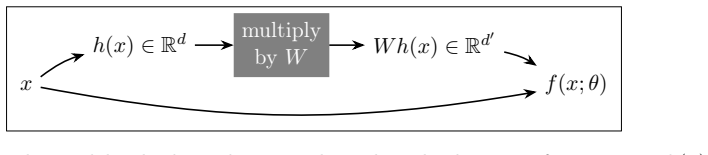
The central claim is Theorem 3.1, the Features at Convergence Theorem: for any weight matrix $W$ through which the model's output factors as $f(x)=g(Wh(x),x)$, stationarity of the $L_2$-regularized loss with respect to $W$ forces $$W^\top W = \mathrm{FACT} := -\frac{1}{n\$\lambda$}\sum_{i=1}^n (\nabla_h \ell_i)(h(x_i))^\top .$$ The proof is a two-line chain-rule computation: left-multiply the zero gradient by $W^\top$ and use that the ridge term contributes $\lambda W^\top W$. The paper's interpretive claim is that this exact identity is the first-principles foundation of the empirically observed Neural Feature Ansatz; empirically, FACT has higher correlation than AGOP (the average gradient outer product) or the equivariant NFA with the feature matrices of trained ReLU MLPs at convergence, and a recursive feature machine updated with FACT reproduces grokking and phase transitions. The paper also constructs a worst-case two-layer setting where the NFA is nearly uncorrelated with the true feature matrix while FACT remains exact, and derives a backward form, bFACT, that fixes left singular vectors.
Load-bearing premise
The identity is exactly stationarity in disguise, so the load-bearing premise is that the trained network is actually at, or close enough to, a critical point of the regularized loss with respect to every weight matrix; the paper's convergence criterion is train loss at most $10^{-3}$, which does not by itself guarantee stationarity.
Editorial extensions
If this is right
- At convergence, every matrix-multiply layer of a weight-decayed network satisfies an exact, hyperparameter-free relation between its feature Gram matrix and the loss gradients through that layer.
- The Neural Feature Ansatz is explained rather than assumed: its empirical agreement follows from the algebraic near-equivalence of the AGOP and FACT updates for inner-product kernels, and its failures appear where the two similarity factors $k'$ and $\tau$ disagree.
- Adaptive kernel learning driven by FACT recovers neural feature-learning phenomena, including grokking of modular arithmetic, phase transitions in sparse parities, and high tabular accuracy, so those phenomena do not require a neural training simulation to arise.
- The backward form bFACT extends the same exact control to the layer output side, determining $W W^\top$ at critical points and fixing right and left singular structure simultaneously.
Reading between the lines
- The authors leave implicit that FACT can serve as a per-layer stationarity certificate: comparing FACT with $W^\top W$ during training measures how close each layer is to a critical point, which could be used to detect grokking onset or to choose an early stopping point.
- The reported instability of FACT-RFM after convergence on sparse parities suggests that iterating the stationarity fixed-point map can leave the basin of attraction of a critical point; a testable extension is to add a proximal or trust-region correction and check whether early stopping becomes unnecessary.
- Because Section 5 writes FACT through representer coefficients and kernel derivatives, one could estimate FACT from the empirical neural tangent kernel of a finite-width network with weight decay, letting practitioners check convergence without additional training or stored state.
- A unifying statement may be within reach: low-rank bias, neural collapse, balancedness, and the FACT identity are all consequences of first-order optimality, so a single convergent-representation theorem could tie these phenomena together; the paper does not develop that unification.
Editorial analysis
A structured set of objections, weighed in public.
Referee Report
Summary. The paper proposes the Features at Convergence Theorem (FACT), asserting that at any critical point of the λ-regularized training loss with respect to a weight matrix W, the feature matrix W^T W equals -1/(nλ) Σ_i (∇_h ℓ_i) h(x_i)^T. The authors position this exact stationarity condition as a first-principles alternative to the empirically motivated Neural Feature Ansatz (NFA), and report that FACT has higher correlation with learned feature matrices than NFA or eNFA on MNIST/CIFAR. They introduce FACT-RFM (a fixed-point algorithm whose update is engineered so that fixed points satisfy FACT) and apply it to UCI tabular data, sparse parity, and modular arithmetic, claiming it reproduces phase transitions and grokking. They also derive a comparison between FACT and AGOP for inner-product kernels, and construct an adversarial two-layer network where NFA is provably uncorrelated while FACT holds. The paper concludes that FACT unifies first-order optimality analyses with the NFA literature.
Significance. The central identity is a rearranged first-order optimality condition; its proof is correct and it is exactly true at differentiable critical points. If the empirical premise that trained networks reach such critical points is established, the paper would provide a simple, parameter-free relation that grounds the NFA and explains its success, and the adversarial separation is a useful counterexample to NFA's universality. The paper also ships explicit constructions and derivations for the RFM update and the separation theorem. However, the contribution's value hinges on empirical verification of approximate stationarity, which the manuscript does not currently provide; several secondary empirical claims are not supported by the displayed evidence.
major comments (4)
- [Appendix A, Figure 2, Figure 8] Appendix A operationalizes convergence as batch train loss ≤ 10^-3, but Theorem 3.1 requires exact stationarity of the λ-regularized loss with respect to W. A small train loss does not imply a small gradient norm, especially for overparameterized ReLU networks; Figure 8 itself shows that FACT correlation only approaches 1 in the terminal phase. The paper never reports the gradient norm of the regularized loss or the residual ||W^T W - FACT|| at the final iterate, so the central empirical claim that trained networks satisfy FACT is not directly tested. Please add direct stationarity measures and, if necessary, report correlations at points where the residual is actually small.
- [Section 4.3, Figure 5] The text states that both FACT-RFM and NFA-RFM 'achieve 100% test accuracy and exhibit delayed generalization aligned to the grokking phenomenon', but Figure 5 displays only feature matrices, not training or test accuracy over iterations. Delayed generalization is a temporal phenomenon and cannot be read from a final-iterate feature plot. Please include accuracy-versus-iteration curves (or a quantitative measure of delay) for both methods; without this, the abstract's claim that FACT captures grokking behavior is unsupported.
- [Section 5, Proposition 5.1, discussion after it] The paragraph following Proposition 5.1 claims that FACT·M^T is positive semidefinite when k is non-increasing, citing k(t)=exp(t) and k(t)=t^2 as examples. exp(t) is increasing, so the stated condition is not even satisfied by the cited examples. More importantly, PSD-ness depends on the matrix [k'(x_i^T M x_j)] being PSD (after congruence by the data), not on the monotonicity of k; odd powers such as k(t)=t^4 show this is not a general monotonicity property. This invalidates the stated simplification M_{t+1} ← (FACT_t M_t)^{1/2} and the related comparison between the FACT-RFM and NFA-RFM updates for inner-product kernels unless a correct condition and proof are supplied.
- [Appendix D, Lemma D.2] Lemma D.2 as stated is false. For Q = u u^T with ||u||=1 and singular value 1, the claimed minimum cost is 2, but choosing a and c such that a c^2 = 1 yields cost a^2 + c^2 = a^2 + 1/a, whose minimum over a > 0 is 3·2^{-2/3} ≈ 1.89 < 2. The proof's initial inequality a_i^2 + ||w_i||^2 ≥ 2 |a_i|^{2/3} ||w_i||^{4/3} fails, e.g., for a_i = 2^{-1/2}, ||w_i|| = 1. The upper-bound direction (the constructive representation) is sufficient for the use in Theorem 6.1, but the lemma should be corrected or replaced with a one-sided statement.
minor comments (6)
- [Table 1] No error bars or number of seeds are reported; the 0.12 percentage point gap between FACT-RFM and NFA-RFM is likely within run-to-run noise, so the claim that both methods 'obtain roughly the same high accuracy performance' needs variance estimates.
- [Section 4.3, Figure 4] The figure caption repeats '1 Hidden Layer ReLU MLP' three times and does not describe what is plotted; the text's claim of a phase transition needs a clear plot of test accuracy or feature alignment versus data size or iteration.
- [Section 5, first paragraph] There is a typo: 'thse' should be 'these'.
- [Appendix D] The proof has two subsections numbered '3a' (the AGOP estimate and the AGOP-power estimate); renumber them.
- [Section 7, Figure 8] The text remarks that sqrt(FACT·FACT^T) has nontrivial correlation during training, but Figure 8 does not include that quantity; either add it to the figure or remove the remark.
- [Section 4.2] The FACT-RFM update is explicitly constructed so that its fixed points satisfy the FACT relation (Appendix E), so the RFM experiments in Section 4 should be described as applications of the construction rather than as independent evidence that neural networks satisfy FACT.
Circularity Check
Minor self-definitional element in the FACT-RFM applications; the central FACT theorem itself is a non-circular necessary condition from stationarity.
-
self definitional
[Section 4.2, equation (FACT-RFM update); Appendix E, 'Derivation and justification of FACT-RFM update']
"The exponents in these updates are chosen so that the fixed points of these updates coincide with the FACT relation derived for networks at convergence in Theorem 3.1. ... the most natural solution is to symmetrize FACT and instead run the scheme W_{t+1} ← (FACT_t FACT_t^⊤)^{1/4}, since indeed when FACT_t = W_t^⊤ W_t we are at a fixed point with this update."
The FACT-RFM update is explicitly engineered so that its fixed point satisfies the FACT relation by construction. Therefore, any observation that features produced by FACT-RFM obey FACT at convergence, or that FACT-RFM reproduces phenomena like grokking and sparse-parity phase transitions, is not an independent confirmation of the FACT relation: the relation is built into the algorithm's defining update. This is a self-definitional aspect of the applications section, not of the central theorem. Theorem 3.1 itself is a rearranged first-order stationarity condition, which is a necessary mathematical consequence and does not assume its own conclusion.
full rationale
The central claim of the paper, Theorem 3.1, is not circular. It derives W^T W = FACT from the first-order optimality condition ∇_W L_λ(θ) = 0, and the paper explicitly acknowledges that it is 'a straightforward modification of the stationarity conditions.' This is a necessary condition, not an assumed ansatz, so the identity has independent mathematical content. The empirical validation in Figure 2 compares FACT against the actual learned W^T W of trained ReLU MLPs, which is a genuine test, although the operationalization of 'convergence' as train loss ≤ 10^-3 (Appendix A) does not directly guarantee stationarity; that is a validation-gap concern rather than circularity. The FACT-RFM algorithm is a more problematic area: the update is designed so that its fixed points satisfy FACT, so the algorithm's behavior is to some extent self-definitional. However, the paper does not use FACT-RFM results to prove Theorem 3.1; it uses them as applications of an already-derived relation. Self-citations to prior NFA work by overlapping authors are present but are used as baselines or empirical conjectures, not as a load-bearing uniqueness argument. Overall, the core derivation is self-contained and non-circular, with one minor by-construction element in the algorithmic applications, warranting a low circularity score of 2.
Assumptions & free parameters
free parameters (4)
- Early stopping iteration (sparse parity FACT-RFM) =
not specified
- RFM ridge lambda and kernel bandwidth =
cross-validated, values not given in main text
- Geometric averaging exponent in FACT-RFM update' =
1/8
- Adversarial construction constants in Theorem 6.1 =
p_epsilon=epsilon^8, tau_epsilon=epsilon^3, lambda_epsilon=epsilon^32 p_epsilon
assumptions (5)
- domain assumption The model depends on W only through multiplication W h(x) (Eq. 2.1).
- domain assumption Training reaches a critical point of the lambda-regularized loss with respect to W.
- domain assumption Non-zero weight decay lambda > 0 and differentiable losses.
- domain assumption Inner-product kernel form K_W(x,x')=k(x^T M x') and the stated monotonicity of k in Section 5.
- standard math Matrix concavity inequality of Rotfel'd and Thompson used in Lemma D.2.
Cite this review
Pith. "Pith review of The Features at Convergence Theorem: a first-principles alternative to the Neural Feature Ansatz for how networks learn representations." pith.science (2026). https://pith.science/paper/N7SBMGE6
@misc{pith2026250705644,
  author       = {Pith},
  title        = {Pith review of: The Features at Convergence Theorem: a first-principles alternative to the Neural Feature Ansatz for how networks learn representations},
  year         = {2026},
  howpublished = {\url{https://pith.science/paper/N7SBMGE6}},
  note         = {Machine review of arXiv:2507.05644}
}
read the original abstract
It is a central challenge in deep learning to understand how neural networks learn representations. A leading approach is the Neural Feature Ansatz (NFA) (Radhakrishnan et al. 2024), a conjectured mechanism for how feature learning occurs. Although the NFA is empirically validated, it is an educated guess and lacks a theoretical basis, and thus it is unclear when it might fail, and how to improve it. In this paper, we take a first-principles approach to understanding why this observation holds, and when it does not. We use first-order optimality conditions to derive the Features at Convergence Theorem (FACT), an alternative to the NFA that (a) obtains greater agreement with learned features at convergence, (b) explains why the NFA holds in most settings, and (c) captures essential feature learning phenomena in neural networks such as grokking behavior in modular arithmetic and phase transitions in learning sparse parities, similarly to the NFA. Thus, our results unify theoretical first-order optimality analyses of neural networks with the empirically-driven NFA literature, and provide a principled alternative that provably and empirically holds at convergence.
Figures


Figures from the paper (8 more)


Reference graph
Works this paper leans on
-
[1]
E. Abbe, E. B. Adsera, and T. Misiakiewicz. The merged-staircase property: a necessary and nearly sufficient condition for sgd learning of sparse functions on two-layer neural networks. InConference on Learning Theory, pages 4782–4887. PMLR, 2022
work page 2022
-
[2]
E. Abbe, E. B. Adsera, and T. Misiakiewicz. Sgd learning on neural networks: leap complexity and saddle-to-saddle dynamics. InThe Thirty Sixth Annual Conference on Learning Theory, pages 2552–2623. PMLR, 2023
work page 2023
- [3]
-
[4]
S. Arora, N. Cohen, and E. Hazan. On the optimization of deep networks: Implicit acceleration by overparameterization. In J. Dy and A. Krause, editors,Proceedings of the 35th International Conference on Machine Learning, volume 80 ofProceedings of Machine Learning Research, pages 244–253. PMLR, 10–15 Jul 2018
work page 2018
- [5]
-
[6]
G. B. Arous, R. Gheissari, and A. Jagannath. Online stochastic gradient descent on non-convex losses from high-dimensional inference.Journal of Machine Learning Research, 22(106):1–51, 2021
work page 2021
- [7]
-
[8]
D. Beaglehole, A. Radhakrishnan, E. Boix-Adserà, and M. Belkin. Aggregate and conquer: detecting and steering llm concepts by combining nonlinear predictors over multiple layers.arXiv preprint arXiv:2502.03708, 2025
arXiv 2025
Show all 53 references
-
[9]
Beaglehole, A
D. Beaglehole, A. Radhakrishnan, P. Pandit, and M. Belkin. Mechanism of feature learning in convolutional neural networks.arXiv preprint arXiv:2309.00570, 2023
2023 arXiv
-
[10]
Cabannes, E
V. Cabannes, E. Dohmatob, and A. Bietti. Scaling laws for associative memories.arXiv preprint arXiv:2310.02984, 2023
2023 arXiv
-
[11]
Cabannes, B
V. Cabannes, B. Simsek, and A. Bietti. Learning associative memories with gradient descent.arXiv preprint arXiv:2402.18724, 2024
2024 arXiv
-
[12]
Damian, J
A. Damian, J. Lee, and M. Soltanolkotabi. Neural networks can learn representations with gradient descent. InConference on Learning Theory, pages 5413–5452. PMLR, 2022. 27
2022
-
[13]
Davis and W
C. Davis and W. M. Kahan. The rotation of eigenvectors by a perturbation. iii.SIAM Journal on Numerical Analysis, 7(1):1–46, 1970
1970
-
[14]
B. L. Edelman, E. Edelman, S. Goel, E. Malach, and N. Tsilivis. The evolution of statistical induction heads: In-context learning markov chains.arXiv preprint arXiv:2402.11004, 2024
2024 arXiv
-
[15]
B. L. Edelman, S. Goel, S. Kakade, E. Malach, and C. Zhang. Pareto frontiers in neural feature learning: Data, compute, width, and luck.NeurIPS, 2023
2023
-
[16]
Fernandez-Delgado, E
M. Fernandez-Delgado, E. Cernadas, S. Barro, and D. Amorim. Do we need hundreds of classifiers to solve real world classification problems?Journal of Machine Learning Research, 2014
2014
-
[17]
S. Frei, G. Vardi, P. Bartlett, and N. Srebro. The double-edged sword of implicit bias: Generalization vs. robustness in relu networks.Advances in Neural Information Processing Systems, 36, 2024
2024
-
[18]
Galanti, Z
T. Galanti, Z. S. Siegel, A. Gupte, and T. Poggio. Sgd and weight decay secretly minimize the rank of your neural network.arXiv preprint arXiv:2206.05794, 2022
2022 arXiv
-
[19]
Gan and T
Y. Gan and T. Poggio. For hyperbfs agop is a greedy approximation to gradient descent. Technical report, Center for Brains, Minds and Machines (CBMM), 2024
2024
-
[20]
A. Gromov. Grokking modular arithmetic.arXiv preprint arXiv:2301.02679, 2023
2023 arXiv
-
[21]
Gunasekar, J
S. Gunasekar, J. D. Lee, D. Soudry, and N. Srebro. Implicit bias of gradient descent on linear convolutional networks.Advances in neural information processing systems, 31, 2018
2018
-
[22]
Gunasekar, B
S. Gunasekar, B. E. Woodworth, S. Bhojanapalli, B. Neyshabur, and N. Srebro. Implicit regularization in matrix factorization.Advances in neural information processing systems, 30, 2017
2017
-
[23]
X. Han, V. Papyan, and D. L. Donoho. Neural collapse under mse loss: Proximity to and dynamics on the central path.arXiv preprint arXiv:2106.02073, 2021
2021 arXiv
-
[24]
Jacot, F
A. Jacot, F. Gabriel, and C. Hongler. Neural tangent kernel: Convergence and generalization in neural networks, 2018
2018
-
[25]
Ji and M
Z. Ji and M. Telgarsky. The implicit bias of gradient descent on nonseparable data. In Conference on learning theory, pages 1772–1798. PMLR, 2019
2019
-
[26]
Ji and M
Z. Ji and M. Telgarsky. Directional convergence and alignment in deep learning. Advances in Neural Information Processing Systems, 33:17176–17186, 2020. 28
2020
-
[27]
Kothapalli
V. Kothapalli. Neural collapse: A review on modelling principles and generalization. arXiv preprint arXiv:2206.04041, 2022
2022 arXiv
-
[28]
Krizhevsky, G
A. Krizhevsky, G. Hinton, et al. Learning multiple layers of features from tiny images. 2009
2009
-
[29]
Kumar, B
T. Kumar, B. Bordelon, S. J. Gershman, and C. Pehlevan. Grokking as the transition from lazy to rich training dynamics.arXiv preprint arXiv:2310.06110, 2023
2023 arXiv
-
[30]
Y. LeCun. The mnist database of handwritten digits.http://yann. lecun. com/exdb/mnist/, 1998
1998
-
[31]
P. M. Long. Properties of the after kernel.arXiv preprint arXiv:2105.10585, 2021
2021 arXiv
-
[32]
Lyu and J
K. Lyu and J. Li. Gradient descent maximizes the margin of homogeneous neural networks.arXiv preprint arXiv:1906.05890, 2019
1906 arXiv
-
[33]
Mallinar, D
N. Mallinar, D. Beaglehole, L. Zhu, A. Radhakrishnan, P. Pandit, and M. Belkin. Emergence in non-neural models: grokking modular arithmetic via average gradient outer product.ICML, 2025
2025
-
[34]
Marion and L
P. Marion and L. Chizat. Deep linear networks for regression are implicitly regularized towards flat minima.NeurIPS, 2024
2024
-
[35]
M. A. Mohamadi, Z. Li, L. Wu, and D. Sutherland. Grokking modular arithmetic can be explained by margin maximization. InNeurIPS 2023 Workshop on Mathematics of Modern Machine Learning, 2023
2023
-
[36]
Morwani, B
D. Morwani, B. L. Edelman, C.-A. Oncescu, R. Zhao, and S. Kakade. Feature emergence via margin maximization: case studies in algebraic tasks.arXiv preprint arXiv:2311.07568, 2023
2023 arXiv
-
[37]
Nanda, L
N. Nanda, L. Chan, T. Lieberum, J. Smith, and J. Steinhardt. Progress measures for grokking via mechanistic interpretability.arXiv preprint arXiv:2301.05217, 2023
2023 arXiv
-
[38]
Nichani, A
E. Nichani, A. Damian, and J. D. Lee. How transformers learn causal structure with gradient descent.arXiv preprint arXiv:2402.14735, 2024
2024 arXiv
-
[39]
Olsson, N
C. Olsson, N. Elhage, N. Nanda, N. Joseph, N. DasSarma, T. Henighan, B. Mann, A. Askell, Y. Bai, A. Chen, et al. In-context learning and induction heads.arXiv preprint arXiv:2209.11895, 2022
2022 arXiv
-
[40]
Radhakrishnan, D
A. Radhakrishnan, D. Beaglehole, P. Pandit, and M. Belkin. Mechanism for feature learning in neural networks and backpropagation-free machine learning models.Science, 383(6690):1461–1467, 2024. 29
2024
-
[41]
Radhakrishnan, M
A. Radhakrishnan, M. Belkin, and D. Drusvyatskiy. Linear recursive feature machines provably recover low-rank matrices.Proceedings of the National Academy of Sciences, 122(13):e2411325122, 2025
2025
-
[42]
S. Y. Rotfel’d. The singular numbers of the sum of completely continuous operators. InSpectral Theory, pages 73–78. Springer, 1969
1969
-
[43]
A. M. Saxe, J. L. McClelland, and S. Ganguli. Exact solutions to the nonlinear dynamics of learning in deep linear neural networks.arXiv preprint, 2014
2014
-
[44]
Schölkopf
B. Schölkopf. Learning with kernels: support vector machines, regularization, optimiza- tion, and beyond, 2002
2002
-
[45]
Soudry, E
D. Soudry, E. Hoffer, M. S. Nacson, S. Gunasekar, and N. Srebro. The implicit bias of gradient descent on separable data.Journal of Machine Learning Research, 19(70):1–57, 2018
2018
-
[46]
Stewart, F
L. Stewart, F. Bach, Q. Berthet, and J.-P. Vert. Regression as classification: Influence of task formulation on neural network features. InInternational Conference on Artificial Intelligence and Statistics, pages 11563–11582. PMLR, 2023
2023
-
[47]
Thompson
R. Thompson. Convex and concave functions of singular values of matrix sums.Pacific Journal of Mathematics, 66(1):285–290, 1976
1976
-
[48]
Woodworth, S
B. Woodworth, S. Gunasekar, J. D. Lee, E. Moroshko, P. Savarese, I. Golan, D. Soudry, and N. Srebro. Kernel and rich regimes in overparametrized models. InConference on Learning Theory, pages 3635–3673. PMLR, 2020
2020
-
[49]
Zangrando, P
E. Zangrando, P. Deidda, S. Brugiapaglia, N. Guglielmi, and F. Tudisco. Neural rank collapse: Weight decay and small within-class variability yield low-rank bias.arXiv preprint arXiv:2402.03991, 2024
2024
-
[50]
L. Zhu, D. Davis, D. Drusvyatskiy, and M. Fazel. Iteratively reweighted kernel machines efficiently learn sparse functions.arXiv preprint arXiv:2505.08277, 2025
2025
-
[51]
L. Zhu, C. Liu, A. Radhakrishnan, and M. Belkin. Catapults in sgd: spikes in the training loss and their impact on generalization through feature learning.arXiv preprint arXiv:2306.04815, 2023
2023 arXiv
-
[52]
Ziyin, I
L. Ziyin, I. Chuang, T. Galanti, and T. Poggio. Formation of representations in neural networks.ICLR, 2025
2025
-
[53]
Ziyin, B
L. Ziyin, B. Li, and X. Meng. Exact solutions of a deep linear network.NeurIPS, 2022. 30
2022
Reviewed August 6, 2026 · model on record in the stance chip above.
Discussion (0). Sign in to comment.