REVIEW 4 major objections 4 minor 4 cited by
Probing Yoctosecond Quantum Dynamics in Toponium Formation at Colliders
T0 review · 4 major / 4 minor · reviewed 2026-08-06 · deepseek-v4-flash
Pith's one-line read The paper argues that the b-quark production ratio near 343 GeV can tell whether toponium forms instantly or after a causal delay, with a projected >5 sigma separation at CEPC/FCC-ee.
desk verdict The yoctosecond angle is real and the R_b machinery is competently built, but the headline >5 sigma discrimination is a parameter choice, not a scenario prediction. read the letter →
The pith
A machine-rendered reading of the paper's core claim, the machinery that carries it, and where it could break.
The reading
What carries the argument
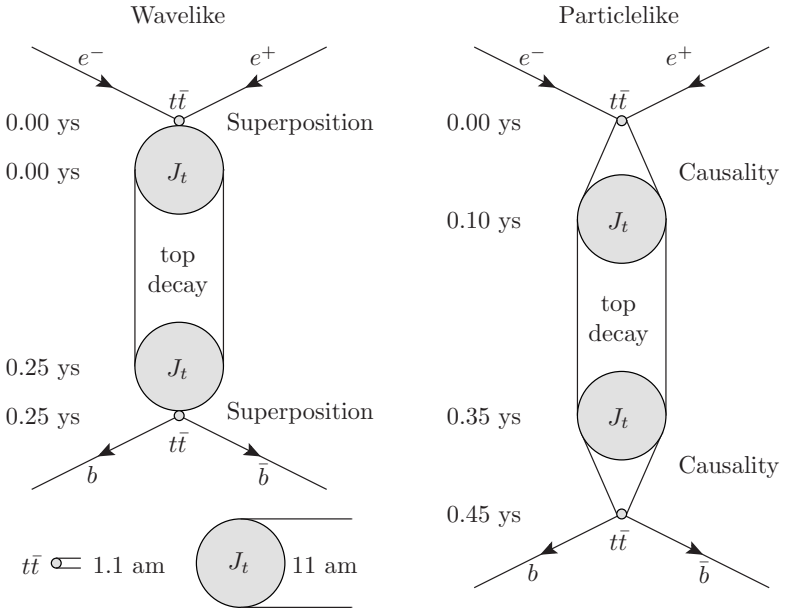
The load-bearing object is the ratio $R_b$, defined as the $e^+e^-\to b\bar{b}$ cross section divided by the sum over all light-quark flavors, measured at several center-of-mass energies around $\sqrt{s}=343$ GeV. The mechanism is the interference between the resonant toponium amplitudes $M(J_t(nS))\propto e^{-2At_n/\tau_t}$ and the nonresonant $\gamma/Z$ continuum. The formation time $t_n\simeq 9.81\,n^3\times 10^{-26}$ s comes from classical Coulomb motion under the QCD potential $V(r)=-\lambda/r$; the dimensionless multiplier $A$ encodes the quantum formation scenario ($A=0$ instantaneous vs $A\in[0.5,2]$ causal). The exponential factor is what makes the temporal dynamics visible: a longer causal delay suppresses the resonant peak, shifting $R_b$'s energy profile by an amount the top quark's own decay clock can time.
What would settle it
A CEPC or FCC-ee run with 1500 fb$^{-1}$ measuring $R_b$ at the three proposed energy points would settle the comparison: data lying on the $A=0$ curve within the quoted uncertainties would exclude the $A=0.5$ particlelike scenario at $6.1\sigma$, while data on the $A=0.5$ curve would exclude the wavelike scenario at $5.5\sigma$; a first-principles QCD calculation yielding a different functional form for the formation suppression would independently invalidate the test.
Extended reading notes
Core claim
The paper's central claim is that the time structure of toponium formation leaves a measurable imprint in the cross-section ratio $R_b$ near the $t\bar{t}$ threshold. In the wavelike scenario the resonance amplitude is unsuppressed ($A=0$); in the particlelike scenario the finite causal formation time $t_n \simeq 9.81\,n^3\times 10^{-26}$ s suppresses the amplitude by $e^{-2At_n/\tau_t}$ with $A\in[0.5,2]$. Because the top decay width $\tau_t=5.02\times 10^{-25}$ s is comparable to $t_n$, the suppression is neither negligible nor overwhelming. The paper computes $R_b$ for both cases, including interference with $\gamma$ and $Z$ continuum amplitudes, and shows that three energy points near $345$ GeV with a total of $1500$ fb$^{-1}$ at CEPC or FCC-ee give a $\chi^2$ separation of $6.1\sigma$ (wave true, particle false) or $5.5\sigma$ (particle true, wave false). It further notes that the LHC branching ratio $R^A_{ZH}$ for $\eta_t(nS)\to ZH$ offers a complementary $2$--$3\sigma$ discrimination, supporting the same conclusion.
Load-bearing premise
The load-bearing premise is that a single multiplier $A$ can represent the unknown quantum formation time, so that the resonance amplitude is suppressed by $e^{-2At_n/\tau_t}$; the paper concedes that a first-principles derivation of $A$ is still missing.
Editorial extensions
If this is right
- A 1500 fb$^{-1}$ CEPC/FCC-ee run at the three proposed energies will exclude the particlelike scenario with $A=0.5$ at $6.1\sigma$ if the wavelike scenario is true.
- The same run will exclude the wavelike scenario at $5.5\sigma$ if the particlelike scenario is true.
- The discrimination remains above $5\sigma$ under $1\sigma$ variations of $\lambda$ and $m_t$, and above $5.1\sigma$ even with the enlarged FCC-ee mass uncertainty.
- The LHC branching ratio $R^A_{ZH}$ for $\eta_t(nS)\to ZH$ gives an independent $2$--$3\sigma$ indication in favor of a causal formation delay.
- Larger values of $A$ produce stronger suppression of the resonant amplitude, so the experimental separation grows if the true formation time is longer than the minimal causal value.
Reading between the lines
- Because the paper tests only $A=0$ against $A=0.5$, a null result would not falsify causal formation generally; it would only rule out that particular parametrization, so the reach of the method depends on the prior range allowed for $A$.
- The $n^3$ scaling of $t_n$ suggests that measuring the excited $nS$ states, if their line shapes can be resolved, could map $A$ as a function of $n$ and test whether the exponential suppression is really linear in $t_n$.
- A confirmed particlelike signal would give a collider-scale handle on the time-energy relation for a quantum bound state, connecting this measurement to the broader program of quantum clocks and relativistic quantum information.
- Other short-lived resonances whose lifetime is comparable to their formation time could serve as analogous chronometers, generalizing the method beyond toponium.
Editorial analysis
A structured set of objections, weighed in public.
Referee Report
Summary. This paper considers two phenomenological descriptions of toponium formation at a future e+e- collider: a 'wavelike' scenario with instantaneous formation (A=0) and a 'particlelike' scenario with a finite causal formation time parametrized as t_n^Q = A t_n with A in [0.5,2]. The authors propose to distinguish them through the b-quark cross-section ratio R_b near sqrt(s)=343 GeV, using the top quark lifetime as a 'quantum chronometer.' They report simulated >5 sigma discrimination with 1500 fb^-1 at CEPC/FCC-ee by comparing A=0 with A=0.5, and quote 2-3 sigma support from LHC data through a branching-ratio estimate that assumes A=1. The paper concludes that colliders can resolve yoctosecond-scale quantum state formation.
Significance. If the two scenarios were derived from first principles, this would be a striking and novel proposal: the top quark's finite width does provide an internal clock, and the R_b interference observable is concrete and experimentally accessible. The paper deserves credit for specifying a pseudo-experimental procedure, giving an explicit uncertainty formula (Eq. (15)), and testing robustness against 1-sigma variations in lambda and m_t. However, the central claim is not self-contained. The 'particlelike' prediction is a one-parameter family with an undetermined multiplier A, and the quoted significance simply compares A=0 with a chosen A=0.5. The text concedes that a first-principles derivation of A is missing. As a result, the paper is best read as a sensitivity study for an ad hoc suppression factor, not as a demonstration that two physical scenarios can be distinguished. The LHC support is also not independently verifiable, since Ref. [21] is a placeholder preprint.
major comments (4)
- [Toponium formation, Eqs. (12)-(13)] The particlelike scenario is not uniquely defined. Equation (12) sets t_n^Q = A t_n with A in [0.5,2], and the amplitude suppression exp(-2 A t_n / tau_t) in Eq. (13) is posited rather than derived; the text states that 'a complete first-principles derivation of A remains elusive.' The predicted R_b profile depends exponentially on A, yet the lepton-collider projections use A=0.5 while the LHC projection uses A=1. The reported 6.1 sigma and 5.5 sigma exclusions are therefore point estimates for chosen parameter values, not predictions of the 'particlelike' scenario as a whole.
- [Collider probes, text after Eq. (17)] The paper is internally inconsistent about the range of A. It identifies the extreme light-speed limit as A=0.189, which lies outside the declared particlelike range [0.5,2]. With A=0.189, exp(-2 A t_1 / tau_t) is approximately 0.93, so the R_b suppression is much smaller than in the A=0.5 pseudo-experiments. Thus the claimed >5 sigma separation does not hold for the full set of causally allowed delays that the paper itself identifies; it holds only for the particular delay A=0.5.
- [Preliminary test at the LHC, Eqs. (19)-(20) and Ref. [21]] The LHC support is not independently checkable. Ref. [21] is a 'To be submitted' preprint with a placeholder arXiv number and no results shown, and the 2-3 sigma sensitivity estimate compares A=0 with A=1, another arbitrary choice. Even if the data exist, this does not constitute independent support for the framework outside the particular A value assumed.
- [Collider probes, Eq. (16)] The statistical procedure is not specified consistently. The chi-squared sum in Eq. (16) runs over i=1,2, but the pseudo-experiments described in the same section use three energy points, and the text assigns ndf=2. Since the quoted 6.1 sigma and 5.5 sigma significances come from this fit, the number of data points and the treatment of the mass constraint must be specified unambiguously.
minor comments (4)
- [Toponium formation, Eq. (13)] The suppression exponent in the amplitude is written as -2 A t_n / tau_t in Eq. (13), whereas the text after Eq. (12) says the amplitude is suppressed by exp(-A t_n / tau_t) and the cross section by exp(-2 A t_n / tau_t); please make the convention consistent.
- [References, Ref. [21]] Ref. [21] should be replaced by a complete citation or removed, since a 'To be submitted' placeholder with no arXiv number cannot be used to substantiate a quantitative claim.
- [Introduction, paragraph 3] The sentence beginning 'At ¯tpair is produced' is garbled and should be rewritten, for example as 'The t-bar-t pair is produced via a pointlike interaction.'
- [Abstract and Introduction] The statement that both descriptions are 'compatible with the principles of relativistic quantum field theory' is not supported by a derivation or by a reference; please either explain the claimed compatibility or soften the claim.
Circularity Check
The >5σ claim reduces to the chosen formation-time parameter A; the particlelike scenario has no unique prediction, and the 'independent' LHC support cites the authors' own unpublished paper.
-
self definitional
[Toponium formation, Eq. (12), and Collider probes, Eq. (13)]
"We parametrize the quantum formation time as t Q n =At n, where A= 0 (wavelike, instantaneous), ∈[0.5,2] (particlelike, causal). This modifies the amplitude by a factor e −Atn/τt, resulting in cross-section suppression by e−2Atn/τt. Although a complete first-principles derivation of A remains elusive, this parameterization allows for experimental discrimination between these different formation scenarios through measurable suppression in formation amplitudes."
The R_b difference is introduced by the exponential e^{-2At_n/τ_t}: the wave scenario is A=0 and the 'particlelike' scenario is an arbitrary A>0. The paper concedes no derivation of A, so the particlelike prediction is not a consequence of causality; it is the chosen value. The significance calculation sets A=0.5, while the paper's own light-speed estimate A=0.189 lies outside the declared [0.5,2] range and would nearly eliminate the difference. Therefore the claimed >5σ discrimination between instantaneous and causal formation is, by construction, a discrimination between the selected parameter values, not between the two physically motivated scenarios.
-
self citation load bearing
[Preliminary test at the LHC, Eqs. (18)-(20) and Ref. [21]]
"With approximately 3000 fb−1 of data expected to be collected at the LHC, this branching ratio difference could correspond to a potential 2–3σ level sensitivity [5, 21], offering preliminary evidence in favor of a causal formation delay."
Ref. [21] is listed as 'To be submitted' and its author list includes Yu-Jie Zhang, an author of this paper. The sentence presents [5, 21] as the basis for '2–3σ level sensitivity' and then calls it 'preliminary evidence' and 'independent support' in the abstract. Because the supporting estimate is an unpublished self-citation, the LHC corroboration is not independent evidence; it is the same group's own projection, so the load-bearing support for the LHC claim reduces to a self-citation.
full rationale
The paper's lepton-collider prediction is not self-contained as a scenario prediction: the 'particlelike' formation scenario is parametrized by A, and the R_b suppression is imposed as e^{-2At_n/τ_t} in Eq. (13). No first-principles derivation fixes A; the paper admits 'a complete first-principles derivation of A remains elusive.' The headline >5σ significance is computed for A=0.5 versus A=0, not for the full causal range [0.5,2], and the paper's own light-speed estimate A=0.189 would yield almost no suppression, so the claimed discrimination is an artifact of the chosen parameter value rather than a robust consequence of causality. The LHC corroboration is also weakened by self-citation: the '2–3σ level sensitivity' estimate relies on Ref. [21], an unpublished 'To be submitted' paper by the same authors, undermining the abstract's claim of independent LHC support. The underlying potential-model and R_b machinery from Refs. [4,9] are external and not themselves circular, but the paper's central scenario-discrimination claim reduces, by construction, to the choice of A. This warrants a score of 7.
Assumptions & free parameters
free parameters (1)
- A, quantum formation-time multiplier =
0 (wave), 0.5 (R_b baseline), 1 (LHC projection); range [0.5,2]
assumptions (7)
- domain assumption Coulomb-like QCD potential V(r) = -lambda/r with lambda = 0.309 +/- 0.010.
- domain assumption Nonrelativistic Hamiltonian with complex width (Eq. 3) governs toponium dynamics.
- domain assumption Initial state at creation is pointlike, psi(r,0-) ~ delta(r).
- standard math Completeness relation (Eq. 6) with continuum and non-S-wave contributions omitted is enough.
- domain assumption Classical trajectory equations (8)-(9) define the causal formation time t_n (Eq. 10).
- ad hoc to paper The quantum formation time is A*t_n and the resonant amplitude is suppressed by exp(-2 A t_n / tau_t).
- domain assumption The uncertainty model (Eq. 15) and mass priors (Eq. 16) from Ref [4] apply to pseudo-data.
Cite this review
Pith. "Pith review of Probing Yoctosecond Quantum Dynamics in Toponium Formation at Colliders." pith.science (2026). https://pith.science/paper/N5PUMGTM
@misc{pith2026250705703,
  author       = {Pith},
  title        = {Pith review of: Probing Yoctosecond Quantum Dynamics in Toponium Formation at Colliders},
  year         = {2026},
  howpublished = {\url{https://pith.science/paper/N5PUMGTM}},
  note         = {Machine review of arXiv:2507.05703}
}
abstract
The formation of toponium, a bound state of top and anti-top quarks, provides an unprecedented system for investigating quantum state dynamics at ultrashort timescales. We explore two distinct phenomenological descriptions of this process: a 'wavelike' scenario emphasizing the role of quantum superposition at creation, and a 'particlelike' scenario where a finite formation time is governed by relativistic causality. Both descriptions are compatible with the principles of relativistic quantum field theory. We propose to distinguish these scenarios by exploiting the top quark's intrinsic lifetime ($\tau_t \sim 5.02 \times 10^{-25}$\,s) as a quantum chronometer. We simulate the cross-section ratio $R_b = \sigma(e^+e^- \to b\bar{b})/\sum_q \sigma(e^+e^- \to q\bar{q})$ ($q = u,d,s,c,b$) near $\sqrt{s} = 343$\,GeV at future lepton colliders (CEPC/FCC-ee). These distinct scenarios yield observable $R_b$ profiles, enabling $>5\sigma$ discrimination with 1500\,fb$^{-1}$ of data. Preliminary LHC data provide independent $2$--$3\sigma$ support. This framework establishes a collider-based method to explore time-dependent quantum phenomena in particle production with yoctosecond ($10^{-24}$\,s) resolution.
Figures

Forward citations
Cited by 4 Pith papers
-
Phenomenology of Hypothetical Single-Top Hadronic States
QCD sum-rule calculations yield single-top baryon and meson masses near the top-quark mass, with a few channels slightly below the naive quark-sum threshold.
-
Triple top baryon $\Omega_{ttt}$
The triple-top baryon Ωttt is predicted to have mass 513.58 GeV, binding energy 4.13 GeV, and a dominant W+W+W+bbb decay, with production cross sections too small to observe at near-future colliders.
-
The S-wave topped meson
The first four S-wave t-bar-b and t-bar-c quasi-bound states are predicted roughly 5.1/5.4/5.6/5.7 GeV and 1.9/2.2/2.5/2.6 GeV above the top-quark mass.
-
Examining possible doubly topped baryon configurations
QCD sum rules give doubly topped baryon masses of 345-350 GeV, essentially the sums of the constituent quark masses, with no sign of genuine binding.
Reference graph
Works this paper leans on
-
[4]
Toponium: The smallest bound state and simplest hadron in quantum mechanics,
J.-H. Fu, Y.-J. Li, H.-M. Yang, Y.-B. Li, Y.-J. Zhang, and C.-P. Shen, “Toponium: The smallest bound state and simplest hadron in quantum mechanics,”Phys. Rev. D111no. 11, (2025) 114020,arXiv:2412.11254 [hep-ph]. [5]CMSCollaboration, A. Hayrapetyanet al., “Observation of a pseudoscalar excess at the top quark pair production threshold,”arXiv:2503.22382 [hep-ex]
arXiv 2025
-
[21]
Search for Toponium in ZH final state at LHC (To be submitted),
W.-Z. Li, L.-S. Tan, Y.-J. Li, J.-H. Fu, Y.-J. Zhang, T.-G. Cheng, C.-P. Shen, and L. Yuan, “Search for Toponium in ZH final state at LHC (To be submitted),”arXiv:250*.XXXXX (To be submitted) [hep-ex]
-
[1]
On the Einstein-Podolsky-Rosen paradox,
J. S. Bell, “On the Einstein-Podolsky-Rosen paradox,”Physics Physique Fizika1(1964) 195–200
work page 1964
-
[2]
Experimental test of Bell’s inequalities using time varying analyzers,
A. Aspect, J. Dalibard, and G. Roger, “Experimental test of Bell’s inequalities using time varying analyzers,”Phys. Rev. Lett.49(1982) 1804–1807. [3]A TLASCollaboration, G. Aadet al., “Observation of quantum entanglement with top quarks at the ATLAS detector,”Nature633no. 8030, (2024) 542–547,arXiv:2311.07288 [hep-ex]
arXiv 1982
-
[6]
Top-Quark Decay at Next-to-Next-to-Next-to-Leading Order in QCD,
L. Chen, X. Chen, X. Guan, and Y.-Q. Ma, “Top-Quark Decay at Next-to-Next-to-Next-to-Leading Order in QCD,”arXiv:2309.01937 [hep-ph]. [7]CEPC Study GroupCollaboration, W. Abdallahet al., “CEPC Technical Design Report: Accelerator,”Radiat. Detect. Technol. Methods8no. 1, (2024) 1–1105,arXiv:2312.14363 [physics.acc-ph]. [8]FCCCollaboration, A. Abadaet al., ...
arXiv 2024
-
[9]
Toponium: Implementation of a toponium model in FeynRules,
J.-H. Fu, Y.-J. Zhang, G.-Z. Xu, and K.-Y. Liu, “Toponium: Implementation of a toponium model in FeynRules,”arXiv:2504.12634 [hep-ph]
-
[10]
Study on Toponium: Spectrum and Associated Processes,
S.-J. Jiang, B.-Q. Li, G.-Z. Xu, and K.-Y. Liu, “Study on Toponium: Spectrum and Associated Processes,”arXiv:2412.18527 [hep-ph]
-
[11]
Top quark pair production near threshold,
Y. Sumino, K. Fujii, K. Hagiwara, H. Murayama, and C. K. Ng, “Top quark pair production near threshold,”Phys. Rev. D47(1993) 56–81
work page 1993
Show all 20 references
-
[12]
Top quark mass measurements at thet ¯tthreshold with CEPC,
Z. Li, X. Sun, Y. Fang, G. Li, S. Xin, S. Wang, Y. Wang, Y. Zhang, H. Zhang, and Z. Liang, “Top quark mass measurements at thet ¯tthreshold with CEPC,”Eur. Phys. J. C83no. 4, (2023) 269,arXiv:2207.12177 [hep-ex]. [Erratum: Eur.Phys.J.C 83, 501 (2023)]. 10
2023 arXiv
-
[13]
Analytic third-order QCD corrections to top-quark and semileptonic b→u decays,
L.-B. Chen, H. T. Li, Z. Li, J. Wang, Y. Wang, and Q.-f. Wu, “Analytic third-order QCD corrections to top-quark and semileptonic b→u decays,”Phys. Rev. D109no. 7, (2024) L071503,arXiv:2309.00762 [hep-ph]
2024 arXiv
-
[14]
P. A. M. Dirac,The principles of quantum mechanics. No. 27. Oxford university press, 1981
1981
-
[15]
Rigorous QCD analysis of inclusive annihilation and production of heavy quarkonium,
G. T. Bodwin, E. Braaten, and G. P. Lepage, “Rigorous QCD analysis of inclusive annihilation and production of heavy quarkonium,”Phys. Rev. D51(1995) 1125–1171, arXiv:hep-ph/9407339. [Erratum: Phys.Rev.D 55, 5853 (1997)]
1995 arXiv
-
[16]
Two topics in quantum chromodynamics,
J. D. Bjorken, “Two topics in quantum chromodynamics,” in1989 Cargese Summer Institute in Particle Physics. 11, 1989
1989
-
[17]
The Heavy top quark threshold: QCD and the Higgs,
M. J. Strassler and M. E. Peskin, “The Heavy top quark threshold: QCD and the Higgs,” Phys. Rev. D43(1991) 1500–1514
1991
-
[18]
Novel method for identifying the heaviest QED atom,
J.-H. Fu, S. Jia, X.-Y. Zhou, Y.-J. Zhang, C.-P. Shen, and C.-Z. Yuan, “Novel method for identifying the heaviest QED atom,”Sci. Bull.69(2024) 1386–1391,arXiv:2305.00171 [hep-ph]
2024 arXiv
-
[19]
Report of the Topical Group on Top quark physics and heavy flavor production for Snowmass 2021,
K. Agasheet al., “Report of the Topical Group on Top quark physics and heavy flavor production for Snowmass 2021,”arXiv:2209.11267 [hep-ph]
2021 arXiv
-
[20]
Measuring quantum discord at the LHC,
T. Han, M. Low, N. McGinnis, and S. Su, “Measuring quantum discord at the LHC,”JHEP 05(2025) 081,arXiv:2412.21158 [hep-ph]
2025 arXiv
-
[22]
How suppressed are the radiative interference effects in heavy instable particle production?,
V. S. Fadin, V. A. Khoze, and A. D. Martin, “How suppressed are the radiative interference effects in heavy instable particle production?,”Phys. Lett. B320(1994) 141–144, arXiv:hep-ph/9309234
1994 arXiv
-
[23]
Nonfactorizable photonic corrections to e+e− →W W→4 fermions,
A. Denner, S. Dittmaier, and M. Roth, “Nonfactorizable photonic corrections to e+e− →W W→4 fermions,”Nucl. Phys. B519(1998) 39–84,arXiv:hep-ph/9710521
1998 arXiv
-
[24]
This suppresses infrared and Coulomb divergences from soft gluon exchange [22, 23], rendering higher-order corrections negligible
This approximation is justified by the large top quark width Γ t = 1.31 GeV, which keeps its virtuality above √mtΓt. This suppresses infrared and Coulomb divergences from soft gluon exchange [22, 23], rendering higher-order corrections negligible. 11
Reviewed August 6, 2026 · model on record in the stance chip above.
Discussion (0). Sign in to comment.