REVIEW 4 major objections 6 minor 1 cited by
Psychometric Item Validation Using Virtual Respondents with Trait-Response Mediators
T0 review · 4 major / 6 minor · reviewed 2026-08-06 · deepseek-v4-flash
Pith's one-line read The paper claims that a mediator-guided LLM simulation can screen psychometric items so that the selected sets score in the top 1% (Big5) to top 13% (Schwartz and VIA) of all possible selections when validated against human responses.
desk verdict A solid, well-scoped framework for LLM-based item screening with a clever mediator idea, but the headline percentile claims rest on a small human benchmark and a selection-on-the-same-benchmark design. read the letter →
The pith
A machine-rendered reading of the paper's core claim, the machinery that carries it, and where it could break.
The reading
What carries the argument
The load-bearing mechanism is the mediator-guided simulation prompt, which gives each virtual respondent four ingredients: an opening sentence fixing the target trait at a high level ('I highly value {trait}') with its definition, a persona profile sampled from the Persona-Chat dataset, a single generated mediator sentence inserted into that profile, and the survey item with answer choices and instructions. The mediator is the new ingredient — it tells the LLM why a person high in the trait might answer a particular item in a non-obvious way, exposing items whose validity depends on an unstated default context. The ranking metric is convergent validity, the Spearman correlation across virtual respondents between an item's answers (inverted for negatively keyed items) and the official-item trait score; growing the virtual panel from 50 to 500 respondents raises the selected set's human-evaluated quality. Five mediator generation strategies are compared — free generation from trait definitions, generation guided by the five CAPS categories, generation from candidate items, extraction of conflicting World Values Survey items, and sampling real human demographics — with trait-definition-only generation performing best.
What would settle it
A decisive replication would apply the framework to a trait theory outside the tested three (or to the same theories in a new language) and compare mediator-selected item sets against a human sample of several hundred respondents per item rather than about 77; the claim fails if the selected sets no longer beat random selection (roughly the 50th percentile) or fail to beat the no-mediator baseline. A cheaper check on the released dataset is to correlate each item's simulated convergent validity with its human convergent validity — a near-zero per-item correlation would mean the top-percentile result rests on shared LLM variance rather than transferable item quality.
Extended reading notes
Core claim
The central claim, stated on the paper's own terms, is that construct validity can be assessed without human respondents by simulating virtual respondents whose persona profiles are augmented with trait-response mediators. A mediator is a factor through which the same trait can yield varying responses to the same item — for example, an extravert who already has many friends may answer 'I like attending social events' with a low score — and the authors take this notion from the cognitive-affective personality system (CAPS) theory, extending it from situations to traits. Starting from an item pool four times the size of each official survey, the framework generates mediators by several strategies, runs every item through 500 mediator-integrated virtual respondents, and ranks items by convergent validity: the Spearman correlation between an item's simulated answers and the respondent's simulated official-item trait score. The ground-truth quality of each item is measured the same way from about 77 human respondents per survey, and the best mediator strategy selected item sets ranking in the top 1% (Big5) to the top 13% (Schwartz and VIA) of the empirical distribution of all possible $N$-item selections, while consistently beating a no-mediator ablation and an LLM-as-a-judge baseline on ranking accuracy. The authors explicitly disclaim that the simulation replicates human psychological processes; their claim is narrower — that mediator-guided correlations pick out items that human respondents also find valid.
Load-bearing premise
The framework assumes that an item's convergent validity computed from LLM responses — where the same LLM supplies both the item answer and the official-item trait score — carries over to the item's convergent validity with real human respondents, and this transfer is checked against only about 77 human respondents per survey, so the benchmark itself carries sampling noise.
Editorial extensions
If this is right
- Survey development cost drops sharply: screening an item pool becomes an API call, with expensive human panels reserved for final confirmation rather than initial validation.
- Mediators are the active ingredient: removing them (the no-mediator baseline) consistently lowers selected-set quality, and real human demographics as mediators underperform LLM-generated ones, consistent with earlier findings that demographic personas alone fail psychometric simulation.
- Scale matters: increasing the number of virtual respondents from 50 to 500 improves both the convergent validity and the internal consistency of the selected items, mirroring the value of larger human samples.
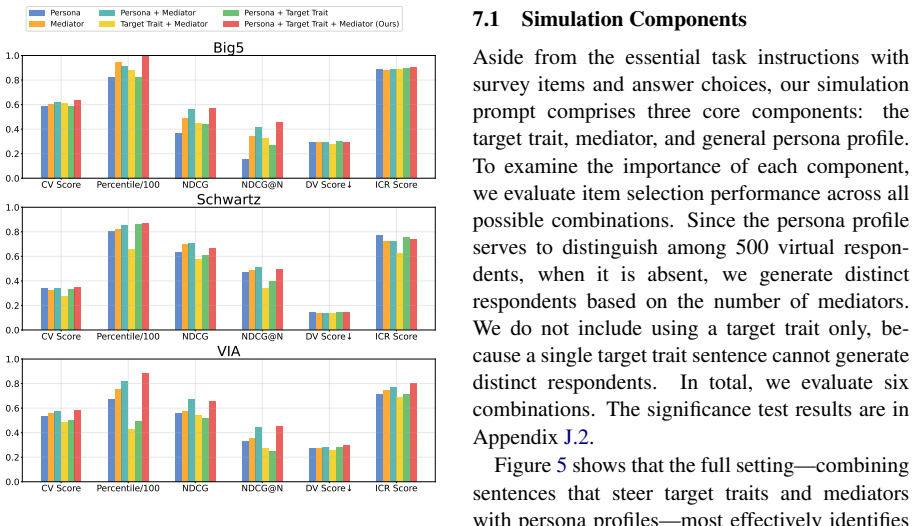
- The framework is portable across models: similar selection quality is achieved with GPT-4.1-mini, GPT-4.1-nano, LLaMA-4-Scout, and LLaMA-3.3-70B, and free-form mediator generation from trait definitions works for three different psychological theories.
- The released dataset — generated items plus human and LLM responses for Big5, Schwartz, and VIA — provides a benchmark for future automated item-validation methods.
Reading between the lines
- Editorial inference: if the simulated-to-human transfer of validity survives a large-sample replication, the same screening could extend to domains the paper did not test — emotion, cognition, and clinical scales with existing official items — and the authors themselves flag English-only items and the absence of cross-cultural validation as open limits.
- Editorial inference: because each virtual respondent supplies both the item answer and the official-item trait score, part of the reported ranking power could reflect the LLM's internal consistency rather than true trait measurement; human-transfer of the ranking is the unproven link until independent validation samples confirm it.
- Editorial inference: the framework's dependence on official items confines its demonstrated value to survey refinement and shortening; a de novo route would require factor analysis over simulated response matrices, which the authors mention as a possibility but do not demonstrate.
- Editorial inference: the paper's own significance tests find the Schwartz results statistically unstable, which the authors attribute to the circular structure of values; a natural boundary test is whether closely related trait batteries are systematically harder to rank, which would delimit the method's scope.
Editorial analysis
A structured set of objections, weighed in public.
Referee Report
Summary. The paper proposes a framework for validating psychometric survey items without large human panels: LLM-based virtual respondents, prompted with a target trait, a randomly inserted 'mediator' (a characteristic that can decouple trait from behavior), and a persona profile, respond to both candidate and official items; items are then ranked by convergent validity, defined as the Spearman correlation between item responses and official-item trait scores computed across 500 virtual respondents. The authors evaluate the resulting item rankings against a human benchmark of roughly 77 respondents per survey across three trait theories (Big5, Schwartz, VIA), reporting that the best mediator strategy selects sets in the top 1% (Big5) to 13% (Schwartz, VIA) of all possible selections, and that mediator guidance outperforms random ordering, LLM-as-a-judge, and no-mediator baselines, with ablations over simulation components, simulation scale, and simulation LLM. The manuscript also releases the item pools with human and LLM responses, and includes significance testing, discriminant-validity checks, and item-pool-scale ablations in the appendices.
Significance. If the headline claims survive proper uncertainty quantification, this is a genuinely useful step: it defines a concrete item-validation task with psychometric metrics, grounds the mediator idea in CAPS theory, and evaluates against real human responses rather than only LLM-internal reliability, which is the right benchmark. The public release of the item pools with human and LLM responses is a valuable benchmark asset, and the ablations (Appendix J significance tests, Appendix K maximum-DV analysis, Appendix L item-scale robustness, and Section 7.3 cross-LLM consistency) are unusually thorough for an NLP submission. The main risk is that the central quantitative claims currently rest on a small human sample without respondent-level resampling and on best-method selection within that same sample; both are fixable with the data already collected. The paper is honest in its Limitations section about several scope restrictions, although not about the benchmark-size and selection issues.
major comments (4)
- [§6.1, Table 4, §3.6, Appendix J.1] The headline claims — 'top 1% (Big5) to 13% (Schwartz and VIA)' — are point estimates computed against human convergent validity measured with roughly 77 respondents per survey (§3.6). For item-level Spearman correlations with N≈77, the standard error is approximately 0.11, so the between-method gaps in Table 4 (e.g., 0.632 vs. 0.626 vs. 0.585 for Trait (Free), Trait+Item, and No-Mediator in Big5) are within the noise floor of the benchmark. The significance tests in Appendix J.1 resample the initial item pool 1,000 times while holding the human CV of each item fixed, so they quantify variance due to pool composition, not the sampling variance of the human benchmark. Without a bootstrap over human respondents (resampling the 75–80 participants per survey and recomputing item CVs, the selected-set CV, and its percentile), the top-1%/13% figures have no stated uncertainty. This is load-bearing because the paper's central claim is precisely that mediator-guided simulation selects item sets with near-optimal human convergent validity; the required analysis is feasible with the data already collected.
- [§6, Table 4, Appendix C] The best mediator strategy (Trait (Free) for Big5 and VIA, Trait (CAPS) for Schwartz) and the high-trait-level prompt setting (Appendix C, Table 5) were both chosen on the same human benchmark that defines the headline percentiles. The abstract's 'top 1% to 13%' is therefore a best-of-several-comparisons point estimate and is optimistically biased as a statement about the framework. This matters empirically: for Schwartz, Trait (CAPS) at 87.1 is effectively tied with LLM-Judge (86.8) and No-Mediator (86.3), and Appendix J.1 reports that Schwartz comparisons are unstable. Please report the percentile for a pre-specified method (e.g., Trait (Free)) across all three surveys, and also report the distribution of the best-of-seven percentile under the human-sample bootstrap, so that the selection effect is explicit.
- [§3.4–§3.6, Eq. (2)] The transfer premise is the load-bearing assumption: the virtual CV in Eq. (2) is a conditional correlation, because every virtual respondent is prompted with 'I highly value {trait}', whereas the human CV it is compared against is a marginal correlation over the natural variation of trait levels in the human sample. These need not rank items identically (items that discriminate at low trait levels will be undervalued by the simulation), and the paper provides no theoretical bridge. Because both the item response and the official-item trait score come from the same LLM and the same prompt structure, the virtual CV also partly rewards LLM-internal consistency rather than a human-generalizable property. The only empirical bridge is the small human benchmark, so the manuscript should (a) report the item-level agreement between virtual and human CV (e.g., the Spearman correlation between the two CV vectors over the item pool, per theory, with bootstrap CIs) and (b) state the conditional-versus-marginal limitation in the main text rather than only in the general caveats of Section 9.
- [Appendix F, Eqs. (6)–(7)] The NDCG definition uses the item's CV-based rank as the relevance grade and an exponential gain 2^{rel_i}. With per-trait pools of 40 items (Big5) or 16 items (Schwartz, VIA), the first-ranked item contributes on the order of 2^M to DCG, which dwarfs all other positions; NDCG and NDCG@N in Table 4 are therefore effectively driven by whether the single top-ranked item coincides with the human-CV top item, and the reported values are not comparable to standard NDCG, nor across surveys with different M. Please switch to graded or binary relevance with a standard gain function (or justify the exponential choice) and re-report the ranking columns. This does not affect the percentile-based conclusion from the first major comment, but it does undercut the 'ranking accuracy' comparisons in Section 6.1.
minor comments (6)
- [Figure 3] Figure 3 contains a truncated label ('T ask instruction wit') and a non-grammatical persona sentence ('I have went to school for dance'); please fix these artifacts before publication.
- [§3.4] The trait induction phrase 'I highly value {trait}' is semantically strained for negatively-valenced Big5 traits such as Neuroticism; the paper should clarify how the LLM's interpretation of 'valuing' a trait is intended to map to possessing it, since this is part of the transfer premise discussed in the third major comment.
- [Appendix F] Because the per-trait pool size M differs across theories (40 for Big5 versus 16 for Schwartz and VIA), the reported NDCG values are not comparable across the three surveys even after fixing the gain function; this should either be justified or the cross-survey comparisons should be dropped.
- [Section 9 (Limitations)] The Limitations section is candid about the LLM-human gap and the need for human inspection, but it does not mention the small human benchmark (N≈77), the selection of the best mediator strategy and trait level on that same benchmark, or the absence of human-level resampling; these should be acknowledged explicitly.
- [Table 4] The 'Official' row would be easier to interpret if the paper stated explicitly that official items lie outside the candidate pool, so percentile and NDCG are undefined for them; currently the '-' entries require inference.
- [§5.2] The LLM-as-a-judge baseline averages three criteria (convergent validity, discriminant validity, test-retest reliability) into a single score, but the individual scores are not reported; the equal weighting and the combination of psychometric criteria should be justified.
Circularity Check
No circular derivation: the virtual CV ranking is tested against an independent human benchmark; the same-LLM source of trait scores and the on-benchmark strategy selection are external-validity limitations, not definitional loops.
full rationale
The paper's central claim is that mediator-guided simulation ranks generated items by construct validity, and this ranking is evaluated against real human responses. The virtual convergent validity in Eq. (2) is computed as the Spearman correlation between a generated item response and an average of official-item responses, both obtained from the same LLM virtual respondent. This is an internal-consistency proxy, but it is not the target of the paper's prediction: the paper does not assert that virtual CV is human CV. The reported percentiles are computed from human responses collected in Section 3.6 and analyzed in Section 6, which is an independent external benchmark, and no parameter is fitted to those human responses. The choices of Trait (Free) for Big5 and VIA and Trait (CAPS) for Schwartz were made based on the same human benchmark, and the high trait level was likewise selected using that benchmark; this can inflate point estimates and is a statistical limitation, but it does not make the derivation circular because the framework itself does not use human data to rank items. Appendix J's significance tests resample the item pool while holding human CV estimates fixed, so human-level sampling noise remains unquantified, but that is a robustness concern rather than a circularity concern. The only self-citation (Han et al., 2025) appears in related work and is not load-bearing, and no uniqueness theorem is imported from the authors' prior work. Overall, no step in the claimed derivation reduces by construction to its own inputs.
Assumptions & free parameters
free parameters (3)
- Trait level setting =
High ("I highly value {trait}")
- Item pool scale =
4x official items
- Number of virtual respondents =
500
assumptions (4)
- ad hoc to paper Traits translate to behavior through mediators (extension of CAPS theory)
- domain assumption Human convergent validity computed from official items is the gold standard
- domain assumption LLM-simulated responses can proxy human respondents for item validation
- standard math Spearman correlation between item response and trait score measures convergent validity
Cite this review
Pith. "Pith review of Psychometric Item Validation Using Virtual Respondents with Trait-Response Mediators." pith.science (2026). https://pith.science/paper/YGAAKWAP
@misc{pith2026250705890,
  author       = {Pith},
  title        = {Pith review of: Psychometric Item Validation Using Virtual Respondents with Trait-Response Mediators},
  year         = {2026},
  howpublished = {\url{https://pith.science/paper/YGAAKWAP}},
  note         = {Machine review of arXiv:2507.05890}
}
read the original abstract
As psychometric surveys are increasingly used to assess the traits of large language models (LLMs), the need for scalable survey item generation suited for LLMs has also grown. A critical challenge here is ensuring the construct validity of generated items, i.e., whether they truly measure the intended trait. Traditionally, this requires costly, large-scale human data collection. To make it efficient, we present a framework for virtual respondent simulation using LLMs. Our central idea is to account for mediators: factors through which the same trait can give rise to varying responses to a survey item. By simulating respondents with diverse mediators, we identify survey items that yield responses robustly correlated with intended traits across these mediators. Experiments on three psychological trait theories (Big5, Schwartz, VIA) show that our mediator generation methods and simulation framework effectively identify high-validity items. LLMs demonstrate the ability to generate plausible mediators from trait definitions and to simulate respondent behavior for item validation. Our problem formulation, metrics, methodology, and dataset open a new direction for cost-efficient survey development and a deeper understanding of how LLMs simulate human survey responses. We release our dataset and code to support future work.
Figures


Figures from the paper (6 more)



Forward citations
Cited by 1 Pith paper
-
Quantifying Data Contamination in Psychometric Evaluations of LLMs
Across 21 LLMs and four standard psychology questionnaires, models recognize the items, know which trait each item measures, and can choose responses to hit a specified target score.
Reference graph
Works this paper leans on
-
[1]
Validity a) Convergent validity - the degree to which the item accurately measures the target trait. b) Discriminant validity - the degree to which the item does not substantially measure traits other than the target trait
-
[2]
In CEUR Workshop Proceedings, volume 3810, pages 59–73
The creative psychometric item gen- erator: A framework for item generation and validation using large language models. In CEUR Workshop Proceedings, volume 3810, pages 59–73. CEUR-WS. Seungbeen Lee, Seungwon Lim, Seungju Han, Giyeong Oh, Hyungjoo Chae, Jiwan Chung, Minju Kim, Beong-woo Kwak, Yeonsoo Lee, Dongha Lee, Jinyoung Yeo, and Youngjae Yu
-
[6]
Reliability a) Test-retest reliability - the degree of consistency in responses when the item is administered to the same individual at different times. <Response format> (Use a 1–100 scale, where 1 = very poor and 100 = excellent.): Convergent validity: [score 1-100] Discriminant validity: [score 1-100] Test-retest reliability: [score 1-100] Explanation:...
work page 2012
-
[2018]
Personalizing Dialogue Agents: I have a dog, do you have pets too? InProceedings of the 56th Annual Meeting of the Association for Computational Linguistics (Volume 1: Long Pa- pers), pages 2204–2213, Melbourne, Australia. Association for Computational Linguistics. Appendix A Survey Information and Dimensions of Traits The full lists of traits correspondi...
work page 1992
-
[2024]
Jongwook Han, Dongmin Choi, Woojung Song, Eun-Ju Lee, and Yohan Jo
Assessing the Alignment of Large Lan- guage Models With Human Values for Mental Health Integration: Cross-Sectional Study Us- ing Schwartz’s Theory of Basic Values.JMIR Mental Health. Jongwook Han, Dongmin Choi, Woojung Song, Eun-Ju Lee, and Yohan Jo. 2025. Value Portrait: Assessing Language Models’ Val- ues through Psychometrically and Ecologically Valid...
work page 2025
-
[2025]
Do LLMs have distinct and consis- tent personality? TRAIT: Personality testset designed for LLMs with psychometrics. In Findings of the Association for Computational Linguistics: NAACL 2025, pages 8412–8452, Albuquerque, New Mexico. Association for Computational Linguistics. Marjaana Lindeman and Markku Verkasalo. 2005. Measuring Values With the Short Sch...
arXiv 2025
Reviewed August 6, 2026 · model on record in the stance chip above.
Discussion (0). Sign in to comment.