REVIEW 4 major objections 5 minor 37 references
Universal Embeddings of Tabular Data
T0 review · 4 major / 5 minor · reviewed 2026-08-06 · deepseek-v4-flash
Pith's one-line read A graph auto-encoder creates task-independent row embeddings for tables that outperform the leading task-free baseline at low dimensions.
desk verdict A useful, clearly-presented idea for task-independent tabular embeddings, but the headline superiority claim is under-evidenced and the graph-reduction equivalence is unproven. read the letter →
The pith
A machine-rendered reading of the paper's core claim, the machinery that carries it, and where it could break.
The reading
What carries the argument
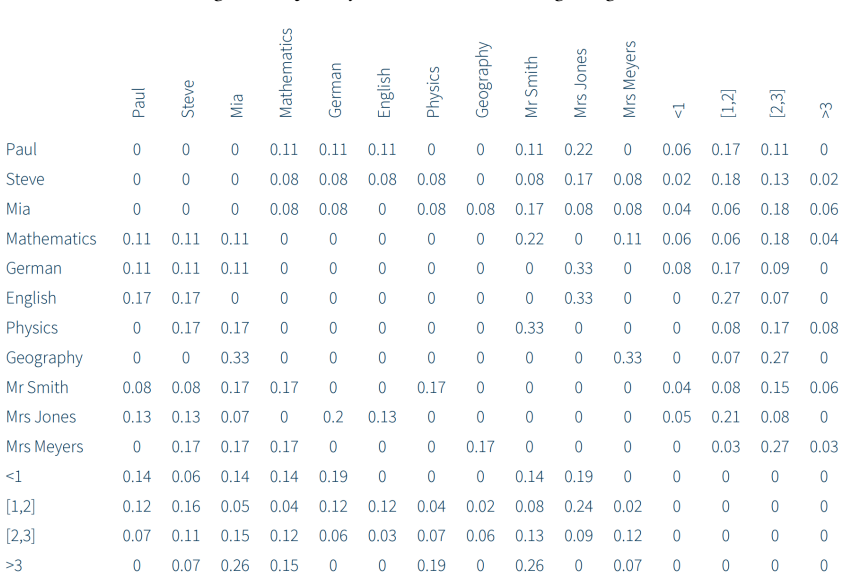
The load-bearing object is the reduced edge-weighted entity graph and its transition matrix. Removing row nodes and linking entities by products of the original edge weights is asserted to preserve the dynamics of random walks, so the reduced graph is meant to carry the same structure as the table. The graph auto-encoder reconstructs this weighted transition matrix with a combined $\ell^2$ and $\ell^1$ loss, forcing the entity embeddings to encode both the presence and the strength of entity co-occurrence. Row embeddings are then computed as weighted means of the entity embeddings of a row's entities, which is what makes unseen rows embeddable without retraining.
What would settle it
Compute the one-step transition matrix of the reduced entity graph and the two-step transition matrix of the original bipartite graph on the same set of entity nodes, and check whether the two matrices agree on any nontrivial table; the paper's stated random-walk equivalence predicts they should. A concrete version is to train embeddings on both graphs for the same table and compare the nearest-neighbor structure of the resulting row embeddings.
Extended reading notes
Core claim
The central claim is that task-independent row embeddings can be learned by reconstructing a weighted entity graph rather than by training on a supervised objective. Starting from a bipartite graph of rows and entities, the paper removes row nodes and links entities with edge weights equal to summed products of the old row-entity weights, then uses a graph auto-encoder to recover the resulting transition matrix. The entity embeddings produced by the encoder are aggregated with the same weights to form row embeddings. On the Titanic survival task and the Rossmann sales regression task, the authors report that their embeddings perform comparably to the sentence-based universal embedding baseline for large dimensions and clearly outperform it for small dimensions, which is the property that matters for storing embeddings in a vector database.
Load-bearing premise
The reduction that deletes row nodes and multiplies edge weights must preserve the structure of the original table, and the paper asserts this equivalence of random-walk dynamics without a proof; if the reduced graph loses or distorts co-occurrence information, the entity and row embeddings inherit that distortion.
Editorial extensions
If this is right
- Rows containing only previously seen entities can be embedded by weighted averaging at test time, with no additional training.
- Vector databases can use smaller embedding dimensions, cutting storage and construction cost, since $d=15$ already reaches the performance the baseline gets at $d=30$ on the Rossmann set.
- One cached embedding supports classification, regression, and outlier detection through distance-based nearest-neighbor search, without a task-specific model.
- Numerical columns are encoded by bin membership plus the value's position inside the bin, so ordering information is kept rather than discarded.
- Information from several connected tables can be combined either by building one common entity graph or by merging separately trained embeddings.
Reading between the lines
- The authors do not test it, but the same machinery suggests an incremental service for database updates: when a new row contains only known entities, its embedding is a lookup-and-average operation, so embeddings can be kept current without retraining.
- A testable extension is outlier detection: rows with unusual entity combinations should have large distance to their k nearest neighbors in the embedding space; if this flagging works without any task-specific training, it would be independent evidence that the reduced graph preserved table structure.
- If the row-node reduction turns out to be lossy, an alternative is to train the graph auto-encoder directly on the bipartite graph and accept larger graphs, trading memory for exact walk probabilities; the paper does not compare these two regimes.
- For multi-table databases, merging separately trained embeddings would allow late-arriving tables to refine earlier embeddings, which the paper mentions as desirable but does not evaluate.
Editorial analysis
A structured set of objections, weighed in public.
Referee Report
Summary. The paper proposes a two-step framework for task-independent ('universal') embeddings of tabular data. A table is first converted into a bipartite graph with row nodes and entity nodes (categorical values and numerical bins), with edge weights encoding the position of numerical values inside bins. The row nodes are then removed, creating a weighted entity graph whose edge weights are products of the original row-entity weights. A graph auto-encoder (GAE) with a weighted reconstruction loss is trained on the associated matrix, producing entity embeddings; row embeddings are obtained by averaging the entity embeddings of the entities appearing in each row, weighted by edge weights. The authors evaluate the embeddings on Kaggle Titanic (classification, AUC) and Rossmann Store Sales (regression, RMSPE), comparing against a word2vec-based 'EmbDI-related' baseline, and report that their method performs comparably at large dimensions and outperforms the baseline at low dimensions, e.g., d=15 versus d=30 for Rossmann.
Significance. If the central claims hold, the framework is a useful contribution to task-agnostic tabular representation learning: it provides cached entity and row embeddings that can serve multiple downstream tasks without retraining, naturally handles unseen rows containing known entities, and avoids target leakage because the embedding stage never sees the target column. The paper also usefully distinguishes 'universal embeddings' from 'universal predictors' such as tabular foundation models. That said, the significance is currently limited by the evidence: only two datasets are tested, the only baseline is a self-described analogue of EmbDI rather than the published algorithm, no variance or exact numerical results are reported, and the key graph-reduction claim is unproven. The core idea is plausible and the limitations section acknowledges the narrow experimental scope, but the paper's headline superiority claim is not yet established.
major comments (4)
- [Section 3.2] The sentence 'Due to the edge weights, the dynamics of random walks on this reduced graph remain the same as on the original graph' is stated without proof and is not true under the row-normalized transition matrix defined in Section 3.3. On the original bipartite graph, a two-step transition from entity a to entity b via row r has probability proportional to w_ar * w_rb / (deg(a) * deg(r)), with a row-degree factor deg(r) that is lost in the reduced graph, where the direct transition probability is proportional to (sum_r w_ar * w_rb) / deg_reduced(a). Please provide a precise proof for the specific normalization used, or state a different notion of 'same dynamics' and verify it empirically. This is load-bearing because the entity embeddings learned from the reduced graph are supposed to represent the original table structure faithfully.
- [Section 4 (Figures 7 and 9); Section 5] The comparison baseline is not the published EmbDI algorithm. The text says the authors 'constructed a word2vec embedding of the entities based on 1,000,000 sentences built on the graph in analogy to the EmbDI algorithm,' but EmbDI builds sentences on the full heterogeneous graph containing row and attribute nodes, not on the reduced entity-only graph used here. The central low-dimensional advantage (e.g., 'd = 15 is sufficient ... whereas EmbDI requires d = 30') may therefore be an artifact of the reimplementation. Please compare against the official EmbDI implementation, or provide the complete reimplementation details and code, and report exact AUC/RMSPE values together with variance over repeated runs; the current figures show only qualitative curves without numerical values or error bars.
- [Section 4.2 and Section 5] The embedding dimension appears to be selected on the test set. The paper sweeps d and then highlights the dimension at which the proposed method matches or beats the baseline (d=15 versus d=30 for Rossmann), but no held-out validation set is used for this selection, and the hyperparameters are described as 'adapted and optimized for each dataset' without a specified protocol. This makes the performance comparison optimistically biased. Please specify a validation-based selection protocol, or report results for all dimensions without selection and include confidence intervals.
- [Section 3.4, Eqs. (2) and (3)] If T in Eq. (3) is the row-wise normalized transition matrix defined in Section 3.3, then T is generally asymmetric, whereas the GAE decoder \hat A = \sigma(ZZ^T) is symmetric by construction; the reconstruction objective is then misspecified. Please clarify whether T is the weighted adjacency matrix or the transition matrix, and if it is the transition matrix, use an asymmetric decoder or an appropriately modified loss. The current notation in Algorithm 1 and Section 3.3 does not resolve this ambiguity.
minor comments (5)
- [Section 3.6, Eq. (4)] The inverse-distance weighting in Eq. (4) divides by \|v_i - v_l\|_2, which is undefined when a training row and a test row have identical embeddings; please add a small epsilon or a tie-handling rule.
- [Figures 7 and 9] Please add numeric axis annotations or a companion table with the exact AUC/RMSPE values for each embedding dimension, and indicate whether the plotted curves are single runs or averages over multiple runs.
- [Section 4.1] The exclusion of PassengerID and Name is justified by their uniqueness, but 'unique entries ... do not provide further information regarding similarity' is a modeling choice rather than a general property; a brief discussion of when ID-like columns should be retained would be helpful.
- [Section 2] The bibliography is extensive, but the claim that tree-based and attention-based models 'do not output reusable embeddings' should be softened, since several transformer-based tabular models do produce intermediate representations even if they are not the paper's intended use case.
- [Section 4] The description of GAE training mentions a maximal gradient norm of 1e-6 and a stopping rule based on relative loss improvement, but no sensitivity analysis or rationale is provided; a short discussion or reference would improve reproducibility.
Circularity Check
No significant circularity: the embedding construction is task-independent and the evaluation pipeline is separate from the training objective.
full rationale
The paper constructs embeddings by building a graph from table entities, reducing row nodes, forming a weighted transition matrix, training a graph auto-encoder to reconstruct that matrix, and aggregating entity embeddings into row embeddings. Nowhere does the training objective use the downstream target column; the target is only used in the separate k-NN evaluation described in Section 3.6. Thus the central claim of universal, task-independent embeddings is not obtained by fitting the evaluation metric. The comparison to EmbDI uses an external baseline and is not a self-citation; none of the references are to the authors' own prior work. The assertion in Section 3.2 that random-walk dynamics are preserved by the graph reduction is unproven and could be a correctness risk, but it is not circular: it is a structural claim about the graph, not a claim that derives its conclusion from its own definition. The choice of embedding dimension and hyperparameters is an experimental-design concern about test-set selection, not a case where a fitted parameter is renamed as a prediction. No equation is shown to be equivalent to its input by construction, and no load-bearing step reduces to a self-citation chain. The manuscript itself acknowledges the limited scope of the evaluation in its limitations paragraph, which further supports that the empirical comparison is preliminary rather than circular.
Assumptions & free parameters
free parameters (5)
- Embedding dimension d =
Varied in experiments; d=15 highlighted for Rossmann
- Number of bins per numerical column =
Titanic: 20 bins for Age/Fare, 1 per distinct for SibSp/Parch; Rossmann: 50 for Date, 1 per distinct for DayOfWeek
- Loss weight alpha =
0
- k in k-NN evaluation =
Not reported
- GAE hyperparameters =
Learning rate 0.01, max gradient norm 1e-6, stop criterion 0.1% per 10,000 epochs
assumptions (4)
- ad hoc to paper The reduced entity graph preserves the random walk dynamics of the original bipartite graph
- domain assumption Euclidean distance in the row embedding space reflects task-relevant similarity
- domain assumption GAE reconstruction of the weighted graph yields embeddings useful for arbitrary downstream targets not used in training
- domain assumption Unseen rows can be embedded by averaging embeddings of known entities
Cite this review
Pith. "Pith review of Universal Embeddings of Tabular Data." pith.science (2026). https://pith.science/paper/VV6UNGCC
@misc{pith2026250705904,
  author       = {Pith},
  title        = {Pith review of: Universal Embeddings of Tabular Data},
  year         = {2026},
  howpublished = {\url{https://pith.science/paper/VV6UNGCC}},
  note         = {Machine review of arXiv:2507.05904}
}
read the original abstract
Tabular data in relational databases represents a significant portion of industrial data. Hence, analyzing and interpreting tabular data is of utmost importance. Application tasks on tabular data are manifold and are often not specified when setting up an industrial database. To address this, we present a novel framework for generating universal, i.e., task-independent embeddings of tabular data for performing downstream tasks without predefined targets. Our method transforms tabular data into a graph structure, leverages Graph Auto-Encoders to create entity embeddings, which are subsequently aggregated to obtain embeddings for each table row, i.e., each data sample. This two-step approach has the advantage that unseen samples, consisting of similar entities, can be embedded without additional training. Downstream tasks such as regression, classification or outlier detection, can then be performed by applying a distance-based similarity measure in the embedding space. Experiments on real-world datasets demonstrate that our method achieves superior performance compared to existing universal tabular data embedding techniques.
Figures


Figures from the paper (5 more)



Reference graph
Works this paper leans on
-
[1]
Sercan Ö. Arik and Tomas Pfister. 2021. TabNet: Attentive Interpretable Tabular Learning. Proceedings of the AAAI Conference on Artificial Intelligence 35, 8 (2021), 6679–6687. https://doi.org/10.1609/aaai.v35i8.16826
-
[2]
Vadim Borisov, Tobias Leemann, Kathrin Seßler, Johannes Haug, Martin Pawel- czyk, and Gjergji Kasneci. 2024. Deep Neural Networks and Tabular Data: A Survey. IEEE Transactions on Neural Networks and Learning Systems 35, 6 (2024), 7499–7519. https://doi.org/10.1109/TNNLS.2022.3229161
arXiv 2024
-
[3]
Riccardo Cappuzzo, Paolo Papotti, and Saravanan Thirumuruganathan. 2020. Creating Embeddings of Heterogeneous Relational Datasets for Data Integration Tasks. In ACM SIGMOD/PODS Conference. 1335–1349. https://doi.org/10.1145/ 3318464.3389742
arXiv 2020
-
[4]
Tianqi Chen and Carlos Guestrin. 2016. XGBoost: A Scalable Tree Boosting System. In Proceedings of the 22nd ACM SIGKDD International Conference on Knowledge Discovery and Data Mining (San Francisco, California, USA) (KDD ’16). Association for Computing Machinery, New York, NY, USA, 785–794. https: //doi.org/10.1145/2939672.2939785
arXiv 2016
-
[5]
Andrei Chernov. 2025. (GG) MoE vs. MLP on Tabular Data. https://arxiv.org/ abs/2502.03608
work page Pith review arXiv 2025
-
[6]
Tianji Cong, Madelon Hulsebos, Zhenjie Sun, Paul Groth, and H. V. Jagadish
-
[7]
Will Cukierski. 2012. Titanic - Machine Learning from Disaster. https://www. kaggle.com/competitions/titanic
work page 2012
-
[8]
Xiang Deng, Huan Sun, Alyssa Lees, You Wu, and Cong Yu. 2020. TURL: table understanding through representation learning. Proc. VLDB Endow. 14, 3 (Nov. 2020), 307–319. https://doi.org/10.14778/3430915.3430921
arXiv 2020
Show all 37 references
-
[9]
Yury Gorishniy, Akim Kotelnikov, and Artem Babenko. 2025. TabM: Advancing tabular deep learning with parameter-efficient ensembling. In The Thirteenth International Conference on Learning Representations . https://openreview.net/ forum?id=Sd4wYYOhmY
2025
-
[10]
Léo Grinsztajn, Edouard Oyallon, and Gaël Varoquaux. 2022. Why do tree-based models still outperform deep learning on typical tabular data?. In Proceedings of the 36th International Conference on Neural Information Processing Systems (New Orleans, LA, USA) (NIPS ’22). Curran A...
2022
-
[11]
Noah Hollmann, Samuel Müller, Lennart Purucker, Arjun Krishnakumar, Max Körfer, Shi Bin Hoo, Robin Tibor Schirrmeister, and Frank Hutter. 2025. Accurate predictions on small data with a tabular foundation model. Nature (09 01 2025). https://doi.org/10.1038/s41586-024-08328-6
2025 doi
- [12]
-
[13]
Jun-Peng Jiang, Si-Yang Liu, Hao-Run Cai, Qile Zhou, and Han-Jia Ye. 2025. Representation Learning for Tabular Data: A Comprehensive Survey. https: //arxiv.org/abs/2504.16109
2025 arXiv
-
[14]
Jun-Peng Jiang, Si-Yang Liu, Hao-Run Cai, Qile Zhou, and Han-Jia Ye. 2025. Table Foundation Models: on knowledge pre-training for tabular learning. https: //arxiv.org/abs/2505.14415v1
2025 arXiv
-
[15]
Guolin Ke, Qi Meng, Thomas Finley, Taifeng Wang, Wei Chen, Weidong Ma, Qiwei Ye, and Tie-Yan Liu. 2017. LightGBM: a highly efficient gradient boost- ing decision tree. In Proceedings of the 31st International Conference on Neural Information Processing Systems (Long Beach, Cal...
2017
-
[16]
Myung Jun Kim, Léo Grinsztajn, and Gaël Varoquaux. 2024. CARTE: Pretrain- ing and Transfer for Tabular Learning. In Proceedings of the 41st International Conference on Machine Learning (Vienna, Austria), Vol. PMLR 235. 23843–23866
2024
-
[17]
Kipf and Max Welling
Thomas N. Kipf and Max Welling. 2016. Variational Graph Auto-Encoders. https://arxiv.org/abs/1611.07308
2016 arXiv
-
[18]
Kipf and Max Welling
Thomas N. Kipf and Max Welling. 2017. Semi-Supervised Classification with Graph Convolutional Networks. In International Conference on Learning Repre- sentations. https://openreview.net/forum?id=SJU4ayYgl
2017
-
[19]
Florian Knauer and Will Cukierski. 2015. Rossmann Store Sales. https://kaggle. com/competitions/rossmann-store-sales
2015
-
[20]
Malkov and D
Yu A. Malkov and D. A. Yashunin. 2020. Efficient and Robust Approximate Nearest Neighbor Search Using Hierarchical Navigable Small World Graphs. IEEE Transactions on Pattern Analysis and Machine Intelligence 42, 4 (2020), 824–
2020
-
[21]
Tomas Mikolov, Kai Chen, Greg Corrado, and Jeffrey Dean. 2013. Efficient Estimation of Word Representations in Vector Space. https://arxiv.org/abs/1301. 3781
2013
-
[22]
Jeffrey Pennington, Richard Socher, and Christopher Manning. 2014. Glove: Global Vectors for Word Representation. EMNLP 14 (2014), 1532–1543. https: //doi.org/10.3115/v1/D14-1162
2014 doi
-
[23]
Liudmila Prokhorenkova, Gleb Gusev, Aleksandr Vorobev, Anna Veronika Doro- gush, and Andrey Gulin. 2018. CatBoost: unbiased boosting with categorical features. In Proceedings of the 32nd International Conference on Neural Information Processing Systems (Montréal, Canada) (NIPS...
2018
-
[24]
Jingang Qu, Gaël Varoquaux David Holzmüller, and Marine Le Morvan. 2025. TabICL: A Tabular Foundation Model for In-Context Learning on Large Data. https://arxiv.org/abs/2502.05564
2025 arXiv
-
[25]
Amin Salehi and Hasan Davulcu. 2020. Graph Attention Auto-Encoders. In 2020 IEEE 32nd International Conference on Tools with Artificial Intelligence (ICTAI) . 989–996. https://doi.org/10.1109/ICTAI50040.2020.00154
2020
-
[26]
Ravid Shwartz-Ziv and Amitai Armon. 2022. Tabular data: Deep learning is not all you need. Inf. Fusion 81, C (2022), 84–90. https://doi.org/10.1016/j.inffus.2021. 11.011
2022 doi
-
[27]
Rajat Singh and Srikanta Bedathur. 2023. Embeddings for Tabular Data: A Survey. https://arxiv.org/abs/2302.11777
2023 arXiv
-
[28]
Bruss, and Tom Goldstein
Gowthami Somepalli, Micah Goldblum, Avi Schwarzschild, C. Bruss, and Tom Goldstein. 2021. SAINT: Improved Neural Networks for Tabular Data via Row Attention and Contrastive Pre-Training. https://doi.org/10.48550/arXiv.2106. 01342
2021 doi
-
[29]
Jun Tan, Ning Gui, and Zhifeng Qiu. 2024. GAEFS: Self-supervised Graph Auto- encoder enhanced Feature Selection.Knowledge-Based Systems 290 (2024), 111523. https://doi.org/10.1016/j.knosys.2024.111523
2024
-
[30]
Gomez, Łukasz Kaiser, and Illia Polosukhin
Ashish Vaswani, Noam Shazeer, Niki Parmar, Jakob Uszkoreit, Llion Jones, Aidan N. Gomez, Łukasz Kaiser, and Illia Polosukhin. 2017. Attention is all you need. In Proceedings of the 31st International Conference on Neural Information Processing Systems (Long Beach, California, ...
2017
-
[31]
Mario Villaizán-Vallelado, Matteo Salvatori, Belén Carro, and Antonio Javier Sanchez-Esguevillas. 2024. Graph Neural Network contextual embedding for Deep Learning on tabular data. Neural Networks 173 (2024), 106180. https: //doi.org/10.1016/j.neunet.2024.106180
2024
-
[32]
Yeming Wen, Dustin Tran, and Jimmy Ba. 2020. BatchEnsemble: an Alternative Approach to Efficient Ensemble and Lifelong Learning. In International Confer- ence on Learning Representations . https://openreview.net/forum?id=Sklf1yrYDr
2020
-
[33]
Zonghan Wu, Shirui Pan, Fengwen Chen, Guodong Long, Chengqi Zhang, and Philip S. Yu. 2021. A Comprehensive Survey on Graph Neural Networks. IEEE Transactions on Neural Networks and Learning Systems 32, 1 (2021), 4–24. https: //doi.org/10.1109/TNNLS.2020.2978386
2021
-
[34]
Chao Ye, Guoshan Lu, Haobo Wang, Liyao Li, Sai Wu, Gang Chen, and Junbo Zhao. 2024. Towards Cross-Table Masked Pretraining for Web Data Mining. https://arxiv.org/abs/2307.04308
2024 arXiv
-
[35]
Pengcheng Yin, Graham Neubig, Wen-tau Yih, and Sebastian Riedel. 2020. TaBERT: Pretraining for Joint Understanding of Textual and Tabular Data. In Proceedings of the 58th Annual Meeting of the Association for Computational Linguistics. 8413–8426. https://doi.org/10.18653/v1/20...
2020 doi
-
[836]
https://doi.org/10.1109/TPAMI.2018.2889473
2018
-
[2024]
Observatory: Characterizing Embeddings of Relational Tables. Proc. VLDB Endow. 17, 4 (2024), 849–862. https://doi.org/10.14778/3636218.3636237
2024
Reviewed August 6, 2026 · model on record in the stance chip above.
Discussion (0). Sign in to comment.