REVIEW 3 major objections 5 minor 33 references
OpenFActScore: Open-Source Atomic Evaluation of Factuality in Text Generation
T0 review · 3 major / 5 minor · reviewed 2026-08-06 · deepseek-v4-flash
Pith's one-line read OpenFActScore is an open-source reimplementation of FActScore that claims fully open language models can reproduce the original metric's model ranking, with a Pearson correlation over 0.99 across 10 language models.
desk verdict Useful open-source FActScore with a plausible but over-sold 0.99 correlation; worth reviewing with statistical fixes. read the letter →
The pith
A machine-rendered reading of the paper's core claim, the machinery that carries it, and where it could break.
The reading
What carries the argument
The load-bearing mechanism is the two-stage FActScore pipeline itself, made model-agnostic. Atomic Fact Generation (AFG) splits each sentence into atomic facts, short statements each carrying one piece of information, using a prompt with a BM25-selected demo; Atomic Fact Validation (AFV) retrieves the top five Wikipedia passages with a GTR retriever, prepends them to a 'True or False?' prompt, and parses the validator's first token. OpenFActScore's engineering contribution is an HFModel class that loads any openly available causal language model with its chat template and system prompt, letting the user swap AFG and AFV models freely. The chosen pair, Olmo for AFG and Gemma for AFV, is what produces the $r > 0.99$ correlation with the original scores.
What would settle it
Have human annotators score the same 10 model outputs used in Table 3 and compare their ranking with OpenFActScore's ranking; if the human-model rank correlation is much lower than 0.99, then the high correlation shows agreement with the closed-source estimator rather than with human factuality. Alternatively, compute OpenFActScore on a fresh set of model outputs from a different domain and check whether the model ranking still matches human judgment.
Extended reading notes
Core claim
The central discovery is that a fully open model pair can approximate the original closed-source FActScore estimator. Using Olmo to decompose model outputs into atomic facts and Gemma to verify each fact against retrieved Wikipedia passages yields FActScore estimates that correlate with the original scores from both FActScore settings at Pearson $r > 0.99$ across 10 language models, preserving the model ranking even though the absolute OpenFActScore values are lower. This is presented as an extension of FActScore rather than a new metric, with the open pipeline intended to make factuality evaluation reproducible and independent of commercial APIs.
Load-bearing premise
The load-bearing assumption is that the original FActScore benchmark data, specifically the human-annotated atomic facts and the 10 model outputs used in Table 3, is an accurate and representative testbed for factuality evaluation; if these outputs are easy to rank or the human labels are noisy, a 0.99 correlation may only show agreement with the original automated pipeline, not with genuine human factuality judgments.
Editorial extensions
If this is right
- Factuality scores for a new language model can be computed with no closed-source API calls, as long as a Wikipedia dump and an open validator are available.
- Model rankings from the original FActScore benchmark are preserved by the open pipeline, so comparative conclusions from that benchmark carry over to OpenFActScore.
- Gemma and Llama 3.1 are more reliable validators than Olmo and Qwen, indicating that strong atomic fact generation does not automatically imply strong atomic fact validation.
- The published system prompts and chat-template handling make the exact scoring procedure reproducible by other researchers.
Reading between the lines
- If the correlation generalizes beyond the biography benchmark, OpenFActScore could serve as a free, reproducible audit tool for hallucination rates in both open and commercial models.
- The lower absolute scores suggest OpenFActScore is calibrated differently from the original; users who care about absolute factuality thresholds rather than rankings should recalibrate before comparing scores across papers.
- A natural test is to run the same two-stage pipeline on other domains with factual ground truth, such as news summarization or non-English biography writing, to see whether the $r > 0.99$ transfers.
- Because the paper chooses Olmo over Gemma for AFG based on a roughly 0.35 percent score difference plus openness, swapping in a slightly better open generator could change the correlation and should be checked before relying on the specific model pair.
Editorial analysis
A structured set of objections, weighed in public.
Referee Report
Summary. The paper introduces OpenFActScore, an open-source reimplementation of the FActScore factuality evaluation framework. It replaces the original closed-source components (InstructGPT for atomic fact generation, ChatGPT/InstLlama for validation) with Hugging Face-compatible models, and describes the implementation, prompts, and design choices. The authors evaluate four open models: Llama-3.1, Gemma, Qwen, and Olmo, using BERTScore-F1 against human-corrected atomic facts for AFG and error rates against human FActScores for AFV. Based on these results, they select Olmo for AFG and Gemma for AFV, apply this pipeline to 10 model outputs from the original FActScore repository, and report that OpenFActScore scores correlate with the original FActScore settings at Pearson r > 0.99 with the same model ranking.
Significance. If the statistical claims are properly supported, this is a useful and reproducible engineering contribution: it shows that a fully open pipeline can approximate the ordinal behavior of a closed-source factuality metric on a standard benchmark. The released codebase, the use of the original human annotations, and the explicit choice of a fully open model (Olmo) are genuine strengths. The scientific novelty is modest, however, since the paper is primarily a reimplementation and evaluation study rather than a new metric. The main limitation is that the headline 0.99 correlation rests on only 10 aggregate model-level points with no uncertainty quantification, so the strength of the conclusion is currently overstated.
major comments (3)
- [Section 4.3, Table 3] The claim that 'the Pearson correlation between FActScore and OpenFActScore in both setting (A) and (B) is over 0.99' is computed from exactly 10 model-level scores with no confidence interval, p-value, or per-entity breakdown. The table does show that the 10 aggregate scores are identically ordered across the three columns, so the ranking claim is supported for this specific sample. However, a high Pearson r is expected when the 10 points span a very wide range (FS(A) from 17.3 to 73.1), and this does not establish that the ranking is reliable for models that are close in factuality (e.g., Alpaca 13B vs Vicuna 7B differ by only about 1 point in FS(OFS)). Please report Fisher-z or bootstrap confidence intervals, Spearman/Kendall rank correlations, and per-entity agreement, and release the per-entity scores so the 0.99 can be independently verified.
- [Section 4.2, Table 2] The 'Cumulative ER' column is the sum of the absolute error rates across the three subject models (e.g., Llama-3.1: 2.8 + 1.6 + 9.0 = 13.4), but it is labeled and discussed as a cumulative error rate. Because signed errors cancel, this metric can conceal large but opposing errors and is not an appropriate loss for model selection. Please report signed error rates and mean absolute error separately, and confirm that the choice of Gemma for AFV and the overall conclusion remain justified under the corrected metric.
- [Section 4.3 and Data Availability] The paper does not provide the OpenFActScore atomic facts, validation labels, or per-entity scores used to compute the FS(OFS) column in Table 3, so the central quantitative claim cannot be recomputed from the manuscript alone. Given that the stated contribution is reproducibility, please release these artifacts alongside the code, including exact model versions, decoding parameters, and the retrieval setting (e.g., Wikipedia dump and GTR model version) used for the final evaluation.
minor comments (5)
- [Conclusion and Table 3] The conclusion states that 'we evaluated productions from 11 different language models,' but Table 3 lists 10 models; please clarify whether the count includes the three subject models in Tables 1-2 or whether a row is missing from Table 3.
- [Abstract] The abstract contains a typo ('setupt' for 'setup') and should be corrected.
- [Throughout] There are several spelling errors, including 'oringial', 'implementatoin', 'differense', 'Althought', and 'architechture'; please proofread the manuscript.
- [Section 4.3] There is an inconsistent capitalization 'OpenFactScore' in the surrounding text, which should be 'OpenFActScore'.
- [Section 4.1] The AFG evaluation uses BERTScore-F1 with a best-match assignment per sentence, but the paper does not report standard deviations across entities or across the three subject models; adding such variation would help interpret the 0.35% difference that motivates choosing Olmo over Gemma.
Circularity Check
No significant circularity: the 0.99 correlation is measured, not derived; the open pipeline's ranking of 8 models unseen during component selection gives the claim independent content.
full rationale
OpenFActScore is an engineering reimplementation of the FActScore pipeline using open models, and its derivation chain contains no fitted parameters, no equations that reduce to their own inputs, and no load-bearing self-citations: the paper relies on the external FActScore benchmark of Min et al. (2023a), not on prior work by the present authors. The central claim, Pearson r > 0.99 between FS(OFS) (Olmo for AFG, Gemma for AFV) and the original FS(A)/FS(B) scores on 10 models (Section 4.3), is an empirical comparison with independent content: eight of the ten model outputs (GPT-4, Alpaca 65B, Alpaca 13B, Vicuna 7B, MPT Chat 7B, Pythia 12B, Dolly 12B, StableLM 7B) played no role in selecting the components, and the comparison target (the original closed-model pipeline) is distinct from the human-annotation agreement criterion used to pick Olmo and Gemma in Sections 4.1-4.2, so nothing forces the resulting ranking or correlation. The only mild in-sample aspect is that Olmo and Gemma were chosen for best agreement with the same human-annotated data that anchors the benchmark, and two of the ten evaluated models (ChatGPT, InstructGPT) overlap with that annotation set; this can slightly inflate apparent agreement, but it is a methodological limitation rather than a circular reduction. Remaining issues — the conclusion says '11 different language models' while Table 3 lists 10, and no confidence interval is given for r at n=10 — are reporting and rigor concerns, not circularity.
Assumptions & free parameters
assumptions (5)
- domain assumption Human-annotated atomic facts from Min et al. (2023a) are an accurate gold standard for Atomic Fact Generation quality.
- domain assumption BERTScore-F1 with best-match selection is a valid proxy for the human-judged semantic equivalence of atomic facts.
- domain assumption The 10 model outputs in the original FActScore repository are representative of LLM outputs for the biography-writing task.
- domain assumption FActScore's three assumptions (atomic facts are undebatable, equally weighted, and non-overlapping in the knowledge source) hold for the biography task.
- standard math A Pearson correlation computed over 10 paired values is a meaningful measure of agreement between two evaluation methods.
Cite this review
Pith. "Pith review of OpenFActScore: Open-Source Atomic Evaluation of Factuality in Text Generation." pith.science (2026). https://pith.science/paper/XXLPEMOZ
@misc{pith2026250705965,
  author       = {Pith},
  title        = {Pith review of: OpenFActScore: Open-Source Atomic Evaluation of Factuality in Text Generation},
  year         = {2026},
  howpublished = {\url{https://pith.science/paper/XXLPEMOZ}},
  note         = {Machine review of arXiv:2507.05965}
}
read the original abstract
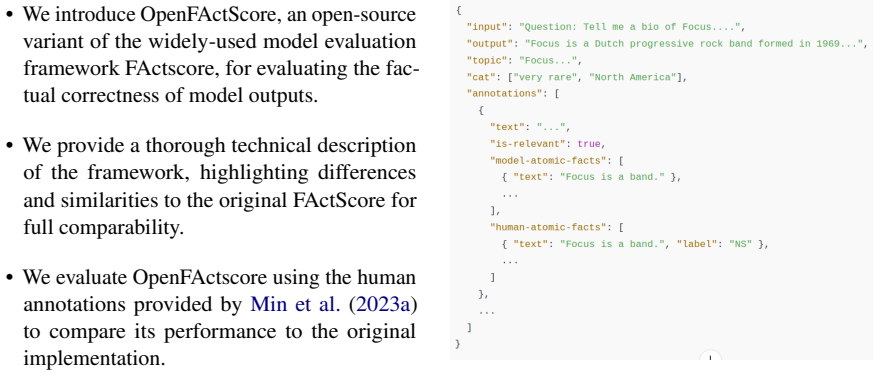
We introduce OpenFActScore, an open-source implementation of the FActScore framework for evaluating the factuality of text generated by large language models (LLMs). FActScore evaluates the factual accuracy of long-form text by using Atomic Fact Generation (AFG) to extract individual factual claims and Atomic Fact Validation (AFV) to verify each claim against a trusted knowledge source. While the original FActScore relies on closed-source and commercial models such as InstructGPT and ChatGPT, OpenFActScore enables the use of any Hugging Face-compatible model for both AFG and AFV. We provide a detailed technical overview of our implementation, highlighting design choices and modifications made to support open models. We evaluate multiple open-source LLMs on both AFG and AFV using the original FActScore benchmark, reporting BERTScore-F1 for AFG and Error Rate relative to human annotations for AFV. Our results show that open models can approximate the performance of closed-source systems, with Gemma achieving the best overall performance, and our final setup obtains a 0.99 Pearson correlation with the original FActScore experiments. OpenFActScore promotes transparency, reproducibility, and cost-effective evaluation, and is available at: https://github.com/lflage/OpenFActScore.
Figures
Reference graph
Works this paper leans on
-
[1]
Janice Ahn, Rishu Verma, Renze Lou, Di Liu, Rui Zhang, and Wenpeng Yin. 2024. https://aclanthology.org/2024.eacl-srw.17/ Large language models for mathematical reasoning: Progresses and challenges . In Proceedings of the 18th Conference of the European Chapter of the Association for Computational Linguistics: Student Research Workshop, pages 225--237, St....
work page 2024
-
[2]
Hussam Alkaissi and Samy I McFarlane. 2023. Artificial hallucinations in chatgpt: implications in scientific writing. Cureus, 15(2)
work page 2023
-
[3]
Meng Cao, Yue Dong, and Jackie Cheung. 2022. https://doi.org/10.18653/v1/2022.acl-long.236 Hallucinated but factual! inspecting the factuality of hallucinations in abstractive summarization . In Proceedings of the 60th Annual Meeting of the Association for Computational Linguistics (Volume 1: Long Papers), pages 3340--3354, Dublin, Ireland. Association fo...
-
[4]
Esin Durmus, He He, and Mona Diab. 2020. Feqa: A question answering evaluation framework for faithfulness assessment in abstractive summarization. arXiv preprint arXiv:2005.03754
arXiv 2020
-
[5]
Tobias Falke, Leonardo F. R. Ribeiro, Prasetya Ajie Utama, Ido Dagan, and Iryna Gurevych. 2019. https://doi.org/10.18653/v1/P19-1213 Ranking generated summaries by correctness: An interesting but challenging application for natural language inference . In Proceedings of the 57th Annual Meeting of the Association for Computational Linguistics, pages 2214--...
-
[6]
Katja Filippova. 2020. Controlled hallucinations: Learning to generate faithfully from noisy data. arXiv preprint arXiv:2010.05873
arXiv 2020
-
[7]
Charlie George and Andreas Stuhlmüller. 2023. https://arxiv.org/abs/2310.10627 Factored verification: Detecting and reducing hallucination in summaries of academic papers . Preprint, arXiv:2310.10627
work page Pith review arXiv 2023
-
[8]
Aaron Grattafiori, Abhimanyu Dubey, Abhinav Jauhri, Abhinav Pandey, Abhishek Kadian, Ahmad Al-Dahle, Aiesha Letman, Akhil Mathur, Alan Schelten, Alex Vaughan, Amy Yang, Angela Fan, Anirudh Goyal, Anthony Hartshorn, Aobo Yang, Archi Mitra, Archie Sravankumar, Artem Korenev, Arthur Hinsvark, and 542 others. 2024. https://arxiv.org/abs/2407.21783 The llama 3...
arXiv 2024
Show all 33 references
-
[9]
Zishan Guo, Renren Jin, Chuang Liu, Yufei Huang, Dan Shi, Linhao Yu, Yan Liu, Jiaxuan Li, Bojian Xiong, Deyi Xiong, and 1 others. 2023. Evaluating large language models: A comprehensive survey. arXiv preprint arXiv:2310.19736
2023 arXiv
-
[10]
Luyang Huang, Lingfei Wu, and Lu Wang. 2020. Knowledge graph-augmented abstractive summarization with semantic-driven cloze reward. arXiv preprint arXiv:2005.01159
2020 arXiv
-
[11]
Yue Huang, Qihui Zhang, Lichao Sun, and 1 others. 2023. Trustgpt: A benchmark for trustworthy and responsible large language models. arXiv preprint arXiv:2306.11507
2023 arXiv
-
[12]
Ziwei Ji, Nayeon Lee, Rita Frieske, Tiezheng Yu, Dan Su, Yan Xu, Etsuko Ishii, Ye Jin Bang, Andrea Madotto, and Pascale Fung. 2023. https://doi.org/10.1145/3571730 Survey of hallucination in natural language generation . ACM Computing Surveys, 55(12):1–38
2023 doi
-
[13]
Kalpesh Krishna, Erin Bransom, Bailey Kuehl, Mohit Iyyer, Pradeep Dasigi, Arman Cohan, and Kyle Lo. 2023. https://doi.org/10.18653/v1/2023.eacl-main.121 L ong E val: Guidelines for human evaluation of faithfulness in long-form summarization . In Proceedings of the 17th Confere...
2023 doi
-
[14]
Yixin Liu, Alex Fabbri, Pengfei Liu, Yilun Zhao, Linyong Nan, Ruilin Han, Simeng Han, Shafiq Joty, Chien-Sheng Wu, Caiming Xiong, and Dragomir Radev. 2023. https://doi.org/10.18653/v1/2023.acl-long.228 Revisiting the gold standard: Grounding summarization evaluation with robus...
2023 doi
-
[15]
Sewon Min, Kalpesh Krishna, Xinxi Lyu, Mike Lewis, Wen-tau Yih, Pang Koh, Mohit Iyyer, Luke Zettlemoyer, and Hannaneh Hajishirzi. 2023 a . https://doi.org/10.18653/v1/2023.emnlp-main.741 FA ct S core: Fine-grained atomic evaluation of factual precision in long form text genera...
2023 doi
-
[16]
Sewon Min, Weijia Shi, Mike Lewis, Xilun Chen, Wen-tau Yih, Hannaneh Hajishirzi, and Luke Zettlemoyer. 2023 b . http://arxiv.org/abs/2212.01349 Nonparametric masked language modeling . (arXiv:2212.01349). ArXiv:2212.01349 [cs]
2023 arXiv
-
[17]
Philipp Mondorf and Barbara Plank. 2024. Beyond accuracy: Evaluating the reasoning behavior of large language models-a survey. In First Conference on Language Modeling
2024
-
[18]
Ani Nenkova and Rebecca Passonneau. 2004. https://aclanthology.org/N04-1019 Evaluating content selection in summarization: The pyramid method . In Proceedings of the Human Language Technology Conference of the North A merican Chapter of the Association for Computational Lingui...
2004
-
[19]
Jianmo Ni, Chen Qu, Jing Lu, Zhuyun Dai, Gustavo Hernandez Abrego, Ji Ma, Vincent Zhao, Yi Luan, Keith Hall, Ming-Wei Chang, and Yinfei Yang. 2022. https://doi.org/10.18653/v1/2022.emnlp-main.669 Large dual encoders are generalizable retrievers . In Proceedings of the 2022 Con...
2022 doi
-
[20]
Team OLMo, Pete Walsh, Luca Soldaini, Dirk Groeneveld, Kyle Lo, Shane Arora, Akshita Bhagia, Yuling Gu, Shengyi Huang, Matt Jordan, Nathan Lambert, Dustin Schwenk, Oyvind Tafjord, Taira Anderson, David Atkinson, Faeze Brahman, Christopher Clark, Pradeep Dasigi, Nouha Dziri, an...
2025 arXiv
-
[21]
Long Ouyang, Jeffrey Wu, Xu Jiang, Diogo Almeida, Carroll Wainwright, Pamela Mishkin, Chong Zhang, Sandhini Agarwal, Katarina Slama, Alex Ray, and 1 others. 2022. Training language models to follow instructions with human feedback. Advances in neural information processing sys...
2022
-
[22]
Pranav Rajpurkar, Jian Zhang, Konstantin Lopyrev, and Percy Liang. 2016. https://doi.org/10.18653/v1/D16-1264 SQ u AD : 100,000+ questions for machine comprehension of text . In Proceedings of the 2016 Conference on Empirical Methods in Natural Language Processing, pages 2383-...
2016 doi
-
[23]
Ori Shapira, David Gabay, Yang Gao, Hadar Ronen, Ramakanth Pasunuru, Mohit Bansal, Yael Amsterdamer, and Ido Dagan. 2019. https://doi.org/10.18653/v1/N19-1072 Crowdsourcing lightweight pyramids for manual summary evaluation . In Proceedings of the 2019 Conference of the North ...
2019 doi
-
[24]
Gemma Team, Aishwarya Kamath, Johan Ferret, Shreya Pathak, Nino Vieillard, Ramona Merhej, Sarah Perrin, Tatiana Matejovicova, Alexandre Ram \'e , Morgane Rivi \`e re, and 1 others. 2025. Gemma 3 technical report. arXiv preprint arXiv:2503.19786
2025 arXiv
-
[25]
Hugo Touvron, Thibaut Lavril, Gautier Izacard, Xavier Martinet, Marie-Anne Lachaux, Timoth \'e e Lacroix, Baptiste Rozi \`e re, Naman Goyal, Eric Hambro, Faisal Azhar, and 1 others. 2023. Llama: Open and efficient foundation language models. arXiv preprint arXiv:2302.13971
2023 arXiv
-
[26]
Yizhong Wang, Swaroop Mishra, Pegah Alipoormolabashi, Yeganeh Kordi, Amirreza Mirzaei, Atharva Naik, Arjun Ashok, Arut Selvan Dhanasekaran, Anjana Arunkumar, David Stap, Eshaan Pathak, Giannis Karamanolakis, Haizhi Lai, Ishan Purohit, Ishani Mondal, Jacob Anderson, Kirby Kuzni...
2022 doi
-
[27]
Adina Williams, Nikita Nangia, and Samuel Bowman. 2018. http://aclweb.org/anthology/N18-1101 A broad-coverage challenge corpus for sentence understanding through inference . In Proceedings of the 2018 Conference of the North American Chapter of the Association for Computationa...
2018
-
[28]
Thomas Wolf, Lysandre Debut, Victor Sanh, Julien Chaumond, Clement Delangue, Anthony Moi, Pierric Cistac, Tim Rault, R \' e mi Louf, Morgan Funtowicz, and Jamie Brew. 2019. https://arxiv.org/abs/1910.03771 Huggingface's transformers: State-of-the-art natural language processin...
2019 arXiv
-
[29]
Shiyue Zhang and Mohit Bansal. 2021. https://doi.org/10.18653/v1/2021.emnlp-main.531 Finding a balanced degree of automation for summary evaluation . In Proceedings of the 2021 Conference on Empirical Methods in Natural Language Processing, pages 6617--6632, Online and Punta C...
2021 doi
-
[30]
Weinberger, and Yoav Artzi
Tianyi Zhang*, Varsha Kishore*, Felix Wu*, Kilian Q. Weinberger, and Yoav Artzi. 2020. https://openreview.net/forum?id=SkeHuCVFDr Bertscore: Evaluating text generation with bert . In International Conference on Learning Representations
2020
-
[31]
Ziyao Zhang, Yanlin Wang, Chong Wang, Jiachi Chen, and Zibin Zheng. 2025. https://arxiv.org/abs/2409.20550 Llm hallucinations in practical code generation: Phenomena, mechanism, and mitigation . Preprint, arXiv:2409.20550
2025 arXiv
-
[32]
online" 'onlinestring :=
ENTRY address archivePrefix author booktitle chapter edition editor eid eprint eprinttype howpublished institution journal key month note number organization pages publisher school series title type volume year doi pubmed url lastchecked label extra.label sort.label short.list...
-
[33]
write newline
" write newline "" before.all 'output.state := FUNCTION n.dashify 't := "" t empty not t #1 #1 substring "-" = t #1 #2 substring "--" = not "--" * t #2 global.max substring 't := t #1 #1 substring "-" = "-" * t #2 global.max substring 't := while if t #1 #1 substring * t #2 gl...
Reviewed August 6, 2026 · model on record in the stance chip above.
Discussion (0). Sign in to comment.