REVIEW 4 major objections 4 minor 2 cited by
Surface-Code Hardware Hamiltonian
T0 review · 4 major / 4 minor · reviewed 2026-08-06 · deepseek-v4-flash
Pith's one-line read A layout-to-Hamiltonian framework for surface-code chips predicts that modest residual qubit–qubit crosstalk, around 2 MHz, can invert the interaction hierarchy and push a processor from a computationally stable regime into a…
desk verdict The diagrammatic framework is real and useful; the Sycamore-specific thresholds and topological-order language are not yet earned. read the letter →
The pith
A machine-rendered reading of the paper's core claim, the machinery that carries it, and where it could break.
The reading
What carries the argument
The central object is a diagrammatic perturbation calculus for Pauli-string coefficients, valid to arbitrary order and any string length, together with a parity rule that assigns signs by counting, for each qubit carrying a $Z$, whether it is in $|1\rangle$. Each diagram contributes products of qubit–qubit exchange amplitudes $J$ divided by the energy gaps to intermediate levels, and the squeezed-denominator notation $\overline{\Delta}_{ij} = f_i^{2\to 1} - f_j^{1\to 0}$ compresses the resulting energy denominators. Diagrammatic results provide closed-form priors that are then refined by exact simulation of the full circuit Hamiltonian, producing the effective lattice Hamiltonian of Eq. (2), from which the regime classification, the Processor Error Tomography ratios, and the gate-fidelity benchmarks are all read.
What would settle it
On a fully calibrated five-qubit tile, measure all $ZZ$ and $ZZZ$ Pauli coefficients at idle while increasing the side-to-side coupling through the paper's threshold; if $|ZZZ|_{\max}$ never exceeds $|ZZ|_{\max}$ for $G_{\mathrm{side}}/G_{\mathrm{radial}}$ above the stated $1/2$ critical ratio, the hierarchy-inversion claim is contradicted.
Extended reading notes
Core claim
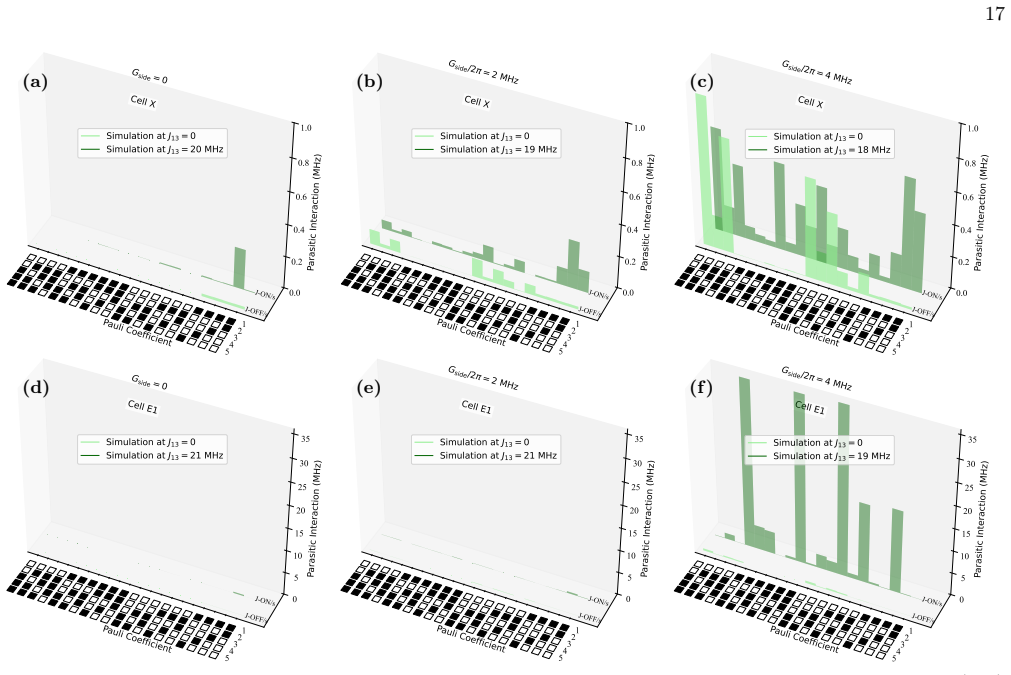
The paper's central claim is that the interaction hierarchy of a surface-code QPU is not fixed by design but is tunable and fragile: increasing only the parasitic side-to-side qubit coupling $G_{\mathrm{side}}/2\pi$ from 0 to 4 MHz, while all qubits stay at their reported idle frequencies, progressively strengthens three-body $ZZZ$ channels until they surpass the two-body $ZZ$ terms, inverting the hierarchy that supports surface-code operation. The inversion is governed by power laws $|ZZ|_{\max} \propto (G_{\mathrm{side}}/G_{\mathrm{radial}})^{\ell_2}$ and $|ZZZ|_{\max} \propto (G_{\mathrm{side}}/G_{\mathrm{radial}})^{\ell_3}$ with $\ell_2 \leq \ell_3$, so three-body terms always grow faster; the crossover occurs at critical ratios such as $G_{\mathrm{side}}/G_{\mathrm{radial}} \approx 1/2$ to $7/8$ depending on cell and gate state. Consequently, cells that look benign in two-body calibration, including specific tiles identified on the Sycamore lattice, can be silently dominated by single $ZZZ$ terms above 300 kHz, pushing gate error past the $10^{-3}$ surface-code threshold and, at the strongest couplings, moving the system into a topologically ordered regime.
Load-bearing premise
The quantitative regime boundaries rest on modeling all residual qubit–qubit crosstalk as a single uniform coupling $G_{\mathrm{side}}$ scanned to 4 MHz, while real side couplings are non-uniform and the public device parameters used for Sycamore are incomplete.
Editorial extensions
If this is right
- A chip designer can pre-compute, for every five-qubit tile, the ratio $|ZZZ|_{\max}/|ZZ|_{\max}$ before fabrication and reject layouts whose tiles fall into the hierarchy-inverted regime.
- Gate calibration must monitor both $ZZ$ and $ZZZ$ channels: suppressing two-body stray couplings alone leaves the dominant error source intact in cells like the ones identified in the paper.
- Because three-body terms grow faster than two-body ones as side coupling increases, small fabrication drifts can push a nominally safe processor across the inversion threshold, coupling device variability to logical error rate.
- Processor Error Tomography gives a lattice-wide survey of parasitic budgets, so operating frequencies and coupler biases can be chosen to keep every tile in the computationally stable phase simultaneously.
- In the inverted regime the same hardware becomes a controllable platform for studying topologically ordered phases, not just a source of errors.
Reading between the lines
- If real side couplings are non-uniform rather than the paper's single $G_{\mathrm{side}}$, the threshold should be interpreted per link; extending the computation with a disorder distribution of $G_{\mathrm{side}}$ would yield a probability that any given fabricated tile is hierarchy-inverted.
- The exponent ordering $\ell_2 \leq \ell_3$ suggests a possibly universal design rule: any direct qubit–qubit coupling that grows relative to the radial coupling will eventually be overtaken by three-body processes, so layout optimization should target the side-to-radial ratio directly.
- The identification of the inverted phase with topological order is inferred from the interaction hierarchy rather than demonstrated by anyonic or degeneracy signatures; a direct probe of those signatures in the effective Hamiltonian would tie the error-channel analysis to quantum error correction.
- The same layout-to-Hamiltonian pipeline could be applied to other proposed fault-tolerant architectures, such as heavy-hex or color-code layouts, provided their coupler graphs are mapped to the same diagrammatic rules.
Editorial analysis
A structured set of objections, weighed in public.
Referee Report
Summary. The paper introduces a diagrammatic perturbative framework for computing effective multi-qubit Pauli-Z Hamiltonians of surface-code unit cells, and applies it to a five-qubit Sycamore-like tile with a central qubit, four side qubits, tunable couplers, and uniform residual side couplings Gside. The authors derive closed-form expressions for ZZ and ZZZ coefficients through third order, validate them against Cirqubit numerical simulations, construct processor-error tomography (PET) maps for the 33 tiles of the Sycamore layout, and benchmark iSWAP gate fidelity under two- and three-body parasitic interactions. They identify three regimes: a computational phase with |ZZ| >> |ZZZ|, an error-dominated hierarchical phase, and a 'hierarchy-inverted'/topologically ordered phase in which three-body terms dominate, with claimed Sycamore-specific thresholds around Gside/2π = 2 MHz and critical ratios Gside/Gradial = 1/2 and 7/8.
Significance. The diagrammatic parity rule and the explicit energy-denominator formulas are a useful and potentially reusable contribution, and the paper is commendable for pairing its perturbative derivation with numerical diagonalization via the publicly cited Cirqubit software. If the regime classification were fully supported, the framework could indeed help pre-fabrication design of superconducting surface-code processors. However, the paper's central quantitative claims are weakened by three gaps: 'exact' is used despite a third-order truncation that the authors themselves show underestimates simulation at larger J13; the 'topologically ordered phase' is asserted from a five-qubit coefficient crossover without any topological diagnostic; and the Sycamore-specific thresholds rest on a uniform Gside scan that is not tied to measured device parameters. These issues are load-bearing for the abstract's promises, so the paper needs a major revision before its practical conclusions can be accepted.
major comments (4)
- [Section III, Eqs. (5)-(7) and Section IV.A] The terms 'exact effective Hamiltonians' in the title/abstract and 'exact' in Section III are not supported by the derivations, which explicitly stop at third perturbative order. In Section IV.A the authors state that 'as J13 increases the analytical estimate progressively underestimates parasitic errors' (see Fig. 4), confirming that the perturbative result is not exact even at the operating point used later. Please remove the word 'exact' or provide a convergence study showing that omitted higher-order terms are negligible at the quoted J13 values (8 MHz, 18-24 MHz).
- [Section VI, subsection 'Phase Transitions'] The claim that the crossover where |ZZZ|max/|ZZ|max exceeds unity in a five-qubit cell is a transition to a 'topologically ordered phase' is not supported by the evidence. A topological phase requires diagnostics such as ground-state degeneracy, Wilson-loop/string operators, and system-size scaling on a lattice larger than a single tile, none of which appears in the manuscript. This claim is repeated in the abstract, Section VI, and the conclusion. Either provide genuine topological-order diagnostics on an extended lattice, or reframe the result as a coupling-hierarchy crossover, which is what the presented data actually establish.
- [Section IV.A and Section VI] The Sycamore-specific thresholds (Gside/2π ≈ 2 MHz and critical ratios 1/2, 7/8) are computed by assigning one uniform value Gside to every data-data link, as introduced in Section IV.A ('we introduce a universal side coupling Gside'), and Section I admits that the publicly available Sycamore parameters are incomplete. Real side couplings are neither uniform nor publicly known, so the presented curves are a scan over a model parameter, not a prediction for the actual device. To support the claimed device-level classification, please either use a measured or realistically distributed set of side couplings, or explicitly label the results as a parametric model study rather than a Sycamore-specific prediction.
- [Section VI, Eq. (11) and Figs. 9 and 12] The power-law exponents l2 and l3 in Eq. (11) are fitted from only two representative cells (X and W), with no reported fit uncertainties or goodness-of-fit metrics, and are then used to assert that l2 <= l3 'consistently across all cells' and to extract the critical ratios that drive the paper's regime boundaries. Since these critical ratios are the central quantitative output, the fit basis is too narrow. Please provide fits for additional cells, report uncertainties, and qualify the universality claim accordingly, or reduce Eq. (11) to a statement about the cells actually studied.
minor comments (4)
- [Section IV.A] The text contains the typo 'J- ]OFF' in the description of the soft-decoupling configuration; this should read 'J-OFF'.
- [Figures 4, 5, 7, 9, 10, and 12] Several axis labels abbreviate Gside/2π and Gradial/2π as 'Gside/2' or 'Gradial/2'; please add the π symbol for consistency with the text and to avoid ambiguity between frequency and angular frequency.
- [Figure 6 caption] The caption lists the channel '1Z3Z5' but the text elsewhere writes 'Z1Z3Z5'; please correct the missing leading Z.
- [Section VI, subsection 'Phase Transitions'] The phrases 'computational phase' and 'topologically ordered phase' are used without operational definitions; please define them precisely (e.g., in terms of the interaction hierarchy and of the possible topological diagnostics) before using them to label the numerical results.
Circularity Check
No significant circularity: the diagrammatic derivation and numerical validation are self-contained; the cited prior work is not load-bearing.
full rationale
Walking the paper's derivation chain, I find no step where a claimed prediction reduces to an input by construction. Section II defines Pauli-string coefficients through a parity rule and sums over energy denominators; these are genuine perturbative computations from the stated lattice Hamiltonian. The agreement with numerical simulations (Figs. 4, 6, 7, 10) uses Cirqubit's separate non-perturbative block-diagonalization procedure, which is independent evidence even though the authors are associated with that software. The operational regimes and hierarchy-inversion thresholds (Sec. VI, Figs. 9 and 12) are read off from simulations, not fitted to experimental data and then relabeled as predictions; the power-law exponents in Eq. (11) are descriptive fits to the simulation curves, so the quantitative critical ratios are fit-dependent but the qualitative crossover claim is not circular. The citation of prior work [20] supplies nomenclature and the hard-decoupling operating point, but the present paper derives the couplings and reproduces the inversion in its own five-qubit cells, so the self-citation is not load-bearing. The admission that public Sycamore parameters are incomplete (Sec. I) is an external-validity limitation on the device-specific values (Gside/2π ≈ 2 MHz, Gside/Gradial = 1/2, 7/8), not a circular-dependency flaw. Overall, no significant circularity; score 0.
Assumptions & free parameters
free parameters (4)
- Gside (uniform side qubit-qubit coupling) =
scanned values: 0, 2π×2 MHz, 2π×4 MHz
- Gradial (direct central-side radial coupling) =
2π×4 MHz and 2π×8 MHz (adopted in Fig. 9)
- Per-cell optimized exchange coupling J13 =
2π×18-24 MHz depending on cell and noise model
- Power-law exponents l2 and l3 =
l2 ≈ 1.3-2.4, l3 ≈ 2.2-4.0 from Figs. 9 and 12
assumptions (5)
- domain assumption After decoupling couplers, the processor Hamiltonian has the diagonal Pauli-Z form of Eq. (2), i.e., H = sum α_i Z_i + sum α_ij Z_i Z_j + sum α_ijk Z_i Z_j Z_k + ..., with no residual X/Y exchange terms in the idle subspace.
- domain assumption Perturbation theory is valid and truncation at third order suffices: J/Delta < 1 and all neglected higher-order diagrams are small.
- domain assumption Couplers remain in their ground states and can be eliminated via block diagonalization, leaving only qubit degrees of freedom.
- ad hoc to paper A single uniform side coupling Gside represents all residual qubit-qubit crosstalk on Sycamore, and the resulting five-qubit-cell hierarchy inversion is interpreted as a transition to a 'topologically ordered regime'.
- domain assumption The circuit parameters reported for Sycamore in Ref. [35], supplemented by the authors' assumptions, adequately represent the real device frequencies and couplings.
Cite this review
Pith. "Pith review of Surface-Code Hardware Hamiltonian." pith.science (2026). https://pith.science/paper/YGJTBCKI
@misc{pith2026250706201,
  author       = {Pith},
  title        = {Pith review of: Surface-Code Hardware Hamiltonian},
  year         = {2026},
  howpublished = {\url{https://pith.science/paper/YGJTBCKI}},
  note         = {Machine review of arXiv:2507.06201}
}
read the original abstract
We present a scalable framework for accurately modeling many-body interactions in surface-code quantum processor units (QPUs). Combining a concise diagrammatic formalism with high-precision numerical methods, our approach efficiently evaluates high-order, long-range Pauli string couplings and maps complete chip layouts onto exact effective Hamiltonians. Applying this method to surface-code architectures, such as Google's Sycamore lattice, we identify three distinct operational regimes: computationally stable, error-dominated, and hierarchy-inverted. Our analysis reveals that even modest increases in residual qubit-qubit crosstalk can invert the interaction hierarchy, driving the system from a computationally favorable phase into a topologically ordered regime. This framework thus serves as a powerful guide for optimizing next-generation high-fidelity surface-code hardware and provides a pathway to investigate emergent quantum many-body phenomena.
Figures


Figures from the paper (9 more)




Forward citations
Cited by 2 Pith papers
-
Parity Cross-Resonance: A Multiqubit Gate
An abstract proposing a native three-qubit parity cross-resonance gate is paired with a body text about heart-rate sensor denoising, leaving the gate's derivation and data absent from the manuscript.
-
Information Transport in Classical-Quantum Hybrid System
A multi-replica master equation for strong-coupling quantum-classical hybrid systems is introduced, and the authors find that coherence plus hybridization suppress net entropy transfer.
Reference graph
Works this paper leans on
-
[1]
Mark the initial computational energy level (red dot)
-
[2]
Identify intermediate computational and non- computational levels reachable by exchangingp particles
-
[3]
The steps above prepare the diagrams for evaluation of their many-body Pauli-string coefficients
Repeat for each marked initial level. The steps above prepare the diagrams for evaluation of their many-body Pauli-string coefficients. Consider for any given diagram, one can take the following steps to evaluate the diagram:
-
[4]
AssignJcoefficients with appropriate overlines and prefactors based on the excitation levels involved
-
[5]
Determine the sign of each diagram using the gen- eralized parity rule
-
[6]
Divide each diagram by the product of energy gaps between the marked initial level and all intermedi- ate levels
-
[7]
Note that different orderings of intermediate transi- tions may yield different diagrams. Each such dia- gram should be treated independently and included in the final sum, with signs assigned according to the parity rule. III. Hamiltonian of QPU In the dispersive limit, diagrammatic perturbation theory yields closed-form estimates of the interaction stre...
work page 2000
-
[8]
P. W. Shor, Polynomial-time algorithms for prime factor- ization and discrete logarithms on a quantum computer, SIAM Journal on Computing26, 1484 (1997)
1997
Show all 51 references
-
[9]
Aspuru-Guzik, A
A. Aspuru-Guzik, A. D. Dutoi, P. J. Love, and M. Head- Gordon, Simulated quantum computation of molecular energies, Science309, 1704 (2005)
2005
-
[10]
Farhi, J
E. Farhi, J. Goldstone, S. Gutmann, J. Lapan, A. Lund- gren, and D. Preda, A quantum adiabatic evolution al- gorithm applied to random instances of an np-complete problem, Science292, 472 (2001)
2001
-
[11]
Mohseni, A
M. Mohseni, A. Scherer, K. G. Johnson, O. Wertheim, M. Otten, N. A. Aadit, K. M. Bresniker, K. Y. Cam- sari, B. Chapman, S. Chatterjee, G. A. Dagnew, A. Es- posito, F. Fahim, M. Fiorentino, A. Khalid, X. Kong, B. Kulchytskyy, R. Li, P. A. Lott, I. L. Markov, R. F. McDermott, G...
2024 arXiv
-
[12]
Tuokkola, Y
M. Tuokkola, Y. Sunada, H. Kivijärvi, J. Al- banese, L. Grönberg, J.-P. Kaikkonen, V. Vesteri- nen, J. Govenius, and M. Möttönen, Methods to achieve near-millisecond energy relaxation and dephas- ing times for a superconducting transmon qubit (2024), arXiv:2407.18778
2024 arXiv
-
[13]
Benevides, M
R. Benevides, M. Drimmer, G. Bisson, F. Adinolfi, U. v. Lüpke, H. M. Doeleman, G. Catelani, and Y. Chu, Quasi- particle dynamics in a superconducting qubit irradiated by a localized infrared source, Physical Review Letters 133, 060602 (2024)
2024
-
[14]
J. Ku, X. Xu, M. Brink, D. C. McKay, J. B. Hertzberg, M. H. Ansari, and B. L. T. Plourde, Suppression of un- wantedzzinteractions in a hybrid two-qubit system, Physical Review Letters125, 200504 (2020)
2020
-
[15]
Gottesman, Stabilizer codes and quantum error cor- rection (1997), arXiv:quant-ph/9705052
D. Gottesman, Stabilizer codes and quantum error cor- rection (1997), arXiv:quant-ph/9705052
1997 arXiv
-
[16]
A. Y. Kitaev, Quantum computations: algorithms and error correction, Russian Mathematical Surveys52, 1191 (1997)
1997
-
[17]
Y. Zhao, Y. Ye, H.-L. Huang, Y. Zhang, D. Wu, H. Guan, Q. Zhu, Z. Wei, T. He, S. Cao, F. Chen, T.-H. Chung, H.Deng, D.Fan, M.Gong, C.Guo, S.Guo, L.Han, N.Li, S. Li, Y. Li, F. Liang, J. Lin, H. Qian, H. Rong, H. Su, L. Sun, S. Wang, Y. Wu, Y. Xu, C. Ying, J. Yu, C. Zha, K. Zhan...
2022
-
[18]
Kandala, K
A. Kandala, K. Temme, A. D. Córcoles, A. Mezzacapo, J. M. Chow, and J. M. Gambetta, Error mitigation ex- tends the computational reach of a noisy quantum pro- cessor, Nature567, 491 (2019). 14
2019
-
[19]
C. Song, J. Cui, H. Wang, J. Hao, H. Feng, and Y. Li, Quantum computation with universal error mitigation on a superconducting quantum processor, Science Advances 5, eaaw5686 (2019)
2019
-
[20]
Pazem and M
J. Pazem and M. H. Ansari, Error mitigation in brain- box quantum autoencoders, Scientific Reports15, 2257 (2025)
2025
-
[21]
Preskill, Quantum Computing in the NISQ era and beyond, Quantum2, 79 (2018)
J. Preskill, Quantum Computing in the NISQ era and beyond, Quantum2, 79 (2018)
2018
-
[22]
Krantz, M
P. Krantz, M. Kjaergaard, F. Yan, T. P. Orlando, S. Gus- tavsson, and W. D. Oliver, A quantum engineer’s guide to superconducting qubits, Applied Physics Reviews6, 021318 (2019)
2019
-
[23]
Ciani, D
A. Ciani, D. P. DiVincenzo, and B. M. Terhal, Lecture notes on quantum electrical circuits (2023), arXiv:2312.05329
2023 arXiv
-
[24]
M. H. Devoret and R. J. Schoelkopf, Superconducting circuits for quantum information: An outlook, Science 339, 1169 (2013)
2013
-
[25]
J. Koch, T. M. Yu, J. Gambetta, A. A. Houck, D. I. Schuster, J. Majer, A. Blais, M. H. Devoret, S. M. Girvin, and R. J. Schoelkopf, Charge-insensitive qubit design de- rived from the Cooper pair box, Physical Review A76, 042319 (2007)
2007
-
[26]
M. H. Ansari, Superconducting qubits beyond the dis- persive regime, Physical Review B100(2019)
2019
-
[27]
Xu, Manabputra, C
X. Xu, Manabputra, C. Vignes, M. H. Ansari, and J. M. Martinis, Lattice hamiltonians and stray interactions within quantum processors, Physical Review Applied22, 064030 (2024)
2024
-
[28]
Berke, E
C. Berke, E. Varvelis, S. Trebst, A. Altland, and D. P. DiVincenzo, Transmon platform for quantum computing challenged by chaotic fluctuations, Nature Communica- tions13, 2495 (2022)
2022
-
[29]
Acharya, I
R. Acharya, I. Aleiner, R. Allen, T. I. Andersen, M. Ans- mann, F. Arute, K. Arya, A. Asfaw, J. Atalaya, R. Bab- bush, D. Bacon, J. C. Bardin, J. Basso, A. Bengtsson, S. Boixo, G. Bortoli, A. Bourassa, J. Bovaird, L. Brill, M. Broughton, B. B. Buckley, D. A. Buell, T. Burger, ...
2023
-
[30]
Acharya, D
R. Acharya, D. A. Abanin, L. Aghababaie-Beni, I. Aleiner, T. I. Andersen, M. Ansmann, F. Arute, K. Arya, A. Asfaw, N. Astrakhantsev, J. Atalaya, R. Babbush, D. Bacon, B. Ballard, J. C. Bardin, J. Bausch, A. Bengtsson, A. Bilmes, S. Blackwell, S. Boixo, G. Bortoli, A. Bourassa,...
2025
-
[31]
Xu and M
X. Xu and M. H. Ansari,zzfreedom in two-qubit gates, Physical Review Applied15, 064074 (2021)
2021
-
[32]
Y. Xu, Z. Hua, T. Chen, X. Pan, X. Li, J. Han, W. Cai, Y. Ma, H. Wang, Y. P. Song, Z.-Y. Xue, and L. Sun, Experimental implementation of universal nonadiabatic geometric quantum gates in a superconducting circuit, Physical Review Letters124, 230503 (2020)
2020
-
[33]
Xu and M
X. Xu and M. Ansari, Parasitic-free gate: An error- protected cross-resonance switch in weakly tunable ar- chitectures, Physical Review Applied19, 024057 (2023)
2023
-
[34]
L. E. Fischer, M. Leahy, A. Eddins, N. Keenan, D. Fer- racin, M. A. C. Rossi, Y. Kim, A. He, F. Pietracap- rina, B. Sokolov, S. Dooley, Z. Zimborás, F. Tacchino, S. Maniscalco, J. Goold, G. García-Pérez, I. Tavernelli, A. Kandala, and S. N. Filippov, Dynamical simulations of m...
2024
-
[35]
A. A. Houck, H. E. Türeci, and J. Koch, On-chip quan- tum simulation with superconducting circuits, Nature Physics8, 292 (2012)
2012
-
[36]
Blais, R.-S
A. Blais, R.-S. Huang, A. Wallraff, S. M. Girvin, and R. J. Schoelkopf, Cavity quantum electrodynamics for superconducting electrical circuits: An architecture for quantum computation, Physical Review A69, 062320 (2004)
2004
-
[37]
L. S. Cederbaum, J. Schirmer, and H. D. Meyer, Block diagonalisation of hermitian matrices, Journal of Physics A: Mathematical and General22, 2427 (1989)
1989
-
[38]
Ansari and X
M. Ansari and X. Xu, Method of operating a cir- cuit with a first and a second qubit, Germany Patent DE102020122245A1 (issued Mar. 3, 2022)
2022
-
[39]
A generalization for the third excited level includes dou- ble overlines and a prefactor √ 3, e.g., √ 3JQiQj
-
[40]
Magesan and J
E. Magesan and J. M. Gambetta, Effective hamiltonian models of the cross-resonance gate, Physical Review A 101, 052308 (2020)
2020
-
[41]
Cirqubit (https://cirqubit.com), Software suite for simu- lating superconducting qubits, (2024)
2024
-
[42]
Arute, K
F. Arute, K. Arya, R. Babbush, D. Bacon, J. C. Bardin, R. Barends, R. Biswas, S. Boixo, F. G. S. L. Brandao, D. A. Buell, B. Burkett, Y. Chen, Z. Chen, B. Chiaro, R. Collins, W. Courtney, A. Dunsworth, E. Farhi, B. Foxen, A. Fowler, C. Gidney, M. Giustina, R. Graff, K. Guerin,...
2019
-
[43]
Jiang and M
Z. Jiang and M. H. Ansari, Concurrent fermionic simu- lation gate (2024), arXiv:2411.19398
2024
-
[44]
Barends, L
R. Barends, L. Lamata, J. Kelly, L. García-Álvarez, A. G. Fowler, A. Megrant, E. Jeffrey, T. C. White, D. Sank, J. Y. Mutus,et al., Digital quantum simula- tion of fermionic models with a superconducting circuit, Nature Communications6, 1 (2015)
2015
-
[45]
These values corresponds toG side = 0,2,4MHz with Gradial = 8MHz
-
[46]
Kitaev, Fault-tolerant quantum computation by anyons, Annals of Physics303, 2 (2003)
A. Kitaev, Fault-tolerant quantum computation by anyons, Annals of Physics303, 2 (2003)
2003
-
[47]
X. G. WEN, Topological orders in rigid states, Interna- tional Journal of Modern Physics B04, 239 (1990)
1990
-
[48]
M. H. Ansari, The statistical fingerprints of quantum gravity (2008)
2008
-
[49]
C.-K. Chiu, J. C. Y. Teo, A. P. Schnyder, and S. Ryu, Classification of topological quantum matter with sym- metries, Reviews of Modern Physics88, 035005 (2016)
2016
-
[50]
B. Zeng, X. Chen, D.-L. Zhou, and X.-G. Wen, Quantum information meets quantum matter – from quantum en- tanglement to topological phase in many-body systems (2015), arXiv:1508.02595
2015 arXiv
-
[51]
phase transition
C. Nayak, S. H. Simon, A. Stern, M. Freedman, and S. Das Sarma, Non-abelian anyons and topological quan- tum computation, Reviews of Modern Physics80, 1083 (2008). 16 A. Unit cell Hamiltonian Given a diamond-like surface code where one central transmonQ 1 couples to four side ...
2008
Reviewed August 6, 2026 · model on record in the stance chip above.
Discussion (0). Sign in to comment.