REVIEW 3 major objections 5 minor 51 references
Harmonic emission as a probe to coherent transitions in the topological superconductors
T0 review · 3 major / 5 minor · reviewed 2026-08-06 · deepseek-v4-flash
Pith's one-line read In a dimerized Kitaev chain, a laser pulse turns the sharp harmonic peaks of the intrinsic supercurrent into broad plateaus and makes band populations oscillate in a Rabi-like manner that the authors attribute to Majorana bound…
desk verdict The static-emission and pairing controls are worth a look, but the MBS-Rabi claim needs a real Rabi analysis and a proper stationary ground state. read the letter →
The pith
A machine-rendered reading of the paper's core claim, the machinery that carries it, and where it could break.
The reading
What carries the argument
The central object is the dimerized Kitaev chain Hamiltonian with staggered hopping w(1∓λ) and real p-wave pairing Δ, whose eigenstates are classified into a valence band (VB), three conduction bands (CB-I–CB-III), and two kinds of degenerate intermediate states: mid-gap states (MGS, split into pMGS and nMGS at ±E) and zero-energy Majorana bound states (MBS). The argument runs on two computed observables: the harmonic emission spectrum obtained from the total current operator J(t) after time-evolving the initial state with an implicit finite-difference propagator, and the instantaneous band populations Pm(t) = ⟨ψ(t)|φm⟩⟨φm|ψ(t)⟩ obtained by projecting onto the field-free eigenbasis. The conjunction of these two observables—plateau formation in the spectrum and oscillation in the populations—carries the claim that laser driving exposes coherent transitions anchored by Majorana bound states.
What would settle it
Project out the Majorana mid-gap states from the initial state (or suppress the pairing below the topological threshold) and recompute the population oscillations: if the same oscillation frequency and line shape persist without Majorana bound states, the Rabi-via-MBS attribution is falsified. Equivalently, drive with a tunable continuous-wave laser and plot the population-oscillation frequency versus detuning: a genuine Rabi process gives a V-shaped frequency sqrt(Ω²+δ²) with a minimum at zero detuning, whereas a quantum beat keeps a fixed frequency set by the energy splitting.
Extended reading notes
Core claim
Starting from the conventional ground state |ψGS⟩ = VB + nMGS of the dimerized Kitaev chain, the static (undriven) system shows sharp harmonic peaks whose positions match transitions such as nMGS↔MBS, VB↔pMGS, and VB↔CB-III, which the paper reads as a signature of the intrinsic supercurrent. Switching on a Gaussian laser pulse enhances the emission into plateau-like regions (e.g., ~12.8–16 eV at λ=0.05) by activating multiple resonant transitions, and the field-driven band populations exhibit coherent oscillations. The paper's central claim is that these Rabi-like oscillations are mediated by Majorana bound states and thereby confirm the quasiparticle nature of the model, establishing laser-driven harmonic emission as a probe of the system's topological and dynamical stability.
Load-bearing premise
The load-bearing assumption is that the observed oscillatory band populations are Rabi oscillations mediated by Majorana bound states, rather than generic quantum beats arising from the free evolution of the deliberately prepared initial superposition |ψGS⟩ = VB + nMGS.
Editorial extensions
If this is right
- Static harmonic emission from the dimerized Kitaev chain occurs only when the initial state includes degenerate mid-gap states (VB+nMGS); a VB-only initial state produces no static emission, and a four-band insulator without pairing produces no static current, so the emission marks both pairing and ground-state degeneracy.
- Under the chosen Gaussian drive, the static peaks merge into plateaus in specific energy windows that shift with the dimerization parameter λ, meaning the harmonic cutoff positions encode the band gaps and edge-state energy differences.
- Coherent oscillations appear in the populations of the conduction bands and intermediate states; if they are Rabi oscillations tied to Majorana bound states, the oscillation frequency and envelope could be read out from the population traces as a measure of MBS coherence.
- The persistence of particle-hole symmetric quasiparticle transitions (e.g., VB to its chiral partner CB-III) under driving suggests that the topological protection survives the strong field, so harmonic emission can serve as a stability probe.
Reading between the lines
- The paper leaves the Rabi attribution qualitative: the same oscillatory signal would arise from quantum beats between the eigenstates composing the deliberately prepared superposition |ψGS⟩ = VB + nMGS, so a two-level fit with Rabi frequency versus detuning is needed to uniquely assign the oscillations to Majorana bound states.
- The plateau-enhancement result is more robust than the MBS-Rabi interpretation: even if the oscillation attribution fails, the static-versus-driven comparison of harmonic spectra remains a workable probe of pairing-induced supercurrent and of the band-edge structure.
- The supplementary comparison with a topologically equivalent four-band insulator suggests a general rule testable in other models: undriven emission appears only when both superconducting pairing and an initial occupation of degenerate (mid-gap or edge) states are present, so HHG could diagnose both ingredients in engineered chains.
- A concrete extension would be frequency-resolved population dynamics: driving with a continuous-wave field and mapping the population-oscillation frequency as a function of detuning would produce a characteristic avoided crossing for genuine Rabi oscillations, while quantum beats would show a detuning-independent frequency.
Editorial analysis
A structured set of objections, weighed in public.
Referee Report
Summary. The paper studies a dimerized Kitaev chain with real p-wave pairing, coupled to a Gaussian laser pulse via the Peierls substitution. Using Crank-Nicolson time propagation, it computes total-current high-harmonic spectra and time-dependent band populations for initial states built from valence-band and midgap states. The authors report static harmonic emission that they attribute to an intrinsic supercurrent, laser-induced plateau structures, and 'Rabi-like oscillations' in band populations attributed to Majorana bound states. The SI provides a four-band topological-insulator control, a pairing-strength sweep, and population dynamics for alternative initial states.
Significance. If established, the central claim would make high-harmonic generation a probe of MBS coherence in topological superconductors, which is a goal of current interest. The numerical method is standard, and the SI contains genuinely useful control calculations: the pairing-strength sweep shows that static emission vanishes for very small Δ, and the four-band TI control shows no static emission without pairing. However, the flagship new result—MBS-mediated Rabi oscillations—is not supported by any quantitative analysis, and the static-emission interpretation is undermined by the non-stationarity of the chosen initial state. The paper would be publishable after substantial additional analysis, but in its present form the abstract overclaims.
major comments (3)
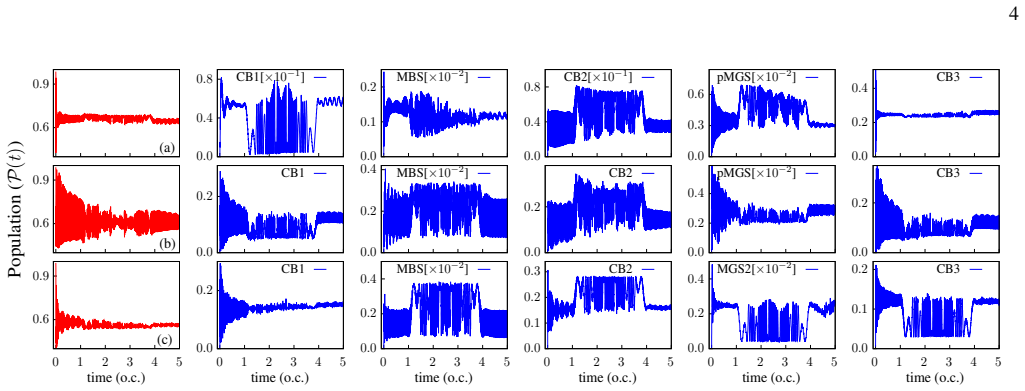
- [Population dynamics (Figs. 2-3) and Fig. 1] Fig. 2 is labeled 'undriven GS' yet shows band populations changing with time for A0=0. This demonstrates that |ψGS⟩=VB+nMGS is not an eigenstate of H0 but a coherent superposition whose free evolution already produces oscillations at the BdG energy differences. The 'Rabi-like oscillations' reported in Fig. 3 and the abstract are therefore not automatically attributable to MBS; the undriven curves in Fig. 2 are the needed baseline, and a quantitative comparison (or subtraction) is missing. Relatedly, the black 'static' emission curves in Fig. 1 are generated by time-evolving this non-stationary state, so the claim of an intrinsic supercurrent should be checked against the true BdG ground state (all negative-energy eigenstates occupied); the SI Fig. 8 result that the VB-only initial state gives no emission is consistent with the alternative explanation that the static emission is simply dephasing of the prepared superposition.
- [Fig. 3 and abstract] No quantitative Rabi test is presented. The manuscript neither fits the population oscillations to a sin²(Ωt/2) law, nor varies the laser amplitude or detuning to show that the oscillation frequency follows the expected Rabi scaling, nor compares with a two-level model derived from the BdG spectrum. The SI four-band TI control addresses only the static/emission part and does not test population dynamics; moreover, it removes pairing but also changes the model structure, so it does not isolate MBS from the pMGS/nMGS midgap states. I request either a parameter scan with a quantitative Rabi analysis or removal of the MBS-Rabi attribution from the abstract and conclusion.
- [Fig. 1 and Table I] The assignment of harmonic peaks to specific band-to-band or midgap transitions relies on colored vertical lines placed on the spectra by inspection. Since the central probe claim is that harmonic energies encode the BdG level differences, the authors should report a quantitative comparison, such as a table of predicted transition energies from the eigenspectrum versus observed peak positions for each λ. This would also help distinguish genuine resonances from features caused by the non-stationary initial state.
minor comments (5)
- [Eqs. (1)-(4)] Define the many-body notation |ψGS⟩=VB+nMGS precisely; clarify whether it is a Slater determinant of occupied BdG eigenstates or a coherent superposition of many-body states.
- [Eq. (2) and laser parameters] The laser parameters (A0=0.1 a.u., 7.2 μm, FWHM 1.25τ) should specify the pulse envelope and the relationship between τ and the optical cycle; also state the unit convention for the vector potential in the Peierls phase exp(-iaA(t)).
- [Captions of Figs. 2 and 3] The captions contain 'expect' for 'except'; additionally, the y-axes use per-state scaling factors (×10^-1, ×10^-2) while the text quotes both total and per-band populations, so please clarify which quantity is plotted.
- [References] Reference [12] appears to be a duplicate of reference [11].
- [Abstract and conclusion] The phrase 'static configuration undergoes a transition' is vague; specify that what is observed is time-dependent population transfer under A0=0.
Circularity Check
The advertised MBS-mediated Rabi oscillations are not derived: the populations already oscillate in the undriven case because the initial state VB+nMGS is a coherent superposition, so the MBS attribution relabels generic quantum beats.
-
renaming known result
[Abstract; Eq. (4) and Figs. 2–3 (population dynamics)]
"Under laser driving, we observe an enhancement in static emission forming a plateau-like structure, accompanied by multiple coherent transitions in the population. These transitions exhibit Rabi-like oscillations, attributed to the presence of Majorana bound states (MBS), further reinforcing the quasiparticle character of the model."
With the definition Pm(t)=⟨ψ(t)|Πm|ψ(t)⟩ and the prepared initial state |ψGS⟩=VB+nMGS, which is a coherent sum of BdG eigenstates, oscillatory populations at Bohr frequencies follow from free Schrödinger evolution even at A0=0. The paper's own Fig. 2, labeled 'undriven GS,' shows exactly these zero-field oscillations. Hence the 'Rabi-like oscillations' are guaranteed by the initial condition by construction; no laser or MBS-mediated mechanism is needed to produce them. No Rabi-frequency-versus-detuning scan, sin² envelope test, or MBS-free control is supplied, so calling them MBS-driven is a relabeling of generic quantum beats rather than a prediction derived from a Majorana-specific term.
full rationale
The harmonic-generation part of the paper is self-contained: the plateau features are consistency-checked against the band structure, no fitted parameter is renamed as a prediction, and the SI comparison to a non-superconducting four-band model independently supports the role of pairing in static emission. The self-citation to the authors' earlier paper [43] for the model analysis and for naming the zero-energy states MBS/MGS is not load-bearing, since the dimerized Kitaev chain and its Majorana zero modes are standard textbook material. The only reduction-by-construction issue is the abstract's central identification of the population oscillations as MBS-mediated Rabi oscillations: because the 'GS' is chosen as VB+nMGS, a deliberately non-eigenstate superposition, the undriven evolution already produces the oscillatory populations displayed in Fig. 2. The laser-driven curves in Fig. 3 are therefore not independent evidence for a Majorana Rabi mechanism unless a quantitative Rabi test is supplied; in the present text the attribution is an interpretation of the same coherent dynamics rather than a distinct predicted quantity. This warrants a partial circularity flag, but not a high score, because the main HHG observables and their band-structure assignments are not circular.
Assumptions & free parameters
free parameters (5)
- Chemical potential µ =
0.225 a.u.
- Hopping amplitude w =
0.25 a.u.
- Pairing potential ∆ =
0.2375 a.u.
- Laser amplitude A0 =
0.1 a.u.
- Dimerization parameter λ =
0.05, 0.4, 0.8
assumptions (5)
- standard math Kitaev chain tight-binding model with real p-wave pairing ∆
- domain assumption Peierls substitution w → w e^(-iaA(t)) for laser coupling
- ad hoc to paper Initial state |ψGS⟩ = VB + nMGS is the conventional ground state
- domain assumption Zero-energy states in the finite chain are Majorana bound states
- domain assumption Crank-Nicholson propagation converges with the chosen time step
Cite this review
Pith. "Pith review of Harmonic emission as a probe to coherent transitions in the topological superconductors." pith.science (2026). https://pith.science/paper/WAFOGSKA
@misc{pith2026250706215,
  author       = {Pith},
  title        = {Pith review of: Harmonic emission as a probe to coherent transitions in the topological superconductors},
  year         = {2026},
  howpublished = {\url{https://pith.science/paper/WAFOGSKA}},
  note         = {Machine review of arXiv:2507.06215}
}
read the original abstract
We investigate the dynamical behavior of a topological superconducting system, demonstrating that its static configuration undergoes a transition driven by an intrinsic supercurrent. By analyzing the band population, we confirm the quasiparticle nature of the system both in the presence and absence of an external laser field. Under laser driving, we observe an enhancement in static emission forming a plateau-like structure, accompanied by multiple coherent transitions in the population. These transitions exhibit Rabi-like oscillations, attributed to the presence of Majorana bound states (MBS), further reinforcing the quasiparticle character of the model. Our results highlight the efficacy of laser driving as a probe of the system's topological and dynamical stability.
Figures


Figures from the paper (7 more)


Reference graph
Works this paper leans on
-
[1]
K. Takasan, S. Sumita, and Y . Yanase, Supercurrent-induced topological phase transitions, Phys. Rev. B106, 014508 (2022)
work page 2022
-
[2]
M. Minutillo, P. Lucignano, G. Campagnano, and A. Russo- manno, Kitaev ring threaded by a magnetic flux: Topological gap, anderson localization of quasiparticles, and divergence of supercurrent derivative, Phys. Rev. B109, 064504 (2024)
work page 2024
-
[3]
G. R. S. and, Unconventional superconduc- tivity, Advances in Physics 66, 75 (2017), https://doi.org/10.1080/00018732.2017.1331615
arXiv 2017
-
[4]
A. Y . Kitaev, Unpaired Majorana fermions in quantum wires, Physics-Uspekhi 44, 131 (2001)
2001
-
[5]
F. del Pozo and K. Le Hur, Topological signatures of a p-wave superconducting wire through light, Phys. Rev. B110, L060503 (2024)
work page 2024
- [6]
-
[7]
Krausz and M
F. Krausz and M. Ivanov, Attosecond physics, Rev. Mod. Phys. 81, 163 (2009)
2009
-
[8]
S. Ghimire, A. D. DiChiara, E. Sistrunk, P. Agostini, L. F. Di- Mauro, and D. A. Reis, Observation of high-order harmonic generation in a bulk crystal, Nature Physics 7, 138 (2011)
work page 2011
Show all 51 references
-
[9]
Ghimire and D
S. Ghimire and D. A. Reis, High-harmonic generation from solids, Nature Physics 15, 10 (2019)
2019
-
[10]
Vampa, C
G. Vampa, C. R. McDonald, G. Orlando, D. D. Klug, P. B. Corkum, and T. Brabec, Theoretical analysis of high-harmonic generation in solids, Phys. Rev. Lett. 113, 073901 (2014)
2014
-
[12]
T. T. Luu and H. J. Wörner, Measurement of the berry curvature of solids using high-harmonic spectroscopy, Nature Communi- cations 9, 916 (2018)
2018
-
[13]
M. Guan, S. Hu, H. Zhao, C. Lian, and S. Meng, Toward at- tosecond control of electron dynamics in two-dimensional ma- terials, Applied Physics Letters 116, 043101 (2020)
2020
-
[14]
Y . Bai, F. Fei, S. Wang, N. Li, X. Li, F. Song, R. Li, Z. Xu, and P. Liu, High-harmonic generation from topological surface states, Nature Physics 17, 311 (2021)
2021
-
[15]
M. R. Bionta, E. Haddad, A. Leblanc, V . Gruson, P. Lassonde, H. Ibrahim, J. Chaillou, N. Émond, M. R. Otto, A. Jiménez- Galán, R. E. F. Silva, M. Ivanov, B. J. Siwick, M. Chaker, and F. m. c. Légaré, Tracking ultrafast solid-state dynamics using high harmonic spectroscopy, Ph...
2021
-
[16]
Neufeld, N
O. Neufeld, N. Tancogne-Dejean, H. Hübener, U. De Giovan- nini, and A. Rubio, Are there universal signatures of topological phases in high-harmonic generation? probably not., Phys. Rev. X 13, 031011 (2023)
2023
-
[17]
N. R, J. N. Bandyopadhyay, and A. R. Holkundkar, Prob- ing topological phase transitions in the aubry-andre-harper model via high-harmonic generation, Phys. Rev. B110, 115103 (2024)
2024
-
[18]
Goulielmakis, V
E. Goulielmakis, V . S. Yakovlev, A. L. Cavalieri, M. Uiber- acker, V . Pervak, A. Apolonski, R. Kienberger, U. Kleineberg, and F. Krausz, Attosecond control and measurement: Light- wave electronics, Science 317, 769 (2007)
2007
-
[19]
Klemke, N
N. Klemke, N. Tancogne-Dejean, G. M. Rossi, Y . Yang, F. Scheiba, R. E. Mainz, G. Di Sciacca, A. Rubio, F. X. Kärtner, and O. D. Mücke, Polarization-state-resolved high- harmonic spectroscopy of solids, Nature Communications 10, 1319 (2019)
2019
-
[20]
J. Li, J. Lu, A. Chew, S. Han, J. Li, Y . Wu, H. Wang, S. Ghimire, and Z. Chang, Attosecond science based on high harmonic generation from gases and solids, Nature Communications 11, 2748 (2020)
2020
-
[21]
Higuchi, M
T. Higuchi, M. I. Stockman, and P. Hommelhoff, Strong-field perspective on high-harmonic radiation from bulk solids, Phys. Rev. Lett. 113, 213901 (2014)
2014
-
[22]
Hohenleutner, F
M. Hohenleutner, F. Langer, O. Schubert, M. Knorr, U. Huttner, S. W. Koch, M. Kira, and R. Huber, Real-time observation of in- terfering crystal electrons in high-harmonic generation, Nature 523, 572 (2015)
2015
-
[23]
Chacón, D
A. Chacón, D. Kim, W. Zhu, S. P. Kelly, A. Dauphin, E. Pisanty, A. S. Maxwell, A. Picón, M. F. Ciappina, D. E. Kim, C. Ticknor, A. Saxena, and M. Lewenstein, Circular dichro- ism in higher-order harmonic generation: Heralding topologi- cal phases and transitions in chern insul...
2020
-
[24]
J. Park, A. Subramani, S. Kim, and M. F. C. and, Recent 10 trends in high-order harmonic generation in solids, Advances in Physics: X 7, 2003244 (2022)
2022
-
[25]
Heide, Y
C. Heide, Y . Kobayashi, S. R. U. Haque, and S. Ghimire, Ultra- fast high-harmonic spectroscopy of solids, Nature Physics 20, 1546 (2024)
2024
-
[26]
I. I. Rabi, Space quantization in a gyrating magnetic field, Phys. Rev. 51, 652 (1937)
1937
-
[27]
Y . O. Dudin, L. Li, F. Bariani, and A. Kuzmich, Observation of coherent many-body rabi oscillations, Nature Physics 8, 790 (2012)
2012
-
[28]
Makhlin, G
Y . Makhlin, G. Schön, and A. Shnirman, Quantum-state engi- neering with josephson-junction devices, Rev. Mod. Phys. 73, 357 (2001)
2001
-
[29]
Y . Chen, S. Peng, Z. Fu, L. Qiu, G. Fan, Y . Liu, S. Wu, X. Xie, and Z. Tao, Ultrafast quantum control of atomic excited states via interferometric two-photon rabi oscillations, Communica- tions Physics 7, 98 (2024)
2024
-
[30]
Wang, Q.-F
Z. Wang, Q.-F. Liang, D.-X. Yao, and X. Hu, Viewing ma- jorana bound states by rabi oscillations, Scientific Reports 5, 10.1038/srep11686 (2015)
2015 doi
-
[31]
H. Pan, S. Das Sarma, and C.-X. Liu, Rabi and ramsey oscil- lations of a majorana qubit in a quantum dot-superconductor array, Phys. Rev. B111, 075416 (2025)
2025
-
[32]
Zhang, K
Y . Zhang, K. Jiang, F. Zhang, J. Wang, and Z. Wang, Atomic line defects and topological superconductivity in unconven- tional superconductors, Phys. Rev. X 11, 011041 (2021)
2021
-
[33]
Sigrist and K
M. Sigrist and K. Ueda, Phenomenological theory of unconven- tional superconductivity, Rev. Mod. Phys.63, 239 (1991)
1991
-
[34]
Wang, J.-J
Y . Wang, J.-J. Miao, H.-K. Jin, and S. Chen, Characterization of topological phases of dimerized kitaev chain via edge corre- lation functions, Phys. Rev. B 96, 205428 (2017)
2017
-
[35]
K. Roy, S. Roy, and S. Basu, Quasiperiodic disorder induced critical phases in a periodically driven dimerized p-wave kitaev chain, Scientific Reports 14, 20603 (2024)
2024
-
[36]
S. Roy, S. N. Nabi, and S. Basu, Critical and topological phases of dimerized kitaev chain in presence of quasiperiodic potential, Phys. Rev. B 107, 014202 (2023)
2023
-
[37]
X. Liu, X. Zhu, P. Lan, X. Zhang, D. Wang, Q. Zhang, and P. Lu, Time-dependent population imaging for high-order- harmonic generation in solids, Phys. Rev. A95, 063419 (2017)
2017
-
[38]
Ernotte, T
G. Ernotte, T. J. Hammond, and M. Taucer, A gauge-invariant formulation of interband and intraband currents in solids, Phys. Rev. B 98, 235202 (2018)
2018
-
[39]
N. R, A. R. Holkundkar, and J. N. Bandyopadhyay, Tempo- ral control of high-order harmonic cutoffs in periodic crystals, Phys. Rev. A 108, 063503 (2023)
2023
-
[40]
A. R. Holkundkar, N. R, and J. N. Bandyopadhyay, Role of interband and intraband current in laser interaction with bichro- matic quasiperiodic crystals, Phys. Rev. B 109, 155155 (2024)
2024
-
[41]
A. A. Zvyagin, Dynamics of the kitaev chain model under para- metric pumping, Phys. Rev. B 90, 014507 (2014)
2014
-
[42]
Vijay, C
R. Vijay, C. Macklin, D. H. Slichter, S. J. Weber, K. W. Murch, R. Naik, A. N. Korotkov, and I. Siddiqi, Stabilizing rabi os- cillations in a superconducting qubit using quantum feedback, Nature 490, 77–80 (2012)
2012
-
[43]
N. R., S. Srinidhi, J. N. Bandyopadhyay, and A. R. Holkundkar, Engineering harmonic emission through spatial modulation in a kitaev chain (2025), arXiv:2506.05003 [cond-mat.other]
2025 arXiv
-
[44]
Baldelli, U
N. Baldelli, U. Bhattacharya, D. González-Cuadra, M. Lewen- stein, and T. Graß, Detecting majorana zero modes via strong field dynamics, ACS Omega 7, 47424 (2022)
2022
-
[45]
Pattanayak, S
A. Pattanayak, S. Pujari, and G. Dixit, Role of majorana fermions in high-harmonic generation from kitaev chain, Sci- entific Reports 12, 6722 (2022)
2022
-
[46]
Bauer and K
D. Bauer and K. K. Hansen, High-harmonic generation in solids with and without topological edge states, Phys. Rev. Lett. 120, 177401 (2018)
2018
-
[47]
Jürß and D
C. Jürß and D. Bauer, High-harmonic generation in su- schrieffer-heeger chains, Phys. Rev. B99, 195428 (2019)
2019
-
[48]
Liu and X.-B
J.-Q. Liu and X.-B. Bian, Detection of edge states by high-order harmonic generation in the harper model, Phys. Rev. B 105, 054308 (2022)
2022
-
[49]
Dziurawiec, J
M. Dziurawiec, J. O. de Almeida, M. L. Bera, M. Płodzie ´n, M. M. Ma ´ska, M. Lewenstein, T. Grass, and U. Bhattacharya, Unraveling multifractality and mobility edges in quasiperiodic aubry-andré-harper chains through high-harmonic generation, Phys. Rev. B 110, 014209 (2024)
2024
-
[50]
Yu, High-order harmonic generation from su-schrieffer- heeger chains with edge states: Three-step processes and their interference, Phys
C. Yu, High-order harmonic generation from su-schrieffer- heeger chains with edge states: Three-step processes and their interference, Phys. Rev. A 110, 033113 (2024)
2024
-
[51]
Jia, X.-H
G.-R. Jia, X.-H. Huang, and X.-B. Bian, Nonadiabatic redshifts in high-order harmonic generation from solids, Opt. Express25, 23654 (2017)
2017
-
[52]
Du and X.-B
T.-Y . Du and X.-B. Bian, Quasi-classical analysis of the dy- namics of the high-order harmonic generation from solids, Opt. Express 25, 151 (2017)
2017
Reviewed August 6, 2026 · model on record in the stance chip above.
Discussion (0). Sign in to comment.