REVIEW 3 major objections 5 minor 40 references
VisioPath: Vision-Language Enhanced Model Predictive Control for Safe Autonomous Navigation in Mixed Traffic
T0 review · 3 major / 5 minor · reviewed 2026-08-06 · deepseek-v4-flash
Pith's one-line read VisioPath embeds zero-shot vision-language model reasoning inside a safety-verified MPC loop and shows in SUMO that the VLM's suggested starting trajectories, not its object detection, deliver faster and safer driving than conventional MPC.
desk verdict Plausible VLM+MPC integration with a real contribution, but the 'collision-free' claims rest on self-referential verification flags rather than actual collisions. read the letter →
The pith
A machine-rendered reading of the paper's core claim, the machinery that carries it, and where it could break.
The reading
What carries the argument
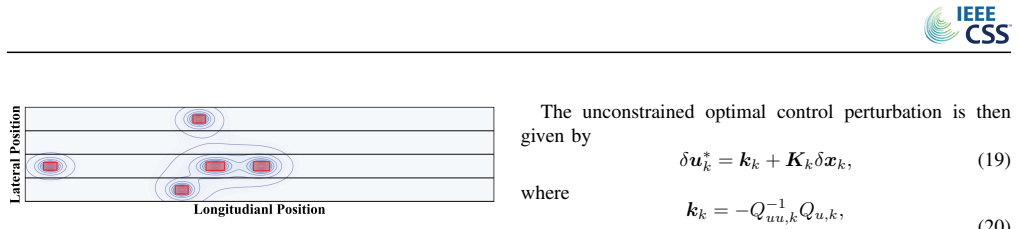
The load-bearing machinery is the pairing of two modules. First, an elliptical collision-avoidance potential $\Phi_i(x_k)=\exp[-\sqrt{(x_k-x_{o,i,k})^2/\sigma_{x,i}(x_k)^2+(y_k-y_{o,i,k})^2/\sigma_{y,i}^2}]$, with the longitudinal radius set by a time-gap policy, turns VLM outputs into smooth repulsive forces inside the stage cost. Second, the VLM's spline-smoothed waypoints provide the initial control sequence for a constrained differential dynamic programming solver with adaptive Levenberg-style regularization ($Q_{uu,k}+\mu I$), so that the optimizer starts near a better local valley. Around these sit the event-triggered replanning logic and the constant-velocity safety verification layer that computes time-to-collision, lateral clearance, and road-boundary compliance over a 3.0 s horizon.
What would settle it
Run the same SUMO scenarios with obstacle vehicles that brake, accelerate, or change lanes inside the 3.0 s verification horizon and count actual bounding-box overlaps; if the collision rate rises above the reported 0.000, the constant-velocity predictor in equation (33) is the point of failure.
Extended reading notes
Core claim
On its own terms, VisioPath's discovery is that a zero-shot VLM can act as both a structured-perception front end and a warm-start generator for a constrained DDP/MPC planner, and that the warm-start function is what drives the measured gains. Each detected obstacle is represented by an elliptical repulsive potential whose longitudinal radius follows a time-gap policy, and the VLM-generated waypoints, spline-smoothed and converted to control inputs, seed the DDP optimizer; when the VLM trajectory is unusable the optimizer falls back to zero initialization. The event-triggered loop replans only on horizon expiry, new obstacles, predicted-position deviations beyond 2.0 m, or lane changes, with a 1.0 s minimum replan interval, and the safety layer flags a trajectory as unsafe or high-risk using bounding-box overlap, time-to-collision, lateral clearance, and road-boundary checks over a 3.0 s constant-velocity horizon. The simulations show this combination improves travel efficiency and safety margins over the baselines, and the paper states the safety layer is a quick assessment rather than a formal guarantee.
Load-bearing premise
The safety and collision-free claims rest on the assumption that every obstacle vehicle keeps a constant velocity over the three-second verification horizon (equation (33)), so a trajectory flagged as safe can still lead to a collision if a driver brakes, accelerates, or changes lanes inside that window.
Editorial extensions
If this is right
- With the safety verification layer active, all three compared methods report a collision rate of 0.000 in the tested SUMO densities, so the replan-on-flag loop, not the optimizer alone, is what prevents collisions in those scenarios.
- Because the image-processing-only variant behaves identically to the plain MPC baseline, the reported efficiency and safety gains are attributed to the VLM's reasoning and initial-trajectory suggestions, not to superior object detection under SUMO's clean visuals.
- The event-triggered design replans only when a horizon elapses, a new obstacle appears, a predicted position deviates by more than 2.0 m, or a lane change is detected, with a 1.0 s minimum interval, which is what keeps computational load low.
- When the VLM's suggested trajectory is unusable, the framework falls back to zero-acceleration initialization, so the optimizer remains operational even if the language-model output is unreliable.
- Real-world video tests of the preprocessing module alone report a mean IoU of 0.836 and speed accuracy of 68.2 percent, which the paper uses to argue the perception front end is feasible, though actual driving experiments are deferred to future work.
Reading between the lines
- If the warm-start benefit transfers to real traffic, the design pattern generalizes beyond driving: any domain where a cheap reasoning model can propose a plausible initial plan and a verifier can veto it could retrofit an existing trajectory optimizer without retraining.
- A direct ablation that would separate warm-start value from perception value is running the same DDP/MPC loop with random or hand-tuned initial trajectories sampled from the same road geometry; if those match VisioPath's travel times, the VLM's reasoning is a convenience rather than the cause.
- The constant-velocity safety horizon is the most likely point of failure in real mixed traffic; replacing it with a short-horizon predictor that accounts for braking and lane-change intentions would be the natural next step, and the paper lists formal reachability-based guarantees as future work.
- Real-world videos show speed estimates within 10 percent of ground truth only about 68 percent of the time, so in real imagery the perception noise may erode the clean SUMO gains; testing the full VisioPath loop on real BEV footage would reveal how much of the advantage survives imperfect speed estimates.
Editorial analysis
A structured set of objections, weighed in public.
Referee Report
Summary. The paper introduces VisioPath, a trajectory-planning framework that combines zero-shot vision-language model (VLM) perception with differential dynamic programming (DDP) in an event-triggered model predictive control (MPC) loop. A bird's-eye-view preprocessing pipeline extracts candidate vehicle bounding boxes and speeds, a commercial VLM produces structured obstacle states, and elliptical potential functions constructed from those states are embedded in a finite-horizon optimal control problem. The DDP solver uses adaptive regularization and warm starts, and a safety verification layer checks planned trajectories against predicted obstacle motion. The framework is evaluated in SUMO against two baselines (MPC-only and MPC with image processing) using travel time, headway, and a reported collision rate. The central claim is that VLM-driven perception and VLM-suggested initial trajectories significantly improve travel efficiency, computational load, and safety margins relative to conventional MPC.
Significance. If the central claim were established, VisioPath would be a practical recipe for using zero-shot VLMs as structured-perception and warm-start modules inside optimization-based automated driving, and the authors should be credited for a clear algorithmic description, explicit safety-verification criteria, and a deterministic preprocessing pipeline that is tested on real-world videos. The result that the improvement comes from VLM reasoning rather than object detection (since SUMO images are essentially perfect for the image-processing baseline) is interesting and potentially important. However, the current experimental evidence does not support the safety and collision-free claims: the reported collision rate counts verification-layer flags under a constant-velocity obstacle model, not actual collisions, and no statistical support is provided for the word 'significantly.' These issues are load-bearing because the paper's headline contributions include safety guarantees and demonstrated superiority over baselines.
major comments (3)
- [Section V.C, Section IV.G, Abstract] The 'Collision Rate' metric is defined in Section V.C as the percentage of scenarios in which the safety verification layer detects bounding-box intersections or insufficient safety margins, and the obstacle predictions entering that layer use the constant-velocity model in Eq. (33). The '0.000' entries in Table 3 therefore show only that no trajectory was flagged under a 3 s constant-velocity assumption, not that no collision occurred in SUMO. Since SUMO obstacle vehicles brake, accelerate, and change lanes, a trajectory can pass verification and still collide. The manuscript itself states in Section IV.G that the layer is 'a quick safety assessment rather than formal guarantees,' which directly conflicts with the abstract's 'ensure collision-free motion' and Section III's claim to 'guarantee safety.' The safety claim is therefore not established by the reported experiments; the authors should either report actual SUMO contact events as the collision rate or provide a verification method with formal guarantees, and align all claims with what is actually measured.
- [Table 3, Section V.D, Section II] No number of simulation runs, confidence intervals, or significance tests are reported anywhere in the experimental section. The word 'significantly' in Section II is therefore unsupported, and the appearance of a single collision rate of 0.286 for all three methods and both density levels, with no variance, further weakens the claim. Likewise, the 33% headway improvement stated in Section V.D is read off Fig. 8 without error bars or trial counts. To support the central empirical comparison, the authors should report repeated independent runs with standard errors or confidence intervals and a statistical test (e.g., a paired test or Wilcoxon signed-rank test) for travel time, headway, and incident counts.
- [Section V.C and Fig. 7] Travel-efficiency results are presented only for the medium-density case, while the high-density scenario is discussed only in terms of safety incidents in Table 3. Section II claims improvements 'across diverse high-traffic scenarios,' but the paper does not report travel time or travel speed for high density for any method. The authors should provide the travel-efficiency metrics for both density levels with variability measures, or explicitly restrict the efficiency claim to the medium-density setting.
minor comments (5)
- [Section II] The sentence describing the preprocessing pipeline contains a grammatical fragment: 'motion-guided connected-component analysis reasoning that is the focus of this work' should be rewritten to describe the five-stage pipeline coherently.
- [Eq. (53)] Equation (53) has an unmatched parenthesis and an incomplete expression involving 'w· 0.95vleader'; the formula should be corrected so that the blending weight w multiplies a complete term.
- [Table 3] The table would benefit from an explicit definition of a 'scenario' and the denominator used for 'Average Dangerous Incidents'; as printed, the reader cannot tell whether these are per-trajectory counts, per-time-step counts, or per-run averages.
- [Section V.A] The simulation timeline is ambiguous: 'a horizon of 1000 seconds' followed by 'The first 500 seconds served as a warm-up' and then '7 minutes of active simulation' should be clarified so that the warm-up duration, active duration, and total simulation length are consistent.
- [Section V.B, Table 1] The real-world evaluation of the preprocessing module uses only four scenes; adding the number of frames per scene and the distribution of vehicle types would strengthen the reported average IoU, precision, recall, and speed accuracy.
Circularity Check
Safety 'collision rate' is defined by the safety layer's own constant-velocity flags, making the reported zero-collision result partly self-referential.
-
self definitional
[Section V.C (Collision Rate definition) and Section IV.G Eqs. (33)-(44); Table 3]
"Collision Rate, defined as the percentage of scenarios in which the output trajectories avoided collisions with obstacle vehicles. Collisions are identified when the safety verification layer detects bounding box intersections or insufficient safety margins as defined in Section IV.G. ... The predicted position of obstacle vehicle j at discrete time step m within the verification horizon is computed using a constant velocity model: p_j,m = p_j,0 + m*T*v_j,0."
The reported 'collision rate' is not an independent SUMO ground-truth collision count; it is defined as the safety verification layer's own flag. That layer detects collisions using predicted obstacle positions from the constant-velocity model (Eq. 33) and bounding-box intersection (Eq. 36). When Unsafe or High-Risk is flagged, the framework triggers replanning (Section IV.H). Thus a 0.000 collision rate with the layer means no trajectory triggered the layer's own criteria, not that no physical collision occurred in mixed traffic. The paper itself concedes the layer is 'a quick safety assessment rather than formal guarantees.' The safety improvement in Table 3 is therefore partly self-referential: the evaluator and the controller use the same detector.
full rationale
The travel-efficiency and computational-load results are empirical SUMO comparisons against baselines; the VLM is a zero-shot commercial model not trained on the test scenarios, and the prior same-author work [34] is background rather than a load-bearing premise. No fitted parameter or self-citation chain forces those numbers. However, the safety-evaluation claim is circular in one specific, quotable place: 'collision rate' is defined as whether the safety verification layer flags predicted bounding-box overlaps under a constant-velocity obstacle model. Because an Unsafe or High-Risk flag triggers replanning in the same loop, the with-safety-layer collision rate of 0.000 is a count of the layer's own criteria rather than an external ground-truth collision count. The paper itself describes the layer as 'a quick safety assessment rather than formal guarantees.' This does not undermine the efficiency or computational-load comparisons, but it means the headline collision-free safety improvement is partly a reduction to the verification definition.
Assumptions & free parameters
free parameters (6)
- Cost weights p1-p4 and obstacle weights lambda_i =
not reported
- Time gap tau =
not reported
- Safety thresholds TTCmin, dlat_min, Tv =
TTCmin=2.0 s, dlat_min=0.5 m, Tv=3.0 s
- Event-trigger thresholds =
position deviation 2.0 m; min replan interval 1.0 s; horizon Th not given
- Speed management parameters =
leader-following distances 20/50 m, blend w, speed saturation 1.0 m/s, progressive acceleration 0.5 m/s per 4 s
- DDP regularization and line-search hyperparameters =
mu_min=1e-6, mu_max=1e6, gamma=5, step sizes {1.0,0.5,0.1,0.05,0.01}
assumptions (6)
- domain assumption Discrete-time double integrator (Eq. 2) adequately describes ego vehicle longitudinal and lateral motion.
- domain assumption Obstacle vehicles move with constant velocity over the safety verification horizon (Eq. 33).
- domain assumption Zero-shot VLM outputs are metrically consistent and correctly structured for the crop patches.
- domain assumption SUMO-generated bird's-eye-view screenshots are representative of real traffic camera imagery for the full VisioPath loop.
- ad hoc to paper Elliptical potential functions with time-gap scaling (Eqs. 7-8) provide sufficient collision-avoidance shaping.
- standard math Active-set constraints in the constrained DDP backward pass remain valid for all xk near the nominal trajectory (Eq. 30).
Cite this review
Pith. "Pith review of VisioPath: Vision-Language Enhanced Model Predictive Control for Safe Autonomous Navigation in Mixed Traffic." pith.science (2026). https://pith.science/paper/PFY24SB5
@misc{pith2026250706441,
  author       = {Pith},
  title        = {Pith review of: VisioPath: Vision-Language Enhanced Model Predictive Control for Safe Autonomous Navigation in Mixed Traffic},
  year         = {2026},
  howpublished = {\url{https://pith.science/paper/PFY24SB5}},
  note         = {Machine review of arXiv:2507.06441}
}
read the original abstract
In this paper, we introduce VisioPath, a novel framework combining vision-language models (VLMs) with model predictive control (MPC) to enable safe autonomous driving in dynamic traffic environments. The proposed approach leverages a bird's-eye view video processing pipeline and zero-shot VLM capabilities to obtain structured information about surrounding vehicles, including their positions, dimensions, and velocities. Using this rich perception output, we construct elliptical collision-avoidance potential fields around other traffic participants, which are seamlessly integrated into a finite-horizon optimal control problem for trajectory planning. The resulting trajectory optimization is solved via differential dynamic programming with an adaptive regularization scheme and is embedded in an event-triggered MPC loop. To ensure collision-free motion, a safety verification layer is incorporated in the framework that provides an assessment of potential unsafe trajectories. Extensive simulations in Simulation of Urban Mobility (SUMO) demonstrate that VisioPath outperforms conventional MPC baselines across multiple metrics. By combining modern AI-driven perception with the rigorous foundation of optimal control, VisioPath represents a significant step forward in safe trajectory planning for complex traffic systems.
Figures


Figures from the paper (5 more)


Reference graph
Works this paper leans on
-
[1]
Differential dynamic programming with non- linear safety constraints under system uncertainties,
G. Alcan and V . Kyrki, “Differential dynamic programming with non- linear safety constraints under system uncertainties,” IEEE Robotics and Automation Letters , vol. 7, no. 2, pp. 1760–1767, 2022
work page 2022
-
[2]
Survey of deep reinforcement learning for motion planning of autonomous vehicles,
S. Aradi, “Survey of deep reinforcement learning for motion planning of autonomous vehicles,” IEEE Transactions on Intelligent Transporta- tion Systems, vol. 23, no. 2, pp. 740–759, 2020
work page 2020
-
[3]
Yolov4: Op- timal speed and accuracy of object detection,
A. Bochkovskiy, C.-Y . Wang, and H.-Y . M. Liao, “Yolov4: Op- timal speed and accuracy of object detection,” arXiv preprint arXiv:2004.10934, 2020
arXiv 2004
-
[4]
Talk2bev: Language-enhanced bird’s-eye view maps for autonomous driving,
T. Choudhary, V . Dewangan, S. Chandhok, S. Priyadarshan, A. Jain, A. K. Singh, S. Srivastava, K. M. Jatavallabhula, and K. M. Krishna, “Talk2bev: Language-enhanced bird’s-eye view maps for autonomous driving,” in 2024 IEEE International Conference on Robotics and Automation (ICRA). IEEE, 2024, pp. 16 345–16 352
work page 2024
-
[5]
XLM for Autonomous Driving Systems: A Comprehensive Review
S. Fourati et al. , “Xlm for autonomous driving systems: A compre- hensive review,” arXiv preprint arXiv:2409.10484 , 2024
work page Pith review arXiv 2024
-
[6]
Control of connected and automated vehicles: State of the art and future challenges,
J. Guanetti, Y . Kim, and F. Borrelli, “Control of connected and automated vehicles: State of the art and future challenges,” Annual reviews in control, vol. 45, pp. 18–40, 2018
work page 2018
-
[7]
Z. Guo et al. , “Co-driver: Vlm-based autonomous driving assistant with human-like behavior and understanding for complex road scenes,” arXiv preprint arXiv:2405.05885 , 2024
arXiv 2024
-
[8]
Trajectory optimization with optimization-based dynamics,
T. A. Howell, S. Le Cleac’h, S. Singh, P. Florence, Z. Manchester, and V . Sindhwani, “Trajectory optimization with optimization-based dynamics,” IEEE Robotics and Automation Letters , vol. 7, no. 3, pp. 6750–6757, 2022
2022
Show all 40 references
-
[9]
D. H. Jacobson and D. Q. Mayne, Differential dynamic programming, ser. Modern analytic and computational methods in science and mathematics. American Elsevier Pub. Co., 1970
1970
-
[10]
J ¨ahne, Digital image processing
B. J ¨ahne, Digital image processing . Springer Science & Business Media, 2005
2005
-
[11]
Constrained differential dynamic programming: A primal-dual augmented la- grangian approach,
W. Jallet, A. Bambade, N. Mansard, and J. Carpentier, “Constrained differential dynamic programming: A primal-dual augmented la- grangian approach,” in 2022 IEEE/RSJ International Conference on Intelligent Robots and Systems (IROS) . IEEE, 2022, pp. 13 371– 13 378
2022
-
[12]
Deep reinforcement learning for autonomous driving: A survey,
B. R. Kiran, I. Sobh, V . Talpaert, P. Mannion, A. A. Al Sallab, S. Yo- gamani, and P. P ´erez, “Deep reinforcement learning for autonomous driving: A survey,” IEEE Transactions on Intelligent Transportation Systems, vol. 23, no. 6, pp. 4909–4926, 2021
2021
-
[13]
Optimal weight adaptation of model predictive control for connected and automated vehicles in mixed traffic with bayesian optimization,
V .-A. Le and A. A. Malikopoulos, “Optimal weight adaptation of model predictive control for connected and automated vehicles in mixed traffic with bayesian optimization,” in 2023 American Control Conference (ACC). IEEE, 2023, pp. 1183–1188
2023
-
[14]
Controller Adaptation via Learning Solutions of Contextual Bayesian Optimization,
——, “Controller Adaptation via Learning Solutions of Contextual Bayesian Optimization,” arXiv preprint arXiv:2403.04881 , 2024
2024 arXiv
-
[15]
Fine-tuning vision language models with graph-based knowledge for explainable medical image analysis,
C. Li, L. Lux, A. H. Berger, M. J. Menten, M. R. Sabuncu, and J. C. Paetzold, “Fine-tuning vision language models with graph-based knowledge for explainable medical image analysis,” arXiv preprint arXiv:2503.09808, 2025
2025
-
[16]
Retinex-based fast algorithm for low-light image enhancement,
S. Liu, W. Long, L. He, Y . Li, and W. Ding, “Retinex-based fast algorithm for low-light image enhancement,” Entropy, vol. 23, no. 6, p. 746, 2021
2021
-
[17]
A decentralized time- and energy-optimal control framework for connected automated vehicles: From simulation to field test,
A. M. I. Mahbub, V . Karri, D. Parikh, S. Jade, and A. A. Malikopoulos, “A decentralized time- and energy-optimal control framework for connected automated vehicles: From simulation to field test,” in SAE Technical Paper 2020-01-0579. SAE International, 2020
2020
-
[18]
Optimal time trajectory and coordination for connected and automated vehicles,
A. A. Malikopoulos, L. Beaver, and I. V . Chremos, “Optimal time trajectory and coordination for connected and automated vehicles,” Automatica, vol. 125, p. 109469, 2021
2021
-
[19]
A decen- tralized energy-optimal control framework for connected automated vehicles at signal-free intersections,
A. A. Malikopoulos, C. G. Cassandras, and Y . J. Zhang, “A decen- tralized energy-optimal control framework for connected automated vehicles at signal-free intersections,” Automatica, vol. 93, pp. 244– 256, 2018
2018
-
[20]
Constrained differential dynamic programming and its application to multireservoir control,
D. M. Murray and S. J. Yakowitz, “Constrained differential dynamic programming and its application to multireservoir control,” Water Resources Research, vol. 15, no. 5, pp. 1017–1027, 1979. 14 VOLUME 00 2021
1979
-
[21]
Differential dynamic programming and Newton’s method for discrete optimal control problems,
——, “Differential dynamic programming and Newton’s method for discrete optimal control problems,” Journal of Optimization Theory and Applications, vol. 43, no. 3, pp. 395–414, 1984
1984
-
[22]
A multi-agent deep reinforcement learning coordination framework for connected and automated vehicles at merging roadways,
S. K. S. Nakka, B. Chalaki, and A. A. Malikopoulos, “A multi-agent deep reinforcement learning coordination framework for connected and automated vehicles at merging roadways,” in 2022 American Control Conference (ACC). IEEE, 2022, pp. 3297–3302
2022
-
[23]
OpenAI o4-mini-high,
OpenAI, “OpenAI o4-mini-high,” https://openai.com/index/ introducing-o3-and-o4-mini/, 2025, accessed: 2025-04-27
2025
-
[24]
Lift, splat, shoot: Encoding images from arbitrary camera rigs by implicitly unprojecting to 3d,
J. Philion and S. Fidler, “Lift, splat, shoot: Encoding images from arbitrary camera rigs by implicitly unprojecting to 3d,” in Computer Vision–ECCV 2020: 16th European Conference, Glasgow, UK, August 23–28, 2020, Proceedings, Part XIV 16. Springer, 2020, pp. 194–210
2020
-
[25]
Rajamani, Vehicle dynamics and control
R. Rajamani, Vehicle dynamics and control . Springer Science & Business Media, 2011
2011
-
[26]
Faster r-cnn: Towards real- time object detection with region proposal networks,
S. Ren, K. He, R. Girshick, and J. Sun, “Faster r-cnn: Towards real- time object detection with region proposal networks,” Advances in Neural Information Processing Systems , vol. 28, 2015
2015
-
[27]
Dis- tributed differential dynamic programming architectures for large-scale multiagent control,
A. D. Saravanos, Y . Aoyama, H. Zhu, and E. A. Theodorou, “Dis- tributed differential dynamic programming architectures for large-scale multiagent control,” IEEE Transactions on Robotics , 2023
2023
-
[28]
Control-limited differential dynamic programming,
Y . Tassa, N. Mansard, and E. Todorov, “Control-limited differential dynamic programming,” in 2014 IEEE International Conference on Robotics and Automation (ICRA) . IEEE, 2014, pp. 1168–1175
2014
-
[29]
Drivevlm: The convergence of autonomous driving and large vision-language models,
X. Tian et al. , “Drivevlm: The convergence of autonomous driving and large vision-language models,” arXiv preprint arXiv:2402.12289 , 2024
2024 arXiv
-
[30]
Bilateral filtering for gray and color images,
C. Tomasi and R. Manduchi, “Bilateral filtering for gray and color images,” in Sixth international conference on computer vision (IEEE Cat. No. 98CH36271) . IEEE, 1998, pp. 839–846
1998
-
[31]
Modified dynamic programming algorithms for GLOSA systems with stochastic signal switching times,
P. Typaldos and M. Papageorgiou, “Modified dynamic programming algorithms for GLOSA systems with stochastic signal switching times,” Transportation Research Part C: Emerging Technologies , vol. 157, p. 104364, 2023
2023
-
[32]
Optimization- based path-planning for connected and non-connected automated ve- hicles,
P. Typaldos, M. Papageorgiou, and I. Papamichail, “Optimization- based path-planning for connected and non-connected automated ve- hicles,” Transportation Research Part C: Emerging Technologies, vol. 134, p. 103487, 2022
2022
-
[33]
Minimization of fuel consumption for vehicle trajectories,
P. Typaldos, I. Papamichail, and M. Papageorgiou, “Minimization of fuel consumption for vehicle trajectories,” IEEE Transactions on Intelligent Transportation Systems , vol. 21, no. 4, pp. 1716–1727, 2020
2020
-
[34]
Corra: Leveraging large language models for dynamic obstacle avoidance of autonomous vehicles,
S. Wang, P. Typaldos, and A. A. Malikopoulos, “Corra: Leveraging large language models for dynamic obstacle avoidance of autonomous vehicles,” arXiv preprint arXiv:2503.02076 , 2025
2025 arXiv
-
[35]
Chain-of-thought prompting elicits reasoning in large language models,
J. Wei, X. Wang, D. Schuurmans, M. Bosma, F. Xia, E. Chi, Q. V . Le, D. Zhou et al. , “Chain-of-thought prompting elicits reasoning in large language models,” Advances in Neural Information Processing Systems, vol. 35, pp. 24 824–24 837, 2022
2022
-
[36]
Differential dynamic programming with nonlinear constraints,
Z. Xie, C. K. Liu, and K. Hauser, “Differential dynamic programming with nonlinear constraints,” in 2017 IEEE International Conference on Robotics and Automation (ICRA) . IEEE, 2017, pp. 695–702
2017
-
[37]
Autotrust: Benchmarking trustworthiness in large vision language models for autonomous driving,
S. Xing et al. , “Autotrust: Benchmarking trustworthiness in large vision language models for autonomous driving,” arXiv preprint arXiv:2412.15206, 2024
2024
-
[38]
The stagewise Kuhn-Tucker condition and differential dynamic programming,
S. Yakowitz, “The stagewise Kuhn-Tucker condition and differential dynamic programming,” IEEE Transactions on Automatic Control , vol. 31, no. 1, pp. 25–30, 1986
1986
-
[39]
Llm4drive: A survey of large language models for autonomous driving,
Z. Yang, X. Jia, H. Li, and J. Yan, “Llm4drive: A survey of large language models for autonomous driving,” arXiv preprint arXiv:2311.01043, 2023
2023 arXiv
-
[40]
Vision language models in autonomous driving: A survey and outlook,
X. Zhou, M. Liu, E. Yurtsever, B. L. Zagar, W. Zimmer, H. Cao, and A. C. Knoll, “Vision language models in autonomous driving: A survey and outlook,” IEEE Transactions on Intelligent Vehicles, 2024. Shanting Wang received B.S. in Civil Engi- neering from University of Waterloo...
2024
Reviewed August 6, 2026 · model on record in the stance chip above.
Discussion (0). Continue with ORCID to comment.