REVIEW 3 major objections 5 minor 1 cited by
Generative Lagrangian data assimilation for ocean dynamics under extreme sparsity
T0 review · 3 major / 5 minor · reviewed 2026-08-06 · deepseek-v4-flash
Pith's one-line read A neural-operator-conditioned diffusion model reconstructs full-resolution ocean fields from 99%-sparse Lagrangian observations, preserving high-wavenumber dynamics that deterministic baselines lose.
desk verdict A credible empirical study of conditional diffusion for extremely sparse reconstruction, but the 'Lagrangian' framing is untested—the synthetic masks are random, not advected, and the real data are satellite tracks. read the letter →
The pith
A machine-rendered reading of the paper's core claim, the machinery that carries it, and where it could break.
The reading
What carries the argument
The load-bearing mechanism is the FNO-conditioned DDPM: a denoising diffusion model (a generative model that learns to reverse a gradual noise-adding process) whose UNET-based denoiser is conditioned, at every diffusion step, on the FNO's coarse prediction from the sparse observations, and whose reverse process is initialized from that same prediction plus noise. The FNO supplies global spatial structure and the diffusion process supplies high-wavenumber detail, so the two together overcome the spectral bias that limits either alone.
What would settle it
A decisive test would be to train and evaluate FNO+DDPM on synthetic observations generated by advecting virtual particles with the flow field from GLORYS, producing trajectory-correlated, non-uniform masks with temporal continuity, and compare high-wavenumber spectral error against the paper's random-mask results; if the spectral advantage over FNO shrinks substantially, the claim that the method reconstructs from Lagrangian observations would not hold for true Lagrangian sampling.
Extended reading notes
Core claim
The central discovery is that conditioning a denoising diffusion probabilistic model on the output of a Fourier Neural Operator allows full-resolution ocean fields to be sampled from a conditional distribution rather than regressed to a point estimate. The FNO maps the extremely sparse input to a coarse but globally coherent prior; the diffusion model then refines this prior, restoring small-scale, high-wavenumber structure that the FNO and UNET alone lose. The paper shows that the resulting spectra track the true Fourier spectrum far into the high-wavenumber range, and that derived physical fields (kinetic energy, strain rate, relative vorticity) remain faithful even at 99% synthetic sparsity and roughly 99.9% satellite sparsity.
Load-bearing premise
The central premise is that removing 99% of grid points at random, independently at each time step, reproduces the difficulty of real Lagrangian observations, whose sampling is trajectory-correlated and spatially non-uniform.
Editorial extensions
If this is right
- FNO+DDPM and UNET+DDPM reconstructions maintain high-wavenumber spectral energy, so derived fields such as strain rate, relative vorticity, and kinetic energy stay physically consistent under extreme sparsity.
- The pipeline reconstructs states in one pass without a background model or ensemble, avoiding the cost of ensemble Kalman filtering or variational assimilation.
- The method works on real satellite altimetry over the Gulf of Mexico with about 99.9% missing data, recovering mesoscale eddies and gradients that deterministic models oversmooth.
- The evaluation shows that RMSE, CC, and SSIM can reward over-smooth reconstructions, implying that data-driven ocean state estimation should be judged with spectral and physics-based diagnostics.
Reading between the lines
- Editorial inference: The synthetic experiments use independently redrawn random masks, whereas real drifters and floats trace temporally coherent, trajectory-correlated paths; the method's performance on true Lagrangian trajectory sampling is therefore not directly measured.
- Editorial inference: The same recipe of a cheap learned prior plus a diffusion refiner could transfer to other sparse inverse problems, such as reconstructing subsurface fields from Argo floats or using SWOT swath altimetry.
- Editorial inference: Because the model is trained on reanalysis labels (GLORYS, CNAPS), it inherits the dynamical priors of those products; removing that dependence would require training directly on raw observations.
Editorial analysis
A structured set of objections, weighed in public.
Referee Report
Summary. The paper proposes a generative data-assimilation framework for reconstructing high-resolution ocean surface fields from extremely sparse observations. The method trains a Fourier Neural Operator (FNO) or UNET as a deterministic regressor from sparse inputs to full fields, then conditions a denoising diffusion probabilistic model (DDPM) on that regressor output; FNO+DDPM and UNET+DDPM are compared against the two regressors. Experiments cover three systems: a 256x256 beta-plane Kolmogorov-flow DNS with 99% random per-sample sparsity, GLORYS Gulf of Mexico SSH/SSU/SSV fields with the same synthetic 99% sparsity, and real satellite altimetry sea-surface height with the CNAPS reanalysis as target. Skill is reported via RMSE, correlation, SSIM, Fourier spectra, kinetic energy, strain rate, and relative vorticity. The paper concludes that the conditional diffusion models outperform the deterministic baselines in preserving small-scale, high-wavenumber dynamics, and positions the approach as a background-model-free alternative to traditional data assimilation.
Significance. If the central claim holds, the work is practically valuable: a one-shot, purely data-driven reconstruction of turbulent ocean fields at 99% sparsity that preserves spectral energy better than deterministic regression would be useful for initialization of data-driven forecast models and for rapid reconstruction from altimetry or future SWOT-like observations. The study has genuine strengths: it evaluates on a canonical turbulent benchmark, on a realistic regional reanalysis, and on real altimetry data; it presents public code; and it goes beyond pointwise metrics by assessing Fourier spectra and derived dynamical quantities such as strain and vorticity. The main weakness is that the experiments do not actually use Lagrangian trajectory observations, despite the title and abstract making Lagrangian data assimilation the central claim; this, together with the partly circular real-data validation, means the headline result is narrower than stated.
major comments (3)
- [Section 2.1 (Systems 1 and 2)] The synthetic observation operator used for the two main training/evaluation systems is not Lagrangian. The text states that 99% of the spatial grid points are randomly removed 'for every sample', i.e., an independent Bernoulli mask that is re-drawn at each time step. Real Lagrangian observations (drifters, floats) have positions that are advected by the flow, are temporally coherent, cluster in dynamically active regions, and sample states along trajectories, not independently random grid points. Because the title, abstract, and introduction claim 'Lagrangian data assimilation', the central capability of the method is not measured by Systems 1 and 2. I recommend either adding experiments with flow-advected synthetic particle trajectories (e.g., integrating tracer positions with the DNS/GLORYS velocity fields) or explicitly reframing the contribution as sparse random-point and satellite-track reconstruction, leaving genuine Lagrangian validation to future work.
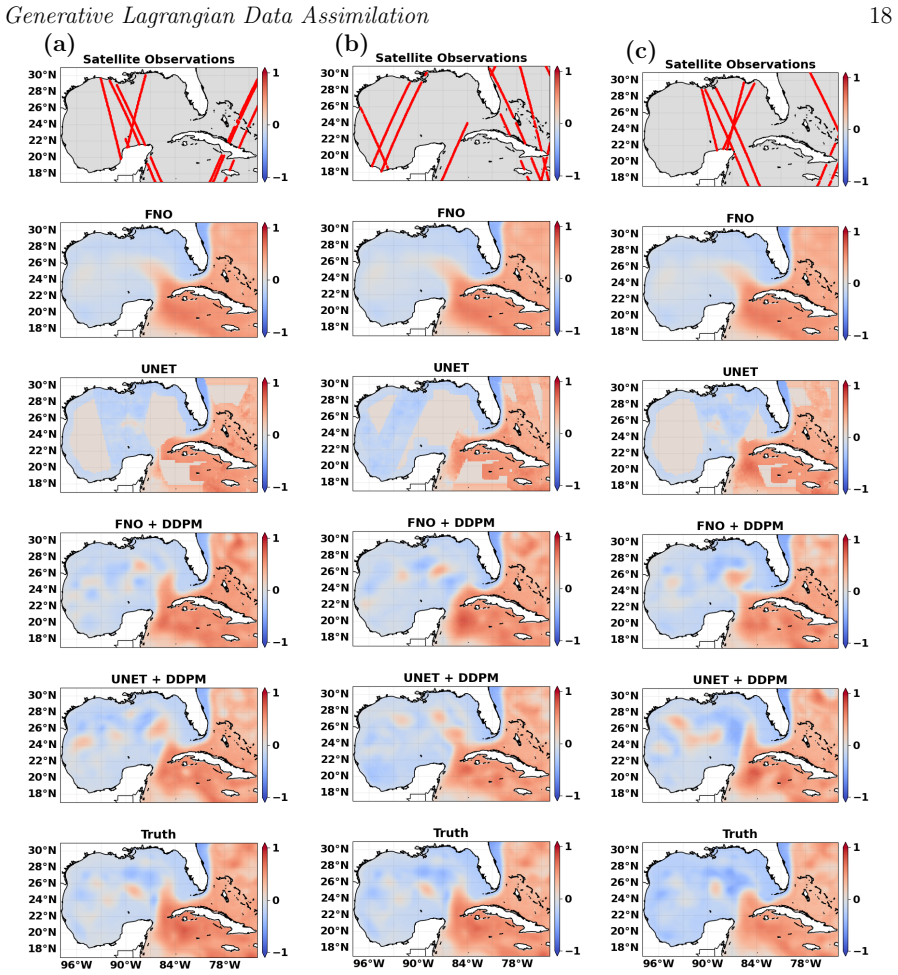
- [Section 3.3 and Abstract] The real-data validation has two problems. First, the sparsity level is inconsistent: the Abstract claims 99.9% sparsity for real satellite observations, while Section 3.3 and Figure 8 state approximately 99.7%. Second, the validation is partly circular: the CNAPS target fields were produced by assimilating the same DUACS satellite altimetry observations into ROMS, so System 3 demonstrates reconstruction of a reanalysis that already contains the input observations, not an independent ground-truth check. The authors should state this circularity explicitly, correct the sparsity number, and soften the claim that real-data performance validates Lagrangian reconstruction.
- [Section 4 (Conclusion and Discussion)] The conclusion states that the framework is 'a scalable, accurate, and computationally efficient alternative to traditional ocean data assimilation systems', but no traditional DA baseline (EnKF, 3D-Var, or optimal interpolation) is included in any experiment. The comparisons in Section 3 are only against UNET and FNO regressors. The comparative claim against DA systems is therefore unsupported by the presented evidence and should either be backed by a baseline experiment or removed from the conclusion.
minor comments (5)
- [Section 3.2] The text before Figure 7 contains a typo: 'FNO+DDMP' should read 'FNO+DDPM'.
- [Section 3.1 / Figure 4] The caption and text say the kinetic energy comparison is 'averaged over 3000 samples', but Section 2.1 describes only 7000 training samples and 100 independent test samples; please specify whether these 3000 samples are from training, validation, or an extra held-out set.
- [Section 2.1 / Section 3.2] For System 2, the paper does not specify the exact temporal locations of the 50 test samples beyond 'outside the training set'; please state the test period explicitly, since consecutive days from a single season would have strong autocorrelation and would change the interpretation of the reported standard deviations.
- [Section 3.3] Please state explicitly how the missing satellite grid cells are encoded as model input (e.g., zeros with a separate mask channel), because the model must distinguish 'unobserved' from 'observed value of zero' in the sparse SSH fields.
- [Equations (5)-(9)] Equation (7) defines the initial noisy sample u_T using the FNO prediction as the mean; please clarify in the text whether this is the actual initialization used at inference time for all reverse-pass steps or only a conceptual prior, and whether any correction is applied for the fact that the reverse chain in Eq. (8) is normally started from pure noise.
Circularity Check
Partial circularity in the real-data validation: the CNAPS target is generated from the same satellite altimetry observations used as model input, while the synthetic Systems 1 and 2 remain independent.
-
fitted input called prediction
[Section 2.1, System 3 (and Abstract, Section 3.3)]
"we validate our proposed framework on a third system using real satellite altimetry observations and a corresponding high-resolution reanalysis dataset, CNAPS [41], which was produced by assimilating these observations into the Regional Ocean Modeling System (ROMS) ... the model is trained to reconstruct full-resolution SSH fields from these sparse observations using the CNAPS reanalysis as the supervisory target."
The System 3 ground truth is not an independent observation of the ocean state: CNAPS is the output of a ROMS-based data assimilation system whose input includes the same sparse satellite SSH observations fed to the model. Training a model to map sparse observations to CNAPS, and then evaluating reconstruction skill against CNAPS, measures how well the model reproduces the assimilation product rather than how well it recovers an independently measured state. The target is therefore partly a function of the model input, so the real-data validation is partially forced by construction. The synthetic Systems 1 and 2 use external DNS and GLORYS targets and are not affected by this circularity.
full rationale
The core derivation is largely self-contained: in Systems 1 and 2, the models are trained on synthetic sparse inputs (random 99% removal) against full-resolution DNS and GLORYS targets that are not derived from the inputs, so those benchmark results are independent and not circular. The FNO-conditioned DDPM architecture is a straightforward combination of published components and does not smuggle in the target through a self-citation or ansatz. The only identified circular step is confined to System 3, where the CNAPS reanalysis used as the ground truth was itself produced by assimilating the very satellite altimetry observations used as model input; this weakens the claim of validation on real satellite data but does not invalidate the synthetic demonstrations. Self-citations to the authors' prior work on spectral bias and OceanNet are contextual and not load-bearing for the main reconstruction result. Overall circularity burden is low to moderate, warranting a score of 3 rather than 0.
Assumptions & free parameters
free parameters (5)
- FNO width =
20
- Number of FNO Fourier layers =
4
- Diffusion steps T =
1000
- Learning rate for FNO training =
0.001
- DDPM beta schedule endpoints (beta_start, beta_end) =
not reported
assumptions (4)
- domain assumption Random per-snapshot removal of 99% of grid points is analogous to Lagrangian observations.
- domain assumption CNAPS reanalysis is a valid ground truth for reconstruction skill.
- standard math Standard DDPM forward and reverse processes (Eqs. 5-9) are correct for conditional reconstruction.
- domain assumption Fourier power spectrum is a sufficient diagnostic of physical fidelity.
Cite this review
Pith. "Pith review of Generative Lagrangian data assimilation for ocean dynamics under extreme sparsity." pith.science (2026). https://pith.science/paper/3PUVBRQL
@misc{pith2026250706479,
  author       = {Pith},
  title        = {Pith review of: Generative Lagrangian data assimilation for ocean dynamics under extreme sparsity},
  year         = {2026},
  howpublished = {\url{https://pith.science/paper/3PUVBRQL}},
  note         = {Machine review of arXiv:2507.06479}
}
abstract
Reconstructing ocean dynamics from observational data is fundamentally limited by the sparse, irregular, and Lagrangian nature of spatial sampling, particularly in subsurface and remote regions. This sparsity poses significant challenges for forecasting key phenomena such as eddy shedding and rogue waves. Traditional data assimilation methods and deep learning models often struggle to recover mesoscale turbulence under such constraints. We leverage a deep learning framework that combines neural operators with denoising diffusion probabilistic models (DDPMs) to reconstruct high-resolution ocean states from extremely sparse Lagrangian observations. By conditioning the generative model on neural operator outputs, the framework accurately captures small-scale, high-wavenumber dynamics even at $99\%$ sparsity (for synthetic data) and $99.9\%$ sparsity (for real satellite observations). We validate our method on benchmark systems, synthetic float observations, and real satellite data, demonstrating robust performance under severe spatial sampling limitations as compared to other deep learning baselines.
Figures


Figures from the paper (6 more)



Forward citations
Cited by 1 Pith paper
-
GPU Performance of an Entropy-Stable Discontinuous Galerkin Euler Solver with Non-Conservative Terms
GPU port of entropy-stable DG Euler solver with non-conservative buoyancy terms reaches nearly 70% of 64-bit peak on A100 volume kernels, delivers 10x speedup and 13x better energy efficiency versus CPU, and preserves...
Reference graph
Works this paper leans on
-
[1]
These initial conditions are obtained from satellite altimeters, ocean buoys, drifters, etc
Introduction Forecasting multi-scale chaotic dynamical systems, e.g., the Earth’s ocean, requires a dynamical model of the system’s equations and accurate initial conditions. These initial conditions are obtained from satellite altimeters, ocean buoys, drifters, etc. [1, 2, 3]. All of these measuring devices that observe the different variables of the oce...
arXiv 2025
-
[2]
Methods 2.1. Systems In this section, we discuss the three different oceanic systems: a canonical high- resolution fluid flow simulation, regional high-resolution reanalysis data, and real satellite observations, for which we have validated our proposed model. System 1: We consider the 2D forced Kolmogorov flow on a β-plane at Re = 10,000. The governing e...
work page 1993
-
[3]
Results In this section, we demonstrate the performance of our proposed DDPM+FNO and DDPM+UNET models as compared to traditional UNET and FNO models in terms of statistical metrics such as RMSE, CC, SSIM, as well as physics-based metrics such as the Fourier spectrum of the reconstructed variables, kinetic energy, strain rate, and relative vorticity. It mu...
work page 2013
-
[4]
Conclusion and Discussion In this study, we introduced a novel generative modeling framework for reconstructing oceanic surface fields from highly sparse and non-stationary Lagrangian satellite observations. By conditioning denoising diffusion probabilistic models (DDPMs) on Fourier Neural Operator (FNO) predictions, we demonstrated significant improvemen...
-
[5]
NA and LJ conducted the research and developed the computational models with equal contributions
Acknowledgement AC and RH designed the research. NA and LJ conducted the research and developed the computational models with equal contributions. TW provided the satellite observations. NA and AC wrote the manuscript. All authors analyzed the results and edited the manuscript. AC and LJ were supported by the National Science Foundation (grant no. 2425667...
-
[6]
Data and Code The computational models used in this study are publicly available in https: //github.com/TACS-UCSC/GenDA-Lagrangian
-
[7]
2019 Frontiers in Marine Science 6 90
Moore A M, Martin M J, Akella S, Arango H G, Balmaseda M, Bertino L, Ciavatta S, Cornuelle B, Cummings J, Frolov S et al. 2019 Frontiers in Marine Science 6 90
work page 2019
-
[8]
Dickey T D 2003 Journal of Marine Systems 40 5–48
work page 2003
Show all 53 references
-
[9]
Kubota M, Iwasaka N, Kizu S, Konda M and Kutsuwada K 2002 Journal of oceanography 58 213–225
2002
-
[10]
Molcard A, Griffa A and ¨Ozg¨ okmen T M 2005Journal of Atmospheric and Oceanic Technology 22 70–83 Generative Lagrangian Data Assimilation 22
-
[11]
Salman H, Kuznetsov L, Jones C and Ide K 2006 Monthly Weather Review 134 1081–1101
2006
-
[12]
Kuznetsov L, Ide K and Jones C K 2003 Monthly Weather Review 131 2247–2260
2003
-
[13]
Apte A, Jones C K and Stuart A 2008 Tellus A: Dynamic Meteorology and Oceanography 60 336–347
2008
-
[14]
Bennett A F 2005 Inverse modeling of the ocean and atmosphere (Cambridge University Press)
2005
-
[15]
Molcard A, Piterbarg L I, Griffa A, ¨Ozg¨ okmen T M and Mariano A J 2003Journal of Geophysical Research: Oceans 108
-
[16]
Oke P R, Sakov P and Schulz E 2009 Dynamics of Atmospheres and Oceans 48 121–142
2009
-
[17]
Schulz-Stellenfleth J and Stanev E 2010 Ocean modelling 33 270–282
2010
-
[18]
Martin M, Hines A and Bell M 2007 Quarterly Journal of the Royal Meteorological Society: A journal of the atmospheric sciences, applied meteorology and physical oceanography 133 981– 995
2007
-
[19]
Lermusiaux P F 2006 Journal of Computational Physics 217 176–199
2006
-
[20]
Smith G C, Roy F, Mann P, Dupont F, Brasnett B, Lemieux J F, Laroche S and B´ elair S 2014 Quarterly Journal of the Royal Meteorological Society 140 881–894
2014
-
[21]
Edwards C A, Moore A M, Hoteit I and Cornuelle B D 2015 Annual review of marine science 7 21–42
2015
-
[22]
Evensen G 2003 Ocean dynamics 53 343–367
2003
-
[23]
Oke P R and Sakov P 2008 Journal of Atmospheric and Oceanic Technology 25 1004–1017
2008
-
[24]
Oke P R, Brassington G B, Griffin D A and Schiller A 2010 Australian Meteorological and Oceanographic Journal 59 67–76
2010
-
[25]
Xie J and Zhu J 2010 Ocean Modelling 33 283–298
2010
-
[26]
Oke P R, Sakov P and Corney S P 2007 Ocean Dynamics 57 32–45
2007
-
[27]
2022 arXiv preprint arXiv:2202.11214
Pathak J, Subramanian S, Harrington P, Raja S, Chattopadhyay A, Mardani M, Kurth T, Hall D, Li Z, Azizzadenesheli K et al. 2022 arXiv preprint arXiv:2202.11214
2022 arXiv
-
[28]
2022 arXiv preprint arXiv:2212.12794
Lam R, Sanchez-Gonzalez A, Willson M, Wirnsberger P, Fortunato M, Pritzel A, Ravuri S, Ewalds T, Alet F, Eaton-Rosen Z et al. 2022 arXiv preprint arXiv:2212.12794
2022 arXiv
-
[29]
Guan H, Arcomano T, Chattopadhyay A and Maulik R 2024 arXiv preprint arXiv:2405.16297
2024 arXiv
-
[30]
2023 arXiv preprint arXiv:2310.02074
Watt-Meyer O, Dresdner G, McGibbon J, Clark S K, Henn B, Duncan J, Brenowitz N D, Kashinath K, Pritchard M S, Bonev B et al. 2023 arXiv preprint arXiv:2310.02074
2023 arXiv
-
[31]
Watt-Meyer O, Henn B, McGibbon J, Clark S K, Kwa A, Perkins W A, Wu E, Harris L and Bretherton C S 2025 npj Climate and Atmospheric Science 8 1–15
2025
-
[32]
Chattopadhyay A, Gray M, Wu T, Lowe A B and He R 2024 Scientific Reports 14 21181 URL https://www.nature.com/articles/s41598-024-21181-0
2024
-
[33]
Lowe A B, Gray M, Chattopadhyay A, Wu T and He R 2025 Artificial Intelligence for the Earth Systems
2025
-
[34]
Gray M, Chattopadhyay A, Wu T, Lowe A and He R 2025 Ocean Science 21 1065–1080
2025
-
[35]
Dheeshjith S, Subel A, Adcroft A, Busecke J, Fernandez-Granda C, Gupta S and Zanna L 2025 Geophysical Research Letters 52 e2024GL114318
2025
-
[36]
2023 arXiv preprint arXiv:2312.12462
Chen K, Bai L, Ling F, Ye P, Chen T, Luo J J, Chen H, Xiao Y, Chen K, Han T et al. 2023 arXiv preprint arXiv:2312.12462
2023
-
[37]
2024 arXiv preprint arXiv:2407.15586
McNally A, Lessig C, Lean P, Boucher E, Alexe M, Pinnington E, Chantry M, Lang S, Burrows C, Chrust M et al. 2024 arXiv preprint arXiv:2407.15586
2024 arXiv
-
[38]
2025 Nature 641 1172–1179
Allen A, Markou S, Tebbutt W, Requeima J, Bruinsma W P, Andersson T R, Herzog M, Lane N D, Chantry M, Hosking J S et al. 2025 Nature 641 1172–1179
2025
-
[39]
Chattopadhyay A, Nabizadeh E, Bach E and Hassanzadeh P 2022arXiv preprint arXiv:2206.04811
-
[40]
Chattopadhyay A, Mustafa M, Hassanzadeh P, Bach E and Kashinath K 2022 Geoscientific Model Development 15 2221–2237
2022
-
[41]
Maulik R, Rao V, Wang J, Mengaldo G, Constantinescu E, Lusch B, Balaprakash P, Foster I and Kotamarthi R 2022 Geoscientific Model Development 15 3433–3445
2022
-
[42]
Martin S A, Manucharyan G E and Klein P 2024 EarthArXiv Under review at Journal of Advances Generative Lagrangian Data Assimilation 23 in Modeling Earth Systems (JAMES) URL https://doi.org/10.31223/X5WD6H
2024 doi
-
[44]
Chattopadhyay A and Hassanzadeh P 2023 arXiv preprint arXiv:2304.07029
2023 arXiv
-
[45]
Maltrud M and Vallis G 1991 Journal of Fluid Mechanics 228 321–342
1991
-
[46]
Garric G, Parent L, Greiner E, Dr´ evillon M, Hamon M, Lellouche J, R´ egnier C, Desportes C, Le Galloudec O, Bricaud C et al. 2018 Performance and quality assessment of the global ocean eddy-permitting physical reanalysis glorys2v4 Proceedings of the Eight EuroGOOS Internatio...
2018
-
[47]
He R, Wu T, Mao S, Zong H, Zambon J, Warrillow J, Dorton J and Hernandez D 2025 arXiv preprint arXiv:2503.06907
2025 arXiv
-
[48]
Storkey D, Blockley E, Furner R, Guiavarc’h C, Lea D, Martin M, Barciela R, Hines A, Hyder P and Siddorn J 2010 Journal of operational oceanography 3 3–15
2010
-
[49]
Ronneberger O, Fischer P and Brox T 2015 U-net: Convolutional networks for biomedical image segmentation Medical Image Computing and Computer-Assisted Intervention (MICCAI) (Springer) pp 234–241 URL http://lmb.informatik.uni-freiburg.de/Publications/2015/ RFB15a/
2015
-
[50]
Oommen V, Bora A, Zhang Z and Karniadakis G E 2024 arXiv preprint arXiv:2409.08477 URL https://arxiv.org/abs/2409.08477
2024 arXiv
-
[51]
Li Z, Kovachki N, Azizzadenesheli K, Liu B, Stuart A and Anandkumar A 2020 arXiv preprint arXiv:2010.08895 URL https://arxiv.org/abs/2010.08895
2020 arXiv
-
[52]
Lai C Y, Hassanzadeh P, Sheshadri A, Sonnewald M, Ferrari R and Balaji V 2023 Annual Review of Fluid Mechanics To appear URL https://arxiv.org/abs/2301.01341
2023 arXiv
-
[53]
Neha F, Bhati D, Shukla D K, Dalvi S M, Mantzou N and Shubbar S 2024 arXiv preprint arXiv:2412.02242 URL https://arxiv.org/abs/2412.02242
2024 arXiv
-
[54]
Lupin-Jimenez L, Darman M, Hazarika S, Wu T, Gray M, He R, Wong A and Chattopadhyay A 2025 arXiv preprint arXiv:2501.05058
2025 arXiv
Reviewed August 6, 2026 · model on record in the stance chip above.
Discussion (0). Sign in to comment.