REVIEW 4 major objections 3 minor 1 cited by
Landau theory for lattice higher gauge theory and Kramers-Wannier duality
T0 review · 4 major / 3 minor · reviewed 2026-08-06 · deepseek-v4-flash
Pith's one-line read This paper claims that lattice higher gauge theory on p-dimensional cells is exactly equivalent to a functional Landau field theory whose classical solutions reproduce the area and perimeter laws and whose Kramers-Wannier duality becomes…
desk verdict The exact Hubbard-Stratonovich rewriting is clean and general, but the weak-coupling deconfined phase and the claimed perimeter law rest on an uncomputed sign flip that, for the explicit weight, fails on large surfaces. read the letter →
The pith
A machine-rendered reading of the paper's core claim, the machinery that carries it, and where it could break.
The reading
What carries the argument
The machinery is the Hubbard-Stratonovich transformation driven by the plaquette-shift operator $\hat{H}$ (18), which converts the Wilson action into a quadratic form and introduces a functional field $\phi[C_p]$ on the space of closed p-dimensional surfaces. The kinetic term then involves the area derivative $\delta/\delta\sigma_{\mu_1\cdots\mu_{p+1}}$ (43), whose continuum limit supplies the d'Alembert operator in (56). The same operator structure makes the p-form global symmetry manifest, and the Fourier-transform and gauging steps in Section 5.1 yield the Kramers-Wannier duality that is the paper's bridge to an infrared duality between Landau theories.
What would settle it
Compute $|\omega[C_p]|^2$ for the weight functional (20) on a finite lattice; if $T_p^2 - (1/g^2)|\omega[C_p]|^2$ remains positive for all $g$, the broken phase, the perimeter law, and the infrared duality do not follow. Alternatively, a lattice Monte Carlo measurement of the Wilson-surface expectation value at small $g$ can directly test whether the perimeter law holds.
Extended reading notes
Core claim
On its own terms, the paper's central discovery is that the lattice higher gauge theory (7) is exactly equivalent to a functional scalar theory (26) on the space of self-avoiding closed p-dimensional surfaces, obtained by a Hubbard-Stratonovich transformation. In the classical continuum limit this becomes a Landau action (56) whose kinetic term is a d'Alembert operator built from area derivatives. Solving the functional equation of motion gives a classical solution that decays as $\exp(-T_p \,\mathrm{Vol}[M_{p+1}])$ in the strong-coupling limit, the area law, and in the weak-coupling limit a broken phase whose order parameter follows the perimeter law and whose low-energy fluctuations are described by p-form Maxwell theory for $\mathrm{U}(1)$ or by a BF-type topological field theory for finite abelian groups. The paper further constructs topological defects as higher-dimensional analogs of vortices and domain walls, uses them to argue the Coleman-Mermin-Wagner theorem for higher-form symmetries, and derives the Kramers-Wannier duality (159), which induces the infrared duality (173) between Landau field theories.
Load-bearing premise
The argument relies on the assertion that the quadratic coefficient $T_p^2 - (1/g^2)|\omega[C_p]|^2$ in Eq. (82) becomes negative for sufficiently small $g$, but $|\omega[C_p]|^2$ is never computed, so the sign flip is not demonstrated.
Editorial extensions
If this is right
- Confinement and deconfinement of p-form gauge theories can be diagnosed by a single mean-field Landau functional: strong coupling produces the area law (81), while weak coupling produces a broken phase with perimeter law.
- For compact U(1) higher-form symmetry, topological defects render the would-be Goldstone mode massive and prevent spontaneous symmetry breaking for $p \geq D-2$; finite abelian p-form symmetry cannot be spontaneously broken for $p \geq D-1$.
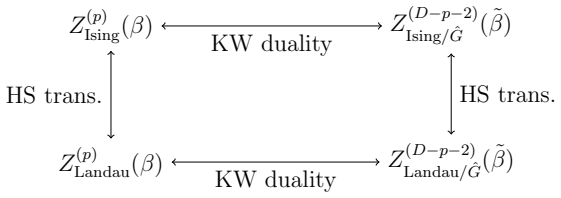
- Kramers-Wannier duality (159) implies an infrared duality (173) between the Landau theory of p-dimensional closed objects and the gauged Landau theory of $(D-p-2)$-dimensional closed objects, so closed objects of different dimensions can belong to the same universality class when they share the same higher-form symmetry.
- In $D=3$, $p=1$, the duality makes the confinement/deconfinement transition of $\mathbb{Z}_N$ lattice gauge theory a particle-like, 0-form transition rather than a string-like one.
- The constructed topological defects are higher-form analogs of global vortices and domain walls, with explicit field profiles determined by the dimensionless equations (113) and (125).
Reading between the lines
- If the central claim holds, a direct numerical test of the sign flip in Eq. (82) is available: evaluating $|\omega[C_p]|^2$ on finite lattices would determine whether the predicted broken phase actually occurs.
- If the infrared duality (173) holds, the critical exponents of $\mathbb{Z}_N$ p-form gauge theories should match those of gauged $(D-p-2)$-form scalar theories, a prediction that could be checked by Monte Carlo or tensor-network studies.
- The construction may extend to non-abelian groups or higher-group symmetries, but the Hubbard-Stratonovich potential (27) would no longer be quadratic in a simple character expansion, so that extension is not automatic.
- Because the Wilson-surface operator is promoted to a fundamental field, the world-volume tension $T_p$ appears as a mass parameter; tuning it across the sign-flip point would describe a brane-condensation transition, a phase structure the paper leaves implicit.
Editorial analysis
A structured set of objections, weighed in public.
Referee Report
Summary. This paper constructs a Landau-type field theory for lattice higher gauge theories on p-dimensional cells by performing an exact Hubbard-Stratonovich transformation that recasts the partition function as a functional integral over a complex scalar field living on the space of self-avoiding closed p-surfaces. The kinetic term becomes a second-order area-derivative operator, and the paper studies the classical continuum limit, mean-field phases, topological defects, the Coleman-Mermin-Wagner theorem for higher-form symmetries, and a Kramers-Wannier duality that is claimed to imply an infrared duality between Landau field theories. The central claim is that the classical solution of the Landau theory exhibits an area law in the strong-coupling limit and a perimeter law in the weak-coupling limit, corresponding respectively to confined and deconfined phases of the original higher gauge theory.
Significance. The paper contains a genuine and clean formal result: the exact equivalence between the lattice higher gauge theory and the functional scalar theory, displayed in Eqs. (22) and (26), is a nontrivial and useful rewriting, and the continuum kinetic term expressed through area derivatives (Eq. (56)) is a natural extension of earlier string-field-theory constructions. The construction of topological-defect solutions for U(1) and Z_N higher gauge theories, the derivation of the Coleman-Mermin-Wagner mechanism from monopole proliferation, and the formulation of a lattice KW duality that acts on the Landau side are interesting and potentially valuable. If the phase structure were fully established, the paper would provide a concrete mean-field framework for higher-form symmetry breaking and a new perspective on IR dualities between theories of extended objects. However, the significance is currently limited by gaps in the derivation of the weak-coupling broken phase and the perimeter-law statement, as detailed in the major comments.
major comments (4)
- [Sec. 4.2, Eq. (82)]
- [Sec. 4.1, Eqs. (73)-(81)]
- [Sec. 3.1 and Sec. 4.1]
- [Sec. 5.2 and Appendix D]
minor comments (3)
- [Sec. 4.3, heading]
- [Sec. 3.2, Eq. (56)]
- [Sec. 4.2, Eq. (86)-(87)]
Circularity Check
Area-law prediction reduces to the input tension T_p; HS and KW-duality sectors remain independent.
-
self definitional
[Sec. 3.3 (Eq. 65) and Sec. 4.1 (Eqs. 72, 80-81)]
"In the next section, we will see that T_p := sqrt(|mu|) corresponds to a world-volume tension of p-brane. ... f''(z) - T_p^2 f(z) ≈ 0 ... f(z) ≈ c × e^{-T_p Vol[M_{p+1}]}."
T_p is introduced in Eq. (57) as an arbitrary input parameter of the continuum action, T_p^2 ∝ a^{-2(p+1)}/(k0+1) for an arbitrary regulator constant k0, with no relation to the lattice inverse coupling β derived from the original gauge theory. The strong-coupling equation of motion (80) is then simply the free massive equation f'' = T_p^2 f, whose solution (81) has decay exponent T_p. Calling this a derivation of the area law is therefore equivalent to saying that the input mass parameter, already named 'bare p-brane tension', reappears as the output area-law exponent. The functional form is the solution of the equation one wrote down, and the tension is not predicted from the lattice gauge theory; it is an input renamed as a prediction.
full rationale
The exact Hubbard-Stratonovich rewriting (25)-(26) is a genuine identity, and the KW-duality derivation (159) follows from the standard Fourier/gauging manipulation of the lattice action; neither reduces to its own conclusion. The main circular step is confined to the mean-field 'prediction' of the area law: T_p is introduced by hand in Eq. (57) and then recovered as the decay exponent in Eq. (81), so this particular prediction is the input parameter renamed. The weak-coupling broken-phase argument in Eq. (82) is a robustness gap rather than a circularity: the coefficient |omega[C_p]|^2 is never evaluated, and with the explicit weight (20) it is volume-suppressed, so the claimed sign flip is not established; this is a correctness risk, not an equation identical to its conclusion. The author's prior works [19,26,27,36] are cited for area-derivative and mean-field technology, but the present paper defines those operations explicitly and does not rely on an unexamined self-citation chain for its exact equivalences. Overall, the exact dualities and the Landau-theory construction keep independent content, while one mean-field phase prediction is tautological.
Assumptions & free parameters
free parameters (7)
- alpha (brane tension in weight functional w) =
not specified; mass dimension p
- T_p (bare p-brane tension) =
proportional to a^{-(p+1)}/(k_0+1)^{1/2}
- N (path-integral normalization) =
set by N c_0(0) = 1
- c (constant in area-law solution) =
undetermined
- |omega[C_p]|^2 (quadratic potential coefficient) =
not computed
- xi (monopole fugacity) =
arbitrary
- lambda (defect self-coupling) =
1 (in numerics)
assumptions (7)
- domain assumption Restriction to self-avoiding closed surfaces Gamma_p (Sec 2)
- domain assumption Volume-suppression weight makes the surface sum convergent (Eq. 20)
- domain assumption Continuum limit replaces the surface sum by a path integral over embeddings (Eq. 52)
- ad hoc to paper General form of the potential expansion (30) and the sign flip of the quadratic term (82)
- ad hoc to paper Ansatz phi = f(Vol[M_{p+1}])/sqrt(2) in the strong-coupling equation of motion (Eq. 73)
- domain assumption Single phase transition as a function of coupling (footnote 7)
- ad hoc to paper Hausdorff dimension D_H = 2(p+1) of random surfaces (Sec 3.3)
invented entities (1)
-
Functional order-parameter field phi[C_p]
Cite this review
Pith. "Pith review of Landau theory for lattice higher gauge theory and Kramers-Wannier duality." pith.science (2026). https://pith.science/paper/6LOYB6QU
@misc{pith2026250706555,
  author       = {Pith},
  title        = {Pith review of: Landau theory for lattice higher gauge theory and Kramers-Wannier duality},
  year         = {2026},
  howpublished = {\url{https://pith.science/paper/6LOYB6QU}},
  note         = {Machine review of arXiv:2507.06555}
}
abstract
We derive a Landau field theory for a lattice higher gauge theory defined on $p$-dimensional open cells (i.e., sites, links, faces, cubes, etc.), and study its continuum-limit and phases. In this approach, the $p$-dimensional Wilson-surface operator of the higher gauge theory is promoted to a fundamental functional field that is charged under the $p$-form global symmetry. By explicitly solving the functional equation of motion, we show that the classical solution exhibits the area~(perimeter) law in the strong (weak) gauge coupling limit. In the deconfined phase, we also construct topological defects for both $\mathrm{U}(1)$ and $\mathbb{Z}_N^{}$ higher gauge theories, as analogs of vortex and domain-wall solutions in conventional field theories with $0$-form global symmetries. Besides, we examine low-energy effective theory by identifying the phase modulations of the functional field as low-energy modes, and discuss the Coleman-Mermin-Wagner theorem for higher-form global symmetries. Finally, we discuss infrared duality among Landau field theories, which originates from Kramers-Wannier duality in lattice higher gauge theories.
Figures


Figures from the paper (7 more)


Forward citations
Cited by 1 Pith paper
-
Revisiting wormhole-induced global symmetry breaking
Ensemble averaging over wormhole α-parameters is dominated by the symmetric point α=0 for spontaneously broken U(1) p-form symmetries, so standard PQ models evade the wormhole-induced axion quality problem.
Reference graph
Works this paper leans on
-
[1]
D. Gaiotto, A. Kapustin, N. Seiberg, and B. Willett,Generalized Global Symmetries, JHEP02(2015), 172,1412.5148
arXiv 2015
-
[2]
Kapustin,Wilson-’t Hooft operators in four-dimensional gauge theories and S- duality, Phys
A. Kapustin,Wilson-’t Hooft operators in four-dimensional gauge theories and S- duality, Phys. Rev. D74(2006), 025005,hep-th/0501015
arXiv 2006
-
[3]
T. Pantev and E. Sharpe,GLSM’s for Gerbes (and other toric stacks), Adv. Theor. Math. Phys.10(2006), no. 1, 77–121,hep-th/0502053
arXiv 2006
-
[4]
Z. Nussinov and G. Ortiz,A symmetry principle for topological quantum order, Annals Phys.324(2009), 977–1057,cond-mat/0702377
arXiv 2009
-
[5]
T. Banks and N. Seiberg,Symmetries and Strings in Field Theory and Gravity, Phys. Rev. D83(2011), 084019,1011.5120
arXiv 2011
-
[6]
A. Kapustin and R. Thorngren,Higher symmetry and gapped phases of gauge theories, (2013),1309.4721
arXiv 2013
-
[7]
O. Aharony, N. Seiberg, and Y. Tachikawa,Reading between the lines of four- dimensional gauge theories, JHEP08(2013), 115,1305.0318
arXiv 2013
-
[8]
A. Kapustin and N. Seiberg,Coupling a QFT to a TQFT and Duality, JHEP04 (2014), 001,1401.0740
arXiv 2014
Show all 51 references
-
[9]
Gaiotto, A
D. Gaiotto, A. Kapustin, Z. Komargodski, and N. Seiberg,Theta, Time Reversal, and Temperature, JHEP05(2017), 091,1703.00501
2017 arXiv
-
[10]
McGreevy,Generalized Symmetries in Condensed Matter, Ann
J. McGreevy,Generalized Symmetries in Condensed Matter, Ann. Rev. Condensed Matter Phys.14(2023), 57–82,2204.03045
2023 arXiv
-
[11]
T. D. Brennan and S. Hong,Introduction to Generalized Global Symmetries in QFT and Particle Physics, (2023),2306.00912
2023 arXiv
-
[12]
Bhardwaj, L
L. Bhardwaj, L. E. Bottini, L. Fraser-Taliente, L. Gladden, D. S. W. Gould, A. Platschorre, and H. Tillim,Lectures on generalized symmetries, Phys. Rept.1051 (2024), 1–87,2307.07547
2024 arXiv
-
[13]
Luo, Q.-R
R. Luo, Q.-R. Wang, and Y.-N. Wang,Lecture Notes on Generalized Symmetries and Applications, (2023),2307.09215
2023 arXiv
-
[14]
P. R. S. Gomes,An introduction to higher-form symmetries, SciPost Phys. Lect. Notes 74(2023), 1,2303.01817
2023 arXiv
-
[15]
Shao,What’s Done Cannot Be Undone: TASI Lectures on Non-Invertible Sym- metries, (2023),2308.00747
S.-H. Shao,What’s Done Cannot Be Undone: TASI Lectures on Non-Invertible Sym- metries, (2023),2308.00747. 45
2023 arXiv
-
[16]
Hayashi and Y
Y. Hayashi and Y. Tanizaki,Unifying Monopole and Center Vortex as the Semi- classical Confinement Mechanism, Phys. Rev. Lett.133(2024), no. 17, 171902, 2405.12402
2024 arXiv
-
[17]
Hidaka, M
Y. Hidaka, M. Nitta, and R. Yokokura,Selection rules of topological solitons from non-invertible symmetries in axion electrodynamics, (2024),2411.05434
2024 arXiv
-
[18]
Yoneya,A Path Functional Field Theory of Lattice Gauge Models and the LargeN Limit, Nucl
T. Yoneya,A Path Functional Field Theory of Lattice Gauge Models and the LargeN Limit, Nucl. Phys. B183(1981), 471–496
1981
-
[19]
Kawana,Classical Continuum Limit of the String Field Theory Dual to Lattice Gauge Theory, PTEP2025(2025), no
K. Kawana,Classical Continuum Limit of the String Field Theory Dual to Lattice Gauge Theory, PTEP2025(2025), no. 3, 033B07,2410.08552
2025 arXiv
-
[20]
A. A. Migdal,Loop Equations and 1/N Expansion, Phys. Rept.102(1983), 199–290
1983
-
[21]
Makeenko and A
Y. Makeenko and A. A. Migdal,Quantum Chromodynamics as Dynamics of Loops, Sov. J. Nucl. Phys.32(1980), 431
1980
-
[22]
A. M. Polyakov,Gauge Fields as Rings of Glue, Nucl. Phys. B164(1980), 171–188
1980
-
[23]
Kawai,A Dual Transformation of the Nielsen-olesen Model, Prog
H. Kawai,A Dual Transformation of the Nielsen-olesen Model, Prog. Theor. Phys.65 (1981), 351
1981
-
[24]
Rey,The Higgs Mechanism for Kalb-ramond Gauge Field, Phys
S.-J. Rey,The Higgs Mechanism for Kalb-ramond Gauge Field, Phys. Rev. D40 (1989), 3396
1989
-
[25]
Iqbal and J
N. Iqbal and J. McGreevy,Mean string field theory: Landau-Ginzburg theory for 1- form symmetries, SciPost Phys.13(2022), 114,2106.12610
2022 arXiv
-
[26]
Hidaka and K
Y. Hidaka and K. Kawana,Effective brane field theory with higher-form symmetry, JHEP01(2024), 016,2310.07993
2024 arXiv
-
[27]
Kawana,Field Theory for Superconducting Branes and Generalized Particle-Vortex Duality, (2024),2406.03670
K. Kawana,Field Theory for Superconducting Branes and Generalized Particle-Vortex Duality, (2024),2406.03670
2024 arXiv
-
[28]
Lake,Higher-form symmetries and spontaneous symmetry breaking, (2018), 1802.07747
E. Lake,Higher-form symmetries and spontaneous symmetry breaking, (2018), 1802.07747
2018 arXiv
-
[29]
H. A. Kramers and G. H. Wannier,Statistics of the two-dimensional ferromagnet. part i, Phys. Rev.60(1941), 252–262
1941
-
[30]
H. A. Kramers and G. H. Wannier,Statistics of the Two-Dimensional Ferromagnet. Part II, Phys. Rev.60(1941), 263–276
1941
-
[31]
Itzykson and J
C. Itzykson and J. M. Drouffe,STATISTICAL FIELD THEORY. VOL. 1: FROM BROWNIAN MOTION TO RENORMALIZATION AND LATTICE GAUGE THE- ORY, Cambridge Monographs on Mathematical Physics, CUP, 1989. 46
1989
-
[32]
Kaidi, K
J. Kaidi, K. Ohmori, and Y. Zheng,Kramers-Wannier-like Duality Defects in (3+1)D Gauge Theories, Phys. Rev. Lett.128(2022), no. 11, 111601,2111.01141
2022 arXiv
-
[33]
Koide, Y
M. Koide, Y. Nagoya, and S. Yamaguchi,Non-invertible topological defects in 4- dimensionalZ 2 pure lattice gauge theory, PTEP2022(2022), no. 1, 013B03, 2109.05992
2022 arXiv
-
[34]
Banks,THE GAUSSIAN TRANSFORMATION CONVERTS LATTICE GAUGE THEORY INTO A FIELD THEORY OF STRINGS, Phys
T. Banks,THE GAUSSIAN TRANSFORMATION CONVERTS LATTICE GAUGE THEORY INTO A FIELD THEORY OF STRINGS, Phys. Lett. B89(1980), 369– 372
1980
-
[35]
Nambu,Generalized Hamiltonian dynamics, Phys
Y. Nambu,Generalized Hamiltonian dynamics, Phys. Rev. D7(1973), 2405–2412
1973
-
[36]
Kawana,Phases and propagation of closed p-brane, (2025),2503.14902
K. Kawana,Phases and propagation of closed p-brane, (2025),2503.14902
2025 arXiv
-
[37]
Parisi,Hausdorff Dimensions and Gauge Theories, Phys
G. Parisi,Hausdorff Dimensions and Gauge Theories, Phys. Lett. B81(1979), 357– 360
1979
-
[38]
Distler, Z
J. Distler, Z. Hlousek, and H. Kawai,Hausdorff Dimension of Continuous Polyakov’s Random Surfaces or Who’ Afraid of Joseph Liouville? Part 2, Int. J. Mod. Phys. A 5(1990), 1093
1990
-
[39]
Kawai,Quantum gravity and random surfaces, Nucl
H. Kawai,Quantum gravity and random surfaces, Nucl. Phys. B Proc. Suppl.26 (1992), 93–110
1992
-
[40]
Kawai, N
H. Kawai, N. Kawamoto, T. Mogami, and Y. Watabiki,Transfer matrix formalism for two-dimensional quantum gravity and fractal structures of space-time, Phys. Lett. B306(1993), 19–26,hep-th/9302133
1993 arXiv
-
[41]
Ambjorn, D
J. Ambjorn, D. Boulatov, J. L. Nielsen, J. Rolf, and Y. Watabiki,The Spectral di- mension of 2-D quantum gravity, JHEP02(1998), 010,hep-th/9801099
1998 arXiv
-
[42]
Ambjørn and T
J. Ambjørn and T. Budd,The toroidal Hausdorff dimension of 2d Euclidean quantum gravity, Phys. Lett. B724(2013), 328–332,1305.3674
2013 arXiv
-
[43]
Villain, J.,A magnetic analogue of stereoisomerism : application to helimagnetism in two dimensions, J. Phys. France38(1977), no. 4, 385–391
1977
-
[44]
A. M. Polyakov,Compact Gauge Fields and the Infrared Catastrophe, Phys. Lett. B 59(1975), 82–84
1975
-
[45]
A. M. Polyakov,Quark Confinement and Topology of Gauge Groups, Nucl. Phys. B 120(1977), 429–458
1977
-
[46]
Panero,A Numerical study of confinement in compact QED, JHEP05(2005), 066, hep-lat/0503024
M. Panero,A Numerical study of confinement in compact QED, JHEP05(2005), 066, hep-lat/0503024. 47
2005 arXiv
-
[47]
Itzykson and J.-M
C. Itzykson and J.-M. Drouffe,Statistical field theory, Cambridge Monographs on Mathematical Physics, Cambridge University Press, 1989
1989
-
[48]
Nguyen, T
M. Nguyen, T. Sulejmanpasic, and M. ¨Unsal,Phases of Theories with ZN 1-Form Symmetry, and the Roles of Center Vortices and Magnetic Monopoles, Phys. Rev. Lett.134(2025), no. 14, 141902,2401.04800
2025 arXiv
-
[49]
M. E. Peskin,Mandelstam ’t Hooft Duality in Abelian Lattice Models, Annals Phys. 113(1978), 122
1978
-
[50]
Karch and D
A. Karch and D. Tong,Particle-Vortex Duality from 3d Bosonization, Phys. Rev. X 6(2016), no. 3, 031043,1606.01893
2016 arXiv
-
[51]
Hasenbusch,Direct Monte Carlo measurement of the surface tension in Ising mod- els, J
M. Hasenbusch,Direct Monte Carlo measurement of the surface tension in Ising mod- els, J. Phys. I(France)3(1993), no. 3, 753–765,hep-lat/9209016. 48
1993 arXiv
Reviewed August 6, 2026 · model on record in the stance chip above.
Discussion (0). Sign in to comment.