REVIEW 4 major objections 6 minor 82 references
Enhancing Diffusion Model Stability for Image Restoration via Gradient Management
T0 review · 4 major / 6 minor · reviewed 2026-08-06 · deepseek-v4-flash
Pith's one-line read The paper claims that diffusion-based image restoration is limited by conflicts and fluctuations between the denoising and likelihood gradients, and that SPGD's warm-up and adaptive momentum fix this, yielding state-of-the-art results on…
desk verdict Useful training-free stabilizer with a real warm-up win, but the SOTA-over-DPS claim is confounded by an unisolated schedule change. read the letter →
The pith
A machine-rendered reading of the paper's core claim, the machinery that carries it, and where it could break.
The reading
What carries the argument
The reverse-update gradient decomposition is the central object: Equation (9) splits each deterministic DDIM step into a fixed scaling, a denoising gradient $g_d$, and a likelihood gradient $g_l$. The progressive warm-up inner loop applies $N$ small updates $x_t^{(j+1)} = x_t^{(j)} - (\zeta/N)\tilde{g}_l(x_t^{(j)})$ before the denoiser is called, reducing directional conflict with the prior. The ADM recursion $\tilde{g}_l^{(j)} = \alpha_j \beta \tilde{g}_l^{(j-1)} + (1-\alpha_j\beta) g_l^{(j)}$, with $\alpha_j$ set by the cosine similarity between the momentum and the current gradient, damps temporal fluctuation while remaining responsive to real direction changes. Proposition 4.1 provides the theoretical support: under an $L$-Lipschitz likelihood gradient and step size below $1/L$, the warm-up phase decreases the likelihood objective at every timestep.
What would settle it
Run the original DPS solver under exactly the same conditions as SPGD—EDM schedule, $T=100$ outer steps, one likelihood update per step—on the same 1,000 FFHQ test images, and compare PSNR, SSIM, and LPIPS with full SPGD. If the metrics match or the gap largely disappears, the warm-up and ADM components are not the cause of the improvement; the schedule change is.
Extended reading notes
Core claim
On the paper's own terms, the central discovery is that the reverse process in a Bayesian diffusion solver can be decomposed into a fixed scaling, a denoising gradient $g_d(x_t)$, and a likelihood gradient $g_l(x_t)$, and that the instability of this two-gradient system is a measurable, fixable cause of poor restoration. The paper shows angular measurements of $g_d$ versus $g_l$ deviating from orthogonality in early timesteps and of $g_l$ versus its own previous value swinging widely in intermediate timesteps. SPGD addresses the first with a progressive warm-up: before each DDIM denoising step, it takes $N$ small steps guided only by the smoothed likelihood gradient, so the state already satisfies the measurement constraint when the prior gradient is applied. It addresses the second with adaptive directional momentum, whose effective momentum coefficient $\alpha_j \beta$ shrinks when the cosine similarity between the current and accumulated gradient drops. The paper claims these two mechanisms stabilize the whole reverse trajectory and yield state-of-the-art PSNR, SSIM, and LPIPS on FFHQ and ImageNet across four restoration tasks.
Load-bearing premise
The measured advantage of SPGD over DPS must come from the warm-up and momentum components, but the paper's ablation 'baseline' uses an improved EDM schedule with $T=100$ while the DPS numbers in Table 1 come from the original DDPM setup with 1,000 steps, and no DPS variant with the same schedule is reported.
Editorial extensions
If this is right
- If the claims hold, SPGD outperforms prior diffusion solvers on FFHQ and ImageNet across inpainting, Gaussian and motion deblurring, and 4x super-resolution, with the largest margins on inpainting and motion deblurring.
- SPGD reaches its best results with $T=100$ outer steps and $N=5$ warm-up steps, for 500 function evaluations, and the paper reports it surpasses DPS run for 1,000 steps; trajectory stabilization can substitute for extra sampling compute.
- The ablation attributes most of the gain to the warm-up; ADM alone does not help, but in combination it further improves LPIPS, so the two components work synergistically rather than redundantly.
- Proposition 4.1 implies the warm-up phase is a descent method on the likelihood objective at each timestep, so the state handed to the denoiser has lower reconstruction error whenever the step-size condition is met.
Reading between the lines
- A stricter control the paper leaves untested is DPS with SPGD's own EDM schedule and $T=100$; without it, part of the reported gap over DPS could be attributed to the schedule rather than to the proposed components.
- The same conflict-and-fluctuation diagnosis should transfer to other conditional diffusion settings where a likelihood-like guidance term is added to a denoising gradient—text-to-image, image-to-image translation, video generation—but the paper only lists these as future work.
- Proposition 4.1 covers the warm-up without momentum; a descent guarantee for the full ADM version would require bounding the bias introduced by the momentum term, which the paper does not attempt.
- A direct mechanism test would correlate per-sample early-conflict angles and fluctuation magnitudes with the gain SPGD delivers over the baseline; the paper's diagnosis predicts larger measured instability corresponds to larger improvement.
Editorial analysis
A structured set of objections, weighed in public.
Referee Report
Summary. The paper studies instability in DPS-style diffusion models for image restoration, attributing it to two gradient-level phenomena: directional conflict between the denoising gradient g_d and the likelihood gradient g_l in early reverse stages, and temporal fluctuation of g_l in intermediate stages. To address these, the authors propose SPGD, which combines (1) a progressive warm-up phase that performs N small likelihood-only gradient steps before each DDIM denoising step, and (2) Adaptive Directional Momentum (ADM) smoothing, which weights the momentum coefficient by the cosine similarity between successive likelihood gradients. The theoretical support is a descent lemma (Proposition 4.1) proving that the warm-up phase decreases the per-timestep likelihood objective under an L-smoothness condition when momentum is disabled. Experiments on FFHQ and ImageNet cover random inpainting, Gaussian and motion deblurring, and 4x super-resolution, with ablations over the design components, the inner step count N, and the momentum base coefficient β. The paper claims state-of-the-art quantitative results and improved generation stability, and the authors release code. The central empirical evidence for the method itself is the ablation table, but the headline comparison against DPS is confounded by a change of sampling schedule and step count.
Significance. The proposed warm-up plus adaptive-momentum recipe is simple, easy to implement on top of existing DPS-style solvers, and the ablation evidence (Table 2) shows a real gain over a shared-schedule baseline: roughly 1.3 dB PSNR on FFHQ inpainting and 1.7 dB on SRx4 at T=100, with consistent SSIM and LPIPS improvements. The paper ships code, reports per-task hyperparameters (Table 5), and gives a complete, checkable proof of its descent lemma, which is a genuine strength. If the controlled comparisons confirm the magnitude of the gain, the warm-up idea is a useful and immediately applicable contribution. However, the current experimental presentation substantially overstates what is established: the state-of-the-art claim over DPS is entangled with a schedule and step-count change whose effect (~4.2 dB on FFHQ inpainting) is several times larger than the method's own contribution, and one of the paper's central summary sentences is contradicted by its own Table 1. The proposition is correct but does not connect likelihood descent to final restoration quality, a limitation the paper's own N=20 ablation illustrates.
major comments (4)
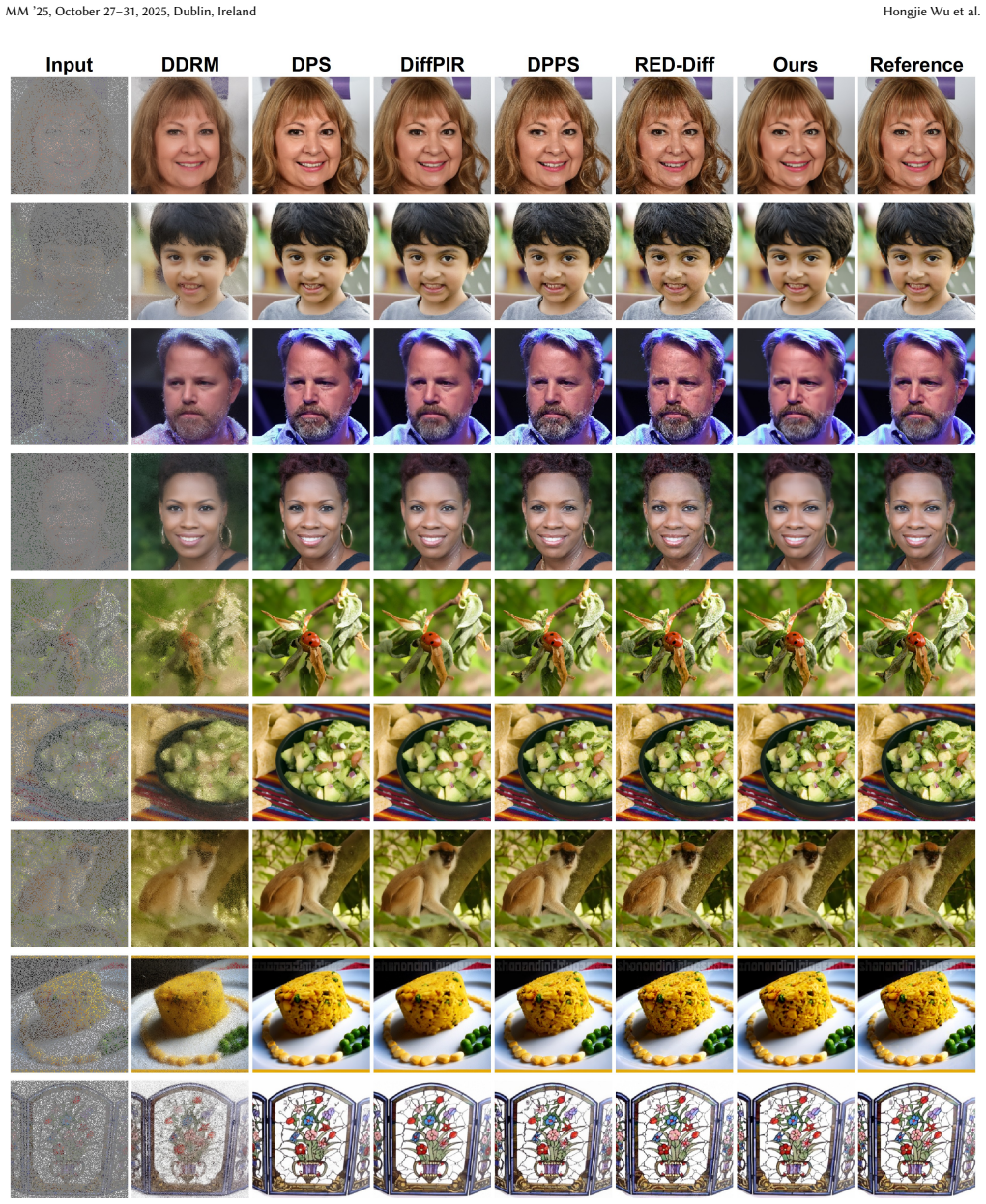
- [§5.1, Table 1, Table 2 footnote, Appendix D] The paper's headline claim of state-of-the-art performance over DPS rests on a comparison that is not isolated from a sampling-schedule change. Table 1 reports SPGD under the EDM schedule with T=100 and N=5 (Appendix D.2) against DPS numbers reproduced from the original DDPM 1000-step implementation (Appendix D.1), whereas the Table 2 ablation baseline, a single DPS-style likelihood correction per denoising step under SPGD's own EDM/T=100 settings, already attains 30.35 dB PSNR on FFHQ inpainting compared with 26.11 dB for DPS in Table 1; Table 3's T=100, N=1 row (30.357 dB) confirms the baseline value. Footnote 2 attributes this ~4.2 dB gap to 'improved experimental settings,' but the manuscript never reports a DPS or N=1 variant under the same EDM schedule, the same T=100 step count, the same per-task ζ values, and the full 1,000-image test set. Since the schedule and step-count change accounts for by far the larger part of the 4.76 dB gap between SPGD and DPS in Table 1, the claimed advantage of the proposed gradient management components over DPS is not established as reported and needs a controlled comparison or a reframed claim.
- [§5.2, Table 1] The sentence 'On the FFHQ dataset, our method achieves the best results for all metrics across all four degradation types' is contradicted by the numbers in Table 1. For SRx4, DDRM's PSNR (29.49) and SSIM (0.853) both exceed SPGD's (29.35 and 0.831); for Gaussian deblurring, DPPS (0.793), DPS (0.782), and DDRM (0.779) all report higher SSIM than SPGD (0.775). The ImageNet statements in the same section are more carefully qualified, but the FFHQ sentence and the abstract's unconditional 'state-of-the-art performance' wording should be corrected to match the table, for example by stating that SPGD achieves the best results on most metrics with the DDRM and DPPS exceptions noted.
- [§4.3, Proposition 4.1, Appendix B, Table 3 (N=20 row)] Proposition 4.1 is a correct but generic descent lemma for L-smooth objectives, and as theoretical support for SPGD it is limited in three specific ways. First, it covers only the β=0 (no-momentum) configuration, whereas the method's default β=0.95 with the ADM recursion of Eqs. (12)-(13) is precisely the component claimed to damp likelihood-gradient fluctuation, and Appendix C.3 concedes that a convergence analysis of the full method is out of scope. Second, the step-size hypothesis η < 1/L is never verified for the actual experimental choices (ζ/N with ζ between 1 and 8), since no Lipschitz constant L is estimated or bounded. Third, and most importantly, the proposition establishes descent only in the per-timestep likelihood objective L_t, which is by construction the quantity the warm-up is designed to decrease, and the paper's own N=20 ablation (Table 3: PSNR drops to 29.90 from 31.63 at N=5) shows that continuing to decrease that objective can degrade final restoration quality. The proposition therefore does not connect likelihood descent to final PSNR/SSIM/LPIPS, and the sentence claiming that it shows SPGD yields a better estimate x-hat_0 should be scoped explicitly to the likelihood objective.
- [§5.4.2, Table 3, Figure 6] The DPS reference rows in Table 3 (T=500 and T=1000 with N=1) are not specified as to sampling schedule, ζ tuning, or update order relative to the SPGD configuration, so the reader cannot tell whether the comparison is controlled; the T=100/N=1 value of 30.357 matching the EDM-based Table 2 baseline suggests these rows do not use the original DDPM schedule of the Table 1 DPS implementation. Under that reading, SPGD at 500 NFEs (31.631 dB) surpasses the T=1000 reference (31.608 dB) by only 0.023 dB PSNR, which does not support the text's 'significantly outperforms ... and even surpasses' wording. Figure 6 likewise compares SPGD (T=100, N=5) with a T=500 curve on a timestep axis, conflating the gradient-management effect with the different outer-step discretization; a matched comparison at equal T, equal NFEs, and clearly stated schedules is required before the efficiency claim can be assessed.
minor comments (6)
- [§5.1, Appendix D.1] The sentence 'All experiments are conducted using the same pre-trained models and a fixed random seed to ensure fair comparisons' is at odds with Appendix D.1, which specifies that DPS outcomes come from the original 1,000-step DDPM implementation; the sentence should state explicitly what is matched (checkpoints, seeds) and what is not (schedule, step count, guidance hyperparameters).
- [§3.2, Figure 2] The claims of 'significant' gradient conflict and fluctuation are supported only by single-sample angle traces without averaging or dispersion; reporting per-dataset mean angle trajectories with error bars, and quantifying the fluctuation claim (for example, the mean absolute change of consecutive g_l angles) with a before/after ADM comparison, would make the diagnostic section falsifiable.
- [§5.4.1, Algorithm 1] The 'ADM-only' ablation variant in Table 2 is not specified anywhere in Algorithm 1 or the appendix, and the explanation in §5.4.1 describes momentum as accumulating across outer timesteps (t-1, t, ...), while Algorithm 1 re-initializes the momentum buffer at every outer step (lines 5-6); the variant's update rule must be pinned down for the synergy claim to be reproducible.
- [§5.4.2, Figure 6] The text refers to the comparison curve as 'DPS (T=500)' while the figure caption calls it 'the baseline without gradient management (T=500)'; these are different objects, and the horizontal axis should be expressed in NFEs rather than timesteps to match the 'same NFEs' argument, since SPGD uses T=100 and the reference uses T=500.
- [§2.2, Equation (9)] The phrase 'The another category of methods' is ungrammatical, and the likelihood gradient in Eq. (9) is displayed with the ζ factor while the g_l notation in Algorithm 1 denotes the unweighted gradient; the paper should state explicitly that ζ is applied in the update rule to avoid confusion.
- [Appendix C.1] The novelty discussion mentions the authors' own prior work on history-gradient updates (ref. [17]) but does not specify the algorithmic difference between that momentum/history mechanism and the proposed ADM beyond the adaptive weight in Eq. (13); a concrete comparison would clarify the contribution over [17].
Circularity Check
No load-bearing circularity: SPGD's empirical gains come from shared-schedule ablations; the DPS comparison issue is a confound, not a circular derivation.
full rationale
SPGD's derivation chain is not circular under the definitions in the prompt. Proposition 4.1 is a standard descent lemma for gradient descent on the likelihood objective L_t; the warm-up update in Eq. (10) is exactly gradient descent on L_t, and the proposition states the usual descent consequence rather than assuming the paper's restoration-quality claims. The state-of-the-art claim rests on Tables 1-3. Table 2 ablates warm-up and ADM on a shared EDM T=100 schedule, so the warm-up-over-baseline gain (30.35 to 31.63 PSNR on FFHQ inpainting) is an empirical result, not an identity; the paper also honestly reports that ADM alone does not improve metrics. No fitted parameter is renamed as a prediction: zeta is tuned per task, but the evaluated quantities are PSNR/SSIM/LPIPS on held-out images, and comparisons use shared pre-trained checkpoints. The paper's self-citations ([17], [57]) appear as related-work context and comparison baselines and are not used to justify the core mechanism. The Footnote 2 discrepancy between the Table 2 baseline and DPS is a potential experimental confound (different schedules and step counts), but a confounded benchmark comparison is a validity concern, not circularity, because no equation reduces to an input or to a self-citation chain.
Assumptions & free parameters
free parameters (4)
- zeta (likelihood step size) =
2.5 (inpainting), 1.5/1 (Gaussian deblur for FFHQ/ImageNet), 1 (motion), 8/7 (SR for FFHQ/ImageNet)
- beta (ADM base momentum) =
0.95
- N (warm-up steps) =
5
- T (outer diffusion steps) =
100
assumptions (3)
- domain assumption The likelihood objective L_t(x_t) has an L-Lipschitz gradient for a finite L that satisfies eta < 1/L.
- domain assumption The DPS Laplacian approximation p_t(y|x_t) ~ p_t(y|hat x_0(x_t)) provides a valid likelihood gradient.
- domain assumption The pre-trained diffusion model provides an accurate prior score, and the denoising gradient g_d is stable and reliable.
Cite this review
Pith. "Pith review of Enhancing Diffusion Model Stability for Image Restoration via Gradient Management." pith.science (2026). https://pith.science/paper/D3DIJID3
@misc{pith2026250706656,
  author       = {Pith},
  title        = {Pith review of: Enhancing Diffusion Model Stability for Image Restoration via Gradient Management},
  year         = {2026},
  howpublished = {\url{https://pith.science/paper/D3DIJID3}},
  note         = {Machine review of arXiv:2507.06656}
}
read the original abstract
Diffusion models have shown remarkable promise for image restoration by leveraging powerful priors. Prominent methods typically frame the restoration problem within a Bayesian inference framework, which iteratively combines a denoising step with a likelihood guidance step. However, the interactions between these two components in the generation process remain underexplored. In this paper, we analyze the underlying gradient dynamics of these components and identify significant instabilities. Specifically, we demonstrate conflicts between the prior and likelihood gradient directions, alongside temporal fluctuations in the likelihood gradient itself. We show that these instabilities disrupt the generative process and compromise restoration performance. To address these issues, we propose Stabilized Progressive Gradient Diffusion (SPGD), a novel gradient management technique. SPGD integrates two synergistic components: (1) a progressive likelihood warm-up strategy to mitigate gradient conflicts; and (2) adaptive directional momentum (ADM) smoothing to reduce fluctuations in the likelihood gradient. Extensive experiments across diverse restoration tasks demonstrate that SPGD significantly enhances generation stability, leading to state-of-the-art performance in quantitative metrics and visually superior results. Code is available at https://github.com/74587887/SPGD.
Figures


Figures from the paper (12 more)




Reference graph
Works this paper leans on
-
[1]
Ismail Alkhouri, Shijun Liang, Cheng-Han Huang, Jimmy Dai, Qing Qu, Saiprasad Ravishankar, and Rongrong Wang. 2024. SITCOM: Step-wise Triple-Consistent Diffusion Sampling for Inverse Problems. arXiv preprint arXiv:2410.04479 (2024)
arXiv 2024
-
[2]
Jiezhang Cao, Yue Shi, Kai Zhang, Yulun Zhang, Radu Timofte, and Luc Van Gool
-
[3]
Gabriel Cardoso, Yazid Janati el idrissi, Sylvain Le Corff, and Eric Moulines. 2024. Monte Carlo guided Denoising Diffusion models for Bayesian linear inverse problems.. In The Twelfth International Conference on Learning Representations . https://openreview.net/forum?id=nHESwXvxWK
work page 2024
-
[4]
Hernan Carrillo, Michaël Clément, Aurélie Bugeau, and Edgar Simo-Serra. 2023. Diffusart: Enhancing line art colorization with conditional diffusion models. In Proceedings of the IEEE/CVF Conference on Computer Vision and Pattern Recognition. 3486–3490
work page 2023
-
[5]
Stanley H Chan, Xiran Wang, and Omar A Elgendy. 2016. Plug-and-play ADMM for image restoration: Fixed-point convergence and applications. IEEE Transac- tions on Computational Imaging 3, 1 (2016), 84–98
work page 2016
-
[6]
Zheng Chen, Yulun Zhang, Ding Liu, Jinjin Gu, Linghe Kong, Xin Yuan, et al
-
[7]
Jooyoung Choi, Sungwon Kim, Yonghyun Jeong, Youngjune Gwon, and Sungroh Yoon. 2021. ILVR: Conditioning Method for Denoising Diffusion Probabilistic Models. In 2021 IEEE/CVF International Conference on Computer Vision (ICCV) . IEEE, 14347–14356
work page 2021
-
[8]
Advances in neural information processing systems 36 (2024)
Hierarchical integration diffusion model for realistic image deblurring. Advances in neural information processing systems 36 (2024)
work page 2024
Show all 82 references
-
[9]
Hyungjin Chung, Byeongsu Sim, Dohoon Ryu, and Jong Chul Ye. 2022. Improving Diffusion Models for Inverse Problems using Manifold Constraints. InAdvances in Neural Information Processing Systems , Alice H. Oh, Alekh Agarwal, Danielle Bel- grave, and Kyunghyun Cho (Eds.). https:...
2022
-
[10]
Hyungjin Chung, Jeongsol Kim, Michael Thompson Mccann, Marc Louis Klasky, and Jong Chul Ye. 2023. Diffusion Posterior Sampling for General Noisy In- verse Problems. In International Conference on Learning Representations . https: //openreview.net/forum?id=OnD9zGAGT0k
2023
-
[11]
Prafulla Dhariwal and Alexander Nichol. 2021. Diffusion models beat gans on image synthesis. Advances in neural information processing systems 34 (2021), 8780–8794
2021
-
[12]
Hyungjin Chung, Jong Chul Ye, Peyman Milanfar, and Mauricio Delbracio. 2024. Prompt-tuning Latent Diffusion Models for Inverse Problems. In Forty-first In- ternational Conference on Machine Learning . https://openreview.net/forum?id= hrwIndai8e
2024
-
[13]
Zehao Dou and Yang Song. 2024. Diffusion Posterior Sampling for Linear Inverse Problem Solving: A Filtering Perspective. In The Twelfth International Conference on Learning Representations. https://openreview.net/forum?id=tplXNcHZs1
2024
-
[14]
Anh-Dung Dinh, Daochang Liu, and Chang Xu. 2023. PixelAsParam: A Gradient View on Diffusion Sampling with Guidance. InProceedings of the 40th International Conference on Machine Learning, Vol. 202. PMLR, 8120–8137. https://proceedings. mlr.press/v202/dinh23a.html
2023
-
[15]
Omar Elharrouss, Noor Almaadeed, Somaya Al-Maadeed, and Younes Akbari
-
[16]
Bradley Efron. 2011. Tweedie’s formula and selection bias. J. Amer. Statist. Assoc. 106, 496 (2011), 1602–1614
2011
-
[17]
Linchao He, Hongyu Yan, Mengting Luo, Hongjie Wu, Kunming Luo, Wang Wang, Wenchao Du, Hu Chen, Hongyu Yang, Yi Zhang, and Jiancheng Lv
-
[18]
Jonathan Ho, Ajay Jain, and Pieter Abbeel. 2020. Denoising diffusion probabilistic models. Advances in Neural Information Processing Systems 33 (2020), 6840–6851
2020
-
[19]
Martin Nicolas Everaert, Athanasios Fitsios, Marco Bocchio, Sami Arpa, Sabine Süsstrunk, and Radhakrishna Achanta. 2024. Exploiting the signal-leak bias in diffusion models. InProceedings of the IEEE/CVF Winter Conference on Applications of Computer Vision. 4025–4034
2024
-
[20]
William Huang, Yifeng Jiang, Tom Van Wouwe, and Karen Liu. 2024. Constrained diffusion with trust sampling. Advances in Neural Information Processing Systems 37 (2024), 93849–93873
2024
-
[21]
arXiv:2307.12070 [cs.CV] https://arxiv.org/abs/2307.12070
Fast and Stable Diffusion Inverse Solver with History Gradient Update. arXiv:2307.12070 [cs.CV] https://arxiv.org/abs/2307.12070
-
[22]
Tero Karras, Samuli Laine, and Timo Aila. 2019. A style-based generator ar- chitecture for generative adversarial networks. In Proceedings of the IEEE/CVF conference on computer vision and pattern recognition . 4401–4410
2019
-
[23]
Shudong Huang, Hongjie Wu, Yazhou Ren, Ivor Tsang, Zenglin Xu, Wentao Feng, and Jiancheng Lv. 2022. Multi-view subspace clustering on topological manifold. Advances in Neural Information Processing Systems 35 (2022), 25883–25894
2022
-
[24]
Michel Ledoux. 2001. The concentration of measure phenomenon . Number 89. American Mathematical Soc
2001
-
[25]
Tero Karras, Miika Aittala, Timo Aila, and Samuli Laine. 2022. Elucidating the design space of diffusion-based generative models.Advances in neural information processing systems 35 (2022), 26565–26577
2022
-
[26]
Xiang Li, Soo Min Kwon, Ismail R Alkhouri, Saiprasad Ravishankar, and Qing Qu. 2024. Decoupled data consistency with diffusion purification for image restoration. arXiv preprint arXiv:2403.06054 (2024)
2024 arXiv
-
[27]
Bahjat Kawar, Michael Elad, Stefano Ermon, and Jiaming Song. 2022. Denoising Diffusion Restoration Models. In Advances in Neural Information Processing Sys- tems, Alice H. Oh, Alekh Agarwal, Danielle Belgrave, and Kyunghyun Cho (Eds.). https://openreview.net/forum?id=kxXvopt9pWK
2022
-
[28]
Andreas Lugmayr, Martin Danelljan, Andres Romero, Fisher Yu, Radu Timofte, and Luc Van Gool. 2022. Repaint: Inpainting using denoising diffusion proba- bilistic models. In Proceedings of the IEEE/CVF conference on computer vision and pattern recognition. 11461–11471
2022
-
[29]
Jaakko Lehtinen, Jacob Munkberg, Jon Hasselgren, Samuli Laine, Tero Karras, Miika Aittala, and Timo Aila. 2018. Noise2Noise: Learning image restoration without clean data. InInternational Conference on Machine Learning. International Machine Learning Society, 4620–4631
2018
-
[30]
Chenlin Meng, Robin Rombach, Ruiqi Gao, Diederik Kingma, Stefano Ermon, Jonathan Ho, and Tim Salimans. 2023. On distillation of guided diffusion mod- els. In Proceedings of the IEEE/CVF Conference on Computer Vision and Pattern Recognition. 14297–14306
2023
-
[31]
Jingyun Liang, Jiezhang Cao, Guolei Sun, Kai Zhang, Luc Van Gool, and Radu Timofte. 2021. Swinir: Image restoration using swin transformer. In Proceedings of the IEEE/CVF International Conference on Computer Vision . 1833–1844
2021
-
[32]
Xinyu Peng, Ziyang Zheng, Wenrui Dai, Nuoqian Xiao, Chenglin Li, Junni Zou, and Hongkai Xiong. 2024. Improving Diffusion Models for Inverse Problems Using Optimal Posterior Covariance. In International Conference on Machine Learning. PMLR, 40347–40370
2024
-
[33]
Morteza Mardani, Jiaming Song, Jan Kautz, and Arash Vahdat. 2024. A Variational Perspective on Solving Inverse Problems with Diffusion Models. In The Twelfth International Conference on Learning Representations . https://openreview.net/ forum?id=1YO4EE3SPB
2024
-
[34]
Barron, and Ben Mildenhall
Ben Poole, Ajay Jain, Jonathan T. Barron, and Ben Mildenhall. 2022. DreamFusion: Text-to-3D using 2D Diffusion. arXiv (2022)
2022
-
[35]
Peyman Milanfar. 2012. A tour of modern image filtering: New insights and methods, both practical and theoretical. IEEE Signal Processing Magazine 30, 1 (2012), 106–128
2012
-
[36]
Litu Rout, Yujia Chen, Abhishek Kumar, Constantine Caramanis, Sanjay Shakkot- tai, and Wen-Sheng Chu. 2024. Beyond first-order tweedie: Solving inverse problems using latent diffusion. In Proceedings of the IEEE/CVF Conference on Computer Vision and Pattern Recognition . 9472–9481
2024
-
[37]
Boris T Polyak. 1964. Some methods of speeding up the convergence of iteration methods. Ussr computational mathematics and mathematical physics 4, 5 (1964), 1–17
1964
-
[38]
Olga Russakovsky, Jia Deng, Hao Su, Jonathan Krause, Sanjeev Satheesh, Sean Ma, Zhiheng Huang, Andrej Karpathy, Aditya Khosla, Michael Bernstein, et al
-
[39]
Robin Rombach, Andreas Blattmann, Dominik Lorenz, Patrick Esser, and Björn Ommer. 2022. High-resolution image synthesis with latent diffusion models. In Proceedings of the IEEE/CVF Conference on Computer Vision and Pattern Recognition. 10684–10695
2022
-
[40]
Chitwan Saharia, Jonathan Ho, William Chan, Tim Salimans, David J Fleet, and Mohammad Norouzi. 2022. Image Super-Resolution via Iterative Refinement. IEEE Transactions on Pattern Analysis and Machine Intelligence 45, 4 (2022), 4713– 4726
2022
-
[41]
Litu Rout, Negin Raoof, Giannis Daras, Constantine Caramanis, Alex Dimakis, and Sanjay Shakkottai. 2023. Solving Linear Inverse Problems Provably via Posterior Sampling with Latent Diffusion Models. In Thirty-seventh Conference on Neural Information Processing Systems
2023
-
[42]
Jascha Sohl-Dickstein, Eric Weiss, Niru Maheswaranathan, and Surya Ganguli
-
[43]
Bowen Song, Soo Min Kwon, Zecheng Zhang, Xinyu Hu, Qing Qu, and Liyue Shen. 2024. Solving Inverse Problems with Latent Diffusion Models via Hard Data Consistency. In The Twelfth International Conference on Learning Representations . https://openreview.net/forum?id=j8hdRqOUhN
2024
-
[44]
Chitwan Saharia, William Chan, Huiwen Chang, Chris Lee, Jonathan Ho, Tim Salimans, David Fleet, and Mohammad Norouzi. 2022. Palette: Image-to-image diffusion models. In ACM SIGGRAPH 2022 Conference Proceedings . 1–10
2022
-
[45]
Jiaming Song, Arash Vahdat, Morteza Mardani, and Jan Kautz. 2023. Pseudoinverse-Guided Diffusion Models for Inverse Problems. In International Conference on Learning Representations . https://openreview.net/forum?id=9_ gsMA8MRKQ
2023
-
[46]
Vedant Singh, Surgan Jandial, Ayush Chopra, Siddharth Ramesh, Balaji Krish- namurthy, and Vineeth N Balasubramanian. 2022. On conditioning the input noise for controlled image generation with diffusion models. arXiv preprint arXiv:2205.03859 (2022)
2022 arXiv
-
[47]
Yang Song, Jascha Sohl-Dickstein, Diederik P Kingma, Abhishek Kumar, Stefano Ermon, and Ben Poole. 2021. Score-Based Generative Modeling through Stochas- tic Differential Equations. In International Conference on Learning Representations. https://openreview.net/forum?id=PxTIG12RRHS
2021
-
[48]
In MM ’25, October 27–31, 2025, Dublin, Ireland Hongjie Wu et al
Deep unsupervised learning using nonequilibrium thermodynamics. In MM ’25, October 27–31, 2025, Dublin, Ireland Hongjie Wu et al. International Conference on Machine Learning . PMLR, 2256–2265
2025
-
[49]
Ilya Sutskever, James Martens, George Dahl, and Geoffrey Hinton. 2013. On the importance of initialization and momentum in deep learning. In International conference on machine learning . PMLR, 1139–1147
2013
-
[50]
Jiaming Song, Chenlin Meng, and Stefano Ermon. 2021. Denoising Diffusion Implicit Models. In International Conference on Learning Representations . https: //openreview.net/forum?id=St1giarCHLP
2021
-
[51]
Michel Talagrand. 1995. Concentration of measure and isoperimetric inequalities in product spaces. Publications Mathématiques de l’Institut des Hautes Etudes Scientifiques 81 (1995), 73–205
1995
-
[52]
Yang Song, Liyue Shen, Lei Xing, and Stefano Ermon. 2022. Solving Inverse Problems in Medical Imaging with Score-Based Generative Models. In Interna- tional Conference on Learning Representations . https://openreview.net/forum?id= vaRCHVj0uGI
2022
-
[53]
Xiyu Wang, Anh-Dung Dinh, Daochang Liu, and Chang Xu. 2024. Boosting diffusion models with an adaptive momentum sampler. In Proceedings of the Thirty-Third International Joint Conference on Artificial Intelligence . 1416–1424
2024
-
[54]
Charles M Stein. 1981. Estimation of the mean of a multivariate normal distribu- tion. The annals of Statistics (1981), 1135–1151
1981
-
[55]
Z Wang, AC Bovik, HR Sheikh, and EP Simoncelli. 2004. Image quality assessment: from error visibility to structural similarity.IEEE Transactions on Image Processing 13, 4 (2004), 600–612
2004
-
[56]
Ying Tai, Jian Yang, Xiaoming Liu, and Chunyan Xu. 2017. Memnet: A persistent memory network for image restoration. In Proceedings of the IEEE International Conference on Computer Vision . 4539–4547
2017
-
[57]
Hongjie Wu, Linchao He, Mingqin Zhang, Dongdong Chen, Kunming Luo, Mengting Luo, Ji-Zhe Zhou, Hu Chen, and Jiancheng Lv. 2024. Diffusion Posterior Proximal Sampling for Image Restoration. In ACM Multimedia 2024. https://openreview.net/forum?id=Wzqrle4BzA
2024
-
[58]
Jianyi Wang, Zongsheng Yue, Shangchen Zhou, Kelvin CK Chan, and Chen Change Loy. 2024. Exploiting diffusion prior for real-world image super- resolution. International Journal of Computer Vision 132, 12 (2024), 5929–5949
2024
-
[59]
Jia-Hao Wu, Fu-Jen Tsai, Yan-Tsung Peng, Chung-Chi Tsai, Chia-Wen Lin, and Yen-Yu Lin. 2024. Id-blau: Image deblurring by implicit diffusion-based reblurring augmentation. In Proceedings of the IEEE/CVF Conference on Computer Vision and Pattern Recognition. 25847–25856
2024
-
[60]
Yinhuai Wang, Jiwen Yu, and Jian Zhang. 2023. Zero-Shot Image Restora- tion Using Denoising Diffusion Null-Space Model. In The Eleventh Interna- tional Conference on Learning Representations . https://openreview.net/forum?id= mRieQgMtNTQ
2023
-
[61]
Bin Xia, Yulun Zhang, Shiyin Wang, Yitong Wang, Xinglong Wu, Yapeng Tian, Wenming Yang, and Luc Van Gool. 2023. Diffir: Efficient diffusion model for image restoration. In Proceedings of the IEEE/CVF International Conference on Computer Vision. 13095–13105
2023
-
[62]
Yuanbo Wen, Tao Gao, and Ting Chen. 2024. Unpaired Photo-realistic Image Deraining with Energy-informed Diffusion Model. In ACM Multimedia 2024 . https://openreview.net/forum?id=9ACKEhyS8u
2024
-
[63]
Haotian Ye, Haowei Lin, Jiaqi Han, Minkai Xu, Sheng Liu, Yitao Liang, Jianzhu Ma, James Y Zou, and Stefano Ermon. 2024. Tfg: Unified training-free guidance for diffusion models. Advances in Neural Information Processing Systems 37 (2024), 22370–22417
2024
-
[64]
Hongjie Wu, Shudong Huang, Chenwei Tang, Yancheng Zhang, and Jiancheng Lv. 2023. Pure graph-guided multi-view subspace clustering. Pattern Recognition 136 (2023), 109187
2023
-
[65]
Jiahui Yu, Zhe Lin, Jimei Yang, Xiaohui Shen, Xin Lu, and Thomas S Huang
-
[66]
Zihui Wu, Yu Sun, Yifan Chen, Bingliang Zhang, Yisong Yue, and Katherine L Bouman. 2024. Principled Probabilistic Imaging using Diffusion Models as Plug- and-Play Priors. arXiv e-prints (2024), arXiv–2405
2024
-
[67]
Kai Zhang, Wangmeng Zuo, Yunjin Chen, Deyu Meng, and Lei Zhang. 2017. Beyond a gaussian denoiser: Residual learning of deep cnn for image denoising. IEEE Transactions on Image Processing 26, 7 (2017), 3142–3155
2017
-
[68]
Tongda Xu, Xiyan Cai, Xinjie Zhang, Xingtong Ge, Dailan He, Ming Sun, Jingjing Liu, Ya-Qin Zhang, Jian Li, and Yan Wang. 2025. Rethinking Diffusion Pos- terior Sampling: From Conditional Score Estimator to Maximizing a Poste- rior. In The Thirteenth International Conference on...
2025
-
[69]
Yuzhe Zhang, Jiawei Zhang, Hao Li, Zhouxia Wang, Luwei Hou, Dongqing Zou, and Liheng Bian. 2024. Diffusion-based blind text image super-resolution. In Proceedings of the IEEE/CVF Conference on Computer Vision and Pattern Recognition. 25827–25836
2024
-
[70]
Tian Ye, Sixiang Chen, Wenhao Chai, Zhaohu Xing, Jing Qin, Ge Lin, and Lei Zhu
-
[71]
In Proceedings of the IEEE/CVF Conference on Computer Vision and Pattern Recognition
Learning diffusion texture priors for image restoration. In Proceedings of the IEEE/CVF Conference on Computer Vision and Pattern Recognition . 2524–2534
-
[74]
Kai Zhang, Yawei Li, Wangmeng Zuo, Lei Zhang, Luc Van Gool, and Radu Tim- ofte. 2021. Plug-and-play Image Restoration with Deep Denoiser Prior. IEEE Transactions on Pattern Analysis and Machine Intelligence44, 10 (2021), 6360–6376
2021
-
[76]
Efros, Eli Shechtman, and Oliver Wang
Richard Zhang, Phillip Isola, Alexei A. Efros, Eli Shechtman, and Oliver Wang
-
[77]
2018 IEEE/CVF Conference on Computer Vision and Pattern Recognition (2018), 586–595
The Unreasonable Effectiveness of Deep Features as a Perceptual Metric. 2018 IEEE/CVF Conference on Computer Vision and Pattern Recognition (2018), 586–595
2018
-
[79]
Yuanzhi Zhu, Kai Zhang, Jingyun Liang, Jiezhang Cao, Bihan Wen, Radu Timofte, and Luc Van Gool. 2023. Denoising Diffusion Models for Plug-and-Play Image Restoration. In Proceedings of the IEEE/CVF Conference on Computer Vision and Pattern Recognition. 1219–1229. Enhancing Diff...
2023
-
[80]
B Proofs B.1 Descent Lemma for L-Smooth Functions To support the proof of Proposition 4.1, we first state and prove the following lemma concerning functions with 𝐿-smooth gradients
(20) Finally, the complete algorithm in an gradient perspective can be expressed as: x𝑡−1 = 1√𝛼𝑡 x𝑡 | {z } fixed scaling − √1− ¯𝛼𝑡√𝛼𝑡 −√1− ¯𝛼𝑡−1 𝝐𝜽(x𝑡 , 𝑡) | {z } denoising gradient g𝑑(x𝑡) − 𝜁∇x𝑡∥y−A( ˆx0(x𝑡))∥ 2 2| {z } likelihood gradient g𝑙(x𝑡) = 1√𝛼𝑡 x𝑡 | {z } fixed scalin...
-
[81]
By the Fundamental Theorem of Calculus for vector functions, we have: 𝑓(w′)− 𝑓(w) = ∫ 1 0 ⟨∇𝑓(w+ 𝑡(w′− w)), w′− w⟩ 𝑑𝑡
(22) Proof. By the Fundamental Theorem of Calculus for vector functions, we have: 𝑓(w′)− 𝑓(w) = ∫ 1 0 ⟨∇𝑓(w+ 𝑡(w′− w)), w′− w⟩ 𝑑𝑡 . (23) Adding and subtracting⟨∇𝑓(w), w′− w⟩ = ∫ 1 0⟨∇𝑓(w), w′− w⟩ 𝑑𝑡 : 𝑓(w′)− 𝑓(w) =⟨∇𝑓(w), w′− w⟩+ ∫ 1 0 ⟨∇𝑓(w+ 𝑡(w′− w)) −∇ 𝑓(w), w′− w⟩ 𝑑𝑡 . (24...
2025
-
[82]
Thus, each warm-up step guarantees a non-increasing likelihood objective, 𝐿𝑡(x(𝑗+1) 𝑡 )≤ 𝐿𝑡(x(𝑗) 𝑡 ), with strict decrease if g𝑙(x(𝑗) 𝑡 ) ≠ 0
(29) The condition𝜂 < 1/𝐿 ensures that(1−𝐿𝜂/2) > 1/2 > 0. Thus, each warm-up step guarantees a non-increasing likelihood objective, 𝐿𝑡(x(𝑗+1) 𝑡 )≤ 𝐿𝑡(x(𝑗) 𝑡 ), with strict decrease if g𝑙(x(𝑗) 𝑡 ) ≠ 0. Summing this per-step inequality over 𝑗 = 0, . . . , 𝑁− 1 yields: 𝑁−1∑︁ 𝑗=0 ...
2025
-
[2015]
International journal of computer vision 115 (2015), 211–252
Imagenet large scale visual recognition challenge. International journal of computer vision 115 (2015), 211–252
2015
-
[2018]
In 2018 IEEE/CVF Conference on Computer Vision and Pattern Recognition
Generative Image Inpainting with Contextual Attention. In 2018 IEEE/CVF Conference on Computer Vision and Pattern Recognition . IEEE, 5505–5514
2018
-
[2020]
Neural Processing Letters 51 (2020), 2007–2028
Image inpainting: A review. Neural Processing Letters 51 (2020), 2007–2028
2020
-
[2024]
In Pro- ceedings of the IEEE/CVF Conference on Computer Vision and Pattern Recognition
Deep equilibrium diffusion restoration with parallel sampling. In Pro- ceedings of the IEEE/CVF Conference on Computer Vision and Pattern Recognition . 2824–2834
Reviewed August 6, 2026 · model on record in the stance chip above.
Discussion (0). Continue with ORCID to comment.