REVIEW 4 major objections 6 minor 36 references
MK-Pose: Category-Level Object Pose Estimation via Multimodal-Based Keypoint Learning
T0 review · 4 major / 6 minor · reviewed 2026-08-06 · deepseek-v4-flash
Pith's one-line read MK-Pose claims that fusing RGB, depth, and a category text description with self-supervised keypoints delivers the best category-level pose accuracy reported on REAL275 and CAMERA25 without shape priors, plus strong zero-shot transfer to…
desk verdict Solid incremental SOTA on standard benchmarks, but the zero-shot cross-category claim is unsupported due to missing NOCS canonical-frame alignment. read the letter →
The pith
A machine-rendered reading of the paper's core claim, the machinery that carries it, and where it could break.
The reading
What carries the argument
The load-bearing mechanism is the self-supervised keypoint detection module: learnable keypoint queries $F^{in}_{kpt}$ attend to position- and global-feature-enhanced fused object features $F'_{obj}$; a soft heatmap $H = \mathrm{Softmax}(S/\tau)$ from cosine similarity maps queries to point locations $P_{kpt}$; a Graph Attention Network updates keypoint features. Around this, a graph-enhanced fusion module injects relative position encodings $P^{rel}_{kpt}$ and $P^{rel}_{knn}$ into KNN cross-attention, then broadcasts a global mean feature through self-attention. The pose&size module predicts NOCS coordinates and uses the symmetry-aware loss $L_{ps}$ with a symmetry set $R_S$ and an infinite-symmetry vector $v$.
What would settle it
Evaluate MK-Pose on an entirely unseen category with a clearly different canonical frame, such as chair or knife, and compare per-category IoU50 against per-category NOCS coordinate consistency; if the predicted NOCS coordinates for a new category are not consistently aligned across instances (large dispersion in the predicted canonical frame), the zero-shot generalization claim collapses.
Extended reading notes
Core claim
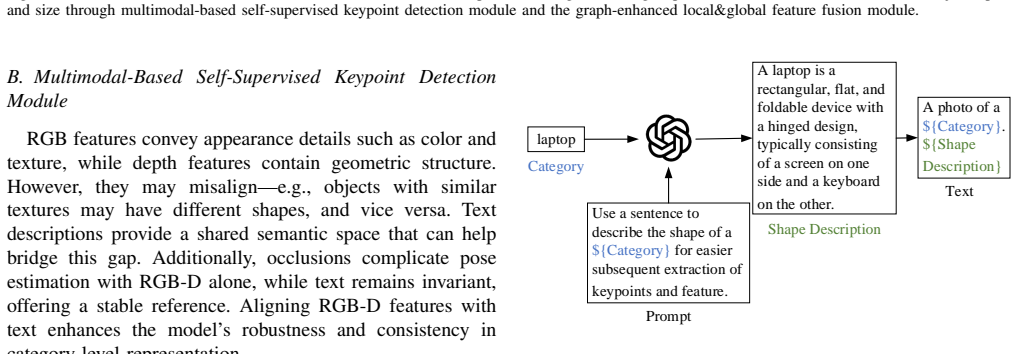
The central claim is that a multimodal keypoint-learning pipeline, MK-Pose, achieves state-of-the-art category-level 6D pose and size estimation without shape priors. Inputs are an RGB crop, a point cloud, and a CLIP text embedding of an LLM-generated category description. Learnable queries attend over fused RGB-depth-text features to produce keypoints via soft heatmap matching, a graph attention network refines keypoint relations, and a two-stage feature fusion combines local KNN geometry with global context. Pose and size are regressed from predicted NOCS coordinates, following DPDN [24], with a symmetry-aware loss that handles finite and infinite symmetries. Reported results include REAL275 IoU50 84.0, IoU75 80.3, 5\deg/2cm 60.8, and CAMERA25 IoU50 94.1, IoU75 92.2, 10\deg/2cm 86.1, with HouseCat6D unseen-category IoU50 of 37.5 versus 19.7 for AG-Pose.
Load-bearing premise
The zero-shot HouseCat6D result assumes the NOCS-based rotation and size heads, trained only on six categories (bottle, can, bowl, laptop, camera, mug), can produce valid 3D bounding boxes for unseen categories (box, shoe, tube), even though NOCS coordinate spaces are category-specific and no category alignment or adapter is described.
Editorial extensions
If this is right
- If the reported numbers hold, category-level pose estimation can achieve higher accuracy without shape priors than with them, making the method applicable to novel instances and categories in warehouse and manufacturing settings.
- Text features act as a stable cross-modal anchor; removing them (w/o text ablation: 53.3 vs 60.8 at 5\deg/2cm) quantifies their contribution under occlusion.
- The symmetry-aware loss unifies handling of no, finite, and infinite symmetry, removing a common source of pose ambiguity for symmetric objects like bottles, bowls, and mugs.
- Because the keypoints are learned self-supervised, no per-instance keypoint annotations are needed, simplifying deployment to new categories.
- Cross-dataset testing on HouseCat6D suggests the approach extends to categories absent from training, at least for coarse IoU metrics.
Reading between the lines
- A natural extension would be to adapt the NOCS head per new category with a lightweight adapter or test-time optimization; without such adaptation, the zero-shot result may degrade as the diversity of unseen categories grows.
- The LLM-generated textual descriptions may be replaceable by automatically mined category descriptions; if text is the key to occlusion robustness, then categories with ambiguous text descriptions (e.g., 'tool') would be expected to show smaller gains.
- Because keypoint detection is fully self-supervised, the same framework might transfer to instance-level or articulated pose estimation where keypoint definitions are unclear.
- The reported ablation suggests global features matter most; this could motivate exploring global context beyond average pooling, such as cross-attention over category prototypes.
Editorial analysis
A structured set of objections, weighed in public.
Referee Report
Summary. MK-Pose is a category-level 6D object pose estimation method that fuses RGB images, point clouds, and category-level text embeddings from CLIP in a unified framework. The method uses a self-supervised keypoint detection module based on learnable queries, soft heatmap matching, and graph attention, followed by a graph-enhanced local/global feature fusion module and a symmetry-aware pose/size loss. The authors evaluate on the standard CAMERA25 and REAL275 benchmarks, reporting state-of-the-art accuracy among shape-prior-free methods on most metrics, and also present a cross-dataset evaluation on HouseCat6D where MK-Pose is compared with AG-Pose for both seen and unseen categories. The central claim is empirical: MK-Pose outperforms existing methods in IoU and pose average precision without shape priors.
Significance. If the reported results hold, the paper makes a useful contribution by demonstrating that a multimodal formulation with self-supervised keypoint learning and a general symmetry-aware loss can achieve competitive category-level pose estimates without shape priors. The inclusion of text features, the self-supervised keypoint mechanism, and the handling of both finite and infinite symmetries are sensible and potentially generalizable ideas. The evaluation on standard benchmarks and the availability of a comparison to recent strong baselines are strengths. However, the significance is tempered by three concerns: the zero-shot cross-category generalization claim is not backed by a clear canonical-frame alignment protocol, the abstract overstates the CAMERA25 results, and the lack of error bars or released code makes the reported margins difficult to assess.
major comments (4)
- [IV-B / Fig. 4 / III-D] The zero-shot cross-dataset claim for unseen categories (box, shoe, tube) is not established. The pose and size heads regress from predicted NOCS coordinates following DPDN [24] (Section III-D), and NOCS maps instances into a category-specific canonical frame. The model is trained on only six categories (bottle, can, bowl, laptop, camera, mug), so no canonical frame is defined for the unseen categories. No per-category alignment or adapter is described that would place the predicted coordinates in the same frame as HouseCat6D's ground-truth annotations. Without such a mechanism, the reported IoU50 of 37.5% for unseen categories could be an artifact of Umeyama alignment absorbing a fixed frame offset, rather than evidence of true cross-category pose understanding. The manuscript should specify how NOCS coordinates for novel categories are aligned, or use a metric that does not depend on a shared canonical frame. In addition, the zero-shot comparison is limited to AG-Pose; the authors should also compare with open-vocabulary category-level pose estimation methods such as [23].
- [Abstract / IV-B / Table II] The abstract's claim that MK-Pose 'outperforms existing state-of-the-art methods in both IoU and average precision' is too strong. On CAMERA25, GenPose [21] reports 5°/2cm of 79.9, while Table II lists MK-Pose at 77.9; MK-Pose is not the best on this metric. The claim should be qualified to say 'on most metrics' or explicitly acknowledge the GenPose exception.
- [IV-A / Tables I and II] No error bars, multiple seeds, or statistical significance tests are reported, and several margins over the next-best method are small. For example, on CAMERA25 the IoU50 margin is 94.1 vs 93.8 and the 10°/5cm margin is 91.7 vs 91.6. Without an estimate of variance, the reader cannot tell whether these differences are meaningful. Please report mean and standard deviation over at least three training runs, or provide a comparable significance analysis for the close entries.
- [III-B / Eqs. (7)-(9)] The keypoint detection module is under-specified as written. In Eq. (7), P_kpt and F_kpt are defined via the heatmap H, but H in Eq. (8) is the softmax of S, and S in Eq. (9) is computed using F_kpt itself. This circular definition makes the equations uncomputable. The text says H is predicted by the cosine similarity between F_out_kpt and F_obj, so Eq. (9) should presumably use F_out_kpt; please correct the notation and clarify the order of computation.
minor comments (6)
- [IV-B] The text after Table I contains a long garbled passage of '/uni00000045/...' tokens that appears to be a LaTeX or encoding artifact; this should be removed and the surrounding comparison paragraph restored to readable prose.
- [III-B] The abbreviation 'GAN' is used for the graph attention network in the keypoint detection module, but GAN typically denotes a generative adversarial network. Use 'GAT' consistently to avoid confusion.
- [Table II] Entries for GPV-Pose and Query6DoF in the 10°/5cm column are listed as '89' and '90' without a decimal point, while all other entries have one decimal; please format them consistently as 89.0 and 90.0.
- [IV-A / IV-B] The HouseCat6D protocol is incomplete: the paper does not state which categories in the test set are considered 'seen' vs 'unseen', whether Mask R-CNN is trained on HouseCat6D images or uses ground-truth masks, or how the model was adapted (if at all) to the different image statistics of HouseCat6D. Please provide these details.
- [IV-A / Code availability] The abstract states that codes will be released, but no code or checkpoint is available in the submission. For reproducibility, please provide code, or at minimum list all hyperparameters, random seeds, and the exact text prompts used with GPT-4o, since the LLM generation step may introduce nondeterminism.
- [III-B / Eq. (3)] The notation F_text is used for both the CLIP text encoder and the extracted text feature, which is confusing in Eq. (3) and (4). Use distinct symbols, e.g., E_text for the encoder and F_text for the feature.
Circularity Check
No significant circularity: central claims are empirical benchmark comparisons, and the only self-citation (PS6D symmetry loss) is a non-load-bearing component.
full rationale
The paper's central claim is a set of empirical results on CAMERA25, REAL275, and HouseCat6D. The pose is obtained by a trained network whose losses (Lcd, Ldiv, Lrec, Lps, Lnocs) are defined from observed geometry, text, and standard NOCS supervision; none of these equations define the evaluation metric or the compared baselines. The reported IoU and average precision numbers are comparisons against external methods (NOCS, AG-Pose, GenPose, DPDN, etc.) and against held-out ground truth, so they are not determined by construction from the training objective. The only self-reference is [31], the authors' previous PS6D work, cited for the symmetry-aware pose-and-size loss in Section III-D (Eq. 19) and mentioned in the introduction. This is a component-level reuse: the loss is tested in the ablation study (w/o sym), and the main state-of-the-art claim does not rest on the citation as authority. The zero-shot HouseCat6D experiment raises a genuine external-validity question: no canonical-frame alignment is described for unseen categories box, shoe, and tube, so the NOCS-based pose and size heads may not share a frame with HouseCat6D's ground-truth NOCS annotations. That is a correctness or generalization concern, not a circular reduction. The paper would need additional evidence to substantiate cross-category generalization; it does not, however, smuggle the conclusion into its assumptions. Therefore no circular step is identified and the score is low.
Assumptions & free parameters
free parameters (6)
- Loss weights lambda_1..lambda_6 =
0.3, 2.0, 10.0, 15.0, 1.0, 2.0
- Softmax temperature tau =
0.1
- Number of keypoints N_kpt =
96
- KNN neighborhood size k =
16
- Diversity threshold T =
0.01
- Sampled points N =
1024
assumptions (5)
- domain assumption NOCS normalized coordinate space is valid and comparable across instances within each training category.
- domain assumption Hand-defined symmetry handling correctly captures object symmetries.
- domain assumption Text descriptions from GPT-4o and CLIP provide a stable, transferable semantic signal.
- domain assumption Test-time instance masks from MaskRCNN are accurate.
- ad hoc to paper HouseCat6D provides ground-truth annotations compatible with MK-Pose outputs for categories not in training.
Cite this review
Pith. "Pith review of MK-Pose: Category-Level Object Pose Estimation via Multimodal-Based Keypoint Learning." pith.science (2026). https://pith.science/paper/2ZPZR32P
@misc{pith2026250706662,
  author       = {Pith},
  title        = {Pith review of: MK-Pose: Category-Level Object Pose Estimation via Multimodal-Based Keypoint Learning},
  year         = {2026},
  howpublished = {\url{https://pith.science/paper/2ZPZR32P}},
  note         = {Machine review of arXiv:2507.06662}
}
read the original abstract
Category-level object pose estimation, which predicts the pose of objects within a known category without prior knowledge of individual instances, is essential in applications like warehouse automation and manufacturing. Existing methods relying on RGB images or point cloud data often struggle with object occlusion and generalization across different instances and categories. This paper proposes a multimodal-based keypoint learning framework (MK-Pose) that integrates RGB images, point clouds, and category-level textual descriptions. The model uses a self-supervised keypoint detection module enhanced with attention-based query generation, soft heatmap matching and graph-based relational modeling. Additionally, a graph-enhanced feature fusion module is designed to integrate local geometric information and global context. MK-Pose is evaluated on CAMERA25 and REAL275 dataset, and is further tested for cross-dataset capability on HouseCat6D dataset. The results demonstrate that MK-Pose outperforms existing state-of-the-art methods in both IoU and average precision without shape priors. Codes will be released at \href{https://github.com/yangyifanYYF/MK-Pose}{https://github.com/yangyifanYYF/MK-Pose}.
Figures


Figures from the paper (2 more)


Reference graph
Works this paper leans on
-
[24]
J. Lin, Z. Wei, C. Ding, and K. Jia, “Category-level 6d object pose and size estimation using self-supervised deep prior deformation networks,” in European Conference on Computer Vision . Springer, 2022, pp. 19–34
work page 2022
-
[23]
Open-vocabulary category-level object pose and size estimation,
J. Cai, Y . He, W. Yuan, S. Zhu, Z. Dong, L. Bo, and Q. Chen, “Open-vocabulary category-level object pose and size estimation,” IEEE Robotics and Automation Letters , 2024
work page 2024
-
[21]
Generative category-level object pose estimation via diffusion models,
J. Zhang, M. Wu, and H. Dong, “Generative category-level object pose estimation via diffusion models,” Advances in Neural Information Processing Systems, vol. 36, 2024
work page 2024
-
[1]
Self6d: Self-supervised monocular 6d object pose estimation,
G. Wang, F. Manhardt, J. Shao, X. Ji, N. Navab, and F. Tombari, “Self6d: Self-supervised monocular 6d object pose estimation,” in Computer Vision–ECCV 2020: 16th European Conference, Glasgow, UK, August 23–28, 2020, Proceedings, Part I 16 . Springer, 2020, pp. 108–125
work page 2020
-
[2]
Model globally, match locally: Efficient and robust 3d object recognition,
B. Drost, M. Ulrich, N. Navab, and S. Ilic, “Model globally, match locally: Efficient and robust 3d object recognition,” in 2010 IEEE com- puter society conference on computer vision and pattern recognition . Ieee, 2010, pp. 998–1005
work page 2010
-
[3]
S. Hinterstoisser, V . Lepetit, S. Ilic, S. Holzer, G. Bradski, K. Konolige, and N. Navab, “Model based training, detection and pose estimation of texture-less 3d objects in heavily cluttered scenes,” in Computer Vision–ACCV 2012: 11th Asian Conference on Computer Vision, Daejeon, Korea, November 5-9, 2012, Revised Selected Papers, Part I 11 . Springer, 2...
work page 2012
-
[4]
Posecnn: A convolutional neural network for 6d object pose estimation in cluttered scenes,
Y . Xiang, T. Schmidt, V . Narayanan, and D. Fox, “Posecnn: A convolutional neural network for 6d object pose estimation in cluttered scenes,” arXiv preprint arXiv:1711.00199 , 2017
arXiv 2017
-
[5]
Densefusion: 6d object pose estimation by iterative dense fusion,
C. Wang, D. Xu, Y . Zhu, R. Mart ´ın-Mart´ın, C. Lu, L. Fei-Fei, and S. Savarese, “Densefusion: 6d object pose estimation by iterative dense fusion,” in Proceedings of the IEEE/CVF conference on computer vision and pattern recognition , 2019, pp. 3343–3352
work page 2019
Show all 36 references
-
[6]
Pvnet: Pixel- wise voting network for 6dof pose estimation,
S. Peng, Y . Liu, Q. Huang, X. Zhou, and H. Bao, “Pvnet: Pixel- wise voting network for 6dof pose estimation,” in Proceedings of the IEEE/CVF conference on computer vision and pattern recognition , 2019, pp. 4561–4570
2019
-
[7]
Symfm6d: Symmetry-aware multi-directional fusion for multi-view 6d object pose estimation,
F. Duffhauss, S. Koch, H. Ziesche, N. A. Vien, and G. Neumann, “Symfm6d: Symmetry-aware multi-directional fusion for multi-view 6d object pose estimation,” IEEE Robotics and Automation Letters , 2023
2023
-
[8]
Ove6d: Object viewpoint encoding for depth-based 6d object pose estimation,
D. Cai, J. Heikkil ¨a, and E. Rahtu, “Ove6d: Object viewpoint encoding for depth-based 6d object pose estimation,” in Proceedings of the IEEE/CVF Conference on Computer Vision and Pattern Recognition , 2022, pp. 6803–6813
2022
-
[9]
Normalized object coordinate space for category-level 6d object pose and size estimation,
H. Wang, S. Sridhar, J. Huang, J. Valentin, S. Song, and L. J. Guibas, “Normalized object coordinate space for category-level 6d object pose and size estimation,” in Proceedings of the IEEE/CVF Conference on Computer Vision and Pattern Recognition , 2019, pp. 2642–2651
2019
-
[10]
Fs-net: Fast shape-based network for category-level 6d object pose estimation with decoupled rotation mechanism,
W. Chen, X. Jia, H. J. Chang, J. Duan, L. Shen, and A. Leonardis, “Fs-net: Fast shape-based network for category-level 6d object pose estimation with decoupled rotation mechanism,” in Proceedings of the IEEE/CVF Conference on Computer Vision and Pattern Recognition , 2021, pp....
2021
-
[11]
Shape prior deformation for categorical 6d object pose and size estimation,
M. Tian, M. H. Ang, and G. H. Lee, “Shape prior deformation for categorical 6d object pose and size estimation,” in Computer Vision– ECCV 2020: 16th European Conference, Glasgow, UK, August 23–28, 2020, Proceedings, Part XXI 16 . Springer, 2020, pp. 530–546
2020
-
[12]
Sgpa: Structure-guided prior adaptation for category-level 6d object pose estimation,
K. Chen and Q. Dou, “Sgpa: Structure-guided prior adaptation for category-level 6d object pose estimation,” in Proceedings of the IEEE/CVF International Conference on Computer Vision , 2021, pp. 2773–2782
2021
-
[13]
Sar-net: Shape alignment and recovery network for category-level 6d object pose and size estimation,
H. Lin, Z. Liu, C. Cheang, Y . Fu, G. Guo, and X. Xue, “Sar-net: Shape alignment and recovery network for category-level 6d object pose and size estimation,” in Proceedings of the IEEE/CVF conference on computer vision and pattern recognition , 2022, pp. 6707–6717
2022
-
[14]
Rbp-pose: Residual bounding box projection for category-level pose estimation,
R. Zhang, Y . Di, Z. Lou, F. Manhardt, F. Tombari, and X. Ji, “Rbp-pose: Residual bounding box projection for category-level pose estimation,” in European Conference on Computer Vision . Springer, 2022, pp. 655–672
2022
-
[15]
Dualposenet: Category- level 6d object pose and size estimation using dual pose network with refined learning of pose consistency,
J. Lin, Z. Wei, Z. Li, S. Xu, K. Jia, and Y . Li, “Dualposenet: Category- level 6d object pose and size estimation using dual pose network with refined learning of pose consistency,” in Proceedings of the IEEE/CVF International Conference on Computer Vision , 2021, pp. 3560–3569
2021
-
[16]
Gpv-pose: Category-level object pose estimation via geometry-guided point-wise voting,
Y . Di, R. Zhang, Z. Lou, F. Manhardt, X. Ji, N. Navab, and F. Tombari, “Gpv-pose: Category-level object pose estimation via geometry-guided point-wise voting,” in Proceedings of the IEEE/CVF Conference on Computer Vision and Pattern Recognition , 2022, pp. 6781–6791
2022
-
[17]
Prior-free category-level pose estimation with implicit space transformation,
J. Liu, Y . Chen, X. Ye, and X. Qi, “Prior-free category-level pose estimation with implicit space transformation,” in IEEE International Conference on Computer Vision 2023 (02/10/2023-06/10/2023, Paris) , 2023
2023
-
[18]
Query6dof: Learning sparse queries as implicit shape prior for category-level 6dof pose estimation,
R. Wang, X. Wang, T. Li, R. Yang, M. Wan, and W. Liu, “Query6dof: Learning sparse queries as implicit shape prior for category-level 6dof pose estimation,” in Proceedings of the IEEE/CVF International Conference on Computer Vision , 2023, pp. 14 055–14 064
2023
-
[19]
Instance-adaptive and geometric-aware keypoint learning for category-level 6d object pose estimation,
X. Lin, W. Yang, Y . Gao, and T. Zhang, “Instance-adaptive and geometric-aware keypoint learning for category-level 6d object pose estimation,” in Proceedings of the IEEE/CVF Conference on Computer Vision and Pattern Recognition , 2024, pp. 21 040–21 049
2024
-
[20]
Lapose: Laplacian mixture shape modeling for rgb-based category-level object pose estimation,
R. Zhang, Z. Huang, G. Wang, C. Zhang, Y . Di, X. Zuo, J. Tang, and X. Ji, “Lapose: Laplacian mixture shape modeling for rgb-based category-level object pose estimation,” in European Conference on Computer Vision. Springer, 2024, pp. 467–484
2024
-
[22]
Omni6dpose: a benchmark and model for universal 6d object pose estimation and tracking,
J. Zhang, W. Huang, B. Peng, M. Wu, F. Hu, Z. Chen, B. Zhao, and H. Dong, “Omni6dpose: a benchmark and model for universal 6d object pose estimation and tracking,” in European Conference on Computer Vision. Springer, 2024, pp. 199–216
2024
-
[25]
Gs-pose: Category-level object pose estimation via geometric and semantic correspondence,
P. Wang, T. Ikeda, R. Lee, and K. Nishiwaki, “Gs-pose: Category-level object pose estimation via geometric and semantic correspondence,” in European Conference on Computer Vision . Springer, 2024, pp. 108–126
2024
-
[26]
Cppf: Towards robust category- level 9d pose estimation in the wild,
Y . You, R. Shi, W. Wang, and C. Lu, “Cppf: Towards robust category- level 9d pose estimation in the wild,” in Proceedings of the IEEE/CVF Conference on Computer Vision and Pattern Recognition , 2022, pp. 6866–6875
2022
-
[27]
Diffusionnocs: Managing symmetry and uncer- tainty in sim2real multi-modal category-level pose estimation,
T. Ikeda, S. Zakharov, T. Ko, M. Z. Irshad, R. Lee, K. Liu, R. Ambrus, and K. Nishiwaki, “Diffusionnocs: Managing symmetry and uncer- tainty in sim2real multi-modal category-level pose estimation,” in2024 IEEE/RSJ International Conference on Intelligent Robots and Systems (IRO...
2024
-
[28]
Deep learning reactive robotic grasping with a versatile vacuum gripper,
H. Zhang, J. Peeters, E. Demeester, and K. Kellens, “Deep learning reactive robotic grasping with a versatile vacuum gripper,” IEEE Transactions on Robotics , vol. 39, no. 2, pp. 1244–1259, 2022
2022
-
[29]
Attribute-based robotic grasping with data-efficient adaptation,
Y . Yang, H. Yu, X. Lou, Y . Liu, and C. Choi, “Attribute-based robotic grasping with data-efficient adaptation,” IEEE Transactions on Robotics, 2024
2024
-
[30]
Learning human-like functional grasping for multi-finger hands from few demonstrations,
W. Wei, P. Wang, S. Wang, Y . Luo, W. Li, D. Li, Y . Huang, and H. Duan, “Learning human-like functional grasping for multi-finger hands from few demonstrations,” IEEE Transactions on Robotics , 2024
2024
-
[31]
Ps6d: Point cloud based symmetry-aware 6d object pose estimation in robot bin-picking,
Y . Yang, Z. Cui, Q. Zhang, and J. Liu, “Ps6d: Point cloud based symmetry-aware 6d object pose estimation in robot bin-picking,” in 2024 IEEE/RSJ International Conference on Intelligent Robots and Systems (IROS), 2024, pp. 7167–7174
2024
-
[32]
Dinov2: Learning robust visual features without supervision,
M. Oquab, T. Darcet, T. Moutakanni, H. V o, M. Szafraniec, V . Khali- dov, P. Fernandez, D. Haziza, F. Massa, A. El-Nouby et al., “Dinov2: Learning robust visual features without supervision,” arXiv preprint arXiv:2304.07193, 2023
2023 arXiv
-
[33]
Pointnet++: Deep hierarchical feature learning on point sets in a metric space,
C. R. Qi, L. Yi, H. Su, and L. J. Guibas, “Pointnet++: Deep hierarchical feature learning on point sets in a metric space,” Advances in neural information processing systems , vol. 30, 2017
2017
-
[34]
Learning transferable visual models from natural language supervision,
A. Radford, J. W. Kim, C. Hallacy, A. Ramesh, G. Goh, S. Agarwal, G. Sastry, A. Askell, P. Mishkin, J. Clark et al., “Learning transferable visual models from natural language supervision,” in International conference on machine learning . PMLR, 2021, pp. 8748–8763
2021
-
[35]
Mask r-cnn,
K. He, G. Gkioxari, P. Doll ´ar, and R. Girshick, “Mask r-cnn,” in Proceedings of the IEEE international conference on computer vision , 2017, pp. 2961–2969
2017
-
[36]
Housecat6d-a large-scale multi-modal category level 6d object perception dataset with household objects in realistic scenarios,
H. Jung, S.-C. Wu, P. Ruhkamp, G. Zhai, H. Schieber, G. Rizzoli, P. Wang, H. Zhao, L. Garattoni, S. Meier, D. Roth, N. Navab, and B. Busam, “Housecat6d-a large-scale multi-modal category level 6d object perception dataset with household objects in realistic scenarios,” in Proc...
2024
Reviewed August 6, 2026 · model on record in the stance chip above.
Discussion (0). Continue with ORCID to comment.