REVIEW 3 major objections 5 minor 51 references
TNO colours provide new evidence for a past close flyby of another star to the Solar System
T0 review · 3 major / 5 minor · reviewed 2026-08-06 · deepseek-v4-flash
Pith's one-line read A single stellar flyby can explain both the orbits and colours of TNOs
desk verdict A plausible flyby model for TNO colours, but the colour match is largely inherited from a fitted initial gradient; the new LSST predictions are the real value. read the letter →
The pith
A machine-rendered reading of the paper's core claim, the machinery that carries it, and where it could break.
The reading
What carries the argument
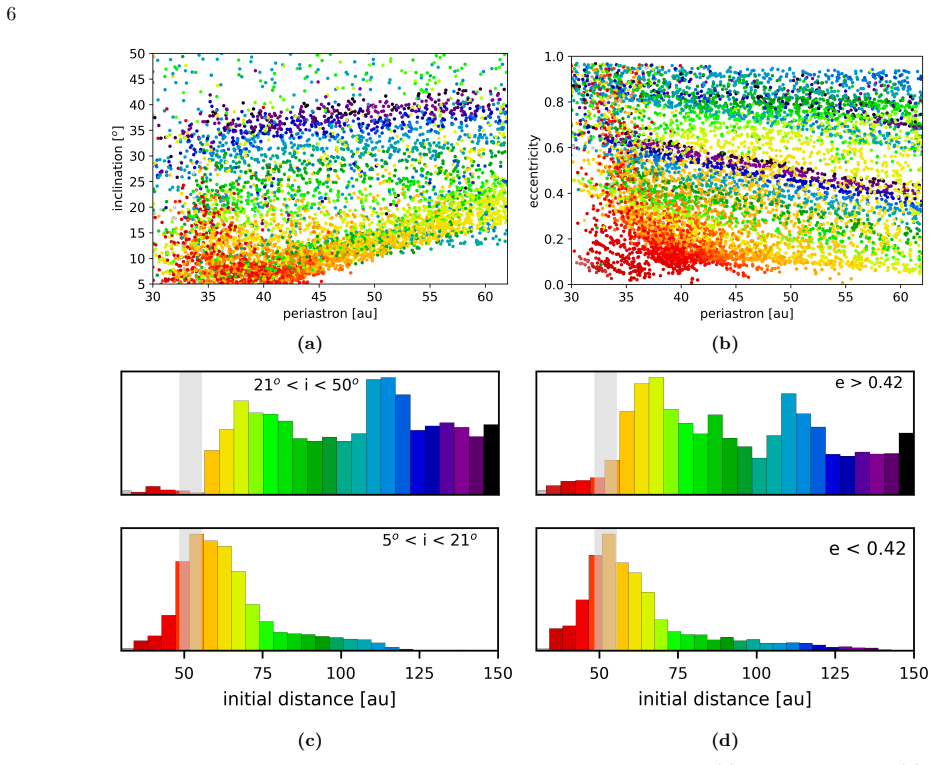
The central mechanism is the pair of spiral density arms excited in the debris disc by the inclined flyby. Along these arms, two adjacent streams of planetesimals move at sub- and super-Keplerian speeds, transporting material inward and outward; this simultaneously lifts outer, grey particles onto inclined, eccentric orbits and preserves the inner red population on nearly circular low-inclination orbits. The pre-flyby colour gradient, a rainbow placeholder for the observed spectral slope, encodes the assumption that very red bodies dominated the 30–50 au region and greyer bodies lay beyond 50 au.
What would settle it
A sufficiently large sample of TNOs found by LSST showing that small distant TNOs (perihelia above 60 au) are predominantly very red, or that retrograde TNOs show the same colour distribution as high-inclination prograde TNOs, would contradict the flyby model's predictions.
Extended reading notes
Core claim
The paper claims that the same stellar flyby already shown to reproduce TNO orbital dynamics also produces the observed colour–dynamics correlations: very red TNOs are scarce at high inclinations (i>21°) and high eccentricities (e>0.42), and are scarce among detached objects. The mechanism is that the flyby's spiral arms transport outer, greyer planetesimals into inclined and eccentric orbits, while the inner very red population stays largely on low-inclination, low-eccentricity orbits. The model also accounts for the rarity of very red irregular moons, because all TNOs injected toward the giant planets come from beyond 60 au. The paper predicts specific colour patterns for distant and retrograde TNOs that the Vera Rubin telescope should be able to test within three years.
Load-bearing premise
The load-bearing premise is that the primordial disc started with a red-to-grey colour gradient, with very red bodies in the cold Kuiper belt region and greyer bodies beyond 50 au; this initial colour distribution is assumed, not derived.
Editorial extensions
If this is right
- Distant TNOs with perihelia between 60 and 100 au should be predominantly grey to blue-grey, with very few very red objects regardless of inclination or eccentricity.
- Retrograde TNOs should show a bimodal colour distribution, with light red and dark blue-grey groups, and lack the medium-grey colour most common among high-inclination prograde TNOs.
- The inclination–perihelion plot should show stripes of blue-grey TNOs at high inclinations, corresponding to material pulled inward from beyond 100 au along the spiral arms.
- The scarcity of very red irregular moons is explained by the fact that all TNOs injected toward the giant planets originate from beyond 60 au.
Reading between the lines
- The model's colour-gradient assumption could be tested independently by measuring radial colour profiles of protoplanetary discs in young clusters; if discs typically lack such a gradient, the placeholder would need revisiting.
- If LSST instead finds distant TNOs with a substantial very red fraction, the flyby scenario would be disfavoured relative to planet-instability models, but the colour predictions depend on the initial gradient, so the two hypotheses are not cleanly separated by dynamics alone.
- The specific flyby parameters (0.8 M_Sun, 110 au, 70°) are not unique in principle; the paper notes that not every flyby produces the observed pattern, so a broader parameter study could map which flybys remain consistent with both colour and orbital data.
Editorial analysis
A structured set of objections, weighed in public.
Referee Report
Summary. The paper argues that a close stellar flyby (M_P = 0.8 M_sun, r_P = 110 au, i_P = 70 deg, omega_P = 80 deg) can simultaneously explain the observed orbital architecture of trans-Neptunian objects and the observed correlations between TNO colour and orbital inclination/eccentricity. The authors simulate the flyby with REBOUND/IAS15 and then follow the long-term evolution with GENGA for 1 Gyr, assigning a pre-flyby radial colour gradient in which the region 30-50 au is very red and the outer disc is grey. They report that the flyby's spiral-arm transport stirs the outer grey population to high inclinations and eccentricities while leaving the inner red population dynamically cold, matching the OSSOS and DES colour–dynamics trends at a qualitative level. They also present two falsifiable predictions for LSST: distant TNOs beyond 60 au should be mostly grey, and retrograde TNOs should show a bimodal colour distribution lacking the most common high-inclination colour.
Significance. If the central claim holds, the paper would be a notable contribution: it connects a previously proposed flyby scenario to the colour–dynamics correlations of TNOs and offers testable predictions for the Vera Rubin Observatory. The numerical methods are solid and standard (REBOUND/IAS15 and GENGA), the simulations use 10,000-50,000 test particles, the data are made publicly available, and the paper explicitly checks robustness to assumed surface-density profiles (Appendix B) and disc size (Appendix A). The LSST predictions are concrete and falsifiable within a few years. However, the evidential weight of the colour match is limited because the initial colour gradient is chosen to encode the observed redness of the cold Kuiper belt and the comparison to observations is visual rather than quantitative. The paper is honest about this limitation in §2 and §4.1, but the abstract and conclusion draw a stronger inference than the evidence currently supports.
major comments (3)
- [§2, §3.1–3.2, Figs. 2–3] This is the load-bearing issue: without such a test, the title's 'new evidence' is not yet established, only a consistency statement.
- [§4.1 and §5]
- [§3.5 and Fig. 5]
minor comments (5)
- [§3.1] The phrase 'the black of red objects at high inclinations' should read 'the lack of red objects at high inclinations'.
- [Fig. 2 caption] The caption uses the symbol Ifree without defining it; please define the free inclination and explain the relationship between Ifree and the plotted inclination.
- [§3.2] The text 'at high inclinationandat high eccentricity' contains missing spaces and should be corrected.
- [Fig. 5] The qualitative terms 'light red', 'medium grey', and 'blue-grey' are used in the text without a quantitative mapping to the colour scale in Fig. 1; please add a legend or a table that translates the false-colour scale into spectral-slope values.
- [References] Several references are cited by preprint arXiv numbers even though published versions exist (e.g., Bernardinelli et al. 2025); please update where possible.
Circularity Check
The colour-matching evidence is largely inherited from the assumed initial red-to-grey gradient, which is itself a 'temporary placeholder' for the observed colour slope; the flyby's specific spiral-arm transport is not independently tested by the colour trends, and the LSST predictions mostly restate the assumed absence of red beyond 50 au.
-
fitted input called prediction
[Section 2 (Method); Section 4.1 (Discussion)]
"These bodies are nearly exclusively very red in colour... Therefore, we assume that the primordial disc was dominated by very red bodies in the cold Kuiper belt region and that beyond this, objects of various shades of grey existed. ... We showed that for our flyby scenario a primordial disc dominated by very red bodies in the cold Kuiper belt region and objects of various shades of grey beyond 50 au can reproduce the observed colour."
The initial colour gradient is not derived from an independent model of TNO chemistry or disc evolution; it is set to match the observed redness of the cold Kuiper belt. Because the cold Kuiper belt is already the dynamically cold, low-inclination, low-eccentricity population, assigning it 'very red' means the model's low-inclination/eccentricity redness is an input. Assigning 'shades of grey' to all material beyond 50 au means the high-inclination/eccentricity population, which the flyby lifts from the outer disc, is grey by construction. The paper even labels the gradient a 'temporary placeholder for the observed slope S', conceding that the colour-dynamics correlation is not independently produced by the flyby's spiral arms.
-
self definitional
[Section 3.5 (Prediction for LSST discoveries)]
"Focusing on distant TNOs with 60 au< p <100 au... we find that the test particle colours range from yellow to dark blue, with very few red objects, regardless of inclination or eccentricity. This translates into distant TNOs predominantly being light red to various shades of grey, and a notable lack of very red objects, even among low-inclination and low-eccentricity TNOs. These TNOs (60 au< p <100 au) are mainly transported inwards from regions between 65 au and 150 au."
The 'prediction' that distant TNOs lack very red colours follows directly from the assumed initial gradient, which contains no very red material beyond 50 au: particles transported inward from 65-150 au are non-red by construction. Likewise, the predicted bimodal retrograde colour distribution (originating from 70-90 au and 120-150 au) is a direct readout of the pre-assigned grey shades at those radii. The flyby determines which origin regions end up where, but the absence of very red colours in all of these predictions is fixed by the initial condition, not discovered.
full rationale
The paper is honest about the status of its central assumption: the red-to-grey radial gradient is described as a 'temporary placeholder for the observed slope S' and as motivated by the observed redness of the cold Kuiper belt. That admission is exactly what makes the circularity visible. The colour-dynamics correlations that the flyby is said to 'simultaneously lead to' (red at low inclination/eccentricity, grey at high inclination/eccentricity) are substantially encoded in the initial condition, since the cold Kuiper belt is already the dynamically cold inner population and the outer disc is already grey. The flyby's dynamical transport is real and does produce non-trivial features, such as the origin splitting of retrograde orbits, but the qualitative colour trends and the LSST predictions of grey distant TNOs reduce to the assumed gradient. No load-bearing self-citation issue was found: the prior flyby simulations are used as dynamical input but the colour test is new; however, the new test is largely a repackaging of the assumed colour gradient. The comparison to OSSOS/DES is qualitative, with no goodness-of-fit statistic, which further limits the independent content of the 'match', though that is a correctness/evidence concern rather than circularity per se. Overall, the central claim is partially circular: the colour part of the evidence is inherited from a fitted initial condition, while the dynamical part retains independent content.
Assumptions & free parameters
free parameters (7)
- Perturber mass M_P =
0.8 solar masses
- Perturber periastron r_P =
110 au
- Perturber inclination i_P =
70 degrees
- Perturber argument of periastron omega_P =
80 degrees
- Initial colour gradient =
Red at 30-50 au, grey beyond 50 au up to 150 au
- Initial surface density =
Constant (alternatives 1/r and 1/r^1.5 in appendix)
- Primordial disc size =
150 au
assumptions (4)
- domain assumption Cold Kuiper belt objects remained close to their place of origin
- domain assumption The flyby occurred in a young stellar cluster with high stellar density
- domain assumption Gas mass in the debris disc is negligible, so N-body treatment suffices
- ad hoc to paper The colour gradient is a placeholder for the observed spectral slope S
Cite this review
Pith. "Pith review of TNO colours provide new evidence for a past close flyby of another star to the Solar System." pith.science (2026). https://pith.science/paper/KLZ7UTD2
@misc{pith2026250706693,
  author       = {Pith},
  title        = {Pith review of: TNO colours provide new evidence for a past close flyby of another star to the Solar System},
  year         = {2026},
  howpublished = {\url{https://pith.science/paper/KLZ7UTD2}},
  note         = {Machine review of arXiv:2507.06693}
}
read the original abstract
Thousands of small bodies, known as trans-Neptunian objects (TNOs), orbit the Sun beyond Neptune. TNOs are remnants of the planets' formation from a disc of gas and dust, so it is puzzling that they move mostly on eccentric orbits inclined to the planetary plane and show a complex red-to-grey colour distribution. A close stellar flyby can account for the TNOs' dynamics, but it is unclear if this can also explain the correlation between their colours and orbital characteristics. Assuming an initial red-to-grey colour gradient in the disc, our numerical study finds that the spiral arms induced by the stellar flyby simultaneously lead to the observed TNOs' colour patterns and orbital dynamics. The combined explanation of these TNO properties strengthens the evidence for a close flyby of another star to the young Solar System. Our study predicts that (1) small TNOs beyond 60 au will mostly be grey, and (2) retrograde TNOs will lack the colour most common to high-inclination TNOs. The anticipated TNO discoveries by the Vera Rubin telescope will be able to test these predictions. A confirmed flyby would allow us to reveal the chemical composition of the Solar System's primordial disc.
Figures


Figures from the paper (2 more)

Reference graph
Works this paper leans on
-
[1]
2021, AJ, 162, 19, doi: 10.3847/1538-3881/abf6ca
Ali-Dib, M., Marsset, M., Wong, W.-C., & Dbouk, R. 2021, AJ, 162, 19, doi: 10.3847/1538-3881/abf6ca
-
[2]
Andrews, S. M. 2020, ARA&A, 58, 483, doi: 10.1146/annurev-astro-031220-010302
-
[3]
2021, PSJ, 2, 158, doi: 10.3847/PSJ/ac0979
Ashton, E., Gladman, B., & Beaudoin, M. 2021, PSJ, 2, 158, doi: 10.3847/PSJ/ac0979
-
[4]
Bannister, M. T., Gladman, B. J., Kavelaars, J. J., et al. 2018, ApJS, 236, 18, doi: 10.3847/1538-4365/aab77a
-
[5]
Barucci, M. A., & Merlin, F. 2020, in The Trans-Neptunian Solar System, ed. D. Prialnik, M. A. Barucci, & L. Young (Elsevier), 109–126, doi: 10.1016/B978-0-12-816490-7.00005-9
-
[6]
Bernardinelli, P. H., Bernstein, G. M., Jindal, N., et al. 2023, ApJS, 269, 18, doi: 10.3847/1538-4365/acf6bf
-
[7]
Bernardinelli, P. H., Bernstein, G. M., Abbott, T. M. C., et al. 2025, arXiv e-prints, arXiv:2501.01551. https://arxiv.org/abs/2501.01551
arXiv 2025
-
[8]
2024, arXiv e-prints, arXiv:2412.04583
Brown, G., Malhotra, R., & Rein, H. 2024, arXiv e-prints, arXiv:2412.04583. https://arxiv.org/abs/2412.04583
Show all 51 references
-
[9]
Brown, M. E. 2012, AREPS, 40, 467, doi: 10.1146/annurev-earth-042711-105352
2012 doi
-
[10]
E., Schaller, E
Brown, M. E., Schaller, E. L., & Fraser, W. C. 2011, ApJL, 739, L60, doi: 10.1088/2041-8205/739/2/L60
2011 doi
-
[11]
Chambers, J. E. 1999, MNRAS, 304, 793–799, doi: 10.1046/j.1365-8711.1999.02379.x
1999
-
[12]
2005, Icarus, 174, 90, doi: 10.1016/j.icarus.2004.09.009
Doressoundiram, A., Peixinho, N., Doucet, C., et al. 2005, Icarus, 174, 90, doi: 10.1016/j.icarus.2004.09.009
2005 doi
-
[13]
P., Wong, I., Brunetto, R., et al
Emery, J. P., Wong, I., Brunetto, R., et al. 2024, Icarus, 414, 116017, doi: 10.1016/j.icarus.2024.116017
2024
-
[14]
A., & Ip, W
Fernandez, J. A., & Ip, W. H. 1984, Icarus, 58, 109, doi: 10.1016/0019-1035(84)90101-5
1984 doi
-
[15]
C., Benecchi, S
Fraser, W. C., Benecchi, S. D., Kavelaars, J. J., et al. 2021, PSJ, 2, 90, doi: 10.3847/psj/abf04a
2021 doi
-
[16]
2021, ARA&A, 59, 203, doi: https: //doi.org/10.1146/annurev-astro-120920-010005
Gladman, B., & Volk, K. 2021, ARA&A, 59, 203, doi: https: //doi.org/10.1146/annurev-astro-120920-010005
2021 doi
-
[17]
R., Grundy, W
Glein, C. R., Grundy, W. M., Lunine, J. I., et al. 2024, Icarus, 412, 115999, doi: https://doi.org/10.1016/j.icarus.2024.115999
2024
-
[18]
L., & Stadel, J
Grimm, S. L., & Stadel, J. G. 2014, ApJ, 796, 23, doi: 10.1088/0004-637X/796/1/23
2014 doi
-
[19]
L., Stadel, J
Grimm, S. L., Stadel, J. G., Brasser, R., Meier, M. M. M., & Mordasini, C. 2022, ApJ, 932, 124, doi: 10.3847/1538-4357/ac6dd2
2022 doi
- [20]
-
[21]
R., & Delsanti, A
Hainaut, O. R., & Delsanti, A. C. 2002, A&A, 389, 641, doi: 10.1051/0004-6361:20020431
2002 doi
-
[22]
Hall, S. M. 1997, MNRAS, 287, 148, doi: 10.1093/mnras/287.1.148
1997 doi
-
[23]
2020, ApJ, 895, 126, doi: 10.3847/1538-4357/ab70ba
Hendler, N., Pascucci, I., Pinilla, P., et al. 2020, ApJ, 895, 126, doi: 10.3847/1538-4357/ab70ba
2020 doi
-
[24]
2018, AJ, 155, 56, doi: 10.3847/1538-3881/aaa1a4
Jewitt, D. 2018, AJ, 155, 56, doi: 10.3847/1538-3881/aaa1a4
2018 doi
-
[25]
2007, ARA&A, 45, 261, doi: 10.1146/annurev.astro.44.051905.092459
Jewitt, D., & Haghighipour, N. 2007, ARA&A, 45, 261, doi: 10.1146/annurev.astro.44.051905.092459
2007 arXiv
-
[26]
C., & Luu, J
Jewitt, D. C., & Luu, J. X. 2001, AJ, 122, 2099, doi: 10.1086/323304 J ´ ılkov´ a, L., Portegies Zwart, S., Pijloo, T., & Hammer, M. 2015, MNRAS, 453, 3157, doi: 10.1093/mnras/stv1803
2001 doi
-
[27]
2001, Icarus, 153, 416, doi: 10.1006/icar.2001.6700
Kobayashi, H., & Ida, S. 2001, Icarus, 153, 416, doi: 10.1006/icar.2001.6700
2001
-
[28]
F., Morbidelli, A., Van Laerhoven, C., Gomes, R., & Tsiganis, K
Levison, H. F., Morbidelli, A., Van Laerhoven, C., Gomes, R., & Tsiganis, K. 2008, Icarus, 196, 258, doi: 10.1016/j.icarus.2007.11.035
2008 doi
-
[29]
C., Pike, R
Marsset, M., Fraser, W. C., Pike, R. E., et al. 2019, AJ, 157, 94, doi: 10.3847/1538-3881/aaf72e
2019 doi
-
[30]
C., Schwamb, M
Marsset, M., Fraser, W. C., Schwamb, M. E., et al. 2023, PSJ, 4, 160, doi: 10.3847/PSJ/ace7d0
2023 doi
-
[31]
E., & Levison, H
Morbidelli, A., Brown, M. E., & Levison, H. F. 2003, EM&P, 92, 1, doi: 10.1023/B:MOON.0000031921.37380.80
2003
-
[32]
E., & Quarles, B
Musielak, Z. E., & Quarles, B. 2014, RPPh, 77, 065901, doi: 10.1088/0034-4885/77/6/065901 Nesvorn´ y, D., Vokrouhlick´ y, D., & Deienno, R. 2014, ApJ, 784, 22, doi: 10.1088/0004-637X/784/1/22 Nesvorn´ y, D., Vokrouhlick´ y, D., Alexandersen, M., et al. 2020, AJ, 160, 46, doi: ...
2014 doi
-
[33]
2010, A&A, 509, A63, doi: 10.1051/0004-6361/200912641
Olczak, C., Pfalzner, S., & Eckart, A. 2010, A&A, 509, A63, doi: 10.1051/0004-6361/200912641
2010 doi
-
[34]
H., & Kavelaars, J
Parker, A. H., & Kavelaars, J. J. 2010, ApJL, 722, L204, doi: 10.1088/2041-8205/722/2/L204
2010 doi
-
[35]
2008, AJ, 136, 1837, doi: 10.1088/0004-6256/136/5/1837
Peixinho, N., Lacerda, P., & Jewitt, D. 2008, AJ, 136, 1837, doi: 10.1088/0004-6256/136/5/1837
2008 doi
-
[36]
2023, Nature, 620, 516, doi: 10.1038/s41586-023-06317-9
Perotti, G., Christiaens, V., Henning, T., et al. 2023, Nature, 620, 516, doi: 10.1038/s41586-023-06317-9
2023 doi
-
[37]
M., Kavelaars, J
Petit, J. M., Kavelaars, J. J., Gladman, B. J., et al. 2011, AJ, 142, 131, doi: 10.1088/0004-6256/142/4/131
2011 doi
-
[38]
M., Kavelaars, J
Petit, J. M., Kavelaars, J. J., Gladman, B. J., et al. 2017, AJ, 153, 236, doi: 10.3847/1538-3881/aa6aa5
2017 doi
-
[39]
2003, ApJ, 592, 986, doi: 10.1086/375808
Pfalzner, S. 2003, ApJ, 592, 986, doi: 10.1086/375808
2003 doi
-
[40]
2018, ApJ, 863, 45, doi: 10.3847/1538-4357/aad23c
Pfalzner, S., Bhandare, A., Vincke, K., & Lacerda, P. 2018, ApJ, 863, 45, doi: 10.3847/1538-4357/aad23c
2018 doi
-
[41]
2024a, Nature Astronomy, 8, 1380, doi: 10.1038/s41550-024-02349-x 14
Pfalzner, S., Govind, A., & Portegies Zwart, S. 2024a, Nature Astronomy, 8, 1380, doi: 10.1038/s41550-024-02349-x 14
-
[42]
Pfalzner, S., Govind, A., & Wagner, F. W. 2024b, ApJL, 972, L21, doi: 10.3847/2041-8213/ad63a6
-
[43]
A., & Holler, B
Pinilla-Alonso, N., Stansberry, J. A., & Holler, B. J. 2020, in The Trans-Neptunian Solar System, ed. D. Prialnik, M. A. Barucci, & L. Young (Elsevier), 395–412, doi: 10.1016/B978-0-12-816490-7.00018-7
2020 doi
-
[44]
N., et al
Pinilla-Alonso, N., Brunetto, R., De Pr´ a, M. N., et al. 2025, Nature Astronomy, 9, 230, doi: 10.1038/s41550-024-02433-2
2025 doi
-
[45]
N., Izidoro, A., & Morbidelli, A
Raymond, S. N., Izidoro, A., & Morbidelli, A. 2018, arXiv e-prints, arXiv:1812.01033. https://arxiv.org/abs/1812.01033
2018 arXiv
-
[46]
Rein, H., & Spiegel, D. S. 2014, MNRAS, 446, 1424, doi: 10.1093/mnras/stu2164
2014 doi
-
[47]
E., Fraser, W
Schwamb, M. E., Fraser, W. C., Bannister, M. T., et al. 2019, ApJS, 243, 12, doi: 10.3847/1538-4365/ab2194
2019 doi
-
[48]
2012, A&A, 538, A10, doi: 10.1051/0004-6361/201117682
Steinhausen, M., Olczak, C., & Pfalzner, S. 2012, A&A, 538, A10, doi: 10.1051/0004-6361/201117682
2012 doi
-
[49]
C., & Romanishin, W
Tegler, S. C., & Romanishin, W. 1998, Nature, 392, 49, doi: 10.1038/32108
1998 doi
-
[50]
C., & Romanishin, W
Tegler, S. C., & Romanishin, W. 2000, Nature, 407, 979, doi: 10.1038/35039572
2000 doi
-
[51]
Thirouin, A., & Sheppard, S. S. 2019, AJ, 158, 53, doi: 10.3847/1538-3881/ab27bc Vokrouhlick´ y, D., Nesvorn´ y, D., & Tremaine, S. 2024, ApJ, 968, 47, doi: 10.3847/1538-4357/ad40a3
2019 doi
Reviewed August 6, 2026 · model on record in the stance chip above.
Discussion (0). Continue with ORCID to comment.