REVIEW 2 major objections 7 minor 3 cited by
Photometry of outer Solar System objects from the Dark Energy Survey II: a joint analysis of trans-Neptunian absolute magnitudes, colors, lightcurves and dynamics
T0 review · 2 major / 7 minor · reviewed 2026-08-10 · deepseek-v4-flash
Pith's one-line read This paper claims that the 696 DES TNOs are consistent with just two birth populations—NIRB and NIRF—whose size and variability distributions are the same in every dynamical class, with the cold classicals being pure NIRF and excited…
desk verdict Large DES TNO analysis with a solid two-color picture, but inconsistent Bayes-factor sign conventions and an untested separability assumption make the central claims unverifiable as written. read the letter →
The pith
A machine-rendered reading of the paper's core claim, the machinery that carries it, and where it could break.
The reading
What carries the argument
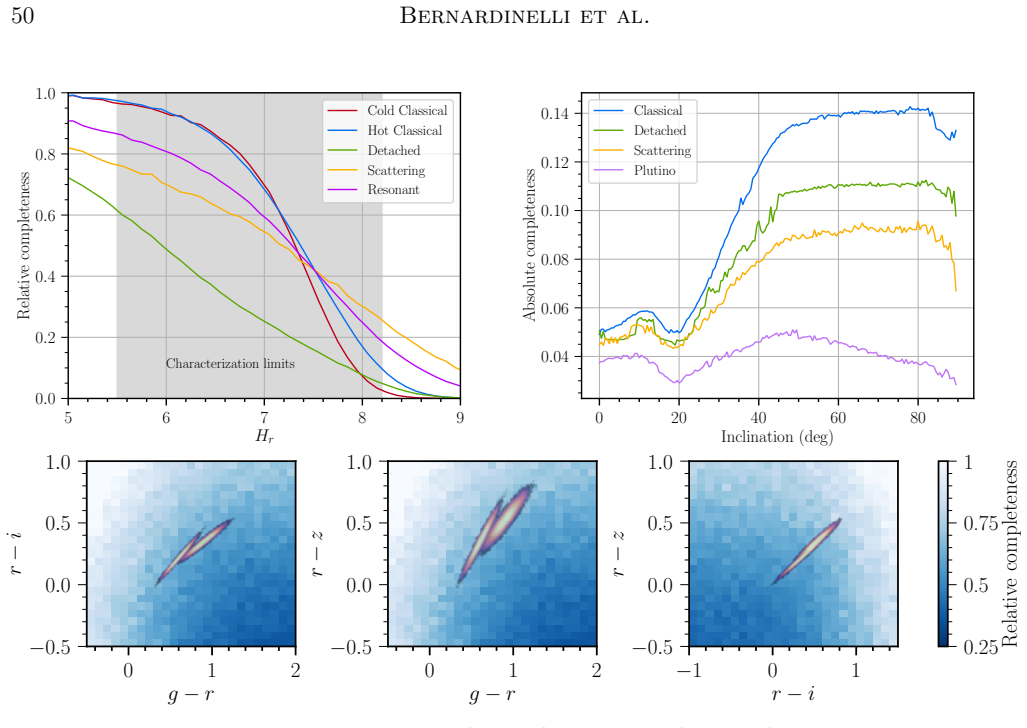
The argument rides on a mixture-model likelihood for the full catalog. Each dynamical class $d$ is modeled as an unknown mixture $p_d = \sum_\beta f_{\beta|d}\,p_\beta$ of physical subpopulations, and within a subpopulation the orbital, color, magnitude, and lightcurve-amplitude distributions are assumed separable: $p_\beta(c,H_r,A,P) = p_\beta(c)p_\beta(H_r)p_\beta(P)p_\beta(A)$. The color terms come from a Gaussian mixture model fitted to $g-r$, $r-i$, $i-z$ colors; the magnitude term is a rolling power law; the amplitude term is a $\beta$ distribution; and the orbital term is an indicator for the dynamical class. Measurement noise enters through posterior 'swarms' per object from a prior Markov chain, and the parameters are sampled with Hamiltonian Monte Carlo, with model comparisons made by Bayesian evidence ratios. The load-bearing step is the shared-parameter test: if the $H_r$ and $A$ distributions of each color class are the same for every dynamical class, then color can be read as a birthmark.
What would settle it
Re-fit the full DES sample allowing the mean lightcurve amplitude (or the H slope) to depend on position within the NIRB or NIRF color locus; if the Bayesian evidence ratio favors the correlated model, the shared-distribution conclusion collapses. Alternatively, check the two-Gaussian color model against a larger sample such as LSST's first TNO catalog: if more than about 1% of objects fall outside both Gaussians beyond photometric error, the two-birth-population picture fails.
Extended reading notes
Core claim
The central claim is that the DES data support a model in which each of the two GMM color components, NIRB and NIRF, has a population with size ($H_r$) and variability ($A$) distributions that are the same in every dynamical state, supporting their assignment as birth populations. The paper further finds that all objects share a common rolling power-law $p(H_r)$, that NIRF objects are significantly more variable than NIRB objects, that cold classicals are pure NIRF while hot classical, scattered, and detached objects are $\approx 70\%$ NIRB, and that inclination distributions of the NIRB and NIRF members differ within the hot classicals and some resonances. Beyond the two-component picture, the NIRB members of hot classicals are bluer on average than detached or scattered NIRBs, and the CC NIRFs favor the redder end of the NIRF sequence, indicating radial stratification within each birth population.
Load-bearing premise
Inside each color family, an object's color, size, and lightcurve amplitude are assumed to be statistically independent of one another, and this separability is asserted without being tested.
Editorial extensions
If this is right
- The cold classical Kuiper belt formed entirely in the outer (NIRF) birth region, with no detectable NIRB contamination.
- Hot classicals, scattering, and detached objects share a common NIRB fraction near 70%, implying a common formation footprint.
- NIRB and NIRF objects share a rolling power-law absolute-magnitude distribution, so planetesimal formation made similar size spectra across both birth regions.
- NIRF objects are more photometrically variable than NIRB objects even when cold classicals are removed, so variability is a birth characteristic.
- Inclination distributions differ between NIRB and NIRF members of the hot classicals and some resonances, so present-day dynamics retains memory of birth location.
Reading between the lines
- I infer that the redder-than-average NIRB hot classicals versus detached NIRBs imply a radial color gradient inside the inner birth region, not just a two-zone disk.
- The paper's separability assumption could be tested by checking whether mean lightcurve amplitude varies along the NIRB color locus; LSST data should make that test decisive.
- The discrepancies in population counts with other surveys (e.g. cold classicals 1.5–1.8 times smaller) suggest a joint cross-survey analysis will be needed before the absolute numbers are treated as settled.
- If the NIRF/NIRB splitting survives the larger LSST sample, the color families could be used as a tracer of the primordial disk's radial composition gradient.
Editorial analysis
A structured set of objections, weighed in public.
Referee Report
Summary. The paper presents a joint statistical analysis of 696 Dark Energy Survey TNOs with 5.5 < H_r < 8.2, modeling the intrinsic color distribution as a two-component Gaussian mixture ('NIRB' and 'NIRF') and then, assuming separability of color, absolute magnitude, orbital parameters, and lightcurve amplitude within each component, inferring the H_r and A distributions and the NIRB fraction for each dynamical class. The main claims are that within each color component the H_r and A distributions are shared across dynamical classes, supporting the interpretation of the color components as birth populations; that cold classicals are pure NIRF while excited populations are roughly 70% NIRB with resonance-dependent variations; that the NIRB and NIRF components have distinct inclination distributions in some classes; and that there is evidence for color stratification within the components. Goodness-of-fit tests give p = 0.918 for the color model and p = 0.860 for the H_r model.
Significance. If correct, these results would provide strong, quantitative constraints on the formation locations and migration histories of TNOs, and the methodological framework for joint inference from catalogs with heterogeneous photometry is a valuable contribution. The paper's strengths include a careful treatment of selection functions, full propagation of per-object measurement uncertainties through the likelihood, explicit goodness-of-fit testing, and a clear statement of the intended public release of code and chains. However, the headline conclusions rest on Bayesian evidence ratios whose sign convention is inconsistent across sections, and on a separability assumption that the paper's own Section 5 contradicts. Both issues are load-bearing, so the present version cannot be accepted without substantial revision.
major comments (2)
- [Section 4.1; Appendix B; Sections 4.2-4.4] The Bayesian evidence ratio sign convention is inconsistent across the paper. Section 4.1 defines R between H1 (one shared p(A) for all NIRB and one for all NIRF objects) and H2 (per-dynamical-class parameters), states that R > 2.30, 3.45, 4.61 are decisive in favor of H2, and then reports R = 5.016, 6.143 and R = 13.556 as 'decisive evidence in favor of the shared-parameter models.' Appendix B instead defines R = log p(D|H2)/p(D|H1) with H2 the shared-parameter model, so positive R favors shared. Section 4.3 uses R = 62.185 to 'completely rule out' a common f_NIRB, which is coherent only if positive R favors distinct models. These conventions are mutually incompatible. Because the code and chains are not yet public, I cannot determine which convention produced each quoted value. If the Section 4.1 convention is applied literally, the reported R values for shared p(A) and p(H) would actually disfavor the shared-parameter models, reversing the paper's central claim; if the Appendix B convention is used, the Section 4.3 exclusion of common f_NIRB would reverse. The authors must restate a single convention, recompute or reinterpret every R value, and confirm which conclusions survive.
- [Section 3.2, Eq. (19); Sections 5.1 and 5.2] Equation (19) assumes that within a family β the distributions of c, H_r, A, and P are separable. This assumption is not tested, and the paper's own Section 5 indicates it is violated. Section 5.2 reports that the red and blue halves of the NIRF component have significantly different lightcurve-amplitude sharpness parameters (s differs by 3.1σ, R = -4.552), and Section 5.1 reports that the HC and detached populations have different NIRB+/NIRB- ratios (R = -4.043). These findings mean that color position correlates with A and with dynamical class within the nominal NIRB/NIRF components. The shared p(A) conclusion in Section 4.1 was derived under the two-component model with Eq. (19); if the sub-structure is real, the apparent sharing of p(A) across dynamical classes could be an artifact of mixing components with different A distributions in different proportions. The authors should re-run the shared-H and shared-A tests within each split component (NIRB+, NIRB-, NIRF+, NIRF-) or otherwise demonstrate that the Section 4.1 conclusions are insensitive to the within-component structure.
minor comments (7)
- [Section 6 title] The title 'THE INCLINATION DISTRIBUTION FOR THE NIRB AND NIRB POPULATIONS' should read 'NIRB AND NIRF POPULATIONS'.
- [Section 5.1] The uniform prior over the simplex is the Dirichlet(1,1,1) distribution, not the Dirichlet distribution with parameters α_i = -1; please correct the prior or justify the improper choice.
- [Section 5.1, Eq. (25)] The condition 'c′1 ≷ 0' is ambiguous; specify c′1 > 0 for NIRB+ and c′1 < 0 for NIRB−.
- [Sections 4.2, 4.3, 7.1] There are several typographical errors: 'the CC populations is' (Section 4.3), 'another phyical property' (Section 4.2), and 'Our methodology is will scale gracefully' (Section 7.1).
- [Appendix B, Eqs. (B12)-(B14)] The notation p(q|D) is used both for a posterior and for the marginal likelihood ∫df L({q,f}|D), which is confusing; please introduce a distinct symbol such as \tilde{L}(q|D).
- [Section 6.2, Figure 12 caption] The statement 'a positive value shows a preference for the two component model' appears inconsistent with the text's use of R = -76.55 to reject a single NIRF component for the Classicals; please clarify which hypotheses this particular evidence ratio compares.
- [Section 8 / Code availability] The HMC software and chains are stated to be released only after acceptance; given that the evidence ratios are central and the sign convention is currently ambiguous, making the code and chains available to the referee or in a public repository would materially help verification.
Circularity Check
No significant circularity: the shared H_r and A test uses physical measurements not used to define the color classes, though the evidence-ratio sign convention is internally inconsistent and the Eq. 19 separability is untested.
full rationale
The paper's central inference is not a reduction of a prediction to its inputs. The NIRB/NIRF color components are fitted to DES griz colors, but the claim that H_r and A distributions are shared across dynamical classes is tested with absolute magnitudes and lightcurve amplitudes, which are different observables from the colors used to define the classes. The f_NIRB fractions are fitted mixture weights, not out-of-sample predictions, so no fitted parameter is renamed as a prediction. Self-citations to Bernardinelli et al. (2022, 2023) provide the survey selection function, per-object measurement swarms, and the beta-distribution ansatz for p(A); these are prior measurement products and stated functional assumptions, not an unverified uniqueness theorem invoked to forbid alternatives, so they are not load-bearing circularity. Two caveats belong to correctness rather than circularity: (1) the separability assumption p_beta(c, H_r, A, P) = p_beta(c) p_beta(H_r) p_beta(P) p_beta(A) in Eq. 19 is stated but not tested, and the paper itself notes departures from the two-component model in Section 5; if colors correlate with size or variability within a birth population, the inferred shared distributions would be biased. (2) The sign convention for the log Bayes factor R is used inconsistently: Section 4.1 defines H1=shared and H2=separate, says positive R favors H2, yet reports R=5.016, 6.143, and 13.556 as decisive evidence for shared distributions; Appendix B's Eq. B13 also makes positive R favor separate per-class parameters, while Section 4.3 uses positive R to rule out a common f_NIRB. Under the Section 4.1 convention, these positive values would actually disfavor the shared-parameter conclusion. This is a serious labeling or interpretation error that must be corrected, but it is not a circular identity between the statistic and the conclusion. The overall circularity score is therefore 0.
Assumptions & free parameters
free parameters (15)
- GMM mean NIRB =
mu = (0.609, 0.223, 0.355)
- GMM covariance NIRB =
3x3 matrix in Table 1
- GMM mean NIRF =
mu = (0.902, 0.347, 0.524)
- GMM covariance NIRF =
3x3 matrix in Table 1
- GMM amplitudes =
f_NIRB = 0.446, f_NIRF = 0.554
- Rolling power law slope NIRB =
theta_NIRB = 0.856 ± 0.047
- Rolling power law curvature NIRB =
theta'_NIRB = -0.099 ± 0.059
- Rolling power law slope NIRF =
theta_NIRF = 0.829 ± 0.053
- Rolling power law curvature NIRF =
theta'_NIRF = -0.321 ± 0.073
- Lightcurve mean amplitude NIRB =
Abar_NIRB = 0.118 ± 0.007
- Lightcurve sharpness NIRB =
s_NIRB = 1.054 ± 0.058
- Lightcurve mean amplitude NIRF =
Abar_NIRF = 0.151 ± 0.008
- Lightcurve sharpness NIRF =
s_NIRF = 0.922 ± 0.087
- NIRB fraction per dynamical class =
CC: 0.019, HC: 0.631, Scattering: 0.686, Detached: 0.710, plus resonance values in Table 2
- Inclination concentration parameters =
log kappa per class and color (e.g., kappa_NIRF_HC = 20.9, kappa_NIRB_HC = 13.25)
assumptions (7)
- domain assumption Within a family, colors, absolute magnitudes, orbital parameters, and lightcurve amplitudes are independent: pβ(c,Hr,A,P) = pβ(c)pβ(Hr)pβ(P)pβ(A).
- domain assumption TNO surface colors were established at birth and are not modified by subsequent migration or surface processing.
- domain assumption The observed orbital distribution can be bootstrapped to the full population by weighting each object by the inverse of its selection probability.
- domain assumption Orbital angles Omega, omega, and M are uniformly distributed within each dynamical class.
- ad hoc to paper The rolling power law (Eq 20) and the beta distribution (Eq 21) adequately describe H_r and lightcurve amplitude distributions.
- ad hoc to paper The von Mises-Fischer distribution describes inclination distributions.
- domain assumption The GMM parameters from Section 2 are fixed and not re-fit in the joint analysis.
invented entities (2)
-
NIRB color class
independent evidence
-
NIRF color class
independent evidence
Cite this review
Pith. "Pith review of Photometry of outer Solar System objects from the Dark Energy Survey II: a joint analysis of trans-Neptunian absolute magnitudes, colors, lightcurves and dynamics." pith.science (2026). https://pith.science/paper/5L5N6P7Z
@misc{pith2026250101551,
  author       = {Pith},
  title        = {Pith review of: Photometry of outer Solar System objects from the Dark Energy Survey II: a joint analysis of trans-Neptunian absolute magnitudes, colors, lightcurves and dynamics},
  year         = {2026},
  howpublished = {\url{https://pith.science/paper/5L5N6P7Z}},
  note         = {Machine review of arXiv:2501.01551}
}
abstract
For the 696 trans-Neptunian objects (TNOs) with absolute magnitudes $5.5 < H_r < 8.2$ detected in the Dark Energy Survey (DES), we characterize the relationships between their dynamical state and physical properties -- namely $H_r$, indicating size; colors, indicating surface composition; and flux variation semi-amplitude $A$, indicating asphericity and surface inhomogeneity. We seek ``birth'' physical distributions that can recreate these parameters in every dynamical class. We show that the observed colors of these TNOs are consistent with 2 Gaussian distributions in $griz$ space, ``near-IR bright'' (NIRB) and ``near-IR faint'' (NIRF), presumably an inner and outer birth population, respectively. We find a model in which both the NIRB and NIRF $H_r$ and $A$ distributions are independent of current dynamical states, supporting their assignment as birth populations. All objects are consistent with a common rolling $p(H_r)$, but NIRF objects are significantly more variable. Cold classicals (CCs) are purely NIRF, while hot classical (HC), scattered, and detached TNOs are consistent with $\approx70\%$ NIRB, and resonances' NIRB fractions show significant variation. The NIRB component of the HCs and of some resonances have broader inclination distributions than the NIRFs, i.e. their current dynamics retains information about birth location. We find evidence for radial stratification within the birth NIRB population, in that HC NIRBs are on average redder than detached or scattered NIRBs; a similar effect distinguishes CCs from other NIRFs. We estimate total object counts and masses of each class within our $H_r$ range. These results will strongly constrain models of the outer solar system.
Figures


Figures from the paper (11 more)


Forward citations
Cited by 3 Pith papers
-
TNO colours provide new evidence for a past close flyby of another star to the Solar System
A stellar flyby with a 0.8 solar mass star at 110 au can simultaneously explain the orbital dynamics and colour distribution of trans-Neptunian objects, assuming an initial red-to-grey colour gradient in the primordial disc.
-
Predictions of the LSST Solar System Yield: Near-Earth Objects, Main Belt Asteroids, Jupiter Trojans, and Trans-Neptunian Objects
Using the Sorcha survey simulator and the near-final LSST v3.4 cadence, the paper predicts LSST will discover 5.36 million solar system objects, including 5.09 million main-belt asteroids, with 70% of distant populati...
-
The Surfaces of Small to Mid-Size Plutinos: Evidence of an Association Between Inclination and Surface Type
Plutinos with low osculating inclinations are predominantly FaintIR (cold-classical-like) in surface class, an association present at 99.3% significance in a combined sample of 43 plutinos.
Reference graph
Works this paper leans on
-
[1]
, " * write output.state after.block = add.period write newline
ENTRY address archivePrefix author booktitle chapter doi edition editor eprint howpublished institution journal key month number organization pages publisher school series title misctitle type volume year version url label extra.label sort.label short.list INTEGERS output.state before.all mid.sentence after.sentence after.block FUNCTION init.state.consts ...
-
[2]
write newline
" write newline "" before.all 'output.state := FUNCTION format.url url empty "" new.block "" url * "" * if FUNCTION format.eprint eprint empty "" archivePrefix empty "" archivePrefix "arXiv" = new.block " " eprint * " " * new.block " " eprint * " " * if if if FUNCTION format.doi doi empty "" " " doi * " " * if FUNCTION format.pid doi empty eprint empty ur...
-
[3]
- [1] #1 = = ^ ^ ^ .\!\!^ d .\!\!^ h .\!\!^ m .\!\!^ s .\!\!^ @mss
thebibliography [1] 20pt to REFERENCES 6pt =0pt 10pt plus 3pt =0pt =0pt =1pt plus 1pt =0pt =0pt -12pt =13pt plus 1pt =20pt =13pt plus 1pt \@M =10000 =-1.0em =0pt =0pt 0pt =0pt =1.0em @enumiv\@empty 10000 10000 `\.\@m \@noitemerr \@latex@warning Empty `thebibliography' environment \@ifnextchar \@reference \@latexerr Missing key on reference command Each re...
2019
-
[4]
Adams, E. R., Gulbis, A. A., Benecchi, S. D., et al. 2014, Astronomical Journal, 148, 55, 10.1088/0004-6256/148/3/55
-
[5]
Alexandersen, M., Gladman, B., Kavelaars, J. J., et al. 2016, The Astronomical Journal, 152, 111, 10.3847/0004-6256/152/5/111
-
[6]
2013, , 558, A33, 10.1051/0004-6361/201322068
Astropy Collaboration . 2013, , 558, A33, 10.1051/0004-6361/201322068
-
[7]
2018, , 156, 123, 10.3847/1538-3881/aabc4f
---. 2018, , 156, 123, 10.3847/1538-3881/aabc4f
-
[8]
Barucci, M. A., Belskaya, I. N., Fulchignoni, M., & Birlan, M. 2005, The Astronomical Journal, 130, 1291, 10.1086/431957
doi:10.1086/431957 2005
Show all 114 references
-
[9]
A., Fulchignoni, M., Birlan, M., et al
Barucci, M. A., Fulchignoni, M., Birlan, M., et al. 2001, Astronomy and Astrophysics, 371, 1150, 10.1051/0004-6361:20010501
2001 doi
-
[10]
C., Batygin, Y
Batygin, K., Adams, F. C., Batygin, Y. K., & Petigura, E. A. 2020, 10.3847/1538-3881/ab665d
2020 doi
-
[11]
2023, The Planetary Science Journal, 4, 145, 10.3847/PSJ/ace88d
Beaudoin, M., Gladman, B., Huang, Y., et al. 2023, The Planetary Science Journal, 4, 145, 10.3847/PSJ/ace88d
2023 doi
-
[12]
H., Bernstein, G
Bernardinelli, P. H., Bernstein, G. M., Sako, M., et al. 2020 a , The Astrophysical Journal Supplement Series, 247, 32, 10.3847/1538-4365/ab6bd8
2020 doi
-
[13]
2020 b , The Planetary Science Journal, 1, 28, 10.3847/PSJ/ab9d80
---. 2020 b , The Planetary Science Journal, 1, 28, 10.3847/PSJ/ab9d80
2020 doi
-
[14]
2022, The Astrophysical Journal Supplement Series, 258, 41, 10.3847/1538-4365/ac3914
---. 2022, The Astrophysical Journal Supplement Series, 258, 41, 10.3847/1538-4365/ac3914
2022 doi
-
[15]
H., Bernstein, G
Bernardinelli, P. H., Bernstein, G. M., Jindal, N., et al. 2023, The Astrophysical Journal Supplement Series, 269, 18, 10.3847/1538-4365/acf6bf
2023 doi
-
[16]
M., Trilling, D
Bernstein, G. M., Trilling, D. E., Allen, R. L., et al. 2004, The Astronomical Journal, 128, 1364, 10.1086/422919
2004 doi
- [17]
-
[18]
J., Deems, S., Furlani, T
Boerner, T. J., Deems, S., Furlani, T. R., Knuth, S. L., & Towns, J. 2023, in Practice and Experience in Advanced Research Computing 2023: Computing for the Common Good, PEARC '23 (New York, NY, USA: Association for Computing Machinery), 173–176, 10.1145/3569951.3597559
2023
-
[19]
T., Fremling, C., Morbidelli, A., et al
Bolin, B. T., Fremling, C., Morbidelli, A., et al. 2023, Monthly Notices of the Royal Astronomical Society: Letters, 521, L29, 10.1093/mnrasl/slad018
2023 doi
-
[20]
W., & Roweis, S
Bovy, J., Hogg, D. W., & Roweis, S. T. 2011, The Annals of Applied Statistics, 5, 1657, 10.1214/10-AOAS439
2011 doi
-
[21]
2018, JAX : composable transformations of P ython+ N um P y programs, 0.3.13
Bradbury, J., Frostig, R., Hawkins, P., et al. 2018, JAX : composable transformations of P ython+ N um P y programs, 0.3.13. http://github.com/google/jax
2018
-
[22]
Brown, M. E. 2001, The Astronomical Journal, 121, 2804, 10.1086/320391
2001 doi
-
[23]
2012, Annual Review of Earth and Planetary Sciences, 40, 467, 10.1146/annurev-earth-042711-105352
---. 2012, Annual Review of Earth and Planetary Sciences, 40, 467, 10.1146/annurev-earth-042711-105352
2012 doi
-
[24]
2012, in Proceedings of Machine Learning Research, Vol
Brubaker, M., Salzmann, M., & Urtasun, R. 2012, in Proceedings of Machine Learning Research, Vol. 22, Proceedings of the Fifteenth International Conference on Artificial Intelligence and Statistics, ed. N. D. Lawrence & M. Girolami (La Palma, Canary Islands: PMLR), 161--172. h...
2012
-
[25]
E., Schwamb, M
Buchanan, L. E., Schwamb, M. E., Fraser, W. C., et al. 2022, The Planetary Science Journal, 3, 9, 10.3847/PSJ/ac42c9
2022 doi
-
[26]
2019, , 158, 214, 10.3847/1538-3881/ab480b
Chen , Y.-T., Gladman , B., Volk , K., et al. 2019, , 158, 214, 10.3847/1538-3881/ab480b
2019 doi
-
[27]
2024, in AAS/Division for Planetary Sciences Meeting Abstracts, Vol
Collyer , C., Pike , R., Alexandersen , M., et al. 2024, in AAS/Division for Planetary Sciences Meeting Abstracts, Vol. 56, AAS/Division for Planetary Sciences Meeting Abstracts, 211.08
2024
-
[28]
L., Lawler, S
Crompvoets, B. L., Lawler, S. M., Volk, K., et al. 2022, The Planetary Science Journal, 3, 113, 10.3847/PSJ/ac67e0
2022 doi
-
[29]
M., Dalle Ore, L
Dalle Ore, C. M., Dalle Ore, L. V., Roush, T. L., et al. 2013, Icarus, 222, 307, 10.1016/j.icarus.2012.11.015
2013 doi
-
[30]
I., & Murray-Clay, R
Dawson, R. I., & Murray-Clay, R. 2012, The Astrophysical Journal, 750, 43, 10.1088/0004-637X/750/1/43
2012 doi
-
[31]
P., Laird, N
Dempster, A. P., Laird, N. M., & Rubin, D. B. 1977, Journal of the Royal Statistical Society: Series B (Methodological), 39, 1, 10.1111/j.2517-6161.1977.tb01600.x
1977
-
[32]
A., Romon, J., & Veillet, C
Doressoundiram, A., Barucci, M. A., Romon, J., & Veillet, C. 2001, Icarus, 154, 277, 10.1006/icar.2001.6724
2001
-
[33]
2002, IEEE Transactions on Pattern Analysis and Machine Intelligence, 24, 381, 10.1109/34.990138
Figueiredo, M., & Jain, A. 2002, IEEE Transactions on Pattern Analysis and Machine Intelligence, 24, 381, 10.1109/34.990138
2002 doi
-
[34]
C., & Brown, M
Fraser, W. C., & Brown, M. E. 2012, Astrophysical Journal, 749, 33, 10.1088/0004-637X/749/1/33
2012 doi
-
[35]
C., Brown, M
Fraser, W. C., Brown, M. E., Morbidelli, A., Parker, A., & Batygin, K. 2014, Astrophysical Journal, 782, 100, 10.1088/0004-637X/782/2/100
2014 doi
-
[36]
C., Pike, R
Fraser, W. C., Pike, R. E., Marsset, M., et al. 2023, The Planetary Science Journal, 4, 80, 10.3847/PSJ/acc844
2023 doi
-
[37]
A., de Sanctis, M
Fulchignoni, M., Belskaya, I., Barucci, M. A., de Sanctis, M. C., & Doressoundiram, A. 2008, Transneptunian Object Taxonomy . https://ui.adsabs.harvard.edu/abs/2008ssbn.book..181F
2008
-
[38]
2013, Bayesian Data Analysis, Third Edition, Chapman & Hall/CRC Texts in Statistical Science (Taylor & Francis)
Gelman, A., Carlin, J., Stern, H., et al. 2013, Bayesian Data Analysis, Third Edition, Chapman & Hall/CRC Texts in Statistical Science (Taylor & Francis). https://books.google.com/books?id=ZXL6AQAAQBAJ
2013
-
[39]
G., & Vanlaerhoven , C
Gladman , B., Marsden , B. G., & Vanlaerhoven , C. 2008, Nomenclature in the Outer Solar System , ed. M. A. Barucci , H. Boehnhardt , D. P. Cruikshank , A. Morbidelli , & R. Dotson (University of Arizona Press), 43--57
2008
-
[40]
2021, Annual Review of Astronomy and Astrophysics, 59, 203, 10.1146/annurev-astro-120920-010005
Gladman, B., & Volk, K. 2021, Annual Review of Astronomy and Astrophysics, 59, 203, 10.1146/annurev-astro-120920-010005
2021 doi
-
[41]
M., Petit, J
Gladman, B., Lawler, S. M., Petit, J. M., et al. 2012, Astronomical Journal, 144, 23, 10.1088/0004-6256/144/1/23
2012 doi
-
[42]
Gomes, R. S. 2003, Icarus, 161, 404, 10.1016/S0019-1035(02)00056-8
2003 doi
-
[43]
2022, The Astrophysical Journal Supplement Series, 259, 54, 10.3847/1538-4365/ac559a
Huang, Y., Gladman, B., & Volk, K. 2022, The Astrophysical Journal Supplement Series, 259, 54, 10.3847/1538-4365/ac559a
2022 doi
-
[44]
Hunter, J. D. 2007, Computing in Science & Engineering, 9, 90, 10.1109/MCSE.2007.55
2007 doi
-
[45]
2023, yuzie007/mpltern: 1.0.0, 1.0.0, Zenodo, 10.5281/zenodo.8025024
Ikeda, Y. 2023, yuzie007/mpltern: 1.0.0, 1.0.0, Zenodo, 10.5281/zenodo.8025024
2023 doi
-
[46]
M., Tyson, J
Ivezi \'c , Z ., Kahn, S. M., Tyson, J. A., et al. 2019, The Astrophysical Journal, 873, 111, 10.3847/1538-4357/ab042c
2019 doi
-
[47]
1961, Theory of Probability, 3rd edn
Jeffreys, H. 1961, Theory of Probability, 3rd edn. (Oxford, UK: Oxford University Press)
1961
-
[48]
2018, The Astronomical Journal, 155, 56, 10.3847/1538-3881/aaa1a4
Jewitt, D. 2018, The Astronomical Journal, 155, 56, 10.3847/1538-3881/aaa1a4
2018 doi
-
[49]
C., & Luu, J
Jewitt, D. C., & Luu, J. X. 2001, The Astronomical Journal, 122, 2099, 10.1086/323304
2001 doi
-
[50]
2001--, SciPy : Open source scientific tools for Python
Jones, E., Oliphant, T., Peterson, P., et al. 2001--, SciPy : Open source scientific tools for Python . http://www.scipy.org/
2001
-
[51]
A., & Sheppard, S
Kaib, N. A., & Sheppard, S. S. 2016, The Astronomical Journal, 152, 133, 10.3847/0004-6256/152/5/133
2016 doi
-
[52]
J., Petit, J.-M., Gladman, B., et al
Kavelaars, J. J., Petit, J.-M., Gladman, B., et al. 2021, The Astrophysical Journal Letters, 920, L28, 10.3847/2041-8213/ac2c72
2021 doi
-
[53]
C., Lin, H
Khain, T., Becker, J. C., Lin, H. W., et al. 2020, The Astronomical Journal, 159, 133, 10.3847/1538-3881/ab7002
2020 doi
-
[54]
2014, The Astrophysical Journal, 793, L2, 10.1088/2041-8205/793/1/L2
Lacerda, P., Fornasier, S., Lellouch, E., et al. 2014, The Astrophysical Journal, 793, L2, 10.1088/2041-8205/793/1/L2
2014 doi
-
[55]
K., Pitrou, A., & Seibert, S
Lam, S. K., Pitrou, A., & Seibert, S. 2015, in Proceedings of the Second Workshop on the LLVM Compiler Infrastructure in HPC, LLVM '15 (New York, NY, USA: Association for Computing Machinery), 10.1145/2833157.2833162
2015
-
[56]
M., Shankman, C., Kavelaars, J
Lawler, S. M., Shankman, C., Kavelaars, J. J., et al. 2018, The Astronomical Journal, 155, 197, 10.3847/1538-3881/aab8ff
2018 doi
-
[57]
M., Pike, R
Lawler, S. M., Pike, R. E., Kaib, N., et al. 2019, The Astronomical Journal, 157, 253, 10.3847/1538-3881/ab1c4c
2019 doi
- [58]
-
[59]
M., & Raftery, A
Lewis, S. M., & Raftery, A. E. 1997, Journal of the American Statistical Association, 92, 648, 10.2307/2965712
1997 doi
-
[60]
Lin, H. W., W. Gerdes, D., J. Hamilton, S., et al. 2019, Icarus, 321, 426, 10.1016/j.icarus.2018.12.006
2019 doi
-
[61]
1996, The Astronomical Journal, 112, 2310, 10.1086/118184
Luu, J., & Jewitt, D. 1996, The Astronomical Journal, 112, 2310, 10.1086/118184
1996 doi
- [62]
-
[63]
2023, Research Notes of the American Astronomical Society, 7, 143, 10.3847/2515-5172/ace4c3
Malhotra , R., & Roy , S. 2023, Research Notes of the American Astronomical Society, 7, 143, 10.3847/2515-5172/ace4c3
2023 doi
-
[64]
Markwardt, L., Wen Lin, H., Gerdes, D., & Adams, F. C. 2023, The Planetary Science Journal, 4, 135, 10.3847/PSJ/ace528
2023 doi
-
[65]
C., Pike, R
Marsset, M., Fraser, W. C., Pike, R. E., et al. 2019, The Astronomical Journal, 157, 94, 10.3847/1538-3881/aaf72e
2019 doi
-
[66]
C., Schwamb, M
Marsset, M., Fraser, W. C., Schwamb, M. E., et al. 2023, The Planetary Science Journal, 4, 160, 10.3847/PSJ/ace7d0
2023 doi
-
[67]
C., Malhotra, R., & Keane, J
Matheson, I. C., Malhotra, R., & Keane, J. T. 2023, Monthly Notices of the Royal Astronomical Society, 522, 3298, 10.1093/mnras/stad1208
2023 doi
-
[68]
Melchior, P., & Goulding, A. D. 2018, Astronomy and Computing, 25, 183, 10.1016/j.ascom.2018.09.013
2018 doi
-
[69]
P., Paprocki, M., et al
Meurer, A., Smith, C. P., Paprocki, M., et al. 2017, PeerJ Computer Science, 3, e103, 10.7717/peerj-cs.103
2017 doi
-
[70]
2000, Estimating a Dirichlet distribution, Technical report, MIT
Minka, T. 2000, Estimating a Dirichlet distribution, Technical report, MIT
2000
-
[71]
2020, in The Trans-Neptunian Solar System, ed
Morbidelli , A., & Nesvorn \'y , D. 2020, in The Trans-Neptunian Solar System, ed. D. Prialnik , M. A. Barucci , & L. Young , 25--59, 10.1016/B978-0-12-816490-7.00002-3
2020 doi
-
[72]
2020, in The Trans-Neptunian Solar System, ed
M \"u ller , T., Lellouch , E., & Fornasier , S. 2020, in The Trans-Neptunian Solar System, ed. D. Prialnik , M. A. Barucci , & L. Young , 153--181, 10.1016/B978-0-12-816490-7.00007-2
2020 doi
-
[73]
J., & Adams , F
Napier , K. J., & Adams , F. C. 2022, Research Notes of the American Astronomical Society, 6, 46, 10.3847/2515-5172/ac5b6c
2022 doi
-
[74]
J., Lin, H
Napier, K. J., Lin, H. W., Gerdes, D. W., et al. 2024, The Planetary Science Journal, 5, 50, 10.3847/PSJ/ad1528
2024 doi
-
[75]
2011, in Handbook of Markov Chain Monte Carlo , ed
Neal, R. 2011, in Handbook of Markov Chain Monte Carlo , ed. S. Brooks, A. Gelman, G. Jones, & X.-L. Meng, Vol. 20116022 (Chapman and Hall/CRC), 10.1201/b10905-6
2011 doi
-
[76]
2015 a , Astronomical Journal, 150, 73, 10.1088/0004-6256/150/3/73
Nesvorný, D. 2015 a , Astronomical Journal, 150, 73, 10.1088/0004-6256/150/3/73
2015 doi
-
[77]
2015 b , Astronomical Journal, 150, 68, 10.1088/0004-6256/150/3/68
---. 2015 b , Astronomical Journal, 150, 68, 10.1088/0004-6256/150/3/68
2015 doi
-
[78]
2016, The Astrophysical Journal, 825, 94, 10.3847/0004-637x/825/2/94
Nesvorný, D., & Vokrouhlický, D. 2016, The Astrophysical Journal, 825, 94, 10.3847/0004-637x/825/2/94
2016 doi
-
[79]
2020, The Astronomical Journal, 160, 46, 10.3847/1538-3881/ab98fb
Nesvorný, D., Vokrouhlický, D., Alexandersen, M., et al. 2020, The Astronomical Journal, 160, 46, 10.3847/1538-3881/ab98fb
2020 doi
-
[80]
Nielsen, S. F. 2000, Bernoulli, 6, 457, 10.2307/3318671
2000 doi
-
[81]
Oliphant, T. E. 2015, Guide to NumPy, 2nd edn. (USA: CreateSpace Independent Publishing Platform)
2015
-
[82]
2015, Astronomy and Astrophysics, 577, A35, 10.1051/0004-6361/201425436
Peixinho, N., Delsanti, A., & Doressoundiram, A. 2015, Astronomy and Astrophysics, 577, A35, 10.1051/0004-6361/201425436
2015 doi
-
[83]
J., et al
Petit, J.-M., Gladman, B., Kavelaars, J. J., et al. 2023, The Astrophysical Journal Letters, 947, L4, 10.3847/2041-8213/acc525
2023 doi
-
[84]
M., Kavelaars, J
Petit, J. M., Kavelaars, J. J., Gladman, B. J., et al. 2011, Astronomical Journal, 142, 10.1088/0004-6256/142/4/131
2011 doi
-
[85]
E., Fraser, W
Pike, R. E., Fraser, W. C., Schwamb, M. E., et al. 2017, The Astronomical Journal, 154, 101, 10.3847/1538-3881/aa83b1
2017 doi
-
[86]
E., Proudfoot, B
Pike, R. E., Proudfoot, B. C., Ragozzine, D., et al. 2019, Nature Astronomy, 10.1038/s41550-019-0867-z
2019 doi
-
[87]
E., Fraser, W
Pike, R. E., Fraser, W. C., Volk, K., et al. 2023, The Planetary Science Journal, 4, 200, 10.3847/PSJ/ace2c2
2023 doi
-
[88]
2007, Numerical Recipes 3rd Edition: The Art of Scientific Computing, Numerical Recipes: The Art of Scientific Computing (Cambridge University Press)
Press, W. 2007, Numerical Recipes 3rd Edition: The Art of Scientific Computing, Numerical Recipes: The Art of Scientific Computing (Cambridge University Press). https://books.google.com/books?id=1aAOdzK3FegC
2007
-
[89]
2024, personal communication
Proudfoot, B., & Ragozzine, D. 2024, personal communication
2024
-
[90]
Proudfoot, B. C. N., Fernández-Valenzuela, E., Stansberry, J. A., et al. 2024, The Astronomical Journal, 168, 269, 10.3847/1538-3881/ad864e
2024 doi
-
[91]
Proudfoot, B. C. N., & Ragozzine, D. 2019, The Astronomical Journal, 157, 230, 10.3847/1538-3881/ab19c4
2019 doi
-
[92]
Pérez, F., & Granger, B. E. 2007, Computing in Science & Engineering, 9, 21, 10.1109/MCSE.2007.53
2007 doi
-
[93]
Ragozzine, D., & Brown, M. E. 2007, The Astronomical Journal, 134, 2160, 10.1086/522334
2007 doi
-
[94]
2012, Astronomy & Astrophysics, 537, A128, 10.1051/0004-6361/201118085
Rein, H., & Liu, S.-F. 2012, Astronomy & Astrophysics, 537, A128, 10.1051/0004-6361/201118085
2012 doi
-
[95]
2015, Monthly Notices of the Royal Astronomical Society, 452, 376, 10.1093/mnras/stv1257
Rein, H., & Tamayo, D. 2015, Monthly Notices of the Royal Astronomical Society, 452, 376, 10.1093/mnras/stv1257
2015 doi
-
[96]
Rubin, D. B. 1976, Biometrika, 63, 581, 10.1093/biomet/63.3.581
1976 doi
-
[97]
Russell , H. N. 1916, , 43, 173, 10.1086/142244
1916 doi
-
[98]
E., Fraser, W
Schwamb, M. E., Fraser, W. C., Bannister, M. T., et al. 2019, The Astrophysical Journal Supplement Series, 243, 12, 10.3847/1538-4365/ab2194
2019 doi
-
[99]
R., Benecchi, S
Showalter, M. R., Benecchi, S. D., Buie, M. W., et al. 2021, Icarus, 356, 114098, 10.1016/j.icarus.2020.114098
2021
-
[100]
C., Smith, P., Kalyanam, R., et al
Song, X. C., Smith, P., Kalyanam, R., et al. 2022, in Practice and Experience in Advanced Research Computing 2022: Revolutionary: Computing, Connections, You, PEARC '22 (New York, NY, USA: Association for Computing Machinery), 10.1145/3491418.3530766
2022
-
[101]
A., Bagenal, F., Ennico, K., et al
Stern, S. A., Bagenal, F., Ennico, K., et al. 2015, Science, 350, aad1815, 10.1126/science.aad1815
2015 doi
-
[102]
A., Weaver, H
Stern, S. A., Weaver, H. A., Spencer, J. R., et al. 2019, Science, 364, 10.1126/science.aaw9771
2019 doi
- [103]
- [104]
-
[105]
C., Romanishin, W., & G
Tegler, S. C., Romanishin, W., & G. J. Consolmagno, S. J. 2016, The Astronomical Journal, 152, 210, 10.3847/0004-6256/152/6/210
2016 doi
-
[106]
E., Gerdes, D
Trilling, D. E., Gerdes, D. W., Jurić, M., et al. 2024, The Astronomical Journal, 167, 132, 10.3847/1538-3881/ad1529
2024 doi
-
[107]
A., & Brown, M
Trujillo, C. A., & Brown, M. E. 2002, The Astrophysical Journal, 566, L125, 10.1086/339437
2002 doi
-
[108]
2019, The Astronomical Journal, 158, 49, 10.3847/1538-3881/ab24e1
Van Laerhoven, C., Gladman, B., Volk, K., et al. 2019, The Astronomical Journal, 158, 49, 10.3847/1538-3881/ab24e1
2019 doi
-
[109]
2019, The Astronomical Journal, 158, 64, 10.3847/1538-3881/ab2639
Volk, K., & Malhotra, R. 2019, The Astronomical Journal, 158, 64, 10.3847/1538-3881/ab2639
2019 doi
-
[110]
2016, The Astronomical Journal, 152, 23, 10.3847/0004-6256/152/1/23
Volk, K., Murray-Clay, R., Gladman, B., et al. 2016, The Astronomical Journal, 152, 23, 10.3847/0004-6256/152/1/23
2016 doi
-
[111]
Willmer, C. N. A. 2018, 10.3847/1538-4365/aabfdf
2018 doi
-
[112]
Wong, I., & Brown, M. E. 2017, The Astronomical Journal, 153, 145, 10.3847/1538-3881/aa60c3
2017 doi
-
[113]
Wu, C. F. J. 1983, The Annals of Statistics, 11, 95. http://www.jstor.org/stable/2240463
1983
-
[114]
N., & Goodman, J
Youdin, A. N., & Goodman, J. 2005, The Astrophysical Journal, 620, 459, 10.1086/426895
2005 doi
Reviewed August 10, 2026 · model on record in the stance chip above.
Discussion (0). Continue with ORCID to comment.