REVIEW 3 major objections 6 minor 1 cited by
A Neural Representation Framework with LLM-Driven Spatial Reasoning for Open-Vocabulary 3D Visual Grounding
T0 review · 3 major / 6 minor · reviewed 2026-08-06 · deepseek-v4-flash
Pith's one-line read The paper claims that spatial reasoning can be bolted onto any neural 3D representation by decomposing language with an LLM and querying a hierarchical feature field.
desk verdict Solid engineering combination with a clean LLM-driven decomposition idea, but the self-referential SAM-based evaluation means the headline numbers are not yet trustworthy evidence of spatial reasoning. read the letter →
The pith
A machine-rendered reading of the paper's core claim, the machinery that carries it, and where it could break.
The reading
What carries the argument
The load-bearing mechanism is the combination of an LLM-based query decomposer and a visual-properties-enhanced hierarchical feature field. The decomposer turns a free-form query into three instructions: target category, anchor category, and spatial relation, so that the vision side never has to infer the relation from raw CLIP text matching. The hierarchical field contains a language field and an instance field; both map 3D position, physical scale, opacity, and color to embeddings, and the instance field is trained with a margin-based contrastive loss so that objects sharing the same semantic label, such as two books, receive distinct instance embeddings. An instance graph then merges candidate regions before the spatial relation is checked, and the four supported relation types are Horizontal Proximity, Vertical Proximity, Support, and Allocentric relations.
What would settle it
Recompute the extended LERF spatial-reasoning accuracy using human-annotated 3D bounding boxes as ground truth while keeping the proposed method unchanged; if the gap over the language-field baselines narrows substantially or vanishes, the result rests on shared mask supervision rather than on spatial reasoning.
Extended reading notes
Core claim
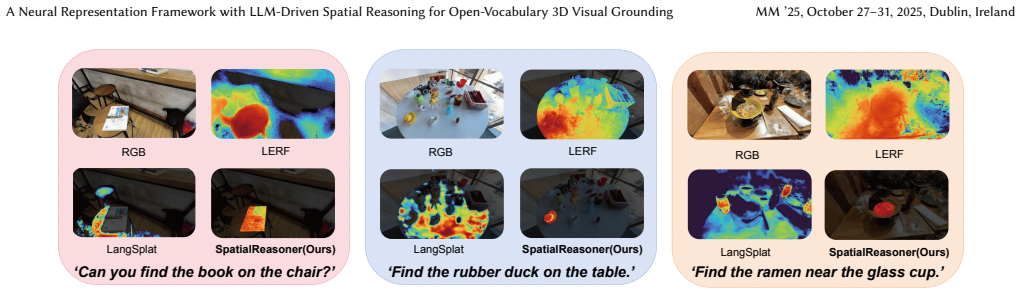
The central claim is that existing language-field methods localize objects directly from the whole query and therefore fail at spatial relations, and that the failure can be fixed by adding spatial reasoning in both the language and the scene. SpatialReasoner fine-tunes a small LLM to parse a query into target, anchor, and relation instructions, and constructs a hierarchical feature field with a language field and an instance field, both conditioned on visual properties—opacity and color—extracted from the neural reconstruction. Querying these fields hierarchically activates candidate targets and anchors, an instance graph merges related candidates, and the spatial relation is explicitly verified to pick the final instance. The paper reports that this design integrates into NeRF, Instant-NGP, and 3DGS and reaches overall localization accuracies of 83.4, 87.8, and 91.7 percent on the extended LERF spatial-reasoning benchmark, outperforming the language-field baselines it compares against.
Load-bearing premise
The evaluation's ground-truth boxes on the extended LERF dataset are produced by the automatic segmentation model on rendered novel views, and the same segmentation model generates the masks that supervise the proposed fields, so the comparison assumes those automatic masks are an unbiased measure of correct localization.
Editorial extensions
If this is right
- Integrating SpatialReasoner into NeRF, Instant-NGP, or 3DGS yields localization accuracy of 83.4, 87.8, and 91.7 percent on the extended LERF spatial-reasoning benchmark, roughly double the best language-field baseline.
- Because the framework only needs posed images plus the same neural representation already used for reconstruction, it brings spatial-relation grounding to any scene that can be reconstructed as a radiance field or Gaussian splatting.
- Separating query parsing from scene reasoning means the language-side LLM can be improved or swapped without retraining the 3D fields, and vice versa.
- The contrastively supervised instance field is what lets the method distinguish identical objects such as two books, so relational grounding no longer collapses to category matching.
Reading between the lines
- Beyond the paper, the same decompose-then-query design could be transferred to 2D referring segmentation or video object grounding, where relational phrases such as "left of" or "behind" also break pure CLIP feature matching.
- A testable extension the paper leaves implicit is a full ablation of the LLM: replacing it with a fixed rule-based parser would show how much of the gain comes from language-side decomposition versus scene-side hierarchical fields.
- The shared use of the automatic segmentation model for both supervision and evaluation suggests the strongest next check is a human-annotated spatial-relation benchmark, which would separate genuine spatial understanding from segmentation bias.
Editorial analysis
A structured set of objections, weighed in public.
Referee Report
Summary. The paper proposes SpatialReasoner, a framework for open-vocabulary 3D visual grounding that augments neural representation--based language fields with an LLM fine-tuned to decompose queries into target, anchor, and spatial relation, and a hierarchical feature field (language plus instance) that incorporates opacity and color as visual properties and SAM masks as supervision. The pipeline is instantiated on NeRF, Instant-NGP, and 3DGS and evaluated on an extended LERF dataset, the Replica dataset, and a newly introduced Re3D dataset. The central claim is that adding LLM-driven spatial relation decomposition and a visual-properties-enhanced hierarchical feature field lets language-field methods outperform prior work on spatial-relation queries, with reported accuracies of 83.4%, 87.8%, and 91.7% on the extended LERF benchmark for the three backbones.
Significance. If the claims were established, the contribution would be practically useful: it offers a modular upgrade path for existing NeRF/3DGS language fields to handle spatial queries, and the decomposition into target, anchor, and relation is a plausible design. The paper also reports experiments across three backbones and includes ablations of visual properties, the instance field, and the instance graph. However, the evaluation is currently not independent of the training signal, and the spatial-relation verification mechanism is unspecified. These issues must be addressed before the empirical claims can be taken as evidence for the advertised spatial reasoning capability.
major comments (3)
- [Sec. 4.1 and Sec. 3.3] The extended LERF evaluation is confounded with the method's training signal. Section 4.1 states that ground-truth labels for the extended LERF benchmark are generated by rendering novel views and using SAM. Section 3.3 uses the same SAM automatic mask generator to create the mask supervision for the language field (Eq. 4) and the instance field (Eq. 5), and to compute physical scales used in candidate generation. As a result, the reported 83.4--91.7% accuracies in Table 1 and 85.3--92.8% mIoU values in Table 2 largely measure how well the method reproduces the mask family it was optimized to fit, not whether it resolves spatial relations such as "the book on the chair." Because no human-annotated ground truth or standard benchmark such as ScanRefer, Sr3D, or Nr3D is reported, the quantitative support for the central spatial-reasoning claim is currently undermined. Please re-evaluate with independent human-annotated boxes or masks, or on an existing benchmark, and report results separately for each of the four spatial relations.
- [Sec. 3.4] The core mechanism for verifying spatial relations is not described. The text states that SpatialReasoner "considers four spatial relations (Horizontal Proximity, Vertical Proximity, Support, Allocentric)" and that "the specific object is determined accordingly," but no algorithm, thresholds, geometric tests, or decision rules are given. Equation (6) similarly defines the instance graph edge set through an unspecified threshold on affine differences, without stating how the threshold is chosen or how connected components are converted into final candidates. Since spatial relation verification is the load-bearing component for the central claim, this under-specification prevents the reader from assessing whether the method performs spatial reasoning in 3D. Please provide the full procedure, including parameters, pseudocode, and a failure analysis.
- [Sec. 3.2 and Sec. 4.1] The paper fine-tunes an LLM on Sr3D and Sr3D++ and mentions that the number of instructions is set to 3 for those benchmarks, but it reports no quantitative results on these human-annotated datasets or on ScanRefer/Nr3D. The newly introduced Re3D dataset is captured with the same Polycam pipeline and evaluated with the same protocol as the extended LERF benchmark, so it does not break the SAM circularity. Adding results on at least one standard human-annotated 3D visual grounding benchmark is necessary to demonstrate that the reported gains are not an artifact of the evaluation protocol. The paper should also report LLM decomposition accuracy on held-out queries and describe the fine-tuning data and instruction templates to rule out trivial overlap with the test queries.
minor comments (6)
- [Figures 2 and 3] There are typos in the figure text: "mask-extraceted" in Figure 2 and "localozation" in Figure 3; these should be corrected.
- [Eq. (6)] The notation in Eq. (6) is unclear: the dimension of V, the meaning of the tensor product, and the norm used should be defined explicitly, and the threshold for defining edges from the affine differences should be stated.
- [Sec. 3.4] The phrase "the number of instructions (n) is adapted per benchmark" is not instantiated for LERF, Replica, or Re3D; please specify n and the actual instruction templates for each dataset.
- [Sec. 3.2 and Sec. 4.1] The method description refers to fine-tuning ChatGPT, while the implementation uses TinyLlama; this discrepancy should be reconciled.
- [Table 4] The claim that the method improves performance "without significantly increasing the inference cost" is not supported for the NeRF variant: SpatialReasoner(NeRF) has a single-view activation time of 1.43 s, more than 35 times slower than LangSplat's 0.04 s.
- [Sec. 4.1] The metric definitions should specify how the rendered relevance map is thresholded to compute mIoU against the annotated ground-truth mask, and the Replica head/common/tail split should be described with dataset statistics.
Circularity Check
Extended-LERF evaluation is self-referential: SAM provides both the mask supervision and the ground-truth boxes, so the reported spatial-reasoning gains partly measure SAM-mask fit.
-
fitted input called prediction
[Sec. 4.1 (Datasets, LERF) and Sec. 3.3 (Supervision Generation, Eq. 5)]
"To assess localization performance under spatial language queries, we enhance LERF by rendering novel views and generating ground truth labels using the Segment Anything Model (SAM). ... SpatialReasoner first utilizes the automatic mask generator of SAM [14] to generate object masks from training views. ... Localization accuracy considers a label a success if the highest relevance pixel falls inside the annotated box."
The extended-LERF 'annotated' boxes/masks are produced by SAM, and the same automatic SAM mask generator supplies the supervision for the proposed method: SAM masks are used to extract CLIP features, compute physical scales, and define the mask-contrastive instance loss (Eq. 5). The metric then counts a hit when the highest-relevance pixel falls inside a SAM-generated box, and mIoU overlaps the rendered relevance map with SAM masks. Hence a model optimized to concentrate relevance within SAM mask interiors on training views is rewarded on novel views for reproducing that same mask family, independent of whether it actually resolved the spatial relation (e.g., which book is on the chair).
full rationale
The quantitative support for the central claim rests on Tables 1-5, but the main benchmark is confounded in a way that makes part of the reported gain circular. The paper's own Sec. 4.1 states that ground-truth labels on the extended LERF are generated by SAM, and Sec. 3.3 states that SAM's automatic mask generator supplies the masks used to supervise the language and instance fields, including the mask-contrastive loss in Eq. 5. Because the metric counts a success when the highest-relevance pixel falls inside the SAM-generated annotated box, and mIoU is measured against SAM masks, the evaluation rewards the very mask distribution the method was optimized to fit. This makes the advantage over LangSplat and LERF on LERF partly self-referential. I do not find a load-bearing self-citation chain: ReasonGrounder is a related-work citation, not a source of the framework's validity, and no uniqueness theorem is imported. The LLM decomposition and the geometric spatial-relation verification are genuine, non-circular components, so the central mechanism is not entirely equivalent to its input. However, the absence of human-annotated ground-truth benchmarks (e.g., ScanRefer, Sr3D, or Nr3D) means the central spatial-reasoning claim is supported mainly by the SAM-vs-SAM evaluation. Score 6 reflects a partial circularity in the evaluation design, not a wholesale fabricated derivation.
Assumptions & free parameters
free parameters (4)
- instance graph edge threshold
- spatial relation rule thresholds
- instruction count n =
3 for Sr3D/Sr3D++
- instance loss margin lambda_in
assumptions (5)
- standard math Volume rendering integration for feature fields
- domain assumption CLIP text-image embedding alignment
- domain assumption Depth deprojection accuracy
- ad hoc to paper Four-way spatial relation taxonomy
- domain assumption Fine-tuned LLM parses queries correctly
Cite this review
Pith. "Pith review of A Neural Representation Framework with LLM-Driven Spatial Reasoning for Open-Vocabulary 3D Visual Grounding." pith.science (2026). https://pith.science/paper/G4KS7G33
@misc{pith2026250706719,
  author       = {Pith},
  title        = {Pith review of: A Neural Representation Framework with LLM-Driven Spatial Reasoning for Open-Vocabulary 3D Visual Grounding},
  year         = {2026},
  howpublished = {\url{https://pith.science/paper/G4KS7G33}},
  note         = {Machine review of arXiv:2507.06719}
}
read the original abstract
Open-vocabulary 3D visual grounding aims to localize target objects based on free-form language queries, which is crucial for embodied AI applications such as autonomous navigation, robotics, and augmented reality. Learning 3D language fields through neural representations enables accurate understanding of 3D scenes from limited viewpoints and facilitates the localization of target objects in complex environments. However, existing language field methods struggle to accurately localize instances using spatial relations in language queries, such as ``the book on the chair.'' This limitation mainly arises from inadequate reasoning about spatial relations in both language queries and 3D scenes. In this work, we propose SpatialReasoner, a novel neural representation-based framework with large language model (LLM)-driven spatial reasoning that constructs a visual properties-enhanced hierarchical feature field for open-vocabulary 3D visual grounding. To enable spatial reasoning in language queries, SpatialReasoner fine-tunes an LLM to capture spatial relations and explicitly infer instructions for the target, anchor, and spatial relation. To enable spatial reasoning in 3D scenes, SpatialReasoner incorporates visual properties (opacity and color) to construct a hierarchical feature field. This field represents language and instance features using distilled CLIP features and masks extracted via the Segment Anything Model (SAM). The field is then queried using the inferred instructions in a hierarchical manner to localize the target 3D instance based on the spatial relation in the language query. Extensive experiments show that our framework can be seamlessly integrated into different neural representations, outperforming baseline models in 3D visual grounding while empowering their spatial reasoning capability.
Figures


Figures from the paper (3 more)


Forward citations
Cited by 1 Pith paper
-
QuASH: Using Natural-Language Heuristics to Query Visual-Language Robotic Maps
Querying VLM robot maps with an SVM trained on LLM-generated synonym/antonym embeddings outperforms cosine-threshold and single-antonym baselines on images and OpenSeg maps, but not consistently on LSeg maps.
Reference graph
Works this paper leans on
-
[1]
Josh Achiam, Steven Adler, Sandhini Agarwal, Lama Ahmad, Ilge Akkaya, Floren- cia Leoni Aleman, Diogo Almeida, Janko Altenschmidt, Sam Altman, Shyamal Anadkat, et al. 2023. Gpt-4 technical report. arXiv preprint arXiv:2303.08774 (2023)
arXiv 2023
-
[2]
Panos Achlioptas, Ahmed Abdelreheem, Fei Xia, Mohamed Elhoseiny, and Leonidas Guibas. 2020. Referit3d: Neural listeners for fine-grained 3d object identification in real-world scenes. InComputer Vision–ECCV 2020: 16th European Conference, Glasgow, UK, August 23–28, 2020, Proceedings, Part I 16 . Springer, 422–440
2020
-
[3]
Robert A Brebin, Loren Carpenter, and Pat Hanrahan. 1998. Volume rendering. In Seminal graphics: pioneering efforts that shaped the field . 363–372
work page 1998
-
[4]
Dave Zhenyu Chen, Angel X Chang, and Matthias Nießner. 2020. Scanrefer: 3d object localization in rgb-d scans using natural language. In European conference on computer vision. Springer, 202–221
2020
-
[5]
Nianchen Deng, Zhenyi He, Jiannan Ye, Budmonde Duinkharjav, Praneeth Chakravarthula, Xubo Yang, and Qi Sun. 2022. Fov-nerf: Foveated neural radi- ance fields for virtual reality. IEEE Transactions on Visualization and Computer Graphics 28, 11 (2022), 3854–3864
work page 2022
-
[6]
Golnaz Ghiasi, Xiuye Gu, Yin Cui, and Tsung-Yi Lin. 2022. Scaling open- vocabulary image segmentation with image-level labels. In European Conference on Computer Vision. Springer, 540–557
2022
-
[7]
Michael A Goodrich, Alan C Schultz, et al. 2008. Human–robot interaction: a survey. Foundations and Trends ® in Human–Computer Interaction 1, 3 (2008), 203–275
work page 2008
-
[8]
Xiuye Gu, Tsung-Yi Lin, Weicheng Kuo, and Yin Cui. 2021. Open-vocabulary object detection via vision and language knowledge distillation. arXiv preprint arXiv:2104.13921 (2021)
arXiv 2021
Show all 52 references
-
[9]
Huy Ha and Shuran Song. 2022. Semantic abstraction: Open-world 3d scene understanding from 2d vision-language models. arXiv preprint arXiv:2207.11514 (2022)
2022 arXiv
-
[10]
Yining Hong, Haoyu Zhen, Peihao Chen, Shuhong Zheng, Yilun Du, Zhenfang Chen, and Chuang Gan. 2023. 3d-llm: Injecting the 3d world into large language models. Advances in Neural Information Processing Systems 36 (2023), 20482– 20494
2023
-
[11]
Bernhard Kerbl, Georgios Kopanas, Thomas Leimkühler, and George Drettakis
-
[12]
Justin Kerr, Chung Min Kim, Ken Goldberg, Angjoo Kanazawa, and Matthew Tancik. 2023. Lerf: Language embedded radiance fields. In Proceedings of the IEEE/CVF International Conference on Computer Vision . 19729–19739
2023
-
[13]
Chung Min Kim, Mingxuan Wu, Justin Kerr, Ken Goldberg, Matthew Tancik, and Angjoo Kanazawa. 2024. GARField: Group Anything with Radiance Fields. arXiv preprint arXiv:2401.09419 (2024)
2024 arXiv
-
[14]
Alexander Kirillov, Eric Mintun, Nikhila Ravi, Hanzi Mao, Chloe Rolland, Laura Gustafson, Tete Xiao, Spencer Whitehead, Alexander C Berg, Wan-Yen Lo, et al
-
[15]
Ranjay Krishna, Yuke Zhu, Oliver Groth, Justin Johnson, Kenji Hata, Joshua Kravitz, Stephanie Chen, Yannis Kalantidis, Li-Jia Li, David A Shamma, et al
-
[16]
In Proceedings of the IEEE/CVF International Conference on Computer Vision
Segment anything. In Proceedings of the IEEE/CVF International Conference on Computer Vision. 4015–4026
-
[17]
Feng Liang, Bichen Wu, Xiaoliang Dai, Kunpeng Li, Yinan Zhao, Hang Zhang, Peizhao Zhang, Peter Vajda, and Diana Marculescu. 2023. Open-vocabulary semantic segmentation with mask-adapted clip. In Proceedings of the IEEE/CVF Conference on Computer Vision and Pattern Recognition ...
2023
-
[18]
Haitao Lin, Yanwei Fu, and Xiangyang Xue. 2023. PourIt!: Weakly-supervised Liquid Perception from a Single Image for Visual Closed-Loop Robotic Pouring. In Proceedings of the IEEE/CVF International Conference on Computer Vision . 241– 251
2023
-
[19]
Boyi Li, Kilian Q Weinberger, Serge Belongie, Vladlen Koltun, and René Ranftl
-
[20]
Zhenyang Liu, Yikai Wang, Sixiao Zheng, Tongying Pan, Longfei Liang, Yanwei Fu, and Xiangyang Xue. 2025. ReasonGrounder: LVLM-Guided Hierarchical Feature Splatting for Open-Vocabulary 3D Visual Grounding and Reasoning. arXiv preprint arXiv:2503.23297 (2025)
2025 arXiv
-
[21]
Shiyang Lu, Haonan Chang, Eric Pu Jing, Abdeslam Boularias, and Kostas Bekris
-
[22]
Timo Lüddecke and Alexander Ecker. 2022. Image segmentation using text and image prompts. In Proceedings of the IEEE/CVF conference on computer vision and pattern recognition. 7086–7096
2022
-
[23]
Yichen Liu, Benran Hu, Junkai Huang, Yu-Wing Tai, and Chi-Keung Tang. 2023. Instance neural radiance field. In Proceedings of the IEEE/CVF International Con- ference on Computer Vision . 787–796
2023
-
[24]
Ben Mildenhall, Pratul P Srinivasan, Matthew Tancik, Jonathan T Barron, Ravi Ramamoorthi, and Ren Ng. 2021. Nerf: Representing scenes as neural radiance fields for view synthesis. Commun. ACM 65, 1 (2021), 99–106
2021
-
[25]
Thomas Müller, Alex Evans, Christoph Schied, and Alexander Keller. 2022. In- stant neural graphics primitives with a multiresolution hash encoding. ACM transactions on graphics (TOG) 41, 4 (2022), 1–15
2022
-
[26]
In Conference on Robot Learning
Ovir-3d: Open-vocabulary 3d instance retrieval without training on 3d data. In Conference on Robot Learning . PMLR, 1610–1620
-
[27]
Jelena Novosel, Prashanth Viswanath, and Bruno Arsenali. 2019. Boosting se- mantic segmentation with multi-task self-supervised learning for autonomous driving applications. In Proc. of NeurIPS-Workshops, Vol. 3
2019
-
[28]
Junhua Mao, Jonathan Huang, Alexander Toshev, Oana Camburu, Alan L Yuille, and Kevin Murphy. 2016. Generation and comprehension of unambiguous object descriptions. In Proceedings of the IEEE conference on computer vision and pattern recognition. 11–20
2016
-
[29]
Minghan Qin, Wanhua Li, Jiawei Zhou, Haoqian Wang, and Hanspeter Pfister
-
[30]
Alec Radford, Jong Wook Kim, Chris Hallacy, Aditya Ramesh, Gabriel Goh, Sandhini Agarwal, Girish Sastry, Amanda Askell, Pamela Mishkin, Jack Clark, et al. 2021. Learning transferable visual models from natural language supervision. In International conference on machine learni...
2021
-
[31]
Simon Niedermayr, Josef Stumpfegger, and Rüdiger Westermann. 2024. Com- pressed 3d gaussian splatting for accelerated novel view synthesis. InProceedings of the IEEE/CVF Conference on Computer Vision and Pattern Recognition . 10349– 10358
2024
-
[32]
Dhruv Shah, Benjamin Eysenbach, Gregory Kahn, Nicholas Rhinehart, and Sergey Levine. 2021. Ving: Learning open-world navigation with visual goals. In 2021 IEEE International Conference on Robotics and Automation (ICRA) . IEEE, 13215– 13222
2021
-
[33]
Songyou Peng, Kyle Genova, Chiyu Jiang, Andrea Tagliasacchi, Marc Pollefeys, Thomas Funkhouser, et al. 2023. Openscene: 3d scene understanding with open vocabularies. In Proceedings of the IEEE/CVF Conference on Computer Vision and Pattern Recognition. 815–824
2023
-
[34]
Julian Straub, Thomas Whelan, Lingni Ma, Yufan Chen, Erik Wijmans, Simon Green, Jakob J Engel, Raul Mur-Artal, Carl Ren, Shobhit Verma, et al. 2019. The replica dataset: A digital replica of indoor spaces. arXiv preprint arXiv:1906.05797 (2019)
2019 arXiv
-
[35]
LangSplat: 3D Language Gaussian Splatting.arXiv preprint arXiv:2312.16084 (2023)
2023 arXiv
-
[36]
Suhani Vora, Noha Radwan, Klaus Greff, Henning Meyer, Kyle Genova, Mehdi SM Sajjadi, Etienne Pot, Andrea Tagliasacchi, and Daniel Duckworth. 2021. Nesf: Neural semantic fields for generalizable semantic segmentation of 3d scenes. arXiv preprint arXiv:2111.13260 (2021)
2021 arXiv
-
[37]
Fabio Remondino, Ali Karami, Ziyang Yan, Gabriele Mazzacca, Simone Rigon, and Rongjun Qin. 2023. A critical analysis of NeRF-based 3D reconstruction. Remote Sensing 15, 14 (2023), 3585
2023
-
[38]
Jiarui Xu, Sifei Liu, Arash Vahdat, Wonmin Byeon, Xiaolong Wang, and Shalini De Mello. 2023. Open-vocabulary panoptic segmentation with text-to-image diffusion models. In Proceedings of the IEEE/CVF Conference on Computer Vision and Pattern Recognition. 2955–2966
2023
-
[39]
Thomas B Sheridan. 2016. Human–robot interaction: status and challenges. Human factors 58, 4 (2016), 525–532
2016
-
[40]
Zhihao Yuan, Xu Yan, Yinghong Liao, Ruimao Zhang, Sheng Wang, Zhen Li, and Shuguang Cui. 2021. Instancerefer: Cooperative holistic understanding for visual grounding on point clouds through instance multi-level contextual referring. In Proceedings of the IEEE/CVF International...
2021
-
[41]
Matthew Tancik, Vincent Casser, Xinchen Yan, Sabeek Pradhan, Ben Mildenhall, Pratul P Srinivasan, Jonathan T Barron, and Henrik Kretzschmar. 2022. Block- nerf: Scalable large scene neural view synthesis. In Proceedings of the IEEE/CVF conference on computer vision and pattern ...
2022
-
[42]
Peiyuan Zhang, Guangtao Zeng, Tianduo Wang, and Wei Lu. 2024. Tinyllama: An open-source small language model. arXiv preprint arXiv:2401.02385 (2024)
2024 arXiv
-
[43]
Zhaoqing Wang, Yu Lu, Qiang Li, Xunqiang Tao, Yandong Guo, Mingming Gong, and Tongliang Liu. 2022. Cris: Clip-driven referring image segmentation. In Proceedings of the IEEE/CVF conference on computer vision and pattern recognition . 11686–11695
2022
-
[44]
Luowei Zhou, Yannis Kalantidis, Xinlei Chen, Jason J Corso, and Marcus Rohrbach
-
[45]
Licheng Yu, Patrick Poirson, Shan Yang, Alexander C Berg, and Tamara L Berg
-
[48]
Hao Zhang, Fang Li, and Narendra Ahuja. 2024. Open-NeRF: Towards Open Vo- cabulary NeRF Decomposition. In Proceedings of the IEEE/CVF Winter Conference on Applications of Computer Vision . 3456–3465
2024
-
[50]
Xiaoshuai Zhang, Sai Bi, Kalyan Sunkavalli, Hao Su, and Zexiang Xu. 2022. Nerfu- sion: Fusing radiance fields for large-scale scene reconstruction. In Proceedings of the IEEE/CVF Conference on Computer Vision and Pattern Recognition . 5449–5458
2022
-
[2016]
In Computer Vision–ECCV 2016: 14th European Conference, Amsterdam, The Netherlands, October 11-14, 2016, Proceedings, Part II 14
Modeling context in referring expressions. In Computer Vision–ECCV 2016: 14th European Conference, Amsterdam, The Netherlands, October 11-14, 2016, Proceedings, Part II 14 . Springer, 69–85
2016
-
[2017]
International journal of computer vision 123 (2017), 32–73
Visual genome: Connecting language and vision using crowdsourced dense image annotations. International journal of computer vision 123 (2017), 32–73
2017
-
[2019]
In Proceedings of the IEEE/CVF conference on computer vision and pattern recognition
Grounded video description. In Proceedings of the IEEE/CVF conference on computer vision and pattern recognition . 6578–6587
-
[2022]
arXiv preprint arXiv:2201.03546 (2022)
Language-driven semantic segmentation. arXiv preprint arXiv:2201.03546 (2022)
2022 arXiv
-
[2023]
ACM Transac- tions on Graphics 42, 4 (2023), 1–14
3d gaussian splatting for real-time radiance field rendering. ACM Transac- tions on Graphics 42, 4 (2023), 1–14
2023
Reviewed August 6, 2026 · model on record in the stance chip above.
Discussion (0). Sign in to comment.