REVIEW 3 major objections 6 minor 1 cited by
Towards Multimodal Understanding via Stable Diffusion as a Task-Aware Feature Extractor
T0 review · 3 major / 6 minor · reviewed 2026-08-06 · deepseek-v4-flash
Pith's one-line read Pre-trained text-to-image diffusion models can serve as question-aware visual encoders that supply the fine-grained detail CLIP misses.
desk verdict Interesting empirical study of diffusion features for MLLMs, but the load-bearing question-conditioned pipeline is never tested for prompt leakage, so the headline gains are provisional. read the letter →
The pith
A machine-rendered reading of the paper's core claim, the machinery that carries it, and where it could break.
The reading
What carries the argument
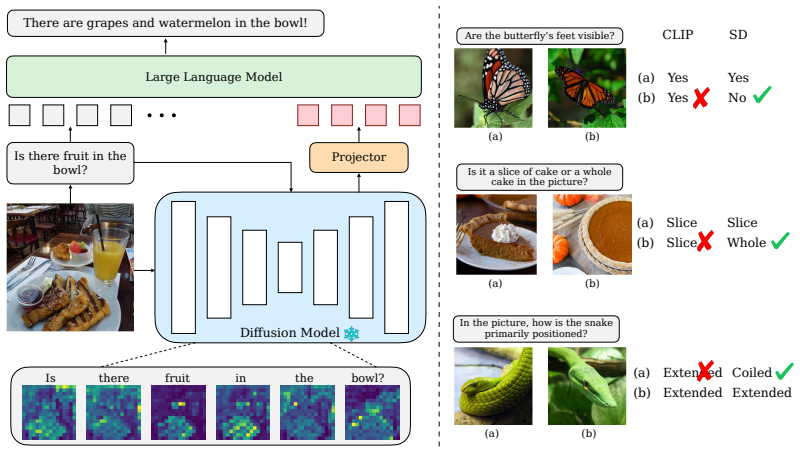
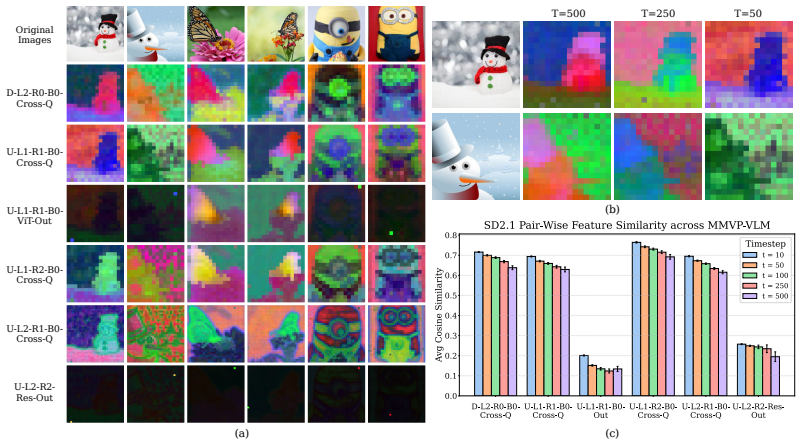
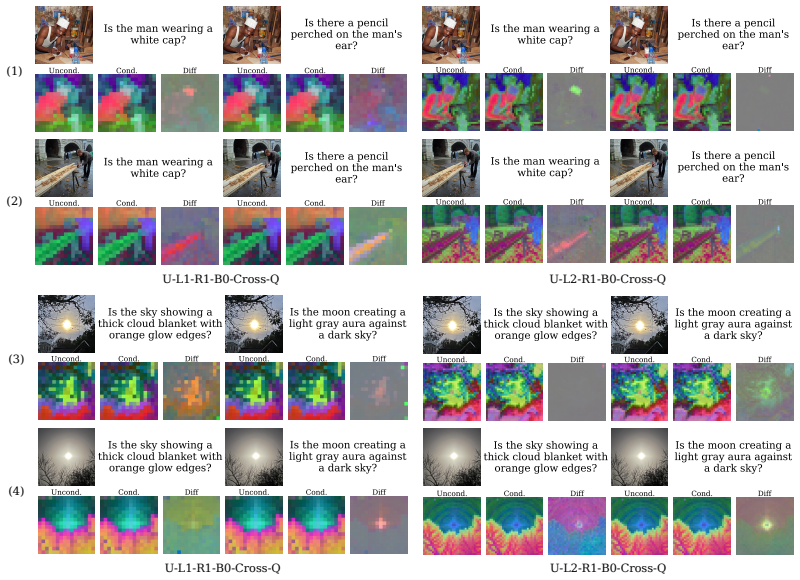
The mechanism that carries the argument is the text-conditioned cross-attention module inside the diffusion U-Net, specifically the pixel-wise query features (Cross-Q) extracted at up-stage blocks such as U-L1-R1-B0-Cross-Q at a 16x16 resolution and timestep around 50. These features directly interact with the text embedding, and the paper shows that amplifying the text guidance via $X_{\text{amp}} = X_{\text{uncond}} + s(X_{\text{cond}} - X_{\text{uncond}})$ increasingly focuses the representation on prompt-relevant image regions, measured by CKA similarity and PCA visualizations. For fusion, CLIP features act as queries over diffusion features as keys and values in a cross-attention layer, letting the LLM pull task-relevant spatial details from the diffusion encoder while keeping CLIP's global semantic alignment. The leakage analysis uses mismatched image-text pairs and CIDEr/SPICE scores to quantify how much of the prompt the LLM can decode from the features, and caption dropout is the proposed mitigation.
What would settle it
Ask the final CLIP + question-conditioned diffusion model the same MMVP question paired with a randomly chosen, unrelated image. If accuracy stays near the reported 30.7 rather than collapsing to chance, the answer is being recovered from the question prompt embedded in the diffusion features, refuting the claim that the gain comes from improved visual understanding.
Extended reading notes
Core claim
The paper's central claim is that the cross-attention features of a text-to-image diffusion model (Stable Diffusion v2.1-base) are semantically rich, encode fine-grained image-text alignment, and can be steered by the text prompt so that the visual representation highlights regions relevant to the user's question. Treating the diffusion model as a frozen, instruction-aware encoder, the authors align its features to an LLM through the LLaVA training pipeline and evaluate the resulting MLLM on general and vision-centric benchmarks. They report that the best configuration—CLIP features as queries in a cross-attention layer over conditional diffusion features—improves MMVP accuracy by 7 points and NaturalBench accuracy by 0.9 points over the LLaVA-v1.5 baseline. A key part of the discovery is the leakage phenomenon: when trained with captions as the text condition, the LLM can recover the original prompt from the diffusion features (up to a CIDEr of 12.97 on mismatched image-text pairs), and this leakage is mitigated by randomly dropping the text condition during pretraining. The paper concludes that diffusion models are promising as complementary, query-aware visual encoders, especially for spatial and compositional reasoning.
Load-bearing premise
The claim's VQA gains assume that the prompt leakage demonstrated with caption prompts does not also let the language model answer from question text hidden inside the diffusion features.
Editorial extensions
If this is right
- Frozen diffusion encoders can be dropped into existing MLLM pipelines to improve spatial, compositional, and part-level visual reasoning without changing the LLM.
- Text conditioning at guidance scale s=4 yields better task-aware features than unconditional features, suggesting that prompt-aware encoding, not just richer features, drives the gains.
- Prompt leakage is a real failure mode when conditioning an encoder on text, and caption dropout is a simple, effective mitigation during pretraining.
- MLLMs built on CLIP plus conditional diffusion features beat the CLIP-only baseline on MMVP and NaturalBench while staying competitive on general VQA benchmarks.
Reading between the lines
- An open question the paper leaves implicit: the leakage probe is run with caption prompts only, so the reported VQA gains could partly reflect the LLM decoding the question from question-conditioned features; rerunning the mismatched image-text protocol with questions would settle this.
- The guidance-scale interpolation suggests ensembling features across multiple values of s (e.g., 0, 1.5, 4) could push performance further, an idea the authors mention only as future work.
- Because the paper shows SDXL exhibits even stronger text-dependence than SD2.1, the leakage-vs-task-awareness trade-off is likely a general property of text-to-image models, so any instruction-conditioned diffusion encoder should be screened for leakage.
- The 'register' tokens observed in output features resemble global descriptors found in self-supervised ViTs, hinting that diffusion output features could serve a dual role: global image descriptor plus fine-grained local features, but the paper does not exploit this.
Editorial analysis
A structured set of objections, weighed in public.
Referee Report
Summary. This paper proposes using a frozen text-to-image diffusion model (Stable Diffusion v2.1-base) as an instruction-aware visual encoder for multimodal LLMs. The authors analyze diffusion features across blocks and timesteps, quantify cross-attention alignment on MMVP-VLM and Winoground, identify a prompt-leakage phenomenon in caption-conditioned features, propose caption dropout as a mitigation, and finally fuse CLIP with question-conditioned diffusion features in a LLaVA-1.5 framework, reporting improvements on MMVP and NaturalBench in Table 2. The paper is primarily empirical and includes substantial appendix material on block configurations, training hyperparameters, per-timestep results, and SDXL comparisons.
Significance. If the results hold, the paper makes a useful empirical case that diffusion representations carry complementary fine-grained, compositional, and question-relevant visual information that CLIP lacks, and it documents an important failure mode (prompt leakage) that any such approach must address. The strengths are the breadth of the analysis across blocks, timesteps, guidance scales, and cross-attention maps; the honest documentation of leakage and a concrete mitigation; and the reproducible training setup described in the appendix. The significance is conditional on closing the question-conditioned leakage gap and on showing that the reported gains are not artifacts of benchmark-driven configuration selection.
major comments (3)
- [§5.2, Table 2 and §4.3] The final pipeline conditions the diffusion model on the user's question at s=4 during SFT (Sec 5.2), but the leakage analysis in Sec 4.3 is restricted to caption prompts. The mismatched-image experiment shows that with caption conditioning at s=4 the LLM can recover the prompt text from diffusion features (CIDEr 12.97 for SD2.1 and 63.48 for SDXL in Table 9), and caption dropout only mitigates this. Because MMVP and NaturalBench questions contain the very concepts that must be verified visually, a question-conditioned model that leaks the prompt could answer from language alone, making the reported MMVP and NaturalBench gains in Table 2 reflect a shortcut rather than improved visual encoding. The authors need to run the mismatched-image test with question prompts (e.g., random image paired with a target question) and report whether the model can recover the question or answer it without the correct image.
- [§3.2, Fig 3 and §5.2, Table 2] The main quantitative claims rely on configurations selected on the evaluation benchmarks themselves. The block/timestep choice U-L1-R1-B0-Cross-Q at T=50 is chosen after comparing performance on MMVP, BLINK-val, and NaturalBench in Fig 3, and the guidance scale s=4 is chosen after inspecting Table 2 on the same benchmarks. This selection-dependent reporting can inflate the reported gains. The paper should either fix the configuration on a held-out validation set before evaluating on the test benchmarks, or present the full configuration grid with a multiple-comparison-corrected significance statement.
- [Table 2] No error bars or significance tests are reported for the central fusion results. Several of the reported improvements are small (NaturalBench G-Acc 15.26 vs 14.32, Q-Acc 40.71 vs 37.70, with GQA actually lower at 62.5 vs 62.7), so a single run does not establish that these gains are reliable. Please report multiple seeds or variance estimates for Table 2, and correct the headline '+7 points' to '+6.0 points' to match the table (30.7 vs 24.7).
minor comments (6)
- [Abstract and §5.2] The text states that MMVP improves by '+7 points' and the abstract says '+6%', but Table 2 shows 30.7 vs 24.7, which is +6.0 points; please reconcile these numbers.
- [§3.2] The sentence 'We evaluate using a two sets of benchmarks' contains a typo and should read 'two sets'.
- [Table 5] The entry '31..48' appears to be a typo for '31.48'.
- [§4.1] The image-text matching score is computed directly from the same cross-attention maps being evaluated, via LogSumExp pooling; this is a legitimate proxy but should be explicitly flagged as less independent than a separate scoring model.
- [Table 1] The comparison in Table 1 is not fully apples-to-apples: the SD cross-attention method uses 512×512 images and an ensemble of five timesteps, while the CLIP models use a single forward pass at 224 or 336 resolution; please state this clearly and avoid the claim of outperforming 'CLIP-based models across all benchmarks' when DFN-CLIP achieves a higher MMVP-VLM average (39.3 vs 34.6).
- [Table 2] The column header 'Config LLaVA-B MMVP GQA Natural-Bench All Acc Acc Q-Acc I-Acc G-Acc' is difficult to parse; please clarify which columns correspond to which benchmark and metric.
Circularity Check
No circularity found: the central claim is validated on external benchmarks and no load-bearing step reduces to its own inputs by construction.
full rationale
The paper's central claim, that fusing CLIP with question-conditioned Stable Diffusion features improves MLLM accuracy, is tested against the LLaVA-v1.5 baseline on external benchmarks (MMVP, NaturalBench, BLINK, Winoground); none of these benchmarks is defined in terms of the method's own outputs, so the result is not circular. The Sec 4.1 image-text matching evaluation uses cross-attention maps as a scoring function, but correctness is judged by MMVP-VLM and Winoground, making the comparison falsifiable rather than definitional. The layer and timestep choices are supported by the paper's own PCA/CKA/benchmark sweeps; this is analysis-driven design, not a fitted parameter renamed as a prediction. Citations to the authors' prior work ([26], [51]) are background statements about repurposing diffusion features and are not load-bearing for the reported gains. The remaining concern flagged in the reader's take and in Sec 4.3/6, namely that the final question-conditioned pipeline is not explicitly tested for prompt leakage, is a validity threat, not a circularity: it would require an empirical demonstration that the LLM recovers question text from diffusion features, which the paper does not provide. No step in the derivation chain is equivalent to its inputs by construction.
Assumptions & free parameters
free parameters (5)
- Guidance scale s =
4
- Timestep T =
50
- Block configuration =
U-L1-R1-B0-Cross-Q
- Timestep ensemble for cross-attention matching =
t in {189,389,589,789,989}
- Caption dropout rate =
not specified
assumptions (3)
- domain assumption Stable Diffusion v2.1-base provides sufficiently rich intermediate features for downstream LLM alignment.
- domain assumption The 16x16 spatial resolution of extracted features preserves task-relevant detail.
- domain assumption The question text passed to the diffusion model at inference does not leak answer information into the features in the VQA setting.
Cite this review
Pith. "Pith review of Towards Multimodal Understanding via Stable Diffusion as a Task-Aware Feature Extractor." pith.science (2026). https://pith.science/paper/SKN4OV52
@misc{pith2026250707106,
  author       = {Pith},
  title        = {Pith review of: Towards Multimodal Understanding via Stable Diffusion as a Task-Aware Feature Extractor},
  year         = {2026},
  howpublished = {\url{https://pith.science/paper/SKN4OV52}},
  note         = {Machine review of arXiv:2507.07106}
}
read the original abstract
Recent advances in multimodal large language models (MLLMs) have enabled image-based question-answering capabilities. However, a key limitation is the use of CLIP as the visual encoder; while it can capture coarse global information, it often can miss fine-grained details that are relevant to the input query. To address these shortcomings, this work studies whether pre-trained text-to-image diffusion models can serve as instruction-aware visual encoders. Through an analysis of their internal representations, we find diffusion features are both rich in semantics and can encode strong image-text alignment. Moreover, we find that we can leverage text conditioning to focus the model on regions relevant to the input question. We then investigate how to align these features with large language models and uncover a leakage phenomenon, where the LLM can inadvertently recover information from the original diffusion prompt. We analyze the causes of this leakage and propose a mitigation strategy. Based on these insights, we explore a simple fusion strategy that utilizes both CLIP and conditional diffusion features. We evaluate our approach on both general VQA and specialized MLLM benchmarks, demonstrating the promise of diffusion models for visual understanding, particularly in vision-centric tasks that require spatial and compositional reasoning. Our project page can be found https://vatsalag99.github.io/mustafar/.
Figures

Figures from the paper (9 more)


Forward citations
Cited by 1 Pith paper
-
LAP: Fast LAtent Diffusion Planner for Autonomous Driving
LAP plans trajectories in a VAE-learned latent space with one- or two-step latent diffusion, beating prior learning-based planners on nuPlan hard scenarios with up to ~10x lower inference latency.
Reference graph
Works this paper leans on
-
[1]
Eyes wide shut? exploring the visual shortcomings of multimodal llms,
S. Tong, Z. Liu, Y . Zhai, Y . Ma, Y . LeCun, and S. Xie, “Eyes wide shut? exploring the visual shortcomings of multimodal llms,” inProceedings of the IEEE/CVF Conference on Computer Vision and Pattern Recognition, pp. 9568–9578, 2024
work page 2024
-
[2]
Learning transferable visual models from natural language supervision,
A. Radford, J. W. Kim, C. Hallacy, A. Ramesh, G. Goh, S. Agarwal, G. Sastry, A. Askell, P. Mishkin, J. Clark,et al., “Learning transferable visual models from natural language supervision,” inInternational conference on machine learning, pp. 8748–8763, PMLR, 2021
work page 2021
-
[3]
Detailclip: Detail-oriented clip for fine-grained tasks,
A. K. Monsefi, K. P. Sailaja, A. Alilooee, S.-N. Lim, and R. Ramnath, “Detailclip: Detail-oriented clip for fine-grained tasks,”arXiv preprint arXiv:2409.06809, 2024
arXiv 2024
-
[4]
Is clip the main roadblock for fine-grained open-world perception?,
L. Bianchi, F. Carrara, N. Messina, and F. Falchi, “Is clip the main roadblock for fine-grained open-world perception?,” 2024
work page 2024
-
[5]
Discffusion: Discriminative Diffusion Models as Few-shot Vision and Language Learners
X. He, W. Feng, T.-J. Fu, V . Jampani, A. Akula, P. Narayana, S. Basu, W. Y . Wang, and X. E. Wang, “Discffusion: Discriminative diffusion models as few-shot vision and language learners,”arXiv preprint arXiv:2305.10722, 2023
work page Pith review arXiv 2023
-
[6]
Brave: Broadening the visual encoding of vision-language models,
O. F. Kar, A. Tonioni, P. Poklukar, A. Kulshrestha, A. Zamir, and F. Tombari, “Brave: Broadening the visual encoding of vision-language models,”arXiv preprint arXiv:2404.07204, 2024
arXiv 2024
-
[7]
Cambrian-1: A fully open, vision-centric exploration of multimodal llms,
S. Tong, E. Brown, P. Wu, S. Woo, M. Middepogu, S. C. Akula, J. Yang, S. Yang, A. Iyer, X. Pan, et al., “Cambrian-1: A fully open, vision-centric exploration of multimodal llms,”arXiv preprint arXiv:2406.16860, 2024
arXiv 2024
-
[8]
From clip to dino: Visual encoders shout in multi-modal large language models,
D. Jiang, Y . Liu, S. Liu, X. Zhang, J. Li, H. Xiong, and Q. Tian, “From clip to dino: Visual encoders shout in multi-modal large language models,”arXiv preprint arXiv:2310.08825, 2023
arXiv 2023
Show all 70 references
-
[9]
Mini-gemini: Mining the potential of multi-modality vision language models,
Y . Li, Y . Zhang, C. Wang, Z. Zhong, Y . Chen, R. Chu, S. Liu, and J. Jia, “Mini-gemini: Mining the potential of multi-modality vision language models,” 2024
2024
-
[10]
Prismer: A vision-language model with multi-task experts,
S. Liu, L. Fan, E. Johns, Z. Yu, C. Xiao, and A. Anandkumar, “Prismer: A vision-language model with multi-task experts,”arXiv preprint arXiv:2303.02506, 2023
2023 arXiv
-
[11]
Vcoder: Versatile vision encoders for multimodal large language models,
J. Jain, J. Yang, and H. Shi, “Vcoder: Versatile vision encoders for multimodal large language models,” in Proceedings of the IEEE/CVF Conference on Computer Vision and Pattern Recognition, pp. 27992–28002, 2024
2024
-
[12]
Question aware vision transformer for multimodal reasoning,
R. Ganz, Y . Kittenplon, A. Aberdam, E. B. Avraham, O. Nuriel, S. Mazor, and R. Litman, “Question aware vision transformer for multimodal reasoning,” 2024
2024
-
[13]
Api: Attention prompting on image for large vision-language models,
R. Yu, W. Yu, and X. Wang, “Api: Attention prompting on image for large vision-language models,” 2024
2024
-
[14]
Instructblip: Towards general-purpose vision-language models with instruction tuning,
W. Dai, J. Li, D. Li, A. M. H. Tiong, J. Zhao, W. Wang, B. Li, P. Fung, and S. Hoi, “Instructblip: Towards general-purpose vision-language models with instruction tuning,” 2023
2023
-
[15]
Blip-2: Bootstrapping language-image pre-training with frozen image encoders and large language models,
J. Li, D. Li, S. Savarese, and S. Hoi, “Blip-2: Bootstrapping language-image pre-training with frozen image encoders and large language models,” inInternational conference on machine learning, pp. 19730–19742, PMLR, 2023
2023
-
[16]
High-resolution image synthesis with latent diffusion models,
R. Rombach, A. Blattmann, D. Lorenz, P. Esser, and B. Ommer, “High-resolution image synthesis with latent diffusion models,” inProceedings of the IEEE/CVF conference on computer vision and pattern recognition, pp. 10684–10695, 2022
2022
-
[17]
Photorealistic text-to-image diffusion models with deep language understanding,
C. Saharia, W. Chan, S. Saxena, L. Li, J. Whang, E. L. Denton, K. Ghasemipour, R. Gontijo Lopes, B. Karagol Ayan, T. Salimans, J. Ho, D. J. Fleet, and M. Norouzi, “Photorealistic text-to-image diffusion models with deep language understanding,” inAdvances in Neural Information...
2022
-
[18]
Hierarchical text-conditional image generation with clip latents,
A. Ramesh, P. Dhariwal, A. Nichol, C. Chu, and M. Chen, “Hierarchical text-conditional image generation with clip latents,” 2022
2022
-
[19]
Sdxl: Improving latent diffusion models for high-resolution image synthesis,
D. Podell, Z. English, K. Lacey, A. Blattmann, T. Dockhorn, J. Müller, J. Penna, and R. Rombach, “Sdxl: Improving latent diffusion models for high-resolution image synthesis,” 2023
2023
-
[20]
Prompt-to-prompt image editing with cross attention control,
A. Hertz, R. Mokady, J. Tenenbaum, K. Aberman, Y . Pritch, and D. Cohen-Or, “Prompt-to-prompt image editing with cross attention control,” 2022. 11
2022
-
[21]
What the daam: Interpreting stable diffusion using cross attention,
R. Tang, L. Liu, A. Pandey, Z. Jiang, G. Yang, K. Kumar, P. Stenetorp, J. Lin, and F. Ture, “What the daam: Interpreting stable diffusion using cross attention,” 2022
2022
-
[22]
Towards understanding cross and self-attention in stable diffusion for text-guided image editing,
B. Liu, C. Wang, T. Cao, K. Jia, and J. Huang, “Towards understanding cross and self-attention in stable diffusion for text-guided image editing,” 2024
2024
-
[23]
Plug-and-play diffusion features for text-driven image- to-image translation,
N. Tumanyan, M. Geyer, S. Bagon, and T. Dekel, “Plug-and-play diffusion features for text-driven image- to-image translation,” inProceedings of the IEEE/CVF Conference on Computer Vision and Pattern Recognition, pp. 1921–1930, 2023
1921
-
[24]
Diffusion model is secretly a training-free open vocabulary semantic segmenter,
J. Wang, X. Li, J. Zhang, Q. Xu, Q. Zhou, Q. Yu, L. Sheng, and D. Xu, “Diffusion model is secretly a training-free open vocabulary semantic segmenter,”arXiv preprint arXiv:2309.02773, 2023
2023 arXiv
-
[25]
Repurposing diffusion-based image generators for monocular depth estimation,
B. Ke, A. Obukhov, S. Huang, N. Metzger, R. C. Daudt, and K. Schindler, “Repurposing diffusion-based image generators for monocular depth estimation,” inProceedings of the IEEE/CVF Conference on Computer Vision and Pattern Recognition (CVPR), 2024
2024
-
[26]
Do text-free diffusion models learn discriminative visual representations?,
S. Mukhopadhyay, M. Gwilliam, Y . Yamaguchi, V . Agarwal, N. Padmanabhan, A. Swaminathan, T. Zhou, J. Ohya, and A. Shrivastava, “Do text-free diffusion models learn discriminative visual representations?,” arXiv preprint arXiv:2311.17921, 2023
2023 arXiv
-
[27]
Deconstructing denoising diffusion models for self-supervised learning,
X. Chen, Z. Liu, S. Xie, and K. He, “Deconstructing denoising diffusion models for self-supervised learning,” 2024
2024
-
[28]
Coca: Contrastive captioners are image-text foundation models,
J. Yu, Z. Wang, V . Vasudevan, L. Yeung, M. Seyedhosseini, and Y . Wu, “Coca: Contrastive captioners are image-text foundation models,”Trans. Mach. Learn. Res., vol. 2022, 2022
2022
-
[29]
Multimodal few-shot learning with frozen language models,
M. Tsimpoukelli, J. L. Menick, S. Cabi, S. M. A. Eslami, O. Vinyals, and F. Hill, “Multimodal few-shot learning with frozen language models,” inAdvances in Neural Information Processing Systems(M. Ranzato, A. Beygelzimer, Y . Dauphin, P. Liang, and J. W. Vaughan, eds.), vol. 3...
2021
-
[30]
Flamingo: a visual language model for few-shot learning,
J.-B. Alayrac, J. Donahue, P. Luc, A. Miech, I. Barr, Y . Hasson, K. Lenc, A. Mensch, K. Millican, M. Reynolds, R. Ring, E. Rutherford, S. Cabi, T. Han, Z. Gong, S. Samangooei, M. Monteiro, J. L. Menick, S. Borgeaud, A. Brock, A. Nematzadeh, S. Sharifzadeh, M. a. Bi´nkowski, R...
2022
-
[31]
Visual instruction tuning,
H. Liu, C. Li, Q. Wu, and Y . J. Lee, “Visual instruction tuning,” inNeurIPS, 2023
2023
-
[32]
Minigpt-4: Enhancing vision-language understanding with advanced large language models,
D. Zhu, J. Chen, X. Shen, X. Li, and M. Elhoseiny, “Minigpt-4: Enhancing vision-language understanding with advanced large language models,”arXiv preprint arXiv:2304.10592, 2023
2023 arXiv
-
[33]
Minigpt-v2: large language model as a unified interface for vision-language multi-task learning,
J. Chen, D. Zhu, X. Shen, X. Li, Z. Liu, P. Zhang, R. Krishnamoorthi, V . Chandra, Y . Xiong, and M. Elhoseiny, “Minigpt-v2: large language model as a unified interface for vision-language multi-task learning,”arXiv preprint arXiv:2310.09478, 2023
-
[34]
Openflamingo: An open-source framework for training large autoregressive vision-language models,
A. Awadalla, I. Gao, J. Gardner, J. Hessel, Y . Hanafy, W. Zhu, K. Marathe, Y . Bitton, S. Gadre, S. Sagawa, J. Jitsev, S. Kornblith, P. W. Koh, G. Ilharco, M. Wortsman, and L. Schmidt, “Openflamingo: An open-source framework for training large autoregressive vision-language m...
2023 arXiv
-
[35]
Evaluating object hallucination in large vision-language models,
Y . Li, Y . Du, K. Zhou, J. Wang, W. X. Zhao, and J.-R. Wen, “Evaluating object hallucination in large vision-language models,”arXiv preprint arXiv:2305.10355, 2023
2023 arXiv
-
[36]
Multi-modal hallucination control by visual information grounding,
A. Favero, L. Zancato, M. Trager, S. Choudhary, P. Perera, A. Achille, A. Swaminathan, and S. Soatto, “Multi-modal hallucination control by visual information grounding,” inProceedings of the IEEE/CVF Conference on Computer Vision and Pattern Recognition, pp. 14303–14312, 2024
2024
-
[37]
Detecting and preventing hallucinations in large vision language models,
A. Gunjal, J. Yin, and E. Bas, “Detecting and preventing hallucinations in large vision language models,” inProceedings of the AAAI Conference on Artificial Intelligence, vol. 38, pp. 18135–18143, 2024
2024
-
[38]
A survey on hallucination in large language models: Principles, taxonomy, challenges, and open questions,
L. Huang, W. Yu, W. Ma, W. Zhong, Z. Feng, H. Wang, Q. Chen, W. Peng, X. Feng, B. Qin,et al., “A survey on hallucination in large language models: Principles, taxonomy, challenges, and open questions,” arXiv preprint arXiv:2311.05232, 2023
2023 arXiv
-
[39]
Halle-switch: Rethinking and controlling object existence hallucinations in large vision language models for detailed caption,
B. Zhai, S. Yang, X. Zhao, C. Xu, S. Shen, D. Zhao, K. Keutzer, M. Li, T. Yan, and X. Fan, “Halle-switch: Rethinking and controlling object existence hallucinations in large vision language models for detailed caption,”arXiv preprint arXiv:2310.01779, 2023. 12
-
[40]
Aligning large multimodal models with factually augmented rlhf,
Z. Sun, S. Shen, S. Cao, H. Liu, C. Li, Y . Shen, C. Gan, L.-Y . Gui, Y .-X. Wang, Y . Yang,et al., “Aligning large multimodal models with factually augmented rlhf,”arXiv preprint arXiv:2309.14525, 2023
2023 arXiv
-
[41]
Blink: Multimodal large language models can see but not perceive,
X. Fu, Y . Hu, B. Li, Y . Feng, H. Wang, X. Lin, D. Roth, N. A. Smith, W.-C. Ma, and R. Krishna, “Blink: Multimodal large language models can see but not perceive,”arXiv preprint arXiv:2404.12390, 2024
2024 arXiv
-
[42]
Llava-next: Improved reasoning, ocr, and world knowledge,
H. Liu, C. Li, Y . Li, B. Li, Y . Zhang, S. Shen, and Y . J. Lee, “Llava-next: Improved reasoning, ocr, and world knowledge,” January 2024
2024
-
[43]
Mm1: Methods, analysis & insights from multimodal llm pre-training,
B. McKinzie, Z. Gan, J.-P. Fauconnier, S. Dodge, B. Zhang, P. Dufter, D. Shah, X. Du, F. Peng, F. Weers,et al., “Mm1: Methods, analysis & insights from multimodal llm pre-training,”arXiv preprint arXiv:2403.09611, 2024
2024 arXiv
-
[44]
Improved baselines with visual instruction tuning,
H. Liu, C. Li, Y . Li, and Y . J. Lee, “Improved baselines with visual instruction tuning,” 2023
2023
-
[45]
4m: Massively multimodal masked modeling,
D. Mizrahi, R. Bachmann, O. Kar, T. Yeo, M. Gao, A. Dehghan, and A. Zamir, “4m: Massively multimodal masked modeling,”Advances in Neural Information Processing Systems, vol. 36, 2024
2024
-
[46]
4m-21: An any-to-any vision model for tens of tasks and modalities,
R. Bachmann, O. F. Kar, D. Mizrahi, A. Garjani, M. Gao, D. Griffiths, J. Hu, A. Dehghan, and A. Zamir, “4m-21: An any-to-any vision model for tens of tasks and modalities,”arXiv preprint arXiv:2406.09406, 2024
2024 arXiv
-
[47]
Llava-plus: Learning to use tools for creating multimodal agents,
S. Liu, H. Cheng, H. Liu, H. Zhang, F. Li, T. Ren, X. Zou, J. Yang, H. Su, J. Zhu, L. Zhang, J. Gao, and C. Li, “Llava-plus: Learning to use tools for creating multimodal agents,” 2023
2023
-
[48]
Visual programming: Compositional visual reasoning without training,
T. Gupta and A. Kembhavi, “Visual programming: Compositional visual reasoning without training,” in Proceedings of the IEEE/CVF Conference on Computer Vision and Pattern Recognition, pp. 14953–14962, 2023
2023
-
[49]
Spatialbot: Precise spatial understanding with vision language models,
W. Cai, I. Ponomarenko, J. Yuan, X. Li, W. Yang, H. Dong, and B. Zhao, “Spatialbot: Precise spatial understanding with vision language models,” 2024
2024
-
[50]
Your diffusion model is secretly a zero- shot classifier,
A. C. Li, M. Prabhudesai, S. Duggal, E. Brown, and D. Pathak, “Your diffusion model is secretly a zero- shot classifier,” inProceedings of the IEEE/CVF International Conference on Computer Vision (ICCV), pp. 2206–2217, October 2023
2023
-
[51]
Diffusion models beat gans on image classification,
S. Mukhopadhyay, M. Gwilliam, V . Agarwal, N. Padmanabhan, A. Swaminathan, S. Hegde, T. Zhou, and A. Shrivastava, “Diffusion models beat gans on image classification,”arXiv preprint arXiv:2307.08702, 2023
2023 arXiv
-
[52]
Open-V ocabulary Panoptic Segmentation with Text-to-Image Diffusion Models,
J. Xu, S. Liu, A. Vahdat, W. Byeon, X. Wang, and S. De Mello, “Open-V ocabulary Panoptic Segmentation with Text-to-Image Diffusion Models,”arXiv preprint arXiv:2303.04803, 2023
2023 arXiv
-
[53]
Diffusion models for zero-shot open-vocabulary segmentation,
L. Karazija, I. Laina, A. Vedaldi, and C. Rupprecht, “Diffusion models for zero-shot open-vocabulary segmentation,”arXiv preprint arXiv:2306.09316, 2023
2023 arXiv
-
[54]
Not all diffusion model activations have been evaluated as discriminative features,
B. Meng, Q. Xu, Z. Wang, X. Cao, and Q. Huang, “Not all diffusion model activations have been evaluated as discriminative features,” 2024
2024
-
[55]
Dinov2: Learning robust visual features without supervision,
M. Oquab, T. Darcet, T. Moutakanni, H. V o, M. Szafraniec, V . Khalidov, P. Fernandez, D. Haziza, F. Massa, A. El-Nouby, M. Assran, N. Ballas, W. Galuba, R. Howes, P.-Y . Huang, S.-W. Li, I. Misra, M. Rabbat, V . Sharma, G. Synnaeve, H. Xu, H. Jegou, J. Mairal, P. Labatut, A. ...
2024
-
[56]
Vicuna: An open-source chatbot impressing gpt-4 with 90%* chatgpt quality,
W.-L. Chiang, Z. Li, Z. Lin, Y . Sheng, Z. Wu, H. Zhang, L. Zheng, S. Zhuang, Y . Zhuang, J. E. Gonzalez, et al., “Vicuna: An open-source chatbot impressing gpt-4 with 90%* chatgpt quality,”See https://vicuna. lmsys. org (accessed 14 April 2023), vol. 2, no. 3, p. 6, 2023
2023
-
[57]
Naturalbench: Evaluating vision-language models on natural adversarial samples,
B. Li, Z. Lin, W. Peng, J. d. D. Nyandwi, D. Jiang, Z. Ma, S. Khanuja, R. Krishna, G. Neubig, and D. Ramanan, “Naturalbench: Evaluating vision-language models on natural adversarial samples,” inThe Thirty-eight Conference on Neural Information Processing Systems Datasets and B...
2024
-
[58]
Openclip,
G. Ilharco, M. Wortsman, R. Wightman, C. Gordon, N. Carlini, R. Taori, A. Dave, V . Shankar, H. Namkoong, J. Miller, H. Hajishirzi, A. Farhadi, and L. Schmidt, “Openclip,” July 2021. If you use this software, please cite it as below
2021
-
[59]
Sigmoid loss for language image pre-training,
X. Zhai, B. Mustafa, A. Kolesnikov, and L. Beyer, “Sigmoid loss for language image pre-training,” 2023
2023
-
[60]
Data filtering networks,
A. Fang, A. M. Jose, A. Jain, L. Schmidt, A. Toshev, and V . Shankar, “Data filtering networks,” 2023. 13
2023
-
[61]
Demystifying clip data,
H. Xu, S. Xie, X. E. Tan, P.-Y . Huang, R. Howes, V . Sharma, S.-W. Li, G. Ghosh, L. Zettlemoyer, and C. Feichtenhofer, “Demystifying clip data,” 2024
2024
-
[62]
Eva-clip: Improved training techniques for clip at scale,
Q. Sun, Y . Fang, L. Wu, X. Wang, and Y . Cao, “Eva-clip: Improved training techniques for clip at scale,” 2023
2023
-
[63]
Microsoft COCO captions: Data collection and evaluation server,
X. Chen, H. Fang, T. Lin, R. Vedantam, S. Gupta, P. Dollár, and C. L. Zitnick, “Microsoft COCO captions: Data collection and evaluation server,”CoRR, vol. abs/1504.00325, 2015
2015 arXiv
-
[64]
Accurate computation of the log-sum-exp and softmax functions,
P. Blanchard, D. J. Higham, and N. J. Higham, “Accurate computation of the log-sum-exp and softmax functions,” 2019
2019
-
[65]
Winoground: Probing vision and language models for visio-linguistic compositionality,
T. Thrush, R. Jiang, M. Bartolo, A. Singh, A. Williams, D. Kiela, and C. Ross, “Winoground: Probing vision and language models for visio-linguistic compositionality,” inCVPR, 2022
2022
-
[66]
Similarity of neural network representations revisited,
S. Kornblith, M. Norouzi, H. Lee, and G. Hinton, “Similarity of neural network representations revisited,” inInternational conference on machine learning, pp. 3519–3529, PMLR, 2019
2019
-
[67]
Cider: Consensus-based image description evaluation,
R. Vedantam, C. Lawrence Zitnick, and D. Parikh, “Cider: Consensus-based image description evaluation,” inProceedings of the IEEE conference on computer vision and pattern recognition, pp. 4566–4575, 2015
2015
-
[68]
Spice: Semantic propositional image caption evaluation,
P. Anderson, B. Fernando, M. Johnson, and S. Gould, “Spice: Semantic propositional image caption evaluation,” inComputer Vision–ECCV 2016: 14th European Conference, Amsterdam, The Netherlands, October 11-14, 2016, Proceedings, Part V 14, pp. 382–398, Springer, 2016
2016
-
[69]
Decoupled weight decay regularization,
I. Loshchilov and F. Hutter, “Decoupled weight decay regularization,” 2019. 14 Towards Multimodal Understanding via Stable Diffusion as a Task-Aware Feature Extractor Supplementary Material A Experimental Settings A.1 Block Configurations We first describe our block-selection ...
2019
-
[70]
Frisbees
For the second image of the otter, we see that the “Frisbees” map precisely localizes the frisbees 3 Table 7: Comparison of SD2.1 model across varying timesteps for Winoground Benchmark, using 512×512 images. For ‘Ensemble’ we use timesteps t∈ {189,389,589,789,989} , and avera...
Reviewed August 6, 2026 · model on record in the stance chip above.
Discussion (0). Sign in to comment.