REVIEW 5 major objections 6 minor 44 references
FedP3E: Privacy-Preserving Prototype Exchange for Non-IID IoT Malware Detection in Cross-Silo Federated Learning
T0 review · 5 major / 6 minor · reviewed 2026-08-06 · deepseek-v4-flash
Pith's one-line read FedP3E claims one round of noisy class-prototype exchange lets federated clients learn disjoint IoT malware classes, beating FedAvg and FedProx with accuracy from 95.11% to 99.57%.
desk verdict The severe non-IID result is the real contribution, but the privacy claim is asserted not demonstrated, and the numbers need seeds and error bars. read the letter →
The pith
A machine-rendered reading of the paper's core claim, the machinery that carries it, and where it could break.
The reading
What carries the argument
The load-bearing object is the class-wise Gaussian Mixture prototype: the component means $\mu_j^{(c)}$ of a GMM fit to local feature vectors of class $c$, with component count selected by the Bayesian Information Criterion and then perturbed as $\tilde{\mu}_j^{(c)} = \mu_j^{(c)} + \epsilon$, $\epsilon \sim \mathcal{N}(0, \sigma^2 I)$ with $\sigma = 0.01$. This object's job is to compress one client's knowledge of a class into a few vectors, let the server merge all clients' views into global prototypes $\hat{\mu}_l^{(c)}$ via Mini-Batch K-Means, and give each client a seed set for SMOTE interpolation $x_{\mathrm{syn}} = \hat{\mu}_a^{(c)} + \lambda (\hat{\mu}_b^{(c)} - \hat{\mu}_a^{(c)})$, $\lambda \sim U(0,1)$, that produces synthetic training samples for classes the client has never seen. The whole argument that one round of prototype exchange closes the non-IID gap at under 10% of a model round's communication cost rests on this mechanism.
What would settle it
A decisive experiment is to run the severe non-IID scenario with the GMMs fit strictly on each client's 80% training split, holding the 20% test partition out of prototype construction, and then attempt a reconstruction attack on the transmitted noisy means; if accuracy collapses toward baseline or the attacker recovers the true class means with small error, the central claim fails.
Extended reading notes
Core claim
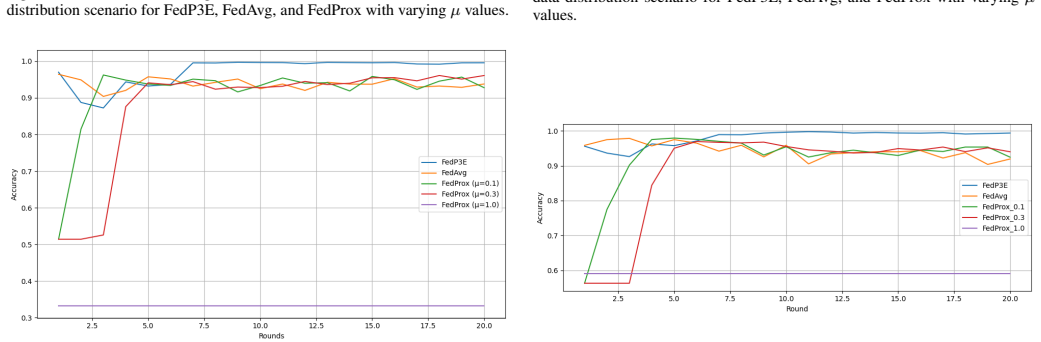
The core discovery is that indirect representation sharing through perturbed class prototypes can stand in for the missing class signal in non-IID federated learning. Each client fits a Gaussian Mixture Model to the 115-dimensional feature vectors of each class it holds, chooses the component count by Bayesian Information Criterion, and uploads only the component means after adding zero-mean Gaussian noise with standard deviation 0.01. The server clusters these noisy prototypes by class with Mini-Batch K-Means and sends the merged prototypes back to all clients, which then use SMOTE-style linear interpolation between prototype pairs to synthesize roughly 10% extra training samples for rare or absent classes. On the paper's own evaluation, this one-time, accuracy-gated exchange lets a three-client federation trained with FedAvg-style aggregation reach 99.71% accuracy in the IID case, 99.57% under light non-IID, 99.40% under moderate non-IID, and 95.11% under severe non-IID, while the baselines stay near random or collapse entirely in the worst setting. The authors present this as the reason cross-silo FL can handle statistical heterogeneity without exchanging raw data or gradients.
Load-bearing premise
The load-bearing premise is that Gaussian noise with standard deviation 0.01 added to the 115-dimensional class prototypes makes those prototypes safe to share; if that noise does not actually prevent reconstruction of sensitive class statistics, the framework's privacy guarantee collapses even if the accuracy mechanism still works.
Editorial extensions
If this is right
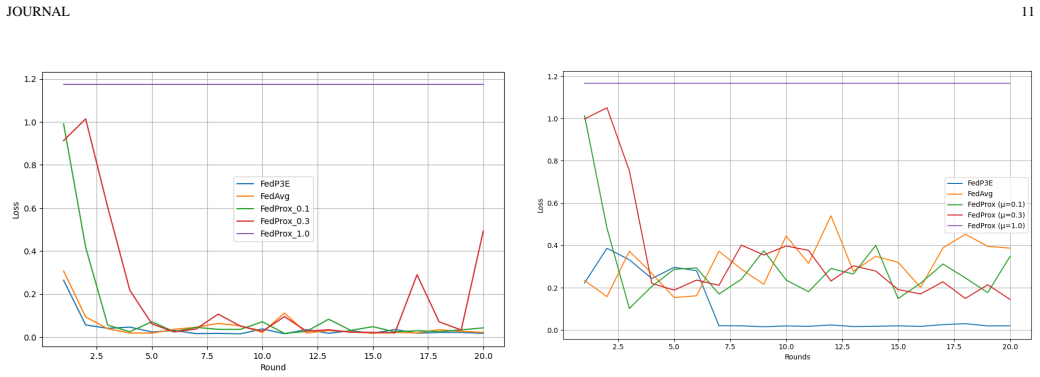
- A system with fully disjoint client labels can still learn a global multi-class malware detector: in the severe non-IID setting, the reported accuracy is 95.11% where FedAvg and FedProx fall to roughly 49% or lower.
- A single accuracy-triggered exchange is sufficient: the mechanism activates only when early global accuracy drops below 97%, so balanced settings pay almost no extra communication, and the one-time exchange itself costs less than 10% of a full model update.
- The largest gains are on minority malware families: the paper reports minority-class recall improvements of about 6 percentage points over FedAvg in light non-IID and about 7 points in moderate non-IID.
- The mechanism layers onto standard FedAvg aggregation and leaves the model architecture unchanged, so existing cross-silo deployments could adopt it without altering their training objective.
Reading between the lines
- The same one-shot prototype recipe should transfer to other federated tasks with disjoint labels, such as medical imaging or financial fraud, because it only assumes that class-conditional feature vectors form clusters that a GMM can summarize.
- A simpler summary than full GMM components—for example, per-class means and variances—might deliver most of the reported accuracy at lower computational cost, and comparing the two would isolate how much of the gain comes from multi-modality versus from sharing class statistics at all.
- Because features are min-max scaled to [0,1], a noise scale of 0.01 is small relative to typical inter-class distances, so the natural next test is formal sensitivity analysis or a reconstruction attack on the transmitted prototypes; this would determine whether a provable privacy guarantee can be attached to the same accuracy numbers.
Editorial analysis
A structured set of objections, weighed in public.
Referee Report
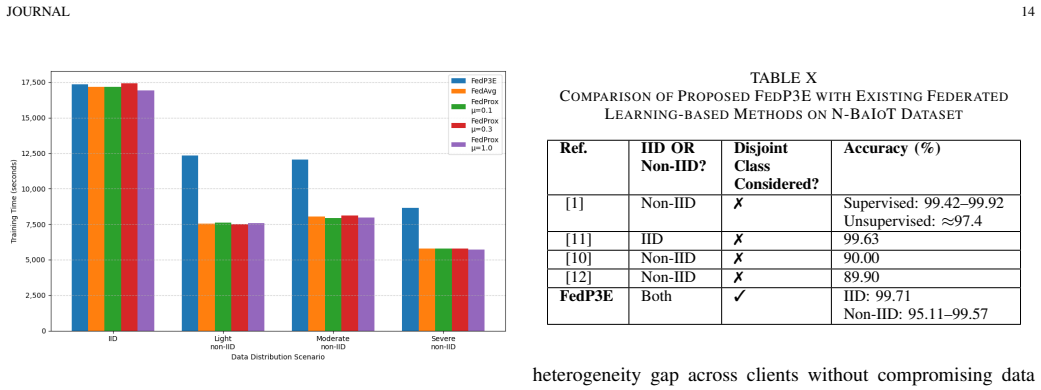
Summary. The paper proposes FedP3E, a federated learning framework for IoT malware detection in which clients periodically share Gaussian-noise-perturbed GMM component means ("prototypes") with a server; the server aggregates them via Mini-Batch K-Means, broadcasts global prototypes back to clients, and clients then use SMOTE to synthesize additional training samples for underrepresented classes. The method is evaluated on N-BaIoT with three clients under IID and three non-IID scenarios, comparing accuracy, F1, loss, training time, and communication overhead against FedAvg and FedProx. The central claims are that the one-time prototype exchange improves accuracy under non-IID conditions and that additive Gaussian noise preserves privacy.
Significance. FedP3E addresses a real problem—class imbalance and label skew in cross-silo FL—and the paper has some clear strengths: the communication-cost analysis in Section V.C.6 quantifies the one-time exchange as less than 10% of a model round, the data-partition tables are detailed, and Algorithm 1 gives a concrete procedural description. However, the manuscript's headline properties are not yet established. The privacy guarantee rests on an unexamined noise mechanism with no threat model, sensitivity bound, or differential-privacy accounting, and the empirical comparison gives FedP3E additional synthetic training data that the baselines do not receive, so the reported gains do not isolate the proposed mechanism. If the authors add a rigorous privacy analysis, error bars, and controlled ablations, the core idea could be a useful contribution to the cross-silo FL literature.
major comments (5)
- [IV.D, Eq. (2)] The claim that perturbed prototypes 'thwart sample reconstruction' is not supported. The mechanism adds Gaussian noise with σ=0.01 to GMM component means of min-max-scaled [0,1] features, but no sensitivity bound is derived, no differential-privacy budget is computed, and no reconstruction or membership-inference attack is evaluated. Because the released values are means of class feature vectors and are not clipped, the sensitivity of each coordinate to a single sample is not bounded by the stated mechanism. With three prototypes per class (Section V.A.6), the effective noise is further reduced by averaging, so the asserted privacy property is not established. This is load-bearing because the title and abstract claim 'privacy-preserving'; either a formal DP guarantee with per-coordinate sensitivity analysis or an empirical attack evaluation is needed.
- [V.C.4, Algorithm 1] The comparison against FedAvg and FedProx is confounded by the extra training signal given to FedP3E. In Algorithm 1 (lines 20-23), clients receive global prototypes and generate synthetic samples with SMOTE for classes missing locally, while baselines receive no such information. In the severe non-IID case (Table IX), FedP3E reaches 95.11% while all FedAvg/FedProx variants stay near 49.39% or lower, but part of this gap is attributable to the fact that FedP3E's local training set is augmented with information about classes it never observed. To support the claim that prototype exchange is the cause of the improvement, an ablation is needed—for example, FedP3E without prototype exchange, or baselines augmented with the same synthetic prototypes—so that the measured advantage is not built into the protocol.
- [Table IX, V.C.3] The results contain internal inconsistencies and are single-run point estimates. Section V.C.3 states that FedProx (µ=0.3) 'plateaus near 96.1% accuracy' in the moderate non-IID scenario, but Table IX lists 94.02% for that cell. The abstract states accuracy ranges from 95.11% to 99.57%, omitting the 99.71% IID and 99.40% moderate values listed in Table IX. In addition, no seeds, confidence intervals, or repeated runs are reported anywhere, so it is impossible to assess whether the differences between methods are significant. The FedProx (µ=1.0) results (12.67% in IID, 33.28% light, 59.11% moderate, 4.85% severe) are surprisingly poor and suggest a possible baseline misconfiguration; this should be checked and documented.
- [Algorithm 1, V.A.1] It is not stated whether the GMM prototypes are fit on the 80% training split or on the full local dataset. Section V.A.1 describes an 80/20 stratified train/test split, but Algorithm 1 (lines 11-13) says only 'Fit a GMM to local features X_c' without specifying that X_c is restricted to the training split. If the full local data are used, the prototypes encode test-set information and the reported accuracies are inflated. The algorithm and experimental setup must state the split used for prototype fitting.
- [IV.D, V.A.6, V.C.6] The number of GMM components is handled inconsistently. Section IV.D says K_c is selected via BIC, while Section V.A.6 and Section V.C.6 assume m_k=3 prototypes per class and use that in the communication-cost calculation. If BIC is used, the number of prototypes varies by class and client, and the advertised '4.37%' upload overhead is not an accurate bound; if m_k=3 is fixed, the text should say so and the BIC statement should be removed. This needs to be clarified for reproducibility.
minor comments (6)
- [Table VIII] The table header 'P3E Federated-Learning Hyper-parameters' should read 'FedP3E Federated-Learning Hyper-parameters'.
- [Table IX] The Training time column has spacing anomalies (e.g., '8 663.3', '5 788', '5 785.5') and inconsistent decimal places; these should be cleaned up.
- [Algorithm 1] Algorithm 1 uses an unspecified evaluation round r*, while the text says the exchange is triggered at round 6 if mean accuracy over rounds 1-5 is below 97%; the algorithm should define r* and state which split is used to compute Accuracy(M_t^G).
- [Acknowledgments] The Acknowledgments section contains placeholder text ('This should be a simple paragraph before the References...') that should be removed before submission.
- [II] The opening sentence of Section II contains a subject-verb agreement error: 'examine advanced strategies' should be 'examines advanced strategies'.
- [Table I] Table I lists IoT-23 with reference [37] while the text in Section II.C refers to [29]; please unify the citation.
Circularity Check
Central accuracy claim is vulnerable to a train/test leakage ambiguity: Algorithm 1 fits GMM prototypes on unqualified 'local features' and adds SMOTE samples derived from them to the training set, while Section V.A.1 defines a held-out test subset.
-
other
[Algorithm 1, lines 11-22; Section V.A.1 (Preprocessing)]
"Fit a GMM to local features Xc ... Extract component means µ(c) j as prototypes ... Apply SMOTE to {ˆµ(c) l } to generate synthetic samples ... Add synthetic data to local dataset Dk ... Each client loads its local CSV partition, scales all features to [0, 1] with Min–Max normalisation, and performs an 80/20 stratified split to create training and test subsets."
Algorithm 1 does not restrict the GMM fit to the training split defined in Section V.A.1. As written, 'local features Xc' is unqualified, so the GMM may be fit on the full local feature matrix including the test subset. The component means become prototypes, are perturbed and aggregated, and SMOTE then synthesizes training samples from those prototypes, which are added to the local dataset before continued training. If the GMM sees the test split, the synthetic training samples encode test-set statistics, so the final test accuracy (95.11-99.71%) partially measures the model's fit to information derived from the test set itself. The reported FedP3E advantage over FedAvg and FedProx would then be forced by construction rather than independently predicted.
full rationale
The only concrete circularity risk in the paper is the unresolved train/test ambiguity in the prototype-generation pipeline: Algorithm 1's unqualified 'local features Xc' and the later 'Add synthetic data to local dataset Dk' can, under the literal reading, inject test-derived information into training, which would make the headline accuracy numbers circular by construction. The privacy claim is unsupported (no sensitivity bound, no DP accounting, no attack evaluation) but that is a correctness gap, not a circularity. The two self-citations ([2], [9]) are contextual and not load-bearing. The communication-cost figure (9.58%) is illustrative arithmetic based on assumed prototype counts, not a circular derivation. If the GMMs are in fact fit only on the training split, the measured performance gains are an empirical property of the method rather than a logical tautology, and the remaining concern is a fairness caveat (baselines receive no synthetic data) rather than circularity. Because the paper leaves the split qualification unstated, the central result is partially vulnerable to a construction-forced outcome, warranting a score of 4 rather than 0.
Assumptions & free parameters
free parameters (5)
- Gaussian noise amplitude sigma =
0.01
- Prototype exchange trigger threshold tau =
0.97 (mean accuracy over rounds 1-5)
- SMOTE augmentation fraction =
10% of training size
- GMM components per class (mk) =
3 (assumed in the cost estimate)
- Global prototypes per class (mprime_k) =
4 (assumed in the cost estimate)
assumptions (4)
- ad hoc to paper Gaussian noise at sigma=0.01 on [0,1]-scaled prototype means preserves privacy and thwarts sample reconstruction.
- domain assumption Class-conditional GMM means alone carry enough signal for cross-client knowledge transfer.
- domain assumption GMM prototypes are fitted on the 80% training split only, not the held-out 20% test split.
- domain assumption The reported global accuracy is computed by pooling the three clients' test splits under a consistent rule.
Cite this review
Pith. "Pith review of FedP3E: Privacy-Preserving Prototype Exchange for Non-IID IoT Malware Detection in Cross-Silo Federated Learning." pith.science (2026). https://pith.science/paper/UGGXGXUL
@misc{pith2026250707258,
  author       = {Pith},
  title        = {Pith review of: FedP3E: Privacy-Preserving Prototype Exchange for Non-IID IoT Malware Detection in Cross-Silo Federated Learning},
  year         = {2026},
  howpublished = {\url{https://pith.science/paper/UGGXGXUL}},
  note         = {Machine review of arXiv:2507.07258}
}
read the original abstract
As IoT ecosystems continue to expand across critical sectors, they have become prominent targets for increasingly sophisticated and large-scale malware attacks. The evolving threat landscape, combined with the sensitive nature of IoT-generated data, demands detection frameworks that are both privacy-preserving and resilient to data heterogeneity. Federated Learning (FL) offers a promising solution by enabling decentralized model training without exposing raw data. However, standard FL algorithms such as FedAvg and FedProx often fall short in real-world deployments characterized by class imbalance and non-IID data distributions -- particularly in the presence of rare or disjoint malware classes. To address these challenges, we propose FedP3E (Privacy-Preserving Prototype Exchange), a novel FL framework that supports indirect cross-client representation sharing while maintaining data privacy. Each client constructs class-wise prototypes using Gaussian Mixture Models (GMMs), perturbs them with Gaussian noise, and transmits only these compact summaries to the server. The aggregated prototypes are then distributed back to clients and integrated into local training, supported by SMOTE-based augmentation to enhance representation of minority malware classes. Rather than relying solely on parameter averaging, our prototype-driven mechanism enables clients to enrich their local models with complementary structural patterns observed across the federation -- without exchanging raw data or gradients. This targeted strategy reduces the adverse impact of statistical heterogeneity with minimal communication overhead. We evaluate FedP3E on the N-BaIoT dataset under realistic cross-silo scenarios with varying degrees of data imbalance.
Figures


Figures from the paper (4 more)


Reference graph
Works this paper leans on
-
[1]
Federated learning for malware detection in IoT devices,
V . Rey, P. M. S. S ´anchez, A. H. Celdr ´an, and G. Bovet, “Federated learning for malware detection in IoT devices,” Computer Networks , vol. 204, p. 108693, 2022
work page 2022
-
[2]
R. Darwish, M. Abdelsalam, and S. Khorsandroo, “Deep learning based xiot malware analysis: A comprehensive survey, taxonomy, and research challenges,” Journal of Network and Computer Applications , p. 104258, 2025
work page 2025
-
[3]
IoT malware surges by 400% in 2023 with US being the most targeted country – Zscaler,
DailyHostNews, “IoT malware surges by 400% in 2023 with US being the most targeted country – Zscaler,” 2023, Accessed: 14 April 2024. [Online]. Available: https://www.linkedin.com/pulse/ iot-malware-surges-400-2023-us-being-most-targeted-country-m9m1f JOURNAL 15
work page 2023
-
[4]
Machine learning algorithms and frameworks in ransomware detection,
D. Smith, S. Khorsandroo, and K. Roy, “Machine learning algorithms and frameworks in ransomware detection,” IEEE Access , vol. 10, pp. 117 597–117 610, 2022
work page 2022
-
[5]
An adaptive federated learning scheme with differential privacy preserving,
X. Wu, Y . Zhang, M. Shi, P. Li, R. Li, and N. N. Xiong, “An adaptive federated learning scheme with differential privacy preserving,” Future Generation Computer Systems , vol. 127, pp. 362–372, 2022
work page 2022
-
[6]
Graph representation feder- ated learning for malware detection in internet of health things,
M. Amjath, S. Henna, and U. Rathnayake, “Graph representation feder- ated learning for malware detection in internet of health things,” Results in Engineering, vol. 25, p. 103651, 2025
work page 2025
-
[7]
Fs- real: Towards real-world cross-device federated learning,
D. Chen, D. Gao, Y . Xie, X. Pan, Z. Li, Y . Li, B. Ding, and J. Zhou, “Fs- real: Towards real-world cross-device federated learning,” in Proceed- ings of the 29th ACM SIGKDD Conference on Knowledge Discovery and Data Mining , 2023, pp. 3829–3841
work page 2023
-
[8]
Sgde: Secure generative data exchange for cross-silo federated learning,
E. Lomurno, A. Archetti, L. Cazzella, S. Samele, L. Di Perna, and M. Matteucci, “Sgde: Secure generative data exchange for cross-silo federated learning,” in Proceedings of the 2022 5th International Confer- ence on Artificial Intelligence and Pattern Recognition , 2022, pp. 205– 214
work page 2022
Show all 44 references
-
[9]
Comparative analysis of federated learning, deep learning, and traditional machine learning techniques for iot malware detection,
R. Darwish and K. Roy, “Comparative analysis of federated learning, deep learning, and traditional machine learning techniques for iot malware detection,” in 2025 IEEE 4th International Conference on AI in Cybersecurity (ICAIC) . IEEE, 2025, pp. 1–10
2025
-
[10]
A horizontal federated learning approach to iot malware traffic detection: An empirical evaluation with n-baiot dataset,
P. H. Do, T. D. Le, V . Vishnevsky, A. Berezkin, and R. Kirichek, “A horizontal federated learning approach to iot malware traffic detection: An empirical evaluation with n-baiot dataset,” in 2024 26th International Conference on Advanced Communications Technology (ICACT). IEE...
2024
-
[11]
A federated learning based botnet detection method for industrial internet of things,
H. Zhou and Z. Sheng, “A federated learning based botnet detection method for industrial internet of things,” in Proceedings of the 8th In- ternational Conference on Cyber Security and Information Engineering , 2023, pp. 282–288
2023
-
[12]
Distributed optimization for iot attack detection using federated learning and siberian tiger optimizer,
B. B. Gupta, A. Gaurav, W. Alhalabi, V . Arya, E. Alharbi, and K. T. Chui, “Distributed optimization for iot attack detection using federated learning and siberian tiger optimizer,” ICT Express, 2025
2025
-
[13]
A knowledge transfer- based semi-supervised federated learning for iot malware detection,
X. Pei, X. Deng, S. Tian, L. Zhang, and K. Xue, “A knowledge transfer- based semi-supervised federated learning for iot malware detection,” IEEE Transactions on Dependable and Secure Computing, vol. 20, no. 3, pp. 2127–2143, 2022
2022
-
[14]
Comprehensive android malware detection based on federated learning architecture,
W. Fang, J. He, W. Li, X. Lan, Y . Chen, T. Li, J. Huang, and L. Zhang, “Comprehensive android malware detection based on federated learning architecture,” IEEE Transactions on Information Forensics and Security, vol. 18, pp. 3977–3990, 2023
2023
-
[15]
Privacy-preserving malware detection in android-based iot devices through federated markov chains,
G. D’Angelo, E. Farsimadan, M. Ficco, F. Palmieri, and A. Robustelli, “Privacy-preserving malware detection in android-based iot devices through federated markov chains,” Future Generation Computer Sys- tems, vol. 148, pp. 93–105, 2023
2023
-
[16]
Efficient and lightweight convolutional networks for iot malware detection: A federated learning approach,
M. Abdel-Basset, H. Hawash, K. M. Sallam, I. Elgendi, K. Munasinghe, and A. Jamalipour, “Efficient and lightweight convolutional networks for iot malware detection: A federated learning approach,” IEEE Internet of Things Journal, vol. 10, no. 8, pp. 7164–7173, 2022
2022
-
[17]
Federated learning with heterogeneous models for on-device malware detection in iot networks,
S. Shukla, S. Rafatirad, H. Homayoun, and S. M. P. Dinakarrao, “Federated learning with heterogeneous models for on-device malware detection in iot networks,” in 2023 Design, Automation & Test in Europe Conference & Exhibition (DATE) . IEEE, 2023, pp. 1–6
2023
-
[18]
Sim-fed: Secure iot malware detection model with federated learning,
M. Nobakht, R. Javidan, and A. Pourebrahimi, “Sim-fed: Secure iot malware detection model with federated learning,” Computers and Electrical Engineering, vol. 116, p. 109139, 2024
2024
-
[19]
Federated learning-based ran- somware detection via indicators of compromise,
S. Koike, H. Tanaka, and M. Maeda, “Federated learning-based ran- somware detection via indicators of compromise,” 2024
2024
-
[20]
Privacy-preserving federated learning approach for distributed malware attacks with in- termittent clients and image representation,
F. Ullah, G. Srivastava, S. Ullah, and L. Mostarda, “Privacy-preserving federated learning approach for distributed malware attacks with in- termittent clients and image representation,” IEEE Transactions on Consumer Electronics, vol. 70, no. 1, pp. 4585–4596, 2023
2023
-
[21]
Client selection for federated learning with non-iid data in mobile edge computing,
W. Zhang, X. Wang, P. Zhou, W. Wu, and X. Zhang, “Client selection for federated learning with non-iid data in mobile edge computing,” IEEE Access, vol. 9, pp. 24 462–24 474, 2021
2021
-
[22]
Resource-efficient federated learning with non-iid data: An auction theoretic approach,
E. Seo, D. Niyato, and E. Elmroth, “Resource-efficient federated learning with non-iid data: An auction theoretic approach,” IEEE Internet of Things Journal, vol. 9, no. 24, pp. 25 506–25 524, 2022
2022
-
[23]
Fedsld: Federated learning with shared label distribu- tion for medical image classification,
J. Luo and S. Wu, “Fedsld: Federated learning with shared label distribu- tion for medical image classification,” in 2022 IEEE 19th International Symposium on Biomedical Imaging (ISBI) . IEEE, 2022, pp. 1–5
2022
-
[24]
Fednse: Optimal node selection for federated learning with non-iid data,
S. Bansal, M. Bansal, R. Verma, R. Shorey, and H. Saran, “Fednse: Optimal node selection for federated learning with non-iid data,” in 2023 15th International Conference on COMmunication Systems & NETworkS (COMSNETS). IEEE, 2023, pp. 713–721
2023
-
[25]
K-fl: Kalman filter- based clustering federated learning method,
H. Kim, B. Kim, Y . Kim, C. You, and H. Park, “K-fl: Kalman filter- based clustering federated learning method,” IEEE Access, vol. 11, pp. 36 097–36 105, 2023
2023
-
[26]
Clustered federated multitask learning on non-iid data with enhanced privacy,
J. Shu, T. Yang, X. Liao, F. Chen, Y . Xiao, K. Yang, and X. Jia, “Clustered federated multitask learning on non-iid data with enhanced privacy,”IEEE Internet of Things Journal, vol. 10, no. 4, pp. 3453–3467, 2022
2022
-
[27]
{IoTPOT}: analysing the rise of {IoT} compromises,
Y . M. P. Pa, S. Suzuki, K. Yoshioka, T. Matsumoto, T. Kasama, and C. Rossow, “ {IoTPOT}: analysing the rise of {IoT} compromises,” in 9th USENIX Workshop on Offensive Technologies (WOOT 15) , 2015
2015
-
[28]
Bot-iot dataset - unsw research,
U. of New South Wales (UNSW), “Bot-iot dataset - unsw research,” https://research.unsw.edu.au/projects/bot-iot-dataset, accessed: 03 Jan 2025
2025
-
[29]
Iot-23 dataset: A labeled dataset for iot malware and benign traffic,
S. Laboratory, “Iot-23 dataset: A labeled dataset for iot malware and benign traffic,” https://www.stratosphereips.org/datasets-iot23, accessed: 03 Jan 2025
2025
-
[30]
Drebin: Effective and explainable detection of android malware in your pocket
D. Arp, M. Spreitzenbarth, M. Hubner, H. Gascon, K. Rieck, and C. Siemens, “Drebin: Effective and explainable detection of android malware in your pocket.” in Ndss, vol. 14, 2014, pp. 23–26
2014
-
[31]
Microsoft malware classification challenge,
R. Ronen, M. Radu, C. Feuerstein, E. Yom-Tov, and M. Ah- madi, “Microsoft malware classification challenge,” arXiv preprint arXiv:1802.10135, 2018
2018 arXiv
-
[32]
Malware images: visualization and automatic classification,
L. Nataraj, S. Karthikeyan, G. Jacob, and B. S. Manjunath, “Malware images: visualization and automatic classification,” in Proceedings of the 8th international symposium on visualization for cyber security , 2011, pp. 1–7
2011
-
[33]
Dissecting android malware: Characterization and evolution,
Y . Zhou and X. Jiang, “Dissecting android malware: Characterization and evolution,” in2012 IEEE symposium on security and privacy. IEEE, 2012, pp. 95–109
2012
-
[34]
A detailed analysis of the kdd cup 99 data set,
M. Tavallaee, E. Bagheri, W. Lu, and A. A. Ghorbani, “A detailed analysis of the kdd cup 99 data set,” in 2009 IEEE symposium on computational intelligence for security and defense applications . Ieee, 2009, pp. 1–6
2009
-
[35]
Intrusion detection system for healthcare systems using medical and network data: A comparison study,
A. A. Hady, A. Ghubaish, T. Salman, D. Unal, and R. Jain, “Intrusion detection system for healthcare systems using medical and network data: A comparison study,” IEEE Access, vol. 8, pp. 106 576–106 584, 2020
2020
-
[36]
N-baiot—network-based detection of iot botnet attacks using deep autoencoders,
Y . Meidan, M. Bohadana, Y . Mathov, Y . Mirsky, A. Shabtai, D. Breiten- bacher, and Y . Elovici, “N-baiot—network-based detection of iot botnet attacks using deep autoencoders,” IEEE Pervasive Computing , vol. 17, no. 3, pp. 12–22, 2018
2018
-
[37]
Iot-23: A labeled dataset with malicious and benign iot network traffic,
S. Garcia, A. Parmisano, and M. J. Erquiaga, “Iot-23: A labeled dataset with malicious and benign iot network traffic,” (No Title), 2020
2020
-
[38]
Towards the development of realistic botnet dataset in the internet of things for network forensic analytics: Bot-iot dataset,
N. Koroniotis, N. Moustafa, E. Sitnikova, and B. Turnbull, “Towards the development of realistic botnet dataset in the internet of things for network forensic analytics: Bot-iot dataset,” Future Generation Computer Systems, vol. 100, pp. 779–796, 2019
2019
-
[39]
Cross-silo federated learning: Chal- lenges and opportunities,
C. Huang, J. Huang, and X. Liu, “Cross-silo federated learning: Chal- lenges and opportunities,” arXiv preprint arXiv:2206.12949 , 2022
2022 arXiv
-
[40]
Federated learning with non-iid data: A survey,
Z. Lu, H. Pan, Y . Dai, X. Si, and Y . Zhang, “Federated learning with non-iid data: A survey,” IEEE Internet of Things Journal , 2024
2024
-
[41]
Client specific dynamic aggregation for non-iid federated learning,
V . Altomare, D. Thakur, A. Guzzo, and F. Piccialli, “Client specific dynamic aggregation for non-iid federated learning,” in 2024 IEEE International Conference on Big Data (BigData) . IEEE, 2024, pp. 7622–7631
2024
-
[42]
Communication-efficient learning of deep networks from decentralized data,
B. McMahan, E. Moore, D. Ramage, S. Hampson, and B. A. y Arcas, “Communication-efficient learning of deep networks from decentralized data,” in Artificial intelligence and statistics . PMLR, 2017, pp. 1273– 1282
2017
-
[43]
Federated optimization in heterogeneous networks,
T. Li, A. K. Sahu, M. Zaheer, M. Sanjabi, A. Talwalkar, and V . Smith, “Federated optimization in heterogeneous networks,” Proceedings of Machine learning and systems , vol. 2, pp. 429–450, 2020
2020
-
[44]
A non-parametric view of fedavg and fedprox: Beyond stationary points,
L. Su, J. Xu, and P. Yang, “A non-parametric view of fedavg and fedprox: Beyond stationary points,” arXiv preprint arXiv:2106.15216 , 2021
2021 arXiv
Reviewed August 6, 2026 · model on record in the stance chip above.
Discussion (0). Continue with ORCID to comment.