REVIEW 3 major objections 5 minor 1 cited by
EscherNet++: Simultaneous Amodal Completion and Scalable View Synthesis through Masked Fine-Tuning and Enhanced Feed-Forward 3D Reconstruction
T0 review · 3 major / 5 minor · reviewed 2026-08-06 · deepseek-v4-flash
Pith's one-line read A single diffusion model fine-tuned with hierarchical masking performs amodal completion and novel view synthesis at once, replacing the two-stage pipeline and cutting mesh reconstruction time by 95%.
desk verdict A solid masked-fine-tuning recipe that genuinely unifies amodal completion and NVS in one diffusion model, but the headline gains are measured on a benchmark made from the same occlusion generator used in training, so the real-world generalization claim needs more support. read the letter →
The pith
A machine-rendered reading of the paper's core claim, the machinery that carries it, and where it could break.
The reading
What carries the argument
The load-bearing mechanism is masked fine-tuning of the EscherNet diffusion backbone, applied at two levels: input-level masking, where training views are randomly occluded by overlaying object silhouettes from rendered Objaverse data, and feature-level masking, where a random half of the feature vectors in encoded input maps are dropped for roughly a quarter of training samples. Input-level masking teaches the model to predict complete views from partially visible ones, while feature-level masking adds robustness and semantic-geometric comprehension, and the model's inherited ability to synthesize views at any query pose is what makes the training-free integration with feed-forward image-to-mesh models work.
What would settle it
Run the model on real photographs or a held-out synthetic set where occluders are drawn from a distribution disjoint from the training silhouettes (hands, furniture, glasses, or foliage instead of Objaverse objects), and check whether the reported PSNR and Volume IoU gains over the two-stage baselines persist; if they collapse, the robustness is tied to the training occlusion distribution rather than to general amodal understanding.
Extended reading notes
Core claim
On the paper's own terms, the discovery is that hierarchical masked fine-tuning—applying occlusion-like masks to the input views and random masks to the encoded feature maps of a pre-trained multi-view diffusion model—produces an end-to-end model that synthesizes complete novel views from occluded inputs in a zero-shot manner. The same model supports a flexible number of input and output views, so arbitrary query viewpoints can be generated, which the authors exploit to feed downstream feed-forward reconstructors like InstantMesh without retraining them. In 10-input occluded settings it reports state-of-the-art results, improving PSNR by 3.9 and Volume IoU by 0.28 over prior methods, and qualitatively generalizing to real-world occluded inputs.
Load-bearing premise
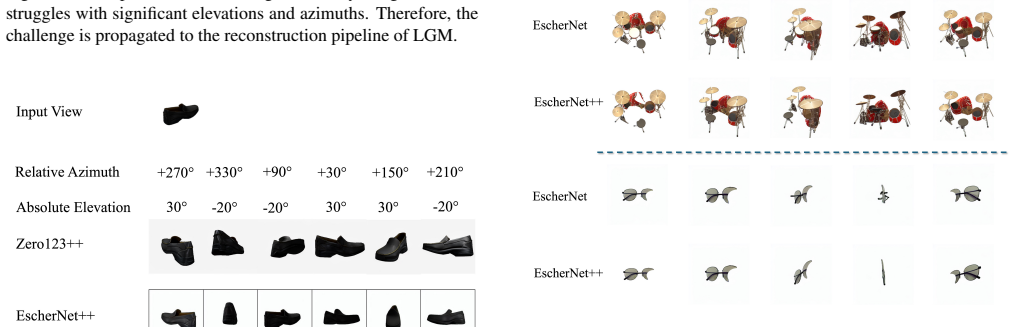
Everything rests on the assumption that occlusions made by pasting random object silhouettes onto rendered views behave like real occlusions, so that a model trained on them transfers to the real world; the paper's own failure example—a partially visible pair of eyeglasses—shows what happens when that assumption does not hold.
Editorial extensions
If this is right
- A single model performs both amodal completion and novel view synthesis end-to-end, so occluded-input reconstruction no longer requires a separate completion stage with its own storage and compute.
- On the OccNVS benchmark with 10 input views, the paper reports a 3.9 PSNR gain over prior NVS methods under occlusion and a 0.28 Volume IoU gain in occluded 3D reconstruction.
- Because the model can emit views at arbitrary query poses, it plugs into pre-trained feed-forward reconstructors such as InstantMesh without extra training, reaching competitive reconstruction quality in about 5% of the time.
- Adding more synthesized views continues to improve reconstruction quality, pointing to a scalable path for fast 3D reconstruction from sparse occluded inputs.
Reading between the lines
- The same two-level masking recipe could plausibly transfer to other conditional generation tasks with partially observable inputs, such as depth completion, video inpainting, or multi-sensor fusion, where a single model might likewise replace staged pipelines.
- Since the OccNVS test set is generated by the same silhouette-overlay procedure as the training data, the demonstrated robustness lives inside one occlusion distribution; a benchmark with occluders sampled from a disjoint distribution would settle how far the gains generalize.
- The 25% feature-masking rate is an empirical sweet spot, and one could probe whether adapting this rate over training or per input difficulty yields further gains.
- The 95% time reduction is measured for the specific InstantMesh integration in batch inference, so per-object speedups will vary with the number of requested views and the consistency of the synthesized inputs.
Editorial analysis
A structured set of objections, weighed in public.
Referee Report
Summary. The paper proposes EscherNet++, a model obtained by fine-tuning EscherNet with two masking schemes: input-level masking, where rendered views are occluded by randomly overlaid Objaverse silhouettes, and feature-level masking, where encoded feature maps are randomly dropped. The resulting diffusion model is designed to perform simultaneous amodal completion and novel view synthesis from multiple input views, and its output views can be fed to feed-forward reconstructors such as InstantMesh and LGM without retraining. Experiments on the authors' OccNVS benchmark report large gains over baselines on occluded NVS and reconstruction, plus a 95% reduction in reconstruction time; qualitative demos on real images are also shown.
Significance. If the empirical claims held, the contribution would be practically attractive: a single NVS model that handles occluded inputs, supports flexible input/output view counts, and integrates in a training-free manner with fast feed-forward reconstruction. The internal ablations (Tables 4-6) are consistent with the proposed mechanism: input-level masking is the main driver of occlusion robustness, and feature-level masking gives smaller but consistent gains. The paper is also transparent about failure cases in App. C. However, the headline evaluation is weakened by the fact that the OccNVS benchmark is generated by the same synthetic occlusion process used for training, and the real-world support is qualitative only; these issues affect the strength of the 'state-of-the-art' and 'generalizes to real-world' statements.
major comments (3)
- [4, 'Test Settings & Metrics'; 3.2, 'Curated Dataset'] OccNVS is constructed by applying 'a new set of masks to simulate any possible occlusions' using the same silhouette-overlay procedure described in Section 3.2 for training. The test-time occlusion distribution is therefore the same as the training augmentation distribution, differing only in the random seed. This makes the large occluded-task gains (e.g., GSO-30 occluded PSNR 25.06 vs 16.92 for EscherNet at 10 views, Table 1) partly a measure of adaptation to this augmentation rather than evidence of general amodal completion. The paper's own App. C, Fig. 10 shows that an out-of-distribution occlusion (a partially visible pair of eyeglasses) causes the model to collapse to a flat form. Since the abstract claims generalization to 'real-world occluded reconstruction,' please add quantitative evaluation on a held-out occlusion distribution or on real occluded images, and soften the generalization claim accordingly.
- [4.3, Table 3; abstract] The '95% reconstruction time decrease' is computed relative to NeuS-based overfitting pipelines (e.g., SyncDreamer+NeuS at 27 min), not relative to the feed-forward baselines that the method is meant to improve. The same table shows Ours+InstantMesh at about 1.3 min versus Zero123+++InstantMesh at 1.6 min, a roughly 19% reduction. Please report the comparison against the same reconstructor and clarify that the large time saving comes primarily from switching from an overfitting reconstructor to a feed-forward one.
- [4.2, Table 2] The evaluation protocol for 'amodal completion' is underspecified. For EscherNet++, the model synthesizes novel views 'including the input viewpoints'; for the single-image baselines, it is not stated whether completion is measured by reconstructing the same occluded view or a target view, or how multi-view inputs are aggregated for the baselines. Without this specification, the numbers in Table 2 are difficult to interpret relative to the NVS metrics in Table 1.
minor comments (5)
- [Throughout] There are several typos: 'scable' should be 'scalable' in the Figure 1 caption, 'alighed with Eshcernet' should be 'aligned with EscherNet' in Section 4, and the Section 4.2 heading 'Amodel Completion' should be 'Amodal Completion'.
- [App. A] Please fix 'tenser shape' to 'tensor shape' and 'is too large ratio is picked' to 'if too large a ratio is picked.'
- [3.2, App. A] The main text says feature vectors in a feature map are 'randomly masked out with 50 percent chance,' while App. A says masking 50% of the l dimension; please align the wording so the exact masking protocol is unambiguous.
- [Table 3] The row grouping for EscherNet+NeuS and Ours+NeuS is hard to parse because the Time column is missing for those rows; adding explicit row separators would improve readability.
- [Figure 1 caption] The caption describes OccNVS samples as 'unseen during training'; please clarify whether this refers to object identities or also to the occlusion generation protocol, since the protocol itself is the same as the training augmentation.
Circularity Check
No significant circularity: the central masked fine-tuning result is an empirical training/evaluation recipe with held-out objects and unseen test masks, not a derivation that reduces to its inputs.
full rationale
EscherNet++ is a fine-tuned diffusion model initialized from the public EscherNet checkpoint; its central claim (masked fine-tuning with input-level and feature-level masking enables simultaneous amodal completion and novel view synthesis) is an empirical training recipe, not a derivation that reduces to its own inputs. The input-level masking procedure curates paired occluded/complete views by overlaying Objaverse silhouettes onto complete rendered views, and the OccNVS benchmark applies 'a new set of masks' from the same distribution to held-out GSO, RTMV, and NeRF Synthetic objects. This is a domain-matched, in-distribution evaluation rather than a circular step: the model is not defined in terms of the benchmark, the test masks are unseen, and the test objects come from datasets different from the Objaverse training set. The reported +3.9 PSNR and +0.28 Volume IoU gains are therefore internally consistent on OccNVS, though the broader 'generalizing to real-world occluded reconstruction' claim is supported only qualitatively and App. C Fig. 10 explicitly concedes out-of-distribution failures (a partially visible pair of eyeglasses collapses to a flat form); that is a generalization-risk concern, not circularity. Self-citations (e.g., NeRF-MAE [17] for feature-level masking) are not load-bearing, because the masking idea is also attributed to external works [6, 9, 55], and no uniqueness theorem, ansatz-by-self-citation, fitted-parameter-renamed-as-prediction, or definitional identity between an equation and its inputs appears anywhere in the derivation chain.
Assumptions & free parameters
free parameters (3)
- input-level masking probability =
0.5
- feature-level masking probability =
0.25
- feature masking area ratio =
0.5
assumptions (3)
- domain assumption Silhouette-overlay occlusions on rendered Objaverse views are a representative proxy for real-world occlusions.
- domain assumption The public EscherNet checkpoint provides a valid initialization such that masked fine-tuning retains and extends its multi-view consistency.
- domain assumption InstantMesh's canonical six viewpoints remain the correct input configuration for the reconstruction network when views are synthesized by EscherNet++.
Cite this review
Pith. "Pith review of EscherNet++: Simultaneous Amodal Completion and Scalable View Synthesis through Masked Fine-Tuning and Enhanced Feed-Forward 3D Reconstruction." pith.science (2026). https://pith.science/paper/OSYDVKZR
@misc{pith2026250707410,
  author       = {Pith},
  title        = {Pith review of: EscherNet++: Simultaneous Amodal Completion and Scalable View Synthesis through Masked Fine-Tuning and Enhanced Feed-Forward 3D Reconstruction},
  year         = {2026},
  howpublished = {\url{https://pith.science/paper/OSYDVKZR}},
  note         = {Machine review of arXiv:2507.07410}
}
read the original abstract
We propose EscherNet++, a masked fine-tuned diffusion model that can synthesize novel views of objects in a zero-shot manner with amodal completion ability. Existing approaches utilize multiple stages and complex pipelines to first hallucinate missing parts of the image and then perform novel view synthesis, which fail to consider cross-view dependencies and require redundant storage and computing for separate stages. Instead, we apply masked fine-tuning including input-level and feature-level masking to enable an end-to-end model with the improved ability to synthesize novel views and conduct amodal completion. In addition, we empirically integrate our model with other feed-forward image-to-mesh models without extra training and achieve competitive results with reconstruction time decreased by 95%, thanks to its ability to synthesize arbitrary query views. Our method's scalable nature further enhances fast 3D reconstruction. Despite fine-tuning on a smaller dataset and batch size, our method achieves state-of-the-art results, improving PSNR by 3.9 and Volume IoU by 0.28 on occluded tasks in 10-input settings, while also generalizing to real-world occluded reconstruction.
Figures


Figures from the paper (6 more)



Forward citations
Cited by 1 Pith paper
-
Axolotl3D: a Unified Framework for Faithful 3D Shape Completion
A single diffusion model, fine-tuned from Hunyuan3D, completes 3D shapes from any mix of images, masks, cameras, and point clouds, reaching state-of-the-art or competitive accuracy on Toys4K and OmniObject3D.
Reference graph
Works this paper leans on
-
[1]
In- structpix2pix: Learning to follow image editing instructions
Tim Brooks, Aleksander Holynski, and Alexei A Efros. In- structpix2pix: Learning to follow image editing instructions. In Proceedings of the IEEE/CVF Conference on Computer Vision and Pattern Recognition, pages 18392–18402, 2023. 2, 3, 7, 8
work page 2023
-
[2]
pixelsplat: 3d gaussian splats from image pairs for scalable generalizable 3d reconstruction
David Charatan, Sizhe Lester Li, Andrea Tagliasacchi, and Vincent Sitzmann. pixelsplat: 3d gaussian splats from image pairs for scalable generalizable 3d reconstruction. In Pro- ceedings of the IEEE/CVF conference on computer vision and pattern recognition, pages 19457–19467, 2024. 3
work page 2024
-
[3]
Objaverse: A universe of annotated 3d objects
Matt Deitke, Dustin Schwenk, Jordi Salvador, Luca Weihs, Oscar Michel, Eli VanderBilt, Ludwig Schmidt, Kiana Ehsani, Aniruddha Kembhavi, and Ali Farhadi. Objaverse: A universe of annotated 3d objects. In Proceedings of the IEEE/CVF Conference on Computer Vision and Pattern Recognition, pages 13142–13153, 2023. 3, 5
work page 2023
-
[4]
General- izable 3d scene reconstruction via divide and conquer from a single view
Andreea Dogaru, Mert ¨Ozer, and Bernhard Egger. General- izable 3d scene reconstruction via divide and conquer from a single view. arXiv:2404.03421, 2024. 2, 3, 4, 7, 8
arXiv 2024
-
[5]
Google scanned objects: A high- quality dataset of 3d scanned household items
Laura Downs, Anthony Francis, Nate Koenig, Brandon Kin- man, Ryan Hickman, Krista Reymann, Thomas B McHugh, and Vincent Vanhoucke. Google scanned objects: A high- quality dataset of 3d scanned household items. In 2022 In- ternational Conference on Robotics and Automation (ICRA), pages 2553–2560. IEEE, 2022. 2, 6
work page 2022
-
[6]
Mdtv2: Masked diffusion transformer is a strong image synthesizer
Shanghua Gao, Pan Zhou, Ming-Ming Cheng, and Shuicheng Yan. Mdtv2: Masked diffusion transformer is a strong image synthesizer. arXiv preprint arXiv:2303.14389,
-
[7]
Instruct-nerf2nerf: Edit- ing 3d scenes with instructions
Ayaan Haque, Matthew Tancik, Alexei Efros, Aleksander Holynski, and Angjoo Kanazawa. Instruct-nerf2nerf: Edit- ing 3d scenes with instructions. In Proceedings of the IEEE/CVF International Conference on Computer Vision ,
-
[8]
Deep residual learning for image recognition
Kaiming He, Xiangyu Zhang, Shaoqing Ren, and Jian Sun. Deep residual learning for image recognition. In Proceed- ings of the IEEE conference on computer vision and pattern recognition, pages 770–778, 2016. 4
2016
Show all 69 references
-
[9]
Masked autoencoders are scalable vision learners
Kaiming He, Xinlei Chen, Saining Xie, Yanghao Li, Piotr Doll´ar, and Ross Girshick. Masked autoencoders are scalable vision learners. In Proceedings of the IEEE/CVF conference on computer vision and pattern recognition , pages 16000– 16009, 2022. 2, 3, 5
2022
-
[10]
Classifier-free diffusion guidance
Jonathan Ho and Tim Salimans. Classifier-free diffusion guidance. arXiv preprint arXiv:2207.12598, 2022. 4
2022 arXiv
-
[11]
Denoising dif- fusion probabilistic models
Jonathan Ho, Ajay Jain, and Pieter Abbeel. Denoising dif- fusion probabilistic models. Advances in neural information processing systems, 33:6840–6851, 2020. 2, 4
2020
-
[12]
Lrm: Large reconstruction model for single image to 3d
Yicong Hong, Kai Zhang, Jiuxiang Gu, Sai Bi, Yang Zhou, Difan Liu, Feng Liu, Kalyan Sunkavalli, Trung Bui, and Hao Tan. Lrm: Large reconstruction model for single image to 3d. arXiv preprint arXiv:2311.04400, 2023. 3, 5
2023 arXiv
-
[13]
Epidiff: Enhancing multi-view synthesis via localized epipolar-constrained diffusion
Zehuan Huang, Hao Wen, Junting Dong, Yaohui Wang, Yangguang Li, Xinyuan Chen, Yan-Pei Cao, Ding Liang, Yu Qiao, Bo Dai, et al. Epidiff: Enhancing multi-view synthesis via localized epipolar-constrained diffusion. In Proceedings of the IEEE/CVF Conference on Computer Vision and...
2024
-
[14]
Shapo: Im- plicit representations for multi-object shape appearance and pose optimization
Muhammad Zubair Irshad, Sergey Zakharov, Rares Ambrus, Thomas Kollar, Zsolt Kira, and Adrien Gaidon. Shapo: Im- plicit representations for multi-object shape appearance and pose optimization. 2022. 2
2022
-
[15]
Neo 360: Neural fields for sparse view synthesis of outdoor scenes
Muhammad Zubair Irshad, Sergey Zakharov, Katherine Liu, Vitor Guizilini, Thomas Kollar, Adrien Gaidon, Zsolt Kira, and Rares Ambrus. Neo 360: Neural fields for sparse view synthesis of outdoor scenes. In Proceedings of the IEEE/CVF International Conference on Computer Vision ,...
2023
-
[16]
Neural fields in robotics: A survey
Muhammad Zubair Irshad, Mauro Comi, Yen-Chen Lin, Nick Heppert, Abhinav Valada, Rares Ambrus, Zsolt Kira, and Jonathan Tremblay. Neural fields in robotics: A survey. arXiv preprint arXiv:2410.20220, 2024. 2
2024 arXiv
-
[17]
Nerf-mae: Masked autoencoders for self-supervised 3d representation learning for neural radiance fields
Muhammad Zubair Irshad, Sergey Zakharov, Vitor Guizilini, Adrien Gaidon, Zsolt Kira, and Rares Ambrus. Nerf-mae: Masked autoencoders for self-supervised 3d representation learning for neural radiance fields. In European Conference on Computer Vision (ECCV), 2024. 3, 5
2024
-
[18]
Spad: Spatially aware multi-view diffusers
Yash Kant, Aliaksandr Siarohin, Ziyi Wu, Michael Vasilkovsky, Guocheng Qian, Jian Ren, Riza Alp Guler, Bernard Ghanem, Sergey Tulyakov, and Igor Gilitschenski. Spad: Spatially aware multi-view diffusers. In Proceedings of the IEEE/CVF Conference on Computer Vision and Pat- ter...
2024
-
[19]
3d gaussian splatting for real-time radiance field rendering
Bernhard Kerbl, Georgios Kopanas, Thomas Leimk ¨uhler, and George Drettakis. 3d gaussian splatting for real-time radiance field rendering. ACM Trans. Graph., 42(4):139–1,
-
[20]
Lerf: Language embedded radiance fields
Justin Kerr, Chung Min Kim, Ken Goldberg, Angjoo Kanazawa, and Matthew Tancik. Lerf: Language embedded radiance fields. In Proceedings of the IEEE/CVF Interna- tional Conference on Computer Vision, pages 19729–19739,
-
[21]
Auto-encoding variational bayes
Diederik P Kingma. Auto-encoding variational bayes. arXiv preprint arXiv:1312.6114, 2013. 3, 4
2013 arXiv
-
[22]
Segment any- thing
Alexander Kirillov, Eric Mintun, Nikhila Ravi, Hanzi Mao, Chloe Rolland, Laura Gustafson, Tete Xiao, Spencer White- head, Alexander C Berg, Wan-Yen Lo, et al. Segment any- thing. In Proceedings of the IEEE/CVF international confer- ence on computer vision, pages 4015–4026, 2023. 5
2023
-
[23]
Eschernet: A genera- tive model for scalable view synthesis
Xin Kong, Shikun Liu, Xiaoyang Lyu, Marwan Taher, Xi- aojuan Qi, and Andrew J Davison. Eschernet: A genera- tive model for scalable view synthesis. In Proceedings of the IEEE/CVF Conference on Computer Vision and Pattern Recognition, pages 9503–9513, 2024. 2, 3, 4, 7, 8, 1
2024
-
[24]
Neroic: Neural rendering of objects from online image collections
Zhengfei Kuang, Kyle Olszewski, Menglei Chai, Zeng Huang, Panos Achlioptas, and Sergey Tulyakov. Neroic: Neural rendering of objects from online image collections. ACM Transactions on Graphics (TOG), 41(4):1–12, 2022. 2
2022
-
[25]
Neural scene flow fields for space-time view synthesis of dy- namic scenes
Zhengqi Li, Simon Niklaus, Noah Snavely, and Oliver Wang. Neural scene flow fields for space-time view synthesis of dy- namic scenes. In Proceedings of the IEEE/CVF Conference on Computer Vision and Pattern Recognition , pages 6498– 6508, 2021. 3 9
2021
-
[26]
Neuralangelo: High-fidelity neural surface reconstruction
Zhaoshuo Li, Thomas M ¨uller, Alex Evans, Russell H Tay- lor, Mathias Unberath, Ming-Yu Liu, and Chen-Hsuan Lin. Neuralangelo: High-fidelity neural surface reconstruction. In IEEE Conference on Computer Vision and Pattern Recogni- tion (CVPR), 2023. 2
2023
-
[27]
One-2-3-45++: Fast single im- age to 3d objects with consistent multi-view generation and 3d diffusion
Minghua Liu, Ruoxi Shi, Linghao Chen, Zhuoyang Zhang, Chao Xu, Xinyue Wei, Hansheng Chen, Chong Zeng, Ji- ayuan Gu, and Hao Su. One-2-3-45++: Fast single im- age to 3d objects with consistent multi-view generation and 3d diffusion. In Proceedings of the IEEE/CVF Conference on ...
2024
-
[28]
Zero-1-to- 3: Zero-shot one image to 3d object
Ruoshi Liu, Rundi Wu, Basile Van Hoorick, Pavel Tok- makov, Sergey Zakharov, and Carl V ondrick. Zero-1-to- 3: Zero-shot one image to 3d object. In Proceedings of the IEEE/CVF international conference on computer vision, pages 9298–9309, 2023. 2, 3, 4, 8, 1
2023
-
[29]
Syncdreamer: Gen- erating multiview-consistent images from a single-view im- age
Yuan Liu, Cheng Lin, Zijiao Zeng, Xiaoxiao Long, Lingjie Liu, Taku Komura, and Wenping Wang. Syncdreamer: Gen- erating multiview-consistent images from a single-view im- age. arXiv preprint arXiv:2309.03453, 2023. 3, 7, 8, 1
2023 arXiv
-
[30]
Wonder3d: Sin- gle image to 3d using cross-domain diffusion
Xiaoxiao Long, Yuan-Chen Guo, Cheng Lin, Yuan Liu, Zhiyang Dou, Lingjie Liu, Yuexin Ma, Song-Hai Zhang, Marc Habermann, Christian Theobalt, et al. Wonder3d: Sin- gle image to 3d using cross-domain diffusion. In Proceed- ings of the IEEE/CVF Conference on Computer Vision and Pa...
2024
-
[31]
Fsd: Fast self-supervised single rgb-d to categorical 3d objects
Mayank Lunayach, Sergey Zakharov, Dian Chen, Rares Am- brus, Zsolt Kira, and Muhammad Zubair Irshad. Fsd: Fast self-supervised single rgb-d to categorical 3d objects. In Int. Conf. on Robotics and Automation. IEEE, 2024. 2
2024
-
[32]
Nerf: Representing scenes as neural radiance fields for view syn- thesis
Ben Mildenhall, Pratul P Srinivasan, Matthew Tancik, Jonathan T Barron, Ravi Ramamoorthi, and Ren Ng. Nerf: Representing scenes as neural radiance fields for view syn- thesis. Communications of the ACM, 65(1):99–106, 2021. 2, 3, 6
2021
-
[33]
Instant neural graphics primitives with a mul- tiresolution hash encoding
Thomas Muller, Alex Evans, Christoph Schied, and Alexan- der Keller. Instant neural graphics primitives with a mul- tiresolution hash encoding. ACM transactions on graphics (TOG), 41(4):1–15, 2022. 2, 3
2022
-
[34]
Semantically-aware neural radiance fields for visual scene understanding: A comprehensive review
Thang-Anh-Quan Nguyen, Amine Bourki, Matyas Macud- zinski, Anthony Brunel, and Mohammed Bennamoun. Semantically-aware neural radiance fields for visual scene understanding: A comprehensive review. arXiv preprint arXiv:2402.11141, 2024. 2
2024 arXiv
-
[35]
pix2gestalt: Amodal segmentation by synthesizing wholes
Ege Ozguroglu, Ruoshi Liu, D ´ıdac Sur´ıs, Dian Chen, Achal Dave, Pavel Tokmakov, and Carl V ondrick. pix2gestalt: Amodal segmentation by synthesizing wholes. In 2024 IEEE/CVF Conference on Computer Vision and Pattern Recognition (CVPR), pages 3931–3940. IEEE Computer So- ciet...
2024
-
[36]
Masked autoencoders for point cloud self-supervised learning
Yatian Pang, Wenxiao Wang, Francis EH Tay, Wei Liu, Yonghong Tian, and Li Yuan. Masked autoencoders for point cloud self-supervised learning. In Computer Vision–ECCV 2022: 17th European Conference, Tel Aviv, Israel, October 23–27, 2022, Proceedings, Part II, pages 604–621. Springer,
2022
-
[37]
Dreamfusion: Text-to-3d using 2d diffusion
Ben Poole, Ajay Jain, Jonathan T Barron, and Ben Milden- hall. Dreamfusion: Text-to-3d using 2d diffusion. arXiv preprint arXiv:2209.14988, 2022. 5
2022 arXiv
-
[38]
High quality entity segmentation
Lu Qi, Jason Kuen, Tiancheng Shen, Jiuxiang Gu, Weidong Guo, Jiaya Jia, Zhe Lin, and Ming-Hsuan Yang. High quality entity segmentation. In ICCV, 2023. 1
2023
-
[39]
Learning transferable visual models from natural language supervi- sion
Alec Radford, Jong Wook Kim, Chris Hallacy, Aditya Ramesh, Gabriel Goh, Sandhini Agarwal, Girish Sastry, Amanda Askell, Pamela Mishkin, Jack Clark, et al. Learning transferable visual models from natural language supervi- sion. In International conference on machine learning, ...
2021
-
[40]
High-resolution image synthesis with latent diffusion models
Robin Rombach, Andreas Blattmann, Dominik Lorenz, Patrick Esser, and Bj ¨orn Ommer. High-resolution image synthesis with latent diffusion models. In Proceedings of the IEEE/CVF conference on computer vision and pattern recognition, pages 10684–10695, 2022. 2, 3, 4
2022
-
[41]
U- net: Convolutional networks for biomedical image segmen- tation
Olaf Ronneberger, Philipp Fischer, and Thomas Brox. U- net: Convolutional networks for biomedical image segmen- tation. In Medical image computing and computer-assisted intervention–MICCAI 2015: 18th international conference, Munich, Germany, October 5-9, 2015, proceedings, pa...
2015
-
[42]
Zero123++: a single image to consistent multi-view dif- fusion base model
Ruoxi Shi, Hansheng Chen, Zhuoyang Zhang, Minghua Liu, Chao Xu, Xinyue Wei, Linghao Chen, Chong Zeng, and Hao Su. Zero123++: a single image to consistent multi-view dif- fusion base model. arXiv preprint arXiv:2310.15110, 2023. 2, 3, 8, 1, 5
-
[43]
Panoptic lifting for 3d scene understanding with neural fields
Yawar Siddiqui, Lorenzo Porzi, Samuel Rota Bul ´o, Nor- man M ¨uller, Matthias Nießner, Angela Dai, and Peter Kontschieder. Panoptic lifting for 3d scene understanding with neural fields. In Proceedings of the IEEE/CVF Con- ference on Computer Vision and Pattern Recognition, p...
2023
-
[44]
Denoising diffusion implicit models
Jiaming Song, Chenlin Meng, and Stefano Ermon. Denoising diffusion implicit models. arXiv preprint arXiv:2010.02502, 2020. 2, 4
2010 arXiv
-
[45]
Dreamgaussian: Generative gaussian splatting for effi- cient 3d content creation
Jiaxiang Tang, Jiawei Ren, Hang Zhou, Ziwei Liu, and Gang Zeng. Dreamgaussian: Generative gaussian splatting for effi- cient 3d content creation. arXiv preprint arXiv:2309.16653,
-
[46]
Lgm: Large multi-view gaussian model for high-resolution 3d content creation
Jiaxiang Tang, Zhaoxi Chen, Xiaokang Chen, Tengfei Wang, Gang Zeng, and Ziwei Liu. Lgm: Large multi-view gaussian model for high-resolution 3d content creation. In European Conference on Computer Vision, pages 1–18. Springer, 2024. 5, 7, 8, 1
2024
-
[47]
Mvdiffusion++: A dense high- resolution multi-view diffusion model for single or sparse- view 3d object reconstruction
Shitao Tang, Jiacheng Chen, Dilin Wang, Chengzhou Tang, Fuyang Zhang, Yuchen Fan, Vikas Chandra, Yasutaka Fu- rukawa, and Rakesh Ranjan. Mvdiffusion++: A dense high- resolution multi-view diffusion model for single or sparse- view 3d object reconstruction. In European Conferen...
2024
-
[48]
Rtmv: A ray-traced multi-view synthetic dataset for novel view syn- thesis
Jonathan Tremblay, Moustafa Meshry, Alex Evans, Jan Kautz, Alexander Keller, Sameh Khamis, Thomas M ¨uller, Charles Loop, Nathan Morrical, Koki Nagano, et al. Rtmv: A ray-traced multi-view synthetic dataset for novel view syn- thesis. arXiv preprint arXiv:2205.07058, 2022. 2 10
2022 arXiv
-
[49]
Attention is all you need
A Vaswani. Attention is all you need. Advances in Neural Information Processing Systems, 2017. 4
2017
-
[50]
Mcvd-masked conditional video diffusion for prediction, generation, and interpolation
Vikram V oleti, Alexia Jolicoeur-Martineau, and Chris Pal. Mcvd-masked conditional video diffusion for prediction, generation, and interpolation. Advances in neural informa- tion processing systems, 35:23371–23385, 2022. 4
2022
-
[51]
Sv3d: Novel multi-view syn- thesis and 3d generation from a single image using latent video diffusion
Vikram V oleti, Chun-Han Yao, Mark Boss, Adam Letts, David Pankratz, Dmitry Tochilkin, Christian Laforte, Robin Rombach, and Varun Jampani. Sv3d: Novel multi-view syn- thesis and 3d generation from a single image using latent video diffusion. In European Conference on Computer...
2024
-
[52]
Imagedream: Image-prompt multi-view diffusion for 3d generation
Peng Wang and Yichun Shi. Imagedream: Image-prompt multi-view diffusion for 3d generation. arXiv preprint arXiv:2312.02201, 2023. 3, 8, 1, 5
2023 arXiv
-
[53]
Neus: Learning neural implicit surfaces by volume rendering for multi-view reconstruction
Peng Wang, Lingjie Liu, Yuan Liu, Christian Theobalt, Taku Komura, and Wenping Wang. Neus: Learning neural implicit surfaces by volume rendering for multi-view reconstruction. arXiv preprint arXiv:2106.10689, 2021. 2, 3, 5, 7, 8, 1
2021 arXiv
-
[54]
Image quality assessment: from error visibility to structural similarity
Zhou Wang, Alan C Bovik, Hamid R Sheikh, and Eero P Si- moncelli. Image quality assessment: from error visibility to structural similarity. IEEE transactions on image processing, 13(4):600–612, 2004. 6
2004
-
[55]
Con- vnext v2: Co-designing and scaling convnets with masked autoencoders
Sanghyun Woo, Shoubhik Debnath, Ronghang Hu, Xinlei Chen, Zhuang Liu, In So Kweon, and Saining Xie. Con- vnext v2: Co-designing and scaling convnets with masked autoencoders. In Proceedings of the IEEE/CVF conference on computer vision and pattern recognition , pages 16133– 16...
2023
-
[56]
4d gaussian splatting for real-time dynamic scene rendering
Guanjun Wu, Taoran Yi, Jiemin Fang, Lingxi Xie, Xiaopeng Zhang, Wei Wei, Wenyu Liu, Qi Tian, and Xinggang Wang. 4d gaussian splatting for real-time dynamic scene rendering. In Proceedings of the IEEE/CVF conference on computer vi- sion and pattern recognition, pages 20310–2032...
2024
-
[57]
Sparp: Fast 3d object reconstruction and pose estimation from sparse views
Chao Xu, Ang Li, Linghao Chen, Yulin Liu, Ruoxi Shi, Hao Su, and Minghua Liu. Sparp: Fast 3d object reconstruction and pose estimation from sparse views. In European Con- ference on Computer Vision, pages 143–163. Springer, 2024. 2
2024
-
[58]
Instantmesh: Efficient 3d mesh generation from a single image with sparse-view large reconstruction models
Jiale Xu, Weihao Cheng, Yiming Gao, Xintao Wang, Shenghua Gao, and Ying Shan. Instantmesh: Efficient 3d mesh generation from a single image with sparse-view large reconstruction models. arXiv preprint arXiv:2404.07191 ,
-
[59]
Amodal com- pletion via progressive mixed context diffusion
Katherine Xu, Lingzhi Zhang, and Jianbo Shi. Amodal com- pletion via progressive mixed context diffusion. In Proceed- ings of the IEEE/CVF Conference on Computer Vision and Pattern Recognition, pages 9099–9109, 2024. 3, 4
2024
-
[60]
Gaussian grouping: Segment and edit anything in 3d scenes
Mingqiao Ye, Martin Danelljan, Fisher Yu, and Lei Ke. Gaussian grouping: Segment and edit anything in 3d scenes. In European Conference on Computer Vision , pages 162–
-
[61]
pixelnerf: Neural radiance fields from one or few images
Alex Yu, Vickie Ye, Matthew Tancik, and Angjoo Kanazawa. pixelnerf: Neural radiance fields from one or few images. In Proceedings of the IEEE/CVF conference on computer vi- sion and pattern recognition, pages 4578–4587, 2021. 2, 3
2021
-
[62]
Ir- shad, and Ken Goldberg
Justin Yu, Kush Hari, Karim El-Refai, Arnav Dalil, Justin Kerr, Chung-Min Kim, Richard Cheng, Muhammad Z. Ir- shad, and Ken Goldberg. Persistent object gaussian splat (pogs) for tracking human and robot manipulation of irregu- larly shaped objects. ICRA, 2025. 3
2025
-
[63]
Amodal ground truth and completion in the wild
Guanqi Zhan, Chuanxia Zheng, Weidi Xie, and Andrew Zis- serman. Amodal ground truth and completion in the wild. In Proceedings of the IEEE/CVF Conference on Computer Vision and Pattern Recognition, pages 28003–28013, 2024. 3, 4
2024
-
[64]
The unreasonable effectiveness of deep features as a perceptual metric
Richard Zhang, Phillip Isola, Alexei A Efros, Eli Shecht- man, and Oliver Wang. The unreasonable effectiveness of deep features as a perceptual metric. In Proceedings of the IEEE conference on computer vision and pattern recogni- tion, pages 586–595, 2018. 6
2018
-
[65]
Free3d: Consistent novel view synthesis without 3d representation
Chuanxia Zheng and Andrea Vedaldi. Free3d: Consistent novel view synthesis without 3d representation. In Proceed- ings of the IEEE/CVF Conference on Computer Vision and Pattern Recognition, pages 9720–9731, 2024. 2, 3
2024
-
[66]
3d gaussian splatting in robotics: A survey,
Siting Zhu, Guangming Wang, Xin Kong, Dezhi Kong, and Hesheng Wang. 3d gaussian splatting in robotics: A survey,
-
[67]
Triplane meets gaussian splatting: Fast and generalizable single-view 3d reconstruction with transformers
Zi-Xin Zou, Zhipeng Yu, Yuan-Chen Guo, Yangguang Li, Ding Liang, Yan-Pei Cao, and Song-Hai Zhang. Triplane meets gaussian splatting: Fast and generalizable single-view 3d reconstruction with transformers. In Proceedings of the IEEE/CVF Conference on Computer Vision and Pattern...
2024
-
[68]
Zero123++ is designed to generate 6 fixed views of an object with rel- ative azimuth rotations and absolute elevations
construct the mesh based on novel views. Zero123++ is designed to generate 6 fixed views of an object with rel- ative azimuth rotations and absolute elevations. The 6 in- put images have poses with alternating absolute elevations of 20°and -10°, and their azimuths are defined ...
-
[69]
This is evident in the first two rows of Fig
EscherNet++ exhibits degraded performance on in- puts that contain intricate details and complex spatial lay- outs, similar to the performance of the base model Escher- Net. This is evident in the first two rows of Fig. 10, where despite the model’s ability to infer novel view...
Reviewed August 6, 2026 · model on record in the stance chip above.
Discussion (0). Sign in to comment.