REVIEW 4 major objections 5 minor 40 references
Enhanced Quantum behavior on frustrated Ising model: Quantum Approximate Optimization Algorithm study
T0 review · 4 major / 5 minor · reviewed 2026-08-06 · deepseek-v4-flash
Pith's one-line read QAOA's energy error tracks frustration-driven quantum fluctuations in a 4×4 Ising model, rising sharply between |J2|/J1 = 0.36 and 0.64.
desk verdict A clean QAOA benchmark on a 16-site classical Ising model, but δ is a variational error, not a quantum fluctuation. read the letter →
The pith
A machine-rendered reading of the paper's core claim, the machinery that carries it, and where it could break.
The reading
What carries the argument
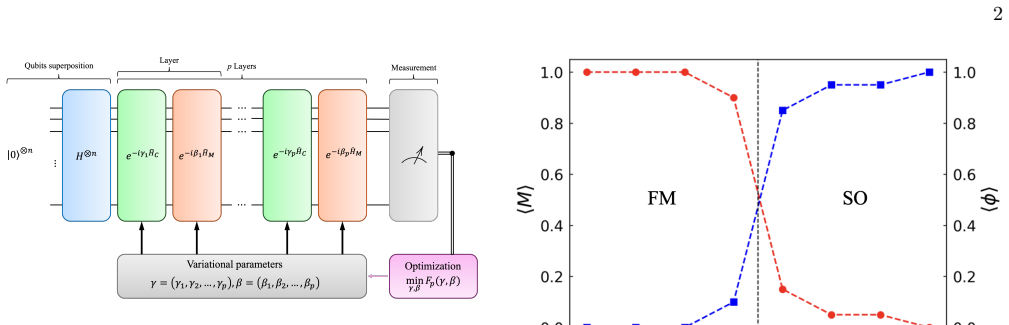
The load-bearing object is the scalar $\delta = \langle E \rangle - E_0$, used as a proxy for the strength of quantum fluctuations. Supporting it is the $p$-layer QAOA ansatz, which alternates the cost Hamiltonian $H_C = -J_1 \sum_{\langle i,j\rangle} Z_i Z_j - J_2 \sum_{\langle\langle i,j\rangle\rangle} Z_i Z_j$ with the transverse X-mixer $H_M = \sum_j X_j$; the variational parameters are tuned by a classical BFGS optimizer using 40 measurement shots, and the order parameters $\langle M \rangle$ and $\langle \varphi \rangle$ are read from the lowest-energy measured configurations. The ansatz's role is to inject dynamical quantum fluctuations into an otherwise classical Ising cost function and to expose them in the measurement statistics.
What would settle it
Compute $\delta$ for the same Hamiltonian while adding an explicit transverse-field term $-h \sum_i X_i$ with increasing $h$; if $\delta$ does not grow monotonically with the genuine quantum fluctuations this field induces, or if a classical sampler that simply draws from all $2^{16}$ spin configurations with the same number of measurement shots reproduces the same $\delta$ profile, then $\delta$ is measuring algorithm error rather than frustration-driven quantum behavior.
Extended reading notes
Core claim
At the paper's own level, the discovery is that the QAOA energy error $\delta = \langle E \rangle - E_0$ behaves as a frustration-sensitive, order-like quantity. On a $4 \times 4$ square lattice with ferromagnetic nearest-neighbor bonds and antiferromagnetic diagonal bonds, QAOA with $p = 15$ layers and 40 measurement shots reproduces the known FM-to-stripe-AF transition at $|J_2|/J_1 = 0.5$. The paper then shows that $\delta$ is essentially zero for $|J_2|/J_1 < 0.36$ and $|J_2|/J_1 > 0.64$, where the ground state is well separated from the first excited state and QAOA samples it almost exclusively, and grows rapidly in the intermediate window, where QAOA measurement probabilities spread over multiple excited states. The authors interpret this growing $\delta$ as enhanced quantum fluctuations and conclude that QAOA captures quantum behavior that classical binary-spin approaches miss.
Load-bearing premise
The load-bearing premise is that the QAOA energy error $\delta$ measures frustration-induced quantum fluctuations rather than algorithmic inaccuracy; if that identification is wrong, the central claim does not follow.
Editorial extensions
If this is right
- Where $\delta \approx 0$, QAOA's measured configuration is essentially the ground state, so the algorithm itself can certify the absence of strong quantum fluctuations without a separate gap computation.
- Inside the window $0.36 < |J_2|/J_1 < 0.64$, the ground-state probability saturates below 0.5 at moderate depth, meaning shallow QAOA cannot resolve the near-degenerate low-energy manifold there.
- The $\delta$ profile offers a practical way to locate the boundaries of the regime where frustration-induced quantum effects matter, at least for finite-size simulations.
- The reproduced transition at $|J_2|/J_1 = 0.5$ gives a consistency check that QAOA's approximate output still carries the model's phase structure.
Reading between the lines
- The paper's own Hamiltonian has only commuting $\sigma^z \sigma^z$ terms, so its exact eigenstates are classical bitstrings; the 'quantum fluctuations' it reports are generated by the QAOA mixer. Treating $\delta$ as a physical measure of frustration-induced quantum fluctuations is an interpretive identification, not a direct consequence of the simulation.
- A decisive check would be to add an explicit transverse field $-h\sum_i X_i$ to the Hamiltonian and compare $\delta$ computed by QAOA with the exact ground-state overlap of the transverse-field model; the interpretation is strengthened if the two quantities track each other as $h$ grows.
- The comparison 'beyond classical algorithms' is made against classical approaches restricted to binary spin configurations; a fairer test would pit QAOA against an optimized classical heuristic, such as simulated annealing or exhaustive enumeration with matched shot counts, on the same 16-spin instance.
Editorial analysis
A structured set of objections, weighed in public.
Referee Report
Summary. This manuscript applies the Quantum Approximate Optimization Algorithm (QAOA) to a 4x4 square-lattice frustrated Ising model with ferromagnetic nearest-neighbor couplings J1 and antiferromagnetic diagonal couplings J2 < 0. The authors compute the FM and stripe-AF order parameters, the probability of measuring the ground state as a function of QAOA depth p, and the probabilities of dominant energy states. They then introduce a quantity δ = ⟨E⟩ − E0, the difference between the QAOA ensemble-averaged energy and the exact ground-state energy, and interpret it as a measure of frustration-induced quantum fluctuations. Based on this quantity, they claim that quantum behavior is enhanced in the region 0.36 < |J2|/J1 < 0.64 and that QAOA captures quantum effects beyond the reach of classical algorithms.
Significance. If the central claim were valid, the paper would provide a practical way to quantify frustration-induced quantum fluctuations using a variational quantum algorithm, which would be a useful contribution to both quantum optimization and frustrated magnetism. The numerical pipeline is straightforward and the use of exact ground-state energies keeps the evaluation of δ non-circular in a narrow statistical sense. However, the model in Eq. (1) is a classical Ising Hamiltonian with only commuting σzσz terms, so the wavefunction has no intrinsic quantum fluctuations; the only non-classical ingredient is the QAOA mixer of Eq. (3), an algorithmic choice. The quantity δ is therefore a variational optimization error, and the paper provides no argument establishing that this error equals physical quantum fluctuations. The claim that QAOA captures quantum behavior 'beyond the reach of classical algorithms' is additionally unsupported because no classical baseline, finite-size analysis, or convergence diagnostics are presented.
major comments (4)
- [Section II, Eq. (1) and Eq. (3)] The Hamiltonian in Eq. (1), rewritten as the cost Hamiltonian in Eq. (2), contains only commuting σz_i σz_j terms. Every eigenstate of this Hamiltonian is a classical product state, so the model has no intrinsic quantum fluctuations. The only non-classical dynamics is the external mixer HM = Σ_j X_j in Eq. (3), which is an algorithmic ingredient of QAOA rather than a physical term. Consequently, the quantity δ = ⟨E⟩ − E0 defined in Section III is a variational optimization error—the residual energy of a finite-depth QAOA circuit after classical BFGS optimization—not a physical measure of frustration-induced quantum fluctuations. The manuscript provides no argument connecting these two quantities, and the central claim depends entirely on that connection.
- [Introduction, third paragraph, and Section II] The transition at |J2|/J1 = 0.5 is repeatedly called a quantum phase transition. Since Eq. (1) is a classical Ising Hamiltonian with commuting terms, this is at most a classical level crossing with a vanishing gap; there is no non-commuting term in the Hamiltonian that could drive quantum fluctuations. This terminology is load-bearing because the paper interprets the small-gap region as a region of enhanced quantum fluctuations. The authors need either to justify the quantum-phase-transition terminology or to reframe the transition as a classical level crossing.
- [Section III, Fig. 4(c)] The peak in δ in the region 0.36 < |J2|/J1 < 0.64 coincides exactly with the region where the spectral gap between the ground state and the first excited state is small, which is where variational optimization is expected to become difficult. The manuscript provides no classical baseline—for example, simulated annealing, exact exhaustive search with the same sample budget, or a classical optimizer acting directly on bitstrings—and no convergence analysis in p or in the classical optimizer. The data therefore cannot distinguish enhanced physical quantum fluctuations from QAOA's failure to converge. The conclusion that QAOA captures quantum behavior 'beyond the reach of classical algorithms' is unsupported without such a comparison.
- [Section III, Figs. 3 and 4] The quantitative basis for the central claim is thin: the paper uses only 40 measurement samples per parameter point, reports no error bars, uses a single system size (4x4), and provides no finite-size scaling. The saturation of the ground-state probability below 0.5 at large p in Fig. 3 is attributed to quantum fluctuations, but it could equally be explained by an insufficient ansatz depth or imperfect classical optimization. The paper does not test this alternative explanation, which is essential because δ is defined as an energy deviation and the same curve is then used to identify the quantum regime.
minor comments (5)
- [Introduction, second-to-last paragraph] The phrase 'thank to absence' should read 'thanks to the absence'.
- [Section II, Eq. (2)] The notation in the second sum of Eq. (2) contains a typo ('ZiZ ′ j' should be a properly indexed ZiZj term), and the angle-bracket notation <i,j> versus <<i,j>> is not consistently typeset.
- [Section III, Figs. 4(a) and 4(b)] The 'dominant energy states' are not defined: the figure caption should state how energy states are labeled (e.g., by energy eigenvalue or by bitstring) and how the probabilities are accumulated over the 40 samples.
- [Section III, definition of δ] The paper states that the exact ground-state energy E0 is known but does not describe how E0 was obtained (exact diagonalization, exhaustive enumeration, or another method); this information is needed for reproducibility.
- [References] Reference 15 is missing the journal name and volume (it appears to be Phys. Rev. B 110, 205142 (2024)), and Reference 5 contains incorrectly formatted author names with accent marks; these should be corrected.
Circularity Check
Central claim reduces to the definition of δ: QAOA residual energy is renamed 'quantum fluctuations', so the identified quantum regime is where the variational optimization fails.
-
self definitional
[Section III, Fig. 4(c); definition of δ and its interpretation; Conclusion.]
"To quantify these quantum effects, we introduced a novel physical quantity δ = ⟨E⟩ − E0, which serves to distinguish between the classical and quantum regimes. ... The δ values remain nearly zero for |J2|/J1 < 0.36 in the FM phase and for |J2|/J1 > 0.64 in the stripe AF phase, indicating weak quantum fluctuations in both regimes. In contrast, δ increases rapidly in the intermediate region 0.36 < |J2|/J1 < 0.64, signaling the emergence of significant quantum fluctuations near the phase transition."
δ is defined as the difference between the QAOA ensemble-averaged energy and the exact ground-state energy E0; this is the residual error of the variational optimization, not an intrinsic physical observable of the Ising Hamiltonian in Eq. (1), which contains only commuting ZiZj terms. The paper then uses the size of this same δ to identify 'weak quantum fluctuations' and 'significant quantum fluctuations,' so the central conclusion—that quantum behavior is enhanced for 0.36<|J2|/J1<0.64—is equivalent to saying that QAOA's energy expectation fails to reach E0 in that window. The 'quantum regime' is defined by δ, and δ is then quoted as evidence of that regime; no independent quantum observable or classical baseline is supplied.
full rationale
The order-parameter calculation (Fig. 2) and the ground-state probability curves (Fig. 3) are self-consistent numerical observations, and the FM-to-stripe-AF transition at |J2|/J1=0.5 is independently known and reproduced. However, the paper's novel claim—the quantitative metric δ for quantum effects—is circular in the specific sense that δ = ⟨E⟩−E0 is a variational residual, and the 'quantum regime' is defined by δ and then rediscovered as the region where δ is large. Because Eq. (1) is a diagonal (classical) cost Hamiltonian and quantum fluctuations are introduced only by the external mixer HM=ΣXj, calling δ a measure of frustration-induced quantum fluctuations is a renaming of optimization error rather than a first-principles derivation. No classical optimizer baseline, finite-size analysis, or convergence diagnostics are provided to support the 'beyond the reach of classical algorithms' claim; that statement is therefore unsupported, though it is not itself a circular reduction. The numerical pipeline (E0 from exact diagonalization, no free parameters fit to the conclusion) prevents a higher score. Self-citations to Park & Lee work exist but are not load-bearing here, since the phase-transition location is independently verifiable from the Hamiltonian.
Assumptions & free parameters
free parameters (2)
- QAOA layer count p =
p = 15 for order parameters, p up to 18 for success probability
- quantum regime boundaries =
|J2|/J1 between 0.36 and 0.64
assumptions (4)
- ad hoc to paper The J1-J2 Ising model on a 4x4 square lattice is a quantum model with a quantum phase transition at |J2|/J1 = 0.5.
- ad hoc to paper delta = <E> - E0 measures physical quantum fluctuations.
- domain assumption BFGS finds globally optimal QAOA variational parameters.
- domain assumption Exact ground state energies E0 are known.
Cite this review
Pith. "Pith review of Enhanced Quantum behavior on frustrated Ising model: Quantum Approximate Optimization Algorithm study." pith.science (2026). https://pith.science/paper/HY2MDWAG
@misc{pith2026250707457,
  author       = {Pith},
  title        = {Pith review of: Enhanced Quantum behavior on frustrated Ising model: Quantum Approximate Optimization Algorithm study},
  year         = {2026},
  howpublished = {\url{https://pith.science/paper/HY2MDWAG}},
  note         = {Machine review of arXiv:2507.07457}
}
read the original abstract
We investigated the quantum effects of a frustrated Ising model on a two-dimensional square lattice using the Quantum Approximate Optimization Algorithm (QAOA). While strong spin frustration is known to induce quantum fluctuations at low temperatures, previous classical approaches restricted to binary (up or down) spin configurations have been insufficient to fully capture the quantum contributions of frustration. In this study, we introduced a quantitative metric to evaluate the quantum effects arising from frustration and employed QAOA to differentiate between classical and quantum regimes. Notably, we found that in the weakly frustrated region, QAOA measurements rarely capture first excited states, as they are energetically well separated from the ground state. In contrast, near the quantum phase transition point, excited states appear more frequently in QAOA measurements, highlighting the increased role of quantum fluctuations.
Figures


Reference graph
Works this paper leans on
-
[1]
S. Jin, A. Sen, and A. W. Sandvik, Ashkin-Teller Criticality and Pseudo-First-Order Behavior in a Frustrated Ising Model on the Square Lattice, Phys. Rev. Lett. 108 , 045702 (2012)
work page 2012
-
[2]
S. Jin, A. Sen, W. Guo, and A. W. Sandvik, Phase transitions in the frustrated Ising model on the square lattice, Phys. Rev. B 87 , 144406 (2013)
work page 2013
-
[3]
H. Park and H. Lee, Frustrated Ising model on D-wave quantum annealing machine, J. Phys. Soc. Jpn. 91 , 074001 (2022)
work page 2022
-
[4]
J. Lee, S. Kim, J. Kim, Frustrated Ising model with competing interactions on a square lattice, Phys. Rev. B 109 , 064422 (2024)
work page 2024
-
[5]
D. Bayo, B. civitcio g lu, J. Webb, A. Honecker, and R. Romer, Machine Learning of Phases and Structures for Model Systems in Physics, J. Phys. Soc. Jpn. 94 , 031002 (2025)
work page 2025
-
[6]
Preskill, Quantum Computing in the NISQ era and beyond, Quantum 2 , 79 (2018)
J. Preskill, Quantum Computing in the NISQ era and beyond, Quantum 2 , 79 (2018)
work page 2018
- [7]
- [8]
Show all 40 references
-
[9]
Postler, S
L. Postler, S. Heu en, I. Pogorelov, M. Rispler, T. Feldker, M. Meth, C. D. Marciniak, R. Stricker, M. Ringbauer, R. Blatt, P. Schindler, M. M\" u ller, and T. Monz, Demonstration of fault-tolerant universal quantum gate operations, Nature 605 , 675--680 (2022)
2022
-
[10]
P. D. Nation, A.A. Saki, S. Brandhofer, L. Bello, S. Garion, M. Treinish, and A. Javadi-Abhari, Benchmarking the performance of quantum computing software for quantum circuit creation, manipulation and compilation, Nat. Comput. Sci. 5 , 427--435 (2025)
2025
-
[11]
M. W. Johnson, M. H. S. Amin, S. Gildert, T. Lanting, F. Hamze, N. Dickson, R. Harris, A. J. Berkley, J. Johansson, P. Bunyk, et al., Quantum annealing with manufactured spins, Nature 473 , 194 (2011)
2011
-
[12]
Higgott, D
O. Higgott, D. Wang, and S. Brierley, Variational Quantum Computation of Excited States, Quantum 3 , 156 (2019)
2019
-
[13]
A. D. King, J. Raymond, T. Lanting, et al., Scaling advantage over path-integral Monte Carlo in quantum simulation of geometrically frustrated magnets, Nat. Commun. 12 , 1113 (2021)
2021
-
[14]
Park, and H
H. Park, and H. Lee, Determination of Optimal Chain Coupling made by Embedding in D-Wave Quantum Annealer, AVS Quantum Sci. 6 , 033804 (2024)
2024
-
[15]
Park, and H
H. Park, and H. Lee, Quantum eigensolver on extension of optimized binary configurations, 110 , 205142 (2024)
2024
-
[16]
Farhi, J
E. Farhi, J. Goldstone and S. Gutmann, A quantum approximate optimization algorithm, arXiv:1411.4028 (2014)
2014 arXiv
-
[17]
Farhi, J
E. Farhi, J. Goldstone and S. Gutmann, A Quantum Approximate Optimization Algorithm Applied to a Bounded Occurrence Constraint Problem, arXiv:1412.6062 (2015)
2015 arXiv
-
[18]
Farhi, A
E. Farhi, A. W. Harrow, Quantum Supremacy through the Quantum Approximate Optimization Algorithm, arXiv:1602.07674 (2019)
2019 arXiv
-
[19]
Choi, and J
J. Choi, and J. Kim, A tutorial on quantum approximate optimization algorithm (QAOA): Fundamentals and applications, 2019 international conference on information and communication technology convergence (ICTC), IEEE, 138--142 (2019)
2019
-
[20]
Farhi, D
E. Farhi, D. Gamarnik, and S. Gutmann, The Quantum Approximate Optimization Algorithm Needs to See the Whole Graph: Worst Case Examples, arXiv:2005.08747 (2020)
2020 arXiv
-
[21]
Zhou, S.-T
L. Zhou, S.-T. Wang, S. Choi, H. Pichler, and M. Lukin, Quantum approximate optimization algorithm: Performance, mechanism, and implementation on near-term devices, Phys. Rev. X 10 , 021067 (2020)
2020
-
[22]
Moussa, H
C. Moussa, H. Wang, T. B\" a ck, and V. Dunjko, Unsupervised strategies for identifying optimal parameters in quantum approximate optimization algorithm, EPJ Quantum Technol. 9 , 11 (2022)
2022
-
[23]
Blekos, D
K. Blekos, D. Brand, A. Ceschini, C.-H. Chou, R.-H. Li, K. Pandya, and A. Summer, A review on quantum approximate optimization algorithm and its variants, Phys. Rep. 1068 , 1--66 (2024)
2024
-
[24]
Farhi, J
E. Farhi, J. Goldstone, S. Gutmann, and M. Sipser, Quantum computation by adiabatic evolution, arXiv:quant-ph/0001106 (2000)
2000 arXiv
-
[25]
Farhi, J
E. Farhi, J. Goldstone, S. Gutmann, J. Lapan, A. Lundgren, and D. Preda, A quantum adiabatic evolution algorithm applied to random instances of an NP-complete problem, Science 292 , 472--475 (2001)
2001
-
[26]
J. R. McClean, J. Romero, R. Babbush, and A. Aspuru-Guzik, The theory of variational hybrid quantum-classical algorithms, New J. Phys. 18 , 023023 (2016)
2016
-
[27]
Jiang, E
Z. Jiang, E. G. Rieffel, and Z. Wang, Near-optimal quantum circuit for Grover's unstructured search using a transverse field 95 , 062317 (2017)
2017
-
[28]
Y. Cao, J. Romero, J. P. Olson, M. Degroote, P. D. Johnson, M. Kieferov \'a , I. D. Kivlichan, T. Menke, B. Peropadre, N. P. D. Sawaya, S. Sim, L. Veis, and A. Aspuru-Guzik, Quantum chemistry in the age of quantum computing, Chem. Rev. 119 , 10856--10915 (2019)
2019
-
[29]
Cerezo, A
M. Cerezo, A. Arrasmith, R. Babbush, S. C. Benjamin, S. Endo, K. Fujii, J. R. McClean, K. Mitarai, X. Yuan, L. Cincio, and P. J. Coles, Variational quantum algorithms, Nat. Rev. Phys. 3 , 625--644 (2021)
2021
-
[30]
Carlos, R
B.-P. Carlos, R. LaRose, M. Cerezo, Y. Subasi, L. Cincio, and P. J. Coles, Variational quantum linear solver, Quantum 7 , 1188 (2023)
2023
-
[31]
B. E. Baaquie, and L.-C. Kwek, Quantum computers: Theory and algorithms, 249--256 (2023)
2023
-
[32]
Kokail, C
C. Kokail, C. Maier, R. van Bijnen, T. Brydges, M. K. Joshi, P. Jurcevic, C. A. Muschik, P. Silvi, R. Blatt, C. F. Roos, and P. Zoller, Self-verifying variational quantum simulation of lattice models, Nature 569 , 355--360 (2019)
2019
-
[33]
Bauer, S
B. Bauer, S. Bravyi, M. Motta, and G. K.-L. Chan, Quantum algorithms for quantum chemistry and quantum materials science, Chem. Rev. 120 , 12685--12717 (2020)
2020
-
[34]
Lloyd, M
S. Lloyd, M. Schuld, A. Ijaz, J. Izaac, N. Killoran, Quantum embeddings for machine learning, arXiv:2001.03622 (2020)
2020 arXiv
-
[35]
Delgado, J
A. Delgado, J. M. Arrazola, S. Jahangiri, Z. Niu, J. Izaac, C. Robers, and N. Killoran, Variational quantum algorithm for molecular geometry optimization, Phys. Rev. A 104 , 052402 (2021)
2021
-
[36]
Amaro, C
D. Amaro, C. Modica, M. Rosenkranz, M. Fiorentini, M. Benedetti, and M. Lubasch, Filtering variational quantum algorithms for combinatorial optimization, Quantum Sci. Technol. 7 , 015021 (2022)
2022
-
[37]
C. G. Broyden, The Convergence of a Class of Double-rank Minimization Algorithms 1. General Considerations, IMA J. Appl. Math. 6 , 76--90 (1970)
1970
-
[38]
Fletcher, A new approach to variable metric algorithms, Comput
R. Fletcher, A new approach to variable metric algorithms, Comput. J. 13 , 317--322 (1970)
1970
-
[39]
Goldfarb, A family of variable-metric methods derived by variational means, Math
D. Goldfarb, A family of variable-metric methods derived by variational means, Math. Comp. 24 , 23--26 (1970)
1970
-
[40]
D. F. Shanno, Conditioning of quasi-Newton methods for function minimization, Math. Comp. 24 , 647--656 (1970)
1970
Reviewed August 6, 2026 · model on record in the stance chip above.
Discussion (0). Sign in to comment.