REVIEW 4 major objections 4 minor 141 references
A comprehensive study on radial velocity signals using ESPRESSO: Pushing precision to the 10 cm/s level
T0 review · 4 major / 4 minor · reviewed 2026-08-06 · deepseek-v4-flash
Pith's one-line read This paper claims that the ESPRESSO spectrograph reaches an on-sky radial-velocity precision better than 10 cm/s on short timescales and about 40 cm/s over 3.5 years, a level at which the residual noise around quiet stars is dominated by…
desk verdict A careful ESPRESSO data paper with a solid 10 cm/s short-term result, a model-dependent and over-stated 40 cm/s long-term claim, and genuinely useful null detections. read the letter →
The pith
A machine-rendered reading of the paper's core claim, the machinery that carries it, and where it could break.
The reading
What carries the argument
The argument is carried by three tools. First, a modular forward simulation of p-mode pulsations that places individual oscillation modes on the star's actual exposure-and-readout sequence, using the scaling relations $\nu_{\max} \propto M R^{-2} T_{\rm eff}^{-1/2}$, $\Delta\nu \propto M^{1/2} R^{-3/2}$, and mode amplitude $\propto (L/M)^{0.7}$, calibrated on the well-studied stars α Cen A and μ Ara; this reproduces the intra-night scatter of HD 10700 to 1–2 cm/s. Second, a quasi-periodic Gaussian process kernel $$k_{\rm QP}(t,t') = \$eta_1^{2}$ \exp\left[-\frac{2}{\$eta_4^{2}$}\$sin^{2}$\left(\frac{\pi(t-t')}{\eta_3}\right) - \frac{(t-t')^2}{2\$eta_2^{2}$}\right]$$ whose amplitude, evolution timescale, rotation period, and harmonic complexity are sampled jointly with Keplerian orbits inside the kima nested-sampling framework, so that activity and planets compete for the same variance. Third, compatibility limits: fixing the planet number at detected-plus-one and taking the maximum semi-amplitude samples per period bin gives the mass of the largest planet that could hide in the data under the assumed priors, a way of stating detection limits that does not depend on injected signals. The telluric correction applied to the spectra and the split of the data into two instrument configurations (before and after a 2019 fibre-feed intervention) are what allow the 40 cm/s long-term jitter to be measured at all.
What would settle it
A decisive test would be an injection-recovery run on the actual HD 10700 observing schedule: inject a synthetic planet of about 1.5 Earth masses on a roughly 200 d orbit into the real nightly time series with the real errors, re-run the identical kima Gaussian-process analysis, and require recovery in most trials; failing to recover it would falsify the claimed 1.7 Earth-mass per 100 d compatibility limit. In parallel, re-fitting the data with the GP rotation-period prior switched from the activity-calibrated 37.7 d to the interferometric 46 d value would settle whether the roughly 20 d signal survives as a candidate planet.
Extended reading notes
Core claim
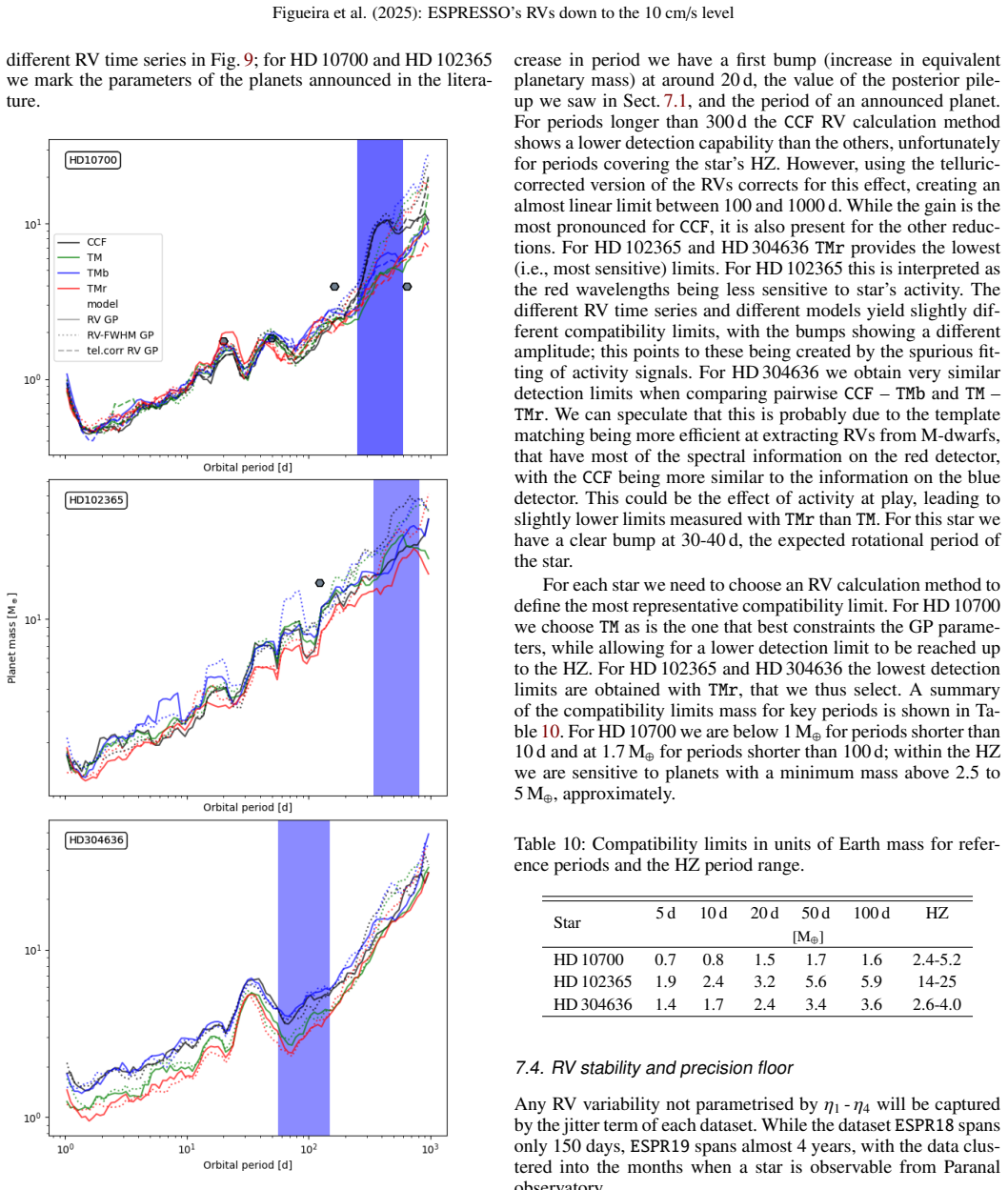
The central claim is that ESPRESSO demonstrates an on-sky radial-velocity precision better than 10 cm/s on short timescales (under one hour) and of roughly 40 cm/s over 3.5 years on the best-behaved target, HD 10700, with 20 to 30 cm/s stability demonstrated over single years. Using a forward model of p-mode pulsations built from asteroseismic scaling relations, the paper reproduces the intra-night RV scatter of HD 10700 to within a few cm/s and shows the pulsation contribution to nightly averages is 4 to 9 cm/s. On night-averaged time series, a joint model of a quasi-periodic Gaussian process for activity plus Keplerian orbits finds no significant planetary signals around HD 10700, HD 102365, or HD 304636: the roughly 20 d signal in HD 10700 is formally non-significant once activity is modelled and may be the first harmonic of the roughly 42 d rotation, while the announced 16 Earth-mass planet at 122 d around HD 102365 and a 3.93 Earth-mass planet at 162 d around HD 10700 are not supported by the data. Compatibility limits derived from the posterior samples show sensitivity down to 1.7 Earth masses for periods up to 100 d and 2.4 to 5.2 Earth masses within the habitable zone of HD 10700. The measured 40 cm/s long-term jitter sits below the 58 to 71 cm/s level that current supergranulation prescriptions predict, imposing tight constraints on granulation modelling.
Load-bearing premise
The planet search and the quoted 40 cm/s precision rest on one assumption: that a quasi-periodic Gaussian process, whose rotation-period and evolution-timescale priors come from activity calibrations with roughly 20% scatter, fully absorbs the stellar activity signal; if that model is misspecified, it could swallow a real planet, leave a spurious one in its place, or bias the noise estimate.
Editorial extensions
If this is right
- Earth-mass planets in the habitable zones of nearby Sun-like stars are now within observational reach: the ESPRESSO noise floor on the sky is below 10 cm/s on short timescales, and the excess over 3.5 years on the quietest star is about 40 cm/s, which is budgeted by stellar signals rather than by the instrument.
- Current supergranulation prescriptions predicting 58 to 71 cm/s of radial-velocity scatter are effectively ruled out on HD 10700 at the measured 40 cm/s, so future granulation models must reproduce this lower level before they can be used to forecast detection limits.
- Two previously announced planets are not confirmed: the 3.93 Earth-mass planet at 162 d around HD 10700 should have been detected by this analysis and is not, and the 16 Earth-mass planet at 122 d around HD 102365 is reinterpreted as activity, since half of that star's RV variance correlates with line-profile indicators.
- The roughly 20 d periodic signal in HD 10700 cannot be claimed as a planet: it becomes formally non-significant once a quasi-periodic Gaussian process models the activity, and its period lies close to the first harmonic of the roughly 42 d rotation, leaving its origin ambiguous.
- Low-activity indicators do not select RV-quiet stars: HD 10700 and HD 102365 have nearly identical $\log R'_{\rm HK}$ values yet very different RV scatter and indicator correlations, so target selection for Earth-twin searches needs a different metric than the usual activity index.
- The measured long-term jitter of about 40 cm/s on HD 10700 directly constrains the impact of granulation on radial velocities, imposing stringent limits on how much of the stellar noise budget can be attributed to convective motions.
Reading between the lines
- If the 40 cm/s jitter is confirmed on a larger sample of quiet stars, the bottleneck for Earth-twin detection shifts fully from instruments to stellar physics, and the next required step is a physical, rather than phenomenological, model of granulation together with a characterisation of low-amplitude white-light flares, whose timescales match the observed noise.
- The yearly jitter variability (roughly 23 to 57 cm/s across the four sub-datasets) suggests the stellar noise floor changes on activity-cycle timescales; a testable strategy would be to schedule the most precise RV campaigns during phases of minimum activity and to monitor the activity index continuously to track the expected jitter.
- The pulsation forward model, validated at the cm/s level on τ Ceti, could be applied to asteroseismically well-characterised stars to disentangle poor stellar parameters from genuine extra scatter sources for stars like HD 102365 and HD 20794, a cleaner test than the current comparison against literature parameters.
- A joint analysis of ESPRESSO radial velocities with contemporaneous TESS photometry on these same stars could test the low-amplitude-flare hypothesis directly, since flares should imprint a characteristic, short-lived, non-Gaussian radial-velocity signature.
Editorial analysis
A structured set of objections, weighed in public.
Referee Report
Summary. This manuscript presents a comprehensive ESPRESSO GTO radial-velocity study of four nearby low-activity stars (HD 10700, HD 20794, HD 102365, HD 304636). The authors derive stellar parameters via spectroscopy, SED fitting, and isochrones; model p-mode pulsations with scaling relations; compute RVs with the CCF and S-BART template matching (including per-detector and telluric-corrected versions); and search for planets with GLS, l1 periodograms, and the kima package using a quasi-periodic Gaussian process for activity. They report no significant planetary detections, derive compatibility limits reaching about 1.7 Earth masses for HD 10700 at 100 d, and claim that ESPRESSO reaches better than 10 cm/s precision on sub-hour timescales and about 40 cm/s over 3.5 yr, with 20-30 cm/s on yearly subsets, constraining granulation and supergranulation models.
Significance. If correct, the claimed 40 cm/s long-term precision would be an important milestone for ESPRESSO and for the feasibility of detecting Earth-mass planets in habitable zones of Sun-like stars, and the comparison with supergranulation models would be of broad interest. The paper's strengths include the public release of reduced RVs through DACE, the use of multiple independent RV extractions (CCF, S-BART, blue/red detectors), the careful identification and exclusion of corrupted data (ADC failure, pressure-gauge event, earthquake), and the honest reporting of non-detections. The pulsation modelling reproduces the intra-night scatter of HD 10700 to 1-2 cm/s. However, the headline precision figures are fitted GP jitter values rather than direct measurements, and the robustness of those values to the GP assumptions is not demonstrated.
major comments (4)
- [§7.4, Table G.3, §9] The central claim that ESPRESSO reaches 40 cm/s precision over 3.5 yr is the posterior jitter of the ESPR19 dataset from a kima fit with a quasi-periodic GP, not a direct measurement. The jitter absorbs any variance not explained by the GP, so the value is only meaningful if the GP captures all stellar signals. For the telluric-corrected TM run on HD 10700 the harmonic-complexity hyperparameter is eta4 = 0.42+0.23-0.14, close to the prior lower bound of 0.2, and Appendix G.1 states that for eta4 much less than 1 the kernel is no longer quasi-periodic and effectively adds a white-noise component. In this regime the GP can absorb the supergranulation signal and any planetary signal near the rotation period or its harmonic, biasing the jitter low. The paper notes correlations between the jitter and eta2/eta4 at the prior boundary (Sect. 7.1), and Sect. 8.4 reports a posterior pile-up at 20 d and a local GP eta3 maximum at 20 d, showing that the GP is already interacting with the candidate signal. Table 11 shows yearly jitter values varying from 20 to 57 cm/s, indicating that the quoted 20-30 cm/s yearly precision is similarly model-dependent. No robustness test (e.g., an alternative eta4 prior, fixing eta4, or a model including a Harvey component) is presented. The 40 cm/s headline and the supergranulation constraint in Sect. 8.2 are therefore not fully supported.
- [§8.2, Tables 7 and 9] The conclusion that supergranulation models overpredict the RV signal compares the predicted 65-75 cm/s rms to the GP residual jitter of about 40 cm/s, not to the observed long-term scatter. The raw nightly-averaged weighted rms of the HD 10700 telluric-corrected RVs is 62-68 cm/s (Table 9), which is comparable to the supergranulation prediction quoted in Section 8.2 and to the 58-71 cm/s values from the authors' own simulations in Section 5.2. Because the quasi-periodic GP with small eta4 can absorb broad-band variance, the fact that the residual jitter is below the prediction does not demonstrate that supergranulation is absent or overpredicted. A direct comparison with the raw rms, or a model that explicitly fits a supergranulation component, is needed before claiming stringent constraints on granulation models.
- [Abstract, §9, Fig. 1, Table 6] The abstract and conclusions state that ESPRESSO reaches an on-sky RV precision better than 10 cm/s on timescales shorter than 1 h. This is not supported by the measured intra-night scatter, which is about 40 cm/s for HD 10700, about 50 cm/s for HD 20794, and about 60 cm/s for HD 102365, with photon-noise medians of 10-20 cm/s (Fig. 1, Table 6). The sub-10 cm/s figure appears to refer either to the pulsation contribution to the nightly averages (epuls = 4-5 cm/s) or to the agreement between the pulsation simulation and the observations for HD 10700, not to the achieved precision of individual RVs. The wording should be corrected to distinguish these quantities.
- [§7.3, Table 10] The compatibility limits are derived under the same quasi-periodic GP model. If the GP is flexible enough to absorb planetary signals, as suggested by the 20 d posterior pile-up for HD 10700 in Sect. 7.1 and Fig. G.1, the limits in Table 10 may be overly optimistic, particularly near the rotation period and its harmonics. A statement of this model dependence, or a sensitivity test with a different activity model, would make the limits more robust.
minor comments (4)
- [§2.1] The footnote recommending a novel is not appropriate for a journal article and should be removed.
- [§6.1, §6.3] There are typos in the star name: 'HD 304646' in Sect. 6.1 and 'HD 3046336' in Sect. 6.3 should be 'HD 304636'.
- [§9] The sentence 'By further further splitting the datasets' contains a duplicated word and should be corrected.
- [§3.4, Table B.1] The main text could briefly note that the rotation period changes by 10-20 d depending on the assumed spectral type, as shown in Appendix B, because these Prot values are used as priors for eta3 in the GP analysis.
Circularity Check
No circular step is exhibited; the 40 cm/s precision claim is a fitted GP jitter presented as a measurement, not as a prediction, and the central comparisons use externally calibrated models.
full rationale
The paper's headline claims are empirical characterizations rather than derivations from inputs. The intra-night scatter comparison uses forward pulsation simulations from literature scaling relations (Eqs. 1-3) applied to independently derived stellar parameters, so it is not circular. The 40 cm/s over 3.5 yr is the posterior jitter of the kima quasi-periodic GP fit to HD 10700 telluric-corrected RVs (Table G.3, ESPR19 jitter = 0.41+0.06-0.06 m/s; Conclusions, Section 9). This is model-dependent because the GP may absorb part of the variance, and the paper itself warns in Appendix G.1 that for extreme eta4 the kernel is not quasi-periodic and can act as a white-noise component; however, the jitter is a fitted noise parameter, not a quantity predicted from the model's inputs, so it is not circular by construction. The supergranulation constraint in Section 8.2 compares this jitter to predictions from Al Moulla et al. (2023), an external model, and the disagreement is a scientific inference, not a tautology. Self-citations (kima: Faria et al. 2018; S-BART: Silva et al. 2022; rotation calibration: Suarez Mascareno et al. 2016) are methodological or used as weakly informative priors with stated 20% uncertainties, and the rotation-period posterior (eta3 ~ 42 d) is not forced by the prior (37.7 +- 7.5 d). No equation reduces to its own input, and no fitted parameter is renamed as a prediction. The analysis is therefore not circular, though the precision and supergranulation conclusions carry model-robustness risk that the paper partially acknowledges.
Assumptions & free parameters
free parameters (7)
- GP amplitude eta1 =
0.42-0.57 m/s (median across reductions for HD 10700)
- GP evolution timescale eta2 =
~90-120 d for HD 10700
- GP rotation period eta3 =
~42 d for HD 10700
- GP harmonic complexity eta4 =
~0.45 for HD 10700 TM
- Instrument jitter ESPR18 and ESPR19 =
0.75-0.86 m/s and 0.41-0.51 m/s (HD 10700 telluric-corrected)
- RV offsets between datasets =
~0-2 m/s depending on star and method
- Linear and quadratic RV slopes =
~0.25-0.4 m/s/yr and ~-0.15 m/s/yr^2 for HD 10700
assumptions (5)
- domain assumption A quasi-periodic Gaussian process can adequately represent the stellar activity-induced RV signal.
- domain assumption Pulsation scaling relations (Eqs. 1-3) and the envelope width FWHM_env = 10 Delta_nu apply to the target stars.
- domain assumption The solar granulation and supergranulation power spectra from Al Moulla et al. (2023) can be scaled to other stars.
- domain assumption Stellar masses, radii, luminosities from ARIADNE and PARAM/PARSEC are accurate within stated errors.
- domain assumption The Kopparapu et al. (2013, 2014) model provides correct habitable zone boundaries.
Cite this review
Pith. "Pith review of A comprehensive study on radial velocity signals using ESPRESSO: Pushing precision to the 10 cm/s level." pith.science (2026). https://pith.science/paper/P2JS33SP
@misc{pith2026250707514,
  author       = {Pith},
  title        = {Pith review of: A comprehensive study on radial velocity signals using ESPRESSO: Pushing precision to the 10 cm/s level},
  year         = {2026},
  howpublished = {\url{https://pith.science/paper/P2JS33SP}},
  note         = {Machine review of arXiv:2507.07514}
}
abstract
We analyse ESPRESSO data for the stars HD10700, HD20794, HD102365, and HD304636 acquired via its Guaranteed Time Observations (GTO) programme. We characterise the stars' radial velocity (RV) signals down to a precision of 10 cm/s on timescales ranging from minutes to planetary periods falling within the host's habitable zone (HZ). We study the RV signature of pulsation, granulation, and stellar activity, inferring the potential presence of planets around these stars. Thus, we outline the population of planets that while undetectable remain compatible with the available data. A simple model of stellar pulsations successfully reproduced the intra-night RV scatter of HD10700 down to a few cm/s. For HD102365 and HD20794, an additional source of scatter at the level of several 10 cm/s remains necessary to explain the data. A kima analysis was used to evaluate the number of planets supported by the nightly averaged time series of each of HD10700, HD102365, and HD304636, under the assumption that a quasi-periodic Gaussian process (GP) regression is able to model the activity signal. While a frequency analysis of HD10700 RVs is able to identify a periodic signal at 20d, when it is modelled along with the activity signal the signal is formally non-significant. ESPRESSO data on their own do not provide conclusive evidence for the existence of planets around these three stars. ESPRESSO is shown to reach an on-sky RV precision of better than 10 cm/s on short timescales (<1h) and of 40 cm/s over 3.5 yr. A subdivision of the datasets showcases a precision reaching 20-30 cm/s over one year. These results impose stringent constraints on the impact of granulation mechanisms on RV. In spite of no detections, our analysis of HD10700 RVs demonstrates a sensitivity to planets with a mass of 1.7M$_{\oplus}$ for periods of up to 100 d, and a mass of 2-5M$_{\oplus}$ for the star's HZ. (abridged)
Figures


Figures from the paper (7 more)



Reference graph
Works this paper leans on
-
[1]
2018, , 614, A55
Aguilera-G \'o mez , C., Ram \' rez , I., & Chanam \'e , J. 2018, , 614, A55
2018
-
[2]
2023, , 669, A39
Al Moulla , K., Dumusque , X., Figueira , P., et al. 2023, , 669, A39
2023
-
[3]
2012, Philosophical Transactions of the Royal Society of London Series A, 370, 2765
Allard , F., Homeier , D., & Freytag , B. 2012, Philosophical Transactions of the Royal Society of London Series A, 370, 2765
2012
-
[4]
2022, , 666, A196
Allart , R., Lovis , C., Faria , J., et al. 2022, , 666, A196
2022
-
[5]
F., & Barcel \'o Forteza , S
Aller , A., Lillo-Box , J., Jones , D., Miranda , L. F., & Barcel \'o Forteza , S. 2020, , 635, A128
2020
-
[6]
G., Delgado-Mena , E., Santos , N
Antoniadis-Karnavas , A., Sousa , S. G., Delgado-Mena , E., Santos , N. C., & Andreasen , D. T. 2024, , 690, A58
2024
-
[7]
G., Delgado-Mena , E., et al
Antoniadis-Karnavas , A., Sousa , S. G., Delgado-Mena , E., et al. 2020, , 636, A9
2020
-
[8]
Aschwanden , M. J. & G \"u del , M. 2021, , 910, 41
2021
Show all 141 references
-
[9]
& Schwarzschild , M
Bahng , J. & Schwarzschild , M. 1961, , 134, 312
1961
-
[10]
Bailer-Jones , C. A. L., Rybizki , J., Fouesneau , M., Mantelet , G., & Andrae , R. 2018, , 156, 58
2018
-
[11]
1996, , 457, L99
Baliunas , S., Sokoloff , D., & Soon , W. 1996, , 457, L99
1996
-
[12]
L., Horne , J
Baliunas , S. L., Horne , J. H., Porter , A., et al. 1985, , 294, 310
1985
-
[13]
Baluev , R. V. 2008, , 385, 1279
2008
-
[14]
1996, , 119, 373
Baranne , A., Queloz , D., Mayor , M., et al. 1996, , 119, 373
1996
-
[15]
2011, , 528, A4
Boisse , I., Bouchy , F., H \'e brard , G., et al. 2011, , 528, A4
2011
-
[16]
C., Vauclair , S., & Sosnowska , D
Bouchy , F., Bazot , M., Santos , N. C., Vauclair , S., & Sosnowska , D. 2005, , 440, 609
2005
-
[17]
& Carrier , F
Bouchy , F. & Carrier , F. 2002, , 390, 205
2002
-
[18]
2012, , 427, 127
Bressan , A., Marigo , P., Girardi , L., et al. 2012, , 427, 127
2012
-
[19]
Brewer , B. J. 2014, arXiv e-prints, arXiv:1411.3921
2014 arXiv
-
[20]
J., P\' a rtay, L
Brewer, B. J., P\' a rtay, L. B., & Cs\' a nyi, G. 2011, Statistics and Computing, 21, 649–656
2011
-
[21]
L., Schofield , M., Kuszlewicz , J
Campante , T. L., Schofield , M., Kuszlewicz , J. S., et al. 2016, , 830, 138
2016
-
[22]
& Kurucz , R
Castelli , F. & Kurucz , R. L. 2003, in Modelling of Stellar Atmospheres, ed. N. Piskunov , W. W. Weiss , & D. F. Gray , Vol. 210, A20
2003
-
[23]
Castro-Gonz \'a lez , A., Demangeon , O. D. S., Lillo-Box , J., et al. 2023, , 675, A52
2023
-
[24]
J., et al
Castro-Gonz \'a lez , A., Lillo-Box , J., Armstrong , D. J., et al. 2024, , 691, A233
2024
-
[25]
J., Cegla , H
Chaplin , W. J., Cegla , H. M., Watson , C. A., Davies , G. R., & Ball , W. H. 2019, , 157, 163
2019
-
[26]
& Kipping , D
Chen , J. & Kipping , D. 2017, , 834, 17
2017
-
[27]
2019, , 487, 1082
Collier Cameron , A., Mortier , A., Phillips , D., et al. 2019, , 487, 1082
2019
-
[28]
C., Figueira , P., et al
Cunha , D., Santos , N. C., Figueira , P., et al. 2014, , 568, A35
2014
-
[29]
2006, , 458, 609
da Silva , L., Girardi , L., Pasquini , L., et al. 2006, , 458, 609
2006
-
[30]
B., Hara , N., & S \'e gransan , D
Delisle , J. B., Hara , N., & S \'e gransan , D. 2020, , 635, A83
2020
-
[31]
C., & Walker , D
Diego , F., Charalambous , A., Fish , A. C., & Walker , D. D. 1990, in Society of Photo-Optical Instrumentation Engineers (SPIE) Conference Series, Vol. 1235, Instrumentation in Astronomy VII, ed. D. L. Crawford , 562--576
1990
-
[32]
2025, , 979, 214
DiTomasso , V., L \'o pez-Morales , M., Peacock , S., et al. 2025, , 979, 214
2025
-
[33]
2017, , 598, A133
Dumusque , X., Borsa , F., Damasso , M., et al. 2017, , 598, A133
2017
-
[34]
C., & Monteiro , M
Dumusque , X., Udry , S., Lovis , C., Santos , N. C., & Monteiro , M. J. P. F. G. 2011, , 525, A140
2011
-
[35]
Eastman , J., Siverd , R., & Gaudi , B. S. 2010, , 122, 935
2010
-
[36]
P., Adibekyan , V., Amazo-G \'o mez , E
Faria , J. P., Adibekyan , V., Amazo-G \'o mez , E. M., et al. 2020, , 635, A13
2020
-
[37]
P., Santos , N
Faria , J. P., Santos , N. C., Figueira , P., & Brewer , B. J. 2018, The Journal of Open Source Software, 3, 487
2018
-
[38]
P., Su \'a rez Mascare \ n o , A., Figueira , P., et al
Faria , J. P., Su \'a rez Mascare \ n o , A., Figueira , P., et al. 2022, , 658, A115
2022
-
[39]
Feng , F., Tuomi , M., & Jones , H. R. A. 2017 a , , 605, A103
2017
-
[40]
Feng , F., Tuomi , M., Jones , H. R. A., et al. 2017 b , , 154, 135
2017
-
[41]
T., & Hobson , M
Feroz , F., Balan , S. T., & Hobson , M. P. 2011, , 415, 3462
2011
-
[42]
Gaia Collaboration , Vallenari , A., Brown , A. G. A., et al. 2023, , 674, A1
2023
-
[43]
Garc \' a , R. A. & Ballot , J. 2019, Living Reviews in Solar Physics, 16, 4
2019
-
[44]
Y., Persson , C
Georgieva , I. Y., Persson , C. M., Goffo , E., et al. 2023, , 674, A117
2023
-
[45]
2013, , 770, L36
Giannattasio , F., Del Moro , D., Berrilli , F., et al. 2013, , 770, L36
2013
-
[46]
Gomes da Silva , J., Bensabat , A., Monteiro , T., & Santos , N. C. 2022, , 668, A174
2022
-
[47]
2018, The Journal of Open Source Software, 3, 667
Gomes da Silva , J., Figueira , P., Santos , N., & Faria , J. 2018, The Journal of Open Source Software, 3, 667
2018
-
[48]
C., Adibekyan , V., et al
Gomes da Silva , J., Santos , N. C., Adibekyan , V., et al. 2021, , 646, A77
2021
-
[49]
Gray , D. F. & Baliunas , S. L. 1994, , 427, 1042
1994
-
[50]
O., Corbally , C
Gray , R. O., Corbally , C. J., Garrison , R. F., et al. 2006, , 132, 161
2006
-
[51]
Gregory , P. C. 2005, , 631, 1198
2005
-
[52]
2014, , 148, 53
Gullikson , K., Dodson-Robinson , S., & Kraus , A. 2014, , 148, 53
2014
-
[53]
C., Bouchy , F., Stalport , M., et al
Hara , N. C., Bouchy , F., Stalport , M., et al. 2020, , 636, L6
2020
-
[54]
C., Bou \'e , G., Laskar , J., & Correia , A
Hara , N. C., Bou \'e , G., Laskar , J., & Correia , A. C. M. 2017, , 464, 1220
2017
-
[55]
D., Collier Cameron , A., Queloz , D., et al
Haywood , R. D., Collier Cameron , A., Queloz , D., et al. 2014, , 443, 2517
2014
-
[56]
L., Bott , K., Dalba , P
Hill , M. L., Bott , K., Dalba , P. A., et al. 2023, , 165, 34
2023
-
[57]
C., et al
Hojjatpanah , S., Figueira , P., Santos , N. C., et al. 2019, , 629, A80
2019
-
[58]
2008, Advances in Space Research, 41, 846
Howe , R. 2008, Advances in Space Research, 41, 846
2008
-
[59]
Hudson , H. S. 1991, , 133, 357
1991
-
[60]
A., Quinn , S
Hurt , S. A., Quinn , S. N., Latham , D. W., et al. 2021, , 161, 157
2021
-
[61]
O., Wende-von Berg , S., Dreizler , S., et al
Husser , T. O., Wende-von Berg , S., Dreizler , S., et al. 2013, , 553, A6
2013
-
[62]
& Wright, J
Kanodia, S. & Wright, J. 2018, Research Notes of the AAS, 2, 4
2018
-
[63]
Kass, R. E. & Raftery, A. E. 1995, Journal of the American Statistical Association, 90, 773
1995
-
[64]
2017, , 597, A137
Kervella , P., Bigot , L., Gallenne , A., & Th \'e venin , F. 2017, , 597, A137
2017
-
[65]
2016, , 594, A107
Kervella , P., Mignard , F., M \'e rand , A., & Th \'e venin , F. 2016, , 594, A107
2016
-
[66]
Kipping , D. M. 2013, , 434, L51
2013
-
[67]
& Bedding , T
Kjeldsen , H. & Bedding , T. R. 2011, , 529, L8
2011
-
[68]
2010, , 403, 1949
Koen , C., Kilkenny , D., van Wyk , F., & Marang , F. 2010, , 403, 1949
2010
-
[69]
K., Ramirez , R., Kasting , J
Kopparapu , R. K., Ramirez , R., Kasting , J. F., et al. 2013, , 765, 131
2013
-
[70]
K., Ramirez , R
Kopparapu , R. K., Ramirez , R. M., SchottelKotte , J., et al. 2014, , 787, L29
2014
-
[71]
M., Fischer , D
Korolik , M., Roettenbacher , R. M., Fischer , D. A., et al. 2023, , 166, 123
2023
-
[72]
1980, Journal of Hydrology, 46, 79
Kumaraswamy , P. 1980, Journal of Hydrology, 46, 79
1980
-
[73]
2017, , 153, 75
Kunder , A., Kordopatis , G., Steinmetz , M., et al. 2017, , 153, 75
2017
-
[74]
Kurucz , R. L. 1993, SYNTHE spectrum synthesis programs and line data
1993
-
[75]
A., Mamajek , E
Laliotis , K., Burt , J. A., Mamajek , E. E., et al. 2023, , 165, 176
2023
-
[76]
2020, , 642, A121
Lillo-Box , J., Figueira , P., Leleu , A., et al. 2020, , 642, A121
2020
-
[77]
2015, The Messenger, 162, 9
Lo Curto , G., Pepe , F., Avila , G., et al. 2015, The Messenger, 162, 9
2015
-
[78]
Lomb , N. R. 1976, , 39, 447
1976
-
[79]
C., et al
Lovis , C., Dumusque , X., Santos , N. C., et al. 2011, arXiv e-prints, arXiv:1107.5325
2011 arXiv
-
[80]
2006, , 441, 305
Lovis , C., Mayor , M., Pepe , F., et al. 2006, , 441, 305
2006
-
[81]
Lu , E. T. & Hamilton , R. J. 1991, , 380, L89
1991
-
[82]
N., Silva Aguirre , V., Davies , G
Lund , M. N., Silva Aguirre , V., Davies , G. R., et al. 2017, , 835, 172
2017
-
[83]
F., Dumusque , X., et al
Maldonado , J., Phillips , D. F., Dumusque , X., et al. 2019 a , , 627, A118
2019
-
[84]
2019 b , , 624, A94
Maldonado , J., Villaver , E., Eiroa , C., & Micela , G. 2019 b , , 624, A94
2019
-
[85]
Mamajek , E. E. & Hillenbrand , L. A. 2008, , 687, 1264
2008
-
[86]
2011, , 741, 119
Mathur , S., Hekker , S., Trampedach , R., et al. 2011, , 741, 119
2011
-
[87]
2003, The Messenger, 114, 20
Mayor , M., Pepe , F., Queloz , D., et al. 2003, The Messenger, 114, 20
2003
-
[88]
2022, , 658, A57
Meunier , N., Kretzschmar , M., Gravet , R., Mignon , L., & Delfosse , X. 2022, , 658, A57
2022
-
[89]
Meunier , N., Pous , R., Sulis , S., Mary , D., & Lagrange , A. M. 2023, , 676, A82
2023
-
[90]
W., Haywood , R
Milbourne , T. W., Haywood , R. D., Phillips , D. F., et al. 2019, , 874, 107
2019
-
[91]
C., et al
Nari , N., Dumusque , X., Hara , N. C., et al. 2025, , 693, A297
2025
-
[92]
C., et al
Neves , V., Bonfils , X., Santos , N. C., et al. 2013, , 551, A36
2013
-
[93]
Nicholson , B. A. & Aigrain , S. 2022, , 515, 5251
2022
-
[94]
W., Hartmann , L
Noyes , R. W., Hartmann , L. W., Baliunas , S. L., Duncan , D. K., & Vaughan , A. H. 1984 a , , 279, 763
1984
-
[95]
W., Weiss , N
Noyes , R. W., Weiss , N. O., & Vaughan , A. H. 1984 b , , 287, 769
1984
-
[96]
Pecaut , M. J. & Mamajek , E. E. 2013, , 208, 9
2013
-
[97]
2021, , 645, A96
Pepe , F., Cristiani , S., Rebolo , R., et al. 2021, , 645, A96
2021
-
[98]
2011, , 534, A58
Pepe , F., Lovis , C., S \'e gransan , D., et al. 2011, , 534, A58
2011
-
[99]
2002, , 388, 632
Pepe , F., Mayor , M., Galland , F., et al. 2002, , 388, 632
2002
-
[100]
2022, , 935, 143
Pietras , M., Falewicz , R., Siarkowski , M., Bicz , K., & Pre \'s , P. 2022, , 935, 143
2022
-
[101]
Pietrow , A. G. M., Cretignier , M., Druett , M. K., et al. 2024, , 682, A46
2024
-
[102]
W., Sivan , J
Queloz , D., Henry , G. W., Sivan , J. P., et al. 2001, , 379, 279
2001
-
[103]
Rasmussen , C. E. & Williams , C. K. I. 2006, Gaussian Processes for Machine Learning
2006
-
[104]
R., Winn , J
Ricker , G. R., Winn , J. N., Vanderspek , R., et al. 2014, in Society of Photo-Optical Instrumentation Engineers (SPIE) Conference Series, Vol. 9143, Space Telescopes and Instrumentation 2014: Optical, Infrared, and Millimeter Wave, ed. J. Oschmann , Jacobus M., M. Clampin , ...
2014
-
[105]
W., et al
Riello , M., De Angeli , F., Evans , D. W., et al. 2021, , 649, A3
2021
-
[106]
& Rieutord , M
Rincon , F. & Rieutord , M. 2018, Living Reviews in Solar Physics, 15, 6
2018
-
[107]
2012, Philosophical Transactions of the Royal Society of London Series A, 371, 20110550
Roberts , S., Osborne , M., Ebden , M., et al. 2012, Philosophical Transactions of the Royal Society of London Series A, 371, 20110550
2012
-
[108]
S., Bossini , D., Miglio , A., et al
Rodrigues , T. S., Bossini , D., Miglio , A., et al. 2017, , 467, 1433
2017
-
[109]
S., Girardi , L., Miglio , A., et al
Rodrigues , T. S., Girardi , L., Miglio , A., et al. 2014, , 445, 2758
2014
-
[110]
A., Pall \'e , P
Salabert , D., Garc \' a , R. A., Pall \'e , P. L., & Jim \'e nez , A. 2011, in Journal of Physics Conference Series, Vol. 271, GONG-SoHO 24: A New Era of Seismology of the Sun and Solar-Like Stars (IOP), 012030
2011
-
[111]
2007, , 463, 297
Samadi , R., Georgobiani , D., Trampedach , R., et al. 2007, , 463, 297
2007
-
[112]
Scargle , J. D. 1982, , 263, 835
1982
-
[113]
M., Chazelas , B., Lovis , C., et al
Schmidt , T. M., Chazelas , B., Lovis , C., et al. 2022, , 664, A191
2022
-
[114]
J., Prieto , J
Shappee , B. J., Prieto , J. L., Grupe , D., et al. 2014, , 788, 48
2014
-
[115]
M., Faria , J
Silva , A. M., Faria , J. P., Santos , N. C., et al. 2022, , 663, A143
2022
-
[116]
Simon , G. W. & Leighton , R. B. 1964, , 140, 1120
1964
-
[117]
Sneden , C. A. 1973, PhD thesis, University of Texas, Austin
1973
-
[118]
& Vauclair , S
Soriano , M. & Vauclair , S. 2010, , 513, A49
2010
-
[119]
2022, , 663, A4
Soubiran , C., Brouillet , N., & Casamiquela , L. 2022, , 663, A4
2022
-
[120]
G., Adibekyan , V., Delgado-Mena , E., et al
Sousa , S. G., Adibekyan , V., Delgado-Mena , E., et al. 2021, , 656, A53
2021
-
[121]
G., Santos , N
Sousa , S. G., Santos , N. C., Adibekyan , V., Delgado-Mena , E., & Israelian , G. 2015, , 577, A67
2015
-
[122]
G., Santos , N
Sousa , S. G., Santos , N. C., Israelian , G., Mayor , M., & Monteiro , M. J. P. F. G. 2007, , 469, 783
2007
-
[123]
M., Rajani , G., Paniveni , U., & Srikanth , R
Sowmya , G. M., Rajani , G., Paniveni , U., & Srikanth , R. 2023, Astrophysical Bulletin, 78, 606
2023
-
[124]
R., Triaud , A
Standing , M. R., Triaud , A. H. M. J., Faria , J. P., et al. 2022, , 511, 3571
2022
-
[125]
P., Figueira , P., et al
Su \'a rez Mascare \ n o , A., Faria , J. P., Figueira , P., et al. 2020, , 639, A77
2020
-
[126]
Su \'a rez Mascare \ n o , A., Rebolo , R., & Gonz \'a lez Hern \'a ndez , J. I. 2016, , 595, A12
2016
-
[127]
I., & Esposito , M
Su \'a rez Mascare \ n o , A., Rebolo , R., Gonz \'a lez Hern \'a ndez , J. I., & Esposito , M. 2017, , 468, 4772
2017
-
[128]
M., Marfil , E., Montes , D., & Gonz \'a lez Hern \'a ndez , J
Tabernero , H. M., Marfil , E., Montes , D., & Gonz \'a lez Hern \'a ndez , J. I. 2022, , 657, A66
2022
-
[129]
R., Huber , D., & van Saders , J
Tayar , J., Claytor , Z. R., Huber , D., & van Saders , J. 2022, , 927, 31
2022
-
[130]
C., Kjeldsen , H., Bedding , T
Teixeira , T. C., Kjeldsen , H., Bedding , T. R., et al. 2009, , 494, 237
2009
-
[131]
G., Butler , R
Tinney , C. G., Butler , R. P., Jones , H. R. A., et al. 2011, , 727, 103
2011
-
[132]
Tuomi , M., Jones , H. R. A., Jenkins , J. S., et al. 2013, , 551, A79
2013
-
[133]
VanderPlas , J. T. 2018, , 236, 16
2018
-
[134]
Vines , J. I. & Jenkins , J. S. 2022, , 513, 2719
2022
-
[135]
Wehbe , B., Cabral , A., Martins , J. H. C., et al. 2020, , 491, 3515
2020
-
[136]
2010, in Society of Photo-Optical Instrumentation Engineers (SPIE) Conference Series, Vol
Wildi , F., Pepe , F., Chazelas , B., Lo Curto , G., & Lovis , C. 2010, in Society of Photo-Optical Instrumentation Engineers (SPIE) Conference Series, Vol. 7735, Ground-based and Airborne Instrumentation for Astronomy III, ed. I. S. McLean , S. K. Ramsay , & H. Takami , 77354X
2010
-
[137]
& Kochanek , C
Winecki , D. & Kochanek , C. S. 2024, , 971, 61
2024
-
[138]
& Liu , J
Yang , H. & Liu , J. 2019, , 241, 29
2019
-
[139]
& K \"u rster , M
Zechmeister , M. & K \"u rster , M. 2009, , 496, 577
2009
-
[140]
, " * write output.state after.block = add.period write newline
ENTRY address archiveprefix author booktitle chapter edition editor howpublished institution eprint journal key month note number organization pages publisher school series title type volume year label extra.label sort.label short.list INTEGERS output.state before.all mid.sent...
-
[141]
write newline
" write newline "" before.all 'output.state := FUNCTION n.dashify 't := "" t empty not t #1 #1 substring "-" = t #1 #2 substring "--" = not "--" * t #2 global.max substring 't := t #1 #1 substring "-" = "-" * t #2 global.max substring 't := while if t #1 #1 substring * t #2 gl...
Reviewed August 6, 2026 · model on record in the stance chip above.
Discussion (0). Continue with ORCID to comment.