Gate Freezing Method for Gradient-Free Variational Quantum Algorithms in Circuit Optimization
Pith reviewed 2026-05-19 05:35 UTC · model grok-4.3
The pith
Freezing converged gates reallocates effort to improve convergence in gradient-free quantum optimizers.
A machine-rendered reading of the paper's core claim, the machinery that carries it, and where it could break.
Core claim
The gate freezing method incorporates information from previous parameter iterations to selectively freeze gates that appear well-optimized, thereby conserving resources by focusing optimization on underperforming gates and achieving improved convergence in parameterized quantum circuits for variational quantum algorithms.
What carries the argument
Gate freezing procedure, which pauses parameter updates for gates identified as sufficiently optimized using historical iteration data.
Load-bearing premise
Information from previous iterations can reliably identify which gates are poorly optimized without introducing bias or extra noise sensitivity.
What would settle it
Applying the gate freezing method to the same set of circuits and optimizers yields no improvement or a decline in final convergence quality compared with the unfrozen baseline.
Figures





read the original abstract
Parameterized quantum circuits (PQCs) are pivotal components of variational quantum algorithms (VQAs), which represent a promising pathway to quantum advantage in noisy intermediate-scale quantum (NISQ) devices. PQCs enable flexible encoding of quantum information through tunable quantum gates and have been successfully applied across domains such as quantum chemistry, combinatorial optimization, and quantum machine learning. Despite their potential, PQC performance on NISQ hardware is hindered by noise, decoherence, and the presence of barren plateaus, which can impede gradient-based optimization. To address these limitations, we propose novel methods for improving gradient-free optimizers Rotosolve, Fraxis, and FQS, incorporating information from previous parameter iterations. Our approach conserves computational resources by reallocating optimization efforts toward poorly optimized gates, leading to improved convergence. The experimental results demonstrate that our techniques consistently improve the performance of various optimizers, contributing to more robust and efficient PQC optimization.
Editorial analysis
A structured set of objections, weighed in public.
Referee Report
Summary. The manuscript proposes a Gate Freezing Method to improve gradient-free variational quantum algorithms (specifically Rotosolve, Fraxis, and FQS) for parameterized quantum circuits. The approach uses information from previous parameter iterations to identify and freeze well-optimized gates, reallocating optimization effort to poorly optimized gates in order to conserve computational resources and achieve better convergence. The authors assert that experimental results demonstrate consistent performance gains over standard implementations of these optimizers.
Significance. If the central heuristic proves robust, the method could provide a lightweight, practical enhancement to existing gradient-free VQA optimizers on NISQ hardware by reducing redundant evaluations. It directly targets resource efficiency rather than introducing new theoretical machinery, which is a modest but potentially useful contribution in the variational quantum algorithms literature.
major comments (3)
- [§3] §3 (Gate Freezing Method): The criterion for identifying 'poorly optimized gates' from prior iterations is presented only as an empirical heuristic without an explicit mathematical definition, threshold, or pseudocode. This is load-bearing because the central claim of resource savings rests on the reliability of this selection rule; without it, reproducibility and analysis of bias from inter-gate correlations cannot be assessed.
- [§4] §4 (Experimental Results): The reported improvements lack circuit specifications (qubit count, depth, ansatz structure), noise models, number of independent runs, error bars, or quantitative baseline comparisons against unmodified Rotosolve/Fraxis/FQS. These omissions prevent verification of the claim that the method 'consistently improves performance' and conserves resources.
- [§2.3] §2.3 (Assumptions): The paper states that historical parameter values reliably indicate gate quality, yet provides no robustness test against strong parameter correlations or shot noise. This assumption is load-bearing for the resource-conservation claim, as stale freezing decisions could lock in suboptimal configurations that later reallocations cannot recover.
minor comments (2)
- [Abstract] Abstract: The phrase 'various optimizers' is used; the full text clarifies these are Rotosolve, Fraxis, and FQS, but this should be stated explicitly in the abstract for clarity.
- [Figures] Figure captions: Ensure all experimental figures include axis labels, legend entries for frozen vs. non-frozen runs, and sample sizes.
Simulated Author's Rebuttal
We thank the referee for their constructive and detailed comments, which have helped us improve the clarity and completeness of the manuscript. We address each major comment point by point below and have revised the paper accordingly.
read point-by-point responses
-
Referee: [§3] §3 (Gate Freezing Method): The criterion for identifying 'poorly optimized gates' from prior iterations is presented only as an empirical heuristic without an explicit mathematical definition, threshold, or pseudocode. This is load-bearing because the central claim of resource savings rests on the reliability of this selection rule; without it, reproducibility and analysis of bias from inter-gate correlations cannot be assessed.
Authors: We agree that the original description in §3 lacked sufficient formality. In the revised manuscript we have added an explicit mathematical definition of the freezing criterion (based on the absolute change in each gate parameter across the previous k iterations falling below a tunable threshold τ), the specific value of τ used in experiments, and pseudocode for the full gate-freezing procedure. We have also included a brief analysis of how inter-gate correlations may affect the selection rule and note that the method remains effective even when moderate correlations are present. revision: yes
-
Referee: [§4] §4 (Experimental Results): The reported improvements lack circuit specifications (qubit count, depth, ansatz structure), noise models, number of independent runs, error bars, or quantitative baseline comparisons against unmodified Rotosolve/Fraxis/FQS. These omissions prevent verification of the claim that the method 'consistently improves performance' and conserves resources.
Authors: We acknowledge that the original §4 was missing these essential details. The revised version now specifies the circuit families (4–10 qubits, hardware-efficient and QAOA-style ansatze with depths 8–24), the noise models (depolarizing and amplitude-damping channels at rates 0.001–0.05), the number of independent runs (50 per configuration), error bars (one standard deviation), and quantitative baseline comparisons. Tables report average reductions in the number of optimizer iterations (18–32 %) and final cost values relative to the unmodified Rotosolve, Fraxis, and FQS implementations. revision: yes
-
Referee: [§2.3] §2.3 (Assumptions): The paper states that historical parameter values reliably indicate gate quality, yet provides no robustness test against strong parameter correlations or shot noise. This assumption is load-bearing for the resource-conservation claim, as stale freezing decisions could lock in suboptimal configurations that later reallocations cannot recover.
Authors: This is a fair criticism. The original manuscript did not contain dedicated robustness experiments. We have added a new subsection with additional simulations that vary both the degree of parameter correlation at initialization and the number of shots per evaluation (100 to 10 000). The results show graceful degradation under high shot noise; a periodic “unfreezing” step every m iterations is introduced to mitigate the risk of permanently locking in suboptimal gates. We openly discuss the remaining limitations of the heuristic under extreme noise. revision: yes
Circularity Check
Empirical heuristic for gate freezing shows no circular derivation
full rationale
The paper introduces a practical method to improve gradient-free optimizers by reallocating effort to poorly optimized gates using information from prior parameter iterations. No derivation chain, first-principles prediction, or uniqueness theorem is presented that reduces by the paper's own equations to a fitted input or self-citation loop. The approach is framed as an empirical technique validated through experiments on Rotosolve, Fraxis, and FQS, without claiming that any output quantity is mathematically forced by the inputs via construction. The central claims rest on observed performance gains rather than self-referential logic, making the work self-contained against external benchmarks.
Axiom & Free-Parameter Ledger
axioms (2)
- domain assumption Parameterized quantum circuits can be optimized by gradient-free methods such as Rotosolve, Fraxis, and FQS on NISQ hardware.
- ad hoc to paper Information from previous parameter iterations reliably indicates which gates remain poorly optimized.
invented entities (1)
-
Gate freezing heuristic
no independent evidence
Reference graph
Works this paper leans on
-
[1]
Parameter Distances The results for gate freezing with iterations κ = 5, 10, 15 and incremental gate freezing with Rotosolve are shown in Fig. 6. In both subplots in Fig. 6, the gate freezing method outperforms the original baseRotosolve in terms of convergence speed and better mean values across the 20 runs. For all freeze iterations κ, the best median v...
-
[2]
III B to measure the rotations of the unitaries on a Bloch sphere
Matrix Norm Distances In this section, we use the derived matrix norm from Sec. III B to measure the rotations of the unitaries on a Bloch sphere. Due to the simple nature of Rotosolve, we now only consider Fraxis and FQS. Similarly to the previous section, we use κ = 2, 5 and incremental freez- ing for gate freezing. The threshold values T are set to 0.0...
-
[3]
the number of gate freeze iterations κd
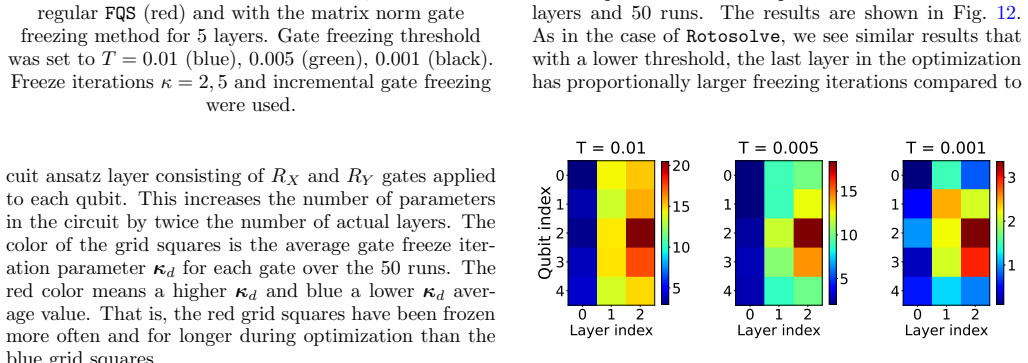
Incremental freezing – Gate freeze iterations In this section, we show our results for individual gates w.r.t. the number of gate freeze iterations κd. We exam- ine the average of the incremental gate freezing iterations κ that exceed the given threshold T . After each run, the vector κ was saved in the data file. We ran a total of 50 runs for each optimi...
-
[4]
with the corresponding lattice size and coefficients t and U, and applying the Jordan-Wigner mapping [47] to the creation and annihilation operators. The mapping requires 2 qubits for each lattice site, which means that the lattice of size 1 × 3 is a 6-qubit system. Next, we show our results for incremental freezing for Rotosolve, Fraxis, and FQS. In all ...
-
[5]
We used the same ansatz circuit as for the Heisenberg model
Parameter Distances We tested fixed and incremental freezing for Rotosolve with 3 layers and Fraxis and FQS optimiz- ers with 5 layers. We used the same ansatz circuit as for the Heisenberg model. A total of 20 runs were performed. The number of gate optimization iterations was set to 50 for regular Rotosolve and Fraxis, and 30 for FQS. The incremental ga...
-
[6]
The experiment was done in the same way as for the parameter distances
Matrix Norm Distances Now we present our results for Fraxis and FQS with matrix norm as distance metric. The experiment was done in the same way as for the parameter distances. A total of 20 runs with 50 iterations for Fraxis and 30 iter- ations for FQS with freeze iterations set to κ = 2, 5. The incremental gate freezing algorithms were executed until th...
work page 2022
- [7]
-
[8]
A. Peruzzo, J. McClean, P. Shadbolt, M.-H. Yung, X.-Q. Zhou, P. J. Love, A. Aspuru-Guzik, and J. L. O’brien, A variational eigenvalue solver on a photonic quantum processor, Nature communications 5, 4213 (2014)
work page 2014
- [9]
- [10]
-
[11]
A. Delgado, J. M. Arrazola, S. Jahangiri, Z. Niu, J. Izaac, C. Roberts, and N. Killoran, Variational quantum algo- rithm for molecular geometry optimization, Physical Re- view A 104, 052402 (2021)
work page 2021
-
[12]
M. Motta and J. E. Rice, Emerging quantum comput- ing algorithms for quantum chemistry, Wiley Interdisci- plinary Reviews: Computational Molecular Science 12, e1580 (2022)
work page 2022
-
[13]
Y. Cao, J. Romero, J. P. Olson, M. Degroote, P. D. John- son, M. Kieferov´ a, I. D. Kivlichan, T. Menke, B. Per- opadre, N. P. Sawaya, et al. , Quantum chemistry in the age of quantum computing, Chemical reviews119, 10856 (2019)
work page 2019
-
[14]
M. Svensson, M. Andersson, M. Gr¨ onkvist, P. Vikst˚ al, D. Dubhashi, G. Ferrini, and G. Johansson, Hybrid quantum-classical heuristic to solve large-scale integer linear programs, Phys. Rev. Appl. 20, 034062 (2023)
work page 2023
-
[15]
G. E. Crooks, Performance of the quantum approximate optimization algorithm on the maximum cut problem, arXiv preprint arXiv:1811.08419 (2018)
work page internal anchor Pith review Pith/arXiv arXiv 2018
-
[16]
P. Vikst˚ al, M. Gr¨ onkvist, M. Svensson, M. Andersson, G. Johansson, and G. Ferrini, Applying the quantum ap- proximate optimization algorithm to the tail-assignment problem, Physical Review Applied 14, 034009 (2020)
work page 2020
-
[17]
J. Liu, K. H. Lim, K. L. Wood, W. Huang, C. Guo, and H.-L. Huang, Hybrid quantum-classical convolu- tional neural networks, Science China Physics, Mechanics & Astronomy 64, 290311 (2021)
work page 2021
-
[18]
D. Arthur and P. Date, Hybrid quantum-classical neu- ral networks, in 2022 IEEE International Conference on Quantum Computing and Engineering (QCE) (IEEE,
work page 2022
- [19]
-
[20]
J. Shi, W. Wang, X. Lou, S. Zhang, and X. Li, Parame- terized hamiltonian learning with quantum circuit, IEEE Transactions on Pattern Analysis and Machine Intelli- gence 45, 6086 (2022)
work page 2022
-
[21]
J. R. McClean, J. Romero, R. Babbush, and A. Aspuru- Guzik, The theory of variational hybrid quantum- classical algorithms, New Journal of Physics 18, 023023 (2016)
work page 2016
-
[22]
M. Benedetti, E. Lloyd, S. Sack, and M. Fiorentini, Pa- rameterized quantum circuits as machine learning mod- els, Quantum science and technology 4, 043001 (2019)
work page 2019
-
[23]
A. Kandala, A. Mezzacapo, K. Temme, M. Takita, M. Brink, J. M. Chow, and J. M. Gambetta, Hardware- efficient variational quantum eigensolver for small molecules and quantum magnets, nature549, 242 (2017)
work page 2017
-
[24]
P. J. O’Malley, R. Babbush, I. D. Kivlichan, J. Romero, J. R. McClean, R. Barends, J. Kelly, P. Roushan, A. Tranter, N. Ding, et al. , Scalable quantum simula- tion of molecular energies, Physical Review X 6, 031007 (2016)
work page 2016
-
[25]
L. Bittel and M. M¨ uller, Training of quantum cir- cuits: A review of recent developments, arXiv preprint arXiv:2102.01604 (2021)
-
[26]
S. Hadfield, Z. Wang, B. O’gorman, E. G. Rieffel, D. Ven- turelli, and R. Biswas, From the quantum approximate optimization algorithm to a quantum alternating opera- tor ansatz, Algorithms 12, 34 (2019)
work page 2019
-
[27]
Z. Wang, S. Hadfield, Z. Jiang, and E. G. Rieffel, Quan- tum approximate optimization algorithm for maxcut: A fermionic view, Physical Review A 97, 022304 (2018)
work page 2018
- [28]
-
[29]
B. Bertini, F. Heidrich-Meisner, C. Karrasch, T. Prosen, R. Steinigeweg, and M. ˇZnidariˇ c, Finite-temperature transport in one-dimensional quantum lattice models, Rev. Mod. Phys. 93, 025003 (2021)
work page 2021
-
[30]
K. Mitarai, M. Negoro, M. Kitagawa, and K. Fujii, Quantum circuit learning, Physical Review A 98, 032309 (2018)
work page 2018
-
[31]
Preskill, Quantum computing in the nisq era and be- yond, Quantum 2, 79 (2018)
J. Preskill, Quantum computing in the nisq era and be- yond, Quantum 2, 79 (2018)
work page 2018
- [32]
-
[33]
J. R. McClean, S. Boixo, V. N. Smelyanskiy, R. Bab- bush, and H. Neven, Barren plateaus in quantum neural network training landscapes, Nature communications 9, 4812 (2018)
work page 2018
- [34]
- [35]
- [36]
-
[37]
Y. Wang, B. Qi, C. Ferrie, and D. Dong, Trainabil- ity enhancement of parameterized quantum circuits via reduced-domain parameter initialization, Physical Re- view Applied 22, 054005 (2024)
work page 2024
-
[38]
X. Lee, Y. Saito, D. Cai, and N. Asai, Parameters fix- ing strategy for quantum approximate optimization algo- rithm, 2021 IEEE International Conference on Quantum Computing and Engineering (QCE) , 10 (2021)
work page 2021
-
[39]
A Quantum Approximate Optimization Algorithm
E. Farhi, J. Goldstone, and S. Gutmann, A quan- tum approximate optimization algorithm, arXiv preprint arXiv:1411.4028 (2018)
work page internal anchor Pith review Pith/arXiv arXiv 2018
- [40]
-
[41]
S. Sim, J. Romero, J. F. Gonthier, and A. A. Kunitsa, Adaptive pruning-based optimization of parameterized quantum circuits, Quantum Science and Technology 6, 025019 (2021)
work page 2021
-
[42]
M. Ostaszewski, E. Grant, and M. Benedetti, Structure optimization for parameterized quantum circuits, Quan- tum 5, 391 (2021)
work page 2021
- [43]
-
[44]
K. Wada, R. Raymond, Y. Sato, and H. C. Watanabe, Se- quential optimal selections of single-qubit gates in param- eterized quantum circuits, Quantum Science and Tech- nology 9, 035030 (2024)
work page 2024
- [45]
-
[46]
N. Moll, P. Barkoutsos, L. S. Bishop, J. M. Chow, A. Cross, D. J. Egger, S. Filipp, A. Fuhrer, J. M. Gam- betta, M. Ganzhorn, et al. , Quantum optimization us- ing variational algorithms on near-term quantum devices, Quantum Science and Technology 3, 030503 (2018)
work page 2018
-
[47]
M. A. Nielsen and I. L. Chuang, Quantum computation and quantum information (Cambridge university press, 2010)
work page 2010
-
[48]
PennyLane: Automatic differentiation of hybrid quantum-classical computations
V. Bergholm, J. Izaac, M. Schuld, C. Gogolin, S. Ahmed, V. Ajith, M. S. Alam, G. Alonso-Linaje, B. Akash- Narayanan, A. Asadi, J. M. Arrazola, U. Azad, S. Ban- ning, C. Blank, T. R. Bromley, B. A. Cordier, J. Ceroni, A. Delgado, O. D. Matteo, A. Dusko, T. Garg, D. Guala, A. Hayes, R. Hill, A. Ijaz, T. Isacsson, D. Ittah, S. Ja- hangiri, P. Jain, E. Jiang,...
work page internal anchor Pith review Pith/arXiv arXiv 2022
-
[49]
W. Heisenberg, ¨Uber die quantentheoretische umdeutung kinematischer und mechanischer beziehungen, Zeitschrift f¨ ur Physik43, 172 (1928)
work page 1928
-
[50]
Hubbard, Electron correlations in narrow energy bands, Proc
J. Hubbard, Electron correlations in narrow energy bands, Proc. Roy. Soc. (London), Ser. A Vol: 276 , 10.1098/rspa.1963.0204 (1963)
-
[51]
T. Esslinger, Fermi-hubbard physics with atoms in an op- tical lattice, Annual Review of Condensed Matter Physics 1, 129–152 (2010)
work page 2010
-
[52]
A. Altland and B. Simons, Condensed Matter Field Theory, Cambridge books online (Cambridge University Press, 2010)
work page 2010
-
[53]
E. Wigner and P. Jordan, ¨Uber das paulische ¨ aquivalenzverbot, Z. Phys47, 46 (1928)
work page 1928
-
[54]
P. Weinberg and M. Bukov, Quspin: a python package for dynamics and exact diagonalisation of quantum many body systems part i: spin chains, SciPost Physics 2, 003 (2017)
work page 2017
-
[55]
https://github.com/joonpank/PQC_Optimization_ Gate_Freezing, [Accessed 18-06-2025]
work page 2025
-
[56]
M. Tisoc and J. V. Beltr´ an, Mutual information: A way to quantify correlations, Revista Brasileira de Ensino de F´ ısica44, e20220055 (2022)
work page 2022
-
[57]
K. Modi, A. Brodutch, H. Cable, T. Paterek, and V. Ve- dral, The classical-quantum boundary for correlations: Discord and related measures, Rev. Mod. Phys. 84, 1655 (2012)
work page 2012
-
[58]
L. Henderson and V. Vedral, Classical, quantum and to- tal correlations, Journal of Physics A: Mathematical and General 34, 6899–6905 (2001)
work page 2001
-
[59]
M. Horodecki, J. Oppenheim, and A. Winter, Partial quantum information, Nature 436, 673 (2005)
work page 2005
-
[60]
G. De Chiara and A. Sanpera, Genuine quantum corre- lations in quantum many-body systems: a review of re- cent progress, Reports on Progress in Physics 81, 074002 (2018)
work page 2018
-
[61]
S. Sim, P. D. Johnson, and A. Aspuru-Guzik, Express- ibility and entangling capability of parameterized quan- 23 tum circuits for hybrid quantum-classical algorithms, Ad- vanced Quantum Technologies 2, 1900070 (2019)
work page 2019
- [62]
- [63]
discussion (0)
Sign in with ORCID, Apple, or X to comment. Anyone can read and Pith papers without signing in.