REVIEW 3 major objections 5 minor 1 cited by
Common Data Properties Limit Object-Attribute Binding in CLIP
T0 review · 3 major / 5 minor · reviewed 2026-08-06 · deepseek-v4-flash
Pith's one-line read The paper argues that CLIP's object-attribute binding failure is caused by properties of the training data—sparse captions, few multi-object images, and captioners' saliency bias—rather than by the model architecture or loss.
desk verdict Careful synthetic study that convincingly shows data properties control CLIP binding, but the saliency claim is confounded and the real-data transfer is asserted rather than shown. read the letter →
The pith
A machine-rendered reading of the paper's core claim, the machinery that carries it, and where it could break.
The reading
What carries the argument
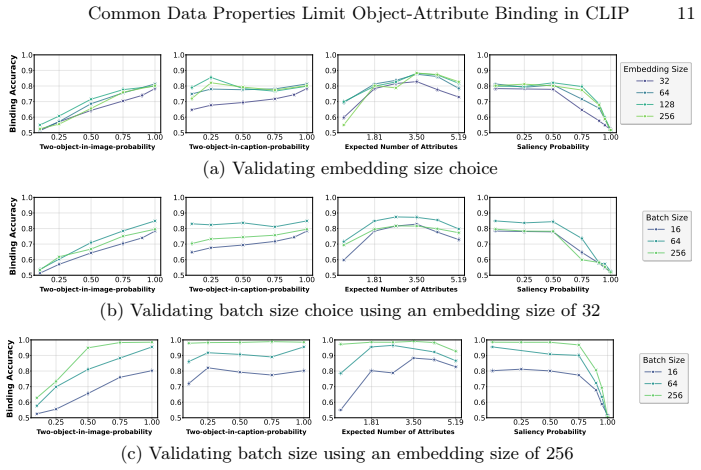
The central object is MADMAN (Multi-Attribute and Digit for Multi-Attribute biNding), a synthetic dataset built from transformed MNIST digits placed in a 3x3 grid, two per image, with template captions that chain attributes before each digit class. It makes four data properties independently controllable: the probability that an image contains two objects, the probability that a two-object image has both objects captioned, the distribution of the number of attributes per object in the caption, and the presence of a saliency bias (a center-placed object that is always captioned and mentioned first). The load-bearing evaluation is a forced-choice binding-accuracy score: for each attribute that is recognized in both objects, the authors swap that attribute between the two objects' captions and check that the model assigns higher similarity to the ground-truth caption. Realistic parameter values come from manual annotation of 100 CC12M image-caption pairs, which yields the estimates of about 95% multi-object images, 60% two-object captions, expected attributes per object of 0.57, and saliency in about 90% of images.
What would settle it
Take a large web-scale corpus, automatically re-caption it so that every visible object is mentioned, the expected number of attributes per object is around 3.5, and no single object is systematically favored, then retrain a CLIP-scale model and measure binding accuracy on SugarCrepe-style swapped-caption tests. If binding accuracy does not rise well above the current near-chance level, the paper's transfer from MADMAN to real data fails.
Extended reading notes
Core claim
The central claim, stated in Section 4.1, is that "CLIP models are able to learn object-attribute binding but properties of the data inhibit this." Trained on a realistic MADMAN configuration—two objects in about 95% of images, both objects captioned in about 60% of two-object cases, an expected 0.57 attributes per object in captions, and saliency bias in roughly 90% of images—the model's binding accuracy sits at or near chance for all six attributes, and raising batch size to 256 or embedding size to 256 changes little. Varying the properties individually shows a steady rise in binding as multi-object images and multi-object captions become more frequent; an inverted-U curve in attributes per object, with a peak near 3.5; and a steep drop as saliency bias exceeds 0.75. Combining all optimal settings yields above 90% binding for most attributes and near 100% with a larger batch and model. Hard-negative training (NegCLIP) improves binding on realistic data but remains far below simply switching to ideal data. Out-of-distribution tests on unseen object-attribute combinations show the same trends, indicating the model learned a compositional representation rather than memorized combinations.
Load-bearing premise
The load-bearing premise is that a small CLIP trained on synthetic images behaves like a large CLIP trained on real web data, and that four data-property estimates taken from 100 manually annotated web images represent natural data; if either fails, the claim that data properties are the main cause of CLIP's binding problem may not hold for real models.
Editorial extensions
If this is right
- If the central claim is right, then improving CLIP's binding on real data is mainly a data-curation problem: re-captioning or filtering web-scraped corpora to describe all objects, include a moderate number of attributes per object, and reduce saliency bias should transfer the gains seen on MADMAN.
- Batch-size scaling and hard-negative mining are not the cure: the paper shows these produce at best small gains on realistic data, so future fixes should focus on data rather than only on loss design.
- Saliency bias is a candidate primary cause on natural data: at realistic levels above 0.75, adding saliency to otherwise ideal data drops binding accuracy from about 90–95% to roughly 51–62%, and it diminishes the influence of the other three properties.
- Because the same trends appear on held-out object-attribute combinations, the learned representations are compositional rather than memorized class labels, so the data-property effects are expected to generalize beyond the synthetic vocabulary.
- The inverted-U in attribute density predicts an optimal caption length on real data; captions that are too sparse (like most web captions) or too dense (a bag-of-words can already disambiguate) both hurt binding.
Reading between the lines
- The authors do not test this on real data, but their account implies that re-captioning a large web corpus to mention every object, keep attribute density near 3.5 per object, and break saliency bias should produce a measurable jump in CLIP's binding accuracy on compositional benchmarks.
- A corollary they leave implicit is that original human captions are not neutral descriptions: because humans preferentially caption salient objects, even perfectly matched image-caption pairs carry a bias that teaches the model to ignore binding.
- Another extension: the inverse-U predicts an optimal caption length, so caption-enrichment methods should be tuned to a target density rather than made as complete as possible.
- If data properties dominate, comparisons between CLIP-like models trained on different corpora are confounded by differences in these four properties, and controlling them would isolate architectural contributions.
Signed reviews
Editorial analysis
A structured set of objections, weighed in public.
Referee Report
Summary. The paper introduces MADMAN, a synthetic dataset built from transformed MNIST digits in a grid, to study how four data properties affect object-attribute binding in contrastive vision-language models. The properties are p(two-obj-img), p(two-obj-cap), expected number of attributes per object in a caption, and a saliency bias. The authors train small CLIP-like transformers on controlled variants and measure zero-shot binding accuracy with recognition filtering. They report that settings calibrated to 100 CC12M image-caption pairs produce near-chance binding, while a manually chosen 'ideal' setting produces almost perfect binding; they also report that batch size, embedding size, and hard negatives (NegCLIP) do not close the gap, and that the trends persist on out-of-distribution object-attribute combinations. They conclude that CLIP's binding failures are largely caused by common properties of the training data, with saliency bias singled out as a key factor.
Significance. The study is well-executed within its synthetic regime: three seeds with confidence intervals, hyperparameter sweeps across batch and embedding sizes, OOD checks, and unfiltered ablations are included, and code is provided. A data-centric testbed for binding is useful to the community and could redirect attention from loss and architecture fixes toward data curation. If the transfer assumption holds, the work would motivate filtering and re-captioning as concrete remedies. The main unvalidated link is the extrapolation from TinyCLIP on MADMAN to CLIP on natural data, and the saliency operationalization conflates several cues. These issues affect the headline causal attribution but not the internal consistency of the controlled trends.
major comments (3)
- [Section 3.1, Fig. 4b, Table 6] The saliency manipulation is confounded. In MADMAN, a salient object is always placed in the center cell, is always mentioned in the caption, and is always mentioned first. The footnote in Section 4.2 concedes that the text encoder can infer the salient object from first-mention order. Thus increasing p(saliency) simultaneously increases center-position predictability, caption-inclusion rate, and word-order determinism, and the decline in binding accuracy in Fig. 4b and the large drop in the 'Ideal except Saliency bias' row of Table 6 cannot be uniquely attributed to saliency as a real-world captioning tendency. Natural image-caption data does not contain these deterministic positional and order cues. Please add ablations that disentangle the three factors, for example, randomize grid placement while keeping first mention and guaranteed inclusion, or randomize order and omission while keeping center placement, and report the binding curves for each sub-manipulation separately.
- [Section 4.1 and Introduction] The headline conclusion that 'CLIP models are able to learn object-attribute binding but properties of the data inhibit this' is stated for CLIP, while the experiments train a small transformer (TinyCLIP, Appendix Table 4) on a synthetic dataset. The bridge is the assertion in the Introduction that 'the learning algorithm does not change its behavior fundamentally in larger scale training on more complex data,' plus the realistic parameter estimates from 100 manually annotated CC12M images (Appendix 5.2). A 100-image sample gives wide confidence intervals, and the annotation procedure for saliency in CC12M differs from the synthetic definition: in CC12M an image is labeled as having salient objects if there are any non-salient objects, whereas in MADMAN saliency means center placement plus guaranteed first mention. The paper should provide direct evidence for transfer, such as a real-data re-captioning or filtering experiment, or at least a larger-scale synthetic scaling study, otherwise the title and abstract generalize beyond the evidence.
- [Section 4.2 and Table 1] The 'ideal data' setting is selected by reading off the best-performing value of each property from the same binding-accuracy curves that are then used to report the ideal result in Table 1. This makes the high binding in Table 1 a post-hoc optimum rather than an independent validation of the prescription. If the paper claims that 'only when the data expresses our identified data properties does CLIP learn almost perfect binding,' an independent check is needed, for example, choosing the best parameters on a development split and reporting performance on a held-out split, or performing a small random search over the four-dimensional property grid and reporting the out-of-sample best. Without such a check, the 'only when' phrasing overstates what the one-at-a-time sweeps establish.
minor comments (5)
- [Throughout main text] The term 'CLIP' is used for a small transformer trained from scratch on MADMAN; this is only clarified as TinyCLIP in Appendix Table 4. State this at first use in the main text to avoid ambiguity.
- [Appendix 5.3, Table 5] The note that the search was performed 'by chance partially in the optimal setup' is confusing; it appears that the base setup already equals the best setting for three of the four properties, so Table 5 does not isolate the individual contribution of each property. Please rewrite the note to explain what was and was not varied.
- [Appendix Figure 7] The figure shows two distributions labeled E[na] = 3.50 with different shapes; one of the labels is likely a typo and should be corrected.
- [Appendix 5.2] The realistic saliency annotation defines an image as having salient objects if there are any non-salient objects, which is not the same as the MADMAN parameter p(saliency). The mapping between the binary annotation and the synthetic probability should be explained explicitly.
- [Section 3.2] The recognition-filtering threshold of 1.1 times chance level is arbitrary and is not sensitivity-analyzed; please report how many samples are retained per attribute and condition, and whether the main trends change with a stricter or looser threshold.
Circularity Check
Ideal-data claim is a selected optimum rather than an independent prediction; the core controlled sweeps remain non-circular.
-
fitted input called prediction
[Section 4.2 ('The ideal data setting'); Table 1 caption; Abstract]
"Finally, we use the previous experiments to select the best data setup for each of the properties. We end up with: no saliency bias, p(multi-obj-img) = 1, p(multi-obj-cap) = 1 and expected number of Attributes-per-object-in-caption = 3.5. As shown in Tab. 1, combining the optimal setups for all our data properties indeed leads to high binding... Only when the data expresses our identified data properties does CLIP learn almost perfect binding... Ideal Data refers to the best performing dataset properties as found in Section 4.2."
The 'Ideal Data' setting is constructed by reading off the maxima of the same binding-accuracy curves that are then used to support the conclusion. Since the ideal values are definitionally the best-performing values from Section 4.2, the near-perfect binding reported for them is a selected optimum, not an independent prediction. The abstract 'Only when the data expresses our identified data properties does CLIP learn almost perfect binding' therefore reduces, for the ideal row, to 'when the data is set to the values that maximize binding, binding is maximized.' The non-tautological evidence is carried by the full parameter sweeps in Figs. 3-4 and the single-factor ablations in Table 6, not by the Ideal Data row itself.
full rationale
The central empirical content of the paper comes from controlled interventions: each of the four data properties is varied independently while others are held fixed, and binding accuracy is measured on held-out MADMAN evaluation sets. Those sweeps are not circular, because the data property values are inputs and the binding accuracy is an output measured under a fixed evaluation protocol. The one genuinely circular element is the 'Ideal Data' claim: the ideal settings are selected post hoc from the binding-accuracy curves, then presented as showing that ideal data yields almost perfect binding. This is a selection effect rather than an out-of-sample confirmation. The saliency-bias confound raised by the skeptic (salient objects are always centered, always captioned, and always mentioned first) is a serious validity concern for transferring the result to natural data, but it is not a circularity under the paper's own definitions: the paper measures the effect of its operationalized saliency bias rather than deriving the effect from the definition. Self-citation to the MAD dataset [25] is a data-building block and is not load-bearing for the central claim. The transfer assumption from synthetic to real data is explicitly acknowledged as an assumption, not disguised as a derivation. Overall, the main controlled trends are self-contained; only the 'ideal data' summary inflates a selected optimum into what reads like a predicted requirement.
Assumptions & free parameters
free parameters (5)
- p(two-obj-img) realistic =
0.95
- p(two-obj-cap) realistic =
0.6
- E[na] realistic =
0.57
- saliency probability realistic =
0.9
- ideal data setup =
p(two-obj-img)=1, p(two-obj-cap)=1, E[na]=3.5, saliency=0
assumptions (3)
- domain assumption We do not expect that the learning algorithm changes its behavior fundamentally in larger scale training on more complex data.
- domain assumption The data properties measured on 100 manually annotated CC12M images are representative of natural image-caption data.
- domain assumption Saliency is adequately modeled as a centered object that is always mentioned first in the caption.
Cite this review
Pith. "Pith review of Common Data Properties Limit Object-Attribute Binding in CLIP." pith.science (2026). https://pith.science/paper/UUVPTLZW
@misc{pith2026250707985,
  author       = {Pith},
  title        = {Pith review of: Common Data Properties Limit Object-Attribute Binding in CLIP},
  year         = {2026},
  howpublished = {\url{https://pith.science/paper/UUVPTLZW}},
  note         = {Machine review of arXiv:2507.07985}
}
read the original abstract
Contrastive vision-language models like CLIP are used for a large variety of applications, such as zero-shot classification or as vision encoder for multi-modal models. Despite their popularity, their representations show major limitations. For instance, CLIP models learn bag-of-words representations and, as a consequence, fail to distinguish whether an image is of ``a yellow submarine and a blue bus'' or ``a blue submarine and a yellow bus''. Previous attempts to fix this issue added hard negatives during training or modified the architecture, but failed to resolve the problem in its entirety. We suspect that the missing insights to solve the binding problem for CLIP are hidden in arguably the most important part of learning algorithms: the data. In this work, we fill this gap by rigorously identifying the influence of data properties on CLIP's ability to learn binding using a synthetic dataset. We find that common properties of natural data such as low attribute density, incomplete captions, and the saliency bias, a tendency of human captioners to describe the object that is ``most salient'' to them, have a detrimental effect on binding performance. In contrast to common belief, we find that neither scaling the batch size, i.e., implicitly adding more hard negatives, nor explicitly creating hard negatives enables CLIP to learn reliable binding. Only when the data expresses our identified data properties does CLIP learn almost perfect binding.
Figures


Figures from the paper (10 more)



Forward citations
Cited by 1 Pith paper
-
Disentangling Latent Embeddings with Sparse Linear Concept Subspaces (SLiCS)
SLiCS learns group-structured non-negative dictionaries that disentangle dense image embeddings into concept components, improving concept-filtered retrieval and enabling image-to-prompt generation.
Reference graph
Works this paper leans on
-
[1]
arXiv preprint arXiv:2502.14113 (2025)
Assouel, R., Astolfi, P., Bordes, F., Drozdzal, M., Romero-Soriano, A.: Object-centric binding in contrastive language-image pretraining. arXiv preprint arXiv:2502.14113 (2025)
arXiv 2025
-
[2]
arXiv preprint arXiv:2407.07726 (2024)
Beyer, L., Steiner, A., Pinto, A.S., Kolesnikov, A., Wang, X., Salz, D., Neumann, M., Alabdulmohsin, I., Tschannen, M., Bugliarello, E., et al.: Paligemma: A versatile 3b vlm for transfer. arXiv preprint arXiv:2407.07726 (2024)
arXiv 2024
-
[3]
Advances in Neural Information Processing Systems 36, 45020–45054 (2023)
Bordes, F., Shekhar, S., Ibrahim, M., Bouchacourt, D., Vincent, P., Morcos, A.: Pug: Photorealistic and semantically controllable synthetic data for rep- resentation learning. Advances in Neural Information Processing Systems 36, 45020–45054 (2023)
work page 2023
-
[4]
IEEE Transactions on Image Processing22(1), 55–69 (2012)
Borji, A., Sihite, D.N., Itti, L.: Quantitative analysis of human-model agree- ment in visual saliency modeling: A comparative study. IEEE Transactions on Image Processing22(1), 55–69 (2012)
work page 2012
-
[5]
Vision research91, 62–77 (2013)
Borji, A., Sihite, D.N., Itti, L.: What stands out in a scene? a study of human explicit saliency judgment. Vision research91, 62–77 (2013)
work page 2013
-
[6]
Jour- nal of Machine Learning Research20(178), 1–29 (2019)
Castro, D.C., Tan, J., Kainz, B., Konukoglu, E., Glocker, B.: Morpho-mnist: Quantitative assessment and diagnostics for representation learning. Jour- nal of Machine Learning Research20(178), 1–29 (2019)
work page 2019
-
[7]
Changpinyo,S.,Sharma,P.,Ding,N.,Soricut,R.:Conceptual12M:Pushing web-scale image-text pre-training to recognize long-tail visual concepts. In: CVPR (2021)
work page 2021
-
[8]
Chen, X., Wang, X., Changpinyo, S., Piergiovanni, A., Padlewski, P., Salz, D., Goodman, S., Grycner, A., Mustafa, B., Beyer, L., Kolesnikov, A., Puigcerver, J., Ding, N., Rong, K., Akbari, H., Mishra, G., Xue, L., Thap- liyal, A.V., Bradbury, J., Kuo, W., Seyedhosseini, M., Jia, C., Ayan, B.K., Ruiz, C.R., Steiner, A.P., Angelova, A., Zhai, X., Houlsby, N...
work page 2023
Show all 36 references
-
[9]
In: Proceedings of the IEEE/CVF Conference on Computer Vision and Pattern Recognition
Cherti, M., Beaumont, R., Wightman, R., Wortsman, M., Ilharco, G., Gor- don, C., Schuhmann, C., Schmidt, L., Jitsev, J.: Reproducible scaling laws for contrastive language-image learning. In: Proceedings of the IEEE/CVF Conference on Computer Vision and Pattern Recognition. pp...
2023
-
[10]
Advances in Neural Information Processing Systems36, 76137–76150 (2023)
Doveh, S., Arbelle, A., Harary, S., Herzig, R., Kim, D., Cascante-Bonilla, P., Alfassy, A., Panda, R., Giryes, R., Feris, R., et al.: Dense and aligned captions (dac) promote compositional reasoning in vl models. Advances in Neural Information Processing Systems36, 76137–76150 (2023)
2023
-
[11]
In: Proceedings of the Common Data Properties Limit Object-Attribute Binding in CLIP 15 IEEE/CVF Conference on Computer Vision and Pattern Recognition
Doveh, S., Arbelle, A., Harary, S., Schwartz, E., Herzig, R., Giryes, R., Feris, R., Panda, R., Ullman, S., Karlinsky, L.: Teaching structured vision & language concepts to vision & language models. In: Proceedings of the Common Data Properties Limit Object-Attribute Binding i...
2023
-
[12]
Advances in Neural Information Processing Systems 37, 17972–18018 (2024)
Dumpala, S.H., Jaiswal, A., Shama Sastry, C., Milios, E., Oore, S., Sajjad, H.: Sugarcrepe++ dataset: Vision-language model sensitivity to semantic and lexical alterations. Advances in Neural Information Processing Systems 37, 17972–18018 (2024)
2024
-
[13]
Advances in neural information processing systems36, 31096–31116 (2023)
Hsieh, C.Y., Zhang, J., Ma, Z., Kembhavi, A., Krishna, R.: Sugarcrepe: Fixing hackable benchmarks for vision-language compositionality. Advances in neural information processing systems36, 31096–31116 (2023)
2023
-
[14]
In: 2017 IEEE Conference on Computer Vision and Pattern Recognition (CVPR)
Johnson, J., Hariharan, B., Van Der Maaten, L., Fei-Fei, L., Zitnick, C.L., Girshick, R.: CLEVR: A Diagnostic Dataset for Compositional Language and Elementary Visual Reasoning. In: 2017 IEEE Conference on Computer Vision and Pattern Recognition (CVPR). pp. 1988–1997. IEEE, Ho...
2017
-
[15]
arXiv preprint arXiv:2502.03566 (2025)
Koishigarina,D.,Uselis,A.,Oh,S.J.:Clipbehaveslikeabag-of-wordsmodel cross-modally but not uni-modally. arXiv preprint arXiv:2502.03566 (2025)
2025
-
[16]
ATT Labs [Online]
LeCun, Y., Cortes, C., Burges, C.: Mnist handwritten digit database. ATT Labs [Online]. Available: http://yann.lecun.com/exdb/mnist2 (2010)
2010
-
[17]
In: Graham, Y., Purver, M
Lewis, M., Nayak, N., Yu, P., Merullo, J., Yu, Q., Bach, S., Pavlick, E.: Does CLIP bind concepts? probing compositionality in large image models. In: Graham, Y., Purver, M. (eds.) Findings of the Association for Compu- tational Linguistics: EACL 2024. pp. 1487–1500. Associati...
2024
-
[18]
In: International Conference on Learning Represen- tations (2022), https://openreview.net/forum?id=zq1iJkNk3uN
Li, Y., Liang, F., Zhao, L., Cui, Y., Ouyang, W., Shao, J., Yu, F., Yan, J.: Supervision exists everywhere: A data efficient contrastive language-image pre-training paradigm. In: International Conference on Learning Represen- tations (2022), https://openreview.net/forum?id=zq1iJkNk3uN
2022
-
[19]
Ma, Z., Hong, J., Gul, M.O., Gandhi, M., Gao, I., Krishna, R.: Crepe: Can vision-language foundation models reason compositionally? In: Proceedings oftheIEEE/CVFConferenceonComputerVisionandPatternRecognition. pp. 10910–10921 (2023)
2023
-
[20]
arXiv preprint arXiv:2112.10741 (2021)
Nichol, A., Dhariwal, P., Ramesh, A., Shyam, P., Mishkin, P., McGrew, B., Sutskever, I., Chen, M.: Glide: Towards photorealistic image generation and editing with text-guided diffusion models. arXiv preprint arXiv:2112.10741 (2021)
2021 arXiv
-
[21]
Advances in neural information processing sys- tems 37, 32731–32760 (2024)
Patel, M., Kusumba, N.S.A., Cheng, S., Kim, C., Gokhale, T., Baral, C., et al.: Tripletclip: Improving compositional reasoning of clip via synthetic vision-language negatives. Advances in neural information processing sys- tems 37, 32731–32760 (2024)
2024
-
[22]
In: International conference on machine learning
Radford, A., Kim, J.W., Hallacy, C., Ramesh, A., Goh, G., Agarwal, S., Sas- try, G., Askell, A., Mishkin, P., Clark, J., et al.: Learning transferable visual models from natural language supervision. In: International conference on machine learning. pp. 8748–8763. PmLR (2021) ...
2021
-
[23]
arXiv preprint arXiv:2204.06125 1(2), 3 (2022)
Ramesh, A., Dhariwal, P., Nichol, A., Chu, C., Chen, M.: Hierarchi- cal text-conditional image generation with clip latents. arXiv preprint arXiv:2204.06125 1(2), 3 (2022)
2022 arXiv
-
[24]
In: Proceedings of the IEEE/CVF conference on computer vision and pattern recognition
Rombach, R., Blattmann, A., Lorenz, D., Esser, P., Ommer, B.: High- resolution image synthesis with latent diffusion models. In: Proceedings of the IEEE/CVF conference on computer vision and pattern recognition. pp. 10684–10695 (2022)
2022
-
[25]
In: International Conference on Learning Representations (ICLR) (2025)
Schrodi, S., Hoffmann, D.T., Argus, M., Fischer, V., Brox, T.: Two effects, one trigger: On the modality gap, object bias, and information imbalance in contrastive vision-language model. In: International Conference on Learning Representations (ICLR) (2025)
2025
-
[26]
In: Proceedings of the 2023 Conference on Empirical Methods in Natural Language Processing
Tang, Y., Yamada, Y., Zhang, Y., Yildirim, I.: When are lemons purple? the concept association bias of vision-language models. In: Proceedings of the 2023 Conference on Empirical Methods in Natural Language Processing. pp. 14333–14348 (2023)
2023
-
[27]
In: Proceedings of the IEEE/CVF International Conference on Computer Vision
Trager, M., Perera, P., Zancato, L., Achille, A., Bhatia, P., Soatto, S.: Lin- ear spaces of meanings: compositional structures in vision-language models. In: Proceedings of the IEEE/CVF International Conference on Computer Vision. pp. 15395–15404 (2023)
2023
-
[28]
In: The Twelfth International Conference on Learning Representations (2024), https://openreview.net/forum?id=5BCFlnfE1g
Xu, H., Xie, S., Tan, X., Huang, P.Y., Howes, R., Sharma, V., Li, S.W., Ghosh, G., Zettlemoyer, L., Feichtenhofer, C.: Demystifying CLIP data. In: The Twelfth International Conference on Learning Representations (2024), https://openreview.net/forum?id=5BCFlnfE1g
2024
-
[29]
Yuksekgonul, M., Bianchi, F., Kalluri, P., Jurafsky, D., Zou, J.: When and why vision-language models behave like bags-of-words, and what to do about it? In: International Conference on Learning Representations (2023), https://openreview.net/forum?id=KRLUvxh8uaX
2023
-
[30]
In: Proceedings of the IEEE/CVF international confer- ence on computer vision
Zhai, X., Mustafa, B., Kolesnikov, A., Beyer, L.: Sigmoid loss for language image pre-training. In: Proceedings of the IEEE/CVF international confer- ence on computer vision. pp. 11975–11986 (2023)
2023
-
[31]
In: Proceedings of the IEEE/CVF Conference on Computer Vision and Pattern Recognition
Zhong, Y., Yang, J., Zhang, P., Li, C., Codella, N., Li, L.H., Zhou, L., Dai, X., Yuan, L., Li, Y., et al.: Regionclip: Region-based language-image pretraining. In: Proceedings of the IEEE/CVF Conference on Computer Vision and Pattern Recognition. pp. 16793–16803 (2022) Common...
2022
-
[32]
Select oi=(1or2)objectstoaddtotheimage.Wevarythisusingaparameter p(two-obj-img) that determines whether the second object is included or not
-
[33]
they are not inserted in the same cells
Randomly select the n cell locations within the 3x3 grid and place the objects making sure they do not overlap, i.e. they are not inserted in the same cells. Creating the captions. When creating the corresponding captions for the image, we want to be able to vary how much of t...
-
[34]
We vary this by a parame- ter p(two-obj-cap|two-obj-img = True) that determines whether the second object is included or not
Select ot=(1 or 2) objects to add to the caption. We vary this by a parame- ter p(two-obj-cap|two-obj-img = True) that determines whether the second object is included or not. Note: if there is only one object in the image, we can take only that one object in the caption
-
[35]
– We vary the number of attributes (na) used to describe an object by sampling it from a categorical distribution (see Fig
Create a caption for each object using the attributes and the object class as words. – We vary the number of attributes (na) used to describe an object by sampling it from a categorical distribution (see Fig. 7). – When stringing together the words, we separate them with a spa...
-
[36]
Dataset Properties of interest.With the above data generation process, we can vary the data properties of interest
Combine the captions for theot objects separated by the wordand. Dataset Properties of interest.With the above data generation process, we can vary the data properties of interest. Notably, we can also vary image and captions independently to create an imbalance in the informa...
Reviewed August 6, 2026 · model on record in the stance chip above.
Discussion (0). Continue with ORCID to comment.