REVIEW 3 major objections 4 minor 38 references
Hadron-Hadron Interactions from Lattice QCD: Theory meets Experiments
T0 review · 3 major / 4 minor · reviewed 2026-08-06 · deepseek-v4-flash
Pith's one-line read The paper reports that the spatial effective energy of the lattice $\phi$-$N$, $J/\psi$-$N$, and $\eta_c$-$N$ potentials reaches a plateau at exactly $2m_\pi = 292.8$ MeV for $r > 1.0$ fm, identifying two-pion exchange as the dominant…
desk verdict A reliable review of HAL QCD results, but the new E_eff diagnostic in Sec. 7.4 is not yet strong enough to claim TPE dominance. read the letter →
The pith
A machine-rendered reading of the paper's core claim, the machinery that carries it, and where it could break.
The reading
What carries the argument
The load-bearing object is the spatial effective energy $E_{\rm eff}(r)=-\ln[-V_{\rm lat}(r)r^\nu/\alpha]/r$ defined in Eq. (21): it converts a lattice potential $V_{\rm lat}(r)$ into an effective exponent, so that a plateau at $2m_\pi$ signals a tail $\sim e^{-2m_\pi r}/r^\nu$. The paper combines this diagnostic with the HAL QCD method, which obtains the potential from the Nambu–Bethe–Salpeter wave function of the two-hadron correlation function without requiring ground-state saturation. The $\nu=2$ choice is motivated by the asymptotic form of the N$^3$LO TPE potential from Ref. [38], and the comparison is anchored to the K-configuration pion mass $m_\pi=146.4$ MeV, giving the target value $2m_\pi=292.8$ MeV.
What would settle it
Compute the full TPE potential (Eq. (19)) plus the N$^4$LO football contribution over $0.9<r<1.8$ fm, feed it through the same $E_{\rm eff}$ definition with $\nu=2$, and check whether the plateau still appears at $2m_\pi$; alternatively, extend the lattice calculation to $r>1.8$ fm where the asymptotic form is better justified and see whether the plateau survives.
Extended reading notes
Core claim
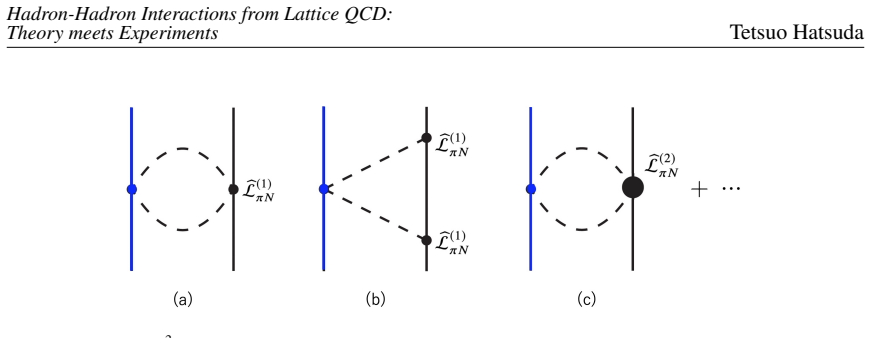
The central discovery the paper is trying to establish is that two-pion exchange is the operative long-range force between a nucleon and a flavor-singlet hadron. In the chiral EFT framework of the paper, the leading TPE between a quarkonium and a nucleon comes from the N$^3$LO triangle diagram (the football diagram vanishes by isospin), giving a potential whose asymptotic form is $-\frac{3g_A^2(c_{d0}+c_m)m_\pi^4}{128\pi^2 f_\pi^2}\frac{e^{-2m_\pi r}}{r^2}$. Feeding the lattice potentials of Refs. [20] and [25] into the diagnostic $E_{\rm eff}(r)=-\ln[-V_{\rm lat}(r)r^\nu/\alpha]/r$ with $\nu=2$, the paper finds that $E_{\rm eff}$ plateaus at $2m_\pi=292.8$ MeV for $r>1.0$ fm in $\phi$-$N$ at Euclidean times $t/a=12,13,14$, in both spin channels of $J/\psi$-$N$, and in $\eta_c$-$N$. The paper presents this plateau as evidence that the long-range part of these interactions is dominated by TPE, while noting that the N$^4$LO football diagram and reduced statistical errors are needed to make the conclusion firm.
Load-bearing premise
The claim rests on assuming that the lattice potential tail is well described by the single exponential form $-\alpha e^{-2m_\pi r}/r^2$ across the fitted window $0.9<r<1.8$ fm; the paper itself notes that the asymptotic TPE formula underestimates the full TPE near $(2m_\pi)^{-1}$ and that the N$^4$LO football diagram is not yet included, so the observed $2m_\pi$ plateau could be an artifact of that assumed form.
Editorial extensions
If this is right
- A shared TPE tail means the long-range parts of $\phi$-$N$, $J/\psi$-$N$, and $\eta_c$-$N$ are all governed by the same pion-pair exchange, so the quarkonium–two-pion couplings extracted from one channel should reproduce the others.
- The $J/\psi$ mass shift in nuclear matter, $\delta m_{J/\psi}\simeq 19(3)$ MeV at normal density, acquires a controlled long-range pion component, making charmonium-nucleus bound states a more concrete target for experiment.
- For the $\phi$-$p$ system, the lattice-constrained spin-1/2 potential with binding energy 12.8–56.1 MeV would have a TPE-anchored tail, allowing femtoscopic correlation data to test the predicted bound state directly.
- The same $E_{\rm eff}$ diagnostic can be applied to the $J/\psi$-$J/\psi$ and $\eta_c$-$\eta_c$ potentials, where TPE is derived from the quarkonium color-polarizability, extending the paradigm to hidden-charm multiquark systems.
Reading between the lines
- A clean test the paper does not perform: extract the couplings $c_{d0}+c_m$ independently from the three channels and check that they agree after converting to the same quarkonium polarizability parameters; consistency would confirm the TPE identification, disagreement would expose the $\nu=2$ assumption.
- Applying the same diagnostic with $\nu=5/2$ (the alternative asymptotic exponent mentioned in Sec. 7.3) would separate a genuine quarkonium-TPE tail from a nucleon-TPE tail; a plateau at $2m_\pi$ under the wrong $\nu$ would mean the fit form, not the physics, is producing the signal.
- Because $T_{cc}^+$ and $D^*$-$D$ already use a two-pion-exchange-inspired fit form, the plateau diagnostic could be carried over to meson-meson channels to look for the same $2m_\pi$ signal in the $D^*$-$D$ potential, connecting the tetraquark interpretation to the TPE paradigm.
Editorial analysis
A structured set of objections, weighed in public.
Referee Report
Summary. This paper is the proceedings contribution of T. Hatsuda (QCHSC24) reviewing HAL QCD lattice calculations of hadron-hadron interactions near the physical pion mass and their comparison with experiments. Sections 2–6 summarize the HAL QCD method, the ΛΛ–ΞN coupled-channel potential and its use in ALICE femtoscopy, the D*-D potential and its relation to the Tcc+ peak seen by LHCb, the phi-N potential and the ALICE phi-proton correlation, and the J/psi-N and eta_c-N potentials. Section 7 discusses the two-pion-exchange (TPE) paradigm: the NN TPE, TPE between flavor-singlet hadrons, TPE between a flavor-singlet hadron and a nucleon, and a new analysis in Sec. 7.4 that defines a spatial effective energy E_eff(r) = -ln[-V_lat(r) r^nu/alpha]/r with nu=2 and alpha fitted to the lattice potentials over 0.9 fm < r < 1.8 fm. The paper reports that for phi-N, J/psi-N and eta_c-N, E_eff(r) plateaus at 2m_pi = 292.8 MeV for r > 1.0 fm, suggesting that the long-range parts of these interactions are dominated by the TPE.
Significance. The review part is a competent summary of published, cross-validated results; the comparisons with ALICE femtoscopic data and LHCb mass spectra are valuable and are stated in a balanced way, with the relevant systematic caveats for the HAL method noted in Sec. 2. The central new claim of Sec. 7.4, if established, would be interesting: it would point to a universal two-pion-exchange tail for flavor-singlet hadron-nucleon systems. However, the analysis as presented is not yet sufficient to establish that claim. The diagnostic in Eq. (21) is not an independent measurement of the TPE tail: it assumes the functional form it is testing and uses an alpha fitted to the same data over the same radial window. The paper itself includes the limitations (the asymptotic form underestimates the full TPE result near the fitted window, and the N4LO football diagram is omitted), and the last paragraph of Sec. 7.4 concedes that firmer conclusions require better statistics and further theoretical input. Given those caveats, the paper is best viewed as a promising research announcement embedded in a review, not as a demonstrated result.
major comments (3)
- [Sec. 7.4, Eq. (21)] The central claim of Sec. 7.4 is not supported by the E_eff diagnostic as defined. E_eff(r) = -ln[-V_lat(r) r^nu/alpha]/r equals 2m_pi for any potential of the form -A e^{-2m_pi r}/r^mu provided one sets nu=mu and alpha=A; with nu fixed to 2 and alpha fitted to V_lat in exactly the window 0.9 fm < r < 1.8 fm where the plateau is reported, the diagnostic mostly checks whether the tail can be parametrized as alpha e^{-2m_pi r}/r^2 in that window. Writing a general potential as -A e^{-2m_pi r} r^{-nu_eff(r)}, one finds E_eff(r) = 2m_pi + [ln(A/alpha) - (nu_eff(r)-2) ln r]/r; the fitted alpha absorbs a constant offset, and a slowly varying nu_eff leaves only a small residual. The observed plateau therefore cannot discriminate the TPE formula Eq. (19) from a generic exponential tail with the same mass scale. To support the claim, the analysis should fit the full expression Eq. (19) (with its r^{-6} prefactor and polynomials) to V_lat and compare its quality with alternative forms, rather than assuming nu=2.
- [Sec. 7.4 vs Eqs. (19)-(20)] The motivation for nu=2 is the asymptotic form Eq. (20), but the paper explicitly states that Eq. (20) significantly underestimates the full TPE result Eq. (19) at distances r ~ (2m_pi)^{-1}. The fit window 0.9 fm < r < 1.8 fm corresponds to x = m_pi r roughly between 0.67 and 1.34, which is far from the asymptotic regime x >> 1. The full TPEP in Eq. (19) contains an r^{-6} prefactor and polynomials g_d(x), g_m(x); it is not a pure r^{-2} Yukawa in this window. Thus using Eq. (20) to fix nu=2 does not test Eq. (19). The additional N4LO football diagram of Fig. 8(c) is also omitted from the comparison, and the manuscript notes that it may be enhanced; until that contribution is estimated or bounded, the connection between the lattice tail and the TPE formula is incomplete.
- [Sec. 7.4, Fig. 9] The statistical support for the plateau is not quantified. Fig. 9 displays E_eff(r) without visible error bars (or with error bars smaller than the symbols, which is not stated), no chi-square or confidence interval is given for the plateau, and alpha is fitted at t/a=14 while E_eff is shown for t/a=12, 13, 14 without a systematic check of the t-dependence. The J/psi-N and eta_c-N curves are based on 'unpublished results based on [25]' with no statement of the lattice parameters or of how their statistical and systematic errors compare with those of the phi-N data. In the absence of these quantitative details, the sentence that E_eff 'reaches a plateau at 2m_pi within the statistical uncertainty' is not verifiable. The concluding caveat of Sec. 7.4 (better statistics and better treatment of the football diagram are needed) should be reflected in the strength of the claim made in the abstract and summary.
minor comments (4)
- [Sec. 1 and Sec. 7.2] There are a few typographical duplicates: 'lattice lattice' in Sec. 1 and 'the the 1st-order πN Lagrangian' in Sec. 7.2; these should be corrected in the final version.
- [Sec. 7.4] The statement that nu=2 'could be replaced by nu=5/2, as discussed at the end of Sec.7.3' is a cross-reference error: Sec. 7.3 ends with the N4LO football diagram, while the r^{-5/2} asymptotic form appears in Eq. (17) of Sec. 7.2 for quarkonium-quarkonium interactions.
- [Fig. 9] The right-panel caption labels the system as 'η-N', while the text and abstract discuss η_c-N; the label should be changed to η_c-N for consistency.
- [Eq. (21)] The definition of E_eff should specify the units of alpha and the precise fitting procedure (least-squares definition, weights, and whether the fit is performed on V_lat or on -V_lat r^2), since the value of the plateau and the quoted conclusion depend on this choice.
Circularity Check
The E_eff plateau in Sec. 7.4 is an in-sample consistency check: the assumed TPE asymptotic form is fitted to the same V_lat data, so the plateau at 2m_pi verifies the ansatz rather than independently measuring TPE dominance.
-
fitted input called prediction
[Section 7.4, Eq. (21) and Fig. 9]
"Eeff(r) = -ln[-Vlat(r) r^nu/alpha] / r ... In the present analysis, we adopt a simple choice of nu = 2, motivated by Eq. (20). ... The constant alpha is determined by fitting the lattice data in the range 0.9 fm < r < 1.8 fm with t/a = 14. ... In all cases, We observe that Eeff(r) reaches a plateau at 2m_pi = 292.8 MeV for r > 1.0 fm within the statistical uncertainty, suggesting that the long-range part of the interaction is dominated by the TPEP."
The diagnostic is defined so that Eeff(r) = 2m_pi is equivalent to Vlat(r) = -alpha e^{-2m_pi r}/r^nu. With nu=2 taken from the TPE asymptotic formula Eq. (20) and alpha fitted to the same V_lat data in the same window (0.9-1.8 fm) where the plateau is reported, the 'observation' of a plateau at 2m_pi is a self-consistency check of the assumed ansatz rather than an independent verification of TPE. The paper itself notes that Eq. (20) significantly underestimates the full TPE result Eq. (19) at r ~ (2m_pi)^-1, and the N4LO football diagram of Fig. 8(c) is omitted, so agreement with the asymptotic form cannot establish agreement with the full TPE prediction.
full rationale
The central claim of Section 7.4 is not fully circular: Eeff(r) does carry shape information, since alpha alone cannot force a flat plateau at exactly 292.8 MeV if the actual decay rate differed from 2m_pi. However, the paper's own diagnostic uses the TPE-motivated asymptotic form Eq. (20) in a regime where the paper admits that form significantly underestimates the full TPE expression Eq. (19), and the omitted N4LO football diagram could modify the result. The conclusion that the long-range interaction is dominated by TPEP is therefore supported principally by agreement with an ansatz whose functional form already encodes the TPE tail. Elsewhere the review compares HAL QCD predictions with independent ALICE and LHCb data (e.g., Xi-N femtoscopy and Tcc spectrum), which provides genuine external validation and prevents a high circularity score. The heavy reliance on the author's own collaboration's prior lattice results is normal for a review of that collaboration's work and is not circular because those results are empirically benchmarked. Score 4 reflects one partially circular in-sample diagnostic while the broader paper retains independent content.
Assumptions & free parameters
free parameters (4)
- alpha (E_eff normalization) =
not given
- nu (E_eff power-law exponent) =
2 (with 5/2 as alternative)
- fit range for alpha =
0.9-1.8 fm
- D*-D fit parameters a1, b1, a2, b2, a3, b3 =
not given
assumptions (5)
- domain assumption The HAL QCD potential from the time-dependent R-correlator is a valid representation of the infinite-volume interaction below the inelastic threshold.
- domain assumption The leading-order truncation of the derivative expansion Eq. (4) is accurate for the channels shown; residual errors are estimated by t-dependence.
- domain assumption Flavor-singlet hadrons do not couple to a single pion, so OPEP is forbidden and TPE is the longest-range interaction.
- domain assumption The N3LO TPE formulas of Ref. [38], Eqs. (18)-(19), apply to phi-N, J/psi-N, and eta_c-N systems.
- domain assumption The lattice potentials for phi-N, J/psi-N, and eta_c-N in Refs. [20,25] are reliable to the quoted statistical accuracy and represent the physical interactions.
Cite this review
Pith. "Pith review of Hadron-Hadron Interactions from Lattice QCD: Theory meets Experiments." pith.science (2026). https://pith.science/paper/KWTXLGE4
@misc{pith2026250708359,
  author       = {Pith},
  title        = {Pith review of: Hadron-Hadron Interactions from Lattice QCD: Theory meets Experiments},
  year         = {2026},
  howpublished = {\url{https://pith.science/paper/KWTXLGE4}},
  note         = {Machine review of arXiv:2507.08359}
}
abstract
We summarize recent developments in the study of hadron-hadron interactions using lattice QCD near the physical pion mass ($m_{\pi} \simeq 146$ MeV), based on the HAL QCD method and its connection to experimental data. In particular, we focus on several key interaction channels shown below. Also, we examine the two-pion exchange (TPE) mechanism, which governs the long-range behavior of interactions between flavor-singlet hadrons, as well as between nucleons and flavor-singlet hadrons.
Figures


Figures from the paper (6 more)



Reference graph
Works this paper leans on
-
[25]
Y. Lyu, T. Doi, T. Hatsuda and T. Sugiura, Phys. Lett. B860 (2025) 139178
work page 2025
- [1]
-
[2]
G. Baym, T. Hatsuda, T. Kojo, P. D. Powell, Y. Song and T. Takatsuka, Rept. Prog. Phys.81 (2018) 056902
work page 2018
-
[3]
R. S. Hayano and T. Hatsuda, Rev. Mod. Phys.82(2010) 2949
work page 2010
- [4]
-
[5]
S. Aoki, T. Hatsuda and N. Ishii, Prog. Theor. Phys.123 (2010) 89
work page 2010
- [6]
-
[7]
S.AokiandT.Doi,in HandbookofNuclearPhysics (eds.I.Tanihata,H.TokiandT.Kajino), pp.1787-1817 (2023) [arXiv:2402.11759 [hep-lat]]
arXiv 2023
Show all 38 references
-
[8]
Zimmermann, MPI-PAE/PTh-61/87 (1987), published in Wandering in the Fields: Festschrift for Professor Kazuhiko Nishijima on the Occasion of His Sixtieth Birthday(eds
W. Zimmermann, MPI-PAE/PTh-61/87 (1987), published in Wandering in the Fields: Festschrift for Professor Kazuhiko Nishijima on the Occasion of His Sixtieth Birthday(eds. K. Kawarabayashi and A. Ukawa), World-Scientific, Singapore, 1987
1987
-
[9]
Lüscher, Commun
M. Lüscher, Commun. Math. Phys.104(1986) 177; ibid.,105(1986) 153; Nucl. Phys. B354 (1991) 531
1986
-
[10]
Aoki and T
S. Aoki and T. Doi, Front. in Phys.8 (2020) 307
2020
-
[11]
Ishikawaet al.[PACS Collaboration], PoSLATTICE2015(2016) 075
K.I. Ishikawaet al.[PACS Collaboration], PoSLATTICE2015(2016) 075
2016
-
[12]
L. Wang, T. Doi, T. Hatsuda and Y. Lyu, PoSLATTICE2024(2025) 076
2025
-
[13]
Sasaki, S
K. Sasaki, S. Aoki, T. Doi, S. Gongyo, T. Hatsuda, Y. Ikeda, T. Inoue, T. Iritani, N. Ishii, K. Murano, T. Miyamoto, [HAL QCD Collaboration], Nucl. Phys. A998 (2020) 121737
2020
-
[14]
Kamiya, K
Y. Kamiya, K. Sasaki, T. Fukui, T. Hyodo, K. Morita, K. Ogata, A. Ohnishi and T. Hatsuda, Phys. Rev. C105 (2022) 014915
2022
-
[15]
Isaka, T
M. Isaka, T. Tada, M. Kimura and Y. Yamamoto, Phys. Rev. C109 (2024) 044317
2024
-
[16]
Acharyaet al.[ALICE Collaboration], Nature588 (2020) 232
S. Acharyaet al.[ALICE Collaboration], Nature588 (2020) 232
2020
-
[17]
R.Aaij et al.[LHCb Collaboration], Nature Phys.18 (2022) 751; Nature Commun.13(2022) 3351
2022
-
[18]
131(2023)161901
Y.Lyu,S.Aoki,T.Doi,T.Hatsuda,Y.IkedaandJ.Meng,Phys.Rev.Lett. 131(2023)161901
2023
-
[19]
Acharyaet al.[ALICE Collaboration], Phys
S. Acharyaet al.[ALICE Collaboration], Phys. Rev. Lett.127 (2021) 172301. 14 Hadron-Hadron Interactions from Lattice QCD: Theory meets Experiments Tetsuo Hatsuda
2021
-
[20]
Y. Lyu, T. Doi, T. Hatsuda, Y. Ikeda, J. Meng, K. Sasaki and T. Sugiura, Phys. Rev. D106 (2022) 074507
2022
-
[21]
Chizzali, Y
E. Chizzali, Y. Kamiya, R. Del Grande, T. Doi, L. Fabbietti, T. Hatsuda and Y. Lyu, Phys. Lett. B848 (2024) 138358
2024
-
[22]
Iritani, S
T. Iritani, S. Aoki, T. Doi, F. Etminan, S. Gongyo, T. Hatsuda, Y. Ikeda, T. Inoue, N. Ishii, T. Miyamoto, K. Sasaki [HAL QCD Collaboration], Phys. Lett. B792 (2019) 284
2019
-
[23]
Aaijet al.[LHCb Collaboration], Phys
R. Aaijet al.[LHCb Collaboration], Phys. Rev. Lett.115 (2015) 072001; ibid.122 (2019) 222001
2015
-
[24]
Krein, A
G. Krein, A. W. Thomas and K. Tsushima, Prog. Part. Nucl. Phys.100 (2018) 161
2018
-
[26]
Yukawa, Proc
H. Yukawa, Proc. Phys. Math. Soc. Jap.17 (1935) 48
1935
-
[27]
Taketani, S
M. Taketani, S. Machida and Onuma, Prog. Theor. Phys.6 (1951) 638(L);ibid.7(1952) 45
1951
-
[28]
Machleidt and D
R. Machleidt and D. R. Entem, Phys. Rept.503 (2011) 1
2011
-
[29]
Epelbaum, H
E. Epelbaum, H. W. Hammer and U. G. Meissner, Rev. Mod. Phys.81(2009) 1773
2009
-
[30]
Kaiser, R
N. Kaiser, R. Brockmann and W. Weise, Nucl. Phys. A625 (1997) 758
1997
-
[31]
Kaiser, S
N. Kaiser, S. Gerstendorfer and W. Weise, Nucl. Phys. A637 (1998) 395
1998
-
[32]
Machleidt and F
R. Machleidt and F. Sammarruca, Eur. Phys. J. A56 (2020) 95
2020
-
[33]
Bhanot and M
G. Bhanot and M. E. Peskin, Nucl. Phys. B156 (1979) 391
1979
-
[34]
Fujii and D
H. Fujii and D. Kharzeev, Phys. Rev. D60(1999) 114039
1999
-
[35]
Brambilla, G
N. Brambilla, G. Krein, J. Tarrús Castellà and A. Vairo, Phys. Rev. D93(2016) 054002
2016
-
[36]
Gongyo, K
S. Gongyo, K. Sasaki, S. Aoki, T. Doi, T. Hatsuda, Y. Ikeda, T. Inoue, T. Iritani, N. Ishii and T. Miyamoto,et al.Phys. Rev. Lett.120(2018) 212001
2018
-
[37]
Y. Lyu, H. Tong, T. Sugiura, S. Aoki, T. Doi, T. Hatsuda, J. Meng and T. Miyamoto, Phys. Rev. Lett.127(2021) 072003
2021
-
[38]
Tarrús Castellà and G
J. Tarrús Castellà and G. Krein, Phys. Rev. D98(2018) 014029. 15
2018
Reviewed August 6, 2026 · model on record in the stance chip above.
Discussion (0). Sign in to comment.