REVIEW 2 major objections 6 minor 81 references
Effects of knotting on the collapse of active ring polymers
T0 review · 2 major / 6 minor · reviewed 2026-08-06 · deepseek-v4-flash
Pith's one-line read Knot topology shifts the collapse point of tangentially active ring polymers: twist knots collapse earlier, and complex twist knots lose the actively stretched regime entirely, while torus knots become more resistant as their crossing…
desk verdict New torus-vs-twist collapse result with a solid torus branch; the twist 'vanishing stretched regime' rests on an excluded point and extrapolation. read the letter →
The pith
A machine-rendered reading of the paper's core claim, the machinery that carries it, and where it could break.
The reading
What carries the argument
The load-bearing objects are the collapse point $N_C$ and two structural observables: the bond correlation function $\beta(\delta) = \langle \sum_{i,j} \mathbf{t}_i \cdot \mathbf{t}_j / N \rangle$, whose argmin gives the typical loop size, and the density $\rho_{3D}$ of close oppositely oriented non-neighboring bonds, which measures collision-prone strand contacts. The mechanism is that stretched torus knots arrange as intertwined double helices with aligned bonds ($\beta$ minimum near $\delta/N = 1/4$), keeping $\rho_{3D}$ near zero, while twist knots lack such order and accumulate noose-like constraints that raise $\rho_{3D}$ and seed deadlocks. Knot complexity enters through the ideal knot length/diameter ratio $p$, which for torus knots grows linearly with $\mathrm{MCN}$.
What would settle it
Simulate tangentially active twist knots with ideal length/thickness ratio $p \gtrsim 40$ (minimal crossing number $\gtrsim 10$) with sufficient statistics and extract $N_C$; if $N_C$ does not keep decreasing below the unknot threshold and instead flattens or rises, the claimed disappearance of the stretched regime for complex twist knots is refuted.
Extended reading notes
Core claim
The central discovery is a family-dependent collapse transition in tangentially active ring polymers. For unknotted rings there is a known activity-induced transition from a stretched to a collapsed state at a polymerization degree $N_C$. Extending this to knotted rings, the paper shows $N_C$ scales linearly with the ideal knot length/diameter ratio $p$ (equivalently minimal crossing number $\mathrm{MCN}$) for double-helix torus knots, whereas for twist knots $N_C$ decreases with $p$; extrapolation suggests twist knots with $\mathrm{MCN} \gtrsim 10$ no longer support an extended active phase. The cause is the shape of the stretched state: torus knots form regular double helices in which non-neighboring bonds are aligned, keeping the density $\rho_{3D}$ of oppositely oriented close bonds near zero, while twist knots display noose-like regions that create collisions and deadlocks, triggering collapse.
Load-bearing premise
The twist-knot branch of the central claim rests on a decreasing fit of collapse point versus knot complexity from which the most complex twist knot studied, $9_2$, was excluded, and on an extrapolation to complexities beyond the simulated range; if including $9_2$ or higher-complexity data overturns this downward trend, the claimed torus-versus-twist dichotomy would be substantially weakened.
Editorial extensions
If this is right
- Knot complexity becomes a design parameter: torus knots with many crossings yield active rings that stay extended at arbitrarily large lengths, while complex twist knots collapse as soon as they are long enough to tie.
- The collapse point of a torus-knotted active ring can be predicted from the ideal knot's length/thickness ratio $p$, connecting a geometric knot invariant to a dynamical phase boundary.
- Activity should bias the knot spectrum of a population of randomly knotted active rings toward torus knots, since complex twist knots cannot form or persist in the extended state.
- The double-helix stretched conformation suppresses inter-strand collisions, so observables like $\rho_{3D}$ in the stretched state could serve as an early indicator of collapse onset.
Reading between the lines
- If the twist-knot trend holds experimentally, knot type could act as a reporter of the active phase: measuring the knot spectrum of active DNA rings might reveal whether the population was in the stretched or collapsed regime.
- Hydrodynamic interactions are neglected here; a testable extension is to repeat the simulations with explicit solvent and check whether the linear growth of $N_C$ for torus knots survives.
- The mechanism suggests a route to knot-selective sorting: choosing activity levels such that twist knots collapse while torus knots remain extended could separate knots by family in a microfluidic device.
- The collapsed state resembles metastable tight knots in semiflexible polymers; comparing collapse kinetics of active rings with passive tight knots could isolate the role of activity in stabilizing the collapsed phase.
Editorial analysis
A structured set of objections, weighed in public.
Referee Report
Summary. The manuscript reports molecular dynamics simulations of tangentially active ring polymers with various knot topologies (unknot, double-helix torus knots, and twist knots), for polymerization degrees N from 20 to 1024 at Péclet number Pe=10. The authors extract a collapse transition point N_C from the probability that the gyration radius falls below 0.9 times the passive value, and they find that torus knots collapse at larger N than twist knots, that N_C increases approximately linearly with the ideal length/diameter ratio p for torus knots while decreasing for twist knots, and that the stretched regime for twist knots is predicted to disappear for p≳40. The proposed mechanism is that stretched torus knots adopt ordered double-helical conformations with aligned non-neighboring bonds that suppress bead collisions, whereas twist knots contain noose-like constraints that promote collisions and collapse.
Significance. If the main claims hold, the paper offers a clear and potentially useful demonstration that knot topology can control the activity-driven swelling-collapse transition of ring polymers, and it proposes a mechanistic picture based on bond alignment and intra-molecular collision density. The systematic coverage of many topologies, the wide range of polymerization degrees, and the explicit measurements of bond correlations and collision density are strengths. The paper is likely to interest researchers in active matter, polymer physics, and knot theory. However, the most novel quantitative claim for twist knots rests on a limited dataset and an extrapolation beyond the simulated range, so the significance is conditional on strengthening that branch.
major comments (2)
- [Results: The collapse transition (Fig. 3)] The decreasing trend of N_C−p with p for twist knots, which underlies the abstract's claim that the stretched regime is 'eventually canceling' and the discussion's speculation about activity biasing the knot spectrum, is not adequately supported. The text states that the linear fit for twist knots excludes the most complex simulated twist knot, 9_2, 'because of the difficulty of measuring its N_C,' and no twist knot with p≳40 or MCN≥10 is simulated; the predicted disappearance at p≳40 is an extrapolation. If the true N_C of 9_2 lies above the fitted line, or if additional higher-complexity twist knots flatten or reverse the trend, the claimed torus-versus-twist dichotomy in the collapse-point scaling would be substantially weakened. Please report the fit including 9_2 with its uncertainty, simulate at least one or two additional twist knots beyond 9_2, or explicitly demote the 'eventually canceling' statement to a conjecture.
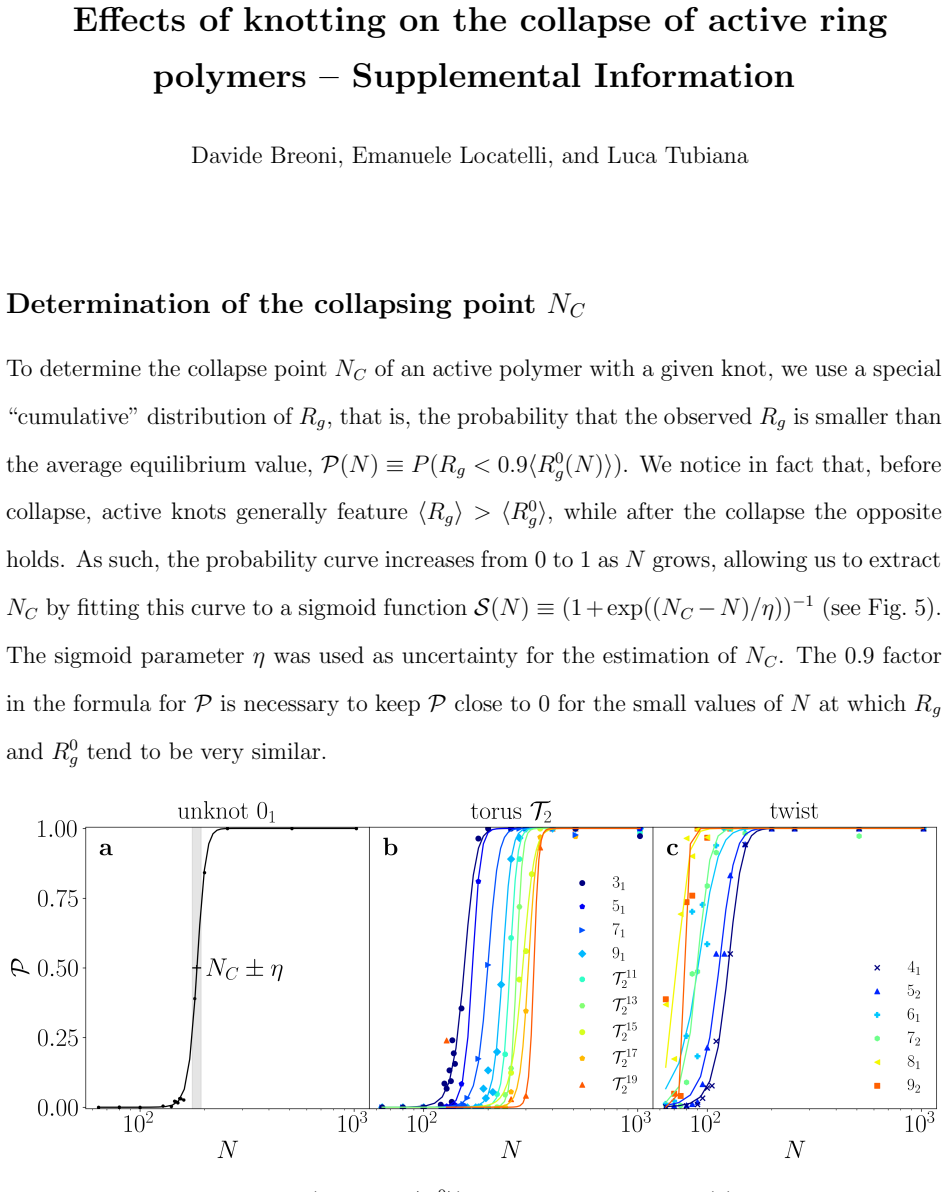
- [SI: Determination of the collapsing point] The collapse point N_C is extracted from P(N) = P(R_g < 0.9 <R_g^0(N)>), where the factor 0.9 is arbitrary and is introduced to keep P close to zero at small N. Since every quantitative result in the paper is a statement about N_C and its dependence on p, the authors should demonstrate that the family ordering and the linear increase/decrease of N_C are insensitive to the chosen threshold, for example by repeating the analysis with thresholds in a range such as 0.85–0.95. Without this sensitivity check, the linear fits in Fig. 3b could reflect the threshold choice rather than a physical trend.
minor comments (6)
- [Methods, Eq. (1)] The WCA cutoff is written as r_c = 6√2 σ, which does not match the standard cutoff 2^(1/6) σ for the WCA potential; please verify the intended formula and correct the typography.
- [Methods, Langevin dynamics] The damping time is written as 'τ γ = .3τ', which is unclear; presumably this means τ_γ = 3τ, but the notation should be clarified.
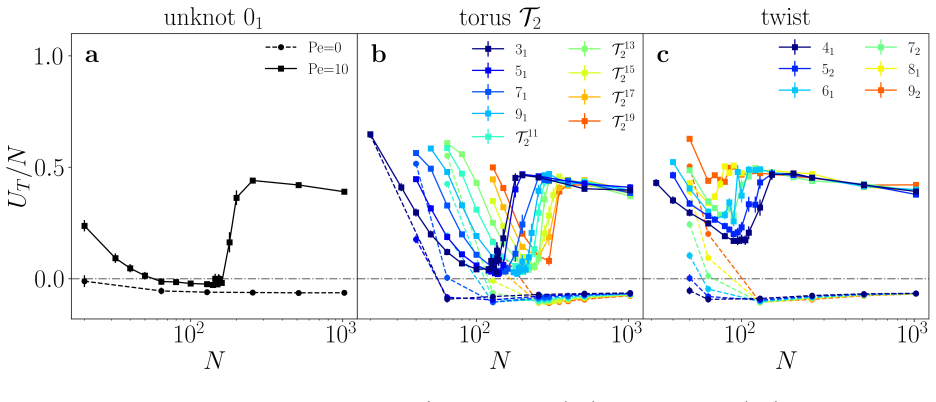
- [Results and Fig. 2 caption] The quantity N_T is used to delimit the collapse threshold range (135≲N_T≲145) but is never formally defined; please define it and state how it is determined.
- [Abstract and Fig. 3] The abstract states that the collapse point 'grows linearly with the minimum crossing number,' while the analysis in Fig. 3 plots N_C against the ideal length/diameter ratio p; please state explicitly how p maps to the minimum crossing number for the simulated knots.
- [Results: Bead collisions and loop formation] The volume V_P = N π/4 σ^3 is described as the volume of a tube of radius 2σ and length Nσ, but such a tube has volume 4π N σ^3; this inconsistency affects the reported absolute values of ρ_3D (e.g., the asymptotic value ~0.3σ^{-3}), even though relative comparisons across topologies may be unaffected.
- [Results: The collapse transition (Fig. 3b)] The linear fits in Fig. 3b are described in the caption but no fit parameters, uncertainties, or goodness-of-fit measures are reported; please include them in the caption or in the SI.
Circularity Check
No significant circularity: the central collapse-point comparison is measured from independent simulations; the only self-citation is interpretive and not load-bearing.
full rationale
The paper's central claims are derived from simulations, not from self-referential definitions. The collapse point N_C is an empirical quantity obtained from each topology's gyration-radius distribution (SI: 'To determine the collapse point N_C ... we use a special cumulative distribution of R_g ... allowing us to extract N_C by fitting this curve to a sigmoid'). The complexity variable p is taken from external ideal-knot literature ('the parameter p = L/d, the ratio between the length and thickness of an ideal knot'), not fitted here or defined in terms of N_C. The torus-versus-twist split is directly visible in measured R_g(N) curves (Fig. 1b,c) and in the rho_3D collision statistics, which are independent observables. The linear fit of N_C versus p (Fig. 3) is a summary of measured data, not a construction forcing the result; a fit cannot be circular unless its input and output coincide by definition, and here the output (collapse point) is measured separately from the input (ideal-knot p). The only self-citation, Ref. 63 (Locatelli et al.), supplies the prior unknot collapse result and the 20-bead scale; the unknot transition is reproduced in this paper's own simulations, and the ~20-bead increment is taken from the present linear fit, so the citation is interpretive rather than load-bearing. The paper's own limitation statements, including that the linear fit in Fig. 3b 'ignore[s]' the 9_2 twist knot 'because of the difficulty of measuring its N_C' and that the predicted disappearance at p >= 40 is an extrapolation beyond simulated knots, are robustness/correctness concerns about the twist-knot branch rather than circularity: N_C remains an independently measured quantity. Thus no step in the derivation reduces by construction or by self-citation to its own input; score 2 reflects only the minor, non-load-bearing self-reference.
Assumptions & free parameters
free parameters (7)
- Péclet number Pe =
10
- WCA energy epsilon =
300 k_BT
- FENE maximum bond length R0 =
1.05 sigma
- FENE stiffness K =
30 epsilon/sigma^2
- Bending stiffness kappa =
1 k_BT
- Collapse probability threshold =
0.9
- Collision pair cutoffs =
distance < 2 sigma; |i-j| > 3
assumptions (6)
- domain assumption The Kremer-Grest model with WCA excluded volume and FENE bonds accurately represents flexible polymer behavior in good solvent.
- domain assumption Ideal knot length/diameter ratios p from Refs 64,65,72,73 are valid descriptors of knot complexity for the simulated topologies.
- domain assumption The FENE/WCA parameters (epsilon=300 kBT, R0=1.05 sigma) prevent changes of knot topology during the active runs.
- domain assumption Simulation time of 1e6 tau and 30 independent realizations are sufficient to estimate steady-state N_C despite glassy dynamics.
- ad hoc to paper The cumulative probability P(R_g < 0.9 <R_g0>) fitted to a sigmoid yields a meaningful collapse point N_C.
- ad hoc to paper The density rho_3D of close, oppositely oriented bond pairs is a valid proxy for collision probability and deadlock formation.
Cite this review
Pith. "Pith review of Effects of knotting on the collapse of active ring polymers." pith.science (2026). https://pith.science/paper/6SDETGKY
@misc{pith2026250708391,
  author       = {Pith},
  title        = {Pith review of: Effects of knotting on the collapse of active ring polymers},
  year         = {2026},
  howpublished = {\url{https://pith.science/paper/6SDETGKY}},
  note         = {Machine review of arXiv:2507.08391}
}
read the original abstract
We use numerical simulations to study tangentially active flexible ring polymers with different knot topologies. Simple, unknotted active rings display a transition from an extended phase to a collapsed one upon increasing the degree of polymerization. We find that topology has a significant effect on the polymer size at which the collapse takes place, with twist knots collapsing earlier than torus knots. Increasing knot complexity further accentuates this difference, as the collapse point of torus knots grows linearly with the minimum crossing number of the knot while that of twist knots shrinks, eventually canceling the actively stretched regime altogether. This behavior is a consequence of the ordered configuration of torus knots in their stretched active state, featuring an effective alignment for non-neighboring bonds which increases with the minimal crossing number. Twist knots do not feature ordered configurations or bond alignment, increasing the likelihood of collisions, leading to collapse. These results show that topology yields a degree of control on the properties of active ring polymers, and can be used to tune them. At the same time, they suggest that activity might introduce a bias for torus knots, as complex twist knots cannot be formed in extended active polymers.
Figures


Figures from the paper (11 more)




Reference graph
Works this paper leans on
-
[1]
Tubiana, L. et al. Topology in soft and biological matter. Physics Reports 2024, 1075, 1--137, DOI: doi:10.1016/j.physrep.2024.04.002
-
[2]
Haque, F. M.; Grayson, S. M. The synthesis, properties and potential applications of cyclic polymers. Nature Chemistry 2020, 12, 433--444, DOI: doi:10.1038/s41557-020-0440-5
-
[3]
Topological and physical links in soft matter systems
Orlandini, E.; Micheletti, C. Topological and physical links in soft matter systems. Journal of Physics: Condensed Matter 2021, 34, 013002
2021
-
[4]
Soft Matter 2016, 12, 9485--9500
On the tree-like structure of rings in dense solutions. Soft Matter 2016, 12, 9485--9500
work page 2016
-
[5]
Topological gelation of reconnecting polymers
Bonato, A.; Marenduzzo, D.; Michieletto, D.; Orlandini, E. Topological gelation of reconnecting polymers. Proceedings of the National Academy of Sciences 2022, 119, e2207728119
work page 2022
-
[6]
Hart, L. F.; Hertzog, J. E.; Rauscher, P. M.; Rawe, B. W.; Tranquilli, M. M.; Rowan, S. J. Material properties and applications of mechanically interlocked polymers. Nature Reviews Materials 2021, 6, 508--530, DOI: doi:10.1038/s41578-021-00278-z
-
[7]
Tying a molecular knot with optical tweezers
Arai, Y.; Yasuda, R.; Akashi, K.-i.; Harada, Y.; Miyata, H.; Kinosita, K.; Itoh, H. Tying a molecular knot with optical tweezers. Nature 1999, 399, 446--448, DOI: doi:10.1038/20894
-
[8]
Jamroz, M.; Niemyska, W.; Rawdon, E. J.; Stasiak, A.; Millett, K. C.; Sułkowski, P.; Sulkowska, J. I. KnotProt : a database of proteins with knots and slipknots. Nucleic Acids Research 2015, 43, D306--D314, DOI: doi:10.1093/nar/gku1059
Show all 81 references
-
[9]
Knots are Generic Stable Phases in Semiflexible Polymers
Majumder, S.; Marenz, M.; Paul, S.; Janke, W. Knots are Generic Stable Phases in Semiflexible Polymers . Macromolecules 2021, 54, 5321--5334, DOI: doi:10.1021/acs.macromol.0c02584
2021 doi
-
[10]
Topological spectra and entropy of chromatin loop networks
Bonato, A.; Chiang, M.; Corbett, D.; Kitaev, S.; Marenduzzo, D.; Morozov, A.; Orlandini, E. Topological spectra and entropy of chromatin loop networks. Physical Review Letters 2024, 132, 248403
2024
-
[11]
Harju, J.; Broedersz, C. P. Physical models of bacterial chromosomes. Molecular Microbiology 2025, 123, 143--153, DOI: doi:10.1111/mmi.15257
2025 doi
-
[12]
Ramakrishnan, S.; Chen, Z.; Fosado, Y. A. G.; Tubiana, L.; Vanderlinden, W.; Savill, N. J.; Schnaufer, A.; Michieletto, D. Single- Molecule Morphology of Topologically Digested Olympic Networks . PRX Life 2024, 2, 013009, DOI: doi:10.1103/PRXLife.2.013009
2024 doi
-
[13]
W.; Roca, J
Arsuaga, J.; Vazquez, M.; McGuirk, P.; Trigueros, S.; Sumners, D. W.; Roca, J. DNA knots reveal a chiral organization of DNA in phage capsids. Proceedings of the National Academy of Sciences 2005, 102, 9165--9169, DOI: doi:10.1073/pnas.0409323102
2005 doi
-
[14]
DNA knots occur in intracellular chromatin
Valdés, A.; Segura, J.; Dyson, S.; Martínez-García, B.; Roca, J. DNA knots occur in intracellular chromatin. Nucleic Acids Research 2018, 46, 650--660, DOI: doi:10.1093/nar/gkx1137
2018 doi
-
[15]
F.; Perkocha, L.; Calendar, R.; Wang, J
Liu, L. F.; Perkocha, L.; Calendar, R.; Wang, J. C. Knotted DNA from bacteriophage capsids. Proceedings of the National Academy of Sciences 1981, 78, 5498--5502, DOI: doi:10.1073/pnas.78.9.5498
1981 doi
-
[16]
Spontaneous Knotting and Unknotting of Flexible Linear Polymers : Equilibrium and Kinetic Aspects
Tubiana, L.; Rosa, A.; Fragiacomo, F.; Micheletti, C. Spontaneous Knotting and Unknotting of Flexible Linear Polymers : Equilibrium and Kinetic Aspects . Macromolecules 2013, 46, 3669--3678, DOI: doi:10.1021/ma4002963
2013 doi
-
[17]
W.; Witteveen, M
Plesa, C.; Verschueren, D.; Pud, S.; van der Torre, J.; Ruitenberg, J. W.; Witteveen, M. J.; Jonsson, M. P.; Grosberg, A. Y.; Rabin, Y.; Dekker, C. Direct observation of DNA knots using a solid-state nanopore. Nature Nanotechnology 2016, 11, 1093--1097, DOI: doi:10.1038/nnano.2016.153
2016 doi
-
[18]
Pore translocation of knotted DNA rings
Suma, A.; Micheletti, C. Pore translocation of knotted DNA rings. Proceedings of the National Academy of Sciences 2017, 114, E2991--E2997, DOI: doi:10.1073/pnas.1701321114
2017 doi
-
[19]
R.; Narsimhan, V.; Soh, B
Klotz, A. R.; Narsimhan, V.; Soh, B. W.; Doyle, P. S. Dynamics of DNA Knots during Chain Relaxation . Macromolecules 2017, 50, 4074--4082, DOI: doi:10.1021/acs.macromol.7b00287
2017 doi
-
[20]
Ma, Z.; Dorfman, K. D. Diffusion of Knotted DNA Molecules in Nanochannels in the Extended de Gennes Regime . Macromolecules 2021, 54, 4211--4218, DOI: doi:10.1021/acs.macromol.1c00143
2021 doi
-
[21]
J.; Kern, J
Rawdon, E. J.; Kern, J. C.; Piatek, M.; Plunkett, P.; Stasiak, A.; Millett, K. C. Effect of Knotting on the Shape of Polymers . Macromolecules 2008, 41, 8281--8287, DOI: doi:10.1021/ma801389c
2008 doi
-
[22]
C.; Plunkett, P.; Piatek, M.; Rawdon, E
Millett, K. C.; Plunkett, P.; Piatek, M.; Rawdon, E. J.; Stasiak, A. Effect of knotting on polymer shapes and their enveloping ellipsoids. The Journal of Chemical Physics 2009, 130, 165104, DOI: doi:10.1063/1.3117923
2009 doi
-
[23]
Effect of Topology on the Conformations of Ring Polymers
Lang, M.; Fischer, J.; Sommer, J.-U. Effect of Topology on the Conformations of Ring Polymers . Macromolecules 2012, 45, 7642--7648, DOI: doi:10.1021/ma300942a
2012 doi
-
[24]
Baiesi, M.; Orlandini, E.; Stella, A. L. Knotted Globular Ring Polymers : How Topology Affects Statistics and Thermodynamics . Macromolecules 2014, 47, 8466--8476, DOI: doi:10.1021/ma5020287
2014 doi
-
[25]
Topological origin of reptation: a collective motion of local knots
Iwata, K. Topological origin of reptation: a collective motion of local knots. Macromolecules 1991, 24, 1107--1116
1991
-
[26]
How Local Flexibility Affects Knot Positioning in Ring Polymers
Orlandini, E.; Baiesi, M.; Zonta, F. How Local Flexibility Affects Knot Positioning in Ring Polymers . Macromolecules 2016, 49, 4656--4662, DOI: doi:10.1021/acs.macromol.6b00712
2016 doi
-
[27]
B.; Marenda, M.; Micheletti, C.; Likos, C
Weiss, L. B.; Marenda, M.; Micheletti, C.; Likos, C. N. Hydrodynamics and Filtering of Knotted Ring Polymers in Nanochannels . Macromolecules 2019, 52, 4111--4119, DOI: doi:10.1021/acs.macromol.9b00516
2019 doi
-
[28]
Tuning Knotted Copolyelectrolyte Conformations via Solution Properties
Tagliabue, A.; Micheletti, C.; Mella, M. Tuning Knotted Copolyelectrolyte Conformations via Solution Properties . Macromolecules 2022, 55, 10761--10772, DOI: doi:10.1021/acs.macromol.2c01933
2022 doi
-
[29]
Dai, L.; Doyle, P. S. Effects of Intrachain Interactions on the Knot Size of a Polymer . Macromolecules 2016, 49, 7581--7587, DOI: doi:10.1021/acs.macromol.6b01653
2016 doi
-
[30]
Controlling Knot Interactions through Confinement
Rusková, R.; Tubiana, L.; Potestio, R.; Račko, D. Controlling Knot Interactions through Confinement . Macromolecules 2025, 58, 6718--6731, DOI: doi:10.1021/acs.macromol.4c02977
2025 doi
-
[31]
F.; Baskaran, A
Hagan, M. F.; Baskaran, A. Emergent self-organization in active materials. Current Opinion in Cell Biology 2016, 38, 74--80, DOI: doi:https://doi.org/10.1016/j.ceb.2016.02.020, Cell architecture
2016 doi
-
[32]
Active matter at the interface between materials science and cell biology
Needleman, D.; Dogic, Z. Active matter at the interface between materials science and cell biology. Nature Reviews Materials 2017, 2, 1--14, DOI: doi:10.1038/natrevmats.2017.48
2017 doi
-
[33]
Collective motion
Vicsek, T.; Zafeiris, A. Collective motion. Physics reports 2012, 517, 71--140
2012
-
[34]
Bird Flocks as Condensed Matter
Cavagna, A.; Giardina, I. Bird Flocks as Condensed Matter . Annual Review of Condensed Matter Physics 2014, 5, 183--207, DOI: doi:10.1146/annurev-conmatphys-031113-133834
2014 doi
-
[35]
C.; Joanny, J.-F.; Ramaswamy, S.; Liverpool, T
Marchetti, M. C.; Joanny, J.-F.; Ramaswamy, S.; Liverpool, T. B.; Prost, J.; Rao, M.; Simha, R. A. Hydrodynamics of soft active matter. Reviews of modern physics 2013, 85, 1143--1189
2013
-
[36]
Dynamical Clustering and Phase Separation in Suspensions of Self - Propelled Colloidal Particles
Buttinoni, I.; Bialké, J.; Kümmel, F.; Löwen, H.; Bechinger, C.; Speck, T. Dynamical Clustering and Phase Separation in Suspensions of Self - Propelled Colloidal Particles . Physical Review Letters 2013, 110, 238301, DOI: doi:10.1103/PhysRevLett.110.238301
2013 doi
-
[37]
E.; Tailleur, J
Cates, M. E.; Tailleur, J. Motility- Induced Phase Separation . Annual Review of Condensed Matter Physics 2015, 6, 219--244, DOI: doi:10.1146/annurev-conmatphys-031214-014710
2015 doi
-
[38]
G.; Gompper, G
Winkler, R. G.; Gompper, G. The physics of active polymers and filaments. The Journal of Chemical Physics 2020, 153, 040901, DOI: doi:10.1063/5.0011466
2020 doi
-
[39]
Cilia- Like Beating of Active Microtubule Bundles
Sanchez, T.; Welch, D.; Nicastro, D.; Dogic, Z. Cilia- Like Beating of Active Microtubule Bundles . Science 2011, 333, 456--459, DOI: doi:10.1126/science.1203963
2011 doi
-
[40]
H.; Shitaka, Y.; Tanaka, D.; Yoshikawa, K.; Chaté, H.; Oiwa, K
Sumino, Y.; Nagai, K. H.; Shitaka, Y.; Tanaka, D.; Yoshikawa, K.; Chaté, H.; Oiwa, K. Large-scale vortex lattice emerging from collectively moving microtubules. Nature 2012, 483, 448--452, DOI: doi:10.1038/nature10874
2012 doi
-
[41]
I.; Bhamla, M
Ozkan-Aydin, Y.; Goldman, D. I.; Bhamla, M. S. Collective dynamics in entangled worm and robot blobs. Proceedings of the National Academy of Sciences 2021, 118, e2010542118
2021
-
[42]
P.; Locatelli, E.; Valeriani, C
Miranda, J. P.; Locatelli, E.; Valeriani, C. Self-organized states from solutions of active ring polymers in bulk and under confinement. Journal of Chemical Theory and Computation 2023, 20, 1636--1645
2023
-
[43]
P.; Tuazon, H.; Kaufman, E.; Chakrabortty, T.; Qin, D.; Dunkel, J.; Bhamla, M
Patil, V. P.; Tuazon, H.; Kaufman, E.; Chakrabortty, T.; Qin, D.; Dunkel, J.; Bhamla, M. S. Ultrafast reversible self-assembly of living tangled matter. Science 2023, 380, 392--398
2023
-
[44]
K.; Cammann, J.; Mazza, M
Faluweki, M. K.; Cammann, J.; Mazza, M. G.; Goehring, L. Active spaghetti: collective organization in cyanobacteria. Physical review letters 2023, 131, 158303
2023
-
[45]
Phase Separation by Entanglement of Active Polymerlike Worms
Deblais, A.; Maggs, A.; Bonn, D.; Woutersen, S. Phase Separation by Entanglement of Active Polymerlike Worms . Physical Review Letters 2020, 124, 208006, DOI: doi:10.1103/PhysRevLett.124.208006
2020 doi
-
[46]
Schaller, V.; Weber, C.; Semmrich, C.; Frey, E.; Bausch, A. R. Polar patterns of driven filaments. Nature 2010, 467, 73--77
2010
-
[47]
Globulelike Conformation and Enhanced Diffusion of Active Polymers
Bianco, V.; Locatelli, E.; Malgaretti, P. Globulelike Conformation and Enhanced Diffusion of Active Polymers . Physical Review Letters 2018, 121, 217802, DOI: doi:10.1103/PhysRevLett.121.217802
2018 doi
-
[48]
R.; Ramírez, J
Tejedor, A. R.; Ramírez, J. Reptation of Active Entangled Polymers . Macromolecules 2019, 52, 8788--8792, DOI: doi:10.1021/acs.macromol.9b01994
2019 doi
-
[49]
Rheology of Entangled Active Polymer - Like T
Deblais, A.; Woutersen, S.; Bonn, D. Rheology of Entangled Active Polymer - Like T . Tubifex Worms . Physical Review Letters 2020, 124, 188002, DOI: doi:10.1103/PhysRevLett.124.188002
2020 doi
-
[50]
Giant activity-induced elasticity in entangled polymer solutions
Breoni, D.; Kurzthaler, C.; Liebchen, B.; Löwen, H.; Mandal, S. Giant activity-induced elasticity in entangled polymer solutions. Nature Communications 2025, 16, 5305, DOI: doi:10.1038/s41467-025-60210-9
2025 doi
-
[51]
H.; Dogic, Z.; Nakamura, F.; Bendix, P
Koenderink, G. H.; Dogic, Z.; Nakamura, F.; Bendix, P. M.; MacKintosh, F. C.; Hartwig, J. H.; Stossel, T. P.; Weitz, D. A. An active biopolymer network controlled by molecular motors. Proceedings of the National Academy of Sciences 2009, 106, 15192--15197, DOI: doi:10.1073/pna...
2009 doi
-
[52]
Bertrand, O. J. N.; Fygenson, D. K.; Saleh, O. A. Active, motor-driven mechanics in a DNA gel. Proceedings of the National Academy of Sciences 2012, 109, 17342--17347, DOI: doi:10.1073/pnas.1208732109
2012 doi
-
[53]
T.; Giuseppone, N
Li, Q.; Fuks, G.; Moulin, E.; Maaloum, M.; Rawiso, M.; Kulic, I.; Foy, J. T.; Giuseppone, N. Macroscopic contraction of a gel induced by the integrated motion of light-driven molecular motors. Nature Nanotechnology 2015, 10, 161--165, DOI: doi:10.1038/nnano.2014.315
2015 doi
-
[54]
E.; Aufderhorst-Roberts, A.; Koenderink, G
Burla, F.; Mulla, Y.; Vos, B. E.; Aufderhorst-Roberts, A.; Koenderink, G. H. From mechanical resilience to active material properties in biopolymer networks. Nature Reviews Physics 2019, 1, 249--263, DOI: doi:10.1038/s42254-019-0036-4
2019 doi
-
[55]
A.; Fedosov, D
Sciortino, A.; Faizi, H. A.; Fedosov, D. A.; Frechette, L.; Vlahovska, P. M.; Gompper, G.; Bausch, A. R. Active membrane deformations of a minimal synthetic cell. Nature Physics 2025, 1--9
2025
-
[56]
P.; Bhamla, M
Deblais, A.; Prathyusha, K.; Sinaasappel, R.; Tuazon, H.; Tiwari, I.; Patil, V. P.; Bhamla, M. S. Worm blobs as entangled living polymers: from topological active matter to flexible soft robot collectives. Soft Matter 2023, 19, 7057--7069
2023
-
[57]
D.; Lewis, J.; Raff, M.; Roberts, K.; Walter, P
Alberts, B.; Bray, D.; Hopkin, K.; Johnson, A. D.; Lewis, J.; Raff, M.; Roberts, K.; Walter, P. Essential Cell Biology ; Garland Science, 2015
2015
-
[58]
N.; Kremer, K
Smrek, J.; Chubak, I.; Likos, C. N.; Kremer, K. Active topological glass. Nature communications 2020, 11, 26
2020
-
[59]
Topology- Based Detection and Tracking of Deadlocks Reveal Aging of Active Ring Melts
Micheletti, C.; Chubak, I.; Orlandini, E.; Smrek, J. Topology- Based Detection and Tracking of Deadlocks Reveal Aging of Active Ring Melts . ACS Macro Letters 2024, 13, 124--129, DOI: doi:10.1021/acsmacrolett.3c00567
2024 doi
-
[60]
Activity-driven polymer knotting for macromolecular topology engineering
Li, J.-X.; Wu, S.; Hao, L.-L.; Lei, Q.-L.; Ma, Y.-Q. Activity-driven polymer knotting for macromolecular topology engineering. Science Advances 2024, 10, eadr0716, DOI: doi:10.1126/sciadv.adr0716
2024 doi
-
[61]
Upsurge of Spontaneous Knotting in Polar Diblock Active Polymers
Vatin, M.; Orlandini, E.; Locatelli, E. Upsurge of Spontaneous Knotting in Polar Diblock Active Polymers . Physical Review Letters 2025, 134, 168301, DOI: doi:10.1103/PhysRevLett.134.168301
2025 doi
-
[62]
Knotting and adsorption of end-grafted active polymers
Shen, Y.-F.; Luo, M.-B. Knotting and adsorption of end-grafted active polymers. Soft Matter 2025, 21, 1873--1883, DOI: doi:10.1039/D4SM01355G
2025 doi
-
[63]
Activity- Induced Collapse and Arrest of Active Polymer Rings
Locatelli, E.; Bianco, V.; Malgaretti, P. Activity- Induced Collapse and Arrest of Active Polymer Rings . Physical Review Letters 2021, 126, 097801, DOI: doi:10.1103/PhysRevLett.126.097801
2021 doi
-
[64]
Y.; Feigel, A.; Rabin, Y
Grosberg, A. Y.; Feigel, A.; Rabin, Y. Flory-type theory of a knotted ring polymer. Physical Review E 1996, 54, 6618--6622, DOI: doi:10.1103/PhysRevE.54.6618
1996 doi
-
[65]
Ideal Knots ; World Scientific, 1998
Stasiak, A.; Katritch, V. Ideal Knots ; World Scientific, 1998
1998
-
[66]
S.; Kremer, K
Grest, G. S.; Kremer, K. Molecular dynamics simulation for polymers in the presence of a heat bath. Physical Review A 1986, 33, 3628--3631, DOI: doi:10.1103/PhysRevA.33.3628
1986 doi
-
[67]
P.; Aktulga, H
Thompson, A. P.; Aktulga, H. M.; Berger, R.; Bolintineanu, D. S.; Brown, W. M.; Crozier, P. S.; in 't Veld, P. J.; Kohlmeyer, A.; Moore, S. G.; Nguyen, T. D.; Shan, R.; Stevens, M. J.; Tranchida, J.; Trott, C.; Plimpton, S. J. LAMMPS - a flexible simulation tool for particle-b...
2022
-
[68]
E.; Elgeti, J.; Gompper, G
Isele-Holder, R. E.; Elgeti, J.; Gompper, G. Self-propelled worm-like filaments: spontaneous spiral formation, structure, and dynamics. Soft matter 2015, 11, 7181--7190
2015
-
[69]
K.; Singh, S
Anand, S. K.; Singh, S. P. Structure and dynamics of a self-propelled semiflexible filament. Physical Review E 2018, 98, 042501
2018
-
[70]
P.; Martín-Roca, J.; Malgaretti, P.; Locatelli, E.; Valeriani, C.; Fernandez, D
Janzen, G.; Miranda, J. P.; Martín-Roca, J.; Malgaretti, P.; Locatelli, E.; Valeriani, C.; Fernandez, D. A. M. Active polymer behavior in two dimensions: A comparative analysis of tangential and push–pull models. The Journal of Chemical Physics 2025, 162, 114905
2025
-
[71]
Oberti, C.; Ricca, R. L. On torus knots and unknots. Journal of Knot Theory and Its Ramifications 2016, DOI: doi:10.1142/S021821651650036X
2016 doi
-
[72]
W.; Bohr, J
Olsen, K. W.; Bohr, J. A principle for ideal torus knots. Europhysics Letters 2013, 103, 30002, DOI: doi:10.1209/0295-5075/103/30002
2013 doi
-
[73]
G.; Dubochet, J.; Stasiak, A
Katritch, V.; Bednar, J.; Michoud, D.; Scharein, R. G.; Dubochet, J.; Stasiak, A. Geometry and physics of knots. Nature 1996, 384, 142--145, DOI: doi:10.1038/384142a0
1996 doi
-
[74]
De Gennes, P. G. Tight knots. Macromolecules 1984, 17, 703--704
1984
-
[75]
Y.; Rabin, Y
Grosberg, A. Y.; Rabin, Y. Metastable Tight Knots in a Wormlike Polymer . Physical Review Letters 2007, 99, 217801, DOI: doi:10.1103/PhysRevLett.99.217801
2007 doi
-
[76]
B.; Doyle, P
Dai, L.; Renner, C. B.; Doyle, P. S. Metastable Tight Knots in Semiflexible Chains . Macromolecules 2014, 47, 6135--6140, DOI: doi:10.1021/ma501585x
2014 doi
-
[77]
Liebetreu, M.; Likos, C. N. Hydrodynamic inflation of ring polymers under shear. Communications Materials 2020, 1, 4, DOI: doi:10.1038/s43246-019-0006-5
2020 doi
-
[78]
Heteropolymer Design and Folding of Arbitrary Topologies Reveals an Unexpected Role of Alphabet Size on the Knot Population
Cardelli, C.; Tubiana, L.; Bianco, V.; Nerattini, F.; Dellago, C.; Coluzza, I. Heteropolymer Design and Folding of Arbitrary Topologies Reveals an Unexpected Role of Alphabet Size on the Knot Population . Macromolecules 2018, 51, 8346--8356, DOI: doi:10.1021/acs.macromol.8b01359
2018 doi
-
[79]
Local Polar and Long - Range Isotropic Activity Assisted Swelling and Collapse Dynamics of an Active Ring Polymer
Kumar, S.; Thakur, S. Local Polar and Long - Range Isotropic Activity Assisted Swelling and Collapse Dynamics of an Active Ring Polymer . Macromolecules 2023, 56, 5229--5236, DOI: doi:10.1021/acs.macromol.3c00384
2023 doi
-
[80]
How a protein searches for its site on DNA : the mechanism of facilitated diffusion
Mirny, L.; Slutsky, M.; Wunderlich, Z.; Tafvizi, A.; Leith, J.; Kosmrlj, A. How a protein searches for its site on DNA : the mechanism of facilitated diffusion. Journal of Physics A: Mathematical and Theoretical 2009, 42, 434013, DOI: doi:10.1088/1751-8113/42/43/434013
2009 doi
-
[81]
SCOPE—Selective Capture Of Metals by Polymeric spongEs
Suter, D. M. Transcription Factors and DNA Play Hide and Seek . Trends in Cell Biology 2020, 30, 491--500, DOI: doi:10.1016/j.tcb.2020.03.003 mcitethebibliography acknots.tex0000664000000000000000000015357215042710521011754 0ustar rootroot [journal=mamobx,manuscript=article] a...
2020 doi
Reviewed August 6, 2026 · model on record in the stance chip above.
Discussion (0). Continue with ORCID to comment.