REVIEW 3 major objections 4 minor 3 cited by
A metal-poor atmosphere with a hot interior for a young sub-Neptune progenitor: JWST/NIRSpec transmission spectrum of V1298 Tau b
T0 review · 3 major / 4 minor · reviewed 2026-08-06 · deepseek-v4-flash
Pith's one-line read The combined HST+JWST spectrum of the young planet V1298 Tau b fixes its mass near 12 Earth masses from the atmosphere's scale height, and its methane deficit points to a deep interior near 500 K — a young sub-Neptune caught mid-evolution.
desk verdict Strong new JWST spectrum of the youngest sub-Neptune yet, but the 'hot interior' headline rests on an adiabatic assumption the authors themselves question. read the letter →
The pith
A machine-rendered reading of the paper's core claim, the machinery that carries it, and where it could break.
The reading
What carries the argument
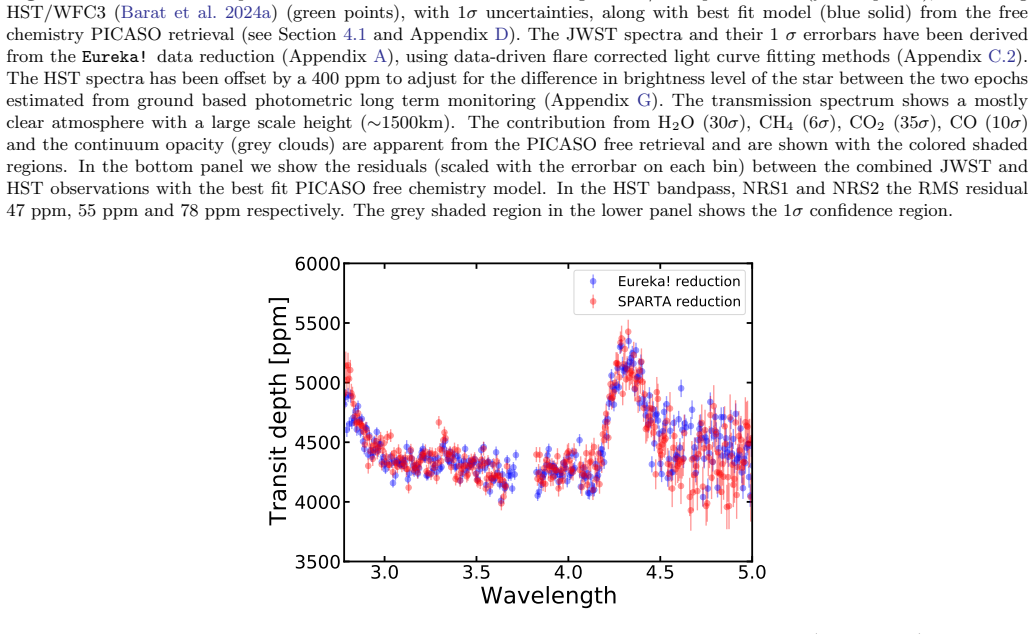
Three linked tools carry the argument. (1) Mass from scale height: a transmission spectrum probes atmospheric layers whose thickness is set by the pressure scale height, which depends inversely on surface gravity, so fitting the planet's mass alongside the abundances converts the large observed scale height into a mass; the paper validates the method by recovering the known radial-velocity mass of WASP-107b ($32\pm3$ vs $30.5\pm1.7\,M_\oplus$). (2) The 'methane thermometer': at fixed metallicity, C/O ratio, and vertical mixing coefficient $K_{zz}$, the methane abundance seen at observable altitudes is set by the depth at which the temperature-pressure profile crosses the CH$_4$/CO equality line, together with whatever mixing dredges up from below; because the other detected molecules pin down the first three quantities, the deep methane deficit reads out the temperature of the deep atmosphere. (3) Two independent grids of self-consistent radiative-convective-thermochemical-equilibrium forward models, one post-processed with a photochemical kinetics solver and the other with a different chemical network including photochemistry, turn this logic into numbers: only deep temperatures near 500–600 K produce enough methane-poor gas without breaking the CO$_2$ and H$_2$O fits, while the free-chemistry retrieval independently measures the same molecules from the data alone.
What would settle it
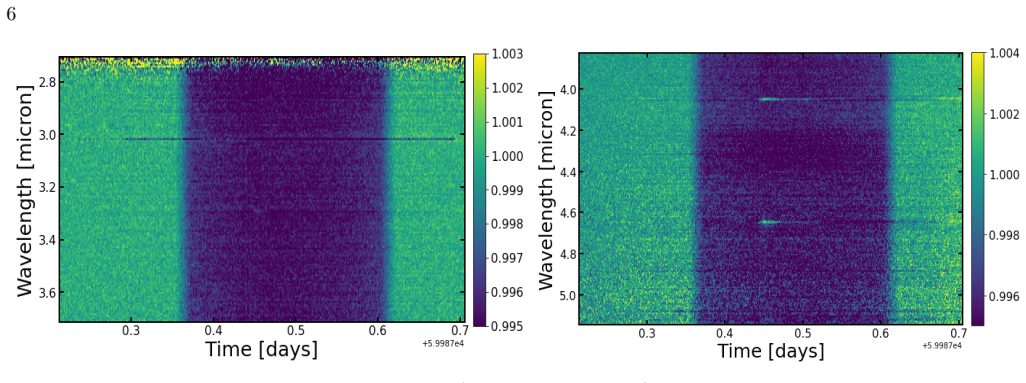
Two checks would settle the central claims. First, an independent mass for V1298 Tau b from transit-timing variations (ongoing, per the paper) that lands outside roughly 12–17 $M_\oplus$ at $3\sigma$ or more would falsify the scale-height mass measurement. Second, for the hot-interior claim, the arbiter is a self-consistent forward model that includes a primordial metallicity gradient (a non-adiabatic interior): if such a model reproduces the observed methane deficit, the CO$_2$ feature, and the water bands with a deep temperature near the 100–200 K that evolution models predict, the 500 K interior is not required — the paper's own admission that only the quench-point temperature is constrained makes this the decisive calculation. A cheaper observational check is whether the $6\sigma$ methane detection survives higher-resolution binning or a re-analysis of the four flare-affected spectral channels that were removed.
Extended reading notes
Core claim
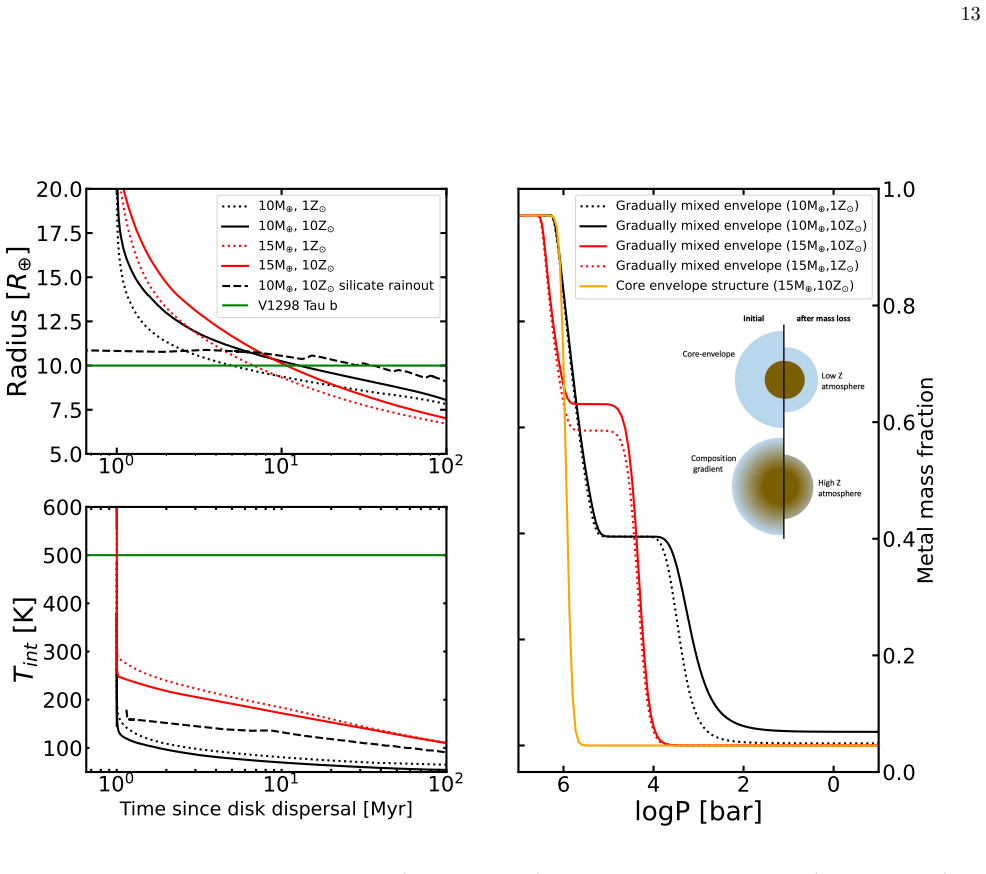
The paper's central claim is that V1298 Tau b is a gas-dwarf sub-Neptune progenitor whose mass can be read off its transmission spectrum. Because the pressure scale height of an atmosphere depends inversely on surface gravity, fitting the observed $\sim$1500 km scale height together with molecular abundances yields $12\pm1\,M_\oplus$ from the free-chemistry retrieval and $15\pm1.7\,M_\oplus$ from the self-consistent forward-model grids, ruling out the earlier radial-velocity mass of $0.64\pm0.19\,M_J$ at roughly $40\sigma$. The combined HST/WFC3 and JWST/NIRSpec G395H spectrum is haze-free and hydrogen/helium-dominated, with detections of CO$_2$ ($35\sigma$), H$_2$O ($30\sigma$), CO ($10\sigma$), CH$_4$ ($6\sigma$), and tentative SO$_2$ and OCS, at an atmospheric metallicity around $10\times$ solar ($\log Z=0.6^{+0.4}_{-0.6}$) and a sub-solar C/O ratio of 0.22. The paper then uses methane as a thermometer of the deep atmosphere: with metallicity, C/O, and vertical mixing pinned down by the other molecules, the observed CH$_4$ deficit, about $7\sigma$ below equilibrium chemistry, can be matched only by temperature-pressure profiles whose deep layers reach roughly 500 K — far above the $\sim$100–200 K that evolutionary models predict — or, alternatively, by a non-adiabatic interior in which a primordial metallicity gradient traps heat. From these temperatures and the planet's size, the paper derives a gas-to-core mass fraction of 0.1–8% with a core near 11–12 $M_\oplus$, consistent with in-situ formation inside the water ice line, and argues that photoevaporation will later strip or enrich this envelope, maturing the planet toward the metal-rich, hazy sub-Neptunes seen at older ages.
Load-bearing premise
The hot-interior reading rests on the assumption that the methane deficit is created by vertical mixing that dredges up methane-poor gas from a deep, fully convective, hot region; the paper itself notes (Sections 5.5 and 5.8.3) that the observations constrain only the temperature near the methane quench point, and that a primordial metallicity gradient could trap heat in the deep atmosphere and produce the same high temperatures without any genuinely hot planet.
Editorial extensions
If this is right
- Transmission spectroscopy can weigh young planets around magnetically active stars, where radial velocities are swamped by stellar jitter; the paper demonstrates roughly 8–10% mass precision and validates the approach on WASP-107b.
- V1298 Tau b is a gas dwarf with a gas-to-core mass fraction of 0.1–8% and a core near 11–12 $M_\oplus$, supporting in-situ formation inside the water ice line without runaway gas accretion.
- If the hot-interior inference holds, the planet's cooling timescale is under a million years, so something must be heating it (tidal or dynamical interactions) or its interior is not adiabatic but holds a heat-trapping compositional gradient; the two scenarios predict different future evolution.
- Photoevaporation, not core-powered mass loss, determines the planet's fate: for envelope mass fractions from 0.2% to 30%, the stripping timescale runs from about 7.5 million to 1.2 billion years, leaving either a bare rocky core or a thin-envelope sub-Neptune.
- The metal-poor, haze-free envelope is what a sub-Neptune is born with; as mass loss removes the outer layers, the atmospheric metallicity can rise by an order of magnitude, reconciling this young planet with the metal-rich, hazy sub-Neptunes of similar mass seen at maturity.
Reading between the lines
- A sample-level test follows directly from the paper's picture: if young sub-Neptunes are born metal-poor and haze-free, then a survey of transiting planets at 10–100 Myr should show a metallicity-age and haze-age trend, with V1298 Tau b and the similarly young HIP-67522b as the first two data points; the paper calls for such a survey but does not predict its slope.
- The same evolution logic makes the radius valley a time-dependent structure: young planets with tiny envelopes like the 500 K model here should populate the valley's sparse region today and drain out of it as they cool, so comparing the young and mature radius distributions is a cheap, spectroscopy-free test of the whole scenario.
- V1298 Tau's other transiting planets (c and d) sit in the same system and are already being monitored for transit-timing variations, so the scale-height mass method could be calibrated within a single system across a range of masses and irradiation — something the WASP-107b check alone does not provide.
- The tentative SO$_2$ and OCS detections are the only molecular signals the self-consistent grids do not reproduce (SO$_2$ disappears at 20-pixel binning); if they survive a second transit or higher-resolution binning, they would demand photochemistry or a sulfur chemistry the current models lack, making them a direct pressure test of the retrieved composition.
Signed reviews
Editorial analysis
A structured set of objections, weighed in public.
Referee Report
Summary. The paper presents JWST/NIRSpec G395H transmission spectroscopy of the young planet V1298 Tau b, combined with the previously published HST/WFC3 spectrum. From a haze-free, H/He-dominated atmosphere with a large scale height, the authors detect CO2, H2O, CO, CH4, SO2, and OCS in a free chemistry retrieval, and infer a planet mass of 12±1 M⊕ (free retrieval) or 15±1.7 M⊕ (PICASO grid), consistent with an external validation on WASP-107b. The self-consistent PICASO and ATMO grids both require a low CH4 abundance, which they explain with a high internal temperature (~500–600 K) and vertical mixing. The paper also reports a low atmospheric metallicity relative to mature sub-Neptunes, a sub-solar C/O ratio, and a gas-to-core mass fraction of 0.1–8%, and discusses formation and evolution scenarios including a possible primordial metallicity gradient.
Significance. If the atmospheric detections and mass measurement hold, this is a valuable dataset: V1298 Tau b is one of the youngest sub-Neptune-class planets with a high-SNR JWST transmission spectrum, and the atmospheric-scale-height mass measurement is an important methodological step for young, RV-jitter-dominated systems. The paper uses two independent reductions (Eureka! and SPARTA), a data-driven flare-detrending scheme, limb-darkening tests, cross-checks against the HST spectrum, and an external mass anchor on WASP-107b, all of which strengthen the observational core. The main interpretive claim, however, is less secure: the 'hot interior' headline depends on an adiabatic, convective-envelope assumption that the authors themselves acknowledge is questionable, and the competing metallicity-gradient explanation is left untested. With a targeted test or a more cautious framing, the paper would be a strong contribution.
major comments (3)
- [§5.8.3 and §5.5; title and abstract] The paper's headline conclusion of a hot interior is not uniquely supported. Section 5.5 states explicitly that converting the quench-region temperature into an internal luminosity requires assuming an adiabatic T-P profile, i.e., a convective interior. Section 5.8.3 then presents a primordial metallicity gradient as a physically motivated alternative that can produce high deep-atmosphere temperatures even with a low internal luminosity, analogous to Uranus, but no forward transmission spectrum is computed for such a stratified, low-luminosity structure. Since a secure low CH4 abundance is consistent with either a hot interior or a thermal-composition gradient, the title and abstract overstate the result. The authors should either generate a stratified-gradient forward model and demonstrate that it cannot match the observed CH4, CO, CO2, and H2O features, or reframe the conclusion as 'a hot deep atmosphere and/or a metallicity gradient.'
- [§4.2 and Table 1] The quantitative internal-temperature constraints are best-fit grid values rather than measured parameters with calibrated uncertainties. The PICASO grid samples Tint only between 100 and 600 K and Table 1 reports '>500±50 K,' while §4.2.1 states that the quoted uncertainties are a first-order approximation and would change with grid resolution. The ATMO grid uses only 200, 400, and 600 K and no uncertainties are quoted. The mutual agreement of PICASO and ATMO therefore shows only that both frameworks prefer the upper end of their prior grids; it does not establish a robust 500–600 K measurement. Please either provide a proper parameter-estimation treatment for the grid parameters or explicitly present the result as a coarse grid preference.
- [§4.2.2, Table 1, and §5.6] The C/O ratio inferred from the ATMO grid (0.35) is inconsistent with the PICASO grid value (0.23), and the authors attribute this to different implementations of changing C/O in the two forward-model codes. Since the sub-solar C/O ratio is used in §5.6 to support the in-situ formation interpretation, this systematic disagreement propagates into a formation claim. The paper should quantify the effect of the C/O prescription (for example by running both grids with the same elemental-abundance variation scheme) or downgrade the C/O-based formation narrative to a tentative suggestion rather than a derived constraint.
minor comments (4)
- [Abstract, §1, §6] The reported age of V1298 Tau b is inconsistent across the manuscript: the abstract says 10–20 Myr, the Introduction says 10–30 Myr, and Section 6 says 20–30 Myr. Please align these statements with the adopted 20±10 Myr isochrone age.
- [§5.4] Typo: 'NIRSPec' should be 'NIRSpec'.
- [Appendix D] The detection-significance procedure is described as setting an abundance to zero and comparing Bayesian evidence, but the text does not state whether the quoted sigma values come directly from Δln Z or from a separate significance conversion. Please specify the statistic used.
- [Table 1] The entry 'Tint > 500±50 K' combines a lower limit with a symmetric uncertainty in a confusing way. Please report the grid-preferred range or a posterior quantile instead.
Circularity Check
No significant circularity: the mass and abundance claims are anchored by external checks, and the hot-interior inference is a model-dependent fit that the paper itself flags as assumption-limited rather than a construction.
full rationale
The central derivations do not reduce to their inputs. The planet mass is retrieved from the transmission spectrum scale height and is independently checked against the WASP-107b RV mass (Section 5.4: 'From a free chemistry retrieval we find a mass of 32±3 M⊕... The RV mass for WASP-107b is 30.5±1.7 M⊕... consistent within 1σ'), and the HST/JWST inter-epoch offset is predicted from ground-based optical variability and matches the retrieved ~400 ppm offset. Molecular detections come from a free, data-driven retrieval whose abundances are then cross-checked with two independent self-consistent grids (PICASO and ATMO) that agree on the dominant species, and the SO2 detection was explicitly robustness-tested by rebinning. The high internal temperature is a best-fit grid parameter, not an independent prediction: the paper states in Section 5.5 that 'to infer the planet's internal luminosity from the temperature of the deep atmospheric layers, we must assume an adiabatic T-P profile, implying a convective interior,' and Section 5.8.3 offers the compositional-gradient alternative that can produce deep-atmosphere heat without high internal luminosity. That is an acknowledged model degeneracy or underdetermination, not circularity: the low CH4 abundance is an observed, independently retrieved quantity that constrains the quench region, and the conversion to Tint rests on an explicit assumption rather than on an identity that makes the conclusion equal to the premise. No load-bearing self-citation chain is present; Barat et al. (2024a) supplies the prior HST data, and Mukherjee et al. (2024a) is cited as a physical model, not as a uniqueness theorem forbidding alternatives. Accordingly, the paper's claims are self-contained relative to its inputs and score 0 on circularity.
Assumptions & free parameters
free parameters (10)
- Planet mass M_p =
12 +/- 1 Earth masses (free), 15 +/- 1.7 (PICASO grid), 15 (ATMO grid)
- Atmospheric temperature T =
444 +/- 38 K
- Gray cloud opacity log(kappa_cld) =
-2.77 +/- 0.23 cm2/g
- HST-JWST offset =
405 +/- 15 ppm
- Molecular abundances (H2O, CH4, CO2, CO, SO2, OCS, etc.) =
Various VMRs, e.g., log CH4 = -6.22 +/- 0.42
- Atmospheric metallicity [M/H] =
0.6 (+0.4/-0.6) solar (free), 1.05 +/- 0.2 (PICASO grid)
- C/O ratio =
0.22 (+0.06/-0.05) (free), 0.23 +/- 0.08 (grid)
- Internal temperature T_int =
about 500 K (PICASO), 600 K (ATMO)
- Eddy diffusion coefficient K_zz =
about 1e7 cm2/s (PICASO), 1e8 (ATMO)
- Heat redistribution factor rfacv =
0.2
assumptions (8)
- domain assumption 1D plane-parallel isothermal atmosphere for free retrieval
- domain assumption H/He-dominated composition with H2 as the main gas
- domain assumption Photochem1D and VULCAN chemical networks accurately model disequilibrium chemistry
- domain assumption Adiabatic, fully convective interior for converting deep-atmosphere temperature to internal luminosity
- domain assumption Stellar parameters Teff=4970 K, logg=4.25, [M/H]=-0.1, Rstar=1.31 Rsun, a=0.1688 AU
- domain assumption Spot temperature 4000 K and photosphere 5000 K for stellar variability scaling
- domain assumption Energy-limited mass loss with eta=0.1 and L_UV=1e30 erg/s
- domain assumption System age 20 +/- 10 Myr from isochrone fitting of Group 29
Cite this review
Pith. "Pith review of A metal-poor atmosphere with a hot interior for a young sub-Neptune progenitor: JWST/NIRSpec transmission spectrum of V1298 Tau b." pith.science (2026). https://pith.science/paper/OXUTCC3E
@misc{pith2026250708837,
  author       = {Pith},
  title        = {Pith review of: A metal-poor atmosphere with a hot interior for a young sub-Neptune progenitor: JWST/NIRSpec transmission spectrum of V1298 Tau b},
  year         = {2026},
  howpublished = {\url{https://pith.science/paper/OXUTCC3E}},
  note         = {Machine review of arXiv:2507.08837}
}
read the original abstract
We present the JWST/NIRSpec G395H transmission spectrum of the young (10 - 20 Myr old) transiting planet V1298 Tau b (9.85+/-0.35 Re, Teq=670K). Combined HST and JWST observations reveal a haze free, H/He dominated atmosphere with a large scale height (~1500km), allowing detection of CO2 (35 sigma), H2O (30 sigma), CO (10 sigma), CH4 (6 sigma), SO2 (4 sigma) and OCS (3.5 sigma). Our observations probe several scale heights (~4.4 in the CO2 4.3 microns and ~3 in the 2.7 micron water band). The planet's mass, inferred from atmospheric scale height using free retrieval and grid modelling is 12+/-1 and 15+/-1.7Me respectively which is significantly lower than previous radial velocity estimates and confirm it as a 'gas-dwarf' sub-Neptune progenitor. We find an atmospheric super-solar metallicity (logZ=0.6^+0.4_-0.6 x solar) and a sub-solar C/O ratio (0.22^+0.06_-0.05). The atmospheric metallicity is low compared to matured sub-Neptunes by an order of magnitude. The CH4 abundance ([CH4]=-6.2^+0.3_-0.5) is ~7 sigma lower than equilibrium chemistry prediction. To adjust for the low methane abundance, the self-consistent grids favour a high internal temperature (~500K) and vertical mixing (Kzz ~10^7-10^8 cm2/s). These internal temperatures are inconsistent with predictions from evolutionary models, which expect ~100 - 200K at the current system age. We estimate a gas-to-core mass fraction between 0.1 - 8 %, with a core mass of 11 - 12 Me, consistent with in-situ gas dwarf formation. A deep atmospheric metallicity gradient may explain both the high internal temperature and low observable metallicity. Over time, mass loss from such an atmosphere could enhance its metallicity, potentially reconciling V1298 Tau b with mature sub-Neptunes.
Figures


Figures from the paper (10 more)




Forward citations
Cited by 3 Pith papers
-
Mitigating Charge Migration in JWST NIRISS Reveals That KELT-7 b is a Metal-enriched Ultra-hot Jupiter Orbiting a Young Metal-rich Star
Correcting NIRISS charge migration reveals KELT-7 b as a metal-enriched (~92x solar) ultra-hot Jupiter with H2O, CO2 and TiO but no H- or clouds, orbiting a young metal-rich star.
-
Pyrat Bay 2.0: an Upgraded Framework for Exoplanet Atmosphere Modeling in the JWST Era
Pyrat Bay 2.0 adds equilibrium chemistry, radiative equilibrium, and vertically varying abundance retrieval, and simulations indicate JWST-quality spectra can recover such variations.
-
The Sonora Substellar Atmosphere Models. VII. Flame Skimmer: Cloud-free Atmospheric and Evolutionary Models for the Coldest Substellar Objects
A new cloud-free grid of atmospheric and evolutionary models for ultra-cool substellar objects spanning 50 to 2400 K, with updated disequilibrium chemistry and public data.
Reference graph
Works this paper leans on
-
[1]
Alam, M. K., Kirk, J., Dos Santos, L. A., et al. 2024, arXiv e-prints, arXiv:2405.17294, doi: 10.48550/arXiv.2405.17294 Alderson, L., Wakeford, H. R., Alam, M. K., et al. 2023, Nature, 614, 664, doi: 10.1038/s41586-022-05591-3 Arora, R., & Goyal, J. 2024, MNRAS, 535, 2512, doi: 10.1093/mnras/stae2419 Asplund, M., Grevesse, N., Sauval, A. J., & Scott, P. 2...
-
[2]
We retrieve upper limits for other molecules included in our model. We do not find significant offset between NRS1 and NRS2 however we find∼400 ppm offset between HST and JWST. SED from Duvvuri et al. (2023). Using the pre-calculatedT(P) profiles, we generate the model atmospheric chemistry for the planet by varying atmospheric metallicity between +0.3 an...
work page 2023
-
[3]
c 2 and c 3 show a strong wavelength dependence for NRS1, and are relatively wavelength independent for NRS2. The smoothed c 2 and c 3 coefficients are used for the data-driven detrending of the spectroscopic light curves in the second iteration of light curve fits described in Appendix C. assume. As c 2 and c3 are correlated to the transit depth, fitting...
work page 2023
-
[7]
However, for the four channels that appear as outliers in Figure 2, the reduced chi square is greater than 10 and thus we eliminate these channels from the rest of our analysis. We find that the four channels which appear as outliers in the transmission spectrum correspond to the cores of stellar lines: 3.03µm (HI Pfundϵ), 3.29µm (HI Pfundδ), 4.04µm (HI B...
work page 2000
-
[11]
of 5000 K for V1298 Tau. Assuming that the stellar variability scales as the ratio of the two blackbody functions (Knutson et al. 2008), we can convert the R-band variability to any different wavelength. In Figure G7 we show the scaled variability of the HST (left) and the JWST NRS2 (right) bandpasses. Although the photometry cadence is low, the variabili...
work page 2008
-
[12]
The blue dots show the spacing of the grid used (See Appendix E). We find that both the metallicities and the C/O ratio are consistent within 1σlevel of confidence between the free retrieval and the grid. We have found a large offset between the HST and JWST white light curve transit depths (∼400 ppm). We find that V1298 Tau was brighter by 0.08 mag in th...
work page 2011
-
[50]
Then we manually removed columns [409:420], [785:803], 30 MAD (Eureka!)=129 ppm MAD (SPARTA) = 133 ppm MAD (Eureka!) = 190 ppm MAD (SPARTA) = 233 ppm Figure B1.Comparison between white light curves in NRS1 (upper panel) and NRS2 (lower panel) obtain fromEureka!data reduction (Appendix A) and SPARTA data reduction (Appendix B) The light curves and scatter ...
work page 2011
-
[100]
Pixels that are>8 pixels vertically away from the center are masked
Then, to get more precise trace center positions, we fit a cubic polynomial to it as a function of the column number. Pixels that are>8 pixels vertically away from the center are masked. For each column, we subtract the median value of the unmasked part as the background. Similarly, we perform row-by-row background subtraction by subtracting the median of...
work page 2024
Show all 12 references
-
[1986]
We correct for the curvature of the trace in both NRS1 and NRS2
from the reduced images to obtain 1D stellar spectra. We correct for the curvature of the trace in both NRS1 and NRS2. We perform another column- by-column median background subtraction at this stage. We used different aperture widths (5-10 pixels) to assess its impact. We fin...
2023
-
[2014]
A double exponential model is preferred over a gaussian rise profile by a ∆BIC of∼2000 for the NRS1 white light curve and∼1000 for the NRS2 white light curve
to estimate the effect of the assumed flare profile. A double exponential model is preferred over a gaussian rise profile by a ∆BIC of∼2000 for the NRS1 white light curve and∼1000 for the NRS2 white light curve. For the spectroscopic light curves we follow an identical approac...
2000
-
[2021]
VULCAN includes disequilibrium chemistry effects such as vertical mixing and photochemistry
to calculate chemical profiles. VULCAN includes disequilibrium chemistry effects such as vertical mixing and photochemistry. In VULCAN, we run all the models with the S-N-C-H-O reaction network for the dis-equilibrium chemistry. The UV stellar flux from Duvvuri et al. (2023) u...
2023
-
[2023]
to model disequilibrium chemistry due to atmospheric vertical mixing and photochemistry in the planet’s atmosphere. To model the effect of photochemistry on the planet’s atmospheric chemistry we use the observed host stars high energy 35 3.5 3.0 2.5 2.0 H2O 7.5 7.0 6.5 6.0 5.5...
Reviewed August 6, 2026 · model on record in the stance chip above.
Discussion (0). Continue with ORCID to comment.