REVIEW 2 major objections 5 minor 64 references
The Network Satisfaction Problem for Relation Algebras with at most 4 Atoms
T0 review · 2 major / 5 minor · reviewed 2026-08-06 · deepseek-v4-flash
Pith's one-line read The paper proves that the network satisfaction problem of every finite relation algebra with at most four atoms is either in polynomial time or NP-hard, and it determines the representation type of each of the 102 four-atom integral…
desk verdict Genuine boundary-crossing classification: full NSP dichotomy for four-atom relation algebras with new hardness and tractability techniques; the main caveat is unshipped computer verifications behind two classification claims. read the letter →
The pith
A machine-rendered reading of the paper's core claim, the machinery that carries it, and where it could break.
The reading
What carries the argument
The central object is the network satisfaction problem NSP(A) for a finite relation algebra A, and the argument is organized around a hierarchy of representation types: normal, fully universal square, fully universal, bounded square, and non-representable. The load-bearing mechanism is the census of all integral relation algebras with at most four atoms, matched against transfer theorems that convert representation type into complexity: Theorem 2.39 characterizes normal representability by an amalgamation property of consistent atomic networks, Corollary 2.41 characterizes fully universal square representability by the same property together with joint embedding, and Lemma 3.4 turns bounded square representations into NP-completeness. Hardness is propagated through the 2-cycle product construction, primitive-positive interpretations, and a reduction from a promise graph-coloring problem; tractability is obtained by path consistency, by polynomial-time algorithms on the atom structure, and by new divide-and-conquer procedures for two of the algebras.
What would settle it
Re-run the two finite checks independently and compare: for each algebra claimed to have a normal representation, verify the amalgamation condition of Theorem 2.39 by hand or with a certified program, and for each atom structure claimed to have an NP-complete CSP, verify the absence of the binary symmetric, majority, or minority polymorphism required by Theorem 2.11; a single algebra failing its claimed condition would overturn the classification, as would a four-atom algebra whose network satisfaction problem is provably neither in P nor NP-hard.
Extended reading notes
Core claim
The central discovery is that the dichotomy between polynomial-time solvability and NP-hardness holds for the network satisfaction problem of every finite relation algebra with at most four atoms. Along the way the paper gives a complete census of the 102 integral four-atom algebras, deciding for each whether it is representable and, if so, whether the representation can be chosen normal (square, fully universal, and homogeneous), fully universal square, fully universal, or of bounded square size. Representable algebras with bounded square size get NP-complete NSP by a guessing argument; normal and fully universal cases are dispatched by existing criteria; the residual cases are settled by gadget reductions, including a reduction from the promise problem of deciding whether a graph is 3-colorable or not even 5-colorable. For normal representations, the paper confirms the tractability conjecture stated in its introduction: whenever the representation does not primitive-positively construct the Boolean not-all-equal relation, the problem is in P. It also shows that the NSP of every algebra in the list except 56 65 is in NP, with the exceptional case covered by a separate publication.
Load-bearing premise
The classification depends on two computer verifications that are described but not supplied with code, data, or certificates: the check of the normal-representability condition of Theorem 2.39 for the algebras listed in (4.1), and the check of the atom-structure polymorphism conditions reported in Remark 6.11; an error in either would undermine the lists of representations and the complexity labels built on them.
Editorial extensions
If this is right
- Every relation algebra with at most four atoms has an NSP that is either polynomial-time solvable or NP-hard, so no Ladner-style intermediate complexity appears in this family.
- For every normal representation in the classification, failure to pp-construct the not-all-equal relation implies polynomial-time solvability, confirming the paper's tractability conjecture on this class.
- Of the 102 integral four-atom algebras, 31 are non-representable and the remaining 71 are representable, with their representation type (normal, fully universal square, fully universal, or bounded square) determined.
- Several previously unclassified algebras receive explicit polynomial-time algorithms, including the 3-edge-coloured clique algebra 24 65 and the quasi-transitive orientation algebra 17 37.
- The NSP of every algebra in the list except 56 65 is shown to be in NP; the remaining case is covered by a separate paper cited in the text.
Reading between the lines
- The two computer checks described in Section 4.3 and Remark 6.11 are the natural targets for independent certification; producing machine-checkable certificates for them would turn the classification into a fully verified result.
- The reduction template of Proposition 5.26—two symmetric atoms p and q with (p,p,p) and (q,q,q) forbidden and (p,q,q) allowed—gives a table-lookable sufficient condition for NP-hardness that is likely to transfer to algebras with more atoms.
- The paper's remark that five-atom algebras already number in the thousands suggests that a direct extension will require automated amalgamation checks with independently verifiable certificates, rather than the handwritten case analysis used here.
- For fully universal representations, the NSP coincides with the CSP of the atom structure, so the boundary between P and NP-hard in this family coincides with the presence or absence of a binary symmetric, majority, or minority polymorphism on the atom structure; that reformulation may guide searches among larger algebras.
Editorial analysis
A structured set of objections, weighed in public.
Referee Report
Summary. The paper extends the Andreka-Maddux classification of relation algebras with at most three atoms and the Hirsch-Cristiani complexity dichotomy to all finite relation algebras with at most four atoms. The main result, Theorem 1.4, states that for every such algebra A the network satisfaction problem NSP(A) is either in P or NP-hard. The proof proceeds by reducing to simple integral algebras, using Maddux's exhaustive lists, and then classifying each algebra according to whether it has a normal, fully universal, bounded-square, or merely universal representation. Polynomial-time algorithms are given for the tractable cases, including divide-and-conquer algorithms for 24_65 and 17_37, and NP-hardness is proved by a variety of methods, including reductions from promise CSPs such as PCSP(K3,K5). The paper also proves Theorem 1.5, confirming the Bodirsky-Pinsker tractability conjecture for the normal representations of these algebras.
Significance. If the classification is correct, this is a substantial step beyond the three-atom case and provides a rich testbed for the infinite-domain CSP programme. The paper contains several original and reusable technical contributions: the combinatorial characterization of fully universal square representations, the use of promise CSP hardness for network satisfaction problems, the explicit representations for 51_65, 56_65, 39_65 and 62_65, and the polynomial-time algorithms for 24_65 and 17_37. The detailed tables (Tables 4 and 5) are valuable as a reference. However, the exhaustive character of the main theorem depends on two computer verifications that are not supplied to the reader, and the paper itself flags one of them as without proof. This reproducibility gap is the main obstacle to accepting the paper in its present form.
major comments (2)
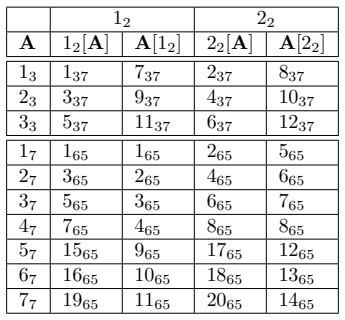
- [Section 4.3, list (4.1) and Figure 7] The classification of which at-most-four-atom algebras have normal representations is load-bearing for Theorem 1.4, but it is justified by the sentence 'we verified the condition in all cases by a computer program,' with no program, source code, data, or certificates supplied. Later arguments that apply only to algebras with normal representations (e.g., Theorems 5.8 and 5.10 and Propositions 5.16-5.21) inherit this classification. The counterexample rows in Figure 7 are also asserted without a displayed verification for each row. I request either a reproducible artifact (program plus output or certificates) or complete hand-verifiable proofs for the inclusions in (4.1) and for each of the fifteen counterexample rows in Figure 7.
- [Remark 6.11] The paper states, 'We mention (without proof) that the CSP of the atom structure of every relation algebra with at most four atoms not mentioned in this section is NP-complete. To check this we used a computer program to verify the conditions given in Theorem 2.11.' No proof, program, or certificates are provided. The displayed hardness proofs in Section 5 do not appear to invoke this remark, but the remark is presented as an exhaustive classification fact and should be either proved, removed, or accompanied by a reproducible verification; otherwise the reader cannot determine whether the atom-structure tractability arguments are complete.
minor comments (5)
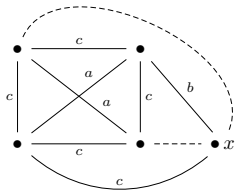
- [Section 5.6, Proposition 5.17] In the displayed pp-formula, the atom 'x4' appears in the conjunct '(r union Id)(z2,x4)', but x4 is not quantified and does not occur in the gadget description; this is presumably a typo for 'z4' (or the quantifier list should be amended).
- [Section 4.6, Propositions 4.13 and 4.14] The assertions that 39_65 fails AP(3,2,4) and 62_65 fails AP(3,2,6) are justified only by pointing to a figure. For reproducibility, please state explicitly which amalgamation instances fail and verify that the displayed labels respect the allowed triples.
- [Section 4.7.3, Proposition 4.26] The proof of representability of 56_65 verifies only the composition b composed with b equals a union b union Id and says the other cases are very similar. Since this representation is used in Corollary 5.27, I recommend including a complete composition table or an appendix with the remaining cases.
- [Remark 4.4] The claim that 62_65 has AP(5) but not AP(6), and that it is the unique four-atom algebra with this behavior, is stated without proof. If this remark is only about the optimality of Theorem 2.39, please label it as such; if it is used in the classification, a proof is needed.
- [Tables 4 and 5, row for 56_65] The table lists NSP(56_65) as NP-complete, citing the unpublished preprint [BGPJ+25] for containment in NP. Since Theorem 1.4 only asserts NP-hardness for this case, the table should clearly mark the NP-completeness entry as relying on an external preprint, or the proof should be included.
Circularity Check
No circularity in the derivation; unshipped computer checks and self-citations are verification concerns, not circular reductions.
full rationale
The paper's classification is built on Maddux's exhaustive lists, the representability results for small relation algebras, independent NP-hardness sources (SAT, graph coloring, PCSP(K3,K5)), and published theorems such as Bulatov's conservative CSP dichotomy. The derivation chain never assumes NSP(A) tractability or hardness in order to prove itself. Self-citations to [BK20], [BK22], [BK23], and [Bod18] are external, published, parameter-free theorems with stated assumptions that do not contain the target result, so they count as independent support rather than circularity. The computer-assisted verifications mentioned in Section 4.3 and Remark 6.11 are not supplied as code or certificates, but they are checks of external criteria (Theorem 2.39 and Theorem 2.11), not fitted parameters or definitions in terms of the conclusion; a wrong verification would be a correctness or reproducibility flaw, not a circular one. I therefore find no step where an equation is equivalent to its input by construction, no fitted parameter is renamed as a prediction, and no load-bearing claim reduces to an unverified self-citation.
Assumptions & free parameters
assumptions (6)
- domain assumption Maddux's enumeration of the 102 integral relation algebras with four atoms is complete and correct
- domain assumption The classification of relation algebras with at most three atoms by Andráska and Maddux is correct
- domain assumption The NSP complexity classification for at most three atoms from Cristiani-Hirsch [CH04] with corrections in [BK20] is correct
- ad hoc to paper The computer program used to verify the normal-representation condition in Section 4.3 is bug-free
- ad hoc to paper The computer program referenced in Remark 6.11 for checking atom-structure NP-completeness is bug-free
- standard math Standard model-theoretic, combinatorics, and complexity theorems used here are correct
Cite this review
Pith. "Pith review of The Network Satisfaction Problem for Relation Algebras with at most 4 Atoms." pith.science (2026). https://pith.science/paper/FCVUWG67
@misc{pith2026250709324,
  author       = {Pith},
  title        = {Pith review of: The Network Satisfaction Problem for Relation Algebras with at most 4 Atoms},
  year         = {2026},
  howpublished = {\url{https://pith.science/paper/FCVUWG67}},
  note         = {Machine review of arXiv:2507.09324}
}
read the original abstract
Andr\'eka and Maddux classified the relation algebras with at most 3 atoms, and in particular they showed that all of them are representable. Hirsch and Cristiani showed that the network satisfaction problem (NSP) for each of these algebras is in P or NP-hard. The literature contains many results on representations of relation algebras; in particular, some relation algebras with four atoms are not representable. We extend the result of Cristiani and Hirsch to relation algebras with at most 4 atoms: the NSP is always either in P or NP-hard. To this end, we construct universal, fully universal, or even normal representations for these algebras, whenever possible.
Figures


Figures from the paper (24 more)







Reference graph
Works this paper leans on
-
[1]
Hajnal Andr \' e ka and Roger D. Maddux. Representations for small relation algebras. Notre Dame Journal of Formal Logic , 35(4):550--562, 1994
work page 1994
-
[2]
Datalog and constraint satisfaction with infinite templates
Manuel Bodirsky and V\'ictor Dalmau. Datalog and constraint satisfaction with infinite templates. Journal on Computer and System Sciences , 79:79--100, 2013. A preliminary version appeared in the proceedings of the Symposium on Theoretical Aspects of Computer Science (STACS'05)
work page 2013
-
[3]
Hereditary First-Order Logic: the tractable quantifier prefix classes
Manuel Bodirsky and Santiago Guzmán-Pro. Hereditary first-order model checking, 2024. Preprint available under https://arxiv.org/abs/2411.10860
work page Pith review arXiv 2024
-
[4]
The G eneric C ircular T riangle- F ree G raph
Manuel Bodirsky and Santiago Guzmán-Pro. The G eneric C ircular T riangle- F ree G raph. Journal of G raph T heory , 109(4):426--445, 2025
work page 2025
-
[5]
Point algebras for temporal reasoning: Algorithms and complexity
Mathias Broxvall and Peter Jonsson. Point algebras for temporal reasoning: Algorithms and complexity. Artificial Intelligence , 149(2):179--220, 2003
work page 2003
-
[6]
Quasi-transitive digraphs
J rgen Bang-Jensen and Jing Huang. Quasi-transitive digraphs. Journal of Graph Theory , 20(2):141--161, 1995
1995
-
[7]
Manuel Bodirsky and Martin Kutz. Pure dominance constraints. In Proceedings of the Symposium on Theoretical Aspects of Computer Science (STACS) , pages 287--298, 2002
work page 2002
-
[8]
Determining the consistency of partial tree descriptions
Manuel Bodirsky and Martin Kutz. Determining the consistency of partial tree descriptions. Artificial Intelligence , 171:185--196, 2007
work page 2007
Show all 64 references
-
[9]
The complexity of temporal constraint satisfaction problems
Manuel Bodirsky and Jan K\'ara. The complexity of temporal constraint satisfaction problems. Journal of the ACM , 57(2):1--41, 2009. An extended abstract appeared in the Proceedings of the Symposium on Theory of Computing (STOC)
2009
-
[10]
Hardness of network satisfaction for relation algebras with normal representations
Manuel Bodirsky and Simon Kn\" a uer. Hardness of network satisfaction for relation algebras with normal representations. In Relational and Algebraic Methods in Computer Science , pages 31--46. Springer International Publishing, 2020
2020
-
[11]
The complexity of network satisfaction problems for symmetric relation algebras with a flexible atom
Manuel Bodirsky and Simon Kn \" a uer. The complexity of network satisfaction problems for symmetric relation algebras with a flexible atom. J. Artif. Intell. Res. , 75:1701--1744, 2022
2022
-
[12]
The complexity of network satisfaction problems for symmetric relation algebras with a flexible atom
Manuel Bodirsky and Simon Kn \" a uer. The complexity of network satisfaction problems for symmetric relation algebras with a flexible atom. Journal of Artificial Intelligence Research , 75, 2022
2022
-
[13]
Network satisfaction problems solved by k -consistency
Manuel Bodirsky and Simon Kn \" a uer. Network satisfaction problems solved by k -consistency. In 50th International Colloquium on Automata, Languages, and Programming, ICALP 2023, July 10-14, 2023, Paderborn, Germany , pages 116:1--116:20, 2023
2023
-
[14]
The equivalence of two dichotomy conjectures for infinite domain constraint satisfaction problems
Libor Barto, Michael Kompatscher, Miroslav Ol s \' a k, Trung Van Pham, and Michael Pinsker. The equivalence of two dichotomy conjectures for infinite domain constraint satisfaction problems. In Proceedings of the 32nd Annual ACM/IEEE Symposium on Logic in Computer Science -- ...
2017 arXiv
-
[15]
Krokhin, and Jakub Opr s al
Jakub Bul \' n, Andrei A. Krokhin, and Jakub Opr s al. Algebraic approach to promise constraint satisfaction. In Proceedings of the 51st Annual ACM SIGACT Symposium on Theory of Computing, STOC 2019, Phoenix, AZ, USA, June 23-26, 2019 , pages 602--613, 2019
2019
-
[16]
Constraint satisfaction problems for reducts of homogeneous graphs
Manuel Bodirsky, Barnaby Martin, Michael Pinsker, and Andr \' a s Pongr \' a cz. Constraint satisfaction problems for reducts of homogeneous graphs. SIAM Journal on Computing , 48(4):1224--1264, 2019. A conference version appeared in the Proceedings of the 43rd International C...
2019
-
[17]
Finite relation algebras with normal representations
Manuel Bodirsky. Finite relation algebras with normal representations. In Relational and Algebraic Methods in Computer Science - 17th International Conference, RAMiCS 2018, Groningen, The Netherlands, October 29 - November 1, 2018, Proceedings , pages 3--17, 2018
2018
-
[18]
Complexity of Infinite-Domain Constraint Satisfaction
Manuel Bodirsky. Complexity of Infinite-Domain Constraint Satisfaction . Lecture Notes in Logic (52). Cambridge University Press, Cambridge, United Kingdom; New York, NY, 2021
2021
-
[19]
The wonderland of reflections
Libor Barto, Jakub Opr s al, and Michael Pinsker. The wonderland of reflections. Israel Journal of Mathematics , 223(1):363--398, 2018
2018
-
[20]
Reducts of R amsey structures
Manuel Bodirsky and Michael Pinsker. Reducts of R amsey structures. AMS Contemporary Mathematics (Model Theoretic Methods in Finite Combinatorics) , 558:489--519, 2011
2011
-
[21]
Topological birkhoff
Manuel Bodirsky and Michael Pinsker. Topological birkhoff. Transactions of the American Mathematical Society , 367, 03 2012
2012
-
[22]
Schaefer's theorem for graphs
Manuel Bodirsky and Michael Pinsker. Schaefer's theorem for graphs. Journal of the ACM , 62(3):52 pages (article number 19), 2015. A conference version appeared in the Proceedings of STOC 2011, pages 655-664
2015
-
[23]
The algebraic dichotomy conjecture for infinite domain constraint satisfaction problems
Libor Barto and Michael Pinsker. The algebraic dichotomy conjecture for infinite domain constraint satisfaction problems. In Proceedings of the 31th A nnual IEEE S ymposium on L ogic in C omputer S cience -- LICS '16 , pages 615--622, 2016. Preprint arXiv:1602.04353
2016 arXiv
-
[24]
Projective clone homomorphisms
Manuel Bodirsky, Michael Pinsker, and Andr\' a s Pongr\'acz. Projective clone homomorphisms. Journal of Symbolic Logic , 86(1):148--161, 2021
2021
-
[25]
Burris and Hanamantagouda P
Stanley N. Burris and Hanamantagouda P. Sankappanavar. A Course in Universal Algebra . Springer Verlag, Berlin, 1981
1981
-
[26]
Andrei A. Bulatov. Tractable conservative constraint satisfaction problems. In Proceedings of the Symposium on Logic in Computer Science (LICS) , pages 321--330, Ottawa, Canada, 2003
2003
-
[27]
Andrei A. Bulatov. A dichotomy theorem for nonuniform CSP s. In 58th IEEE Annual Symposium on Foundations of Computer Science, FOCS 2017, B erkeley, CA , USA , O ctober 15-17 , pages 319--330, 2017
2017
-
[28]
Peter J. Cameron. The random graph. R. L. Graham and J. Ne s et r il, Editors, The Mathematics of Paul Erd\" o s , 1996
1996
-
[29]
The complexity of the constraint satisfaction problem for small relation algebras
Matteo Cristiani and Robin Hirsch. The complexity of the constraint satisfaction problem for small relation algebras. Artificial Intelligence Journal , 156:177--196, 2004
2004
-
[30]
Homogeneous digraphs I
Gregory Cherlin. Homogeneous digraphs I . T he imprimitive case. Logic Colloquium 1985 , 1987
1985
-
[31]
Gregory L. Cherlin. The classification of countable homogeneous directed graphs and countable homogeneous n -tournaments. AMS Memoir , 131(621), January 1998
1998
-
[32]
Homogeneous ordered graphs and metrically homogeneous graphs, 2020
Gregory Cherlin. Homogeneous ordered graphs and metrically homogeneous graphs, 2020. Preprint
2020
-
[33]
Constructions of color schemes
Stephen Comer. Constructions of color schemes. Acta Universitatis Carolinae. Mathematica et Physica , 24, 01 1983
1983
-
[34]
Stephen D. Comer. Extension of polygroups by polygroups and their representations using color schemes. In Ralph S. Freese and Octavio C. Garcia, editors, Universal Algebra and Lattice Theory , pages 91--103, Berlin, Heidelberg, 1983. Springer Berlin Heidelberg
1983
-
[35]
Stephen D. Comer. A remark on chromatic polygroups. Congressus Numerantium , 38:85--95, 1983
1983
-
[36]
Stephen D. Comer. Combinatorial aspects of relations. Algebra Universalis , 18(1):77--94, February 1984
1984
-
[37]
On datalog vs
Anuj Dawar and Stephan Kreutzer. On datalog vs. LFP . In Luca Aceto, Ivan Damg rd, Leslie Ann Goldberg, Magn \' u s M. Halld \' o rsson, Anna Ing \' o lfsd \' o ttir, and Igor Walukiewicz, editors, Automata, Languages and Programming, 35th International Colloquium, ICALP 2008,...
2008
-
[38]
Relation algebras and their application in temporal and spatial reasoning
Ivo D \" u ntsch. Relation algebras and their application in temporal and spatial reasoning. Artificial Intelligence Review , 23:315--357, 2005
2005
-
[39]
R. E. Greenwood and A. M. Gleason. Combinatorial relations and chromatic graphs. Canadian Journal of Mathematics , 7:1–7, 1955
1955
-
[40]
A guide to NP -completeness
Michael Garey and David Johnson. A guide to NP -completeness . CSLI Press, Stanford, 1978
1978
-
[41]
Ward Henson
C. Ward Henson. Countable homogeneous relational systems and categorical theories. Journal of Symbolic Logic , 37:494--500, 1972
1972
-
[42]
Hirsch and I
R. Hirsch and I. Hodkinson. Representability is not decidable for finite relation algebras. Transactions of the American Mathematical Society , 353(4):1387--1401), 2001
2001
-
[43]
Relation Algebras by Games
Robin Hirsch and Ian Hodkinson. Relation Algebras by Games . North Holland, 2002
2002
-
[44]
Relation algebras of intervals
Robin Hirsch. Relation algebras of intervals. Artificial Intelligence Journal , 83:1--29, 1996
1996
-
[45]
A finite relation algebra with undecidable network satisfaction problem
Robin Hirsch. A finite relation algebra with undecidable network satisfaction problem. Logic Journal of the IGPL , 7(4):547--554, 1999
1999
-
[46]
Twenty years of N e s et r il's classification programme of R amsey classes
Jan Hubi c ka and Mat e j Kone c n \`y . Twenty years of N e s et r il's classification programme of R amsey classes. Preprint arXiv:2501.17293, 2025
2025
-
[47]
A shorter model theory
Wilfrid Hodges. A shorter model theory . Cambridge University Press, Cambridge, 1997
1997
-
[48]
Boolean algebras with operators
Bjarni Jónnson and Alfred Tarski. Boolean algebras with operators. American Journal of Mathematics , 74(1):127--162, 1952
1952
-
[49]
Constraint satisfaction over the random tournament, 2018
Simon Kn \"a uer. Constraint satisfaction over the random tournament, 2018. Master Thesis at the Institute of Algebra, TU Dresden
2018
-
[50]
Richard E. Ladner. On the structure of polynomial time reducibility. Journal of the ACM , 22(1):155--171, 1975
1975
-
[51]
Lachlan and Robert E
Alistair H. Lachlan and Robert E. Woodrow. Countable ultrahomogeneous undirected graphs. Transactions of the AMS , 262(1):51--94, 1980
1980
-
[52]
R. Lyndon. The representation of relational algebras. Annals of Mathematics , 51(3):707--729, 1950
1950
-
[53]
A survey of homogeneous structures
Dugald Macpherson. A survey of homogeneous structures. Discrete Mathematics , 311(15):1599--1634, 2011
2011
-
[54]
Roger D. Maddux. Finite symmetric integral relation algebras with no 3-cycles. In Renate A. Schmidt, editor, Relations and Kleene Algebra in Computer Science, 9th International Conference on Relational Methods in Computer Science and 4th International Workshop on Applications ...
2006
-
[55]
Relation Algebras: Volume 150
Roger Duncan Maddux. Relation Algebras: Volume 150 . Studies in logic and the foundations of mathematics. Elsevier Science, London, England, May 2006
2006
-
[56]
On representable relation algebras
Donald Monk. On representable relation algebras. Michigan Mathematical Journal , 11(3):207 -- 210, 1964
1964
-
[57]
The Two-Valued Iterative Systems of Mathematical Logic
Emil Leon Post. The Two-Valued Iterative Systems of Mathematical Logic . H. Milford, Oxford university press, London,, 1941
1941
-
[58]
Schaefer
Thomas J. Schaefer. The complexity of satisfiability problems. Proceedings of the Tenth Annual ACM Symposium on Theory of Computing, STOC 1978, San Diego, California, USA , pages 216--226, 1978
1978
-
[59]
Contributions to the theory of models
Alfred Tarski. Contributions to the theory of models. Koninklijke Nederlandse Akademie van Wetenschappen, Proceedings , 58:56–64, 1955
1955
-
[60]
Constraint propagation algorithms for temporal reasoning: A revised report
Marc Vilain, Henry Kautz, and Peter van Beek. Constraint propagation algorithms for temporal reasoning: A revised report. Reading in Qualitative Reasoning about Physical Systems , pages 373--381, 1989
1989
-
[61]
Tarjan, and Eugene L
Jacobo Valdes, Robert E. Tarjan, and Eugene L. Lawler. The recognition of series parallel digraphs. SIAM Journal on Computing , 11(2):298--313, 1982
1982
-
[62]
Dmitriy N. Zhuk. A proof of CSP dichotomy conjecture. In 58th IEEE Annual Symposium on Foundations of Computer Science, FOCS 2017, B erkeley, CA , USA , O ctober 15-17 , pages 331--342, 2017. https://arxiv.org/abs/1704.01914
2017 arXiv
-
[63]
A proof of the CSP dichotomy conjecture
Dmitriy Zhuk. A proof of the CSP dichotomy conjecture. J. ACM , 67(5):30:1--30:78, 2020
2020
-
[64]
Hypergroups
Paul-Hermann Zieschang. Hypergroups . Springer, 2023
2023
Reviewed August 6, 2026 · model on record in the stance chip above.
Discussion (0). Continue with ORCID to comment.