REVIEW 3 major objections 6 minor 62 references
Efficiency, Feasibility, and Incentive-Awareness in Constrained Online Resource Allocation
T0 review · 3 major / 6 minor · reviewed 2026-08-06 · deepseek-v4-flash
Pith's one-line read The paper argues constrained online resource allocation can tolerate strategic agents at no polynomial-order cost: Õ(√T) regret matching the non-strategic lower bound, exact long-term constraints, and near-truthful reports in equilibrium.
desk verdict A serious paper with a genuinely new mechanism and a plausible high-level story, but the PBE proof has a load-bearing gap involving the cost-feasibility rejection rule, and several smaller mechanical errors need fixing before the main theorem is credible for Algorithm 2 as stated. read the letter →
The pith
A machine-rendered reading of the paper's core claim, the machinery that carries it, and where it could break.
The reading
What carries the argument
Three components carry the argument. (1) Epoch-based lazy updates: the dual variable $\lambda_\ell$ is fixed for the whole epoch $E_\ell$, so any single misreport has limited and delayed influence on future shadow prices. (2) A boosted second-price payment rule: the winner pays their dual-weighted cost plus the runner-up's adjusted report, making truthful reporting weakly dominant in the one-shot epoch game (Lemma B.1, Theorem B.2). (3) Randomized exploration rounds: with probability $1/|E_\ell|$ the mechanism offers a uniformly random price to a random agent, giving any misreport an expected immediate loss of order $(u-v)^2/(K|E_\ell|)$; Lemma B.3 shows this outweighs the $\gamma$-discounted future benefit of manipulating the next dual, so large misreports occur in only $\widetilde{O}(1)$ rounds per epoch. The dual-side novelty is O-FTRL-FP (Eq. (6)), which adds an optimistic prediction term $\widetilde{g}_\ell(\lambda_\ell)^\top \lambda$ — an estimate of the coming epoch's loss built from past reports — to the FTRL objective. Because the prediction depends on $\lambda_\ell$ through an argmax, the update is a fixed-point problem: the paper proves existence of approximate fixed points via a partition-of-unity (Brouwer) argument under an approximate-continuity condition (Lemmas C.4, C.5), and then bounds the three stability errors — allocation mismatch, empirical estimation, and untruthful reports (Lemmas C.6–C.8).
What would settle it
Run the mechanism with nearly patient agents ($\gamma = 1$ or $\gamma = 1 - 1/T$), let them learn their reports with a high-capacity algorithm over thousands of repetitions, and measure whether large misreports persist and whether the average regret stays at $\widetilde{O}(\sqrt{T})$. A sharper targeted check comes from the paper's own Lemma B.3: in the two-agent identical-value example of Example 4, evaluate the inequality that must hold between the exploration loss ($1/(2K|E_\ell|^3)$) and the discounted manipulation benefit; the regime where $\gamma^{s_{\ell+1}}/(1-\gamma)$ exceeds that loss is precisely where the paper's proof no longer guarantees near-truthfulness.
Extended reading notes
Core claim
The paper's central claim is Theorem 3.2 (formalized as Theorem A.2): under Assumptions 1 and 3, Algorithm 2 with the O-FTRL-FP dual update guarantees the existence of a Perfect Bayesian Equilibrium strategy profile $\pi^*$ under which the social-welfare regret relative to the offline optimal allocation is $R_T(\pi^*, \text{Algorithm 2}) = \widetilde{O}(\sqrt{T})$ and the long-term constraint violation is $B_T = 0$. The regret rate matches, up to logarithmic factors, the $\Omega(\sqrt{T})$ lower bound for the non-strategic version of the problem, so incentive compatibility comes at essentially no polynomial-order cost. The near-truthfulness of the equilibrium is what unlocks the faster rate: agents rarely misreport by more than $1/|E_\ell|$, so the planner can treat historical reports as approximately true signals, predict the loss of any candidate dual vector, and run an optimistic online learner. Plain FTRL cannot reach this rate, because the epoch structure needed for incentive compatibility triggers an $\Omega(T^{2/3})$ switching-cost barrier (Theorem 4.4) that only breaks once the losses acquire an almost-i.i.d. structure from truthful reports.
Load-bearing premise
The load-bearing premise is Assumption 1: every agent maximizes a $\gamma$-discounted payoff over the whole game, for a fixed discount factor $\gamma \in (0,1)$, and the guarantee degrades if agents are nearly patient, because the bound on the future benefit of manipulating the next epoch's dual is proportional to $\gamma^{s_{\ell+1}}/(1-\gamma)$, which diverges as $\gamma \to 1$, so the fixed exploration penalty no longer outweighs manipulation and the near-truthful equilibrium is not established.
Editorial extensions
If this is right
- A planner can add robustness to strategic misreporting at no polynomial-order cost: $\widetilde{O}(\sqrt{T})$ regret with exact constraint satisfaction, against the $\Omega(\sqrt{T})$ lower bound in the truthful-agent benchmark.
- Because agents are near-truthful in equilibrium, the planner's historical reports become trustworthy samples, which is what makes optimistic dual prediction possible and upgrades the rate from $T^{2/3}$ to $\sqrt{T}$.
- The mechanism satisfies long-term constraints exactly ($B_T = 0$), since any allocation that would push cumulative cost past the budget is rejected immediately.
- The epoch-based lazy update is necessary for incentives and sufficient for learning only in combination with exploration; the paper formalizes the trade-off as an $\Omega(T^{2/3})$ low-switching barrier for plain FTRL.
- The framework extends to multi-unit multi-demand allocation, so the design principles carry beyond one-item-per-round settings.
Reading between the lines
- The stabilise-then-predict recipe — freeze prices, punish deviations, then exploit the cleaner signal for optimistic learning — likely transfers to other settings where learning and incentives conflict, such as repeated auctions with budgets or procurement with strategic suppliers.
- The O-FTRL-FP subroutine is a reusable primitive: an optimistic learner for decision-dependent, discontinuous loss predictions, applicable beyond mechanism design wherever the loss gradient depends on the chosen action through an argmax.
- For nearly patient agents the paper's guarantees are silent; a testable extension would scale the exploration probability with $1/(1-\gamma)$ and check numerically how the regret constant degrades as $\gamma \to 1$.
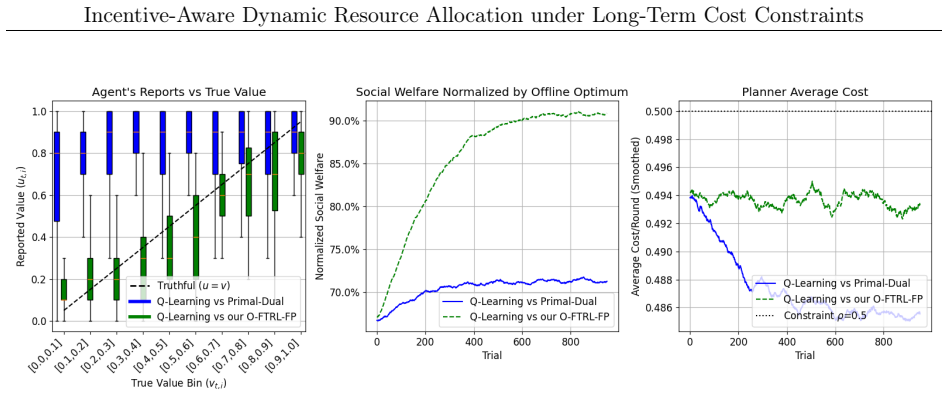
- The simulation suggests a stronger conjecture than the theorem: Q-learning agents not only live alongside a truthful equilibrium but converge to it; measuring convergence rates under different exploration schedules would settle this.
Editorial analysis
A structured set of objections, weighed in public.
Referee Report
Summary. The paper studies repeated allocation of a single indivisible resource among K strategic agents over T rounds, under d long-term cost constraints. Agents hold private values and observe public costs; the planner knows neither value nor cost distributions. The authors propose the Incentive-Aware Primal-Dual (IAPD) framework combining epoch-based lazy dual updates, VCG-style adjusted payments, randomized exploration rounds, and a cumulative-cost rejection safeguard. Two dual-update rules are analyzed: FTRL and a novel Optimistic FTRL with Fixed Points (O-FTRL-FP). The paper claims, under a γ-impatient agent model and a smooth-cost assumption, the existence of a Perfect Bayesian Equilibrium with near-truthful reports, zero long-term constraint violation, and regret Õ(T^{2/3}) for FTRL and Õ(√T) for O-FTRL-FP, the latter matching the non-strategic lower bound up to polylogarithmic factors.
Significance. If correct, the √T regret guarantee under strategic behavior would be a notable contribution, indicating that incentive compatibility can be obtained at negligible asymptotic cost in constrained online allocation. The O-FTRL-FP fixed-point oracle is a novel and interesting technical device, and the appendix provides an extensive proof skeleton with several sophisticated concentration arguments (e.g., Lemmas C.4–C.8). The numerical study is a further strength. However, the main equilibrium theorem relies on an incentive analysis that explicitly excludes the mechanism's own feasibility-rejection rule when evaluating deviations, and this gap must be closed before the central claims are fully supported.
major comments (3)
- [Appendix B.2, Lemma B.3 and proof of Theorem B.5] The incentive analysis is conducted in the 'epoch-ℓ game with exploration rounds' specified by Lines 4 to 12 of Algorithm 2, i.e., without the cumulative-cost rejection rule in Lines 13–14. The proof of Theorem B.5 argues that Line 14 'has no effect' because of the stopping time T_v, but T_v is defined using the equilibrium path allocations. A unilateral deviation can change the cumulative cost process, so Line 14 can trigger at a round t ≤ T_v (where T_v is evaluated under π*) and reject the tentative allocation. When a tentative allocation is rejected, the agent receives utility 0 rather than v−p, so the exploration-round penalty −(u−v)²/(2K|E_ℓ|) used in the proof of Lemma B.3 is not incurred. Consequently, the key inequality preceding Eq. (17) is not justified for Algorithm 2 as stated, and the existence of the PBE π* asserted in Theorem B.5 (and used in Theorems 3.1 and 3.2) is not established. The proof needs to handle deviations that cause earlier triggering of Line 14, or the mechanism must be modified so that the rejection rule does not remove the exploration penalty.
- [Algorithm 2, Line 12 vs. Section 2.1 and Lemma B.1] Line 12 of Algorithm 2 allocates to argmax_i ũ_{t,i} with the maximization implicitly over agents i ∈ [K], while the analysis (Lemma B.1, the definition of e_i*_t in Eq. (13), and the benchmark in Eq. (2)) uses argmax over {0}∪[K], treating forfeiture as a dummy agent with zero value and zero cost. If the mechanism cannot forfeit in standard rounds, the payment becomes the second-highest among the K agents rather than max(0, second-highest), and the truthfulness argument in Lemma B.1 no longer applies. The algorithm should explicitly include the dummy option in the argmax, with forfeiture when the dummy wins, or the analysis must be reworked for a mechanism restricted to [K].
- [Appendix A.1, Theorem A.1] The theorem statement sets L = T^{1/3} and epoch length |E_ℓ| = T/L = T^{2/3}, but the proof's balancing step states 'Setting L = T^{2/3} and |E_ℓ| = T^{1/3}' and the subsequent regret calculation uses that choice. The statement should be corrected to L = T^{2/3}, |E_ℓ| = T^{1/3} to match the proof and the claimed Õ(T^{2/3}) regret. As written, the formal statement is internally inconsistent.
minor comments (6)
- [Appendix A.2, Theorem A.2] The definition of M_ℓ in Theorem A.2 depends on parameters ε and δ that are not specified in the theorem statement. The proof later sets ε = 1/(√T K²ε_c) and δ = 1/(6dT); these values (or an explicit statement that they are arbitrary constants) should be included in the theorem statement so that the regret bound is well-defined.
- [Section 4.2.5] The text 'more preciously' should read 'more precisely'.
- [Appendix B.2, Eq. (20)] In the displayed inequality in the proof of Theorem B.5, the term '3|E_ℓ|/|E_ℓ|' is equal to 3 and appears to be a typographical artifact; it should be written as the additive constant 3 from the union bound over the three failure events.
- [Algorithm 2, Line 14] When Line 14 rejects the tentative allocation by setting i_t = 0, the payment p_{t,i_t} for the tentative winner is not explicitly set to zero. The pseudocode should state that the payment is also canceled to avoid ambiguity.
- [Eq. (14)] In the definition of the stopping time T_v, the term '+1' should be written as the vector 1 ∈ R^d (or explicitly 'coordinate-wise +1') to avoid confusion between scalar and vector addition.
- [General] The title in the running header ('Efficiency, Feasibility, and Incentive-Awareness in Constrained Online Resource Allocation') differs from the title on the first page and in the abstract ('Incentive-Aware Dynamic Resource Allocation under Long-Term Cost Constraints'). The paper should use one consistent title.
Circularity Check
No significant circularity: the regret target is not an input to the equilibrium or fixed-point construction; self-citations are non-load-bearing.
full rationale
Walking the derivation chain, the main claims are not circular. The O-FTRL-FP update in Eq. (6) defines the predictor e_g_l(lambda_l) from historical reports and costs, and then solves a fixed-point problem; the paper explicitly proves the existence of (approximate) fixed points via Lemma C.4 and the approximate-continuity Lemma C.5, rather than assuming the predictor equals the true loss gradient. The near-truthfulness guarantee used in the regret analysis is derived independently in Lemma B.3 from the exploration-round penalty (u-v)^2/(2K|E_l|) and gamma-impatience; it does not import the O(sqrt(T)) regret bound as an input. Theorem B.5 constructs a PBE pi* that is independent of the dual-update subroutine, so Theorem C.3 can legitimately use it to bound the stability terms. The only self-citations are the gamma-impatient model in Assumption 1 (attributed to Golrezaei et al. 2021a, 2023) and a motivating remark that Lemmas B.3/B.4 are inspired by that line of work, but the paper does not rely on those citations as theorems; it provides its own proofs adapted to the cost-constrained setting. The skeptic's concern about Line 14's rejection rule erasing exploration penalties is a potential gap in the equilibrium proof, but it is not a circular reduction: a missing case in a proof is different from a conclusion being assumed as an input. No equation in the paper is defined in terms of the claimed regret, and no fitted parameter is renamed as a prediction. Overall, the derivation is self-contained apart from routine citations of standard online-learning tools.
Assumptions & free parameters
free parameters (4)
- Epoch schedule for FTRL (L, |E_ℓ|) =
Statement says L=T^(1/3), |E_ℓ|=T^(2/3); proof uses L=T^(2/3), |E_ℓ|=T^(1/3)
- Epoch schedule for O-FTRL-FP (L, |E_ℓ|) =
L=ceil(log T), |E_ℓ|=2^(ℓ-1)
- Learning rates η_ℓ =
FTRL: η_ℓ ∝ (Σ|E_ℓ'|²)^(-1/2); O-FTRL-FP: η_ℓ ∝ (Σ|E_ℓ'|)^(-1/2)
- Exploration probability and price distribution =
1/|E_ℓ| per round; p ~ Unif[0,1]
assumptions (7)
- domain assumption γ-impatient agents: each agent i maximizes E[Σ_{t=1}^T γ^t (v_{t,i} - p_{t,i}) 1[i_t=i]] for a fixed unknown γ∈(0,1).
- domain assumption Values and costs are i.i.d. across agents and rounds from fixed unknown distributions V_i and C_i.
- domain assumption Smooth costs: for each i and each λ∈Λ, the density of λ^T c_i is uniformly bounded by ϵ_c.
- domain assumption Agents know the value and cost distributions and the mechanism; the planner does not know the distributions.
- standard math Standard results: FTRL and O-FTRL regret bounds, multiplicative Azuma-Hoeffding, vector Bernstein, Brouwer fixed point theorem, and partition of unity.
- ad hoc to paper The planner can compute an (η_ℓ L_ℓ)-approximate fixed point of Eq. (6).
- ad hoc to paper Payments may be negative and do not enter the social welfare objective.
Cite this review
Pith. "Pith review of Efficiency, Feasibility, and Incentive-Awareness in Constrained Online Resource Allocation." pith.science (2026). https://pith.science/paper/4HWE45P3
@misc{pith2026250709473,
  author       = {Pith},
  title        = {Pith review of: Efficiency, Feasibility, and Incentive-Awareness in Constrained Online Resource Allocation},
  year         = {2026},
  howpublished = {\url{https://pith.science/paper/4HWE45P3}},
  note         = {Machine review of arXiv:2507.09473}
}
abstract
We study the dynamic allocation of indivisible resources to strategic agents under long-term constraints, where the planner aims to maximize social welfare, satisfy multiple constraints, and elicit near-truthful reports. We find standard primal-dual methods fragile in this setting: agents easily manipulate their reports to distort dual variables, sacrificing social efficiency for individual utility. To address this, we propose the Incentive-Aware Primal-Dual (IAPD) framework. On the primal side, we integrate three components to suppress manipulation: a VCG-based payment neutralizes immediate misreporting benefits, while epoch-based lazy updates and random exploration together ensure potential future gains are outweighed by immediate penalties. On the dual side, to overcome a learning barrier due to lazy updates -- which we call the "price of incentives" -- we design a novel optimistic online learning algorithm, O-FTRL-FP. It utilizes a fixed-point oracle to resolve the circular dependency between optimistic dual variables and the resulting allocations. Ultimately, our mechanism attains $\tilde{\mathcal O}(\sqrt T)$ social welfare regret, satisfies all long-term constraints, and induces a near-truthful equilibrium. It also smoothly generalizes to multi-unit multi-demand allocation problems. Notably, this $\tilde{\mathcal O}(\sqrt T)$ regret near-matches the non-strategic $\Omega(\sqrt T)$ lower bound, demonstrating that incentive-awareness can be accommodated at nearly no cost.
Figures


Reference graph
Works this paper leans on
-
[1]
Ivo Adan, Jos Bekkers, Nico Dellaert, Jan Vissers, and Xiaoting Yu. Patient mix optimisation and stochastic resource requirements: A case study in cardiothoracic surgery planning. Health care management science, 12: 0 129--141, 2009
work page 2009
-
[2]
A dynamic near-optimal algorithm for online linear programming
Shipra Agrawal, Zizhuo Wang, and Yinyu Ye. A dynamic near-optimal algorithm for online linear programming. Operations Research, 62 0 (4): 0 876--890, 2014
2014
-
[3]
Learning prices for repeated auctions with strategic buyers
Kareem Amin, Afshin Rostamizadeh, and Umar Syed. Learning prices for repeated auctions with strategic buyers. Advances in neural information processing systems, 26, 2013
work page 2013
-
[4]
Repeated contextual auctions with strategic buyers
Kareem Amin, Afshin Rostamizadeh, and Umar Syed. Repeated contextual auctions with strategic buyers. Advances in Neural Information Processing Systems, 27, 2014
work page 2014
-
[5]
Uniformly bounded regret in the multisecretary problem
Alessandro Arlotto and Itai Gurvich. Uniformly bounded regret in the multisecretary problem. Stochastic Systems, 9 0 (3): 0 231--260, 2019
2019
-
[6]
A difficulty in the concept of social welfare
Kenneth J Arrow. A difficulty in the concept of social welfare. Journal of political economy, 58 0 (4): 0 328--346, 1950
work page 1950
-
[7]
Bandits with knapsacks
Ashwinkumar Badanidiyuru, Robert Kleinberg, and Aleksandrs Slivkins. Bandits with knapsacks. Journal of the ACM (JACM), 65 0 (3): 0 1--55, 2018
2018
-
[8]
Learning in repeated auctions with budgets: Regret minimization and equilibrium
Santiago R Balseiro and Yonatan Gur. Learning in repeated auctions with budgets: Regret minimization and equilibrium. Management Science, 65 0 (9): 0 3952--3968, 2019
work page 2019
Show all 62 references
-
[9]
Multiagent mechanism design without money
Santiago R Balseiro, Huseyin Gurkan, and Peng Sun. Multiagent mechanism design without money. Operations Research, 67 0 (5): 0 1417--1436, 2019
2019
-
[10]
The best of many worlds:: Dual mirror descent for online allocation problems
Santiago R Balseiro, Haihao Lu, and Vahab Mirrokni. The best of many worlds:: Dual mirror descent for online allocation problems. Operations Research, 71 0 (1): 0 101--119, 2023
2023
-
[11]
Robust pseudo-markets for reusable public resources
Siddhartha Banerjee, Giannis Fikioris, and Eva Tardos. Robust pseudo-markets for reusable public resources. In Proceedings of the 24th ACM Conference on Economics and Computation, pages 241--241, 2023
2023
-
[12]
To spend or to gain: Online learning in repeated karma auctions
Damien Berriaud, Ezzat Elokda, Devansh Jalota, Emilio Frazzoli, Marco Pavone, and Florian D \"o rfler. To spend or to gain: Online learning in repeated karma auctions. arXiv preprint arXiv:2403.04057, 2024
2024 arXiv
-
[13]
Convex analysis and optimization, volume 1
Dimitri Bertsekas, Angelia Nedic, and Asuman Ozdaglar. Convex analysis and optimization, volume 1. Athena Scientific, 2003
2003
-
[14]
Near-optimal mechanisms for resource allocation without monetary transfers
Moise Blanchard and Patrick Jaillet. Near-optimal mechanisms for resource allocation without monetary transfers. arXiv preprint arXiv:2408.10066, 2024
2024 arXiv
-
[15]
Market-oriented cloud computing: Vision, hype, and reality for delivering it services as computing utilities
Rajkumar Buyya, Chee Shin Yeo, and Srikumar Venugopal. Market-oriented cloud computing: Vision, hype, and reality for delivering it services as computing utilities. In 2008 10th IEEE international conference on high performance computing and communications, pages 5--13. Ieee, 2008
2008
-
[16]
Online learning with knapsacks: the best of both worlds
Matteo Castiglioni, Andrea Celli, and Christian Kroer. Online learning with knapsacks: the best of both worlds. In International Conference on Machine Learning, pages 2767--2783. PMLR, 2022
2022
-
[17]
Regret analysis of bilateral trade with a smoothed adversary
Nicol \`o Cesa-Bianchi, Tommaso Cesari, Roberto Colomboni, Federico Fusco, and Stefano Leonardi. Regret analysis of bilateral trade with a smoothed adversary. Journal of Machine Learning Research, 25 0 (234): 0 1--36, 2024 a
2024
-
[18]
The role of transparency in repeated first-price auctions with unknown valuations
Nicol \`o Cesa-Bianchi, Tommaso Cesari, Roberto Colomboni, Federico Fusco, and Stefano Leonardi. The role of transparency in repeated first-price auctions with unknown valuations. In Proceedings of the 56th Annual ACM Symposium on Theory of Computing, pages 225--236, 2024 b
2024
-
[19]
Multipart pricing of public goods
Edward H Clarke. Multipart pricing of public goods. Public choice, pages 17--33, 1971
1971
-
[20]
Positive results for mechanism design without money
Richard Cole, Vasilis Gkatzelis, and Gagan Goel. Positive results for mechanism design without money. In Proceedings of the 2013 international conference on Autonomous agents and multi-agent systems, pages 1165--1166, 2013
2013
-
[21]
Non-monetary mechanism design without distributional information: Using scarce audits wisely
Yan Dai, Moise Blanchard, and Patrick Jaillet. Non-monetary mechanism design without distributional information: Using scarce audits wisely. arXiv preprint arXiv:2502.08412, 2025
2025 arXiv
-
[22]
Bandits with switching costs: T 2/3 regret
Ofer Dekel, Jian Ding, Tomer Koren, and Yuval Peres. Bandits with switching costs: T 2/3 regret. In Proceedings of the forty-sixth annual ACM symposium on Theory of computing, pages 459--467, 2014
2014
-
[23]
The adwords problem: online keyword matching with budgeted bidders under random permutations
Nikhil R Devanur and Thomas P Hayes. The adwords problem: online keyword matching with budgeted bidders under random permutations. In Proceedings of the 10th ACM conference on Electronic commerce, pages 71--78, 2009
2009
-
[24]
Near optimal online algorithms and fast approximation algorithms for resource allocation problems
Nikhil R Devanur, Kamal Jain, Balasubramanian Sivan, and Christopher A Wilkens. Near optimal online algorithms and fast approximation algorithms for resource allocation problems. Journal of the ACM (JACM), 66 0 (1): 0 1--41, 2019
2019
-
[25]
Adaptive subgradient methods for online learning and stochastic optimization
John Duchi, Elad Hazan, and Yoram Singer. Adaptive subgradient methods for online learning and stochastic optimization. Journal of machine learning research, 12 0 (7), 2011
2011
-
[26]
Smoothed analysis of online non-parametric auctions
Naveen Durvasula, Nika Haghtalab, and Manolis Zampetakis. Smoothed analysis of online non-parametric auctions. In Proceedings of the 24th ACM Conference on Economics and Computation, pages 540--560, 2023
2023
-
[27]
Online stochastic packing applied to display ad allocation
Jon Feldman, Monika Henzinger, Nitish Korula, Vahab S Mirrokni, and Cliff Stein. Online stochastic packing applied to display ad allocation. In European Symposium on Algorithms, pages 182--194. Springer, 2010
2010
-
[28]
Online resource sharing via dynamic max-min fairness: efficiency, robustness and non-stationarity
Giannis Fikioris, Siddhartha Banerjee, and \'E va Tardos. Online resource sharing via dynamic max-min fairness: efficiency, robustness and non-stationarity. arXiv preprint arXiv:2310.08881, 2023
2023 arXiv
-
[29]
Learning in repeated multiunit pay-as-bid auctions
Rigel Galgana and Negin Golrezaei. Learning in repeated multiunit pay-as-bid auctions. Manufacturing & Service Operations Management, 27 0 (1): 0 200--229, 2025
2025
-
[30]
A. Gibbard. Manipulation of voting schemes: A general result. Econometrica, 41 0 (4): 0 587--601, 1973
1973
-
[31]
Real-time optimization of personalized assortments
Negin Golrezaei, Hamid Nazerzadeh, and Paat Rusmevichientong. Real-time optimization of personalized assortments. Management Science, 60 0 (6): 0 1532--1551, 2014
2014
-
[32]
No-regret learning in price competitions under consumer reference effects
Negin Golrezaei, Patrick Jaillet, and Jason Cheuk Nam Liang. No-regret learning in price competitions under consumer reference effects. Advances in Neural Information Processing Systems, 33: 0 21416--21427, 2020
2020
-
[33]
Dynamic incentive-aware learning:: Robust pricing in contextual auctions
Negin Golrezaei, Adel Javanmard, and Vahab Mirrokni. Dynamic incentive-aware learning:: Robust pricing in contextual auctions. Operations Research, 69 0 (1): 0 297--314, 2021 a
2021
-
[34]
Boosted second price auctions: Revenue optimization for heterogeneous bidders
Negin Golrezaei, Max Lin, Vahab Mirrokni, and Hamid Nazerzadeh. Boosted second price auctions: Revenue optimization for heterogeneous bidders. In Proceedings of the 27th ACM SIGKDD Conference on Knowledge Discovery & Data Mining, pages 447--457, 2021 b
2021
-
[35]
Incentive-aware contextual pricing with non-parametric market noise
Negin Golrezaei, Patrick Jaillet, and Jason Cheuk Nam Liang. Incentive-aware contextual pricing with non-parametric market noise. In International Conference on Artificial Intelligence and Statistics, pages 9331--9361. PMLR, 2023
2023
-
[36]
The remarkable robustness of the repeated fisher market
Artur Gorokh, Siddhartha Banerjee, and Krishnamurthy Iyer. The remarkable robustness of the repeated fisher market. In Proceedings of the 22nd ACM Conference on Economics and Computation, pages 562--562, 2021 a
2021
-
[37]
From monetary to nonmonetary mechanism design via artificial currencies
Artur Gorokh, Siddhartha Banerjee, and Krishnamurthy Iyer. From monetary to nonmonetary mechanism design via artificial currencies. Mathematics of Operations Research, 46 0 (3): 0 835--855, 2021 b
2021
-
[38]
Incentives in teams
Theodore Groves. Incentives in teams. Econometrica: Journal of the Econometric Society, pages 617--631, 1973
1973
-
[39]
Strategy-proof allocation of multiple items between two agents without payments or priors
Mingyu Guo and Vincent Conitzer. Strategy-proof allocation of multiple items between two agents without payments or priors. In AAMAS, pages 881--888, 2010
2010
-
[40]
How the experts algorithm can help solve lps online
Anupam Gupta and Marco Molinaro. How the experts algorithm can help solve lps online. Mathematics of Operations Research, 41 0 (4): 0 1404--1431, 2016
2016
-
[41]
On strategy-proof allocation without payments or priors
Li Han, Chunzhi Su, Linpeng Tang, and Hongyang Zhang. On strategy-proof allocation without payments or priors. In International Workshop on Internet and Network Economics, pages 182--193. Springer, 2011
2011
-
[42]
Catch me if you can: Combatting fraud in artificial currency based government benefits programs
Devansh Jalota, Matthew Tsao, and Marco Pavone. Catch me if you can: Combatting fraud in artificial currency based government benefits programs. arXiv preprint arXiv:2402.16162, 2024
2024 arXiv
-
[43]
Dynamic reserve prices for repeated auctions: Learning from bids
Yash Kanoria and Hamid Nazerzadeh. Dynamic reserve prices for repeated auctions: Learning from bids. In Web and Internet Economics: 10th International Conference, volume 8877, page 232. Springer, 2014
2014
-
[44]
Primal beats dual on online packing lps in the random-order model
Thomas Kesselheim, Klaus Radke, Andreas Tonnis, and Berthold Vocking. Primal beats dual on online packing lps in the random-order model. SIAM Journal on Computing, 47 0 (5): 0 1939--1964, 2018
1939
-
[45]
Sub-sampled cubic regularization for non-convex optimization
Jonas Moritz Kohler and Aurelien Lucchi. Sub-sampled cubic regularization for non-convex optimization. In International Conference on Machine Learning, pages 1895--1904. PMLR, 2017
1904
-
[46]
A nearly linear-time ptas for explicit fractional packing and covering linear programs
Christos Koufogiannakis and Neal E Young. A nearly linear-time ptas for explicit fractional packing and covering linear programs. Algorithmica, 70: 0 648--674, 2014
2014
-
[47]
Simple and fast algorithm for binary integer and online linear programming
Xiaocheng Li, Chunlin Sun, and Yinyu Ye. Simple and fast algorithm for binary integer and online linear programming. Mathematical Programming, 200 0 (2): 0 831--875, 2023
2023
-
[48]
Cardinal bayesian allocation mechanisms without transfers
Antonio Miralles. Cardinal bayesian allocation mechanisms without transfers. Journal of Economic Theory, 147 0 (1): 0 179--206, 2012
2012
-
[49]
The geometry of online packing linear programs
Marco Molinaro and Ramamoorthi Ravi. The geometry of online packing linear programs. Mathematics of Operations Research, 39 0 (1): 0 46--59, 2014
2014
-
[50]
J.R. Munkres. Topology. Featured Titles for Topology. Prentice Hall, Incorporated, 2000. ISBN 9780131816299. URL https://books.google.com/books?id=XjoZAQAAIAAJ
2000
-
[51]
Truthful greedy mechanisms for dynamic virtual machine provisioning and allocation in clouds
Mahyar Movahed Nejad, Lena Mashayekhy, and Daniel Grosu. Truthful greedy mechanisms for dynamic virtual machine provisioning and allocation in clouds. IEEE transactions on parallel and distributed systems, 26 0 (2): 0 594--603, 2014
2014
-
[52]
A modern introduction to online learning
Francesco Orabona. A modern introduction to online learning. arXiv preprint arXiv:1912.13213, 2019
1912 arXiv
-
[53]
Online learning with predictable sequences
Alexander Rakhlin and Karthik Sridharan. Online learning with predictable sequences. In Conference on Learning Theory, pages 993--1019. PMLR, 2013
2013
-
[54]
Satterthwaite
N.A. Satterthwaite. Strategy-proofness and A rrow's conditions: E xistence and correspondence theorems for voting procedures and social welfare functions. Journal of Economic Theory, 10 0 (2): 0 187--217, 1975
1975
-
[55]
Determining location and size of medical departments in a hospital network: A multiobjective decision support approach
Christian Stummer, Karl Doerner, Axel Focke, and Kurt Heidenberger. Determining location and size of medical departments in a hospital network: A multiobjective decision support approach. Health care management science, 7: 0 63--71, 2004
2004
-
[56]
Near-optimal primal-dual algorithms for quantity-based network revenue management
Rui Sun, Xinshang Wang, and Zijie Zhou. Near-optimal primal-dual algorithms for quantity-based network revenue management. arXiv preprint arXiv:2011.06327, 2020
2011 arXiv
-
[57]
Counterspeculation, auctions, and competitive sealed tenders
William Vickrey. Counterspeculation, auctions, and competitive sealed tenders. The Journal of finance, 16 0 (1): 0 8--37, 1961
1961
-
[58]
Q-learning
Christopher JCH Watkins and Peter Dayan. Q-learning. Machine learning, 8: 0 279--292, 1992
1992
-
[59]
Probability with martingales
David Williams. Probability with martingales. Cambridge university press, 1991
1991
-
[60]
Online fair allocation with best-of-many-worlds guarantees
Zongjun Yang, Luofeng Liao, Yuan Gao, and Christian Kroer. Online fair allocation with best-of-many-worlds guarantees. arXiv preprint arXiv:2408.02403, 2024
2024 arXiv
-
[61]
Online allocation and learning in the presence of strategic agents
Steven Yin, Shipra Agrawal, and Assaf Zeevi. Online allocation and learning in the presence of strategic agents. Advances in Neural Information Processing Systems, 35: 0 6333--6344, 2022
2022
-
[62]
Return of the bias: Almost minimax optimal high probability bounds for adversarial linear bandits
Julian Zimmert and Tor Lattimore. Return of the bias: Almost minimax optimal high probability bounds for adversarial linear bandits. In Conference on Learning Theory, pages 3285--3312. PMLR, 2022
2022
Reviewed August 6, 2026 · model on record in the stance chip above.
Discussion (0). Continue with ORCID to comment.