REVIEW 4 major objections 5 minor 43 references
Enhancing Chain-of-Thought Reasoning with Critical Representation Fine-tuning
T0 review · 4 major / 5 minor · reviewed 2026-08-06 · deepseek-v4-flash
Pith's one-line read The paper claims that CRFT, by editing only the hidden states that attention and saliency scores mark as critical, raises LLaMA-2-7B accuracy on GSM8K from 14.6% to 32.8% with 0.016% trainable parameters, beating the fixed-position ReFT…
desk verdict CRFT is a plausible but under-validated extension of ReFT: dynamic position selection via attention/saliency thresholds is new, yet the paper never directly tests whether those thresholds actually mark the counterfactually critical positions it defines. read the letter →
The pith
A machine-rendered reading of the paper's core claim, the machinery that carries it, and where it could break.
The reading
What carries the argument
The load-bearing object is the critical-representation set $M(h)$, defined by counterfactual perturbation in Eq. 1. CRFT operationalizes this set with two filters on the information-flow grid: self-referential filtering keeps positions $i$ whose attention (or saliency) weight on themselves exceeds $\alpha$, marking representations that consolidate earlier information; multi-referential filtering keeps positions $j$ whose column-average influence on later representations exceeds $\beta$, marking regulators. The optimization is the low-rank linear intervention of Eq. 6: for each flagged hidden state, the value is moved inside an $r$-dimensional subspace spanned by orthonormal rows $R$ toward a learned projection $Wh+b$, while all other parameters stay frozen.
What would settle it
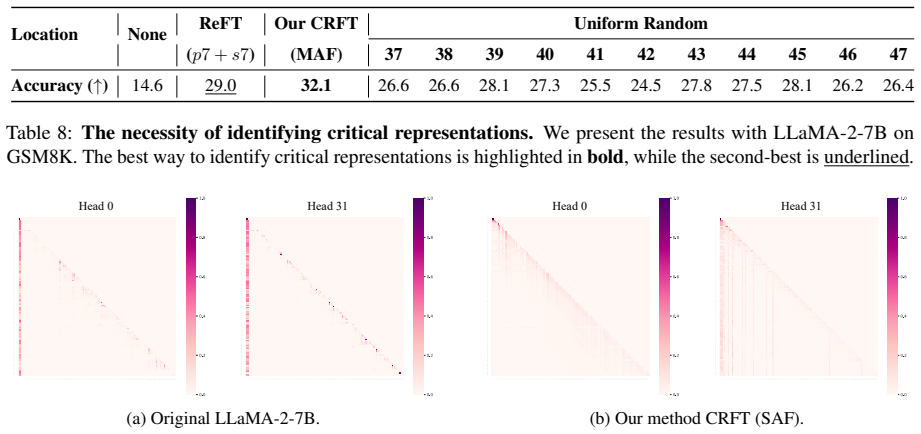
On the full benchmark suite, replace the attention and saliency filters with uniformly random positions at the same layer count, update budget, and rank, across at least three seeds. If the CRFT-minus-random margin is within a couple of accuracy points on most datasets—as Table 8 already shows is nearly the case on GSM8K—then the criticality filter is not the driver. A second check would measure the overlap between threshold-flagged positions and the oracle defined in Eq. 1 from input-level perturbations.
Extended reading notes
Core claim
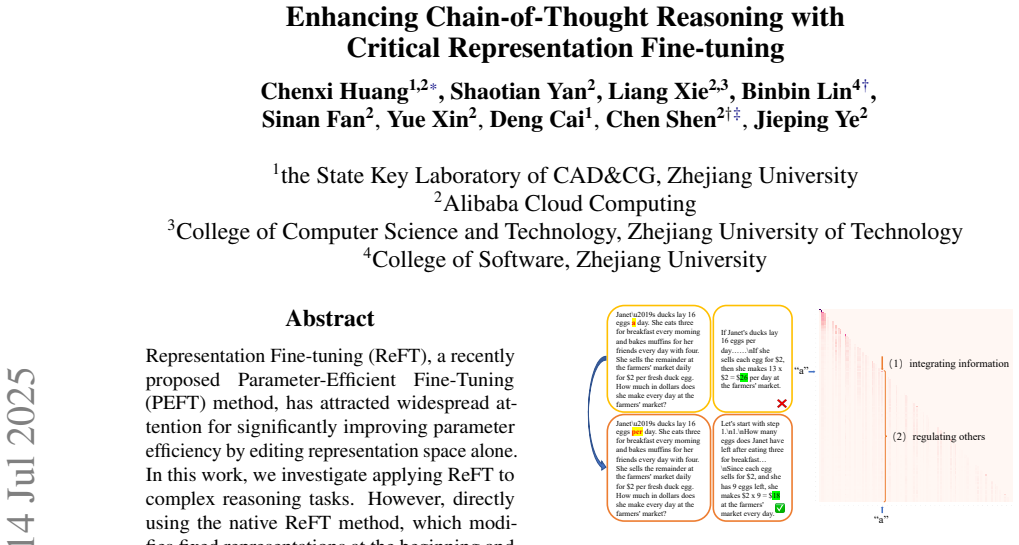
The central claim is that the fixed-position convention of ReFT—editing the first and last seven token representations of every layer—is the wrong inductive bias for reasoning. CRFT instead defines a critical representation as one whose small perturbation changes whether the model answers correctly, and proposes that attention self-flow above a threshold (self-referential filtering) or column-average outgoing attention above a threshold (multi-referential filtering), with saliency counterparts, mark those positions. Editing only those positions with the low-rank update $\Phi(h) = h + R^T(Wh + b - Rh)$ raises LLaMA-2-7B on GSM8K from 14.6% to 32.8%, beating the 29.0% ReFT baseline, while training 0.016% of parameters; the same recipe lifts accuracy across LLaMA-2, LLaMA-3, and Mistral families on arithmetic and commonsense tasks.
Load-bearing premise
The load-bearing premise is that the attention or saliency threshold flags exactly the hidden states whose perturbation would flip the model's correctness; if the proxy misses those positions, CRFT is editing positions that random edits would improve almost as much.
Editorial extensions
If this is right
- CRFT beats the fixed-position ReFT baseline on every reported model and most datasets while training half as many parameters at the same rank, so dynamic position selection is a viable replacement for hand-picked positions.
- Training 0.016% of parameters on a single GPU for four hours on GSM8K with LLaMA-2-7B makes representation-level chain-of-thought fine-tuning practical where full or LoRA fine-tuning is not.
- The few-shot variant, which learns separate update vectors for demonstrations and the question, lifts one-shot GSM8K accuracy from 16.2% to 32.6%, a 16.4-point gain.
- Because intervening in the first half of layers gives the best results, early-layer critical representations appear to propagate task-relevant corrections through the whole chain, an advantage a fixed p7+s7 schedule does not exploit.
- Attention-map visualization shows CRFT reduces the attention-sink at the initial token and broadens information flow, indicating part of the gain comes from redistributing rather than merely amplifying existing interactions.
Reading between the lines
- The criticality filters could be tested against the counterfactual oracle of Eq. 1 directly: if the threshold-selected set has low overlap with perturbation-sensitive positions on held-out layers, the identification step is doing less work than the learnable update; this is my inference, not the paper's claim.
- The method suggests a general recipe for representation-level PEFT on other long-generation tasks, such as code or multi-hop QA: compute attention-derived masks once per prompt and learn per-position subspace updates instead of using fixed position schedules.
- Because random-position interventions already reach 24.5–28.1 on GSM8K, a decisive follow-up would be to report the random-position gap on all eight benchmarks, not just GSM8K, to establish that the information-flow mask is load-bearing at scale.
- The threshold $\alpha$/ $\beta$ is a single scalar shared across layers; an inference worth testing is whether per-layer or per-head thresholds, or a learned mask, would beat the union strategy without the equal-count constraint.
Editorial analysis
A structured set of objections, weighed in public.
Referee Report
Summary. The manuscript proposes Critical Representation Fine-Tuning (CRFT), a parameter-efficient fine-tuning method that freezes the base transformer and learns low-rank updates (Eq. 6) only for token positions identified as critical by self-referential or multi-referential attention/saliency filters (Eqs. 2–5). The paper reports that on GSM8K with LLaMA-2-7B, CRFT reaches 32.8% accuracy versus 29.0% for ReFT p7+s7 and 14.6% for the base model, with only 0.016% trainable parameters, and reports gains across seven other reasoning benchmarks and three additional base models, together with few-shot extensions and ablations on thresholds, intervention counts, layer choice, and selection criteria.
Significance. If the identification step were validated, this would be a useful contribution: dynamic, interpretable position selection for representation editing, with strong parameter efficiency and broad empirical coverage. The paper is also transparent in providing ablation studies and explicit control experiments (Tables 4–8), and the low parameter count is a genuine strength. However, the central scientific claim that attention/saliency thresholds recover the counterfactual critical set behind Eq. 1 is currently supported only indirectly, and the headline numbers rely on the best of many strategy variants. The contribution is therefore promising but needs a focused validation of the mechanism before the main claim can be accepted.
major comments (4)
- [Section 2.2 and Section 3.4] The load-bearing assertion of the paper is that the threshold-based filters in Eqs. 2 and 5 reproduce the counterfactual critical set M(h) defined in Eq. 1, namely the representations whose perturbation flips the correctness of the model output. This equivalence is never directly measured. The evidence in Section 3.4 and Figure 4 is about noise sensitivity of already-correct examples, which is not the same as the flip criterion in Eq. 1, and no random-position comparison at the same cardinality is included in that figure. Please provide a direct overlap test between the selected positions and the positions that actually flip correctness under perturbation, or justify the proxy with a controlled experiment.
- [Section 3.4, Tables 1 and 8] The random-position training control in Table 8 is the most relevant baseline, but it is single-seed per location and reports a range of 24.5–28.1 accuracy. Several CRFT variants in Table 1 are only slightly above that range (29.6–30.4), the ReFT baseline is 29.0, and the headline 32.8 is the best of twelve strategy/mode values. The marginal gain attributed specifically to 'critical' selection is therefore 3.8 points over ReFT, which could plausibly be seed or strategy variance. Please report multiple seeds with mean and standard deviation for the random-position condition at the same intervention count, and either pre-specify the strategy or report the full distribution of CRFT variants rather than only the best.
- [Tables 4, 11, and Section 3.1] The main results in Table 1 use threshold alpha = beta = 0.05, but the ablation in Table 4 shows that alpha = 0.01 gives 33.2 on GSM8K, and Table 11 shows consistent improvements for all strategies at 0.01. Since the paper does not explain why the main tables use 0.05 instead of the better-performing 0.01, the reported configuration is not clearly the tuned one. Please justify the choice of 0.05 or adopt a consistent protocol that avoids selecting hyperparameters and strategy variants on the same benchmark used for the headline claim.
- [Section 3.1 and Tables 1/2] Every CRFT entry in Tables 1 and 2 reports two numbers per strategy, corresponding to two definitions of filtering (previous-layer versus current-layer criticality), and the paper recommends a union strategy without a pre-specified selection rule. With twelve numbers per model on GSM8K alone, the abstract's claim of a 3.8% improvement over ReFT should be tied to a single pre-specified configuration or to a clearly described model-selection procedure; otherwise the headline result is vulnerable to selection over configurations.
minor comments (5)
- [Equations 2 and 3] The notation is inconsistent: Eq. 2 filters based on Info^(l-1)(i,i), while Eqs. 3 and 4 define Info^(l)_SAF(i,i) using attention at layer l; please clarify the layer indexing in both the equations and the surrounding text.
- [Tables 1 and 2] The two values per CRFT entry are explained only in Section 3.1, not in the table captions; please state explicitly in each caption that the first value uses previous-layer filtering and the second uses current-layer filtering.
- [Section 3.3] The three selection criteria in Table 6 ('order', 'score', 'random') are not precisely defined; for example, it is unclear whether 'random' in Table 6 refers to random positions within the thresholded set or fully random positions, and how it relates to the 'Uniform Random' condition in Table 8.
- [Appendix C] Several generation examples appear to be misaligned with their stated tasks; for instance, the AQuA example shows a ribbon-length instruction above a question about ant shadows, and the model responses do not clearly match the displayed prompt. Please check and correct the qualitative examples.
- [Section 3.4] Figure 4 would be more informative if it included the random-position noise curve at the same cardinality as the top-5 and last-5 curves, since that is the control needed to support the claim that the selected positions are specifically output-sensitive.
Circularity Check
No derivation-level circularity: the supervised objective and held-out evaluation are independent of the attention-based position selection, and the identification heuristic is an unproven empirical assumption rather than a reduction.
full rationale
The paper's central claim is empirical and supervised: CRFT selects token positions via attention or saliency thresholds (Eqs. 2 and 5), learns a low-rank correction of those representations through a cross-entropy objective (Eq. 6), and reports final-answer accuracy on held-out GSM8K and other benchmarks. Nothing in this pipeline forces the held-out accuracy to be high by construction; the learned update vectors could in principle fail to generalize, and the random-position control in Table 8 shows that random training-time positions sometimes approach but do not exceed the best CRFT variant. The main gap is that Eq. 1 defines criticality counterfactually, while Eqs. 2 and 5 proxy it by attention self-flow and column averages; this is an unvalidated modeling assumption, not a tautology, because high self-attention is not by definition equivalent to 'perturbation flips correctness.' The noise-sensitivity test in Section 3.4 is a separate empirical check, and its limits are acknowledged in the Limitation paragraph. Self-citations (Yuan et al., Yan et al., Fan et al.) appear only in Related Work and are not load-bearing; the low-rank subspace update is credited to the external ReFT work (Wu et al., 2024b) and the pyvene codebase. Hyperparameters such as alpha are ablated on a validation split, and reporting the best of several strategy/mode configurations creates selection risk, but selecting a configuration after evaluation is not a fitted parameter renamed as a prediction. No equation in the paper reduces to its own input, so there is no derivation-level circularity.
Assumptions & free parameters
free parameters (5)
- Criticality thresholds alpha and beta =
0.05 default, 0.01 preferred
- Intervention count per layer K =
14 (20 better per ablation)
- Selection criterion =
positional order
- Low-rank subspace rank r =
8
- Filtering strategy and mode =
SAF default, Union(attn) for headline, dual reporting modes
assumptions (5)
- domain assumption Eq. 1: a representation is critical if a small perturbation flips the model's correctness on the output.
- domain assumption Attention and saliency scores quantify information flow between representations (cell (i,j) in Figure 2).
- standard math Causal attention masking in decoder-only transformers.
- domain assumption Supervised fine-tuning on LM-generated CoT steps transfers to held-out test sets.
- domain assumption Low-rank orthonormal-subspace editing preserves base model behavior outside edited positions.
invented entities (1)
-
Critical representation set M(h)
Cite this review
Pith. "Pith review of Enhancing Chain-of-Thought Reasoning with Critical Representation Fine-tuning." pith.science (2026). https://pith.science/paper/QJUTSBKH
@misc{pith2026250710085,
  author       = {Pith},
  title        = {Pith review of: Enhancing Chain-of-Thought Reasoning with Critical Representation Fine-tuning},
  year         = {2026},
  howpublished = {\url{https://pith.science/paper/QJUTSBKH}},
  note         = {Machine review of arXiv:2507.10085}
}
read the original abstract
Representation Fine-tuning (ReFT), a recently proposed Parameter-Efficient Fine-Tuning (PEFT) method, has attracted widespread attention for significantly improving parameter efficiency by editing representation space alone. In this work, we investigate applying ReFT to complex reasoning tasks. However, directly using the native ReFT method, which modifies fixed representations at the beginning and end of each layer, yields suboptimal performance, as these fixed-position representations have uncertain impact on the outputs. We observe that, in complex reasoning tasks, there often exist certain critical representations. These representations either integrate significant information from preceding layers or regulate subsequent layer representations. Through layer-by-layer propagation, they exert a substantial influence on the final output. Naturally, fine-tuning these critical representations has the potential to greatly enhance reasoning performance. Building upon these insights, we propose Critical Representation Fine-Tuning (CRFT), a novel method that identifies and optimizes these critical representations through information flow analysis. CRFT operates within a supervised learning framework, dynamically optimizing critical representations in a low-rank linear subspace while freezing the base model. The effectiveness and efficiency of our method are validated across eight benchmarks for arithmetic and commonsense reasoning, using LLaMA and Mistral model families. Furthermore, our method also adapts effectively to few-shot settings, boosting one-shot accuracy by 16.4%. Our work highlights the untapped potential of representation-level optimization for CoT reasoning, offering a lightweight yet powerful alternative to traditional PEFT methods.
Figures


Figures from the paper (8 more)



Reference graph
Works this paper leans on
-
[1]
Badr AlKhamissi, Greta Tuckute, Antoine Bosselut, and Martin Schrimpf. 2024. The llm language network: A neuroscientific approach for identifying causally task-relevant units. arXiv preprint arXiv:2411.02280
arXiv 2024
-
[2]
Maciej Besta, Nils Blach, Ales Kubicek, Robert Gerstenberger, Michal Podstawski, Lukas Gianinazzi, Joanna Gajda, Tomasz Lehmann, Hubert Niewiadomski, Piotr Nyczyk, and 1 others. 2024. Graph of thoughts: Solving elaborate problems with large language models. In Proceedings of the AAAI Conference on Artificial Intelligence, volume 38, pages 17682--17690
2024
-
[3]
Zheng Chu, Jingchang Chen, Qianglong Chen, Weijiang Yu, Tao He, Haotian Wang, Weihua Peng, Ming Liu, Bing Qin, and Ting Liu. 2023. A survey of chain of thought reasoning: Advances, frontiers and future. arXiv preprint arXiv:2309.15402
arXiv 2023
-
[4]
Yung-Sung Chuang, Yujia Xie, Hongyin Luo, Yoon Kim, James Glass, and Pengcheng He. 2023. Dola: Decoding by contrasting layers improves factuality in large language models. arXiv preprint arXiv:2309.03883
arXiv 2023
-
[5]
Christopher Clark, Kenton Lee, Ming-Wei Chang, Tom Kwiatkowski, Michael Collins, and Kristina Toutanova. 2019. Boolq: Exploring the surprising difficulty of natural yes/no questions. arXiv preprint arXiv:1905.10044
arXiv 2019
-
[6]
Karl Cobbe, Vineet Kosaraju, Mohammad Bavarian, Mark Chen, Heewoo Jun, Lukasz Kaiser, Matthias Plappert, Jerry Tworek, Jacob Hilton, Reiichiro Nakano, Christopher Hesse, and John Schulman. 2021. Training verifiers to solve math word problems. arXiv preprint arXiv:2110.14168
arXiv 2021
-
[7]
Damai Dai, Yutao Sun, Li Dong, Yaru Hao, Shuming Ma, Zhifang Sui, and Furu Wei. 2022. Why can gpt learn in-context? language models implicitly perform gradient descent as meta-optimizers. arXiv preprint arXiv:2212.10559
arXiv 2022
-
[8]
Improving complex reasoning with dynamic prompt corruption: A soft prompt optimization approach
Sinan Fan, Liang Xie, Chen Shen, Ge Teng, Xiaosong Yuan, Xiaofeng Zhang, Chenxi Huang, Wenxiao Wang, Xiaofei He, and Jieping Ye. Improving complex reasoning with dynamic prompt corruption: A soft prompt optimization approach. In The Thirteenth International Conference on Learning Representations
Show all 43 references
-
[9]
Atticus Geiger, Hanson Lu, Thomas Icard, and Christopher Potts. 2021. Causal abstractions of neural networks. Advances in Neural Information Processing Systems, 34:9574--9586
2021
-
[10]
Mor Geva, Daniel Khashabi, Elad Segal, Tushar Khot, Dan Roth, and Jonathan Berant. 2021. Did Aristotle Use a Laptop? A Question Answering Benchmark with Implicit Reasoning Strategies . Transactions of the Association for Computational Linguistics (TACL)
2021
-
[11]
Zhiqiang Hu, Lei Wang, Yihuai Lan, Wanyu Xu, Ee-Peng Lim, Lidong Bing, Xing Xu, Soujanya Poria, and Roy Ka-Wei Lee. 2023. Llm-adapters: An adapter family for parameter-efficient fine-tuning of large language models. arXiv preprint arXiv:2304.01933
2023 arXiv
-
[12]
Jing Huang, Zhengxuan Wu, Christopher Potts, Mor Geva, and Atticus Geiger. 2024. Ravel: Evaluating interpretability methods on disentangling language model representations. arXiv preprint arXiv:2402.17700
2024 arXiv
-
[13]
Shima Imani, Liang Du, and Harsh Shrivastava. 2023. Mathprompter: Mathematical reasoning using large language models. arXiv preprint arXiv:2303.05398
2023 arXiv
-
[14]
Peter A Jansen, Elizabeth Wainwright, Steven Marmorstein, and Clayton T Morrison. 2018. Worldtree: A corpus of explanation graphs for elementary science questions supporting multi-hop inference. arXiv preprint arXiv:1802.03052
2018 arXiv
-
[15]
Rik Koncel-Kedziorski, Subhro Roy, Aida Amini, Nate Kushman, and Hannaneh Hajishirzi. 2016. https://doi.org/10.18653/v1/N16-1136 MAWPS : A math word problem repository . In Proceedings of the 2016 Conference of the North A merican Chapter of the Association for Computational L...
2016 doi
-
[16]
Jiachun Li, Pengfei Cao, Chenhao Wang, Zhuoran Jin, Yubo Chen, Daojian Zeng, Kang Liu, and Jun Zhao. 2024. Focus on your question! interpreting and mitigating toxic cot problems in commonsense reasoning. arXiv preprint arXiv:2402.18344
2024 arXiv
-
[17]
Xiang Lisa Li, Ari Holtzman, Daniel Fried, Percy Liang, Jason Eisner, Tatsunori Hashimoto, Luke Zettlemoyer, and Mike Lewis. 2022. Contrastive decoding: Open-ended text generation as optimization. arXiv preprint arXiv:2210.15097
2022 arXiv
-
[18]
Hunter Lightman, Vineet Kosaraju, Yura Burda, Harri Edwards, Bowen Baker, Teddy Lee, Jan Leike, John Schulman, Ilya Sutskever, and Karl Cobbe. 2023. Let's verify step by step. arXiv preprint arXiv:2305.20050
2023 arXiv
-
[19]
Wang Ling, Dani Yogatama, Chris Dyer, and Phil Blunsom. 2017. Program induction by rationale generation: Learning to solve and explain algebraic word problems. arXiv preprint arXiv:1705.04146
2017 arXiv
-
[20]
Pan Lu, Liang Qiu, Kai-Wei Chang, Ying Nian Wu, Song-Chun Zhu, Tanmay Rajpurohit, Peter Clark, and Ashwin Kalyan. 2022. Dynamic prompt learning via policy gradient for semi-structured mathematical reasoning. arXiv preprint arXiv:2209.14610
2022 arXiv
-
[21]
Todor Mihaylov, Peter Clark, Tushar Khot, and Ashish Sabharwal. 2018. Can a suit of armor conduct electricity? a new dataset for open book question answering. arXiv preprint arXiv:1809.02789
2018 arXiv
-
[22]
Arkil Patel, Satwik Bhattamishra, and Navin Goyal. 2021. Are nlp models really able to solve simple math word problems? arXiv preprint arXiv:2103.07191
2021 arXiv
-
[23]
Nazneen Fatema Rajani, Bryan McCann, Caiming Xiong, and Richard Socher. 2019. https://arxiv.org/abs/1906.02361 Explain yourself! leveraging language models for commonsense reasoning . In Proceedings of the 2019 Conference of the Association for Computational Linguistics (ACL2019)
2019 arXiv
-
[24]
Keisuke Sakaguchi, Ronan Le Bras, Chandra Bhagavatula, and Yejin Choi. 2021. Winogrande: An adversarial winograd schema challenge at scale. Communications of the ACM, 64(9):99--106
2021
-
[25]
Maarten Sap, Hannah Rashkin, Derek Chen, Ronan LeBras, and Yejin Choi. 2019. Socialiqa: Commonsense reasoning about social interactions. arXiv preprint arXiv:1904.09728
2019 arXiv
-
[26]
Karen Simonyan. 2013. Deep inside convolutional networks: Visualising image classification models and saliency maps. arXiv preprint arXiv:1312.6034
2013 arXiv
-
[27]
Alon Talmor, Jonathan Herzig, Nicholas Lourie, and Jonathan Berant. 2018. Commonsenseqa: A question answering challenge targeting commonsense knowledge. arXiv preprint arXiv:1811.00937
2018 arXiv
-
[28]
Trieu H Trinh and Quoc V Le. 2018. A simple method for commonsense reasoning. arXiv preprint arXiv:1806.02847
2018 arXiv
-
[29]
A Vaswani. 2017. Attention is all you need. Advances in Neural Information Processing Systems
2017
-
[30]
Lean Wang, Lei Li, Damai Dai, Deli Chen, Hao Zhou, Fandong Meng, Jie Zhou, and Xu Sun. 2023. Label words are anchors: An information flow perspective for understanding in-context learning. arXiv preprint arXiv:2305.14160
2023 arXiv
-
[31]
Jason Wei, Xuezhi Wang, Dale Schuurmans, Maarten Bosma, Fei Xia, Ed Chi, Quoc V Le, Denny Zhou, and 1 others. 2022. Chain-of-thought prompting elicits reasoning in large language models. Advances in neural information processing systems, 35:24824--24837
2022
-
[32]
Muling Wu, Wenhao Liu, Xiaohua Wang, Tianlong Li, Changze Lv, Zixuan Ling, Jianhao Zhu, Cenyuan Zhang, Xiaoqing Zheng, and Xuanjing Huang. 2024 a . Advancing parameter efficiency in fine-tuning via representation editing. arXiv preprint arXiv:2402.15179
2024 arXiv
-
[33]
Zhengxuan Wu, Aryaman Arora, Zheng Wang, Atticus Geiger, Dan Jurafsky, Christopher D Manning, and Christopher Potts. 2024 b . Reft: Representation finetuning for language models. arXiv preprint arXiv:2404.03592
2024 arXiv
-
[34]
Zhengxuan Wu, Atticus Geiger, Aryaman Arora, Jing Huang, Zheng Wang, Noah Goodman, Christopher Manning, and Christopher Potts. 2024 c . https://aclanthology.org/2024.naacl-demo.16 pyvene: A library for understanding and improving P y T orch models via interventions . In Procee...
2024
-
[35]
Guangxuan Xiao, Yuandong Tian, Beidi Chen, Song Han, and Mike Lewis. 2023. Efficient streaming language models with attention sinks. arXiv preprint arXiv:2309.17453
2023 arXiv
-
[36]
Don't take things out of context: Attention intervention for enhancing chain-of-thought reasoning in large language models
Shaotian Yan, Chen Shen, Wenxiao Wang, Liang Xie, Junjie Liu, and Jieping Ye. Don't take things out of context: Attention intervention for enhancing chain-of-thought reasoning in large language models. In The Thirteenth International Conference on Learning Representations
-
[37]
Shunyu Yao, Dian Yu, Jeffrey Zhao, Izhak Shafran, Tom Griffiths, Yuan Cao, and Karthik Narasimhan. 2024. Tree of thoughts: Deliberate problem solving with large language models. Advances in Neural Information Processing Systems, 36
2024
-
[38]
Zhongzhi Yu, Zheng Wang, Yonggan Fu, Huihong Shi, Khalid Shaikh, and Yingyan Celine Lin. 2024. Unveiling and harnessing hidden attention sinks: Enhancing large language models without training through attention calibration. arXiv preprint arXiv:2406.15765
2024 arXiv
-
[39]
Instance-adaptive zero-shot chain-of-thought prompting
Xiaosong Yuan, Chen Shen, Shaotian Yan, Xiao Feng Zhang, Liang Xie, Wenxiao Wang, Renchu Guan, Ying Wang, and Jieping Ye. Instance-adaptive zero-shot chain-of-thought prompting. In The Thirty-eighth Annual Conference on Neural Information Processing Systems
-
[40]
Qingru Zhang, Chandan Singh, Liyuan Liu, Xiaodong Liu, Bin Yu, Jianfeng Gao, and Tuo Zhao. 2023. Tell your model where to attend: Post-hoc attention steering for llms. arXiv preprint arXiv:2311.02262
2023 arXiv
-
[41]
Andy Zou, Long Phan, Sarah Chen, James Campbell, Phillip Guo, Richard Ren, Alexander Pan, Xuwang Yin, Mantas Mazeika, Ann-Kathrin Dombrowski, and 1 others. 2023. Representation engineering: A top-down approach to ai transparency. arXiv preprint arXiv:2310.01405
2023 arXiv
-
[42]
online" 'onlinestring :=
ENTRY address archivePrefix author booktitle chapter edition editor eid eprint eprinttype howpublished institution journal key month note number organization pages publisher school series title type volume year doi pubmed url lastchecked label extra.label sort.label short.list...
-
[43]
write newline
" write newline "" before.all 'output.state := FUNCTION n.dashify 't := "" t empty not t #1 #1 substring "-" = t #1 #2 substring "--" = not "--" * t #2 global.max substring 't := t #1 #1 substring "-" = "-" * t #2 global.max substring 't := while if t #1 #1 substring * t #2 gl...
Reviewed August 6, 2026 · model on record in the stance chip above.
Discussion (0). Sign in to comment.