REVIEW 3 major objections 5 minor 81 references
Breaking the Myth: Can Small Models Infer Postconditions Too?
T0 review · 3 major / 5 minor · reviewed 2026-08-06 · deepseek-v4-flash
Pith's one-line read A 7-billion-parameter model, fine-tuned on 1,500 examples, writes Java postconditions as accurately as GPT-4o.
desk verdict A 7B model fine-tuned on 1.5K reasoning triples reportedly matches GPT-4o on postcondition generation, but the missing train/test disjointness analysis makes the headline claim unverifiable as written. read the letter →
The pith
A machine-rendered reading of the paper's core claim, the machinery that carries it, and where it could break.
The reading
What carries the argument
The load-bearing mechanism is supervised fine-tuning on a dataset of prompt/reasoning/postcondition triples, where each prompt is a structured YAML bundle containing repository-level context, class-level context, the target method signature with its NL description, and task instructions, and each output pairs a step-by-step reasoning trace with a four-part specification: import statements, pre-ghost variables capturing pre-call state, post-ghost variables capturing values after the call, and the condition itself. The reasoning traces let the model self-correct during inference, the pre-ghost and post-ghost variables make stateful postconditions expressible, and injection into the instrumented method with a runtime check enables automated validation against the test suite. Together these components let a 7B model generate specifications that compile, hold on fixed code, and fail on buggy code.
What would settle it
Check the released training set for overlap with Defects4J: extract the method signatures and bodies of the 1,134 evaluated methods and search for them or near-duplicates in the training repositories; if any match is found, the headline comparison to GPT-4o is invalidated. Alternatively, run the fine-tuned model on a fresh, held-out set of methods from repositories never used in training and compare Sem@1.
Extended reading notes
Core claim
On the paper's own terms, the central discovery is that task-specific supervised fine-tuning, with explicit reasoning traces in the training data, unlocks postcondition-inference ability in a small model that the same model without fine-tuning does not have. The fine-tuned model improves semantic correctness from the base model's 12.5% to 43.0% at top-1, matches GPT-4o on semantic correctness and bug distinguishing (11.0% vs. 11.8%), and beats Qwen2.5-Coder-32B and DeepSeek-R1-Distill-32B on most metrics despite using 1.5K training examples versus 800K for DeepSeek-R1-Distill. The paper claims this shows reasoning traces, not model scale, are the main ingredient that makes postcondition generation work.
Load-bearing premise
The whole comparison collapses if any of the 1,134 Defects4J evaluation methods, or code close to them, appeared in the 1,500 training triples, because the paper does not enumerate its training repositories or demonstrate that they exclude Defects4J projects.
Editorial extensions
If this is right
- A 7B model fine-tuned on about 1.5K examples is a viable local alternative to GPT-4o for postcondition generation, with comparable semantic correctness and bug-finding rate.
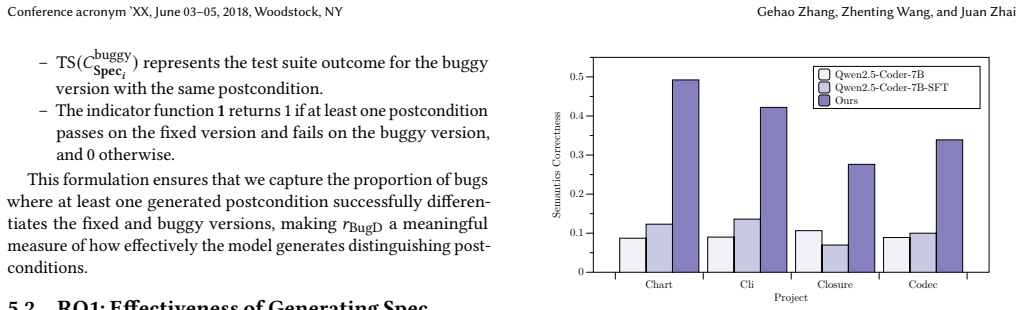
- Omitting reasoning traces from training data cuts semantic-correctness gains dramatically across tested repositories, so reasoning supervision is a key component of the result.
- Longer reasoning traces do not monotonically improve quality; semantic correctness peaks at intermediate reasoning length and drops for the longest traces.
- The structured prompt with repository and class context alone improves GPT-4's semantic correctness, so context is a separate contributor beyond model size.
- Task-specific fine-tuning can bring the benefits of reasoning-oriented training to small models for formal specification tasks, without test-time scaling.
- If the training and evaluation corpora are truly disjoint, the result reframes the cost-quality tradeoff: for narrow, verifiable tasks, data quality and reasoning supervision may matter more than parameter count.
Reading between the lines
- The same pipeline, which works from NL comments, signatures, and class skeletons, could be shifted earlier in the development cycle to produce postconditions before implementation, a direction the paper mentions as formal specification-driven development.
- The observed reasoning-length trend suggests a cheap inference-time lever: sampling several reasoning traces and selecting by length could tune semantic correctness without retraining, though the paper does not propose this.
- The method's dependence on well-documented Java repositories and test suites means transfer to less documented languages or codebases may need new data curation, an open question the paper acknowledges.
- If the disjointness of training and evaluation corpora is confirmed, the result reframes the cost-quality tradeoff: for narrow, verifiable tasks, data quality and reasoning supervision may matter more than parameter count.
Editorial analysis
A structured set of objections, weighed in public.
Referee Report
Summary. The paper proposes a supervised fine-tuning approach for generating Java postconditions from natural-language method descriptions together with class- and repository-level context. The authors construct a training set of roughly 1,500 prompt/reasoning/postcondition triples: DeepSeek-R1 generates candidate specifications and reasoning traces, which are then validated by test-suite injection and manual review. They fine-tune Qwen2.5-Coder-7B-Instruct and evaluate on Defects4J v2.0.0 by injecting generated postconditions into fixed and buggy versions and measuring syntax correctness (Syn@k), semantic correctness (Sem@k), and bug-distinguishing rate (rBugD). The headline result is that the 7B model reaches Sem@1=43.0%, Sem@5=72.3%, Syn@1=72.3%, and rBugD=11.0%, matching or exceeding GPT-4o and surpassing larger open models, despite using only 1.5K training examples.
Significance. If the empirical claims are valid, this is a valuable practical result: a 7B model that can produce compilable, semantically correct, bug-distinguishing postconditions at a fraction of the inference cost of GPT-4o-class models. The injection-based evaluation is a genuine strength, because the metrics are machine-checked against actual compilation and test execution on real and buggy Defects4J versions, rather than judged by an LLM or human preference. The release of code and data would support reproducibility. The main caveat is that the entire comparison rests on the assumption that the 1.5K training triples do not overlap with Defects4J; the manuscript does not currently demonstrate this, so the headline numbers cannot yet be fully credited.
major comments (3)
- [§4.2 and §6] The central empirical claim is not interpretable without a demonstrated train/eval disjointness guarantee. The Quality Filter selects public GitHub repositories, but the paper never enumerates them, and Defects4J v2.0.0 projects are themselves public GitHub repositories. If any training triple was derived from a Defects4J method, or even from nearby code in the same class or repository, the model could memorize the postcondition or the context needed to reconstruct it, inflating Sem@1, Syn@1, and rBugD. Section 6 says membership inference attacks and prompt checks were used to address leakage, but no results of those checks are shown, and the cited reference [11] is titled 'Do Membership Inference Attacks Work on Large Language Models?' and reports largely negative findings, so it cannot serve as evidence of clean data. Please provide the full list of training repositories, a file- and method-level overlap analysis with Defects4J, and a concrete description of the leakage checks actually performed.
- [§5.1.4 and Table 1] The number of evaluation units is internally inconsistent. The text says Defects4J has 835 bugs and that 1,134 tasks were obtained, and that 11,340 postconditions per approach are generated. Table 1, however, reports rBugD denominators of 726 (and 525 for the asterisked baselines), not 835 or 1,134. Please clarify how 835 bugs become 726 bugs, how tasks map to bugs for rBugD, and why the denominator differs from the number of tasks used for Sem@k and Syn@k. Without this clarification, the headline rBugD comparison is not reproducible.
- [§5.2 and Table 1] Direct comparisons of rBugD across rows with different denominators are not controlled. The table reports GPT-4* and StarChat* on 525 bugs while all other models are reported on 726 bugs, and the text draws comparative conclusions such as 'our model performs better than DeepSeek-R1-Distill on each metric' and achieves 'comparable rBugD = 11.0%.' Although the footnote discloses the 525/726 difference, the comparison should be limited to the same bug subset or accompanied by a matched-subset analysis; otherwise the ranking could be an artifact of the different evaluation sets.
minor comments (5)
- [§7 and Table 1] The conclusion states that training used 'only a few hundred training examples,' while the introduction, abstract, and Table 1 state 1.5K examples; please reconcile this factual discrepancy.
- [§4.4 and §5.1.3] The training specifications and reasoning traces were produced by DeepSeek-R1, so the comparison against DeepSeek-R1-Distill-32B is partly a student/teacher distillation comparison; this should be stated explicitly in the experimental setup so readers do not misinterpret the result as a fully independent small-model capability.
- [§4.5] The manual validation stage should report quantitative details such as the number of specifications rejected or revised and the inter-rater agreement among the four experts; currently the reader cannot assess the curation cost or reliability.
- [Figure 5 and §5.3] The text refers to 'Qwen2.5-Coder-7B-SFT' without specifying whether this variant is trained on the same 1.5K examples with the reasoning traces removed; please state this explicitly.
- [Throughout] There are several typos and formatting errors, including 'Specificatin' in the Section 2.1 heading, 'astest-time scaling' in Section 2.2, 'leverage' in Section 4.4, and 'close-sourced' in Section 6; a copyedit pass is needed.
Circularity Check
No significant circularity: the central claim is an empirical comparison against the external Defects4J benchmark; the unresolved train/eval overlap is a validity threat, not a circular reduction.
full rationale
The paper's derivation chain is empirical rather than formal. Training data are constructed in Sections 4.2-4.5 from public GitHub repositories, and evaluation uses Defects4J v2.0.0 (Section 5.1.1); the model's outputs are judged by compiling and running tests on fixed and buggy versions (Eqs. 1-3), which are external to the fine-tuning objective defined in Section 4.6. No equation in the paper defines a predicted quantity in terms of a fitted input: the 1.5K training triples are not used to compute Sem@k, Syn@k, or rBugD, and the fine-tuning loss does not contain evaluation metrics. The comparison against GPT-4o, Qwen2.5-Coder-32B, and DeepSeek-R1-Distill-32B is an external benchmark, not a self-citation chain; the authors' own prior work is cited only as general background and is not load-bearing. The only concern that approaches circularity is training/evaluation contamination: Section 6 asserts membership-inference and prompt checks but does not enumerate training repositories or demonstrate that Defects4J methods are absent from the 1,500 triples. Had a Defects4J method appeared in training, the reported gains could be memorization renamed as prediction; however, the paper provides no quoted evidence of such an overlap, and the absence of a leakage audit is a correctness or validity risk, not a demonstrated reduction of the result to its own inputs. Under the hard rule requiring an exhibited reduction, no circular step can be claimed, so the circularity score is 0.
Assumptions & free parameters
free parameters (4)
- learning_rate =
1e-5
- weight_decay =
1e-4
- training_examples =
~1,500
- generation_attempts =
10
assumptions (4)
- domain assumption Public GitHub repositories with good documentation and tests are a sound source of training specifications.
- domain assumption Automated test pass/fail and human expert review establish correctness of training specifications.
- domain assumption Compilation and test outcomes are valid proxies for semantic correctness of generated postconditions.
- ad hoc to paper Training and evaluation data are disjoint.
Cite this review
Pith. "Pith review of Breaking the Myth: Can Small Models Infer Postconditions Too?." pith.science (2026). https://pith.science/paper/3GOEO24M
@misc{pith2026250710182,
  author       = {Pith},
  title        = {Pith review of: Breaking the Myth: Can Small Models Infer Postconditions Too?},
  year         = {2026},
  howpublished = {\url{https://pith.science/paper/3GOEO24M}},
  note         = {Machine review of arXiv:2507.10182}
}
abstract
Formal specifications are essential for ensuring software correctness, yet manually writing them is tedious and error-prone. Large Language Models (LLMs) have shown promise in generating such specifications from natural language intents, but the giant model size and high computational demands raise a fundamental question: Do we really need large models for this task? In this paper, we show that a small, fine-tuned language model can achieve high-quality postcondition generation with much lower computational costs. We construct a specialized dataset of prompts, reasoning logs, and postconditions, then supervise the fine-tuning of a $7$B-parameter code model. Our approach tackles real-world repository dependencies and preserves pre-state information, allowing for expressive and accurate specifications. We evaluate the model on a benchmark of real-world Java bugs (Defects4J) and compare against both proprietary giants (e.g., GPT-4o) and open-source large models. Empirical results demonstrate that our compact model matches or outperforms significantly larger counterparts in syntax correctness, semantic correctness, and bug-distinguishing capability. These findings highlight that targeted fine-tuning on a modest dataset can enable small models to achieve results formerly seen only in massive, resource-heavy LLMs, offering a practical and efficient path for the real-world adoption of automated specification generation.
Figures


Figures from the paper (5 more)



Reference graph
Works this paper leans on
-
[11]
Michael Duan, Anshuman Suri, Niloofar Mireshghallah, Sewon Min, Weijia Shi, Luke Zettlemoyer, Yulia Tsvetkov, Yejin Choi, David Evans, and Hannaneh Hajishirzi. 2024. Do Membership Inference Attacks Work on Large Language Models? arXiv preprint arXiv: 2402.07841 (2024)
arXiv 2024
-
[1]
Alibaba. 2023. Qwen2.5-Coder: Open-Source Code LLMs. (2023)
2023
-
[2]
Zachary Ankner, Mansheej Paul, Brandon Cui, Jonathan D Chang, and Prithvi- raj Ammanabrolu. 2024. Critique-out-loud reward models. arXiv preprint arXiv:2408.11791 (2024)
arXiv 2024
-
[3]
Angello Astorga, Siwakorn Srisakaokul, Xusheng Xiao, and Tao Xie. 2018. PreInfer: Automatic Inference of Preconditions via Symbolic Analysis. In2018 48th Annual IEEE/IFIP International Conference on Dependable Systems and Networks (DSN). IEEE, 678–689
work page 2018
-
[4]
Osbert Bastani, Saswat Anand, and Alex Aiken. 2015. Specification inference using context-free language reachability. InACM SIGPLAN Notices. ACM, 553–566
work page 2015
-
[5]
Arianna Blasi, Alberto Goffi, Konstantin Kuznetsov, Alessandra Gorla, Michael D Ernst, Mauro Pezzè, and Sergio Delgado Castellanos. 2018. Translating code comments to procedure specifications, In Proceedings of the 27th ACM SIGSOFT Breaking the Myth: Can Small Models Infer Postconditions Too? Conference acronym ’XX, June 03–05, 2018, Woodstock, NY Interna...
work page 2018
-
[6]
Junjie Chen, Yanwei Bai, Dan Hao, Lingming Zhang, Lu Zhang, Bing Xie, and Hong Mei. 2016. Supporting oracle construction via static analysis. 2016 31st IEEE/ACM International Conference on Automated Software Engineering (ASE) (2016), 178–189. https://api.semanticscholar.org/CorpusID:472942
work page 2016
-
[7]
Sehyun Choi, Tianqing Fang, Zhaowei Wang, and Yangqiu Song. 2023. KCTS: knowledge-constrained tree search decoding with token-level hallucination detection. arXiv preprint arXiv:2310.09044 (2023)
arXiv 2023
Show all 81 references
-
[8]
Matthias Cosler, Christopher Hahn, Daniel Mendoza, Frederik Schmitt, and Caroline Trippel. 2023. nl2spec: Interactively translating unstructured natural language to temporal logics with large language models. In International Conference on Computer Aided Verification. Springer...
2023
-
[9]
Manuel Costa, Miguel Castro, Lidong Zhou, Lintao Zhang, and Marcus Peinado
-
[10]
Patrick Cousot, Radhia Cousot, Manuel Fähndrich, and Francesco Logozzo. 2013. Automatic inference of necessary preconditions. In International Workshop on Verification, Model Checking, and Abstract Interpretation. Springer, 128–148
2013
-
[12]
Madeline Endres, Sarah Fakhoury, Saikat Chakraborty, and Shuvendu K Lahiri
-
[13]
Michael D Ernst, Jake Cockrell, William G Griswold, and David Notkin. 2001. Dynamically discovering likely program invariants to support program evolution. IEEE Transactions on Software Engineering 27, 2 (2001), 99–123
2001
-
[14]
Ernst, Jeff H
Michael D. Ernst, Jeff H. Perkins, Philip J. Guo, Stephen McCamant, Carlos Pacheco, Matthew S. Tschantz, and Chen Xiao. 2007. The Daikon system for dynamic detection of likely invariants. Sci. Comput. Program. 69 (2007), 35–45. https://api.semanticscholar.org/CorpusID:17620776
2007
-
[15]
Rustan M
Cormac Flanagan and K. Rustan M. Leino. 2001. Houdini, an Annotation Assistant for ESC/Java. In FME. https://api.semanticscholar.org/CorpusID:1534849
2001
-
[16]
Francesco Fuggitti and Tathagata Chakraborti. 2023. NL2LTL–a python package for converting natural language (NL) instructions to linear temporal logic (LTL) for- mulas. InProceedings of the AAAI Conference on Artificial Intelligence. 16428–16430
2023
-
[17]
Alberto Goffi, Alessandra Gorla, Michael D Ernst, and Mauro Pezzè. 2016. Automatic generation of oracles for exceptional behaviors. InProceedings of the 25th International Symposium on Software Testing and Analysis. ACM, 213–224
2016
-
[18]
Daya Guo, Dejian Yang, Haowei Zhang, Junxiao Song, Ruoyu Zhang, Runxin Xu, Qihao Zhu, Shirong Ma, Peiyi Wang, Xiao Bi, et al . 2025. Deepseek-r1: Incentivizing reasoning capability in llms via reinforcement learning. arXiv preprint arXiv:2501.12948 (2025)
2025 arXiv
-
[19]
Sudheendra Hangal and Monica S. Lam. 2002. Tracking down software bugs using automatic anomaly detection. Proceedings of the 24th Inter- national Conference on Software Engineering. ICSE 2002 (2002), 291–301. https://api.semanticscholar.org/CorpusID:11004588
2002
-
[20]
Johannes Henkel, Christoph Reichenbach, and Amer Diwan. 2008. Developing and debugging algebraic specifications for Java classes. ACM Transactions on Software Engineering and Methodology (TOSEM) 17, 3 (2008), 1–37
2008
-
[21]
Aaron Hurst, Adam Lerer, Adam P Goucher, Adam Perelman, Aditya Ramesh, Aidan Clark, AJ Ostrow, Akila Welihinda, Alan Hayes, Alec Radford, et al. 2024. Gpt-4o system card. arXiv preprint arXiv:2410.21276 (2024)
2024 arXiv
-
[22]
Nan Jiang, Thibaud Lutellier, Yiling Lou, Lin Tan, Dan Goldwasser, and Xiangyu Zhang. 2023. Knod: Domain knowledge distilled tree decoder for automated program repair. In 2023 IEEE/ACM 45th International Conference on Software Engineering (ICSE). IEEE, 1251–1263
2023
-
[23]
James A Jones, Mary Jean Harrold, and John Stasko. 2002. Visualization of test information to assist fault localization. In Proceedings of the 24th International Conference on Software Engineering. ICSE 2002. IEEE, 467–477
2002
-
[24]
René Just, Darioush Jalali, and Michael D Ernst. 2014. Defects4J: A database of existing faults to enable controlled testing studies for Java programs. InProceedings of the 2014 international symposium on software testing and analysis. 437–440
2014
-
[25]
Jens U Kreber and Christopher Hahn. 2021. Generating symbolic reasoning problems with transformer gans. arXiv preprint arXiv:2110.10054 (2021)
2021 arXiv
-
[26]
Axel van Lamsweerde. 2000. Formal specification: a roadmap. InProceedings of the Conference on the Future of Software Engineering. 147–159
2000
-
[27]
Andreas Leitner, Ilinca Ciupa, Manuel Oriol, Bertrand Meyer, and Arno Fiva
-
[28]
Raymond Li, Loubna Ben Allal, Yangtian Zi, Niklas Muennighoff, Denis Kocetkov, Chenghao Mou, Marc Marone, Christopher Akiki, Jia Li, Jenny Chim, et al. 2023. Starcoder: may the source be with you!arXiv preprint arXiv:2305.06161 (2023)
2023 arXiv
-
[29]
Hunter Lightman, Vineet Kosaraju, Yuri Burda, Harrison Edwards, Bowen Baker, Teddy Lee, Jan Leike, John Schulman, Ilya Sutskever, and Karl Cobbe. 2023. Let’s ver- ify step by step. InThe Twelfth International Conference on Learning Representations
2023
-
[30]
In Proceedings of the the 6th joint meeting of the European software engineering conference and the ACM SIGSOFT symposium on The foundations of software engineering
Contract driven development= test driven development-writing test cases. In Proceedings of the the 6th joint meeting of the European software engineering conference and the ACM SIGSOFT symposium on The foundations of software engineering. ACM, 425–434
-
[31]
Lezhi Ma, Shangqing Liu, Yi Li, Xiaofei Xie, and Lei Bu. 2024. Specgen: Automated generation of formal program specifications via large language models. arXiv preprint arXiv:2401.08807 (2024)
2024 arXiv
-
[32]
Bertrand Meyer, Ilinca Ciupa, Andreas Leitner, and Lisa Ling Liu. 2007. Automatic testing of object-oriented software. InInternational Conference on Current Trends in Theory and Practice of Computer Science. Springer, 114–129
2007
-
[33]
Jiacheng Liu, Andrew Cohen, Ramakanth Pasunuru, Yejin Choi, Hannaneh Hajishirzi, and Asli Celikyilmaz. 2023. Don’t throw away your value model! Generating more preferable text with Value-Guided Monte-Carlo Tree Search decoding. arXiv preprint arXiv:2309.15028 (2023)
2023 arXiv
-
[34]
Niklas Muennighoff, Zitong Yang, Weijia Shi, Xiang Lisa Li, Li Fei-Fei, Hannaneh Hajishirzi, Luke Zettlemoyer, Percy Liang, Emmanuel Candès, and Tatsunori Hashimoto. 2025. s1: Simple test-time scaling. arXiv preprint arXiv:2501.19393 (2025)
2025 arXiv
-
[35]
Hoan Anh Nguyen, Robert Dyer, Tien N Nguyen, and Hridesh Rajan. 2014. Mining preconditions of APIs in large-scale code corpus. InProceedings of the 22nd ACM SIGSOFT International Symposium on Foundations of Software Engineering. ACM, 166–177
2014
-
[36]
Facundo Molina, Renzo Degiovanni, Pablo Ponzio, Germán Regis, Nazareno Aguirre, and Marcelo Fabian Frias. 2019. Training Binary Classifiers as Data Struc- ture Invariants. 2019 IEEE/ACM 41st International Conference on Software Engineer- ing (ICSE) (2019), 759–770. https://api...
2019
-
[37]
OpenAI. 2024. Learning to reason with LLMs. https://openai.com/index/learning- to-reason-with-llms/
2024
-
[38]
Jiayi Pan, Glen Chou, and Dmitry Berenson. 2023. Data-efficient learning of natural language to linear temporal logic translators for robot task specification. In 2023 IEEE International Conference on Robotics and Automation (ICRA). IEEE, 11554–11561
2023
-
[39]
Jeremy W Nimmer and Michael D Ernst. 2002. Automatic generation of program specifications. ACM SIGSOFT Software Engineering Notes 27, 4 (2002), 229–239
2002
-
[40]
Hung Phan, Hoan Anh Nguyen, Tien N Nguyen, and Hridesh Rajan. 2017. Statistical learning for inference between implementations and documentation. In Proceedings of the 39th International Conference on Software Engineering: New Ideas and Emerging Results Track. IEEE Press, 27–30
2017
-
[41]
Murali Krishna Ramanathan, Ananth Grama, and Suresh Jagannathan. 2007. Static specification inference using predicate mining. InACM SIGPLAN Notices. ACM, 123–134
2007
-
[42]
Rahul Pandita, Xusheng Xiao, Hao Zhong, Tao Xie, Stephen Oney, and Amit Paradkar. 2012. Inferring method specifications from natural language API descriptions, In Proceedings of the 34th International Conference on Software Engineering. 2012 34th International Conference on So...
2012
-
[43]
Gabriel Ryan, Justin Wong, Jianan Yao, Ronghui Gu, and Suman Sekhar Jana. 2019. CLN2INV: Learning Loop Invariants with Continuous Logic Networks. ArXiv abs/1909.11542 (2019). https://api.semanticscholar.org/CorpusID:202749930
2019 arXiv
-
[44]
Mohamed Nassim Seghir and Daniel Kroening. 2013. Counterexample-guided pre- condition inference. InEuropean Symposium on Programming. Springer, 451–471
2013
-
[45]
Richard Rutledge, Sheryl Duggins, Dan Lo, and Frank Tsui. 2014. Formal specification-driven development. InProceedings of the International Conference on Software Engineering Research and Practice (SERP) . The Steering Committee of The World Congress in Computer Science, Compu...
2014
-
[46]
Naik, and Le Song
Xujie Si, Aaditya Naik, Hanjun Dai, M. Naik, and Le Song. 2020. Code2Inv: A Deep Learning Framework for Program Verification.Computer Aided Verification 12225 (2020), 151–164. https://api.semanticscholar.org/CorpusID:211027794
2020
-
[47]
Charlie Snell, Jaehoon Lee, Kelvin Xu, and Aviral Kumar. 2024. Scaling llm test-time compute optimally can be more effective than scaling model parameters. arXiv preprint arXiv:2408.03314 (2024)
2024 arXiv
-
[48]
Fink, and Marco Pistoia
Sharon Shoham, Eran Yahav, Stephen J. Fink, and Marco Pistoia
-
[49]
IEEE Transactions on Software Engineering 34 (2007), 651–666
Static Specification Mining Using Automata-Based Abstrac- tions. IEEE Transactions on Software Engineering 34 (2007), 651–666. https://api.semanticscholar.org/CorpusID:2483401
2007
-
[50]
Lin Tan, Ding Yuan, Gopal Krishna, and Yuanyuan Zhou. 2007. /* iComment: Bugs or bad comments?*. InACM SIGOPS Operating Systems Review. ACM, 145–158
2007
-
[51]
Lin Tan, Yuanyuan Zhou, and Yoann Padioleau. 2011. aComment: mining annotations from comments and code to detect interrupt related concurrency bugs, In Software Engineering (ICSE), 2011 33rd International Conference on. 2011 33rd International Conference on Software Engineerin...
2011
-
[52]
Colin Frank Snook. 2001. Exploring the barriers to formal specification . Ph. D. Dissertation. University of Southampton
2001
-
[53]
Weisong Sun, Chunrong Fang, Yun Miao, Yudu You, Mengzhe Yuan, Yuchen Chen, Quanjun Zhang, An Guo, Xiang Chen, Yang Liu, et al. 2023. Abstract syntax tree for programming language understanding and representation: How far are we? arXiv preprint arXiv:2312.00413 (2023)
2023 arXiv
-
[54]
Willem Visser, Klaus Havelund, Guillaume Brat, SeungJoon Park, and Flavio Lerda. 2003. Model checking programs. Automated software engineering 10, 2 (2003), 203–232
2003
-
[55]
Hendryx, Summer Yue, and Hugh Zhang
Evan Z Wang, Federico Cassano, Catherine Wu, Yunfeng Bai, William Song, Vaskar Nath, Ziwen Han, Sean M. Hendryx, Summer Yue, and Hugh Zhang
-
[56]
Shin Hwei Tan, Darko Marinov, Lin Tan, and Gary T Leavens. 2012. @tcomment: Testing javadoc comments to detect comment-code inconsistencies, In Software Testing, Verification and Validation (ICST), 2012 IEEE Fifth International Confer- ence on. 2012 IEEE Fifth International Co...
2012
-
[57]
Niki Vazou, Eric L Seidel, Ranjit Jhala, Dimitrios Vytiniotis, and Simon Peyton- Jones. 2014. Refinement types for Haskell. In ACM SIGPLAN Notices . ACM, 269–282
2014
-
[58]
Sean Welleck, Amanda Bertsch, Matthew Finlayson, Hailey Schoelkopf, Alex Xie, Graham Neubig, Ilia Kulikov, and Zaid Harchaoui. 2024. From decoding to meta-generation: Inference-time algorithms for large language models. arXiv preprint arXiv:2406.16838 (2024)
2024 arXiv
-
[59]
Yangzhen Wu, Zhiqing Sun, Shanda Li, Sean Welleck, and Yiming Yang. 2024. An empirical analysis of compute-optimal inference for problem-solving with language models. (2024)
2024
-
[60]
Yangzhen Wu, Zhiqing Sun, Shanda Li, Sean Welleck, and Yiming Yang. 2024. Inference scaling laws: An empirical analysis of compute-optimal inference for problem-solving with language models. arXiv preprint arXiv:2408.00724 (2024)
2024 arXiv
-
[61]
Peiyi Wang, Lei Li, Zhihong Shao, RX Xu, Damai Dai, Yifei Li, Deli Chen, Yu Wu, and Zhifang Sui. 2023. Math-shepherd: Verify and reinforce llms step-by-step without human annotations. arXiv preprint arXiv:2312.08935 (2023)
2023 arXiv
-
[62]
Weishi Wang, Yue Wang, Shafiq Joty, and Steven CH Hoi. 2023. Rap-gen: Retrieval-augmented patch generation with codet5 for automatic program repair. In Proceedings of the 31st ACM Joint European Software Engineering Conference and Symposium on the Foundations of Software Engin...
2023
-
[63]
Yuxi Xie, Kenji Kawaguchi, Yiran Zhao, James Xu Zhao, Min-Yen Kan, Junxian He, and Michael Xie. 2023. Self-evaluation guided beam search for reasoning. Advances in Neural Information Processing Systems 36 (2023), 41618–41650
2023
-
[64]
Huajian Xin, Daya Guo, Zhihong Shao, Zhizhou Ren, Qihao Zhu, Bo Liu, Chong Ruan, Wenda Li, and Xiaodan Liang. 2024. Deepseek-prover: Advancing theorem proving in llms through large-scale synthetic data.arXiv preprint arXiv:2405.14333 (2024)
2024 arXiv
-
[65]
Kaiyu Yang, Aidan Swope, Alex Gu, Rahul Chalamala, Peiyang Song, Shixing Yu, Saad Godil, Ryan J Prenger, and Animashree Anandkumar. 2024. Leandojo: Theorem proving with retrieval-augmented language models.Advances in Neural Information Processing Systems 36 (2024)
2024
-
[66]
Danning Xie, Yitong Li, Mijung Kim, Hung Viet Pham, Lin Tan, Xiangyu Zhang, and Michael W Godfrey. 2022. DocTer: documentation-guided fuzzing for testing deep learning API functions. InProceedings of the 31st ACM SIGSOFT International Symposium on Software Testing and Analysis...
2022
-
[67]
Danning Xie, Byungwoo Yoo, Nan Jiang, Mijung Kim, Lin Tan, Xiangyu Zhang, and Judy S Lee. 2023. Impact of large language models on generating software specifications. arXiv preprint arXiv:2306.03324 (2023)
2023 arXiv
-
[68]
He Ye and Martin Monperrus. 2024. Iter: Iterative neural repair for multi-location patches. In Proceedings of the 46th IEEE/ACM International Conference on Software Engineering. 1–13
2024
-
[69]
Andreas Zeller and Ralf Hildebrandt. 2002. Simplifying and isolating failure- inducing input. IEEE Transactions on software engineering 28, 2 (2002), 183–200
2002
-
[70]
Juan Zhai, Yu Shi, Minxue Pan, Guian Zhou, Yongxiang Liu, Chunrong Fang, Shiqing Ma, Lin Tan, and Xiangyu Zhang. 2020. C2S: translating natural language comments to formal program specifications. InProceedings of the 28th ACM Joint Meeting on European Software Engineering Conf...
2020
-
[71]
Ling Yang, Zhaochen Yu, Bin Cui, and Mengdi Wang. 2025. ReasonFlux: Hierarchical LLM Reasoning via Scaling Thought Templates. arXiv preprint arXiv:2502.06772 (2025)
2025 arXiv
-
[72]
Yuan Yang, Siheng Xiong, Ali Payani, Ehsan Shareghi, and Faramarz Fekri. 2023. Harnessing the power of large language models for natural language to first-order logic translation. arXiv preprint arXiv:2305.15541 (2023)
2023 arXiv
-
[73]
Kunhao Zheng, Juliette Decugis, Jonas Gehring, Taco Cohen, benjamin ne- grevergne, and Gabriel Synnaeve. 2025. What Makes Large Language Models Reason in (Multi-Turn) Code Generation?. InThe Thirteenth International Confer- ence on Learning Representations. https://openreview....
2025
-
[74]
Hao Zhong, Lu Zhang, Tao Xie, and Hong Mei. 2009. Inferring resource specifications from natural language API documentation. In Proceedings of the 2009 IEEE/ACM International Conference on Automated Software Engineering. IEEE Computer Society, 307–318
2009
-
[75]
Andy Zhou, Kai Yan, Michal Shlapentokh-Rothman, Haohan Wang, and Yu-Xiong Wang. 2023. Language agent tree search unifies reasoning acting and planning in language models. arXiv preprint arXiv:2310.04406 (2023)
2023 arXiv
-
[76]
Shun Zhang, Zhenfang Chen, Yikang Shen, Mingyu Ding, Joshua B Tenenbaum, and Chuang Gan. 2023. Planning with large language models for code generation. arXiv preprint arXiv:2303.05510 (2023)
2023 arXiv
-
[77]
Shiyu Zhang, Juan Zhai, Bu Lei, Wang Linzhang, and Xuandong Li. 2020. Auto- mated geration of LTL Specifications For Smart Home IoT Using Natural Language. In 2020 Design, Automation & Test in Europe Conference & Exhibition (DATE). IEEE
2020
-
[81]
Yu Zhou, Ruihang Gu, Taolue Chen, Zhiqiu Huang, Sebastiano Panichella, and Harald Gall. 2017. Analyzing APIs documentation and code to detect directive defects. In 2017 IEEE/ACM 39th International Conference on Software Engineering (ICSE). IEEE, 27–37
2017
-
[2007]
Bouncer: Securing software by blocking bad input.ACM SIGOPS Operating Systems Review 41, 6 (2007), 117–130
2007
-
[2024]
Can large language models transform natural language intent into formal method postconditions? Proceedings of the ACM on Software Engineering 1, FSE (2024), 1889–1912
2024
-
[2025]
In The Thirteenth International Conference on Learning Representations
Planning in Natural Language Improves LLM Search for Code Gener- ation. In The Thirteenth International Conference on Learning Representations . https://openreview.net/forum?id=48WAZhwHHw
Reviewed August 6, 2026 · model on record in the stance chip above.
Discussion (0). Sign in to comment.