REVIEW 4 major objections 6 minor 3 cited by
Show and Polish: Reference-Guided Identity Preservation in Face Video Restoration
T0 review · 4 major / 6 minor · reviewed 2026-08-06 · deepseek-v4-flash
Pith's one-line read IP-FVR claims that conditioning a video diffusion model on a reference face image, through decoupled cross-attention, identity feedback, and exponential blending, restores degraded face videos while preserving identity better than…
desk verdict A competent reference-guided face video restoration system whose headline gains are likely inflated by per-identity fine-tuning that the baselines don't get. read the letter →
The pith
A machine-rendered reading of the paper's core claim, the machinery that carries it, and where it could break.
The reading
What carries the argument
The load-bearing mechanism is the decoupled cross-attention layer, copied in structure from reference-based image generation and extended to video: with query $Q$ from the U-Net, the output is $\text{Attention}(Q,K_t,V_t)+\lambda\,\text{Attention}(Q,K_i,V_i)$, where the first attention uses text features and the second uses visual features from the reference face. Around this core sit three stabilizers: an identity-preserving feedback loss that maximizes a normalized, suffix-weighted cosine-similarity reward between generated frames and the reference embedding; an exponential blending rule that, during denoising of a new clip, mixes the latents of preceding clipped frames at overlapping positions; and a multi-stream negative prompt that subtracts the contributions of a negative text prompt and a degraded visual prompt from the positive denoising prediction. The identity information is adapted per person by training small LoRA weights for the spatial and temporal layers of the video diffusion model.
What would settle it
Run the strongest baseline (for example, CodeFormer or VEnhancer) through the same per-identity LoRA fine-tuning on the same four training scenes used for IP-FVR, then measure IDS and PSNR on the YouRef-heavy test set: if a fine-tuned baseline reaches or exceeds IP-FVR's reported IDS of 0.821 or PSNR of 29.51, the claimed superiority would not be attributable to the proposed identity-conditioning mechanisms.
Extended reading notes
Core claim
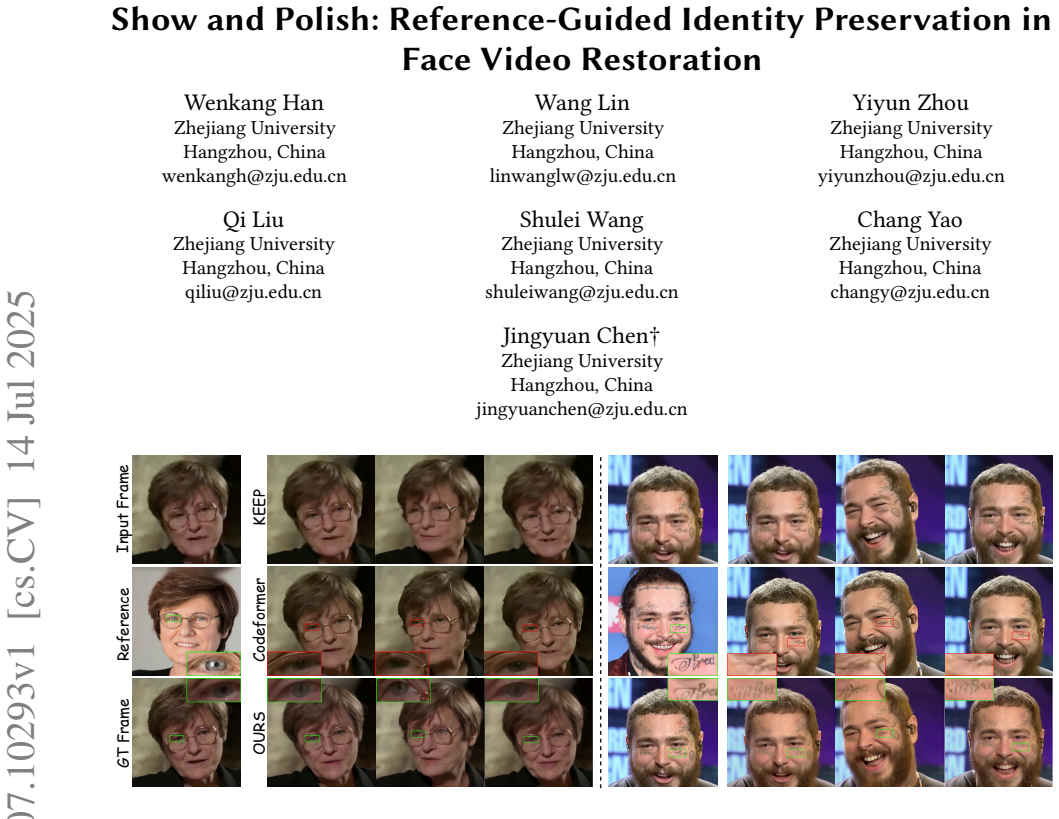
The central claim is that identity-preserving face video restoration can be achieved by conditioning a pretrained video latent diffusion model on an identity-specific reference face through multimodal prompts: a text prompt generated from detected facial attributes and emotion, and an image prompt from the reference face itself. These prompts are fused via decoupled cross-attention, so the denoising U-Net attends to identity features separately from its text conditioning. To keep identity stable within a 24-frame clip, the paper adds an identity-preserving feedback loss driven by cosine similarity of face embeddings, with suffix-weighted temporal aggregation to emphasize later frames. To keep identity stable across clips, it shares noise between overlapping clips and then blends the latent encodings of several preceding clips across denoising steps using an exponential schedule. A multi-stream negative prompt, combining negative text and a degraded-visual reference, steers generation away from nonexistent or false facial attributes. On the YouRef-heavy test set the method reports the best PSNR (29.51), SSIM (0.918), and identity similarity IDS (0.821), and on the real-world FOS-V benchmark it reports the best CLIP-IQA, MUSIQ, LIQE, and flow-warping error among the compared methods.
Load-bearing premise
The central comparison assumes it is fair to give IP-FVR additional per-identity personalization data and LoRA fine-tuning while evaluating all baselines with their default checkpoints; if the baselines received the same data and tuning budget, the reported quality and identity gains could shrink or disappear.
Editorial extensions
If this is right
- If the method is correct, a single reference photo is enough to restore long, heavily degraded face videos without the faces drifting into a generic average identity.
- The identity feedback loss, exponential blending, and noise sharing are modular: each can be removed and the reported temporal-consistency metrics degrade, confirming they serve separable purposes.
- Per-identity LoRA weights make the system plug-and-play at inference, so the same frozen video diffusion model can serve many identities by swapping small parameter sets.
- Both text and visual identity channels matter: ablations show removing either the face-to-text encoder or the visual encoder lowers identity similarity, with the text channel contributing more.
- Diffusion-based baselines that score well on no-reference quality metrics still lag on identity similarity, suggesting that identity conditioning rather than raw generative power is what recovers distinctive features.
Reading between the lines
- The comparison is not perfectly symmetric: Paper's method receives per-identity LoRA fine-tuning on four training scenes, while baselines run with their default checkpoints; if the same fine-tuning budget were given to the baselines, the reported IDS and quality gaps could narrow. This is an inference from the implementation section, not a result claimed in the paper.
- The decoupled cross-attention plus multi-stream negative prompt recipe could transfer to other reference-conditioned video tasks, such as talking-head generation or reenactment, where identity must stay constant while expression and pose vary.
- An inexpensive falsifiable probe would be to measure identity similarity on identities that were never fine-tuned: the paper evaluates after per-identity tuning, and the zero-shot generalization of the pretrained cross-attention weights is not separately quantified.
- The exponential blending approach implies that identity stability over arbitrarily long videos can be obtained at inference time with no extra training, which suggests a practical route to streaming restoration if the latency of blending is acceptable.
Editorial analysis
A structured set of objections, weighed in public.
Referee Report
Summary. The paper proposes IP-FVR, a reference-guided face video restoration method built on a video latent diffusion model. A high-quality reference face image of the target identity is injected through a face-to-text encoder and a decoupled cross-attention module, and per-identity LoRA fine-tuning is applied. To control identity drift, the paper introduces an identity-preserving feedback loss based on cosine-similarity rewards with suffix-weighted temporal aggregation for intra-clip drift, an exponential blending strategy with overlapping clips and shared noise for inter-clip drift, and multi-stream negative prompting at inference. Experiments on a synthetic YouRef dataset and the real-world FOS-V dataset compare IP-FVR against DMDNet, KEEP, CodeFormer, StableSR, RVSR, UAV, and VEnhancer, reporting quality metrics (PSNR, SSIM, LPIPS, CLIP-IQA, MUSIQ, LIQE), identity similarity (IDS), temporal consistency (E_warp, sigma_IDS), and qualitative comparisons. The central claim is that IP-FVR outperforms existing methods in both restoration quality and identity preservation.
Significance. If the claims were established, the paper would make a useful contribution to face video restoration by showing how a single reference image can serve as identity conditioning in a video diffusion model, and by offering practical mechanisms for reducing identity drift within and across clips. The strengths of the manuscript include a clear architectural description, release of code and datasets, qualitative figures that illustrate the intended behavior, and ablations for the decoupled cross-attention, exponential blending, and negative-prompt components. However, the evaluation as presented does not yet demonstrate the claimed superiority, because the comparison protocol gives IP-FVR privileged per-identity fine-tuning and a reference image that baselines do not receive, and because the identity metric is closely aligned with the training objective.
major comments (4)
- [4 (Implementation), Tables 1 and 2] The head-to-head comparison is confounded: IP-FVR receives a clean reference face image and per-identity LoRA weights fine-tuned on four paired low/high-quality scenes of the same identity, while all baselines are run off-the-shelf with their original hyperparameters. The reported gains in IDS (e.g., 0.821 vs. 0.749 for CodeFormer in Table 1) and in quality metrics may therefore reflect access to identity-specific training data and reference conditioning rather than the proposed architecture. The authors should either evaluate IP-FVR without the per-identity LoRA fine-tuning, fine-tune or otherwise personalize the baselines using the same data and budget, or add a directly comparable reference-guided baseline such as PFStorer [48], which is cited but never quantitatively compared.
- [3.3 (Eq. 5) and Section 4 (Evaluation Metrics)] The identity-preserving reward in Eq. (5) is a cosine similarity between face embeddings of the generated frame and the reference face, and the headline evaluation metric IDS is also a cosine similarity computed with ArcFace. If the face encoder used in Eq. (5) is the same ArcFace model, the reported IDS improvements are at least partially produced by directly optimizing the evaluation metric. The paper should specify which face encoder is used for the reward and add identity metrics computed with a different face recognition model, or face verification-based protocols; it should also report an ablation without L_id_reward so that this circularity can be quantified.
- [4.2, Figure 8] The contribution of identity-preserving feedback learning and per-identity LoRA fine-tuning is not isolated quantitatively. Figure 8 is qualitative only, and Table 3 varies the text and visual prompt modalities while keeping the fine-tuning protocol fixed. A quantitative ablation with and without the per-identity LoRA fine-tuning and with and without L_id_reward is needed to separate the method's architectural contribution from the effect of identity-specific training data, especially since the comparison protocol is already unequal.
- [4.1, Table 2] On the real-world FOS-V dataset, the paper reports only CLIP-IQA, MUSIQ, LIQE, and E_warp; no identity metrics such as IDS or sigma_IDS are given. Since identity preservation is a central claim of the paper, the absence of identity evaluation on real-world data weakens the conclusion and should be addressed by reporting identity similarity to the reference face and its temporal standard deviation on FOS-V.
minor comments (6)
- [3.3, Eq. (8)] The notation random{R_0, ..., R_F} is not defined; if it means sampling one reward uniformly, please state this explicitly and describe how the expectation is estimated in training.
- [3.4, Eq. (10)] The sentence 'so s = 3 in this case' is inconsistent with O = 8 and 2s = O, which gives s = 4; please correct the value or the relation.
- [4.2, Table 5] The text states the optimal configuration is w_nt = 0.5 and w_nt = 0.5; the second weight should presumably be w_nv, and the table or text should be corrected.
- [3.5] The ablation study in Section 4.2 refers to 'Section 3.4' for the negative-prompt method, but the multi-stream negative prompt is described in Section 3.5; the cross-reference should be fixed.
- [3.2, Face2Text Encoder] The face-to-text encoder relies on a large language model to organize attribute keywords into natural-language descriptions, but the specific LLM and prompt template are not reported; please provide these details for reproducibility.
- [4, Datasets and Tables 1-2] No error bars, confidence intervals, or per-identity variance are reported, and the evaluation set sizes (18 and 20 celebrities) are modest; reporting variance across identities would make the claimed margins more credible.
Circularity Check
No load-bearing circularity: the identity-preservation claims rest on held-out evaluations and disclosed reference conditioning, not on self-referential definitions.
full rationale
The paper's derivation chain is self-contained with respect to circularity. The most plausible concern is that the training reward in Eq. (5), cosine similarity between the generated frame and the reference face in a face-encoder space, is the same operation as the reported IDS metric, cosine similarity with ArcFace. However, the paper does not state that the training face encoder is ArcFace, the test scenes are explicitly excluded from LoRA fine-tuning, and IDS is reported on held-out clips; maximizing a cosine-similarity reward on training scenes does not by construction determine the held-out IDS value. The per-identity LoRA protocol in Section 4 (Implementation) is a fairness confound: IP-FVR receives identity-specific fine-tuning and a reference image while baselines are run off-the-shelf, so the head-to-head superiority claim is not fully demonstrated. That is an evaluation-protocol/correctness risk, not a logical circularity. The quality metrics (PSNR, SSIM, LPIPS, CLIP-IQA, MUSIQ, LIQE) and temporal metrics (E_warp, sigma_IDS) are externally defined and are not directly optimized by the paper's training equations by construction. No self-citation chain or uniqueness argument is load-bearing. Hence no circular step reaches the quoted-reduction threshold.
Assumptions & free parameters
free parameters (5)
- gamma (discount factor in Eq. 7)
- lambda (image cross-attention weight in Eq. 4)
- w_nt and w_nv (negative prompt weights in Eq. 11) =
0.5, 0.5
- Clip length F=24 and overlap O=8
- Per-identity LoRA fine-tuning budget =
100 steps, four scenes
assumptions (6)
- domain assumption VEnhancer provides a strong pretrained video latent diffusion prior.
- domain assumption Decoupled cross-attention from IP-Adapter transfers from image generation to video restoration.
- domain assumption Face attribute detector, LLM, and CLIP text encoder produce identity-relevant text prompts.
- domain assumption Cosine similarity of face embeddings is a valid measure of identity for both training and evaluation.
- domain assumption A high-quality reference face image of the same identity is available for every target video.
- ad hoc to paper Per-identity LoRA fine-tuning is a fair comparison protocol.
Cite this review
Pith. "Pith review of Show and Polish: Reference-Guided Identity Preservation in Face Video Restoration." pith.science (2026). https://pith.science/paper/6NACWZYQ
@misc{pith2026250710293,
  author       = {Pith},
  title        = {Pith review of: Show and Polish: Reference-Guided Identity Preservation in Face Video Restoration},
  year         = {2026},
  howpublished = {\url{https://pith.science/paper/6NACWZYQ}},
  note         = {Machine review of arXiv:2507.10293}
}
read the original abstract
Face Video Restoration (FVR) aims to recover high-quality face videos from degraded versions. Traditional methods struggle to preserve fine-grained, identity-specific features when degradation is severe, often producing average-looking faces that lack individual characteristics. To address these challenges, we introduce IP-FVR, a novel method that leverages a high-quality reference face image as a visual prompt to provide identity conditioning during the denoising process. IP-FVR incorporates semantically rich identity information from the reference image using decoupled cross-attention mechanisms, ensuring detailed and identity consistent results. For intra-clip identity drift (within 24 frames), we introduce an identity-preserving feedback learning method that combines cosine similarity-based reward signals with suffix-weighted temporal aggregation. This approach effectively minimizes drift within sequences of frames. For inter-clip identity drift, we develop an exponential blending strategy that aligns identities across clips by iteratively blending frames from previous clips during the denoising process. This method ensures consistent identity representation across different clips. Additionally, we enhance the restoration process with a multi-stream negative prompt, guiding the model's attention to relevant facial attributes and minimizing the generation of low-quality or incorrect features. Extensive experiments on both synthetic and real-world datasets demonstrate that IP-FVR outperforms existing methods in both quality and identity preservation, showcasing its substantial potential for practical applications in face video restoration.
Figures


Figures from the paper (6 more)


Forward citations
Cited by 3 Pith papers
-
TAP: Parameter-efficient Task-Aware Prompting for Adverse Weather Removal
A two-stage prompt-tuning method with low-rank and contrastive prompt enhancement claims all-in-one adverse weather removal at 2.75M parameters.
-
BIFE: Better Interaction, Fewer Errors for Minute-Long Video Generation
BlockVid generates minute-long videos with a semantic sparse KV cache, Block Forcing training, and chunk-level noise scheduling, reporting large gains on its own LV-Bench and on VBench.
-
Inferix: A Block-Diffusion based Next-Generation Inference Engine for World Simulation
Inferix provides an optimized inference engine for semi-autoregressive block-diffusion decoding to support high-quality, variable-length video generation in world simulation applications.
Reference graph
Works this paper leans on
-
[48]
Tuomas Varanka, Tapani Toivonen, Soumya Tripathy, Guoying Zhao, and Erman Acar. 2024. PFStorer: Personalized Face Restoration and Super-Resolution. In Proceedings of the IEEE/CVF Conference on Computer Vision and Pattern Recognition. 2372–2381
work page 2024
-
[1]
Octavio Arriaga, Matias Valdenegro-Toro, and Paul Plöger. 2017. Real-time convolutional neural networks for emotion and gender classification. arXiv preprint arXiv:1710.07557 (2017)
work page Pith review arXiv 2017
-
[2]
Kelvin CK Chan, Xintao Wang, Xiangyu Xu, Jinwei Gu, and Chen Change Loy
-
[3]
Kelvin CK Chan, Shangchen Zhou, Xiangyu Xu, and Chen Change Loy. 2022. Investigating tradeoffs in real-world video super-resolution. In Proceedings of the IEEE/CVF Conference on Computer Vision and Pattern Recognition . 5962–5971
2022
-
[4]
Ziyan Chen, Jingwen He, Xinqi Lin, Yu Qiao, and Chao Dong. 2024. Towards Real- world Video Face Restoration: A New Benchmark.arXiv preprint arXiv:2404.19500 (2024)
work page Pith review arXiv 2024
-
[5]
Jiankang Deng, Jia Guo, Niannan Xue, and Stefanos Zafeiriou. 2019. Arcface: Additive angular margin loss for deep face recognition. In Proceedings of the IEEE/CVF conference on computer vision and pattern recognition . 4690–4699
2019
-
[6]
Ruicheng Feng, Chongyi Li, and Chen Change Loy. 2024. Kalman-inspired feature propagation for video face super-resolution. arXiv preprint arXiv:2408.05205 (2024)
work page Pith review arXiv 2024
-
[7]
Yueying Feng, WenKang Han, Tao Jin, Zhou Zhao, Fei Wu, Chang Yao, Jingyuan Chen, et al . 2024. E 3: Exploring Embodied Emotion Through A Large-Scale Egocentric Video Dataset. Advances in Neural Information Processing Systems 37 (2024), 118182–118197
work page 2024
Show all 84 references
-
[8]
Daiheng Gao, Shilin Lu, Shaw Walters, Wenbo Zhou, Jiaming Chu, Jie Zhang, Bang Zhang, Mengxi Jia, Jian Zhao, Zhaoxin Fan, et al . 2024. EraseAnything: Enabling Concept Erasure in Rectified Flow Transformers. arXiv preprint arXiv:2412.20413 (2024)
2024 arXiv
-
[9]
Jinjin Gu, Yujun Shen, and Bolei Zhou. 2020. Image processing using multi-code gan prior. InProceedings of the IEEE/CVF conference on computer vision and pattern recognition. 3012–3021
2020
-
[10]
Yuchao Gu, Xintao Wang, Liangbin Xie, Chao Dong, Gen Li, Ying Shan, and Ming-Ming Cheng. 2022. Vqfr: Blind face restoration with vector-quantized dictionary and parallel decoder. In European Conference on Computer Vision . Springer, 126–143
2022
-
[11]
Wenkang Han, Wang Lin, Liya Hu, Zhenlong Dai, Yiyun Zhou, Mengze Li, Zemin Liu, Chang Yao, and Jingyuan Chen. 2025. Contrastive Cross-Course Knowl- edge Tracing via Concept Graph Guided Knowledge Transfer. arXiv preprint arXiv:2505.13489 (2025)
2025 arXiv
-
[12]
Wenkang Han, Zhixiong Zeng, Jing Huang, Shu Jiang, Liming Zheng, Longrong Yang, Haibo Qiu, Chang Yao, Jingyuan Chen, and Lin Ma. 2025. GUIRoboTron- Speech: Towards Automated GUI Agents Based on Speech Instructions. arXiv preprint arXiv:2506.11127 (2025)
2025
-
[13]
Jingwen He, Wu Shi, Kai Chen, Lean Fu, and Chao Dong. 2022. Gcfsr: a generative and controllable face super resolution method without facial and gan priors. In Proceedings of the IEEE/CVF conference on computer vision and pattern recognition . 1889–1898
2022
-
[14]
Jingwen He, Tianfan Xue, Dongyang Liu, Xinqi Lin, Peng Gao, Dahua Lin, Yu Qiao, Wanli Ouyang, and Ziwei Liu. 2024. Venhancer: Generative space-time enhancement for video generation. arXiv preprint arXiv:2407.07667 (2024)
2024 arXiv
-
[15]
Jonathan Ho, Ajay Jain, and Pieter Abbeel. 2020. Denoising diffusion probabilistic models. Advances in neural information processing systems 33 (2020), 6840–6851
2020
-
[16]
Jonathan Ho and Tim Salimans. 2022. Classifier-free diffusion guidance. arXiv preprint arXiv:2207.12598 (2022)
2022 arXiv
-
[17]
Edward J Hu, Yelong Shen, Phillip Wallis, Zeyuan Allen-Zhu, Yuanzhi Li, Shean Wang, Lu Wang, and Weizhu Chen. 2021. Lora: Low-rank adaptation of large language models. arXiv preprint arXiv:2106.09685 (2021)
2021 arXiv
-
[18]
Jiehui Huang, Xiao Dong, Wenhui Song, Hanhui Li, Jun Zhou, Yuhao Cheng, Shutao Liao, Long Chen, Yiqiang Yan, Shengcai Liao, et al. 2024. Consistentid: Portrait generation with multimodal fine-grained identity preserving. arXiv preprint arXiv:2404.16771 (2024)
2024 arXiv
-
[19]
Takashi Isobe, Xu Jia, Shuhang Gu, Songjiang Li, Shengjin Wang, and Qi Tian
-
[20]
Takashi Isobe, Songjiang Li, Xu Jia, Shanxin Yuan, Gregory Slabaugh, Chunjing Xu, Ya-Li Li, Shengjin Wang, and Qi Tian. 2020. Video Super-Resolution With Temporal Group Attention. In 2020 IEEE/CVF Conference on Computer Vision and Pattern Recognition (CVPR). 8005–8014. https:/...
2020
-
[21]
Takashi Isobe, Fang Zhu, Xu Jia, and Shengjin Wang. 2020. Revisiting temporal modeling for video super-resolution. arXiv preprint arXiv:2008.05765 (2020)
2020 arXiv
-
[22]
Younghyun Jo, Seoung Wug Oh, Jaeyeon Kang, and Seon Joo Kim. 2018. Deep video super-resolution network using dynamic upsampling filters without explicit motion compensation. In Proceedings of the IEEE conference on computer vision and pattern recognition. 3224–3232
2018
-
[23]
Tero Karras, Samuli Laine, Miika Aittala, Janne Hellsten, Jaakko Lehtinen, and Timo Aila. 2020. Analyzing and improving the image quality of stylegan. In Proceedings of the IEEE/CVF conference on computer vision and pattern recognition . 8110–8119
2020
-
[24]
Junjie Ke, Qifei Wang, Yilin Wang, Peyman Milanfar, and Feng Yang. 2021. Musiq: Multi-scale image quality transformer. InProceedings of the IEEE/CVF international conference on computer vision . 5148–5157
2021
-
[25]
Tianshu Kuai, Sina Honari, Igor Gilitschenski, and Alex Levinshtein. 2024. To- wards Unsupervised Blind Face Restoration using Diffusion Prior. arXiv preprint arXiv:2410.04618 (2024)
2024 arXiv
-
[26]
Wei-Sheng Lai, Jia-Bin Huang, Oliver Wang, Eli Shechtman, Ersin Yumer, and Ming-Hsuan Yang. 2018. Learning blind video temporal consistency. In Proceed- ings of the European conference on computer vision (ECCV) . 170–185
2018
-
[27]
Leyang Li, Shilin Lu, Yan Ren, and Adams Wai-Kin Kong. 2025. Set you straight: Auto-steering denoising trajectories to sidestep unwanted concepts. arXiv preprint arXiv:2504.12782 (2025)
2025 arXiv
-
[28]
Xiaoming Li, Wenyu Li, Dongwei Ren, Hongzhi Zhang, Meng Wang, and Wang- meng Zuo. 2020. Enhanced blind face restoration with multi-exemplar images and adaptive spatial feature fusion. In Proceedings of the IEEE/CVF Conference on Computer Vision and Pattern Recognition . 2706–2715
2020
-
[29]
Xiaoming Li, Shiguang Zhang, Shangchen Zhou, Lei Zhang, and Wangmeng Zuo. 2022. Learning dual memory dictionaries for blind face restoration. IEEE Transactions on Pattern Analysis and Machine Intelligence 45, 5 (2022), 5904–5917
2022
-
[30]
Zhen Li, Mingdeng Cao, Xintao Wang, Zhongang Qi, Ming-Ming Cheng, and Ying Shan. 2024. Photomaker: Customizing realistic human photos via stacked id embedding. In Proceedings of the IEEE/CVF Conference on Computer Vision and Pattern Recognition. 8640–8650
2024
-
[31]
Guoqiang Liang, Qingnan Fan, Bingtao Fu, Jinwei Chen, Hong Gu, and Lin Wang
-
[32]
Jingyun Liang, Yuchen Fan, Xiaoyu Xiang, Rakesh Ranjan, Eddy Ilg, Simon Green, Jiezhang Cao, Kai Zhang, Radu Timofte, and Luc V Gool. 2022. Recurrent video restoration transformer with guided deformable attention. Advances in Neural Information Processing Systems 35 (2022), 378–393
2022
-
[33]
Wang Lin, Jingyuan Chen, Jiaxin Shi, Yichen Zhu, Chen Liang, Junzhong Miao, Tao Jin, Zhou Zhao, Fei Wu, Shuicheng Yan, et al. 2024. Non-confusing Generation of Customized Concepts in Diffusion Models. arXiv preprint arXiv:2405.06914 (2024)
2024 arXiv
-
[34]
Ce Liu and Deqing Sun. 2013. On Bayesian adaptive video super resolution. IEEE transactions on pattern analysis and machine intelligence 36, 2 (2013), 346–360
2013
-
[35]
Ziwei Liu, Ping Luo, Xiaogang Wang, and Xiaoou Tang. 2015. Deep Learning Face Attributes in the Wild. In Proceedings of International Conference on Computer Vision (ICCV)
2015
-
[36]
Shilin Lu, Yanzhu Liu, and Adams Wai-Kin Kong. 2023. Tf-icon: Diffusion-based training-free cross-domain image composition. In Proceedings of the IEEE/CVF International Conference on Computer Vision . 2294–2305
2023
-
[37]
Shilin Lu, Zilan Wang, Leyang Li, Yanzhu Liu, and Adams Wai-Kin Kong. 2024. Mace: Mass concept erasure in diffusion models. In Proceedings of the IEEE/CVF Conference on Computer Vision and Pattern Recognition . 6430–6440
2024
-
[38]
Shilin Lu, Zihan Zhou, Jiayou Lu, Yuanzhi Zhu, and Adams Wai-Kin Kong. 2024. Robust watermarking using generative priors against image editing: From bench- marking to advances. arXiv preprint arXiv:2410.18775 (2024). MM’25, October 27 - October 31, 2025, Dublin, Ireland. Han a...
2024 arXiv
-
[39]
Sachit Menon, Alexandru Damian, Shijia Hu, Nikhil Ravi, and Cynthia Rudin
-
[40]
Seungjun Nah, Sungyong Baik, Seokil Hong, Gyeongsik Moon, Sanghyun Son, Radu Timofte, and Kyoung Mu Lee. 2019. Ntire 2019 challenge on video deblurring and super-resolution: Dataset and study. InProceedings of the IEEE/CVF conference on computer vision and pattern recognition ...
2019
-
[41]
Kaihang Pan, Wang Lin, Zhongqi Yue, Tenglong Ao, Liyu Jia, Wei Zhao, Juncheng Li, Siliang Tang, and Hanwang Zhang. 2025. Generative Multimodal Pretraining with Discrete Diffusion Timestep Tokens. In Proceedings of the Computer Vision and Pattern Recognition Conference . 26136–26146
2025
-
[42]
Xingang Pan, Xiaohang Zhan, Bo Dai, Dahua Lin, Chen Change Loy, and Ping Luo. 2021. Exploiting deep generative prior for versatile image restoration and manipulation. IEEE Transactions on Pattern Analysis and Machine Intelligence 44, 11 (2021), 7474–7489
2021
-
[43]
In Proceedings of the ieee/cvf conference on computer vision and pattern recognition
Pulse: Self-supervised photo upsampling via latent space exploration of generative models. In Proceedings of the ieee/cvf conference on computer vision and pattern recognition. 2437–2445
-
[44]
Robin Rombach, Andreas Blattmann, Dominik Lorenz, Patrick Esser, and Björn Ommer. 2022. High-resolution image synthesis with latent diffusion models. In Proceedings of the IEEE/CVF conference on computer vision and pattern recognition . 10684–10695
2022
-
[45]
Ethan M Rudd, Manuel Günther, and Terrance E Boult. 2016. Moon: A mixed objective optimization network for the recognition of facial attributes. In Com- puter Vision–ECCV 2016: 14th European Conference, Amsterdam, The Netherlands, October 11-14, 2016, Proceedings, Part V 14 . ...
2016
-
[46]
Tim Salimans and Jonathan Ho. 2022. Progressive distillation for fast sampling of diffusion models. arXiv preprint arXiv:2202.00512 (2022)
2022 arXiv
-
[47]
Xinmin Qiu, Congying Han, Zicheng Zhang, Bonan Li, Tiande Guo, and Xuecheng Nie. 2023. DiffBFR: Bootstrapping Diffusion Model for Blind Face Restoration. In Proceedings of the 31st ACM International Conference on Multimedia . 7785–7795
2023
-
[49]
Bohan Wang, Zhongqi Yue, Fengda Zhang, Shuo Chen, Li’an Bi, Junzhe Zhang, Xue Song, Kennard Yanting Chan, Jiachun Pan, Weijia Wu, et al. 2025. Discrete visual tokens of autoregression, by diffusion, and for reasoning. arXiv e-prints (2025), arXiv–2505
2025
-
[50]
Dongsheng Wang, Jiequan Cui, Miaoge Li, Wang Lin, Bo Chen, and Hanwang Zhang. 2024. Instruction Tuning-free Visual Token Complement for Multimodal LLMs. In European Conference on Computer Vision . Springer, 446–462
2024
-
[51]
Keda Tao, Jinjin Gu, Yulun Zhang, Xiucheng Wang, and Nan Cheng. 2024. Over- coming False Illusions in Real-World Face Restoration with Multi-Modal Guided Diffusion Model. arXiv preprint arXiv:2410.04161 (2024)
2024 arXiv
-
[52]
Jianyi Wang, Kelvin CK Chan, and Chen Change Loy. 2023. Exploring clip for assessing the look and feel of images. In Proceedings of the AAAI Conference on Artificial Intelligence, Vol. 37. 2555–2563
2023
-
[53]
Jianyi Wang, Zongsheng Yue, Shangchen Zhou, Kelvin CK Chan, and Chen Change Loy. 2024. Exploiting diffusion prior for real-world image super- resolution. International Journal of Computer Vision (2024), 1–21
2024
-
[54]
Qixun Wang, Xu Bai, Haofan Wang, Zekui Qin, Anthony Chen, Huaxia Li, Xu Tang, and Yao Hu. 2024. Instantid: Zero-shot identity-preserving generation in seconds. arXiv preprint arXiv:2401.07519 (2024)
2024 arXiv
-
[55]
Hanting Wang, Tao Jin, Wang Lin, Shulei Wang, Hai Huang, Shengpeng Ji, and Zhou Zhao. 2025. IRBridge: Solving Image Restoration Bridge with Pre-trained Generative Diffusion Models. arXiv preprint arXiv:2505.24406 (2025)
2025 arXiv
-
[56]
Xintao Wang, Kelvin CK Chan, Ke Yu, Chao Dong, and Chen Change Loy. 2019. Edvr: Video restoration with enhanced deformable convolutional networks. In Proceedings of the IEEE/CVF conference on computer vision and pattern recognition workshops. 0–0
2019
-
[57]
Xintao Wang, Yu Li, Honglun Zhang, and Ying Shan. 2021. Towards real-world blind face restoration with generative facial prior. In Proceedings of the IEEE/CVF conference on computer vision and pattern recognition . 9168–9178
2021
-
[58]
Zhouxia Wang, Jiawei Zhang, Runjian Chen, Wenping Wang, and Ping Luo. 2022. Restoreformer: High-quality blind face restoration from undegraded key-value pairs. In Proceedings of the IEEE/CVF conference on computer vision and pattern recognition. 17512–17521
2022
-
[59]
Shulei Wang, Wang Lin, Hai Huang, Hanting Wang, Sihang Cai, WenKang Han, Tao Jin, Jingyuan Chen, Jiacheng Sun, Jieming Zhu, et al. 2025. Towards transformer-based aligned generation with self-coherence guidance. arXiv preprint arXiv:2503.17675 (2025)
2025 arXiv
-
[60]
Guangxuan Xiao, Tianwei Yin, William T Freeman, Frédo Durand, and Song Han
-
[61]
Liangbin Xie, Xintao Wang, Shuwei Shi, Jinjin Gu, Chao Dong, and Ying Shan
-
[62]
Tianfan Xue, Baian Chen, Jiajun Wu, Donglai Wei, and William T Freeman. 2019. Video enhancement with task-oriented flow. International Journal of Computer Vision 127 (2019), 1106–1125
2019
-
[63]
Tao Wu, Mengze Li, Jingyuan Chen, Wei Ji, Wang Lin, Jinyang Gao, Kun Kuang, Zhou Zhao, and Fei Wu. 2024. Semantic Alignment for Multimodal Large Lan- guage Models. In Proceedings of the 32nd ACM International Conference on Multi- media. 3489–3498
2024
-
[64]
Lingbo Yang, Shanshe Wang, Siwei Ma, Wen Gao, Chang Liu, Pan Wang, and Peiran Ren. 2020. Hifacegan: Face renovation via collaborative suppression and replenishment. In Proceedings of the 28th ACM international conference on multimedia. 1551–1560
2020
-
[65]
International Journal of Computer Vision (2024), 1–20
Fastcomposer: Tuning-free multi-subject image generation with localized attention. International Journal of Computer Vision (2024), 1–20
2024
-
[66]
Xi Yang, Chenhang He, Jianqi Ma, and Lei Zhang. 2025. Motion-guided latent diffusion for temporally consistent real-world video super-resolution. InEuropean Conference on Computer Vision . Springer, 224–242
2025
-
[67]
Hu Ye, Jun Zhang, Sibo Liu, Xiao Han, and Wei Yang. 2023. Ip-adapter: Text compatible image prompt adapter for text-to-image diffusion models. arXiv preprint arXiv:2308.06721 (2023)
2023 arXiv
-
[68]
Chang-Han Yeh, Chin-Yang Lin, Zhixiang Wang, Chi-Wei Hsiao, Ting-Hsuan Chen, and Yu-Lun Liu. 2024. DiffIR2VR-Zero: Zero-Shot Video Restoration with Diffusion-based Image Restoration Models. arXiv preprint arXiv:2407.01519 (2024)
2024
-
[69]
Weicai Yan, Wang Lin, Zirun Guo, Ye Wang, Fangming Feng, Xiaoda Yang, Zehan Wang, and Tao Jin. 2025. Diff-prompt: Diffusion-driven prompt generator with mask supervision. arXiv preprint arXiv:2504.21423 (2025)
2025 arXiv
-
[70]
Lvmin Zhang, Anyi Rao, and Maneesh Agrawala. 2023. Adding conditional con- trol to text-to-image diffusion models. InProceedings of the IEEE/CVF International Conference on Computer Vision . 3836–3847
2023
-
[71]
Tao Yang, Peiran Ren, Xuansong Xie, and Lei Zhang. 2021. Gan prior embedded network for blind face restoration in the wild. In Proceedings of the IEEE/CVF conference on computer vision and pattern recognition . 672–681
2021
-
[72]
Shiwei Zhang, Jiayu Wang, Yingya Zhang, Kang Zhao, Hangjie Yuan, Zhiwu Qin, Xiang Wang, Deli Zhao, and Jingren Zhou. 2023. I2vgen-xl: High-quality image- to-video synthesis via cascaded diffusion models. arXiv preprint arXiv:2311.04145 (2023)
2023 arXiv
-
[73]
Weixia Zhang, Guangtao Zhai, Ying Wei, Xiaokang Yang, and Kede Ma. 2023. Blind image quality assessment via vision-language correspondence: A multitask learning perspective. In Proceedings of the IEEE/CVF conference on computer vision and pattern recognition. 14071–14081
2023
-
[74]
Shangchen Zhou, Kelvin Chan, Chongyi Li, and Chen Change Loy. 2022. Towards robust blind face restoration with codebook lookup transformer. Advances in Neural Information Processing Systems 35 (2022), 30599–30611
2022
-
[75]
Peng Yi, Zhongyuan Wang, Kui Jiang, Junjun Jiang, and Jiayi Ma. 2019. Pro- gressive fusion video super-resolution network via exploiting non-local spatio- temporal correlations. In Proceedings of the IEEE/CVF international conference on computer vision. 3106–3115
2019
-
[76]
Zihao Zou, Jiaming Liu, Shirin Shoushtari, Yubo Wang, Weijie Gan, and Ulugbek S Kamilov. 2023. Flair: A conditional diffusion framework with applications to face video restoration. arXiv preprint arXiv:2311.15445 (2023)
2023 arXiv
-
[77]
Richard Zhang, Phillip Isola, Alexei A Efros, Eli Shechtman, and Oliver Wang
-
[82]
Shangchen Zhou, Peiqing Yang, Jianyi Wang, Yihang Luo, and Chen Change Loy
-
[83]
In Proceedings of the IEEE/CVF Conference on Computer Vision and Pattern Recognition
Upscale-A-Video: Temporal-Consistent Diffusion Model for Real-World Video Super-Resolution. In Proceedings of the IEEE/CVF Conference on Computer Vision and Pattern Recognition . 2535–2545
-
[2018]
In Proceedings of the IEEE conference on computer vision and pattern recognition
The unreasonable effectiveness of deep features as a perceptual metric. In Proceedings of the IEEE conference on computer vision and pattern recognition . 586–595
-
[2020]
In Computer Vision – ECCV 2020: 16th European Conference, Glasgow, UK, August 23–28, 2020, Proceedings, Part XII (Glasgow, United Kingdom)
Video Super-Resolution with Recurrent Structure-Detail Network. In Computer Vision – ECCV 2020: 16th European Conference, Glasgow, UK, August 23–28, 2020, Proceedings, Part XII (Glasgow, United Kingdom). Springer-Verlag, Berlin, Heidelberg, 645–660. https://doi.org/10.1007/978...
2020 doi
-
[2021]
In Proceedings of the IEEE/CVF conference on computer vision and pattern recognition
Glean: Generative latent bank for large-factor image super-resolution. In Proceedings of the IEEE/CVF conference on computer vision and pattern recognition . 14245–14254
-
[2023]
In Pro- ceedings of the AAAI Conference on Artificial Intelligence , Vol
Mitigating artifacts in real-world video super-resolution models. In Pro- ceedings of the AAAI Conference on Artificial Intelligence , Vol. 37. 2956–2964
-
[2024]
arXiv preprint arXiv:2410.09864 (2024)
AuthFace: Towards Authentic Blind Face Restoration with Face-oriented Generative Diffusion Prior. arXiv preprint arXiv:2410.09864 (2024)
2024
Reviewed August 6, 2026 · model on record in the stance chip above.
Discussion (0). Sign in to comment.