REVIEW 3 major objections 4 minor 1 cited by
Fault-Tolerant Quantum Error Correction for Constant-Excitation Stabilizer Codes under Coherent Noise
T0 review · 3 major / 4 minor · reviewed 2026-08-06 · deepseek-v4-flash
Pith's one-line read The paper establishes the first complete fault-tolerant error-correction framework for constant-excitation codes, replacing transversal CNOTs with CE-preserving gates so syndrome extraction can run entirely inside the constant-excitation…
desk verdict Sound new constructions for CE codes, but the 'complete FTQEC' claim rests on an unproven ancilla-preparation gadget. read the letter →
The pith
A machine-rendered reading of the paper's core claim, the machinery that carries it, and where it could break.
The reading
What carries the argument
The load-bearing objects are three. First, dual-rail concatenation (Theorem 3): each physical qubit is paired with an ancilla and both are encoded by the zero-controlled NOT encoder $C^0X$, producing a $2n$-qubit CE code with additional stabilizers $-Z_{2j-1}Z_{2j}$. Second, the CE-preserving logical CNOT (Lemma 8): a transversal CNOT followed by the Pauli correction $\prod_j X_{2j}$, realized bitwise as alternating transversal CNOT and zero-controlled NOT gates, restores the signs of the weight-2 stabilizers and keeps both code blocks inside the CE subspace. Third, the CE-compatible ancillas plus the identities that carry the fault-tolerance proofs: the $w$-CE cat state $\frac{1}{\sqrt{2}}(|01\rangle^{\otimes w}+|10\rangle^{\otimes w})$ for the modified Shor extraction, logical $|0_k\rangle_L$ and $|+_k\rangle_L$ states for the modified Steane extraction, and the Lemma 7 commutation relations (for example $C^0X_{1,2}e^{-i\theta Z_2}=e^{i2\theta Z_1Z_2}C^0X_{1,2}$) that determine how coherent phases propagate through gates and measurements.
What would settle it
Simulate Algorithm 1 with an explicit noisy preparation circuit for the $w$-CE cat state (for instance the verification-based procedure cited as [46]) and count double faults under the paper's own noise model: if two faults — one inside that preparation and one in the controlled gates or measurement — ever produce an uncorrectable syndrome for the $[[12,1,3]]$ code, then the $t$-fault-tolerance guarantee of Theorem 9 fails for that gadget and the completeness claim holds only for ideal ancillas.
Extended reading notes
Core claim
The paper's central claim is that a complete fault-tolerant architecture exists for constant-excitation CSS codes under a circuit-level noise model interleaved with collective coherent errors. It proves that the transversal CNOT, normally the backbone of syndrome extraction, is incompatible with CE codes because the dual-rail-concatenated stabilizers $-Z_{2j-1}Z_{2j}$ carry sign $-1$; Lemma 8 shows that appending the correction $\prod_j X_{2j}$ — equivalently, replacing alternating CNOTs with zero-controlled NOT gates — yields a genuine logical CNOT that preserves the CE constraint. With that gate, Theorem 9 shows that any weight-$2w$ stabilizer can be measured fault-tolerantly by a modified Shor circuit using the $w$-CE cat state $\frac{1}{\sqrt{2}}(|01\rangle^{\otimes w}+|10\rangle^{\otimes w})$, and Theorem 10 shows that a modified Steane circuit using logical $|0_k\rangle_L$ and $|+_k\rangle_L$ ancillas is fault-tolerant for CE CSS codes. The same framework yields two minimal distance-3 codes, the $[[12,1,3]]$ and $[[14,3,3]]$ CE CSS codes (Theorem 6), and an extended stabilizer simulation that tracks coherent phases alongside Pauli errors produces pseudo-thresholds for the $[[12,1,3]]$ code that remain close to the no-coherent-noise values when collective coherent noise is added.
Load-bearing premise
The load-bearing premise is that the CE-compatible ancilla states — the $w$-CE cat states for modified Shor extraction and the logical $|0_k\rangle_L$ and $|+_k\rangle_L$ states for modified Steane extraction — can themselves be prepared fault-tolerantly while staying inside the constant-excitation subspace; the paper cites verification circuits for cat states without giving a concrete circuit and explicitly defers the fault-tolerant preparation of $w$-CE cat states to future work.
Editorial extensions
If this is right
- Collective coherent noise no longer has to be twirled into stochastic Pauli noise before error correction begins: the effective error rate for a CE code stays at the stochastic rate $p$ instead of rising to $q_3 = \lambda p/3 + (1-\lambda)\sin^2\theta$.
- Because logical error rate scales as $(r/p_{\rm th})^{t+1}$, replacing the twirled rate $q_3$ by $p$ improves the logical error rate by the factor $R^{t+1}$, which grows exponentially with the code's distance when $R>1$.
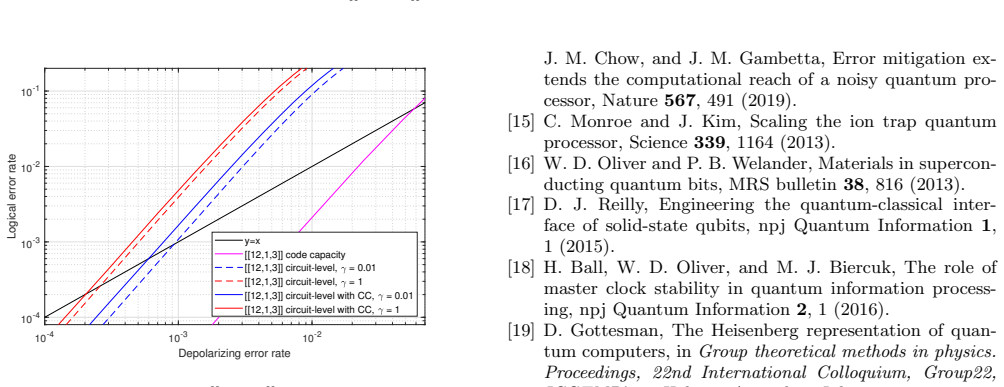
- The $[[12,1,3]]$ CE CSS code is a concrete small code with circuit-level pseudo-thresholds of $2.62\times 10^{-4}$ without coherent noise and $2.04\times 10^{-4}$ with collective coherent noise at idle error ratio $\gamma=1$.
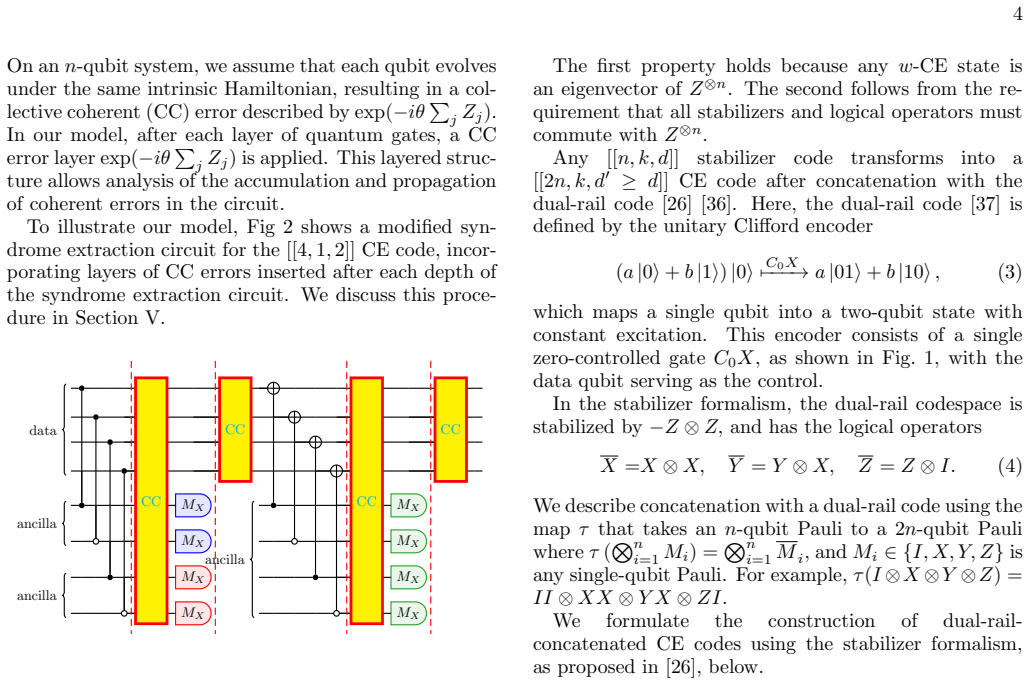
- Fault-tolerant syndrome extraction is available for any CE CSS code in two forms — the modified Shor circuit (Algorithm 1) and the modified Steane circuit (Fig. 4) — so the framework is not tied to a single code family.
Reading between the lines
- Beyond the paper: the same zero-controlled-gate toolkit and phase-tracking simulation should generalise to other non-Clifford noise with $Z$-type support, such as slow $ZZ$ crosstalk or clock-drift-induced dephasing, providing a template for testing CE codes against realistic time-dependent noise.
- Beyond the paper: the paper only simulates the $[[12,1,3]]$ code; running Algorithm 2 on the $[[14,3,3]]$ code would show whether the threshold and its independence from coherent-error magnitude persist at a higher encoding rate.
- Beyond the paper: because Lemma 4 rules out distance-3 CE CSS codes up to length 9 and Lemma 5 rules out the dual-rail route at length 10, a construction outside the dual-rail method at length 10 or 11 would sharpen the minimality claim in Theorem 6.
Editorial analysis
A structured set of objections, weighed in public.
Referee Report
Summary. The paper develops a fault-tolerant quantum error correction framework for constant-excitation CSS stabilizer codes under collective coherent (CC) noise. The main technical contributions are a CE-preserving logical CNOT constructed by interlacing transversal CNOT gates with zero-controlled NOT gates (Lemma 8), modified Shor- and Steane-type syndrome extraction circuits using CE-compatible ancilla states (Theorems 9 and 10), an extended stabilizer simulation algorithm that tracks coherent Z-rotation errors alongside Pauli errors (Section VI), and explicit constructions of the [[12,1,3]] and [[14,3,3]] CE CSS codes (Theorem 6). The paper reports circuit-level pseudo-thresholds for the [[12,1,3]] code, including a scenario with CC noise, and claims that this is the first complete FTQEC framework for CE codes.
Significance. If the completeness claim were fully established, the paper would make a substantive contribution: CE codes are naturally immune to collective phase noise, and the proposed architecture would remove the need to twirl coherent noise into stochastic Pauli noise. The explicit dual-rail code constructions with explicit stabilizer generators, the CE-preserving logical CNOT construction, and the extended stabilizer simulation algorithm are concrete and useful components. The paper is also commendable for giving explicit stabilizer lists and for reporting numerical thresholds rather than only asymptotic arguments. However, the central claim of a complete framework currently rests on Theorems 9 and 10, and as argued below the proofs of these theorems do not establish fault tolerance under Definition 1 because the fault-tolerant preparation of the required ancilla states is not supplied. The significance of the paper would be high if this gap is closed; in its present form, the result is more accurately described as a set of fault-tolerant syndrome-extraction circuits conditional on ideal ancilla preparation.
major comments (3)
- [V.B.1, Theorem 9, Appendix A.4] The proof of Theorem 9 consists entirely of an ideal-circuit computation showing that Algorithm 1 correlates the measurement outcome with the eigenvalue of the stabilizer g. It never checks the two conditions of Definition 1 for faults occurring in the preparation of the w-CE cat state, in the controlled-P gates, or in the measurements. This is not a cosmetic omission: in a standard cat-state preparation, a single X fault before a fan-out CNOT can be copied to multiple ancilla qubits, and through the controlled-P gates this can produce a weight-2 error on the data block, which the distance-3 codes considered in the paper cannot correct. The sentence citing [46] for verification circuits does not provide a CE-compatible preparation circuit, and Section VIII explicitly lists 'fault-tolerant preparation of w-CE cat states' as future work. Therefore the claim that a weight-2w stabilizer can be fault-tolerantly measured by Algorithm 1 is not supported, and the abstract's 'complete FTQEC framework' statement is not justified.
- [V.B.2, Theorem 10, Appendix A.5, Figure 4] Theorem 10 and its proof assume the availability of logical ancilla states |0_k>_L and |+_k>_L that are 'immune to coherent errors', but no fault-tolerant preparation protocol for these states under CE constraints is given. The remark that these states 'can be prepared offline via state distillation [42,43]' is insufficient, because the cited references address ancilla preparation for standard CSS codes and do not show that the distilled states are CE-compatible or that the distillation process itself respects the CE constraint. In addition, distillation typically uses logical CNOT gates, but the standard transversal CNOT is not CE-compatible; the paper's interlaced zero-controlled-NOT construction is invoked only at the level of a remark. Since a single fault in the ancilla preparation can propagate into the data block through the two transversal CNOT stages of Figure 4, the fault-tolerance claim of Theorem 10 is not established by the present proof.
- [Section VII, Figure 5, Table I] The numerical pseudo-thresholds reported in Table I appear to assume ideal ancilla states: Figure 5 states 'Ancilla states are omitted', and Algorithm 3 directly uses the modified Shor syndrome extraction without specifying fault locations for the preparation of the w-CE cat states. Because the fault-tolerant preparation of these ancillas is not provided, the simulated thresholds do not represent an end-to-end threshold for the claimed complete FTQEC protocol. At a minimum, the paper should state explicitly that the thresholds assume ideal ancilla preparation, or it should include the preparation circuits with their fault locations in the simulation. Without this, the comparison with 'about 10^-4' thresholds for conventional codes is not a valid comparison of complete fault-tolerant schemes.
minor comments (4)
- [Section III] The gate set and noise model are presented twice: the second 'C. Quantum gate set' and 'D. Noise model' paragraphs duplicate the first occurrence, including the repeated Figure 1 and Definition 1. This should be cleaned up before publication.
- [Reference [52]] The statement 'The source files of our simulations can be found in [52]' is not verifiable because the reference contains no URL, repository identifier, or DOI, only 'Accessed: July 14, 2025'.
- [Appendix A.7, proof of Lemma 5] The proof of Lemma 5 relies on 'an exhaustive search over all feasible solutions' of an integer program, but the program, its variables, and the solver or code used are not described. Please provide a reproducible certificate or include the search code so that the nonexistence claim can be independently checked.
- [Section VI, Algorithm 2] The simulation algorithm is described procedurally, but its correctness is asserted only as 'straightforward circuit commutation identities'. A short formal statement that Algorithm 2 exactly tracks the evolution of Pauli and coherent errors under the stated noise model, together with a proof sketch, would make the numerical results more reliable.
Circularity Check
No circular reduction of the central FTQEC claim; the derivation is self-contained stabilizer algebra. The one self-citation (Ouyang's dual-rail construction) is independent prior work, and the main weakness—deferred fault-tolerant CE cat-state preparation—is an omitted proof, not circularity.
full rationale
The claimed derivation chain is not circular by construction. Theorem 9 and Theorem 10 are proved from the propagation identities of Lemma 7 and standard stabilizer/Steane-Shor circuit algebra; no parameter is fitted to the target logical error rates, and the pseudo-thresholds in Table I are simulation outputs, not fitted inputs. The CE-preserving logical CNOT (Lemma 8) is derived by explicit stabilizer evolution and a Pauli correction, not by assuming the conclusion. The minimal-code results (Theorem 6) are established by explicit stabilizer tables and a nonexistence argument (Lemmas 4-5). The dual-rail construction in Theorem 3 is taken from [26], a prior paper by coauthor Ouyang, but it is an independent published result with stated assumptions and does not itself assert the FTQEC claims; it is legitimate input rather than a self-referential justification. The most serious weakness is not circularity but an unproven premise: Section VIII explicitly lists 'fault-tolerant preparation of w-CE cat states' as future work, while Theorem 9 and the remark in Section V B1 assume such states can be fault-tolerantly prepared; Theorem 10 similarly assumes fault-tolerant logical ancilla states. This is a missing-support/completeness gap that undercuts the 'first complete FTQEC framework' headline, but it is an omitted proof, not a step in which a conclusion is equivalent to an input by definition. Accordingly, no circular step is logged; the score 2 reflects only the peripheral reliance on the coauthor's independent dual-rail construction and the unresolved ancilla-preparation assumption, which is a correctness risk rather than a circularity.
Assumptions & free parameters
assumptions (5)
- domain assumption Zero-controlled NOT gates C0X and C0Z are available as single native gates with error rates comparable to other two-qubit gates.
- ad hoc to paper w-CE cat states for the modified Shor extraction can be prepared fault-tolerantly.
- ad hoc to paper Logical ancilla states |0_k>_L and |+_k>_L for the modified Steane extraction can be prepared fault-tolerantly via state distillation under CE constraints.
- domain assumption The circuit-level noise model with CC error layers after each gate depth accurately captures relevant hardware noise, and the phase theta of the CC error is randomly sampled from [0,2π).
- domain assumption The lookup-table decoding for the distance-3 code uses a complete precomputed syndrome table for single-location faults.
Cite this review
Pith. "Pith review of Fault-Tolerant Quantum Error Correction for Constant-Excitation Stabilizer Codes under Coherent Noise." pith.science (2026). https://pith.science/paper/YBJRYNQR
@misc{pith2026250710395,
  author       = {Pith},
  title        = {Pith review of: Fault-Tolerant Quantum Error Correction for Constant-Excitation Stabilizer Codes under Coherent Noise},
  year         = {2026},
  howpublished = {\url{https://pith.science/paper/YBJRYNQR}},
  note         = {Machine review of arXiv:2507.10395}
}
abstract
Collective coherent noise poses challenges for fault-tolerant quantum error correction (FTQEC), as it falls outside the usual stochastic noise models. While constant excitation (CE) codes can naturally avoid coherent noise, a complete fault-tolerant framework for the use of these codes under realistic noise models has been elusive. Here, we introduce a complete fault-tolerant architecture for CE CSS codes based on dual-rail concatenation. After showing that transversal CNOT gates violate CE code constraints, we introduce CE-preserving logical CNOT gates and modified Shor- and Steane-type syndrome extraction schemes using zero-controlled NOT gates and CE-compatible ancilla. This enables fault-tolerant syndrome-extraction circuits fully compatible with CE constraints. We also present an extended stabilizer simulation algorithm that efficiently tracks both stochastic and collective coherent noise. Using our framework, we identify minimal CE codes, including the $[[12,1,3]]$ and $[[14,3,3]]$ codes, and demonstrate that the $[[12,1,3]]$ code achieves strong performance under coherent noise. Our results establish the first complete FTQEC framework for CE codes, demonstrating their robustness to coherent noise. This highlights the potential of CE codes as a possible solution for quantum processors dominated by collective coherent noise.
Figures


Figures from the paper (5 more)


Forward citations
Cited by 1 Pith paper
-
Beyond transversality: structure of Clifford circuits for CSS codes
Every code-preserving Clifford circuit for a CSS code is a product of Z-diagonal and X-diagonal circuits, and two-fold transversal circuits realize the full logical Clifford group for 78 codes.
Reference graph
Works this paper leans on
-
[46]
Knill, R
E. Knill, R. Laflamme, and G. J. Milburn, A scheme for efficient quantum computation with linear optics, Nature 409, 46 (2001)
2001
-
[1]
For any input codeword with a Pauli error of weight e 1, and for any number of faultse2 occurring during the protocol such thate1 +e2 ≤ t, the output state is correctable using perfect decoding
-
[2]
For anye ≤ t faults occurring during the proto- col, regardless of the input error, the output state differs from a valid codeword by a Pauli error of weight at moste. FIG. 1. Zero-controlled NOT gate and zero-controlledZgate. We can also realize the zero-controlled NOT gate C0X1,2 via the decompositionX 2 ·CX 1,2 as shown in Fig. 1. Recent advances in sup...
-
[3]
A [[12,1,3]] CE CSS code
-
[4]
A [[14,3,3]] CE CSS code. These two codes are the smallest distance-3 CE CSS codes constructed via Theorem 3, encoding one and mul- tiple logical qubits, respectively. V. F AUL T-TOLERANCE While CE codes are immune to CC errors, they re- main vulnerable to coherent errors on subsets of their qubits. Hence, the study of fault-tolerance for CE sta- bilizer ...
-
[5]
Shor syndrome extraction In Shor syndrome extraction, the measurement of a stabilizer generator of weightw is assisted by aw-qubit cat state, defined as |cat(w)⟩= 1√ 2 ( |0⟩⊗w +|1⟩⊗w ) , (19) which is stabilized by the operators X⊗w,Z 1Z2,Z 2Z3,...,Z w−1Zw. The entanglement in this state enables the collective measurement of the stabilizer without disturbi...
-
[6]
Apply controlled-P(j) gates between the ancilla and the corresponding data qubits: |ψ⟩⊗ 1√ 2 ( |01⟩⊗w +|10⟩⊗w ) CP(j) −−−−→ 1√ 2 (( P(2)P(4) ··· P(2w) |ψ⟩ ) |01⟩⊗w + ( P(1)P(3) ··· P(2w−1) |ψ⟩ ) |10⟩⊗w ) = ( P(2)P(4) ··· P(2w) ⊗I⊗2w) 1√ 2 ( |ψ⟩|01⟩⊗w +(−1)c (g|ψ⟩)|10⟩⊗w )
-
[7]
Apply correctionP(2)P(4) ··· P(2w) to the data qubits: P(2j) −−−→ 1√ 2 ( |ψ⟩(IP |00⟩)⊗w +(−1)c (g|ψ⟩)(IP |11⟩)⊗w) FIG. 3. Modified Shor syndrome extraction for a weight-4 stabilizerP (1)P(2)P(3)P(4). Next, we turn our attention to fault-tolerant syndrome extraction for CE codes. Syndrome extraction typically uses ancillary qubits. Under a coherent error m...
Show all 80 references
-
[8]
Measuring the ancilla qubits in theX basis is equiv- alent to applying Hadamard gates followed by measure- ments in theZ basis. Apply Hadamard gates to each ancilla qubit: Hj −−→ 1√ 2 ( |ψ⟩(IZ |++⟩)⊗w +(−1)c (g|ψ⟩)(IZ |−−⟩)⊗w) = ( I⊗2n ⊗(IZ)⊗w) √ 2 ( |ψ⟩|++⟩⊗w +(−1)c (g|ψ⟩)|−−...
-
[9]
Steane syndrome extraction Steane introduced a syndrome extraction technique for CSS codes [10]. In Fig. 4, we present a modified version of this method, in which two additional Pauli corrections are inserted to complement the action of the transversal CNOT gates, as justified b...
-
[10]
D. P. DiVincenzo and P. W. Shor, Fault-tolerant error correction with efficient quantum codes, Phys. Rev. Lett. 77, 3260 (1996)
1996
-
[11]
Gottesman,Stabilizer codes and quantum error cor- rection, Ph.D
D. Gottesman,Stabilizer codes and quantum error cor- rection, Ph.D. thesis, California Institute of Technology, Pasadena, CA (1997)
1997
-
[12]
Aharonov and M
D. Aharonov and M. Ben-Or, Fault-tolerant quantum computation with constant error, inProceedings of the twenty-ninth annual ACM symposium on Theory of com- puting, STOC ’97 (ACM, New York, NY, USA, 1997) pp. 176–188
1997
-
[13]
E. T. Campbell, B. M. Terhal, and C. Vuillot, Roads towards fault-tolerant universal quantum computation, Nature549, 172 EP (2017)
2017
-
[14]
Knill, R
E. Knill, R. Laflamme, and W. H. Zurek, Resilient quan- tum computation, Science279, 342 (1998)
1998
-
[15]
Aliferis, D
P. Aliferis, D. Gottesman, and J. Preskill, Quantum accu- racy threshold for concatenated distance-3 codes, Quant. Inf. Comput.6, 97 (2006)
2006
-
[16]
Gottesman, Fault-tolerant quantum computation with constant overhead, Quantum Inf
D. Gottesman, Fault-tolerant quantum computation with constant overhead, Quantum Inf. Comput.14, 1338 (2014)
2014
-
[17]
Bravyi, A
S. Bravyi, A. W. Cross, J. M. Gambetta, D. Maslov, P. Rall, and T. J. Yoder, High-threshold and low- 9 1 2 3 4 5 7 6 8 9 10 11 12 Time slot CC CC CC CC CC CC CC CC X X X X X X X X X X X X X X X X X X X X X X X X X X X X X X X X X X FIG. 5. Syndrome extraction circuit for the [...
2024
-
[18]
Kuo and C.-Y
K.-Y. Kuo and C.-Y. Lai, Fault-tolerant belief propa- gation for practical quantum memory, arXiv preprint arXiv:2409.18689 (2024)
2024 arXiv
-
[19]
Kuo and Y
K.-Y. Kuo and Y. Ouyang, Degenerate quantum erasure decoding, arXiv preprint arXiv:2411.13509 (2024)
2024 arXiv
-
[20]
Schindler, J
P. Schindler, J. T. Barreiro, T. Monz, V. Nebendahl, D. Nigg, M. Chwalla, M. Hennrich, C. F. Roos, and R. Blatt, Experimental repetitive quantum error correc- tion, Science332, 1059 (2011)
2011
-
[21]
J. P. Gaebler, T. R. Tan, Y. Lin, Y. Wan, R. Bowler, A. C. Keith, S. Glancy, K. Coakley, E. Knill, D. Leibfried, and D. J. Wineland, High-fidelity universal gate set for Be+ ion qubits, Physical Review Letters117, 060505 (2016)
2016
-
[22]
D. C. McKay, C. J. Wood, S. Sheldon, J. M. Chow, and J. M. Gambetta, Efficient Z gates for quantum comput- ing, Physical Review Applied6, 064007 (2016)
2016
-
[23]
Kandala, K
A. Kandala, K. Temme, A. D. C´ orcoles, A. Mezzacapo, J. M. Chow, and J. M. Gambetta, Error mitigation ex- tends the computational reach of a noisy quantum pro- cessor, Nature567, 491 (2019)
2019
-
[24]
Monroe and J
C. Monroe and J. Kim, Scaling the ion trap quantum processor, Science339, 1164 (2013)
2013
-
[25]
W. D. Oliver and P. B. Welander, Materials in supercon- ducting quantum bits, MRS bulletin38, 816 (2013)
2013
-
[26]
D. J. Reilly, Engineering the quantum-classical inter- face of solid-state qubits, npj Quantum Information1, 1 (2015)
2015
-
[27]
H. Ball, W. D. Oliver, and M. J. Biercuk, The role of master clock stability in quantum information process- ing, npj Quantum Information2, 1 (2016)
2016
-
[28]
Gottesman, The Heisenberg representation of quan- tum computers, inGroup theoretical methods in physics
D. Gottesman, The Heisenberg representation of quan- tum computers, inGroup theoretical methods in physics. Proceedings, 22nd International Colloquium, Group22, ICGTMP’98, Hobart, Australia, July 13-17, 1998, pp. 32–43, arXiv:quant-ph/9807006 [quant-ph]
1998 arXiv
-
[29]
Aaronson and D
S. Aaronson and D. Gottesman, Improved simulation of stabilizer circuits, Phys. Rev. A70, 052328 (2004)
2004
-
[30]
J. R. Seddon, B. Regula, H. Pashayan, Y. Ouyang, and E. T. Campbell, Quantifying quantum speedups: Im- proved classical simulation from tighter magic mono- tones, PRX Quantum2, 010345 (2021)
2021
-
[31]
Hashim, R
A. Hashim, R. K. Naik, A. Morvan, J.-L. Ville, B. Mitchell, J. M. Kreikebaum, M. Davis, E. Smith, C. Iancu, K. P. O’Brien, I. Hincks, J. J. Wallman, J. Emerson, and I. Siddiqi, Randomized compiling for scalable quantum computing on a noisy superconducting quantum processor, Ph...
2021
-
[32]
Viola and E
L. Viola and E. Knill, Robust dynamical decoupling of quantum systems with bounded controls, Phys. Rev. Lett.90, 037901 (2003)
2003
-
[33]
A. M. Souza, G. A. ´Alvarez, and D. Suter, Robust dy- namical decoupling, Philosophical Transactions of the Royal Society A: Mathematical, Physical and Engineer- ing Sciences370, 4748 (2012)
2012
-
[34]
Khodjasteh and D
K. Khodjasteh and D. A. Lidar, Fault-tolerant quan- tum dynamical decoupling, Phys. Rev. Lett.95, 180501 (2005). 10
2005
-
[35]
Ouyang, Avoiding coherent errors with rotated con- catenated stabilizer codes, npj Quantum Information7, 87 (2021)
Y. Ouyang, Avoiding coherent errors with rotated con- catenated stabilizer codes, npj Quantum Information7, 87 (2021)
2021
-
[36]
J. Hu, Q. Liang, N. Rengaswamy, and R. Calder- bank, Mitigating coherent noise by balancing weight-2 Z-stabilizers, IEEE Transactions on Information Theory 68, 1795 (2022)
2022
-
[37]
Chang and C.-Y
E.-J. Chang and C.-Y. Lai, High-rate amplitude-damping shor codes with immunity to collective coherent errors, Phys. Rev. A111, 052602 (2025)
2025
-
[38]
Eastin and E
B. Eastin and E. Knill, Restrictions on transversal en- coded quantum gate sets, Phys. Rev. Lett.102, 110502 (2009)
2009
-
[39]
A. M. Steane, Active stabilization quantum computation, and quantum state synthesis, Phys. Rev. Lett.78, 2252 (1997)
1997
-
[40]
Bravyi, M
S. Bravyi, M. Englbrecht, R. K¨ onig, and N. Peard, Cor- recting coherent errors with surface codes, npj Quantum Information4, 55 (2018)
2018
-
[41]
Sheldon, E
S. Sheldon, E. Magesan, J. M. Chow, and J. M. Gam- betta, Procedure for systematically tuning up cross- talk in the cross-resonance gate, Physical Review A93, 060302(R) (2016)
2016
-
[42]
D. J. Egger and F. K. Wilhelm, Optimized controlled-z gates for two superconducting qubits coupled through a resonator, Superconductor Science and Technology27, 014001 (2013)
2013
-
[43]
Huang and H.-S
S.-Y. Huang and H.-S. Goan, Optimal control for fast and high-fidelity quantum gates in coupled superconducting flux qubits, Phys. Rev. A90, 012318 (2014)
2014
-
[44]
D. Gottesman, An introduction to quantum error correc- tion and fault-tolerant quantum computation, inQuan- tum information science and its contributions to mathe- matics, Proceedings of Symposia in Applied Mathematics, Vol. 68 (2010) pp. 13–58
2010
-
[45]
A slightly more general construction is presented in [27]
-
[47]
A. M. Steane, Error correcting codes in quantum theory, Physical Review Letters77, 793 (1996)
1996
-
[48]
Gottesman and I
D. Gottesman and I. L. Chuang, Demonstrating the via- bility of universal quantum computation using teleporta- tion and single-qubit operations, Nature402, 390 (1999)
1999
-
[49]
Bravyi and A
S. Bravyi and A. Kitaev, Universal quantum computa- tion with ideal Clifford gates and noisy ancillas, Phys. Rev. A71, 022316 (2005)
2005
-
[50]
T. A. Brun, Y.-C. Zheng, K.-C. Hsu, J. Job, and C.-Y. Lai, Teleportation-based fault-tolerant quantum compu- tation in multi-qubit large block codes, arXiv:1504.03913 (2015)
2015 arXiv
-
[51]
Lai, Y.-C
C.-Y. Lai, Y.-C. Zheng, and T. A. Brun, Fault-tolerant preparation of stabilizer states for quantum calderbank- shor-steane codes by classical error-correcting codes, Phys. Rev. A95, 032339 (2017)
2017
-
[52]
Zheng, C.-Y
Y.-C. Zheng, C.-Y. Lai, and T. A. Brun, Efficient prepa- ration of large-block-code ancilla states for fault-tolerant quantum computation, Phys. Rev. A97, 032331 (2018)
2018
-
[53]
Zheng, C.-Y
Y.-C. Zheng, C.-Y. Lai, T. A. Brun, and L.-C. Kwek, Constant depth fault-tolerant Clifford circuits for multi- qubit large block codes, Quant. Sci. Tech.5, 045007 (2020)
2020
-
[54]
Gottesman, Theory of fault-tolerant quantum compu- tation, Phys
D. Gottesman, Theory of fault-tolerant quantum compu- tation, Phys. Rev. A57, 127 (1998)
1998
-
[55]
Escobar-Arrieta and M
G. Escobar-Arrieta and M. Guti´ errez, Improved perfor- mance of the bacon-shor code with steane’s syndrome extraction method, Phys. Rev. A111, 032427 (2025)
2025
-
[56]
Liou and C.-Y
P.-H. Liou and C.-Y. Lai, Reducing quantum error cor- rection overhead with versatile flag-sharing syndrome ex- traction circuits, IEEE Transactions on Quantum Engi- neering , 1 (2025)
2025
-
[57]
Chao and B
R. Chao and B. W. Reichardt, Quantum error correction with only two extra qubits, Phys. Rev. Lett.121, 050502 (2018)
2018
-
[58]
Chamberland and M
C. Chamberland and M. E. Beverland, Flag fault-tolerant error correction with arbitrary distance codes, Quantum 2, 53 (2018)
2018
-
[59]
B. W. Reichardt, Fault-tolerant quantum error correction for Steane’s seven-qubit color code with few or no extra qubits, Quantum Sci. Tech.6, 015007 (2020)
2020
-
[60]
Liou and C.-Y
P.-H. Liou and C.-Y. Lai, Parallel syndrome extraction with shared flag qubits for calderbank-shor-steane codes of distance three, Phys. Rev. A107, 022614 (2023)
2023
-
[61]
Liou and C.-Y
P.-H. Liou and C.-Y. Lai, Accessed: July 14, 2025
2025
-
[62]
A. R. Calderbank and P. W. Shor, Good quantum error- correcting codes exist, Phys. Rev. A54, 1098 (1996)
1996
-
[63]
Dankert, R
C. Dankert, R. Cleve, J. Emerson, and E. Livine, Exact and approximate unitary 2-designs and their application to fidelity estimation, Phys. Rev. A80, 012304 (2009)
2009
-
[64]
Ouyang, Channel covariance, twirling, contraction, and some upper bounds on the quantum capacity, Quan- tum Information and Computation14, 0917 (2014)
Y. Ouyang, Channel covariance, twirling, contraction, and some upper bounds on the quantum capacity, Quan- tum Information and Computation14, 0917 (2014)
2014
-
[65]
A. M. Steane, Multiple particle interference and quan- tum error correction, Proc. R. Soc. London A452, 2551 (1996)
1996
-
[66]
F. J. MacWilliams and N. J. A. Sloane,The Theory of Error-Correcting Codes(North-Holland, Amsterdam, The Netherlands, 1977)
1977
-
[67]
Agrell, A
E. Agrell, A. Vardy, and K. Zeger, Upper bounds for constant-weight codes, IEEE Transactions on Informa- tion Theory46, 2373 (2000). 11 Appendix A: Methods
2000
-
[68]
Stabilizer codes are described in the stabilizer formalism, which we briefly review
CE CSS codes We like to focus on CE codes that are not only sta- bilizer codes [2], but furthermore have a CSS structure [38, 53]. Stabilizer codes are described in the stabilizer formalism, which we briefly review. LetG n denote the n-qubit Pauli group, consisting ofn-fold te...
-
[69]
We show that twirlingMwith Pauli operators results in a tensor product of Pauli channels
Channel twirling We analyze the effect of twirling the mixed channelM, defined as M(ρ) = (1−λ)U ρU† +λD ⊗n p (ρ), whereD p is the single-qubit depolarizing channel, and U= exp(iθ P j Zj) is a unitary CC noise channel. We show that twirlingMwith Pauli operators results in a ten...
-
[70]
It remains to verify thatS ′ defines a valid [[2n, k, d′ ≥d]] stabilizer code
Proof of Theorem 3 The stabilizers−Z 2j−1Z2j define a CE subspace. It remains to verify thatS ′ defines a valid [[2n, k, d′ ≥d]] stabilizer code. Note that ¯X ,¯Z ,and ¯Ypreserve that the commutation relations ofX, Z,andY. Henceτ(g i) andτ(g j) commute sinceg i andg j commute ...
-
[71]
Suppose we aim to measure a weight-2w stabilizerg= (−1) cP(1)P(2) · · ·P(2w) on|ψ⟩
Proof of Theorem 9 Let|ψ⟩be a quantum state encoded by a 2n-qubit CE CSS code. Suppose we aim to measure a weight-2w stabilizerg= (−1) cP(1)P(2) · · ·P(2w) on|ψ⟩. Aw-CE cat state|cat CE(w)⟩= 1√ 2 (|01⟩⊗w +|10⟩ ⊗w) is prepared
-
[72]
Apply controlled-P (j) gates between the ancilla and the corresponding data qubits: |ψ⟩ ⊗1√ 2 |01⟩⊗w +|10⟩ ⊗w CP(j) − − − − →1√ 2 P(2)P(4) · · ·P(2w) |ψ⟩ |01⟩⊗w + P(1)P(3) · · ·P(2w−1) |ψ⟩ |10⟩⊗w = P(2)P(4) · · ·P(2w) ⊗I ⊗2w 1√ 2 |ψ⟩ |01⟩⊗w + (−1)c (g|ψ⟩)|10⟩ ⊗w
-
[73]
Apply correctionP (2)P(4) · · ·P(2w) to the data qubits: P(2j) − − − →1√ 2 |ψ⟩(IP|00⟩) ⊗w + (−1)c (g|ψ⟩) (IP|11⟩) ⊗w
-
[74]
Measuring the ancilla qubits in theXbasis is equiv- alent to applying Hadamard gates followed by measure- ments in theZbasis. Apply Hadamard gates to each ancilla qubit: Hj − − →1√ 2 |ψ⟩(IZ|++⟩) ⊗w + (−1)c (g|ψ⟩) (IZ|−−⟩) ⊗w = I ⊗2n ⊗(IZ) ⊗w √ 2 |ψ⟩ |++⟩⊗w + (−1)c (g|ψ⟩)|−−⟩ ⊗...
-
[75]
These ancilla states are used to measureZand Xerrors, respectively
Proof of Theorem 10 To extract the error syndrome of a quantum state|ψ⟩ encoded by an [[n, k]] CSS code, we employ logical an- cilla states|0 k⟩L and|+ k⟩L, encoded using the same CSS code. These ancilla states are used to measureZand Xerrors, respectively. In the case of a CE...
-
[76]
Proof of Theorem 6 Starting from a [[6,1,2]] CSS code with stabilizers X1X2,X 2X3,X 4X5,X 5X6, andZ 1Z2Z3Z4Z5Z6, we construct a [[12,1,3]] CE CSS code via dual-rail concate- nation in Theorem 3. The following stabilizers defines a [[12,1,3]] CE CSS code: g1 =X1X2X3X4, g2 =X3X4...
-
[77]
To ensure that the concatenated code has distance at least 3, the underlying [[5,1]] CSS code must contain the all-ZstabilizerZZZZZ
Proof of Lemma 5 Assume that a [[10,1,3]] CE CSS code can be con- structed via the dual-rail concatenation method de- scribed in Theorem 3, starting from a [[5,1]] CSS code. To ensure that the concatenated code has distance at least 3, the underlying [[5,1]] CSS code must cont...
-
[78]
For the CSS code to be a CE code, we require that each set Wj =y+x (j) +C 2 forms a constant-weight code, consisting only of code- words with Hamming weightw, for somew∈ {1,
Proof of Lemma 4 Consider a CE CSS codeC(C 1, C2) with basis states |j⟩L = 1p |C2| X c∈C2 |y+x (j) +c⟩, for eachj∈ {0,1} k. For the CSS code to be a CE code, we require that each set Wj =y+x (j) +C 2 forms a constant-weight code, consisting only of code- words with Hamming wei...
-
[79]
, τ(gn−k) and−Z 1Z2,
Proof of Lemma 8: Propagation of errors in a transversal CNOT Consider a CE code with stabilizer groupS ′ generated byτ(g 1), . . . , τ(gn−k) and−Z 1Z2, . . . ,−Z2n−1Z2n. Suppose we have two code blocks, and a transversal CNOT gate is applied, using the first block as control ...
-
[80]
Suppose|ψ⟩=|+⟩ L is measured using the modified Steane syndrome extraction
F ault-tolerant syndrome extraction example Example 1.Consider the [[4,1,2]] CE CSS code with logical state|+⟩ L = 1 2 (|0110⟩+|1001⟩+|0101⟩+|1010⟩) and a correc- tionIXIX. Suppose|ψ⟩=|+⟩ L is measured using the modified Steane syndrome extraction. In the second part of the ci...
Reviewed August 6, 2026 · model on record in the stance chip above.
Discussion (0). Continue with ORCID to comment.